

Rise of Urban Economy and Non-Agricultural Production: Introduction

- The new Turkish regime released social forces that reshaped India’s economic organisation, bringing significant changes to the pre-existing order — driving both the expansion of towns and important alterations in agrarian relationships.
- A marked increase in coin-hoards after AD 1200, alongside the emergence of a large number of new towns, signals this broader transformation.
- This article traces the rise of urban economy and non-agricultural production in the 13th and 14th centuries — beginning with the state of urban life on the eve of the Ghorid conquest, the subsequent growth of towns and their driving factors, the organisation of craft production, and finally a detailed survey of the technology and craftsmanship — from textiles and metallurgy to military technology and shipbuilding — that defined this era of non-agricultural production.
The Urban Economy on the Eve of the Ghorid Conquest
- Urban life was at a genuine low ebb in the centuries preceding the establishment of the Delhi Sultanate — towns were fewer in number and smaller in size.
- D.D. Kosambi observed that even the capital itself functioned as little more than a camp city on the move: the higher ruling class wandered from place to place alongside the army, while the lower ruling class had become almost entirely ruralised.
- R.S. Sharma similarly supported this view of urban decline, convincingly reasserting his theory of urban decay through an enormous body of painstakingly collected archaeological data.
- This theory of town decay is further corroborated by evidence of sluggish trade:
- The near-complete disappearance of gold and silver currencies, and the almost total absence of foreign coins in Indian coin-hoards of the period, both indicate that foreign trade operated at a very low scale.
- The fact that even coins from various regional dynasties rarely appear in the coin-hoards of other regions further suggests that inland commerce, too, was far from widespread.
- This entire scenario changed almost immediately with the establishment of the Delhi Sultanate — both archaeological and numismatic evidence now corroborate the literary evidence of renewed town growth and increased commerce, leading Muhammad Habib to propose a theory of an “Urban Revolution.”
Growth of Towns
- Two simple definitions of a “town” are useful here:
- The usual modern definition: a settlement of 5,000 or more inhabitants.
- A settlement where an overwhelming majority of the population (say, above 70%) is engaged in occupations other than agriculture.
- Direct archaeological evidence remains limited, mainly because medieval archaeology has historically received far less scholarly attention — but literary evidence clearly testifies to the genuine growth of urban centres.
- Important towns mentioned in contemporary sources include Delhi (the capital), Multan, Anhilwara (Patan), Cambay, Kara, Lakhnauti, and Daulatabad (Deogiri).
- Lahore was a major town that decayed following the Mongol invasion in the 13th century, but flourished again in the 14th century.
- While no reliable estimate of any town’s population survives in our sources, there are strong indications that at least some of these settlements were genuinely large by contemporary standards.
- Delhi was the largest: Ibn Battuta, who visited in 1330, described it as of enormous extent and population — the largest city in the Islamic East, despite the fact that Muhammad Tughluq had by then shifted much of its population to Daulatabad, which he describes as itself large enough to rival Delhi in size.
- Some entirely new towns were also established during this period — for instance, Jhain (Chhain) in eastern Rajasthan, renamed “Shahr Nau” during the reign of Alauddin Khalji (1296–1316).
Factors for Urban Expansion
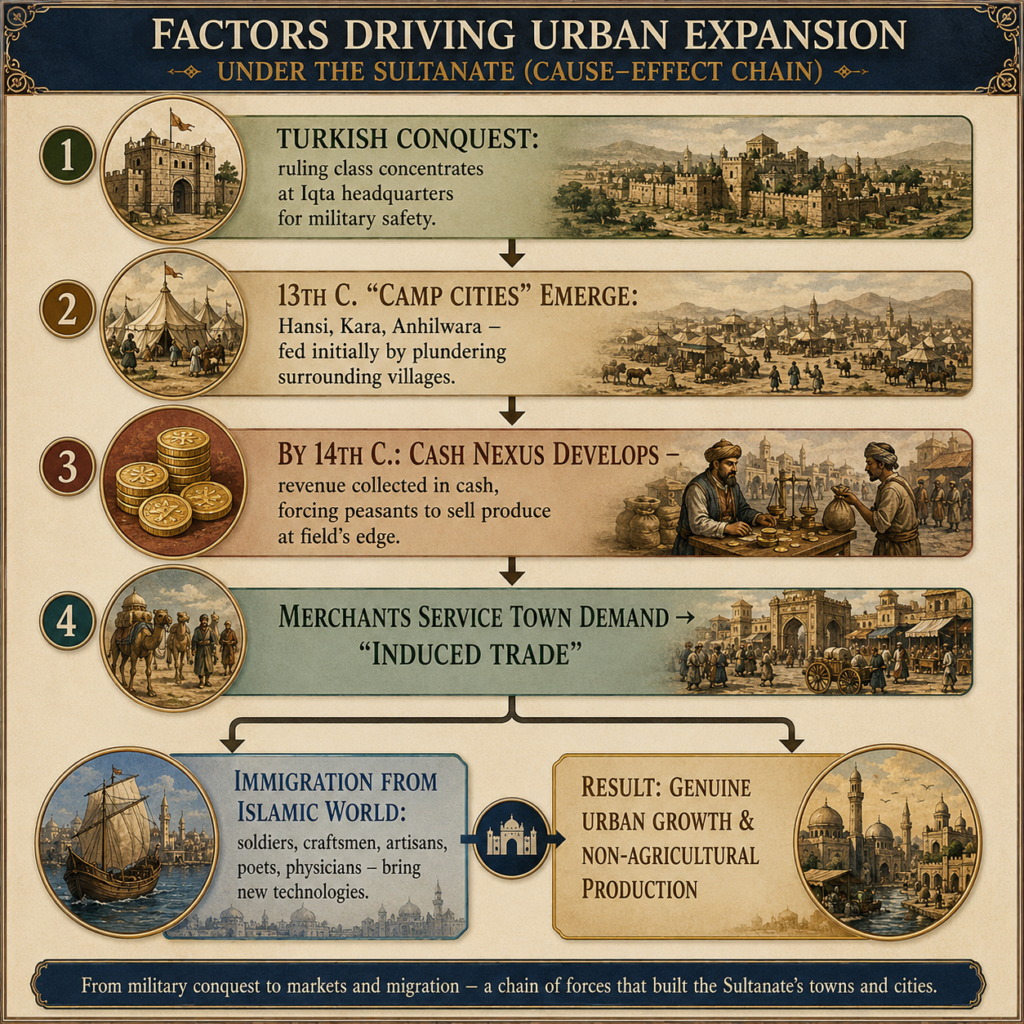
- Concentration at Iqta Headquarters: the strength of any invading force lay in combination rather than dispersal across unfamiliar territory. Consequently, in the initial stages, members of the ruling class naturally preferred to remain concentrated at their iqta headquarters, alongside their cavalry.
- Most 13th-century towns were, in fact, iqta headquarters: the concentration of cavalry, its hangers-on, and the retinue and household of the muqti, meant these settlements emerged in their early phase essentially as camp cities — examples include Hansi, Kara, and Anhilwara.
- These towns had to be fed and provisioned; in the earliest stages, troops typically resorted to plundering surrounding villages to realise their kharaj/mal (revenue).
- The Development of the Cash Nexus: Moreland noted that by the 14th century, a genuine cash nexus had developed — revenue was increasingly realised in cash from peasants, who were consequently forced to sell their produce at the very edge of their fields. Merchants, in turn, catered to the resulting needs of the towns, giving rise to what has been termed “induced trade.”
- Immigration from the Islamic Culture Area: the new ruling class naturally sought the luxuries and comforts of their own cultural tastes, which actively encouraged immigration.
- As described by Isami, these immigrants included soldiers, craftsmen, artisans, singers, musicians, dancers, poets, physicians, astrologers, and various servicemen.
- The immigrant master-craftsmen most likely introduced genuinely new techniques and articles of technology — knowledge that, in time, local Indian artisans would themselves come to learn and adopt.
Urban Manufactures
- A two-fold impetus drove the growth of urban craft production:
- The Sultanate’s ruling class remained firmly town-centred, spending the enormous resources it appropriated as land revenue mainly within towns — whether on purchasing services or procuring manufactured goods. Even spending on the service sector indirectly benefited the urban craft sector through a genuine multiplier effect.
- Demand for high-priced, skill-intensive luxury items, created by the nobility and its retinue, simultaneously generated a mass market for ordinary artisanal products as well.
- The introduction of a number of new technological devices, brought by the invaders, further stimulated this growth.
- In the luxury sector, silk weaving expanded, and carpet weaving arrived from Persia.
- Other major industries included papermaking and the building industry — the latter a particularly major source of employment; Barani records that Alauddin Khalji employed 70,000 craftsmen on his building projects alone.
Organisation of Production
- Two possible models of production organisation are worth considering: whether town artisans worked under a “domestic system” (using their own tools and raw materials, producing and selling their own goods as self-employed craftsmen), or under a “putting-out system” (working from home with their own tools, but supplied with raw material by merchants).
- Contemporary sources shed relatively little direct light on this question. However, since the tools of production — even after the introduction of new devices — remained simple (mostly wood, with only limited iron), they were likely inexpensive, and the artisan generally remained master of his own tools, even as varied forms of labour organisation clearly coexisted.
- Certain artisans hawked or hired out their services directly — the cotton-carder, for instance, who carried a bow-string over his shoulder and went door to door offering his services, as documented in the Khair-ul Majalis.
- Spinning was typically carried out by women working at home, while weavers likewise usually worked at their own looms — weaving cloth for sale from yarn they had either purchased or spun themselves, while also working on wages to weave yarn supplied directly by customers.
- Karkhanas: where the raw material was expensive — silk, or gold/silver thread — and the resulting products were luxury items, craftsmen instead worked in karkhanas, under direct supervision.
- Sultans and high nobles maintained these karkhanas primarily to cater to their own needs, and — contrary to D.D. Kosambi’s assumption — not primarily for the open market.
- Shahabuddin al-Umari, in his Masalik-ul Absar, records that 4,000 silk workers were employed as embroiderers in Muhammad Tughluq’s karkhanas at Delhi alone; Afif similarly records that Feroz Tughluq’s karkhanas produced cloth and carpets on a large scale.
- While no direct textual evidence confirms it, we may reasonably conjecture that merchants, too, perhaps maintained their own karkhanas geared toward market sale.
Non-Agricultural Production: Technology and Craft
- Detailed accounts of the country’s economic resources during the Sultanate period are scarce, and historians must supplement contemporary material with Abul Fazl’s later account in the Ain-i-Akbari, written toward the end of the 16th century.
- Tools, devices, and implements of this period were mostly inexpensive, generally made of wood and earth, with iron used only where strictly necessary; ropes, leather, and bamboo were similarly employed as the need arose.
- India already possessed a rich array of indigenous technologies and crafts, further supplemented by numerous new articles of technology and craft introduced through Muslim immigration — many of which had themselves developed or evolved within the broader Islamic cultural world.
- The most significant manufactures of the period pertained to textiles, metallurgy, building activity, mining, and various ancillary crafts such as leatherwork, papermaking, and toy-making.
Textiles
- Textile production was India’s single largest industry, with roots extending back to ancient times, encompassing the manufacture of cotton, woollen, and silk cloth.
- Cotton cloth fell into two broad categories:
- The coarse (kamin): also called pat, worn by the poor and by faqirs — often manufactured within village households, though also produced regionally (e.g., in Awadh, from where it was imported into Delhi). A slightly superior cotton grade, known as calico (kirpas), was also widely used.
- The fine (mahin): including muslin, produced at Sylhet and Dacca in Bengal, and at Deogir in the Deccan — expensive, and worn only by nobles and the very wealthy. Gujarat likewise produced many varieties of fine cotton cloth.
- Barbosa records that Cambay (Khambayat) served as the centre for manufacturing all kinds of fine and coarse cotton cloth, alongside cheaper varieties of velvets, satins, taffetas, and thick carpets.
- Cloth was both painted and printed, the latter using carved wooden blocks — the 14th-century Sufi Hindi poet Mulla Daud specifically mentions printed (khand chaap) cloth.
- Beyond cloth itself, other goods — carpets, prayer carpets, coverlets, bedding, and bed-strings — were also manufactured across various parts of Gujarat.
- Cloth production improved substantially during this period following the introduction of the spinning-wheel (charkha).
- The spinning wheel is attested in Iran as early as the 12th century by contemporary poets; its earliest reference in India dates only to the middle of the 14th century — suggesting it arrived in India with the Turks, coming into general use by the mid-14th century.
- In its simplest form, the spinning wheel increased a spinner’s efficiency roughly six-fold compared to the traditional hand spindle.
- Another device introduced during this period was the bow of the cotton-carder (naddaf, dhunia), which considerably sped up the process of separating cotton from its seeds.
- Silk was imported from Bengal, where silkworms were reared locally, though a greater supply of silk yarn — including raw silk — was imported from Iran and Afghanistan.
- Silk cloth, and cotton-silk mixed fabric, saw heavy use in Delhi and its surrounding region; the silk of Cambay ranked among the costly cloth varieties directly controlled by Alauddin Khalji.
- The patolas of Gujarat, with their many fancy designs, were highly prized, and Gujarat was equally famous for its gold and silver embroidery, typically worked onto silk cloth.
- Wool was procured from mountainous regions, though sheep were reared in the plains as well; the finest woollen cloths and furs were largely imported from outside India, and worn almost exclusively by the nobility.
- The shawl industry of Kashmir, however, was well established in its own right — Muhammad Tughluq is known to have sent Kashmiri shawls as a gift to the Chinese emperor.
- Carpet weaving likewise developed under royal patronage, incorporating numerous Iranian and Central Asian designs.
- Dyeing:indigo and other vegetable dyes produced the bright colours favoured by both men and women; the dyeing industry developed hand-in-hand with calico-painting.
- The tie-and-dye method was already long-established in Rajasthan, though the precise date of the introduction of wooden-block printing remains uncertain.
Organisation of the Textile Industry
- Spinning was considered women’s work and was carried out within homes — even slave-girls were employed for this purpose.
- Weaving was similarly a household industry, practised in towns and in some villages, with weavers either purchasing their own material or receiving it from merchants.
- Luxury textile items, by contrast, were generally produced in royal workshops (karkhanas) — Muhammad Tughluq’s karkhanas alone employed 4,000 silk workers, weaving and embroidering a range of robes and garments, while Firuz Tughluq recruited and trained a large body of slaves to work in his own karkhanas and across the parganas.
Textile Technology
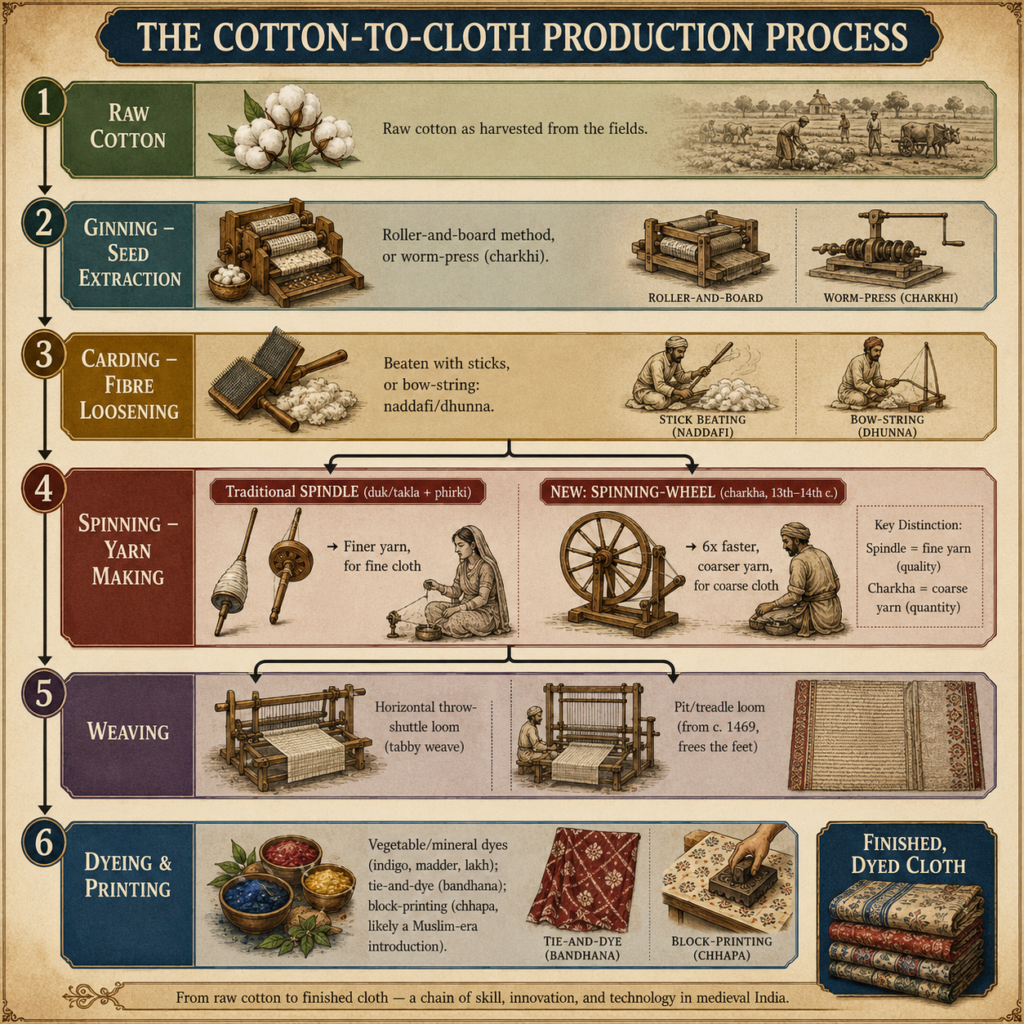
- Several genuinely new techniques were introduced by the Turks in the textile field. After picking, raw cotton passed through three basic stages before it could be woven:
- Ginning (seed extraction): performed either by the roller-and-board method, or by the worm-press/worm-roller (charkhi).
- Carding (fibre loosening): cotton, once separated from its seeds, was “beaten” with sticks or carded using a bow-string to loosen its fibres — known as naddafi in Persian, and dhunna in Hindi.
- Spinning (yarn-making): traditionally performed using a spindle (duk in Persian, takla in Hindi), stabilised by an attached whorl (phirki in Hindi).
- The single most important technological revolution in this sector was the introduction of the spinning-wheel (charkha) through the Muslims, during the 13th–14th centuries.
- The charkha did not exist in ancient India; its earliest literary reference appears in Isami’s Futuh-us Salatin (AD 1350).
- The charkha did not displace the traditional spindle, but rather accelerated its rotation.
- By one estimate, the charkha could produce yarn some six times faster than the spindle, resulting in greater output of both yarn and, consequently, cloth.
- Notably, yarn spun by the traditional spindle was of considerably finer quality, while the charkha produced a coarser yarn, suited to coarser cloth.
- Weaving: a horizontal, throw-shuttle loom was used for simple or “tabby” weave. It remains uncertain whether the pit-loom (treadle loom) was known in ancient India, but its first documented evidence appears in the Miftah-ul Fuzala (c. AD 1469) — this loom allowed weavers to make use of their previously idle feet.
- Dyeing and printing: colours were drawn from both vegetable and mineral sources — indigo, madder, and lakh were widely employed, with indigo used for both bleaching and dyeing.
- Various fixing agents, such as alum, were added to ensure “fast” colours resistant to fading or running.
- The Indian dyer (rangrez) employed numerous techniques, including immersion and tie-and-dye (bandhana).
- Block-printing (chhapa) was likely unknown in ancient India — some scholars credit the Muslims with its diffusion into the country.
Metallurgy
- India possessed a long-standing tradition of metalwork, testified by the iron pillar of Mehrauli (Delhi), which has withstood the ravages of time and weather across centuries.
- Numerous copper and mixed-metal idols further attest to the skill of Indian metalworkers, while Indian damascened swords and daggers were famous across the world.
- Bronze and copper vessels, including fine inlay work produced in the Deccan, enjoyed steady demand across West Asia; the high quality of Sultanate coinage offers further evidence of this metalworking skill.
- Indian gold and silver-smiths were similarly renowned for producing fine jewellery, for which there was insatiable demand from both women and men.
- Ore smelting was carried out using wood and charcoal; there was no “blast” furnace, but bellows adequately served the same purpose.
Building Construction
- The building industry functioned as a major source of employment.
- There had already been a marked spurt in temple-building activity across North India from the 10th century onward, exemplified by the temples at Khajuraho (Bundelkhand), Dilwara (Rajasthan), and sites in Orissa and Gujarat.
- The Turkish sultans proved themselves equally great builders, introducing a new style of arch, the dome and vault, and a new binding material — lime mortar — while constructing cities, forts, and palaces across the subcontinent.
Lime Mortar
- Lime mortar was, without doubt, brought to India by immigrant Muslims during the Delhi Sultanate — traditionally, ancient India had relied on clay, stone, wood, and occasionally brick.
- The basic ingredients of lime mortar were:
- Lime (chuna): of varying types depending on its source material — the two major sources being gypsum and gravel (kankar).
- Surkhi (pounded bricks): added to the lime, followed by additional gelatinous, glutinous, and resinous binding agents — gum, pulses, jaggery, and similar substances — to make the mortar more adhesive.
Arch and Dome/Vaulted Roofing
- One direct result of lime mortar was the extensive use of brick, since mortar made brick construction considerably more durable.
- A further, equally important consequence was that lime mortar paved the way for the construction of the true arch (mihrab).
- Constructing a true arch from bricks or stone requires a genuinely strong cementing agent to hold the voussoirs together — a need lime mortar fulfilled precisely.
- This explains the near-total absence of true arches in Indian buildings prior to the Turkish advent — with one notable exception: excavations at Kausambi (near Allahabad), from the Kushana period, reveal small arches over windows (not gateways), a legacy of the Kushanas’ Central Asian origins, where arch-making was already known. After this period, however, no evidence of true arches appears in India until the arrival of the Muslims.
- An alternative form — the corbelled arch — was, in fact, a variant of trabeate construction (relying on straight horizontal beams or lintels), the pillar-and-beam technique that remained the most distinguishing feature of pre-Muslim Indian architecture.
- The progression from mihrab (true arch) to gumbad (vaulted roofing/dome) was a natural technical development, since a dome is essentially nothing more than a true arch rotated 360 degrees — and was consequently impossible without prior knowledge of true-arch construction. (A dome, notably, should not be confused with the earlier Buddhist stupa.)
- This period saw a genuine spurt in brick-making, with growing numbers of people coming to live in brick and stone houses, even as the poor continued to inhabit mud houses with thatched roofs.
- As stone-cutters, Indian craftsmen remained genuinely unrivalled.
- Amir Khusrau proclaimed that the masons and stone-cutters of Delhi surpassed their counterparts across the entire Muslim world; Timur himself carried off masons and stone-cutters from Delhi to help build his own capital at Samarqand.
- Barani records that Alauddin Khalji employed 70,000 craftsmen for his building projects; both Muhammad Tughluq and Firuz Tughluq were themselves great builders — Firuz not only established several new towns but also had numerous older buildings, including mausoleums, carefully repaired.
- Enamelled tiles were introduced to India during this period, and Hindu rajas and chiefs, too, patronised building artisans — a number of new towns, such as Jodhpur in Rajasthan, were founded during this era. Fine woodwork — doors, seats, and bedsteads for domestic use — was similarly produced throughout the country.
Papermaking and Bookbinding
- Papermaking was another significant contribution of immigrant Muslims.
- Paper was first manufactured in China, around the 1st century AD; the Arabs learned papermaking from the Chinese, but introduced a novel technique of their own — using rags and ropes rather than mulberry-tree bark.
- Indians may have had some knowledge of paper as early as the 7th century AD, but never adopted it as a writing material. When the Chinese traveller I-Ching visited India, he could not locate paper to copy Sanskrit manuscripts intended for China, and — having exhausted his own supply — was forced to request more paper be sent from China.
- There is no evidence of paper’s actual use in India before the 13th century; the earliest surviving paper manuscript in India, from Gujarat, is dated 1223–24. The advent of papermaking meant a considerable increase in the availability of books.
- Paper served many purposes — particularly for books, farmans, and numerous commercial and administrative documents.
- Paper became so widely available that Delhi’s sweetmeat-sellers delivered sweets to customers in paper packets called purya — a practice that continues in India today.
- Genuine papermaking centres remained few and far between. Ma Huan, the 14th-century Chinese navigator, records that Bengal produced paper locally, though the bulk of India’s paper needs were imported from Islamic countries, particularly Samarqand and Syria.
- Paper served many purposes — particularly for books, farmans, and numerous commercial and administrative documents.
- The craft of bookbinding was itself an innovation in India, arriving alongside the broader practice of writing books on paper.
Other Crafts
- Leather-working, based on India’s large cattle wealth, was another widespread craft — organised largely on a caste basis.
- Superior-quality saddles were produced for the large number of horses kept in royal stables, or gifted to nobles; Gujarat produced exquisite red-and-blue leather mats, decorated with birds and beasts, or featuring inlay work.
- Other crafts included salt-making, quarrying for stone and marble, and the extraction of iron and copper ore.
- Salt was also produced through the systematic collection and natural evaporation of saline seawater.
- There was, additionally, diamond mining at Panna and in south India, alongside pearl-diving, while ivory-working constituted another significant craft tradition.
Military Technology
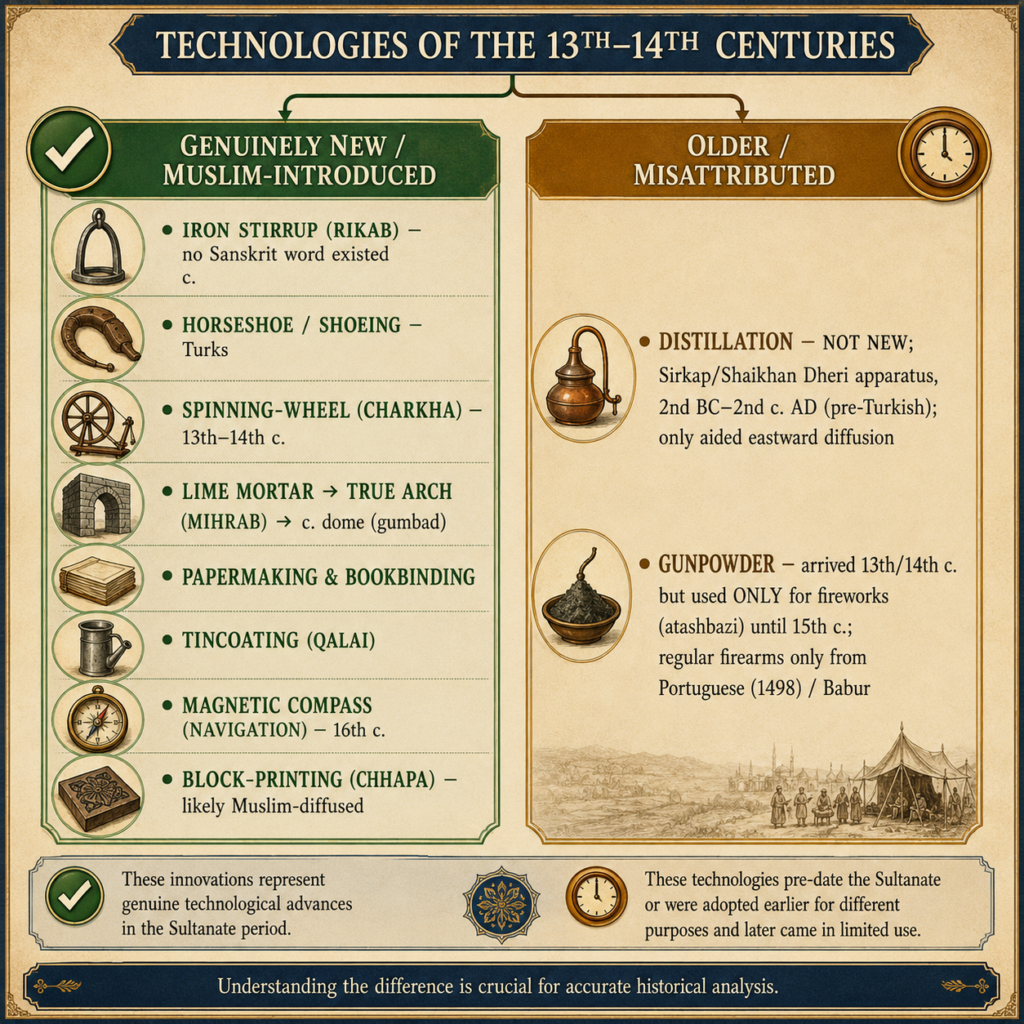
- Stirrup: the iron stirrup (rikab in Persian) was previously unknown in India — there is, notably, no Sanskrit word for stirrup. While devices such as the surcingle, the “big-toe stirrup,” and “suspension hooks” may have existed earlier, the true stirrup was a genuine contribution of the Muslims.
- Horseshoe: the hoof, the most vulnerable part of a horse, is prone to breaking, splitting, and shelling, much like human nails. Shoeing offered two distinct advantages — better grip on soft ground, and protection on rough ground — and was likewise brought to India by the Turks.
- The practice has never been reported at any excavated Indian archaeological site, and Sanskrit veterinary literature on horses (Salihotra) makes no mention of shoeing. Shoeing itself remained largely monopolised by Muslim artisans — a fact that was, in the text’s own words, “not by accident.”
- Gunpowder: immigrant Turks brought gunpowder to India, likely in the late 13th or early 14th century — yet even by the reign of Sultan Feroz Shah Tughluq, its sole use remained pyrotechnic (fireworks, or atashbazi), rather than for firearms or propelling cannon-balls.
- Firearms were first used in India only during the second half of the 15th century, in regions such as Gujarat, Malwa, and the Deccan; their regular use, however, was introduced by the Portuguese upon arriving at Calicut in AD 1498, and by Babur in North India in the early 16th century.
Tincoating
- This craft, too, arrived in India alongside the Turks — the craftsman practising it is known as a qalaigar (from qalai, “tin”).
- Tin (ranga), a highly malleable and ductile metal, protects coated metal vessels from corrosion and chemical poisoning. Abul Fazl, in the Ain-i-Akbari, notes that the royal kitchen’s copper utensils were tinned twice a month, while those of princes were tinned once a month.
Glass Manufacture
- The earliest use of glass in India dates to sometime within the first millennium BC — though the mere presence of an object need not imply full knowledge of its underlying technology.
- Earlier Indian glasswork remained limited to small items — chiefly beads and bangles.
- With the Muslim advent, pharmaceutical phials, jars, and vessels began arriving in India from Islamic countries; it remains uncertain whether glassware manufactured within India during the Sultanate period represented genuine local imitation of these imports.
- Notably, India did not develop the manufacture of more advanced glass articles, such as glass lenses or looking-glasses (mirrors), during this period.
Shipbuilding
- Ships and boats were built with a frame of timber, as everywhere else in the world; planks were first joined using the rabbeting (tongue-and-groove) method, then sewn together with ropes made from coconut husk, sometimes supplemented with wooden nails.
- Iron nails and clamps, by contrast, represented a later development, introduced only under European shipbuilding influence after AD 1498.
- Anchors were traditionally made of stone; iron anchors were a later European introduction.
- For navigation, the magnetic compass stands as a genuinely significant contribution the Muslims diffused into India.
Distillation
- There are two principal methods of producing wine: fermentation (widely known across the world, using fermented rice, sugarcane juice, or mahua flowers), and distillation, a comparatively later development.
- It is sometimes claimed that distillation was itself a Turkish contribution to India — but this view is not accurate: excavations at Sirkap (Taxila) and Shaikhan Dheri (Pakistan) have yielded genuine distillation apparatus — condensers and parts of a still, now housed in the Taxila Museum — dating from the 2nd century BC to 2nd century AD, well before the Turkish arrival in India.
- We may, however, reasonably credit the Turks for the technique’s further eastward diffusion.
Conclusion
- The rise of urban economy and non-agricultural production in the thirteenth and fourteenth centuries represents a genuine break from the preceding centuries of urban decay — driven by the concentration of the new Turkish ruling class at iqta headquarters, the gradual emergence of a cash nexus and “induced trade,” and sustained immigration from the wider Islamic world.
- This urban revival, in turn, fuelled a remarkable expansion in non-agricultural craft production — from the technological transformation of the textile industry (via the charkha), to genuinely new contributions in architecture (lime mortar, the true arch, and the dome), papermaking, military technology, and shipbuilding — even as certain innovations, like gunpowder and distillation, are more accurately understood as older techniques diffused or repurposed, rather than wholly new Turkish inventions.
- Taken together, these developments reveal the Delhi Sultanate not merely as a political conquest, but as the catalyst for one of medieval India’s most significant phases of urban and technological transformation.





 Geography Optional Mains Master Kit 2027: Complete Self-Study System by LotusArise IAS