

Agricultural Production in the Thirteenth and Fourteenth Centuries

The conquest of Northern India by the Ghorids and the establishment of the Delhi Sultanate brought about far more than a change in political structure — it initiated significant economic change, particularly in the domains of revenue administration, land relations, and agricultural production. The conquerors arrived with fairly well-defined concepts regarding tax collection, distribution, and coinage, yet these could not be imposed on India overnight; instead, they were superimposed upon older systems, with modifications introduced by successive Sultans up to the close of the 15th century. Historians remain divided on the scale of this transformation: Muhammad Habib regarded the changes as drastic enough to merit the labels “Urban Revolution” and “Rural Revolution,” while D.D. Kosambi saw them as merely intensifying elements already present in Indian “feudalism.” This article examines the Sultanate’s distinctive system of revenue distribution through the iqta and khalisa, the evolving agrarian measures of successive Sultans, the actual state of agricultural production and crops, the changing nature of agrarian relations between peasants and rural intermediaries, and finally, the technological devices — from the plough to the Persian wheel — that underpinned agriculture in this period.
Distribution of Revenue Resources
- Unlike previous rulers, the soldiers were now paid their salaries in cash.
- Regions that refused to pay land-tax or kharaj were known as mawas, and were plundered or forced to pay through military raids.
- Gradually, a mechanism of simultaneous revenue collection and distribution had to be introduced.
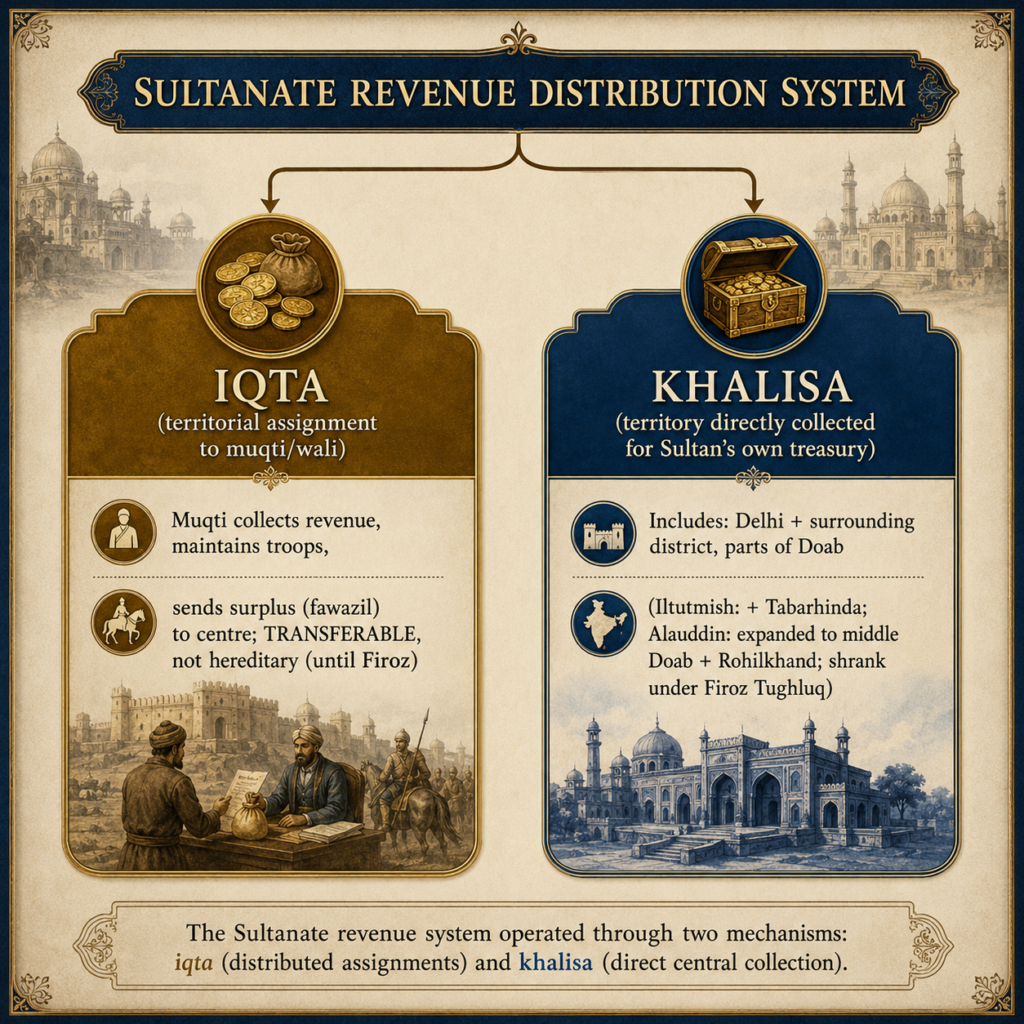
Iqta and Khalisa
- The new rulers brought with them the iqta system, which combined the two functions of revenue collection and distribution, without immediately endangering the unity of the political structure.
- The iqta was a territorial assignment, and its holder was called the muqti or the wali.
- The classical definition of the iqta system was given by Nizam-ul-Mulk Tusi, the Seljuq statesman:
- The iqta was a revenue assignment that the muqti held at the pleasure of the Sultan.
- The muqti was entitled to collect, in a proper manner, the land tax and other dues owed to the Sultan — he had no further claim on the person, women, children, land, or other possessions of the cultivators.
- The muqti had certain obligations to the Sultan, chief among them the maintenance of troops, and furnishing them at call to the Sultan.
- The iqta was a transferable charge, and transfers of iqtas were frequent.
- Khalisa: the territory whose revenues were directly collected for the Sultan’s own treasury.
- Its size seems to have expanded considerably under Alauddin Khalji.
- However, the khalisa did not consist of shifting territories scattered throughout the country.
- In all probability, Delhi, along with its surrounding district — including parts of the Doab — remained in khalisa.
- In Iltutmish’s time, Tabarhinda (Bhatinda) too was part of the khalisa.
- Under Alauddin Khalji, the khalisa covered the whole of the middle Doab and parts of Rohilkhand.
- But during the days of Feroz Tughluq, the khalisa had perhaps reduced considerably in size.
Different Sultans and the Iqta System
- Iltutmish (1210–36) is reported to have assigned “small iqtas” in the Doab to soldiers of the Sultan’s army (hashm-i-qalb), in lieu of salaries.
- Balban (1266–86) made a half-hearted attempt at their resumption, without success.
- It was Alauddin Khalji (1296–1316) who firmly established the practice of paying soldiers’ salaries in cash.
- This practice was again altered by Feroz Tughluq, who began to assign villages to soldiers in lieu of their salaries — these assignments were called wajh, and their holders wajhdars. These assignments tended to become not only permanent but hereditary.
The Iqta System in Operation
- In the early years of the Sultanate’s foundation, neither the revenue income of these assignments was known, nor was the size of the assignee’s contingent fixed.
- However, certain modifications, and mild attempts at central control, were made by Balban (1266–86), who appointed a khwaja (accountant) with each muqti — implying the Sultanate was now trying to determine the actual income of the iqta and the muqti’s expenditure.
- The real intervention in iqta administration came under Alauddin Khalji.
- The central finance department (diwan-i-wizarat) likely prepared some form of estimated revenue income from each iqta.
- The audit was stringent, punishments severe, transfers frequent, and enhancements (taufir) were often made in the estimated revenue of the iqta on various pretexts.
- Ghiyasuddin Tughluq (1320–25) introduced some moderation:
- Enhancements in estimated revenue income by the central finance ministry were not to exceed 1/10th annually.
- Muqtis were allowed to keep 1/10th to 1/20th in excess of their sanctioned salaries.
Land Grants
- Religious persons and institutions — such as dargahs, mosques, madrasas, and other dependents of the ruling class — were maintained through grants of revenue income, called milk, idrar, and inam.
- These grants were not generally resumed or transferred.
- But the Sultan retained the right to cancel them.
- Alauddin Khalji is reputed to have cancelled almost all grants.
- Ghiyasuddin too cancelled a large number of grants.
- However, Feroz Tughluq made a departure — not only returning all previously resumed grants, but also making new grants.
- In spite of this generosity, according to figures recorded by Afif, the total grants made by the Sultan accounted for only about one-twentieth of the total jama (estimated revenue income).
- Nobles, too, made revenue grants out of their own iqtas.
- The Sultans made grants not only in the khalisa but also in the iqtas — these grants covered cultivated as well as cultivable areas not yet brought under plough.
Land Revenue and Its Extraction
Before the Arrival of the Turks
- The traditional share of produce payable by peasants, according to the Dharmashastras, was one-sixth — though we hear of kings in south India demanding one-third or two-thirds of the produce. A Chola king had authorised his feudatories to collect half the produce.
The 13th Century: Continuity with the Old System
- There was hardly any change in the structure of rural society during the 13th century.
- The early Turkish rulers depended on Hindu chiefs to pay land revenue, leaving it to them to collect it from peasants according to existing practices.
- The general approach of the Turkish ruling class is indicated by Barani:
- According to Barani, Balban advised his son, Bughra Khan, not to charge so much land revenue (kharaj) as to reduce the peasant to a state of poverty, nor so little that they became rebellious on account of excess wealth.
- In general, the policy was designed not to interfere with the existing village set-up.
- The Islamic land tax familiar to the new rulers of India was kharaj — essentially a share in the produce of the land, and not a rent on the land.
- During the 13th century, kharaj took the form of tribute.
- This tribute was paid either by potentates surviving from the previous regime, with whom the Sultanate entered into some arrangement.
- In recalcitrant areas (mawas), where such arrangement was not possible, tribute was extorted through plundering raids, mostly in the form of cattle and slaves.
- Before Alauddin Khalji, no serious attempt was made to systematise the assessment and realisation of kharaj.
The 14th Century: New Developments
The 14th century saw a number of significant new developments in land revenue policy.
Agrarian Measures of Alauddin Khalji
- His attempt was to increase revenue collection by enhancing the demand, introducing direct collection, and cutting down leakages to intermediaries.
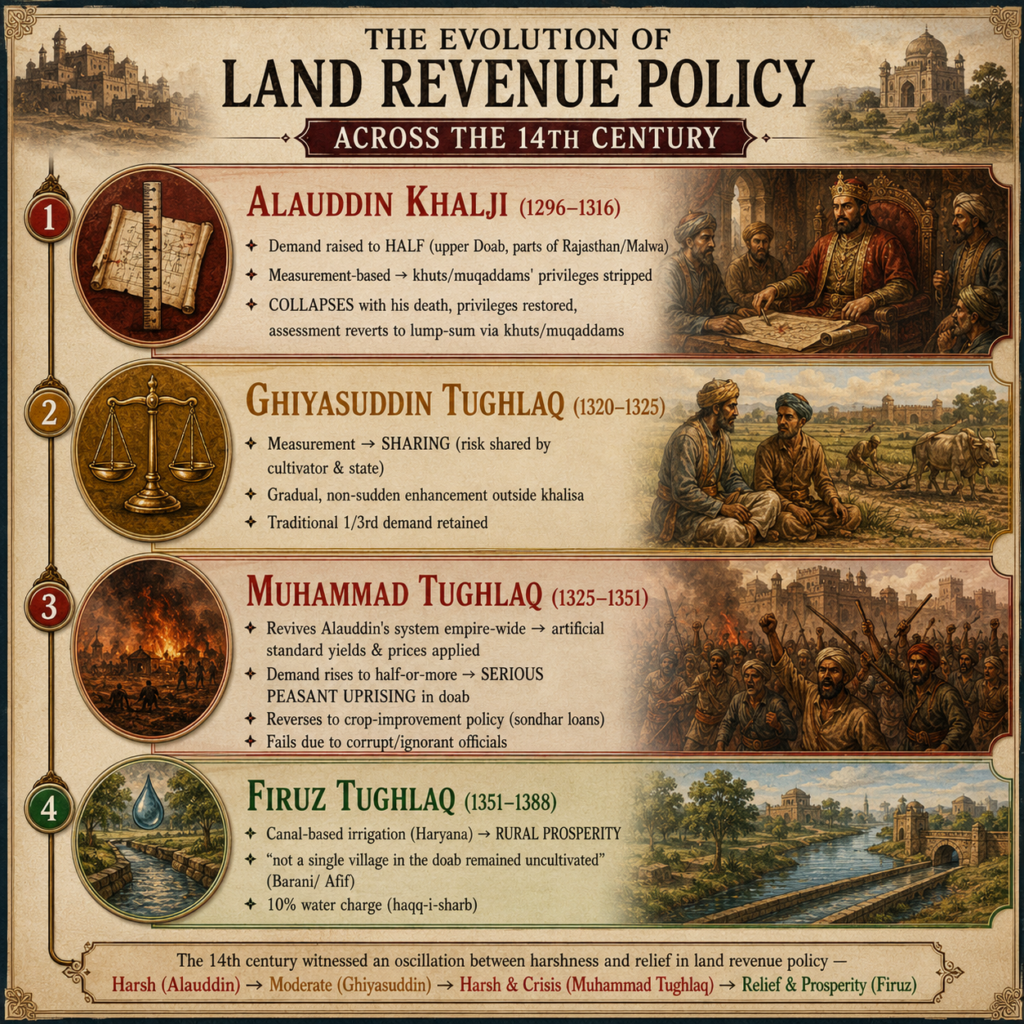
- Alauddin Khalji raised the land-revenue demand to half in the upper Doab region up to Aligarh, and in some areas of Rajasthan and Malwa.
- This area was made khalisa — land revenue collected there went directly to the Imperial treasury.
- The land-revenue demand was based on measurement of the area cultivated by each cultivator.
- In cash or in kind?
- The demand was fixed in kind, but realisation appears to have been mostly in cash.
- Except around Delhi, cultivators were encouraged to pay in cash.
- Barani informs us that revenue collectors were ordered to demand revenue with such rigour that peasants were forced to sell their produce immediately.
- Barani says Alauddin Khalji brought the doab into khalisa, and the tax (mahsul) collected there was spent on paying cash salaries to soldiers.
- Alauddin tried to ensure cultivators sold their grain to the banjaras while the crops were still standing in the field — without transporting them to their own stores, to be sold later at more favourable prices.
- However, this had to be modified in practice, since many cultivators themselves brought grain for sale in the local mandi; these could only have been the rich cultivators.
- Alauddin’s agrarian measures amounted to a massive intervention in village affairs.
- He tried to operate against the privileged sections in villages — the khuts, muqaddams, and chaudhuris, and, to some extent, rich peasants with surplus grain to sell.
- The khuts and muqaddams were suspected of passing their burden onto weaker sections, and of not paying the ghari and charai taxes.
- The attempt to take away all the inherited privileges of the khuts and muqaddams — or of the upper sections of the landed nobility — and to appoint an army of amils, most of whom proved corrupt, to supervise revenue collection, was not likely to succeed.
- Alauddin’s revenue measures collapsed with his death.
- The restoration of khuts’ and muqaddams’ privileges implies the state no longer tried to assess land revenue on individual holdings, but assessed it as a lump sum, leaving the assessment of individuals to the khuts and muqaddams themselves.
- This was also a recognition of the economic and social power wielded by the khuts and muqaddams in the countryside.
- The restoration of khuts’ and muqaddams’ privileges implies the state no longer tried to assess land revenue on individual holdings, but assessed it as a lump sum, leaving the assessment of individuals to the khuts and muqaddams themselves.
Ghiyasuddin Tughlaq’s Moderation
- Ghiyasuddin Tughlaq took the definite step of replacing measurement with sharing in the khalisa areas.
- This was considered a step towards relief for cultivators, since under measurement, the risk of crop failure was largely borne by the cultivator, whereas under sharing, both profit and loss were shared by the cultivator and the state.
- Ghiyasuddin took another important step: in territories held by iqta-holders (outside the khalisa), he ordered that revenue demand should not be raised on the basis of guess or computation, but “by degrees and gradually, because the weight of sudden enhancement would ruin the country and bar the way to prosperity.”
- Perhaps the traditional demand outside khalisa areas remained at one-third, as before.
Muhammad Tughlaq’s Revival and Reversal
- Muhammad Tughlaq tried to revive Alauddin’s system, extending it across the entire empire.
- His measures led to a serious peasant uprising in the doab.
- The reason: in assessing land revenue on individuals, not the actual yield, but an artificially fixed standard yield, was applied to the area under measurement.
- Further, when converting produce into cash, not actual prices, but official standard prices, were applied.
- There was also harshness in levying tax on cattle and houses.
- Thus, the actual incidence of land-revenue demand rose considerably, to half or even more.
- Like Alauddin’s reforms, Muhammad Tughlaq’s measures were designed to curtail the privileges of the more affluent village sections, especially the khuts and muqaddams — but his measures also hurt the average cultivator, which may explain the serious uprising against them in the doab.
- Muhammad Tughlaq then tried to reverse direction.
- In the doab — the directly administered khalisa — he tried to improve cultivation by changing the cropping pattern, replacing inferior crops with superior crops.
- The main inducement was granting loans (sondhar) for digging wells, etc.
- This policy could only have succeeded with the cooperation of richer cultivators, and the khuts and muqaddams who held the largest landholdings and means.
- However, it failed, because officials appointed for the purpose had no knowledge of local conditions, and were only interested in enriching themselves.
Firuz Tughlaq: A Period of Rural Prosperity
- Firuz Tughlaq’s rule is generally considered a period of rural prosperity.
- Barani and Afif tell us that, as a result of the Sultan’s orders, the provinces became cultivated, and tillage extended so widely that not a single village in the doab remained uncultivated. The canal system extended tillage in Haryana.
- Firuz met with greater success by providing water to the peasants of Haryana through his canal system, levying an extra charge of 10 per cent, and leaving it to the peasants to cultivate what they wanted.
Overall Assessment of Land Revenue Under the Sultans
- All in all, it appears that land revenue under the Sultans, especially during the 14th century, remained heavy, hovering in the neighbourhood of half, with a definite effort to reduce the power and privileges of the old intermediaries — the Rais, Rawats, etc. — while the khuts and muqaddams forged ahead.
- This was the first time such a high magnitude of land revenue was assessed and collected from a large and highly fertile area for several decades.
- Both the administrative methods adopted, and the centralisation of large, liquid resources in the hands of the ruling class, had important consequences — for rural life, and for urban manufacturers, trade, and commerce.
- Rural society continued to be unequal, with imperial policies siphoning off a large share of the rural surplus.
- However, there was some limited success in efforts to improve the rural economy — though the benefits were reaped largely by the privileged sections of rural society.
Agricultural Production
- The Sultanate period did not bring any radical change in the overall system of agricultural production.
- However, the arrival of some new technology seems to have helped irrigation, and there was a spread of market crops such as indigo and grapes.
Land-Man Ratio and Extensive Agriculture
- During the 13th–14th centuries, the land-man ratio was very favourable.
- Peasants had more land per head, owing to a much smaller population.
- However, on account of social constraints, we hear of landless labourers and menials in the villages.
- Forests were also much more extensive. An abundance of cultivable land was yet to be brought under plough, and there was good pasturage for cattle.
- This implies agriculture was extensive rather than intensive — so control over bits of land was therefore less important than control over the persons cultivating them.
- Sufi Nizamuddin Auliya, in the 13th century, found wayfarers travelling between Delhi and Badaun harassed by tigers.
- The author of Masalik al-Absar records that in India, cattle were innumerable, and their prices low.
- Afif notes: no village in the Doab was without a cattle-pen (kharaks).
- Large areas of even fertile land were covered by forests and grassland — only by the end of Akbar’s reign (1605) was the middle doab reported to be fully cultivated.
- Peasants had more land per head, owing to a much smaller population.
Crops and Other Agricultural Produce
- A large number of crops were grown by the peasants of the Delhi Sultanate — perhaps unparalleled in other parts of the world, except possibly in South China.
- Ibn Battutah, who travelled all over India, left a detailed account of the food grains and various other crops, fruits, and flowers produced in the country.
- Most were familiar — rice and sugarcane in the east and south, wheat and oil-seeds, etc., in the north.
- Cotton was grown widely, as were barley, sesame, and other inferior crops.
- Ibn Battutah says the soil was so fertile that it produced two crops a year — the familiar rabi (winter) and kharif (monsoon) crops. Rice was sown three times a year.
- Thakkur Pheru:
- Was the mint-master at Delhi under Alauddin Khalji.
- Writing around 1290, he lists some twenty-five crops grown under two harvests, and gives their yields.
- While the yields cannot be fully comprehended, owing to uncertainty around the units used, one gets a fairly good idea of the crops raised.
- Among food crops, he mentions wheat, barley, paddy, millets (juar, moth, etc.), and pulses (mash, mung, lentils, etc.). For cash crops, he refers to sugarcane, cotton, oil-seeds, sesamum, and linseed, etc.
- Improved irrigation facilities would have helped extend the area under rabi (winter) crops, such as wheat and sugarcane.
- Some crops formed the basis of village industries, such as oil-processing, jaggery-making, indigo, spinning, and weaving.
- Barani’s account shows that wine from sugarcane became widespread, and a new rural industry emerged — at least around Delhi and in the Doab — by the 14th century.
- Indigo (though Thakkur Pheru omits it) was also an important item of export to Persia.
- The probable use of lime-mortar in indigo-vats, providing an improved surface, may have helped the manufacture of the dye.
- Potato, maize, red chillies, and tobacco, introduced during the 16th century, are, of course, missing from this period.
The Development of Gardens and Fruit Cultivation
- During the 14th century, under Muhammad bin Tughlaq and Firuz Tughlaq, there was a marked development of gardens.
- Firuz Tughlaq is said to have built 1,200 gardens in the neighbourhood and suburbs of Delhi — 80 on the Salora embankment, and 44 in Chittor.
- These gardens led to the improvement of fruits, especially grapes.
- Thus, wine — apparently grape wine — used to come to Delhi from Meerut and Aligarh.
- Dholpur, Gwalior, and Jodhpur were other places where improved methods of fruit cultivation and gardening were adopted.
- Special attention was paid to the improvement of pomegranates at Jodhpur.
- Sikandar Lodi declared that Persia could not produce pomegranates better than the Jodhpur variety in flavour.
- However, fruits from these orchards were meant mainly for the towns, and for the tables of the wealthy — though they may have generated some employment, and added to the avenues of trade.
- From Ibn Battuta’s account, we get information on fruit growing:
- It appears the technique of “grafting” was not known to peasants.
- Earlier, grapes were grown only in a few places besides Delhi.
- Muhammad Tughluq urged peasants to improve cropping by shifting from wheat to sugarcane to grapes.
- Feroz Tughluq’s laying down of 1,200 orchards in the vicinity of Delhi, to grow seven varieties of grapes, seems to have made them so abundant that, according to Afif, the prices of grapes fell.
- The Indian peasants did not practise sericulture (silkworm rearing) at that time.
- No true silk was produced — only wild and semi-wild silks, namely tasar, eri, and muga, were known.
- Ma Huan, the Chinese navigator, in 1432 makes the first reference to sericulture in Bengal.
Canal Irrigation and Its Impact
- Agriculture was generally dependent upon natural irrigation — that is, rains and floods — so the tendency was to grow mostly a single, rain-watered kharif (autumn) crop, and coarse grains more commonly.
- Canal irrigation is described in our sources; the Delhi Sultans themselves got canals cut for irrigation.
- Ghiyasuddin Tughluq (1320–25) is reported to be the first Sultan to dig canals.
- But the cutting of canals in a much bigger way was undertaken by Feroz Tughluq (1351–88).
- Feroz Tughluq cut two canals from the river Yamuna, carrying them to Hissar, along with one each from the Sutlej and the Ghaggar (joining the Yamuna).
- This was the biggest canal network in India until the 19th century.
- Canal irrigation helped greatly in the extension of cultivation in eastern Punjab.
- There was now an emphasis on cultivating cash crops like sugarcane, which required more water than other crops.
- Afif says:
- A long stretch of land, about 80 krohs (200 miles), was irrigated by the canals Rajabwah and Ulughkhani.
- As a result of abundant water, peasants in eastern Punjab raised two harvests (kharif and rabi), where only one had been possible earlier.
- This led to new agricultural settlements along the canal banks — in areas irrigated by the canals, 52 such colonies sprang up.
- Afif comments enthusiastically: “neither one village remained desolate nor one cubit of land uncultivated.”
Implements and Soil Productivity
- Regarding implements, there was no significant change in them until the 19th century.
- Most land was rain-fed, though digging wells and building bunds (embankments) for storing water were considered holy acts, and the state took an active part in building and preserving them.
- Productivity of the soil:
- Productivity may have been higher because of more extensive manuring by cattle, which were plentiful — as testified by the fact that charai (based on the number of animals) was an important agricultural tax.
- Also, banjaras had thousands of oxen for their journeys.
Agrarian Relations
- Agrarian relations underwent a significant change during this period — though historians disagree on the nature of this change.
- D. Kosambi viewed these changes as merely intensifying elements already present in India’s “feudalism.”
- Habib regarded them as radical and progressive in nature, deserving the designation of a “rural revolution.”
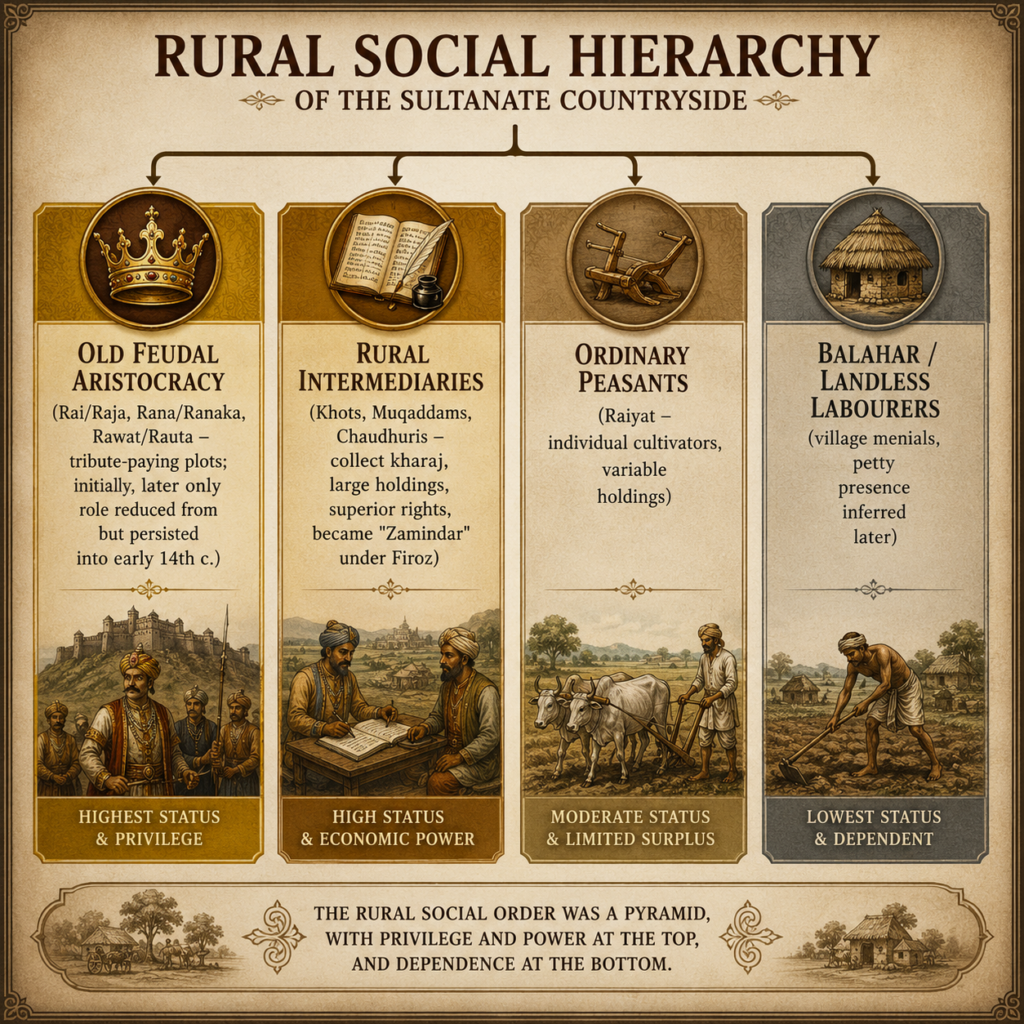
- Minhaj Siraj designates the chiefs opposing the Ghorians and the early Delhi Sultans as rai and rana, and their cavalry commanders as rawat.
- From epigraphic evidence across different parts of Northern India, the earlier feudal hierarchy of raja (rai), ranaka (rana), and rauta (rawat) is fairly well established.
- In the early phase, the Sultans tended to enter into settlement with the defeated and subjugated rural aristocracy — kharaj was largely the tribute imposed upon them.
- It seems that even after this tribute was replaced by a vigorously assessed tax on peasants under Alauddin Khalji, the older rural aristocracy retained some role in revenue collection.
- Afif records: Ghazi Malik, governor of Dipalpur, wanting to pressurise Rana Mal Bhatti, one of the rais (rajas) of the region, went to his territory and demanded the full year’s revenue in cash at once; when the Rana failed to comply, Ghazi tortured the muqaddams and chaudhuris.
- This incident suggests that members of the subjugated aristocracy, wherever present, were — at least until the early years of the 14th century — held responsible for collecting and paying land revenue.
- The administration, in turn, exercised the right to collect it directly through village headmen and chaudhuris.
- Afif records: Ghazi Malik, governor of Dipalpur, wanting to pressurise Rana Mal Bhatti, one of the rais (rajas) of the region, went to his territory and demanded the full year’s revenue in cash at once; when the Rana failed to comply, Ghazi tortured the muqaddams and chaudhuris.
Peasants
- The peasant economy was not egalitarian.
- Cultivation was based on individual peasant farming, but the size of land cultivated by peasants varied greatly.
- From Barani’s account, it appears that at one extreme were the khots and muqaddams, holding large holdings and enjoying superior rights over ordinary peasants (raiyat); at the other extreme was the balahar, the village menial holding a petty plot of land.
- Below the peasant, there must have been a mass of landless labourers, though their presence can only be discerned from later sources, since contemporary accounts make no mention of them.
- Peasants had no proprietary right over the land they tilled — even on their own produce, the superior classes held claims.
- Were they really free? Though recognised as “free born,” the peasant was, at times, deprived of the freedom to leave the land at will, or to change domicile.
- Afif says a village had 200–300 male members.
- Barani says each village had a patwari to keep accounts.
- His bahi (account register) was scrutinised to discover every payment, legal or illegal, made by peasants to revenue officials.
- The patwari was not a government official, but a village official, and was certainly not a creation of the Delhi Sultanate.
The Village Community
- The presence of a village clerk for maintaining accounts may suggest that the village was an administrative unit outside the Sultanate’s administrative system.
- It seems the village was collectively a tax-paying unit — otherwise, there would have been no need for a clerk to keep village accounts.
- The presence of the patwari, and the nature of his duties, thus indicates the existence of a village community.
- It seems that, despite Alauddin Khalji’s efforts to assess tax on the individual peasant, in practice, the village continued to remain the unit of land revenue payment.
- Barani’s complaint about the “burden of life falling on the poor” further indicates that the village community was not an ideal institution, but itself a machinery of exploitation.
Rural Intermediaries
- The rural aristocracy was called khots, muqaddams, and chaudhuris. They belonged to the highest stratum of the peasantry.
- Chaudhuris: among these rural intermediaries, the chaudhuri seems to have emerged during the 14th century. He is not mentioned by Minhaj, or any other source, of the 13th century — he makes his appearance in Barani’s account only during the middle of the 14th century.
- Ibn Battuta defines him as the “chief of a group of 100 villages,” which he calls sadi.
- However, the usual term from the middle of the 14th century for a group of villages is pargana. Irfan Habib suggests that the chaudhuri was, in fact, a successor — though much reduced in authority — to the head of the chaurasi (a group of eighty-four villages) under the Gujara-Pratiharas and Chalukyas.
- Chaudhuris: among these rural intermediaries, the chaudhuri seems to have emerged during the 14th century. He is not mentioned by Minhaj, or any other source, of the 13th century — he makes his appearance in Barani’s account only during the middle of the 14th century.
- From Barani’s account, it appears that before Alauddin Khalji’s agrarian measures, the intermediaries held revenue-free lands.
- As a class, the village headmen were prosperous.
- Barani, with malicious pleasure, records that Alauddin Khalji imposed full land revenue upon them, and withdrew their exemption from house and grazing tax.
- He prohibited them from levying any cesses of their own, thus levelling them to the ordinary peasants.
- However, since rural intermediaries were necessary for the system of land revenue realisation, the stern measures against them were not to last longer.
- Ghiyasuddin Tughluq introduced moderation — the exemption from grazing tax, as well as tax on their own cultivation, was granted again. But they were not allowed to impose any cess upon the peasantry.
- They received further concessions under Feroz Tughluq, and, interestingly, these concessions and the resulting affluence are described very approvingly by Barani.
- From the time of Feroz Tughluq, all these intermediaries were given a blanket designation — Zamindar — a term that came much into vogue during the Mughal period.
Agricultural Technology During the Sultanate
The main technological devices related to agriculture during this period were as follows.
The Plough
- The Miftah-ul-Fuzala — a Persian lexicon compiled around A.D. 1460 in Malwa — clearly shows a plough with an iron share, drawn by two yoked oxen.
- During the Iron Age, with Aryan settlement in the Gangetic plain, the plough developed further — while the entire frame had earlier been of timber, the ploughshare/coulter now became iron, a metallic piece that greatly aided the tillage of comparatively harder soil.
- Kalibangan (Rajasthan), an Indus Valley culture site, is well known for evidence of the use of an “iron-less” plough.
Sowing
- The method of broadcasting was known.
- A seed-drill is mentioned by Barbosa (a Portuguese traveller, c. 1510), in connection with the wet-cultivation of rice.
Harvesting, Threshing, and Winnowing
- Harvesting was carried out with a sickle.
- Threshing was done using oxen.
- Winnowing used wind power.
Irrigational Devices
- Sources of irrigation included rainwater, ponds, and tanks.
- Water from wells was the most important controlled source of irrigation, especially in North India.
- Almost all irrigation devices were oriented towards drawing water from wells.
- Wells were generally masonry, with raised walls and enclosure platforms. Kuchcha wells also existed, but these could not have been durable or strong enough for extensive water-lifting.
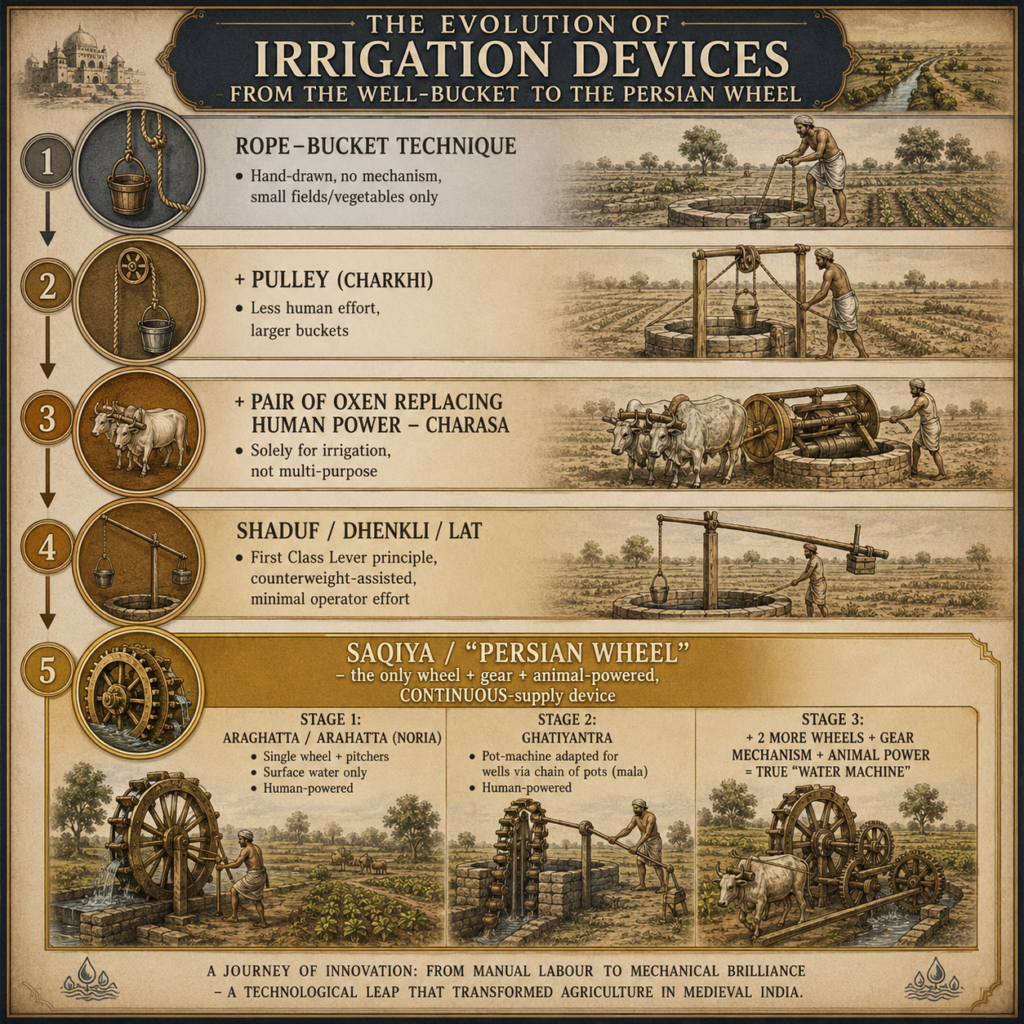
- Broadly, there were five devices or techniques to raise water from wells:
- Rope-bucket technique: the simplest technique — water was drawn with rope and bucket by hand, without any mechanical aid.
- The bucket, being small, could not adequately serve to water large fields — but this technique could well have been used for irrigating small fields, most probably vegetables, which did not require much water.
- The employment of pulleys (charkhi), combined with the rope-bucket contraption, required less human energy, allowing comparatively larger buckets to be attached.
- An improved method of the rope-bucket-pulley contraption employed a pair of oxen to replace human power.
- In some areas of North India, this is still in operation, known as charasa.
- Of all five methods, charasa was not multi-purpose — it was solely devised for irrigation, a fact not fully realised until now.
- The fourth technique is considered semi-mechanical, working on the First Class Lever principle.
- A long rope is lashed to the fork of an upright beam or tree trunk. The bucket is fastened to a rope, whose other end is tied to a swinging pole hovering over the well; the pole’s other end carries a “counterweight,” slightly heavier than the filled bucket — thus, the fulcrum forms at the centre of the pole.
- This contraption requires only minimal effort from the operator.
- The device is known as shaduf in Egypt; it is called tula (balance) in Sanskrit, and in Bihar and Bengal, it is known as dhenkli or lat/latha.
- Rope-bucket technique: the simplest technique — water was drawn with rope and bucket by hand, without any mechanical aid.
Saqiya, or “Persian Wheel”
- None of the four mechanisms described above required wheels as their basic component.
- This water-wheel could well claim to be called a “water machine,” owing to the employment of the gear system.
- With gears, we enter a very advanced technological stage — one surpassed only now by electric tube-wells.
- Controversy about the origins of the saqiya: did it exist in India earlier, or was it a foreign importation through the agency of the Turks? The evolution appears to have occurred as follows:
- 1st stage — Araghatta (or arahatta): In India, the earliest form was one wheel with pitchers or pots of clay attached around its rim — called araghatta or arahatta in Sanskrit (noria in English, a corruption of the Arabic naurah). It worked entirely by human power.
- Its form necessitated setting it up over shallow water, open surface streams, reservoirs, or rivers, where water would level up to its banks — its use over wells was therefore absolutely out of the question.
- 2nd stage — Ghatiyantra (pot-machine): This was designed to exploit wells. It was achieved by releasing the earthen pots fitted around the wheel’s rim, and, in their place, providing a chain or garland (mala) of pots, long enough to reach the well’s water level.
- The words araghatta and arahatta were still in use.
- This too was operated by human power.
- 3rd stage (final): Three developments took place:
- The addition of two more wheels.
- A gear mechanism.
- The use of animal power.
- 1st stage — Araghatta (or arahatta): In India, the earliest form was one wheel with pitchers or pots of clay attached around its rim — called araghatta or arahatta in Sanskrit (noria in English, a corruption of the Arabic naurah). It worked entirely by human power.
- Some modern scholars have confused the two earlier stages of the noria with the saqiya — but the last (final) phase was radically different, both in conception and components.
- A semantic blunder was committed when the same terms — araghatta and arahatta (modern rahat) — were used for the saqiya, once the Muslims brought it in the early medieval period.
- In fact, there is no evidence of water-wheels being operated by animals in Ancient India.
- The five devices for raising water from wells fall into two broad categories:
- Intermittent or discontinuous water-supply devices — the first four belong to this category, and all are operated by humans.
- Continuous supply system — the last device, the saqiya, is the only one in which animal power is employed.
- There were also many implements — such as shovel, pick-axe, and scraper (khurpi) — used not only in agricultural processes, but also in gardening.
Conclusion
Agricultural production and revenue administration during the 13th and 14th centuries reveal a countryside that, while not undergoing any fundamental technological transformation — implements and irrigation methods remained largely unchanged until the 19th century — nonetheless experienced a genuine reorganisation of its fiscal and social structure under Sultanate rule. The iqta and khalisa system provided the Sultanate with an unprecedented capacity to extract, redistribute, and centralise agrarian surplus, most starkly demonstrated in Alauddin Khalji’s 50% revenue demand and his direct assault on the privileges of the khots, muqaddams, and chaudhuris — a policy whose harsh human costs are vividly documented in Barani’s account, and whose oscillating fortunes across the reigns of Ghiyasuddin, Muhammad, and Firuz Tughluq reveal a state perpetually balancing the competing demands of revenue maximisation and rural stability. Meanwhile, favourable land-man ratios, a genuinely impressive diversity of crops and market produce — from Thakkur Pheru’s twenty-five recorded crops to the spread of grape cultivation and indigo — and technological refinements such as the Persian wheel (saqiya) point to an agrarian economy of real sophistication, even as its fruits remained unevenly distributed, concentrated disproportionately in the hands of the ruling class and rural intermediaries who would, by the time of Firuz Tughluq, come to be known collectively — in a term that would define Indian agrarian relations for centuries to come — as Zamindars.




