UNO and the Global Disputes

The United Nations Organization (UNO) and its role in resolving global disputes is a recurring theme in the UPSC History Optional syllabus, particularly under the paper on the World since the Second World War. Understanding the UN’s origins, its institutional structure, and its record as a peacekeeping body — from the Korean War and Suez Crisis to Bosnia and Iraq — is essential for tracing the evolution of the post-1945 international order and for answering questions on the Cold War, decolonization, and global governance. This article examines the background and creation of the UN, its organizational structure, a comparison with the League of Nations, and its varying record of success and failure in managing global disputes.
- The United Nations Organization (UNO), an intergovernmental organization, officially came into existence in October 1945, after the Second World War, with the aim of preventing another such conflict.
- It was formed to replace the League of Nations, which had proved incapable of maintaining peace; in setting up the UNO, the major powers tried to eliminate some of the weaknesses that had handicapped the League.
- The UN Charter was drawn up in San Francisco in 1945, based on proposals made at an earlier meeting between the USSR, the USA, China, and Britain, held at Dumbarton Oaks (USA) in 1944.
- At its founding, the UN had 51 member states; membership now stands at 193 (the latest addition being South Sudan).
- The headquarters of the United Nations is situated in Manhattan, New York City, and enjoys extraterritoriality; further main offices are situated in Geneva, Nairobi, and Vienna.
- The aims of the UN are:
- to preserve peace and eliminate war;
- to remove the causes of conflict by encouraging economic, social, educational, scientific, and cultural progress throughout the world, especially in under-developed countries;
- to safeguard the rights of all individual human beings, and the rights of peoples and nations.
- UN System agencies include the World Bank Group, the World Health Organization, the World Food Programme, UNESCO, and UNICEF; non-governmental organizations may be granted consultative status with ECOSOC and other agencies to participate in the UN’s work.
- The organization won the Nobel Peace Prize in 2001, and a number of its officers and agencies have also been awarded the prize.

Background and Creation
- In the century prior to the UN’s creation, several international treaty organizations and conferences had already been formed, as states first began establishing international bodies to cooperate on specific matters.
- The International Telecommunication Union was founded in 1865.
- The International Telegraph Union and the Universal Postal Union were established in 1874; both are now United Nations specialized agencies.
- In 1899, the International Peace Conference was held in The Hague to elaborate instruments for settling crises peacefully, preventing wars, and codifying the rules of warfare.
- It adopted the Convention for the Pacific Settlement of International Disputes and established the Permanent Court of Arbitration, which began work in 1902.
- To regulate conflicts between nations, the International Committee of the Red Cross and the Hague Conventions of 1899 and 1907 were formed.
- Following the First World War, the Paris Peace Conference established the League of Nations (under the Treaty of Versailles) to maintain harmony between countries.
- The League resolved some territorial disputes and created international structures for areas such as postal mail, aviation, and opium control, some of which would later be absorbed into the UN.
- However, the League lacked representation for colonial peoples (then half the world’s population) and significant participation from several major powers, including the US and USSR; it failed to act against the Japanese invasion of Manchuria (1931), the Second Italian-Ethiopian War (1935), the Japanese invasion of China (1937), and the German expansions under Adolf Hitler that culminated in the Second World War.
- The League proved effective only on those problems where the interests of the major powers were not involved; it was also based not on voting but on consensus, which made decision-making more difficult.
- The International Labour Organization was also created under the Treaty of Versailles as an affiliated agency of the League.
The 1942 “Declaration of United Nations” by the Allies of World War II
The Atlantic Charter
- Churchill and Roosevelt met aboard the British cruiser HMS Prince of Wales in Placentia Bay, Newfoundland, to respond to Germany’s successful attacks on Britain, Greece, and Yugoslavia, and to discuss their respective war aims for the Second World War and outline a postwar international system.
- At the time of the meeting (August 9–10, 1941), Germany had invaded the Soviet Union and was on the verge of attacking Egypt to close off the Suez Canal; Churchill and Roosevelt were also, simultaneously, concerned about Japan’s intentions in Southeast Asia.
- Both leaders had their own reasons for wanting to sign a charter — both hoped that its statement of solidarity with the Allies would sway American opinion toward involvement in the war, but in this they were disappointed: Americans continued to reject the idea of joining the war until after the Japanese bombing of Pearl Harbor.
- The Atlantic Charter was created to show solidarity between the United States and the United Kingdom in the face of German aggression; it served to improve morale and was turned into leaflets that were airdropped over occupied territories.
- The Charter, drafted by Churchill and Roosevelt, included eight “common principles” that the United States and Great Britain would be committed to supporting in the postwar world:
- First, their countries seek no aggrandizement, territorial or otherwise;
- Second, no territorial changes that do not accord with the freely expressed wishes of the peoples concerned;
- Third, respect for the right of all peoples to choose their own form of government, and restoration of sovereign rights and self-government to those forcibly deprived of them;
- Fourth, the furthering, for all States, great or small, victor or vanquished, of access on equal terms to trade and the raw materials of the world;
- Fifth, the fullest collaboration between all nations in the economic field, to secure improved labour standards, economic advancement, and social security for all;
- Sixth, the establishment of a peace affording all nations the means of dwelling in safety;
- Seventh, such a peace should enable all men to traverse the high seas and oceans without hindrance;
- Eighth, the abandonment by all nations of the world of the use of force; pending the establishment of a wider and permanent system of general security, the disarmament of such nations was deemed essential.
- The Atlantic Charter was released by Churchill and Roosevelt on August 14, 1941 (even before US involvement in the Second World War) as a joint declaration following the Newfoundland meeting, providing a broad statement of U.S. and British war aims.
Impact of the Atlantic Charter:
- Though it did not precipitate American involvement in World War II, the Charter was a bold step by Great Britain and the United States.
- It was not a formal treaty but a statement of shared ethics and intent; according to the United Nations, its purpose was to be “a message of hope to the occupied countries”, holding out the promise of a world organization based on international morality.
- In this respect, it succeeded: it provided Allied forces with moral support while sending a powerful message to the Axis powers.
- Additionally:
- The Allied nations agreed to the principles of the Atlantic Charter, thus establishing a commonality of purpose, making it a significant first step toward the United Nations.
- The Charter was perceived by the Axis powers as the beginning of a US–Great Britain alliance, which had the effect of strengthening the militaristic government in Japan.
- Though it pledged no military support for the war in Europe, it signalled the United States as a major player on the world stage — a position the US would firmly hold after World War II in rebuilding a war-torn Europe.
The Declaration by United Nations (1 January 1942)
- On January 1, 1942, representatives of 26 nations at war with the Axis powers met in Washington to sign the “Declaration by United Nations”, endorsing the Atlantic Charter.
- This document pledged the signatory governments to the maximum war effort and bound them against making a separate peace; it incorporated Soviet suggestions but left no role for France.
- The name “United Nations”, coined by US President Franklin D. Roosevelt, was first used in this Declaration of 1 January 1942.
- One major change from the Atlantic Charter was the addition of a provision for religious freedom, which Stalin approved after Roosevelt insisted.
- By 1 March 1945, 21 additional states had signed.
- During the war, “the United Nations” became the official term for the Allies; to join it, countries had to sign the Declaration and declare war on the Axis.
Other Conferences and Declarations
- Quebec Conference (August 1943): the US Secretary of State and the British Foreign Secretary agreed to draft a declaration calling for “a general international organization, based on the principle [of] sovereign equality of all nations”; an agreed declaration was subsequently issued after a Foreign Ministers’ Conference in Moscow (October 1943).
- Tehran Meeting (November 1943): when President Roosevelt met Soviet Premier Joseph Stalin in Tehran, he proposed an international organization comprising an assembly of all member states and a 10-member executive committee to discuss social and economic issues; the United States, Great Britain, Soviet Union, and China would enforce peace as “the four policemen.”
- Meanwhile, Allied representatives founded a set of task-oriented organizations:
- Food and Agricultural Organization (May 1943),
- United Nations Relief and Rehabilitation Administration (November 1943),
- United Nations Educational, Scientific, and Cultural Organization (April 1944),
- International Monetary Fund and World Bank (July 1944),
- International Civil Aviation Organization (November 1944).
Founding the UN, 1945
- In 1945, representatives of 50 countries met in San Francisco at the United Nations Conference on International Organization to draw up the United Nations Charter, deliberating on the basis of proposals worked out by China, the Soviet Union, the United Kingdom, and the United States at the Dumbarton Oaks Conference (August–October 1944).
- The Charter was signed on 26 June 1945 by representatives of the 50 countries; Poland, not represented at the Conference, signed later and became one of the original 51 Member States.
- The United Nations officially came into existence on 24 October 1945, once the Charter had been ratified by China, France, the Soviet Union, the United Kingdom, the United States, and a majority of other signatories; United Nations Day is celebrated on 24 October each year.
- The first meetings of the General Assembly (with 51 nations represented) and the Security Council took place at Central Hall Westminster in London, beginning 6 January 1946.
- The General Assembly selected New York City as the site for the UN headquarters; its site — like the UN headquarters buildings in Geneva, Vienna, and Nairobi — is designated as international territory.
- The Norwegian Foreign Minister, Trygve Lie, was elected as the first UN Secretary-General.
Membership
- Membership in the United Nations is open to all peace-loving states that accept the obligations contained in the Charter and are, in the judgment of the Organization, able and willing to carry them out.
- The admission of any such state is effected by a decision of the General Assembly upon the recommendation of the Security Council.
- There are two non-member observer states of the UN General Assembly: the Holy See (which holds sovereignty over Vatican City) and the State of Palestine.
The Structure of the United Nations Organization
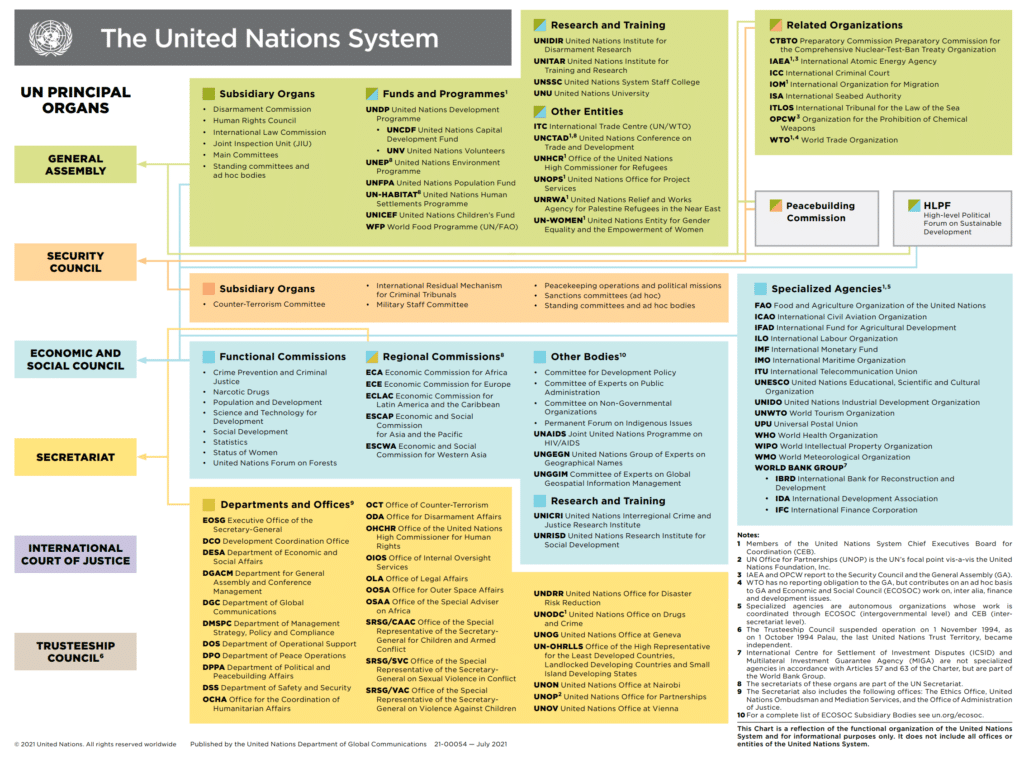
There are now seven main organs of the UN:
General Assembly
- The main deliberative organ of the UN, composed of representatives of all Member States; the year-round work of the United Nations derives largely from the mandates given by the General Assembly.
- A revitalization of the Assembly is under way to enhance its role, authority, effectiveness, and efficiency.
Security Council
- Holds primary responsibility, under the UN Charter, for the maintenance of international peace and security.
- A reform of the Security Council, including its membership, is under consideration.
Secretariat
- Carries out the day-to-day work of the Organization, servicing the other principal organs and carrying out tasks as varied as the issues dealt with by the UN — administering peacekeeping operations, surveying economic and social trends, and preparing studies on human rights, among others.
International Court of Justice
- Located at The Hague in the Netherlands, it is the principal judicial organ of the United Nations.
- It settles legal disputes between states and gives advisory opinions to the UN and its specialized agencies; its Statute is an integral part of the UN Charter.
Trusteeship Council
- Established in 1945 by the UN Charter to provide international supervision for 11 Trust Territories placed under the administration of 7 Member States, ensuring adequate steps were taken to prepare the Territories for self-government and independence.
- The trust territories were mostly former mandates of the League of Nations, or territories taken from nations defeated at the end of World War II.
- The Trusteeship Council suspended operations in 1994, upon the independence of Palau, the last remaining UN trustee territory; by 1994, all Trust Territories had attained self-government or independence.
Economic and Social Council (ECOSOC)
- Established by the UN Charter as the principal organ to coordinate the economic, social, and related work of the United Nations and the specialized agencies and institutions.
- Voting in the Council is by simple majority; each member has one vote.
International Criminal Court (ICC)
- An intergovernmental organization and international tribunal that sits in The Hague, Netherlands.
- The ICC has jurisdiction to prosecute individuals for the international crimes of genocide, crimes against humanity, war crimes, and crimes of aggression.
- It began functioning on 1 July 2002, the date the Rome Statute — a multilateral treaty serving as the ICC’s foundational and governing document — entered into force.
Additional structural points:
- Four of the five principal organs are located at the main UN Headquarters in New York City; the International Court of Justice is located in The Hague, while other major agencies are based in the UN offices at Geneva, Vienna, and Nairobi.
- The six official languages of the United Nations, used in intergovernmental meetings and documents, are: Arabic, Chinese, English, French, Russian, and Spanish.
- Under the Convention on the Privileges and Immunity of the United Nations, the UN and its agencies are immune from the laws of the countries where they operate, safeguarding the UN’s impartiality with regard to host and member countries.
- Below the six organs sits “a collection of entities and organizations, some of which are actually older than the UN itself and operate with almost complete independence from it” — including specialized agencies, research and training institutions, programmes and funds, and other UN entities.
- The United Nations follows the Noblemaire principle, which is binding on any organization belonging to the UN system: this holds that an international organization must remunerate its entire staff equally for work of equal value, irrespective of differences in national pay levels, while also being able to recruit and retain staff from all its member states.
- The World Bank, the International Monetary Fund (IMF), and their affiliated organizations have not agreed to be covered by the UN’s common system of Salaries and Allowances.
Specialized Agencies
- The UN Charter stipulates that each primary organ of the UN can establish various specialized agencies to fulfil its duties, such as the International Atomic Energy Agency, the Food and Agriculture Organization, UNESCO, the World Bank, and the World Health Organization (WHO).
- The UN performs most of its humanitarian work through these agencies.
How Different Is the UN from the League of Nations?
The UN has been more successful
- There are some important differences that have tended to make the UN a more successful body than the League:
- The UN spends much more time and resources on economic and social matters, and its scope is much wider than that of the League; all the specialized agencies, with the exception of the International Labour Organization (founded in 1919), were set up in 1945 or later.
- The UN is committed to safeguarding individual human rights, an area the League did not get involved in.
- Changes in the procedures of the General Assembly and the Security Council (especially the ‘Uniting for Peace’ resolution), together with the increased power and prestige of the Secretary-General, have enabled the UN, on occasion, to take more decisive action than the League ever achieved.
- The UN has a much wider membership and is therefore more of a genuine world organization than the League, with all the extra prestige that this entails.
- Both the USA and the USSR were founder-members of the UN, whereas the USA never joined the League.
- Between 1963 and 1968, no fewer than 43 new members joined the UN, mainly the emerging states of Africa and Asia; later, many former Soviet states joined too, taking membership to 193 — the League never had more than 50 members.
Some weaknesses of the League remain
- Any one of the five permanent members of the Security Council can use its power of veto to prevent decisive action being taken.
- Like the League, the UN has no permanent army of its own and has to rely on forces belonging to its member states.
How Successful Has the UN Been as a Peacekeeping Organization?
- Although it has had mixed success, it is probably fair to say that the UN has been more successful than the League in its peacekeeping efforts, especially in crises that did not directly involve the interests of the great powers, such as the civil war in the Congo (1960–4) and the dispute between the Netherlands and Indonesia over West New Guinea.
- On the other hand, it has often been just as ineffective as the League in situations — such as the Hungarian Rising of 1956 and the 1968 Czech crisis — where the interests of a great power (in these cases, the USSR) seemed to be threatened, and where that power decided to ignore or defy the UN.
- With an increasing Third World presence and the failure of UN mediation in conflicts in the Middle East, Vietnam, and Kashmir, the UN increasingly shifted its attention to its ostensibly secondary goals of economic development and cultural exchange; by the 1970s, the UN budget for social and economic development was far greater than its peacekeeping budget.
- The UN’s varying degrees of success in resolving global disputes can be seen from the following major cases in which it has been involved.
West New Guinea (1946)
- In 1946, the UN helped arrange independence from Holland for the Dutch East Indies, which became Indonesia; however, no agreement was reached about the future of West New Guinea (West Irian), which was claimed by both countries.
- Fighting broke out in 1961; after U Thant (UN Secretary-General) appealed to both sides to reopen negotiations, it was agreed (1962) that the territory should become part of Indonesia.
- The transfer was organized and policed by a UN force — the UN played a vital role in getting negotiations off the ground, though it did not itself decide West Irian’s future.
Palestine (1947)
- The dispute between Jews and Arabs in Palestine was brought before the UN in 1947.
- After an investigation, the UN decided to divide Palestine, setting up the Jewish state of Israel — one of the UN’s most controversial decisions, which was not accepted by the majority of Arabs.
- The UN was unable to prevent a series of wars between Israel and various Arab states (1948–9, 1967, and 1973), though it did useful work arranging ceasefires and providing supervisory forces, while the UN Relief and Works Agency cared for Arab refugees.
The Korean War (1950–3)
- This was the only occasion on which the UN was able to take decisive action in a crisis directly involving the interests of one of the superpowers.
- When South Korea was invaded by communist North Korea in June 1950, the Security Council immediately passed a resolution condemning North Korea and called on member states to send help to the South.
- This was possible only because of the temporary absence of the Russian delegates, who would have vetoed the resolution had they not been boycotting Security Council meetings in protest at the failure to allow communist China to join the UN.
- Troops of 16 countries repelled the invasion and preserved the frontier between the two Koreas along the 38th parallel.
- Though claimed by the West as a great UN success, it was in fact very much an American operation:
- The vast majority of troops, and the Commander-in-Chief, General MacArthur, were American, and the US government had already decided to intervene with force the day before the Security Council decision was taken.
- Only the absence of the Russians enabled the USA to turn it into a UN operation — a situation unlikely to be repeated, since the USSR would thereafter take care to be present at all future Council sessions.
- The Korean War had important results for the future of the UN:
- It led to the passing of the ‘Uniting for Peace’ resolution, which allowed a Security Council veto to be bypassed by a General Assembly vote.
- It also led to a bitter Russian attack on Secretary-General Trygve Lie for his perceived biased role in the crisis; his position soon became untenable, and he eventually retired early, being replaced by Dag Hammarskjöld.
The Suez Crisis (1956)
- This arguably showed the UN at its best. When President Nasser of Egypt suddenly nationalized the Suez Canal, many of whose shares were owned by the British and French, both powers protested strongly and sent troops “to protect their interests.”
- At the same time, the Israelis invaded Egypt from the east; the real aim of all three states was to bring down Nasser.
- A Security Council resolution condemning the use of force was vetoed by Britain and France, whereupon the General Assembly, by a majority of 64 votes to 5, condemned the invasions and called for a withdrawal of troops.
- Given the weight of opinion against them, the aggressors agreed to withdraw, provided the UN ensured a reasonable settlement over the canal and kept the Arabs and Israelis apart.
- A UN force of 5,000, drawn from ten different countries, moved in, while the British, French, and Israelis went home.
- The prestige of the UN and of Dag Hammarskjöld, who handled the operation with considerable skill, was greatly enhanced, though American and Russian pressure was also important in bringing about the ceasefire.
- However, the UN was not so successful in the 1967 Arab–Israeli conflict.
The Hungarian Rising (1956)
- Taking place at the same time as the Suez Crisis, this episode showed the UN at its most ineffective.
- When the Hungarians tried to assert independence from Russian control, Soviet troops entered Hungary to crush the revolt.
- The Hungarian government appealed to the UN, but the Russians vetoed a Security Council resolution calling for a withdrawal of their forces; the General Assembly passed the same resolution and set up a committee to investigate, but the Russians refused to co-operate and no progress could be made.
Civil War in the Congo (1960–4)
- Here, the UN mounted its most complex operation to date, except for Korea.
- When the Congo (known as Zaire since 1971) dissolved into chaos immediately after independence, a UN force numbering over 20,000 at its largest managed to restore some sort of precarious order.
- A special UN Congo Fund was set up to help with the recovery and development of the ravaged country.
- The financial cost was so high that the UN was brought close to bankruptcy, especially as the USSR, France, and Belgium refused to pay their contributions towards the cost of operations, disapproving of how the UN had handled the situation.
- The war also cost the life of Dag Hammarskjöld, who was killed in a plane crash in the Congo.
Cyprus
- A British colony since 1878, the island was granted independence in 1960.
- In 1963, civil war broke out between the Greeks, who made up about 80 per cent of the population, and the Turks.
- A UN peacekeeping force arrived in March 1964; an uneasy peace was restored, but it needed 3,000 UN troops permanently stationed in Cyprus to prevent Greeks and Turks tearing each other apart.
- In 1974, the Greek Cypriots tried to unite the island with Greece; this prompted the Turkish Cypriots, helped by invading Turkish army troops, to seize the north of the island and expel all Greeks from it.
- The UN condemned the invasion but was unable to remove the Turks; UN forces at least achieved a ceasefire and are still policing the frontier between Greeks and Turks.
- However, the UN has still not been successful in finding an acceptable constitution or any other lasting compromise.
Kashmir
- In Kashmir, the UN found itself in a similar situation to Cyprus.
- After 1947, this large province, lying between India and Pakistan, was claimed by both states; the UN negotiated a ceasefire in 1948 after fighting broke out.
- At this point, the Indians were (legally) ruling the southern part of Kashmir and the Pakistanis were occupying the northern part, and for the next 16 years the UN policed the ceasefire line between the two zones.
- When Pakistani troops invaded the Indian zone in 1965, a short war developed, but once again the UN successfully intervened and hostilities ceased.
- There seemed little prospect of the UN, or any other agency, finding a permanent solution.
The Czechoslovak Crisis (1968)
- This was almost a repeat performance of the Hungarian rising twelve years earlier.
- When the Czechs showed what Moscow considered too much independence, Russian and other Warsaw Pact troops were sent in to enforce obedience to the USSR.
- The Security Council tried to pass a motion condemning this action, but the Russians vetoed it, claiming the Czech government had asked for their intervention; although the Czechs denied this, there was nothing the UN could do in view of the USSR’s refusal to co-operate.
The Lebanon
- While civil war raged in Lebanon (1975–87), matters were further complicated by a frontier dispute in the south of the country between Lebanese Christians (aided by the Israelis) and Palestinians.
- In March 1978, the Israelis invaded South Lebanon to destroy Palestinian guerrilla bases from which attacks were being made on northern Israel; in June 1978, the Israelis agreed to withdraw provided the UN assumed responsibility for policing the frontier area.
- The United Nations Interim Force in Lebanon (UNIFIL), consisting of about 7,000 troops, was sent to South Lebanon; it supervised the Israeli withdrawal and had some success in maintaining relative peace, though it was a constant struggle against frontier violations, assassinations, terrorism, and hostage-taking.
- During the early 1990s, a new enemy — the Muslim Shi’ite group Hezbollah, allegedly backed by Iran and Syria — began to harass Israel from bases in South Lebanon.
- In retaliation, the Israelis launched a major attack on South Lebanon (April 1996) and occupied most of the region until 1999; UNIFIL again helped supervise an Israeli withdrawal.
- UNIFIL worked hard to strengthen the Lebanese army, providing training and equipment, and the two forces were eventually able to work together to maintain stability, though a permanent solution still seemed far off.
- In July 2006, the Hezbollah–Israel conflict flared up again; the UN succeeded in arranging a ceasefire, though there were several exchanges of fire between the Lebanese army and the Israeli Defence Force, terrorist attacks on UNIFIL itself, and the firing of rockets into Israel.
The Iran–Iraq War (1980–8)
- The UN was successful in bringing an end to this long-drawn-out war. After years of attempting to mediate, the UN at last negotiated a ceasefire, though it was helped by the fact that both sides were close to exhaustion.
UN Peacekeeping Since the End of the Cold War
- The end of the Cold War did not mean the end of potential conflict: several disputes that had originated many years earlier still lingered on, the Middle East continued to be volatile, and new problems emerged in south-east Asia and Africa.
- After the Cold War, the UN saw a radical expansion in its peacekeeping duties, taking on more missions in ten years than it had in the previous four decades.
- Between 1988 and 2000, the number of adopted Security Council resolutions more than doubled, and the peacekeeping budget increased more than tenfold.
- Between 1990 and 2003, the UN undertook well over 30 peacekeeping operations; at the peak of involvement, in the mid-1990s, there were over 80,000 troops on active service, drawn from 77 countries.
- In the late 1990s and 2000s, UN-authorized international interventions took a wider variety of forms — the UN mission in the Sierra Leone Civil War (1991–2002) was supplemented by British Royal Marines, and the invasion of Afghanistan (2001) was overseen by NATO.
- The UN also negotiated an end to the Salvadoran Civil War, launched a successful peacekeeping mission in Namibia, and oversaw democratic elections in post-apartheid South Africa and post-Khmer Rouge Cambodia; in 1991, it authorized a US-led coalition that repulsed the Iraqi invasion of Kuwait.
- Brian Urquhart, Under-Secretary-General from 1971 to 1985, later described the hopes raised by these successes as a “false renaissance” for the organization, given the more troubled missions that followed.
- A few examples illustrate the growing complexity of the problems facing the UN and the increasing obstacles to success.
The 1991 Gulf War
- UN action during the Gulf War of 1991 was impressive. When Saddam Hussein of Iraq invaded and captured the small but extremely rich neighbouring state of Kuwait (August 1990), the UN Security Council warned him to withdraw or face the consequences; when he refused, a large UN force was sent to Saudi Arabia.
- In a short and decisive campaign, Iraqi troops were driven out, suffering heavy losses, and Kuwait was liberated.
- However, critics of the UN complained that Kuwait received help only because the West needed her oil supplies, while other small nations of no value to the West received no help when invaded by larger neighbours — for example, East Timor, taken over by Indonesia in 1975.
Cambodia
- Problems in Cambodia dragged on for nearly 20 years, but the UN eventually arranged a solution.
- In 1975, the Khmer Rouge, a communist guerrilla force led by Pol Pot, seized power from the right-wing government of Prince Sihanouk.
- Over the next three years, Pol Pot’s brutal regime slaughtered about a third of the population, until in 1978 a Vietnamese army invaded the country, drove out the Khmer Rouge, and set up a new government.
- At first, the UN, prompted by the USA, condemned this action — although many thought Vietnam had done the Cambodian people a great service by getting rid of the cruel Pol Pot regime — because, as part of the Cold War, any action by Vietnam (an ally of the USSR) would be condemned by the USA.
- The end of the Cold War enabled the UN to organize and police a solution: Vietnamese forces were withdrawn (September 1989), and after a long period of negotiation and persuasion, elections were held (June 1993) and the country gradually began to settle down.
Mozambique
- Mozambique, which gained independence from Portugal in 1975, was torn by civil war for many years; by 1990, the country was in ruins and both sides were exhausted.
- Although a ceasefire agreement had been signed in Rome (October 1992) at a conference organized by the Roman Catholic Church and the Italian government, it was not holding, and there was no way elections could be held amid repeated violations.
- The UN now became fully involved, operating a programme of demobilizing and disarming the various armies, distributing humanitarian relief, and preparing for elections, which took place successfully in October 1994.
Somalia
- Somalia disintegrated into civil war in 1991 when the dictator Siad Barre was overthrown, and a power struggle developed between rival supporters of Generals Aidid and Ali Mohammed; food supplies and communications broke down and thousands of refugees fled into Kenya.
- The Organization of African Unity (OAU) asked for UN help, and 37,000 UN troops, mainly American, arrived (December 1992) to safeguard the aid and restore law and order by disarming the “warlords.”
- However, the warlords, especially Aidid, were not prepared to be disarmed, and UN troops began to suffer casualties.
- The Americans withdrew their troops (March 1994), and the remaining UN troops were withdrawn in March 1995, leaving the warlords to fight it out.
- It was a humiliating backdown, but in fact the UN had set itself an impossible task from the start — to forcibly disarm two powerful armies determined to keep fighting, while simultaneously running a humanitarian relief programme.
- At the same time, the UN took no action in the civil war and genocide taking place in Rwanda in 1994: the United Nations Assistance Mission for Rwanda failed to intervene in the Rwandan Genocide amid indecision in the Security Council.
- UN military interventions had the most chance of success when, as in Korea (1950–3) and the 1991 Gulf War, UN troops actively supported one side against the other.
Bosnia
- In the civil war between Bosnian Muslims and Serbs, the UN failed to send enough troops to impose law and order, partly because both the European Community and the USA were reluctant to get involved.
- There was further humiliation for the UN in July 1995 when it was unable to prevent Serb forces from capturing two towns — Srebrenica and Zepa — which the Security Council had designated as safe areas for Muslims.
- UN helplessness was underlined when the Serbs went on to murder around 8,000 Muslim men in Srebrenica.
Iraq — The Overthrow of Saddam Hussein
- In March 2003, the USA and Britain launched an invasion of Iraq, on the grounds that they intended to eliminate its weapons of mass destruction and free the Iraqi people from Saddam Hussein’s brutal regime; UN weapons inspectors had, however, found nothing of significance.
- The attack went ahead even though the UN Security Council had not given its authorization.
- The USA and Britain tried to push a resolution through the Council approving military action, but France, Russia, China, and Germany wanted to allow Saddam more time to co-operate with the weapons inspectors.
- When it became clear France and Russia were prepared to veto any such resolution, the USA and Britain resolved to go ahead unilaterally, without putting the resolution to a Security Council vote, claiming Saddam’s violations of earlier UN resolutions justified the war.
- This US–British action was a serious blow to the prestige of the UN.
- Secretary-General Kofi Annan said the action had brought the UN to “a fork in the road.” Until then, all states had needed the authorization of the Security Council to use force beyond the normal right of self-defence prescribed by Article 51 of the UN Charter; this, he warned, could only set precedents resulting in “a proliferation of the unilateral and lawless use of force.”
- Under the eighth Secretary-General, Ban Ki-moon, the UN intervened with peacekeepers in crises such as the War in Darfur in Sudan and the Kivu conflict in the Democratic Republic of Congo, and sent observers and chemical weapons inspectors to the Syrian Civil War.
- In 2013, an internal review of UN actions in the final battles of the Sri Lankan Civil War (2009) concluded that the organization had suffered “systemic failure.”
Assessment of the United Nations Organization
- Evaluations of the UN’s effectiveness have been mixed: some commentators believe the organization to be an important force for peace and human development, while others have called it ineffective, corrupt, or biased.
- The UN has been in existence for well over half a century, but it is still nowhere near achieving its basic aims — the world remains full of economic and social problems, and acts of aggression and wars continue.
- A number of agencies and individuals associated with the UN have won the Nobel Peace Prize in recognition of their work; two Secretaries-General, Dag Hammarskjöld and Kofi Annan, were each awarded the prize.
- The UN’s failures were, to some extent, caused by weaknesses in its system.
Lack of a Permanent UN Army
- This makes it difficult to prevail upon powerful states to accept its decisions when they choose to put self-interest first; if persuasion and world opinion fail, the UN has to rely on member nations to provide troops to enforce decisions.
- For example, the USSR was able to ignore UN demands for the withdrawal of Russian troops from Hungary (1956) and Afghanistan (1980).
- UN involvement in Somalia (1992–5) and Bosnia (1992–5) showed the impossibility of the UN stopping a war when the warring parties were not ready to stop fighting.
- The USA and Britain were determined to attack Iraq in 2003 without UN authorization, and the UN could do nothing about it, especially as the USA was the world’s only superpower.
- If a potential aggressor knew its forces would be met by a UN armed force equipped and mandated to fight, this would be a powerful disincentive — for example, had a UN force been deployed on the Kuwait side of the Iraq–Kuwait frontier in 1990, or on the Croatian side of the Serbia–Croatia border in 1991, hostilities might well have been prevented.
When Should the UN Become Involved?
- There is a persistent problem about exactly when the UN should become involved during the course of a dispute.
- Sometimes it hangs back too long, making the problem more difficult to solve; sometimes it hesitates so long that it scarcely becomes involved at all — as happened with the war in Vietnam and the war in Angola.
- This left the UN open to accusations of indecision and lack of firmness, causing some states to place more faith in their own regional organizations, such as NATO, for keeping the peace; many agreements were consequently worked out without involving the UN, for example, the end of the Vietnam War, the Camp David peace between Israel and Egypt (1979), and the settlement of the Rhodesia/Zimbabwe problem (1979).
- At this time, critics claimed the UN was becoming irrelevant and no more than an arena for propaganda speeches.
- Part of the problem lay in the Security Council being hampered by the veto its permanent members could use; although the ‘Uniting for Peace’ resolution could offset this to some extent, the veto could still cause long delays before decisive action was taken.
The Increasing Membership of the UN from the 1970s
- The increasing membership of the UN during the 1970s brought new problems.
- By 1970, members from the Third World (Africa and Asia) were in a clear majority; as these nations began to work together, it became increasingly difficult for both Western and Communist blocs to get their resolutions through the General Assembly.
- Western nations began to criticize the Third World bloc for being too “political” — meaning acting in a way the West disapproved of. For example, in 1974 UNESCO passed resolutions condemning “colonialism” and “imperialism,” and in 1979 a Western-bloc motion condemning terrorism was defeated by the Arab states and their supporters.
- Friction reached a crisis point in 1983 at the UNESCO General Congress.
- Many Western nations, including the USA, accused UNESCO of being inefficient and wasteful, and of having unacceptable political aims; matters came to a head over a proposal by some communist states for the internal licensing of foreign journalists, which the USA argued would enable member states to censor each other’s media organizations.
- Consequently, the Americans announced their withdrawal from UNESCO on 1 January 1985, declaring it had become “hostile to the basic institutions of a free society, especially a free market and a free press.” Britain and Singapore withdrew in 1986 for similar reasons; Britain rejoined in 1997 and the USA followed in 2002, but withdrew again in 2019, citing anti-Israel bias.
Waste of Effort and Resources Among the Agencies
- Some agencies sometimes seem to duplicate each other’s work — critics claim the WHO and the FAO overlap too much, and the FAO was criticized in 1984 for spending too much on administration and too little on improving agricultural systems.
- GATT and UNCTAD even seem to work against each other: GATT tries to eliminate tariffs and other trade restrictions, whereas UNCTAD tries to secure preferential treatment for the products of Third World countries.
Shortage of Funds
- Throughout its history, the UN has always been short of funds; the vast scope of its work means it needs incredibly large sums of money to finance its operations, and it is entirely dependent on contributions from member states.
- Each state pays a regular annual contribution based on its general wealth and ability to pay, in addition to a share of the cost of each peacekeeping operation and the expenses of the special agencies.
- Many member states refused to pay from time to time, either due to their own financial difficulties or as a mark of disapproval of UN policies.
- In 1986, the USA withheld more than $100 million until the UN reformed its budgeting system and curbed its extravagance; the Americans wanted the countries that contributed most to have more say in how the money was spent, but most smaller members rejected this as undemocratic.
- In 1987, changes were introduced giving the main financial contributors more control over spending, and the financial situation soon improved.
- However, expenses soared alarmingly in the early 1990s as the UN became involved in a series of new crises in the Middle East (Gulf War), Yugoslavia, and Somalia.
- In August 1993, Secretary-General Dr Boutros-Ghali revealed that many states were well in arrears with their payments, warning that without an immediate injection of cash from the world’s rich states, all UN peacekeeping operations would be in jeopardy.
- Yet the Americans and Europeans felt they already paid too much — the USA, EU, and Japan together paid three-quarters of the expenses — and felt many other wealthy states could afford to contribute far more than they were doing.
Other Problems
- Since its founding, there have been many calls for reform of the United Nations, but little consensus on how to do so — some want the UN to play a greater or more effective role in world affairs, while others want its role reduced to humanitarian work.
- There have also been numerous calls for the UN Security Council’s membership to be increased, for different ways of electing the Secretary-General, and for a United Nations Parliamentary Assembly.
- The most enduring divide in views of the UN is the “North–South split” between richer Northern nations and developing Southern nations.
- Southern nations tend to favour a more empowered UN with a stronger General Assembly, giving them a greater voice in world affairs, while Northern nations prefer a laissez-faire UN that focuses on transnational threats such as terrorism.
- After World War II, the French Committee of National Liberation was slow to be recognized by the US as the government of France, and the country was initially excluded from the conferences that created the new organization.
- The future French president Charles de Gaulle criticized the UN, famously calling it a machin (“contraption”), and was unconvinced that a global security alliance would help maintain world peace, preferring direct defence treaties between countries instead.
- Critics have also accused the UN of bureaucratic inefficiency, waste, and corruption.
- During the 1990s, the US withheld dues citing inefficiency, and only started repayment on condition that a major reforms initiative was introduced; in 1994, the Office of Internal Oversight Services (OIOS) was established by the General Assembly as an efficiency watchdog.
- In 2004, the UN faced accusations that its recently ended Oil-for-Food Programme — under which Iraq had been allowed to trade oil for basic needs to relieve the pressure of sanctions — had suffered from widespread corruption, including billions of dollars in kickbacks.
The UN’s Achievements
- In spite of all these criticisms, it would be wrong to write the UN off as a failure, and there can be no doubt the world would be a far worse place without it.
- It provides a world assembly where representatives of around 190 nations can come together and talk to each other; even the smallest nation has a chance to make itself heard in a world forum.
- Although it has not prevented wars, it has been successful in bringing some wars to an end more quickly, and has prevented further conflict; a great deal of human suffering and bloodshed has been avoided through the actions of UN peacekeeping forces and refugee agencies.
- At the present time (2019), there are around 110,000 UN peacekeepers and 14 peacekeeping missions in action across the world.
- The UN has also done valuable work investigating and publicizing human rights violations under repressive regimes, such as the military governments of Chile and Zaire, slowly influencing governments by bringing international pressure to bear on them.
- Perhaps its most important achievement has been to stimulate international co-operation on economic, social, and technical matters — millions of people, especially in poorer countries, are better off thanks to the work of the UN agencies.
- It continues to involve itself in current problems: UNESCO, the ILO, and the WHO run a joint project to help drug addicts, and there has been a series of 15 conferences on AIDS to co-ordinate the struggle against the disease, particularly in Africa.
The Future of the UN
- Many people thought that with the end of the Cold War, most of the world’s problems would disappear; but this did not happen — during the 1990s there seemed to be more conflicts than ever before, and the world seemed less and less stable.
- Clearly, there was still a vitally important role for the UN to play as international peacekeeper, and many were anxious for it to reform and strengthen itself.
- Kofi Annan, who became Secretary-General in December 1996, had gained an excellent reputation as head of UN peacekeeping operations, and was well aware of the organization’s weaknesses.
- He ordered a thorough review of all UN peace operations; the resulting report, published in 2000, recommended, among other things, that the UN maintain permanent brigade-size forces of 5,000 troops, ready for immediate deployment and commanded by military professionals.
- The spread of terrorism, especially after the September 2001 attacks on New York, prompted Annan to produce his Agenda for Further Change (September 2002) — a plan for reforms to strengthen the UN’s role in fighting terrorism, which included a much-needed streamlining of the cumbersome budget system.
- The really serious problem, brewing since the end of the Cold War and the emergence of the USA as sole superpower, concerned the future relationship between the UN and the USA.
- Tensions began to mount as soon as the Bush administration took office in 2001: within its first year, the new government rejected the 1972 Anti-Ballistic Missile Treaty, the 1997 Kyoto Protocol (aimed at limiting greenhouse gas emissions), and the Rome Statute of the new UN International Criminal Court.
- Tensions reached a climax in March 2003, when the US government, aided by the UK, decided to attack Iraq without UN authorization and against the wishes of the majority of UN members.
- The USA was so disproportionately powerful that it could ignore the UN and act as it pleased unless the UN delivered the outcome it wanted; an important American technique in its quest to influence the UN was to secure the appointment of a sympathetic Secretary-General — Kofi Annan (Secretary-General, 1996–2006) wholeheartedly supported the American line on every major UN involvement except one, Iraq.
- The challenge for the UN in the years ahead is to find a way to harness and make use of the power and influence of the USA, instead of being impeded or stampeded by it.
- The Millennium Summit was held in 2000 to discuss the UN’s role in the 21st century, culminating in the adoption by all member states of the Millennium Development Goals (MDGs) — a commitment to achieving international development in areas such as poverty reduction, gender equality, and public health by 2015, with progress ultimately uneven.
- The Sustainable Development Goals (SDGs) were launched in 2015 to succeed the MDGs.
- The 2005 World Summit reaffirmed the UN’s focus on promoting development, peacekeeping, human rights, and global security; the UN has since sought to improve its accountability and democratic legitimacy by engaging more with civil society and fostering a global constituency.
- In an effort to enhance transparency, the organization held its first public debate between candidates for Secretary-General in 2016; on 1 January 2017, Portuguese diplomat António Guterres became the ninth Secretary-General.
- Guterres has emphasized diplomacy for preventing conflicts, more effective peacekeeping efforts, and streamlining the organization to be more responsive and versatile to global needs.