

Guptas

- After centuries of political disintegration, an empire was established in 319 CE under the Guptas. Although the Gupta Empire was not as large as the Maurya Empire, it kept north India politically united for more than a century.
- When the Gupta dynasty ascended the throne around 320 CE, continuing until 550 CE, it consolidated northern India by subjugating the local and provincial powers that had become independent following the downfall of the Kushans.
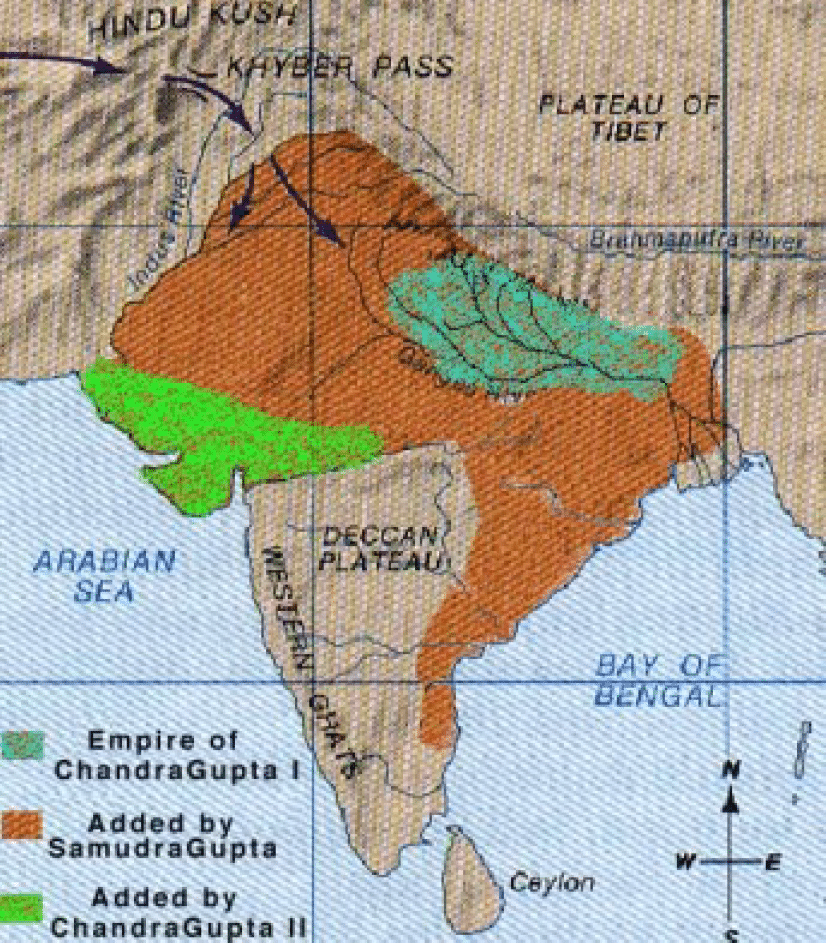
- The empire covered most of northern India and eastern Pakistan, parts of Gujarat and Rajasthan, and what is now eastern India and Bangladesh.
- The Gupta capital was Pataliputra, present-day Patna.
- The Gupta period is referred to as the “Golden Age of India”, marked by extensive inventions and discoveries in science, technology, engineering, art, dialectics, literature, logic, mathematics, astronomy, religion, and philosophy — developments that crystallised the elements of what is generally known as Hindu culture.
- The high points of this cultural creativity are seen in its magnificent architecture, sculptures, and paintings.
- The period produced scholars such as Kalidasa, Aryabhata, Varahamihira, Vishnu Sharma, and Vatsyayana, who made great advancements across many academic fields; both science and political administration reached new heights during the Gupta era.
- Strong trade ties also made the region an important cultural centre, positioning it as a base that would influence nearby kingdoms in Burma, Sri Lanka, and Southeast Asia.
- The earliest available Indian epics are also thought to have been composed around this period.
Origin of the Guptas
Early Kings
- As per inscriptional evidence, the history of the Gupta dynasty begins with its founding by Sri Gupta, around 240 CE, followed by Ghatotkacha, who bore the title Maharaja — a title often held by feudatory chiefs.
- The Poona copper plate inscription of Prabhavati Gupta describes Sri Gupta as the Adhiraja of the Gupta dynasty.
- Gupta records, along with Chinese records furnished by the later Chinese traveller I-Tsing, provide the names of the first three Gupta rulers: Maharaja Sri Gupta, Maharaja Sri Ghatotkacha, and Ghatotkacha’s son, Maharajadhiraja Sri Chandragupta — considered the first Gupta emperor.
Caste
- According to many historians, the Gupta dynasty was a Vaishya dynasty; some scholars argue that the Vaishya Guptas “appeared as a reaction against oppressive rulers.”
- Others base the Vaishya identification on ancient Indian legal texts, which prescribe that a name ending in “Gupta” denotes membership in the Vaishya caste.
- The rise of the Gupta Empire is regarded as one of the most prominent violations of the caste system in ancient India.
- In the Panchobh Copper Plate, some kings bearing the title “Gupta” and related to the imperial dynasty claimed themselves as Vaishyas.
- The Riddhapura copper plate inscription states that Sri Gupta belonged to the Dharan Gotra.
Original Homeland
Theory 1
- The Guptas were initially a family of landowners who acquired political control in the region of Magadha and parts of eastern Uttar Pradesh.
- Uttar Pradesh appears to have been a more important province for the Guptas than Bihar, since early Gupta coins and inscriptions have mainly been found there — suggesting it was the base from which the Guptas expanded in different directions.
- With their probable centre of power at Prayag, they spread into neighbouring regions; the Guptas were possibly feudatories of the Kushanas in Uttar Pradesh, succeeding them without any significant time-lag.
- The Guptas enjoyed certain material advantages: their operations were centred in the fertile land of Madhyadesha, covering Bihar and Uttar Pradesh, allowing them to exploit the iron ores of central India and south Bihar.
- They also benefited from their proximity to regions in north India that carried on silk trade with the Byzantine Empire.
- On account of these favourable factors, the Guptas established their rule over Anuganga (the middle Gangetic basin), Prayag (modern Allahabad), Saket (modern Ayodhya), and Magadha — in time, this kingdom grew into an all-India empire.
Theory 2
- Another, more widely accepted theory — based on both archaeological and written evidence — holds that the Guptas originated from Varendri (now part of Rangpur, Bangladesh).
- The mention of the “Varendra Mrigashihavan Stupa” on a mound in Nepal is strong evidence that the Guptas originated from Bengal; since Sri Gupta built a temple at Mrigashivana, located in Varendri, historians suggest that Varendri may have been under Gupta control at the time they ascended the throne.
- Maharaja Sri Gupta probably ruled a portion of northern or southern Bengal; later, Chandragupta I established his dominion over Magadha through a matrimonial alliance with the Licchavis.
- I-Tsing and other Gupta accounts likewise record that Sri Gupta was the first Gupta ruler, with his ancestral homeland in Varendri, Bengal.
Chandragupta I (319/320–335 CE)
- Chandragupta I (not to be confused with Chandragupta Maurya, 322–298 BCE, founder of the Mauryan Empire) — son of Ghatotkacha and grandson of Sri Gupta — is generally regarded as the founder of the Gupta dynasty.
- By marrying the Lichchhavi princess Kumaradevi of Vaishali, he sought to enhance his prestige, though Vaishali itself does not appear to have formed part of his kingdom.
- As ruler of the Gupta Empire, he is known for forging alliances with many powerful families in the Ganges region.
- His rule remained confined to Magadha and parts of eastern Uttar Pradesh (Saketa and Prayaga).
- He assumed the title of Maharajadhiraja, and his accession around 319–320 CE marked the beginning of the Gupta era.
- Queen Kumaradevi and King Chandragupta I are depicted on a coin issued by their son, Samudragupta (350–380 CE).
Samudragupta (335–380 CE)
- Chandragupta I was succeeded by his son Samudragupta, who became ruler after subduing his rival Kacha, an obscure prince of the dynasty.
- Widely regarded as perhaps the greatest king of the Gupta dynasty, he was a benevolent ruler, a great warrior, and a patron of the arts.
- His name appears in the Javanese text Tantrikamandaka; it is taken to be a title acquired through his conquests, with samudra referring to the “oceans.”
- Harishena, the court poet of Samudragupta, rightly describes him as the hero of a hundred battles, and Vincent Smith called him the “Napoleon of India.”
Sources
(a) Ashokan Pillar at Allahabad (Allahabad Prasasti)
- Samudragupta’s conquests are known from a lengthy eulogy composed by his court poet Harishena and inscribed on an Ashokan pillar at Allahabad, containing a long list of states, kings, and tribes conquered and brought under various degrees of subjugation.
- This pillar — one of the Pillars of Ashoka, emperor of the Maurya dynasty — was at some point moved from its original location and installed within Akbar’s Allahabad Fort.
- While it is one of the few extant pillars carrying Ashokan edicts, it is particularly notable for containing later inscriptions attributed to Samudragupta.
- Also engraved on the stone are inscriptions by the Mughal emperor Jahangir, which record an earlier visit in 1575 by Akbar’s courtier Birbal, on a pilgrimage to the Sangam.
- The Ashokan inscription is in Brahmi script and dated to 232 BCE, while Samudragupta’s eulogy is composed in excellent Sanskrit and written in the more refined Gupta script (a later form of Brahmi) by the poet and minister Harishena.
(b) Eran Stone Inscription of Samudragupta
- Written in Sanskrit and undated, this inscription was found by Alexander Cunningham near the Varaha temple.
- It mentions Samudragupta, who is compared with Dhanada (Kubera) and Antaka (Yama) in joy and wrath respectively, and records the setting up of a temple of Janardana at Airikina to augment his glories.
- Eran is the site of the first reported Sati monument in India, dated to 510 CE.
(c) Coinage
- Much is known about Samudragupta through the coins he issued and his inscriptions — these were of eight different types, all made of pure gold.
- His conquests brought him both the gold and the coin-making expertise gained through his acquaintance with the Kushanas.
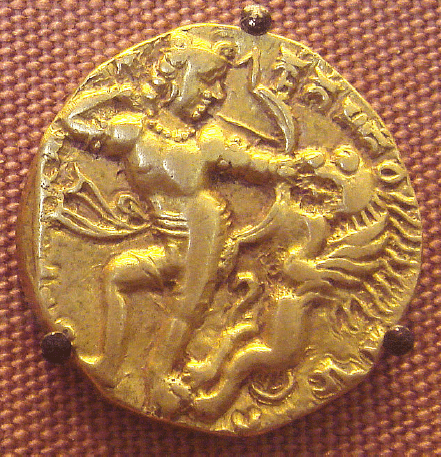
- Samudragupta is considered the father of the Gupta monetary system, having started the minting of several coin types: the Standard Type, Archer Type, Battle Axe Type, Ashvamedha Type, Tiger Slayer Type, King and Queen Type, and Lyre Player Type.
- These coins exhibit fine technical and sculptural finesse. At least three types — Archer, Battle-Axe, and Tiger type — depict Samudragupta in martial armour, bearing epithets such as parakramah (valour), kritanta-parashu (deadly battle-axe), and vyaghra parakramah (valorous tiger), attesting to his skill as a warrior.
- His Ashvamedha type coins commemorate the Ashvamedha sacrifices he performed, signifying his many victories and supremacy.
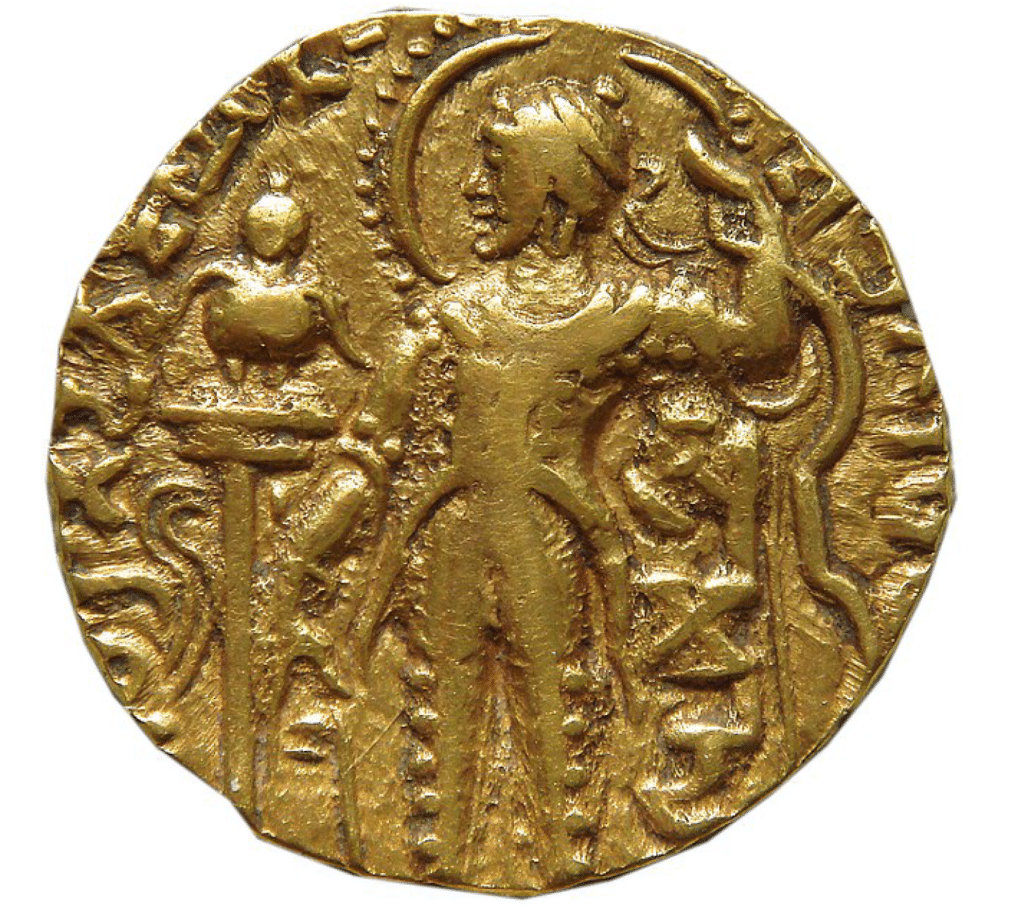
Coin of Samudragupta, with Garuda pillar
Conquest of Samudragupta
- The first category comprised the twelve states of Dakshinapatha, whose kings were captured and then liberated and reinstated: Kosala, Mahakantara, Kaurata, Pishtapura, Kottura, Erandapalli, Kanchi, Avamukta, Vengi, Palakka, Devrashtra, and Kushthalpura.
- The second category comprised the eight kings of Aryavarta, who were violently exterminated — prominent among them were Rudradwa, Ganapatinaga, and Nagasena.
- Eran was annexed into the Gupta empire by Samudragupta as part of his annexation of several Aryavarta kingdoms into Gupta dominion.
- The third category consisted of the rulers of the forest states (atavirarajyas), who were reduced to servitude, along with the chiefs of the five Border States (pratyantas) and nine tribal republics, who were compelled to pay taxes, obey his orders, and offer obeisance.
- The five Border States were Samtata (south-east Bengal), Kamarupa (Assam), Nepala (Nepal), Davaka (Assam), and Kartipura (Kashmir).
- The nine tribal republics were the Malavas, Yaudheyas, Madrakas, Abhiras, Prarjunas, Arjunayanas, Sarakinakas, Kavas, and Kharaparikas.
- The fourth category consisted of the Daivaputra Shahi Shahanushahi (Kushanas), the Shaka, the Murundas, and the dwellers of Sinhala (Ceylon) and other islands, who paid tribute to the king.
Culture and Religion
- Despite his preoccupation with political and military affairs, Samudragupta cultivated music and poetry — some of his gold coins depict him playing the lyre (Veena).
- He was a man of exceptional and varied abilities — warrior, statesman, general, poet, musician, and philanthropist all in one — and coins and inscriptions of the Gupta period attest to his “versatile talents and indefatigable energy.”
- According to the exaggerated portrayal in the Allahabad Prasasti, Samudragupta was “a man of many-sided genius, who put to shame the preceptor of the Lord of Gods, and Tumburu and Narada and others, by his sharp and polished intellect and musical accomplishment.”
- His title of Kaviraj (“King of Poets”) is justified by his poetical compositions, though unfortunately none of these have survived.
- Important scholars present at his court included Harishena, Vasubandhu, and Asanga; he was himself a poet and musician.
- Samudragupta was an upholder of the Brahmanical religion, and in recognition of his services to religion, the Allahabad inscription bestows on him the qualifying title of “Dharma-prachir bandhu.”
- Yet he remained tolerant of other faiths — his patronage of the Buddhist scholar Vasubandhu, and his acceptance of a request from Meghavarman, ruler of Sri Lanka (Ceylon), to build a Buddhist monastery at Bodh Gaya (later called the Mahabodhi Sangharama by the Chinese traveller Xuanzang), amply demonstrate his respect for other religions.
- His Ashvamedha-type coins, together with other coins bearing the figures of Lakshmi and Ganga with her vahana (vehicle) makara (crocodile), testify to his faith in Brahmanical religion.
- Samudragupta had imbibed the true spirit of religion, for which he is described as “Anukampavan” (full of compassion) in the Allahabad inscription, and as “the giver of many hundreds of thousands of cows.”
Ramagupta
- Ramagupta was initially known only from traditional narratives — such as the Sanskrit play Devichandragupta by Vishakhadatta — and was not supported by any contemporary epigraphical evidence.
- Later, however, three Durjanpur inscriptions on Jaina tirthankara images, discovered near Vidisha, mention him as Maharajadhiraja.
- A large number of his copper coins have also been found in the Eran-Vidisha region, classified into five distinct types — including the Garuda, Garudadhvaja, lion, and border-legend types — with Brahmi legends written in the early Gupta style.
- Ramagupta may have been the elder son and immediate successor of Samudragupta, succeeded in turn by his younger brother, Chandragupta II.
- In Devichandragupta, Ramagupta is portrayed as a weak and impotent king, afraid and incapable of warfare.
- He married Dhruvaswamini (Dhruvadevi), who had been betrothed to his brother Chandragupta II by force; he thus became King of the Gupta empire, even though Chandragupta had been declared heir apparent after Samudragupta’s death.
- According to tradition, Ramagupta attempted to expand his kingdom by attacking the Sakas in Gujarat, but the campaign turned disastrous and the Gupta army was trapped.
- The Saka king, Rudrasimha III, demanded that Ramagupta hand over his wife Dhruvaswamini in exchange for peace — a demand the weak king was inclined to accept.
- This infuriated his younger brother Chandragupta, who disguised himself as the queen, went to the Saka chief, and killed him — then murdered his own brother Ramagupta and married Dhruvaswamini himself.
- Historians remain uncertain of the liberties Vishakhadatta took with these events, but Dhruvadevi was indeed Chandragupta II’s chief queen, as confirmed by the Vaisali Terracotta Seal, which calls her “Mahadevi” Dhruvasvamini.
- The Bilsad Pillar Inscription of their son, Kumaragupta I (414–455 CE), likewise refers to her as “Mahadevi Dhruvadevi.”
- The official Gupta records, however, make no mention of Ramagupta, tracing the succession directly from Samudragupta to Chandragupta II.
Chandragupta II “Vikramaditya” (380–412 CE)
- Samudragupta was succeeded by his younger son Chandragupta II — though according to some scholars, Samudragupta, who died shortly before 380 CE, was first succeeded by his elder son Ramagupta (as discussed above).
- During his rule, the Gupta Empire reached its zenith: art, architecture, and sculpture flourished, and the cultural development of ancient India reached its climax — this period of prominence is often called the “Golden Age of India.”
Marriage Alliance and Conquests
- The reign of Chandragupta II marked the high watermark of the Gupta Empire, which he extended through marriage alliances and conquests.
- According to the Allahabad Pillar inscription and Devichandraguptam, Chandragupta II married Kuberanaga of the Naga family — a powerful ruling clan, and this alliance helped expand his empire.
- The marriage of his daughter Prabhavati (by Kuberanaga) to the Vakataka king Rudrasena II helped him establish political influence in the Deccan.
- Her husband died prematurely in 385 CE after a short reign, following which Queen Prabhavatigupta (385–405 CE) ruled the Vakataka kingdom as regent for her two sons — during this twenty-year period, the Vakataka realm was practically a part of the Gupta empire.
- His greatest victory was over the Shaka-Kshatrapa dynasty, whose kingdom in western Malwa and Gujarat he annexed by defeating their last ruler, Rudrasimha III.
- The geographical position of the Vakataka kingdom allowed Chandragupta II to finally defeat the Western Kshatrapas; many historians refer to this period as the Vakataka-Gupta Age.
- Chandragupta II adopted the title Vikramaditya (“Sun of Power”), first used by an earlier Ujjain ruler, King Vikramaditya, who founded the lunar Vikram Samvat (Bikram Samwat) calendar following his victory over the Sakas in 56 BCE.
- This title was later also adopted by the 16th-century Hindu king Samrat Hem Chandra Vikramaditya.
- His conquest gave Chandragupta the western sea coast, famous for trade and commerce, contributing to the prosperity of Malwa and its chief city, Ujjain — which appears to have become his second capital, though Pataliputra remained the official capital.
Chandragupta II’s Campaigns Against Foreign Tribes
- The 4th-century Sanskrit poet Kalidasa credits Chandragupta Vikramaditya with conquering about twenty-one kingdoms.
- After completing his campaigns in eastern and western India, Vikramaditya proceeded northwards, subjugating the Parasikas, then the Hunas and Kambojas, located in the western and eastern Oxus valleys respectively.
- He then crossed the Himalayas, reducing the Kinnaras, Kiratas, and other groups.
- The Brihatkathamanjari of the Kashmiri writer Kshemendra states that Vikramaditya had “unburdened the sacred earth of the barbarians like the Sakas, Mlecchas, Kambojas, Yavanas, Tusharas, Parasikas, Hunas,” etc., “by annihilating these sinful Mlecchas completely.”
- After defeating the Sakas, he assumed the title “sakari.”
Iron Pillar at Mehrauli
- “King Chandra,” whose exploits are recorded in the Mehrauli Iron Pillar Inscription (located in the Qutub Minar complex, Delhi), is identified by many scholars with Chandragupta II.
- The inscription states that Chandra crossed the Sindhu region of seven rivers and defeated the Valhikas (identified with Bactria); it also mentions Chandragupta’s victory over enemies from Vanga (Bengal).
- The pillar bears an inscription stating it was erected as a flagstaff in honour of Vishnu, in memory of Chandragupta II.
- A derivation of Natya-darpana by Vishakhadatta states the pillar was erected by Chandragupta II himself after defeating the Vahilakas, as a memorial to his victory.
- The pillar also highlights ancient India’s achievements in metallurgy — made of 98% wrought iron, it has stood for more than 1,600 years without rusting or decomposing.
- Chandragupta II controlled a vast empire, stretching from the mouth of the Ganges to the mouth of the Indus, and from present-day north Pakistan down to the mouth of the Narmada.
- The large number of beautiful gold coins issued by the Gupta dynasty testify to the imperial grandeur of the age; Chandragupta II also began producing silver coins in the Saka tradition.
Coinage
- Chandragupta II continued issuing most of the gold coin types introduced by his father, Samudragupta, such as the Sceptre type (rare for Chandragupta II), the Archer type, and the Tiger Slayer type.
- He also introduced several new types, such as the Horseman type and Lion-Slayer type, both later used by his son Kumaragupta I.
- Chandragupta II was the first Gupta king to issue silver coins, intended to replace the silver coinage of the Western Kshatrapas after their defeat, and modelled on Kshatrapa coinage.
- The main change was replacing the Kshatrapa dynastic symbol (the three-arched hill) with the Gupta dynastic symbol — the mythic eagle Garuda.
- He further issued lead coins based on Kshatrapa prototypes, and rare copper coins, likely inspired by coins of another defeated tribe, the Nagas.
Religion
- From Chandragupta II onward, Gupta kings are known as Parama Bhagavatas or Bhagavata Vaishnavas.
- The Bhagavata Purana contains the fully developed tenets and philosophy of the Bhagavata tradition, in which Krishna fuses with Vasudeva, transcending the Vedic Vishnu and cosmic Hari to become the ultimate object of bhakti.
Nine Gems
- Indian tradition holds that Dhanwantari, Kshapanaka, Amarasimha, Shanku, Ghatakarpara, Kalidasa, Vetalbhatt (or Vetalabhatta), Vararuchi, and Varahamihira were part of Vikramaditya’s court — the king commissioned these nine men of letters, known as the “nava-ratna” (nine gems), to serve at his court.
- Kalidasa: author of the great epic Shakuntala; a great poet, dramatist, and the most prominent scholar of Sanskrit.
- Amarasimha: author of the Sanskrit Amarkosh.
- Kshapanaka: a prominent astrologer who achieved mastery in astrology.
- Dhanvantari: a physician who achieved mastery in the science of medicine, expert in diagnosis and treatment.
- Vararuchi: an expert linguist and grammarian.
- Varahamihira: author of the world-famous Brihatsamhita and a master of astrology, who is said to have predicted the death of Vikramaditya’s son.
- Ghatakarpara: an expert in sculpture and architecture.
- Shanku: an expert in geography — a name still well known in the field today.
- Vetalabhatta: an expert in black magic and tantric sciences; said to have been a Maga Brahmin known for composing the sixteen-stanza “Niti-pradipa” (“the lamp of conduct”) in tribute to Vikramaditya.
Visit of Fa-Hien
- Fa-Hien, a Chinese Buddhist, was one of the pilgrims who visited India in search of original Buddhist texts, during the reign of the Gupta emperor Chandragupta II — though he never names any king in his account.
- He set out from China in 399 CE and reached India in 405 CE, said to have walked all the way across icy deserts and rugged mountain passes; he entered India from the north-west and reached Pataliputra, later taking back Buddhist texts and images.
- During his stay in India, until 411 CE, he undertook pilgrimages to Mathura, Kanauj, Kapilavastu, Lumbini, Kushinagar, Vaishali, Pataliputra, Kashi, and Rajgriha, making careful observations on the empire’s conditions.
- He spent the rest of his life translating and editing the scriptures he had collected. Faxian wrote a book on his travels, filled with accounts of early Buddhism and the geography and history of numerous countries along the Silk Roads as they were at the turn of the 5th century CE.

Fa-Hien’s Account of India’s Political, Religious, Social, and Economic Conditions
- His travelogues give a detailed impression of Chandragupta’s empire, reflecting its political, religious, social, and economic aspects.
- (Yuan Chwang/Hiuen Tsang, another Chinese Buddhist traveller, visited India around 630–644 CE, during the reign of King Harshavardhana, similarly seeking Buddhist texts and sacred sites.)
- Fa-Hien noted the peacefulness of India, the rarity of serious crime, and the mildness of the administration — he stated it was possible to travel across the country without molestation and without passports.
- On social customs, he noted that respectable persons were vegetarians, with meat-eating confined to lower castes and untouchables; most citizens avoided onions, garlic, meat, and wine. (Yuan Chwang, aware of the four classes and several mixed classes, showed no clear knowledge of caste in its modern form, and mentioned both vegetarian and non-vegetarian practices.)
- He found Buddhism still flourishing, though theistic Hinduism was widespread, having largely replaced older sacrificial Brahminism.
- In the best days of the Gupta Empire, Indian culture reached a perfection it was never to attain again; humanitarian ideas, likely encouraged by Buddhism, moderated the fierce punishments of earlier ages.
- Fa-Hien noted that the death penalty was not imposed in north India — most crimes were punished by fines, and only serious revolt by amputation of a hand; executions were rare. (Yuan Chwang, two centuries later, reported that prisoners under Harsha were not executed but left to languish in dungeons — punishments having grown milder still.)
- According to Fa-Hien, the Shudras lived outside town limits, announcing their entry with the noise of a stick; they worked as butchers, hunters, and fishermen (a practice Yuan Chwang also described).
- Fa-Hien noted that government revenue was based mainly on land taxes amounting to one-sixth of total produce, with no poll tax or additional land tax.
- He wrote: “The people were rich and prosperous and seemed to emulate each other in the practice of virtue. Charitable institutions were numerous, and rest houses for travellers were provided on the highway. The capital possessed an excellent hospital.”
- Government officials received fixed incomes with no public contribution required; donations were common, and Fa-Hien noted free hospitals maintained through the charity of pious citizens.
- (Yuan Chwang similarly reported that Nalanda was supported by the revenues of a hundred villages and the alms of patrons, including Harsha himself, providing free education to over 10,000 students.)
- Fa-Hien was struck by Pataliputra and the great palace of Ashoka; Yuan Chwang, by contrast, noted that Pataliputra was no longer the chief city of north India, its place having been taken by Kannauj.
- Both travellers agreed that the economy was based on agriculture, though only Yuan Chwang described the varna system and marriage customs in detail.
- Fa-Hien gave a detailed account of Buddhist pilgrimage sites, noting the division of Buddhism into Mahayana and Hinayana.
- He observed twenty Buddhist viharas in Mathura, but found conditions deteriorating in Kapilavastu, Gaya, and Kushinagar, indicating the weakening of Buddhism; he visited two viharas near the Ashokan stupa at Pataliputra, one housing Mahayana monks and the other Hinayana monks.
- The ruler of Madhya Pradesh was a worshipper of Vishnu; relations between Hindus and Buddhists were, according to Fa-Hien, cordial and peaceful, reflecting the religious tolerance of the society. (Yuan Chwang similarly described religious conditions, noting the clear decline of Buddhism even as hundreds of monks continued to reside in the country.)
- Fa-Hien also mentioned Jainism, though Yuan Chwang’s account makes no reference to it; both mentioned Shaivism and Vaishnavism.
- Overall, Fa-Hien was less observant and informative on social, economic, and political conditions than Yuan Chwang, who fully described the reign of Harshavardhana — while Fa-Hien never mentions Chandragupta Vikramaditya by name.
- From his accounts, the Gupta Empire appears to have been a prosperous period, until the Rome-China trade axis was disrupted by the fall of the Han dynasty — until then, the Guptas had indeed prospered. His writings remain one of the most important sources for the history of this period.
Kumaragupta I (412–454 CE)
- Chandragupta II died around 413 CE and was succeeded by his son Kumaragupta, born of Mahadevi Dhruvasvamini.
- Kumaragupta is also known as Shakraditya and Mahendraditya; he erected an iron pillar, today visible at the Qutb complex in Mehrauli.
- The Bilsad inscription is the oldest record of his reign, dated to Gupta year 96, corresponding to 415 CE.
- An inscription on a yaksha figure from Mathura, dating to his reign, is dated 432 CE; a pedestal (without any royal name, but presumably from his reign) is dated 442 CE.
- He maintained intact the vast empire built by his two predecessors, though the final years of his reign were difficult.
- The empire was threatened by the rebellion of the Pushyamitras (a central Indian tribe) and an invasion of the White Huns — Kumaragupta successfully defeated both threats and performed the Ashvamedha (horse sacrifice) to celebrate his victory.
- The Tumain inscription mentions a prince, Ghatotkachagupta, appointed as governor of Airikina (Eran) by Kumaragupta I.
- This region likely served as a buffer state between the Huns and the Guptas as the Huns extended their kingdom eastward, marking it as their easternmost boundary.
- He issued new coins bearing images of his namesake, Lord Kumara.
- A silver coin of Kumaragupta (414–455 CE) shows, on the obverse, a bust of the king wearing a cap decorated with crescents (derived from Western Satrap coin designs), and on the reverse, a Garuda bird, encircled by a Brahmi legend reading “Most devout King of Kings Kumaragupta Mahendraditya.”
Skandagupta (454–467 CE)
- Skandagupta, who succeeded Kumaragupta I, was perhaps the last powerful Gupta monarch.
- To consolidate his position, he had to fight the Pushyamitras, defeating that threat before facing an invasion of the Hephthalites, or “White Huns,” from across the north-western frontier.
- Skandagupta crushed the Huna invasion in 455 CE, keeping them at bay for a time — this heroic feat entitled him, like Chandragupta II, to assume the title Vikramaditya; he also assumed the title Kramaditya.
- These prolonged wars appear to have adversely affected the empire’s economy, reflected in Skandagupta’s debased gold coinage; he also appears to have been the last Gupta ruler to mint silver coins in western India.
- Skandagupta’s name appears in the Javanese text Tantrikamandaka.
- The Junagarh inscription of his reign records the public works undertaken during his rule.
- The Sudarshana lake (originally built during Mauryan times) burst due to excessive rains, and was repaired early in his reign by his governor Parnadatta and Parnadatta’s son Chakrapalita.

The Junagadh rock contains inscriptions of Ashoka (fourteen of the Edicts of Ashoka), Rudradaman I and Skandagupta.
- The Junagadh rock bears inscriptions of Ashoka (fourteen of the Edicts of Ashoka), Rudradaman I, and Skandagupta.
- The last known date of Skandagupta is 467 CE, based on his silver coins.
Coinage
- Skandagupta issued four types of gold coins: Archer type, King and Queen type, Chhatra type, and Horseman type.
- His silver coins were of four types: Garuda type, Bull type, Altar type, and Madhyadesha type.
- His initial gold coinage followed the old weight standard used by his father, Kumaragupta, of approximately 8.4 grams — this initial coinage is quite scarce.
- At some point in his reign, Skandagupta revalued his currency, switching from the old dinar standard to a new suvarna standard, weighing approximately 9.2 grams.
- These later coins were exclusively of the Archer type, a standard and type followed by all subsequent Gupta rulers.
Huna Invasion and the Hephthalite Empire in India
- The Hunas were Iranian-speaking Xionite tribes, forming a nomadic confederation in Central Asia, who entered India via the Khyber Pass at the end of the 5th or early 6th century, and were ultimately defeated by the Gupta Empire and the Indian king Yasodharman.
- At its farthest extent in India, the Huna empire covered territory up to Malwa in central India.
- The Central Asian Xionites consisted of four hordes across four cardinal directions: the Black Huns (north), the Red Huns (south), the Celestial Huns (east), and the White Huns, or Hephthalites (west).
- Skandagupta is recorded as having repelled a White Huna invasion in 455 CE, though the Hunas continued to press on South Asia’s north-western frontier (present-day Pakistan), eventually breaking into northern India by the end of the 5th century — hastening the disintegration of the Gupta Empire.
- The initial Huna (Alxon) raids on Gandhara occurred in the late 5th and early 6th century, following the death of Skandagupta (455–470 CE). Chinese and Persian records suggest the Hunas conquered Gandhara from the Kidarites (Ki-to-lo) around 475 CE.
(a) Toramana
- Toramana, a ruler of the Hephthalite Empire, established control over Gandhara and western Punjab, consolidating Hephthalite power there before conquering northern and central India, including Eran in Madhya Pradesh; his territory also extended into Uttar Pradesh, Rajasthan, and Kashmir.
- He was defeated by the Indian emperor Bhanugupta of the Gupta Empire in 510 CE.
- Toramana is known from the Rajatarangini (by the 12th-century Kashmiri Brahmin Kalhana), coins, and inscriptions, including the Gwalior inscription, written in Sanskrit.
- He was succeeded by his son Mihirakula in 520 CE.
(b) Mihirakula
- Mihirakula was one of the most important Hephthalite emperors, ruling territory spanning present-day Afghanistan, Pakistan, and northern and central India, with his capital at Sakala (modern Sialkot, in Pakistani Punjab).
- The Guptas continued to resist the Hunas, allying with neighbouring Indian rulers.
- The Gwalior inscription, issued in Mihirakula’s 15th regnal year, shows his territory extending at least to Gwalior in Madhya Pradesh.
- Mihirakula suffered defeat at the hands of the Aulikara king Yasodharman of Malwa in 528 CE, along with the Gupta emperor Narasimhagupta Baladitya, who had previously paid him tribute.
- According to Huen Tsang, after this defeat, Mihirakula was driven off the plains of northern India by 542 CE, taking refuge in Kashmir, where the local king received him with honour.
- After a few years, Mihirakula incited a revolt against his host, seized power in Kashmir, and then invaded Gandhara, killing many inhabitants and destroying its Buddhist shrines. He claimed to be a worshipper of Shiva.
- Twin monolithic pillars at Sondani, in Mandsaur district, were erected by Yasodharman to commemorate his victory.
- This triumph is recorded in the phrase “Ajay Jarto Hunan,” referring to the defeat of the Huns by the Jats under Yasodharman’s leadership.


- Three inscriptions of Yasodharman have been found at Mandsaur, one dated to samvat 589 (532 CE); Yasodharman had also acquired the title Vikramaditya.
- The Kashmiri poet Kalhana mentions three separate Kalidasas; the second, who wrote Raguvansha and Jyotirvidabharan, served as court poet to Yasodharman. Some analysts suggest this Kalidasa referenced Yasodharman’s victories in the phrase “Raghu digvijaya.”
- The Bijayagadh Stone Pillar Inscription of Vishnuvardhana (Yasodharman’s son), locally known as Bhim ki Lat, was erected at Bayana in Bharatpur district, and also mentions Yasodharman.
(c) Later Hunas
- After the end of the 6th century, little is recorded in India about the Huna. They may have formed matrimonial alliances with the Gurjars, with some historians suggesting their assimilation into the dominant Gurjar community — Huna remains one minor gotra among Gurjars today.
- In north-western India, the Rajputs are said to have formed “as a result of the merging of the Hephthalites and the Gujars with population from north-western India,” though this remains disputed.
Decline of the Gupta Empire
- Skandagupta died around 467 CE, and the line of succession thereafter is highly uncertain.
- He was followed by a series of weak rulers — Purugupta (467–473), Kumaragupta II (473–476), Budhagupta (476–495?), Narasimhagupta Baladitya, Kumaragupta III, Vishnugupta, Vainyagupta, and Bhanugupta — whose realm in the plains of northern India came under continuous attack from the Hunas.
- In the 480s, the Hephthalites broke through Gupta defences in the northwest, and much of the empire’s north-western territory was overrun by the Huns by 500 CE.
- The empire disintegrated further under the attacks of Toramana and his successor Mihirakula; inscriptions suggest the Guptas, though greatly diminished, continued to resist — the Hun invader Toramana was defeated by Bhanugupta in 510 CE.
- The Huns were ultimately defeated and driven out of India in 528 CE by a coalition of the Gupta emperor Narasimhagupta and Yasodharman of Malwa.
- The Guptas continued to rule until around 550 CE, though by then their power had become largely insignificant.
Purugupta
- No inscription of Purugupta has been found so far; he is known through the Bhitari silver-copper seal of his grandson Kumaragupta III, and the Nalanda clay sealings of his sons Narasimhagupta and Budhagupta, and his grandson Kumaragupta III.
- The Sarnath Buddha image inscription indicates that he was succeeded by Kumaragupta II.
Budhagupta
- Budhagupta was the successor of Kumaragupta II and predecessor of Narasimhagupta Baladitya; he maintained close ties with the rulers of the Kannauj kingdom, together seeking to keep the Huns out of the fertile plains of northern India.
- The Eran stone pillar inscription, erected by two brothers, Matrivishnu and Dhanyavishnu, names Budhagupta as their emperor (Bhupati).
- This sandstone pillar at Eran stands 43 feet total, including 5-foot statues at its top.
- The Varaha Temple inscription at Eran, inscribed on the neck of the boar in 8 lines of Sanskrit in Brahmi script and dated to the reign of the Hun king Toramana, records the building of the temple by Dhanyavishnu (younger brother of the deceased Maharaja Matrivishnu) in which the current Varaha image stands. This Varaha would originally have stood beneath a now-collapsed roofed enclosure.
- The Eran stone pillar inscription, erected by two brothers, Matrivishnu and Dhanyavishnu, names Budhagupta as their emperor (Bhupati).

- The Buddha image inscription found at Mathura, dated to Budhagupta’s reign, shows that his authority extended to Mathura in the north.

Vishnugupta and Vainyagupta
- From a fragment of Vishnugupta’s clay sealing, discovered at Nalanda during the excavations of 1927–28, it is known that Vishnugupta was the son of Kumaragupta III and grandson of Narasimhagupta Baladitya.
- Vainyagupta is likewise known from a fragmentary clay sealing at Nalanda and the Gunaighar copper plate inscription, dated to Gupta era 188 (507 CE).
- The Nalanda sealing describes him as Maharajadhiraja and a paramabhagavata (devout worshipper of Vishnu), while the Gunaighar inscription describes him as Maharaja and a “Bhagavan Mahadeva padanudhyato” (devotee of Shiva).
Bhanugupta
- A stone pillar inscription of Bhanugupta, written in Sanskrit and dated to year 191 of the Gupta Era (510–11 CE), was found on a pillar later converted into a Shivalinga, discovered by Cunningham.
- The inscription does not name any reigning king, but mentions Bhanugupta, who may not have been sovereign but a member of the Gupta royal family.
- It records that Bhanugupta’s chieftain Goparaja came to Eran and fought a battle with the Maitras, in which Goparaja was killed; his wife accompanied him in death by cremating herself on his funeral pyre near the site of the pillar — probably the earliest recorded instance of the Sati tradition.
- Various Sati pillars, ranging from the Early Medieval to the Modern period, have also been found at Eran, all using the Saka Samvat era.
- A prayer to God typically opens these inscriptions, followed by the Samvat, date, and the names of the deceased and his wife who became Sati alongside him.
Causes of Decline of the Guptas
- Huna invasions were the principal cause of the decline of Gupta power.
- Other contributing factors included competition from the Vakatakas and the rise of Yasodharman in Malwa, who in 532 CE erected pillars of victory commemorating his conquest of almost all of northern India — though his rule was short-lived, it dealt a severe blow to the Gupta Empire.
- Internal attacks by the Pushyamitras — identified with the Patumitras and Durmitras of the Puranas — also caused significant destabilisation.
- Another cause was the succession of weak rulers following Skandagupta, compounded by underlying administrative weakness: the Guptas made little effort to impose effective control over their regions, their authority holding only as long as powerful rulers occupied the throne.
- Crises of succession or weak monarchs encouraged local chiefs to declare independence, leading to constant military preparedness that crippled the empire’s financial resources.
- Though Skandagupta repelled the early Huna attacks, the ensuing struggle disrupted north-western India’s international trade, eroding one of the Guptas’ most important financial bases.
- By the end of the 5th and beginning of the 6th century CE, taking advantage of this chaos, many regional powers asserted their independence.
- Some historians also point to the beginning of feudalisation of polity, economy, and society — with land grants first to religious and later to secular beneficiaries resulting in loss of revenue and diminished administrative control, while the growing importance of Samantas weakened central authority.
- Another suggested cause is the Gupta rulers’ tilt toward Buddhist asceticism during the reigns of Kumaragupta and Budhagupta, evidenced by the founding of Nalanda University and their patronage of Buddhist learning — seen by some as reflecting an inclination toward non-violence.
- However, this patronage of Buddhist institutions did not mean the Guptas renounced violence in defending their territories, nor is there conclusive evidence that they abandoned royal duties to live as ascetics.
- Ultimately, divisions within the imperial family, the concentration of power among local chiefs and governors, a loose administrative structure, declining foreign trade, and the growing practice of land grants for religious and other purposes, together contributed to the disintegration of the Gupta Empire.
Gupta Administration
- Unlike the Mauryas, the Guptas adopted grandiose titles such as Parameshvara Maharajadhiraja and Paramabhattaraka, implying the existence of lesser kings holding considerable authority within the empire.
- The Guptas also claimed super-human qualities through additional epithets, elevating themselves almost to the level of gods — in the Allahabad Pillar Inscription, Samudragupta is referred to as a god dwelling on earth.
- Kingship was hereditary, though royal power was limited by the absence of a firm practice of primogeniture.
(1) Council of Ministers and Other Officials
- The Guptas continued the traditional machinery of bureaucratic administration, though it was less elaborate than that of the Mauryas.
- The Mantri (chief minister) headed civil administration; other high imperial officers included the Mahabaladhikarta (commander-in-chief), the Mahadandanayaka (general), and the Mahapratihara (chief of the palace guards).
- The Mahabaladhikarta — probably corresponding to the Mahasenapati of the Satavahana kings — controlled subordinate officers such as the Mahashvapati (chief of cavalry), Mahapilupati (officer in charge of elephants), Senapati, and Baladhikarta.
- A high-ranking official appearing for the first time in Gupta records was the Sandhivigrahika (foreign minister).
- The link between central and provincial administration was furnished by the class of officers called Kumaramatyas and Ayuktas.
- The Kumaramatyas were high officers and personal staff of the emperor, appointed in the home provinces and possibly paid in cash; recruitment was not confined to the upper varnas, and offices tended to become combined and hereditary — a trend that naturally weakened royal control.
- The Ayuktas were entrusted with restoring the wealth of conquered kings, and were sometimes placed in charge of districts or metropolitan towns.
(2) Provinces, Districts, and Villages
- Epigraphical records of the Gupta empire reveal a clear hierarchy of administrative divisions, from the empire down to the village.
- The empire itself was known by various names — Rajya, Rashtra, Desha, Mandala, Prithvi, and Avani — and was divided into 26 provinces, styled as Bhukti, Pradesha, and Bhoga.
- These provincial divisions, or bhuktis, were governed by Uparikas, directly appointed by the king.
- The province was often further divided into districts (Vishayas), ruled by Kumaramatyas, Ayuktas, or Vishayapatis, appointed by the provincial governors.
- Gupta inscriptions from Bengal show that the Municipal board (Adhisthanadhikarana) included representatives from major local communities: (a) the Nagarasresthi (guild president), (b) the chief merchant, Sarthavaha, (c) the chief artisan, Prathama Kulika, and (d) the chief scribe, Prathama Kayastha.
- Town administration also included the Pustapalas, officials responsible for managing and keeping records, akin to a city mayor known as Purapala.
- Gupta inscriptions from Bengal show that the Municipal board (Adhisthanadhikarana) included representatives from major local communities: (a) the Nagarasresthi (guild president), (b) the chief merchant, Sarthavaha, (c) the chief artisan, Prathama Kulika, and (d) the chief scribe, Prathama Kayastha.
- The village formed the lowest unit of administration.
- In eastern India, vishayas were divided into vithis, which were further divided into villages; the Gramapati or Gramadhyaksha served as village headman.
- Gupta inscriptions from north Bengal describe intermediate units such as the Rural Board (Asthakuladhikarana), comprising village elders (Mahattaras), the village headman (Gramika), and householders (Kutumbins).
- In the absence of close state supervision, village affairs were managed by leading local elements — no land transactions could proceed without their consent, and village disputes were settled with the help of the Grama-vriddhas or Mahattaras (village elders).
(3) Army
- The best historical accounts of the Gupta military come not from Indian sources but from Chinese and Western observers; a contemporary Indian text, the Siva-Dhanur-veda, regarded as a military classic of the time, offers additional insight.
- The numerical strength of the Gupta army remains unknown. Unlike the Mauryas, the Guptas do not appear to have maintained a large, centrally organised army — troops supplied by feudatories likely constituted the bulk of Gupta military strength, and the Guptas did not enjoy a monopoly over elephants and horses.
- This dependence on feudatories, who wielded considerable authority especially at the empire’s fringes, saw chariots recede and cavalry come to the forefront.
- Despite the prominence of horse archers among their Scythian, Parthian, and Hephthalite (Huna) enemies, the Guptas showed little inclination toward this tactic — relying instead on better discipline, with commanders like Samudragupta and Chandragupta II likely understanding the need for combined-arms tactics and sound logistics.
- Gupta military success likely stemmed from the coordinated use of elephants, armoured cavalry, and foot archers.
- The Guptas relied heavily on infantry archers, with the Indian longbow — reputed for its range and penetrating power — providing an effective counter to invading horse archers; iron shafts were used against armoured elephants, and fire arrows formed part of the bowmen’s arsenal.
- India held a strong historical reputation for its steel weapons, including the steel bow; archers were typically protected by infantry equipped with shields, javelins, and longswords.

- The Guptas also maintained a navy, allowing them to control regional waters.
- The eventual collapse of the Gupta Empire under the Huna onslaught was not directly due to inherent weaknesses in the Gupta army — which had, after all, initially defeated the Hunas under Skandagupta — but more likely stemmed from internal dissolution, which sapped the empire’s ability to resist foreign invasion.
- The Mahabaladhikarta (commander-in-chief) oversaw the subordinate officers described above; the army was paid in cash, with its supply needs managed by an officer-in-charge of stores called the Ranabhandagarika.
(4) Revenue Administration
- Land revenue, alongside fines, formed the main source of state income.
- In Samudragupta’s time, an officer named Gopasramin served as Akshapataladhikrita, responsible for entering matters into accounts registers, recovering royal dues, checking embezzlement, and collecting fines.
- Another prominent official was the Pustapala (record-keeper); the Gupta kings maintained a regular department for the proper survey and measurement of land, as well as for the collection of land revenue.
Gupta Economy
Agriculture
- Agricultural crops formed the main resource base of society, and the bulk of state revenue derived from agriculture.
- Many scholars argue that the state was the exclusive owner of land — the most decisive evidence for this lies in the Paharpur copper plate inscription of Budhagupta, which suggests that while land was, in practice, held by peasants, the king claimed its theoretical ownership.
- Various types of land are mentioned in the inscriptions:
- Kshetra — land under cultivation
- Khila — uncultivable land
- Aprahata — forest land
- Gopata Sarah — pasture land
- Vasti — habitable land
- Different regions used different land measures, such as Nivartana, Kulyavapa, and Dronavapa.
- The importance of irrigation to agriculture was recognised in India from the earliest times.
- According to the Narada Smriti, there were two kinds of dykes: Bardhya, which protected fields from floods, and Khaya, which served irrigation.
- Canals meant to prevent flooding were referred to by Amarasimha as jalanirgamah, while tanks were variously called vapi, tadaga, or dirghika, depending on size.
- Another irrigation method was the use of the ghati-yantra or araghatta (water-wheel).
Land Grants
- Sources from the Gupta period suggest important changes taking place in agrarian society — feudal development surfaced under the Guptas through the grant of fiscal and administrative concessions to priests and administrators.
- This practice, begun in the Deccan under the Satavahanas, became a regular affair in Gupta times.
- Religious functionaries were granted land free of tax, in perpetuity, and authorised to collect from the peasantry all the taxes that would otherwise have gone to the emperor. Religious grants were of two types:
- Agrahara grants, meant for Brahmanas — perpetual, hereditary, and tax-free, accompanied by the assignment of all land revenue.
- Devagrahara grants, made to secular parties such as writers and merchants, for the repair and worship of temples.
- Secular grants of this kind are evident from a grant by the Uccakalpa dynasty, under which two villages were bestowed in perpetuity, with fiscal and administrative rights, upon a person named Pulindabhatta.
- Epigraphic evidence of land grants to officers for administrative or military services is lacking, though such grants cannot be ruled out.
- Certain administrative designations, such as bhagika and bhogapalika, suggest that some officials may have been remunerated through land grants.
Position of Peasantry
- Land grants paved the way for feudal development in India — several inscriptions refer to the emergence of serfdom, whereby peasants remained attached to their land even when it was granted away.
- In some parts of the country, the position of independent peasants was undermined, reducing them to serfs or semi-serfs.
- This repression was compounded by the right of subinfeudation granted to recipients of land grants, who could assign the donated land to tenants on their own terms — including the right to evict them — reducing permanent tenants to the position of tenants-at-will.
- The position of peasants was further undermined by the imposition of forced labour (Vishti) and several new levies and taxes from the Gupta period onward.
Crafts Production and Industry
- Craft production covered a wide range of items. Texts such as the Amarakosha of Amarasimha and the Brihat Samhita — generally dated to this period — list many items, provide their Sanskrit names, and mention the categories of craftsmen who produced them.
- Sites such as Taxila, Ahichchhatra, Mathura, Rajghat, Kausambi, and Pataliputra have yielded craft products including earthenware, terracottas, beads of various stones, glass objects, and metal items.
- Different varieties of silk cloth, called Kshauma and Pattavastra, are mentioned in period texts.
- A 5th-century inscription from Mandasor, in western Malwa, refers to a guild of silk weavers who migrated from south Gujarat and settled in Malwa — indicating a decline in trade and commerce.
- Among the industries flourishing in the Gupta period, mining and metallurgy occupied the top position.
- The Amarakosha provides a comprehensive list of metals; of these, iron was the most useful, and blacksmiths ranked just below peasants in rural society.
- The most eloquent evidence of the advanced state of Gupta metallurgy is the Mehrauli iron pillar of King Chandra, usually identified with Chandragupta II.
- A significant metallurgical development of the period was the manufacture of seals and statues, particularly of the Buddha.
- Contemporary literature also attests to the widespread use of jewellery.
- Ivory work, along with stone cutting and carving, remained highly valued, sculpture being especially favoured; the cutting, polishing, and preparation of precious stones — jasper, agate, carnelian, quartz, and lapis lazuli — was also linked to foreign trade.
- Pottery remained a basic part of industrial production, though the elegant black-polished ware of earlier periods fell out of use, replaced by an ordinary red ware with a brownish slip, produced in large quantities — some pieces enhanced with mica in the clay to achieve a metallic finish.
Trade and Commerce
- There was little material change in trade routes, commercial organisation, currency systems, or trade practices during this period.
- As before, two types of merchants are recorded: the Sresthi, usually settled in one place and enjoying an eminent position, and the Sarthavaha, a caravan trader.
- Internal trade covered everyday commodities sold chiefly in village and town markets, while luxury goods dominated long-distance trade.
- The Narada Smriti and Brihaspati Smriti laid down extensive regulations governing trade practices of the time.
- Compared to the earlier period, long-distance trade declined, for several reasons:
- Silk and spices were the chief Indian exports in Indo-Roman trade, but by the mid-6th century, silkworms were secretly smuggled overland from China into the Byzantine Empire, adversely affecting India’s trade with the west.
- The later expansion of the Arabs under the banner of Islam may have further disrupted India’s trade.
- Indian merchants increasingly relied on Southeast Asian trade instead, establishing trading stations across the region — diverting income away from the western routes.
- The commercial prosperity of the Gupta era represented the concluding phase of an economic momentum that began in the preceding period.
- Guilds (nigama, sreni) remained the major institution for manufacturing and commercial enterprise, largely autonomous in internal organisation, with the government respecting laws generally drafted by a larger body — the corporation of guilds — of which each guild was a member.
- Each guild had a president, called Prathama or Pravara; some industrial guilds, such as those of silk weavers, maintained separate corporations responsible for large-scale projects, such as temple endowments.
- The Buddhist Sangha was, by this time, wealthy enough to participate in commercial activities.
- Interest rates on loans varied by purpose — the high rates charged during the Mauryan period for overseas trade loans were no longer demanded, reflecting greater confidence in overseas ventures.
- The average interest rate had fallen to 20% per annum, compared to 240% in the earlier period — a decline that also indicates greater availability of goods and a corresponding fall in profit margins.
- Commercial decline is also evident from the scarcity of coins in everyday use.
- The Guptas issued the largest number of gold coins (dinaras) in ancient India, though these rarely entered everyday private transactions; copper and silver coins of the period are few, and Fa-Hien notes that cowries became the common medium of exchange.
- It is therefore argued that the Gupta economy was largely based on self-sufficient units of production in villages and towns, with the money economy gradually weakening.
- This languishing trade explains the decline of urban centres, particularly in the Gangetic plains, the heartland of the Gupta Empire.
Social Developments
- Large-scale land grants to Brahmanas suggest that Brahmana supremacy continued through the Gupta period, with the term dvija increasingly used for them; the greater the emphasis on Brahmana purity, the greater the stress on the impurity of the outcaste.
- The Varna system appears to have been considerably modified by the proliferation of castes.
- The Kshatriya caste expanded with the influx of the Hunas, and subsequently the Gurjars, who joined its ranks as Rajputs.
- The growth in Shudra castes and untouchables owed largely to the absorption of backward forest tribes into settled Varna society; craft guilds were also often transformed into castes.
- It has been suggested that transfers of land or land revenue gave rise to a new caste, the Kayasthas (scribes), who came to challenge the Brahmanas’ earlier monopoly over scribal work.
- The position of Shudras improved somewhat in this period — they were now permitted to listen to the epics and Puranas, and allowed to perform certain domestic rites, bringing fees to priests, reflecting a change in their economic status.
- At the same time, the practice of untouchability intensified: penance was prescribed for touching a chandala, who — per Fa-Hien — would strike a stick upon entering a city or marketplace to warn others of his approach.
- The Varna system did not always function smoothly.
- The Shanti Parva of the Mahabharata, likely datable to this period, contains at least nine verses stressing the need for cooperation between Brahmanas and Kshatriyas — possibly indicating concerted opposition from Vaishyas and Shudras.
- The Anushashana Parva of the Mahabharata, meanwhile, portrays the Shudras as a destroyer of kings.
- Most legal texts of this period took the Dharmashastra of Manu as their base, elaborating upon it — notable works include those of Yajnavalkya, Narada, Brihaspati, and Katyayana.
- The joint family system, an essential feature of Hindu caste society, was well established by this time.
Status of Women
- The status of women continued to decline during the Gupta period. In a patriarchal setting, women came to be treated as items of property — a wife was expected to follow her husband even into the next world.
- The practice of sati (self-immolation on the husband’s funeral pyre) gained approval among jurists, though it appears to have been confined to the upper classes; the first memorial of a sati, dated 510 CE, is found in the Eran inscription in Madhya Pradesh.
- Lawgivers of the period almost unanimously advocated early marriage, some even preferring pre-puberty marriage; celibacy was strictly enforced for widows.
- Women were denied any right to property, except for stridhana — jewellery, garments, and similar gifts given at marriage — and were denied formal education.
- Like Shudras, women were permitted to listen to the epics and Puranas, and encouraged to worship Krishna, though women of higher social orders lacked access to independent livelihoods, unlike women of the two lower varnas, who — being free to earn a living — enjoyed comparatively greater freedom.
Social Life
- Prosperous town-dwellers appear to have lived in comfort and ease — the Kamasutra, by the scholar Vatsyayana, describes the life of a well-to-do citizen as devoted to the pleasures and refinements of life.
- Theatrical entertainment was popular both in court circles and beyond; dance performances and music concerts were held mainly in the homes of the wealthy and cultured.
- Gambling, animal fights, athletics, and gymnastics formed an important part of sporting life, with public participation central to religious and secular festivals alike.
- Chess is said to have originated in this period — its early 6th-century form, known as chaturanga (“four divisions of the military”), represented infantry, cavalry, elephants, and chariotry through pieces that would evolve into the modern pawn, knight, rook, and bishop.
- Contrary to Fa-Hien’s claim that vegetarianism was customary, meat was commonly eaten, and the drinking of wine and chewing of betel-leaf were regular practices.
Culture of the Gupta Age
- The Gupta period is popularly called the “Golden Age” of ancient India — though this label may not fully hold in the political and socio-economic fields, given several unhappy developments during the period.
- Archaeological evidence confirms that the Guptas possessed large quantities of gold, issuing the largest number of gold coins of any ancient Indian dynasty.
- Princes and wealthier individuals could divert part of their income to support those engaged in art and literature.
- Both Samudragupta and Chandragupta II were noted patrons of art and literature: Samudragupta is depicted on his coins playing the lute (veena), while Chandragupta II is credited with maintaining nine luminaries (Navratna) at his court.
- The Gupta period’s “Golden Age” reputation is best understood as applying specifically to the fields of art, literature, and similar cultural pursuits.
Gupta Arts and Architecture
- Religion was intimately connected with developments in architecture and the plastic arts (the arts of shaping or modelling — carving and sculpture).
Sculpture
- With the Gupta period, India entered the classical phase of sculpture — through the accumulated efforts of preceding centuries, artistic techniques were perfected, definite types evolved, and ideals of beauty formulated with precision.
- Gupta sculpture not only became the enduring model for Indian art but also served as an ideal for Indian colonies in the Far East: the finished mastery and majestic serenity of the Buddha image came to be adopted and locally adapted by Siam, Cambodia, Burma, Java, Central Asia, China, and Japan as these regions embraced Buddhism.
- In the Gupta period, all the artistic trends of preceding phases culminated in a unified plastic tradition of supreme importance in Indian history.
- Gupta sculpture is the logical outcome of the earlier classical sculpture of Amravati and Mathura — its plasticity derived from Mathura, and its elegance from Amravati — yet it belongs to a sphere entirely its own.
- The artistic traditions of Bharhut, Amravati, Sanchi, and Mathura converged and merged into one; in composition, the female figure became the new focus of attraction, with nature receding into the background, while the human figure itself became the pivot of Gupta sculpture.

Head of a Buddha, Gupta period, 6th century, Mathura.

- The most important contribution of Gupta sculpture is the evolution of perfect divine forms, both Buddhist and Brahmanical.
- A large number of Buddha images have been unearthed at Sarnath, one of which is justly regarded as the finest in India.
- The art of Mathura acquired progressively more Indian elements, reaching great sophistication during the Gupta Empire (4th–6th century CE); the magnificent red sandstone Buddha image from Mathura is a remarkable example of Gupta craftsmanship, considered the pinnacle of Indian Buddhist art.
- Hellenistic elements remain visible in the purity of the statuary and the folds of clothing, refined further with delicate draping and a radiance achieved through pink sandstone; artistic details grew less realistic, as seen in the symbolic, shell-like curls used to render the Buddha’s hair.
- Stone and bronze Buddha images have also been found at Mathura and elsewhere.
- The Bronze Buddha found at Sultanganj (Bhagalpur district) stands 7½ feet high — a Gupta-Pala transitional sculpture and the largest substantially complete copper Buddha figure known from this era, dated by archaeologists to between 500 and 700 CE.
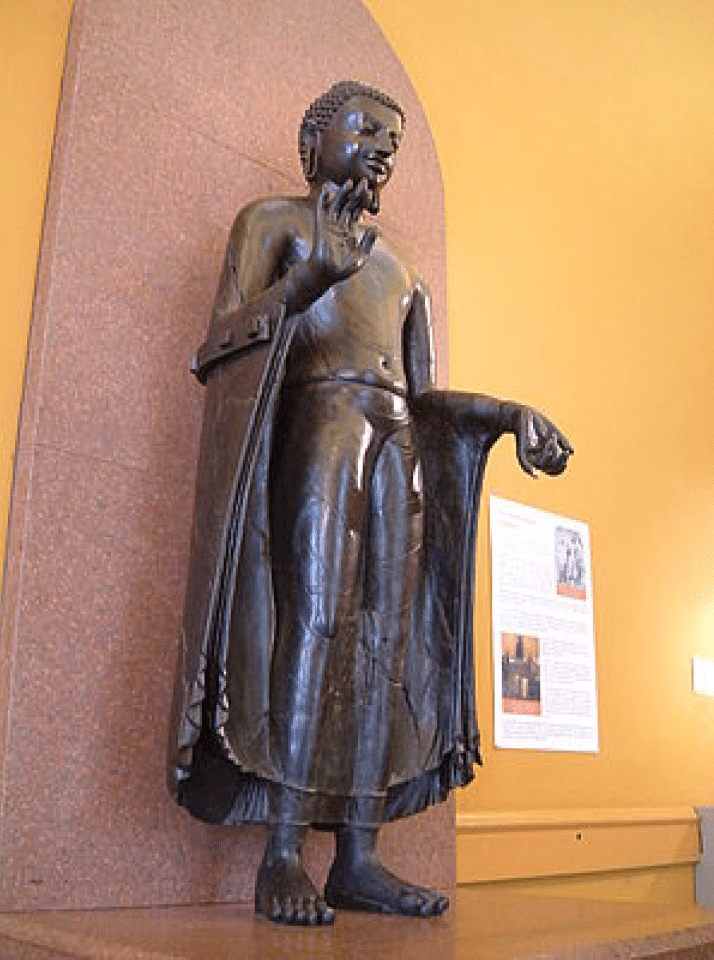
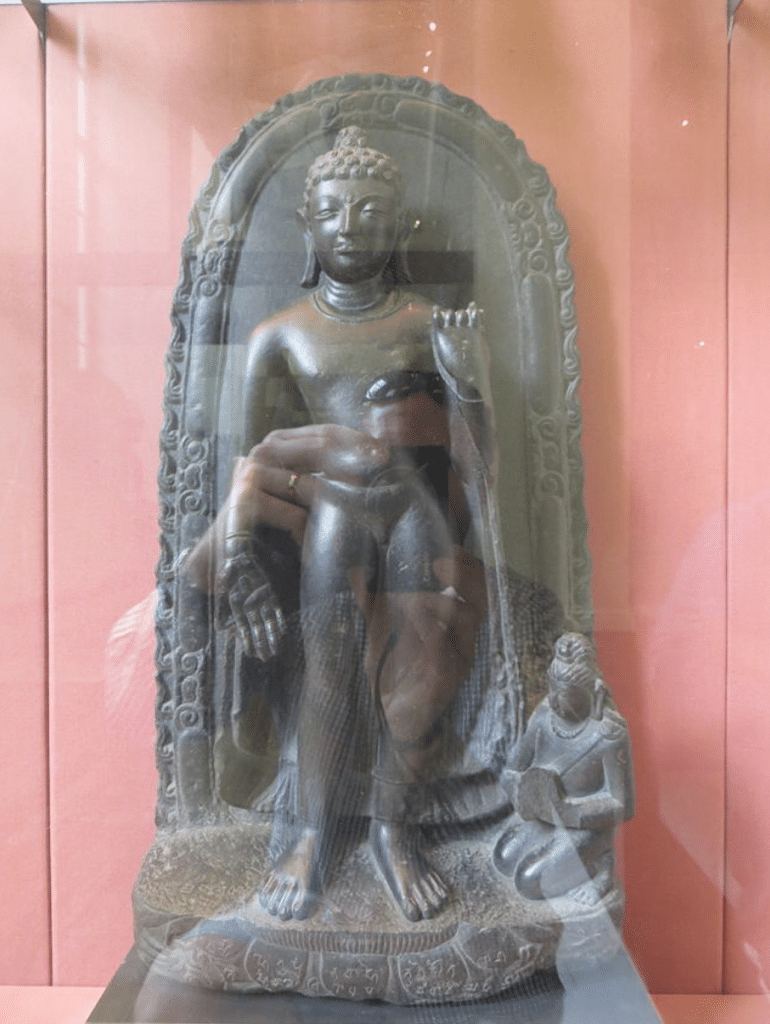
- The statue stands with its right hand raised in abhayamudra, and its left hand held downward with the palm outward, indicating the granting of a favour; the end of the monastic robe is held between thumb and forefinger, in a manner still practised by Theravadin monks today.
- The standing Buddha from Sarnath is an excellent example of Gupta art at its maturity — introducing not only delicacy and refinement of form but also a relaxed posture, the body bending slightly on its own axis, imparting litheness and movement in contrast to the columnar rigidity of comparable Mathura works; even in seated figures, the slender physiognomy conveys a sense of movement.

- The art of metal casting reached a high degree of development — Fa-Hien recorded seeing a copper Buddha image over 25 metres high, though it is no longer traceable.
- As the Guptas supported Brahmanism, images of Vishnu, Shiva, and other Hindu gods were fashioned for the first time in this period — some of the finest examples appear in the panels of the Deogarh temple (Jhansi district).
- A relief carving of Krishna lifting the Govardhana mountain was found at Varanasi.
- Among Brahmanical images, perhaps the most impressive is the Great Boar (Varaha) at the entrance to a cave at Udayagiri.

Terracotta Sculptures
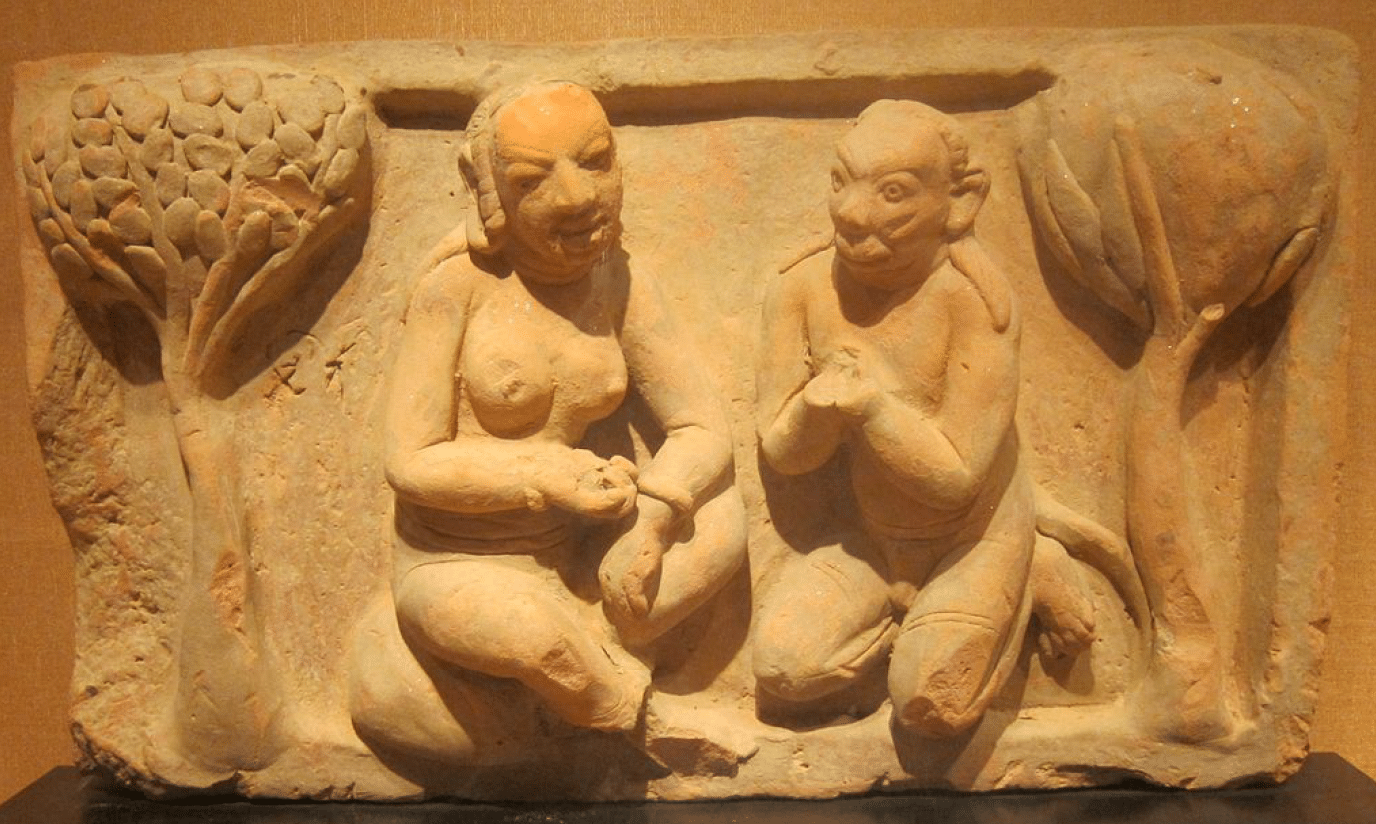
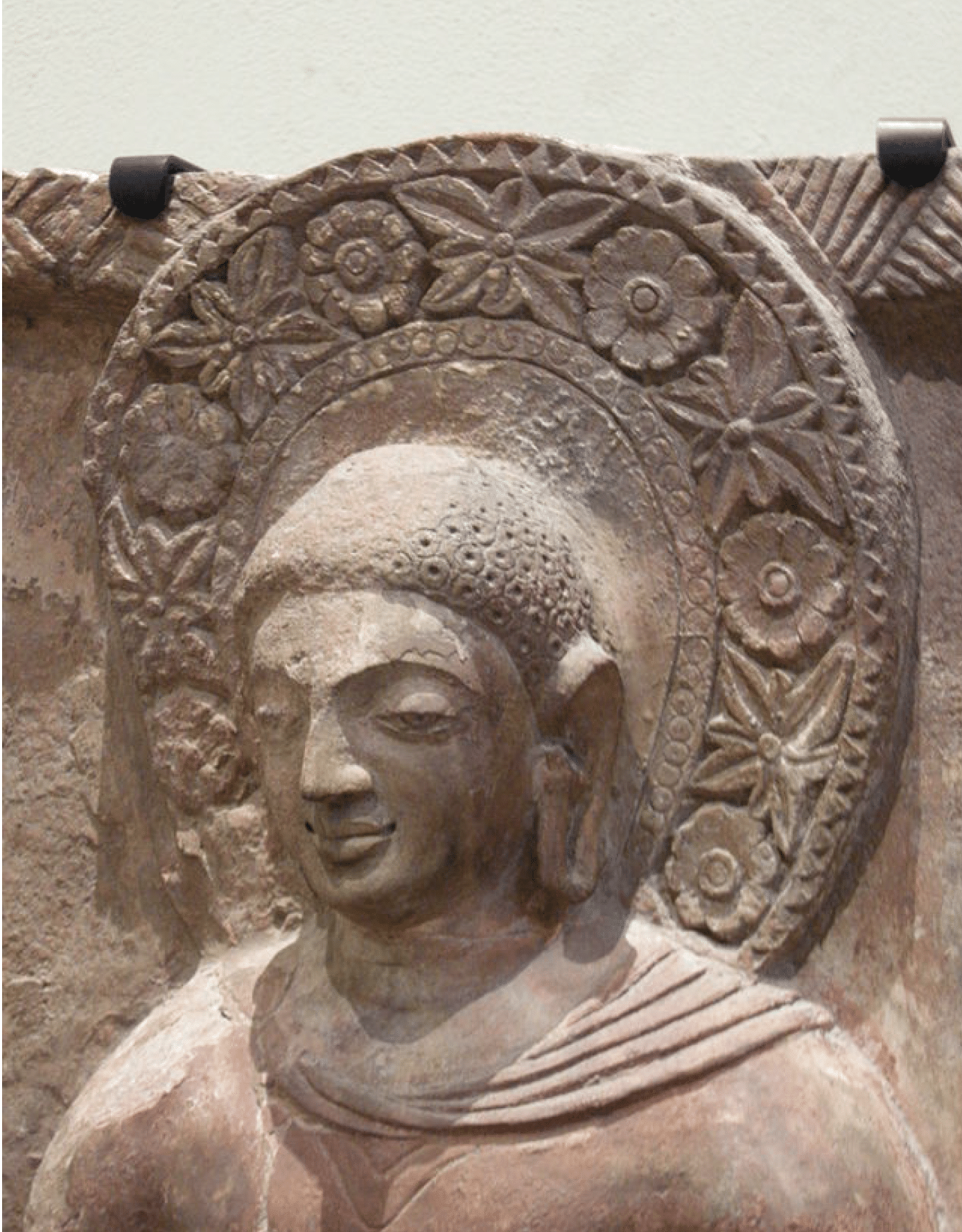
- Terracotta art of this period includes small figurines and plaques found at sites such as Kaushambi, Rajghat, Bhita, and Mathura.
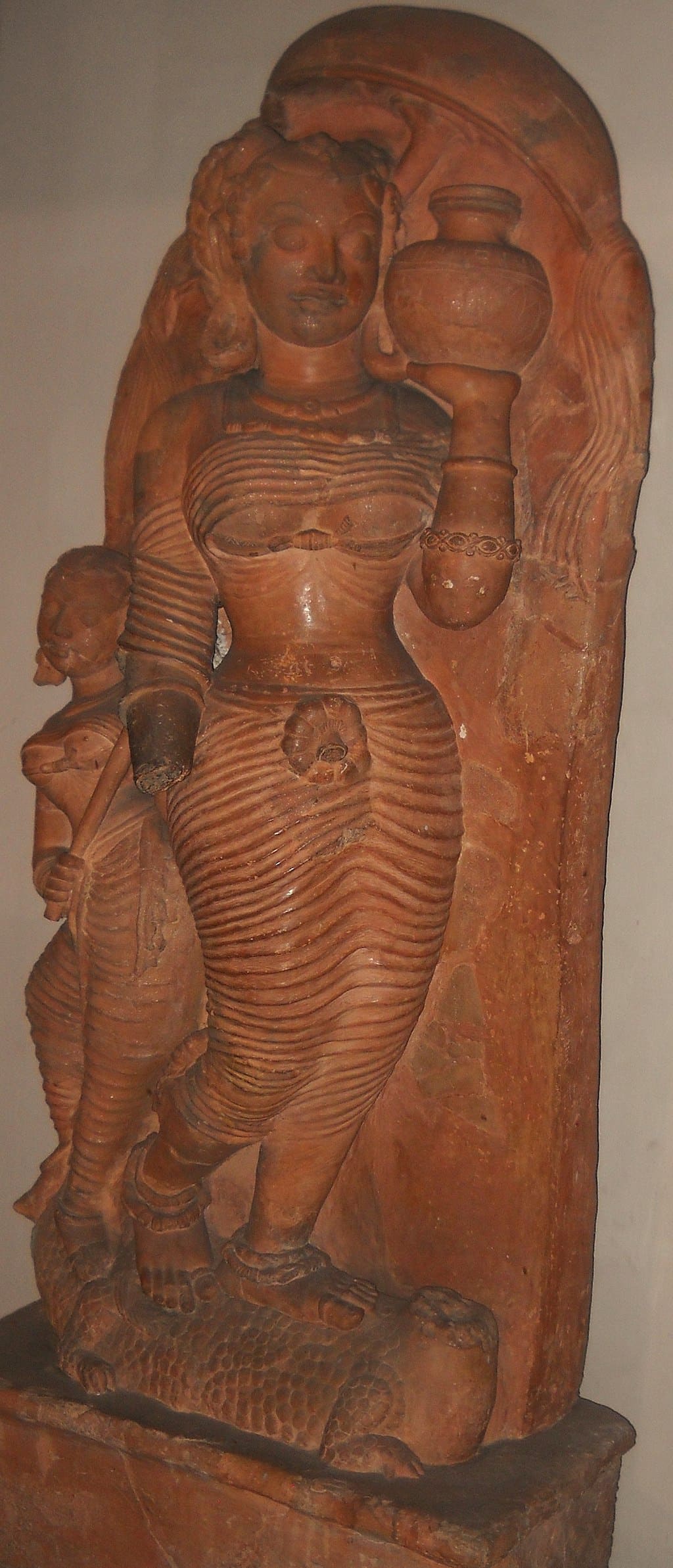
- Terracotta images of Ganga and Yamuna, originally installed in niches flanking the main steps to the upper terrace of the Shiva temple at Ahichhatra, belong to the Gupta period (4th century CE) — Ganga stands on her vehicle, the makara, and Yamuna on the kachchhapa (tortoise).
- The Vakatakas, contemporaries of the Guptas, held paramountcy over the Deccan; the height of artistic perfection achieved in their region can be seen in the later caves at Ajanta, the earlier ones at Ellora, and those at Aurangabad.
 u003cbru003eGanga
 u003cbru003eA Terracotta relief panel depicting a scene from the Rāmāyaṇa, built during the Gupta era.
 u003cbru003eA Terracotta relief panel of a meditating Buddha from the Gupta era.
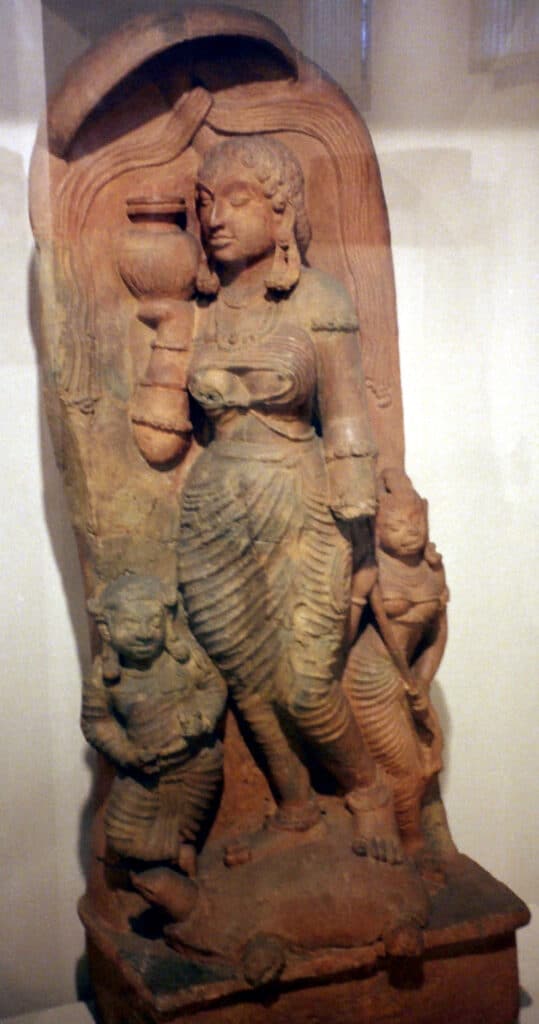 u003cbru003eYamuna
Architecture
(a) Free-Standing Temples
- The Gupta period was comparatively modest in architecture. The doctrine of bhakti and the growing importance of image worship led, for the first time, to the construction of the free-standing temple with its sanctuary (garbha griha), housing the central cult image — marking the beginning of Indian temple architecture.
- These temples were simple, unpretentious structures, though of great significance for later developments. Five well-defined types can be recognised:
- A flat-roofed, square temple with a shallow pillared porch in front.
- A flat-roofed, square temple with a covered ambulatory around the sanctum, preceded by a pillared porch, sometimes with a second storey above.
- A square temple with a low, squat sikhara (tower) above.
- A rectangular temple with an apsidal back and a barrel-vaulted roof.
- A circular temple with shallow rectangular projections at the four cardinal faces.
- The first three types may be regarded as forerunners of medieval Indian temple styles.
- Examples of the first type include Temple No. XVII at Sanchi, the Kankali Devi temple at Tigawa, and the Vishnu and Varaha temples at Eran.
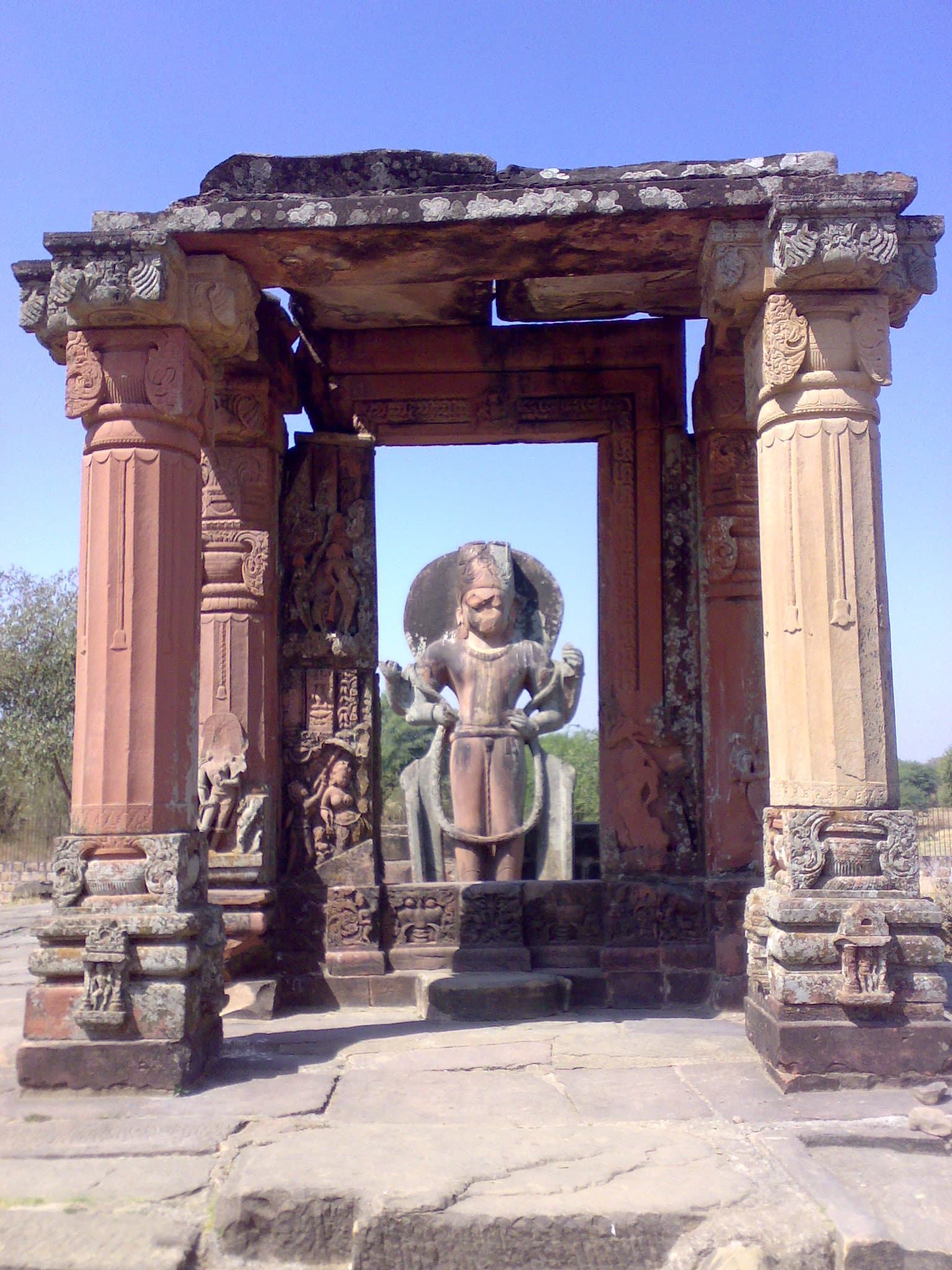 u003cbru003eVishnu Temple
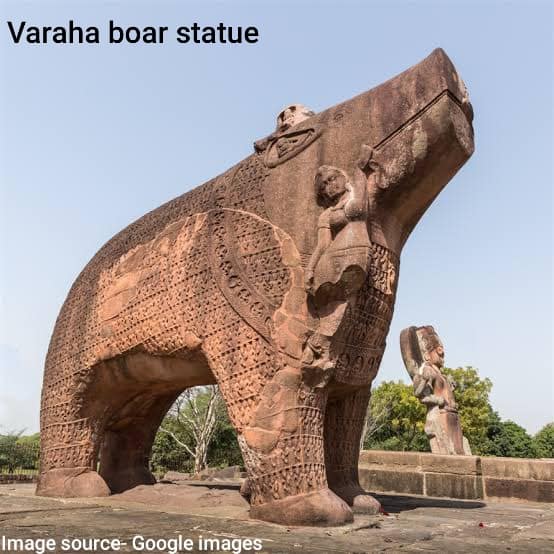 u003cbru003eVishnu Temple and Varah Temple at Eran, Madhya Pradsh
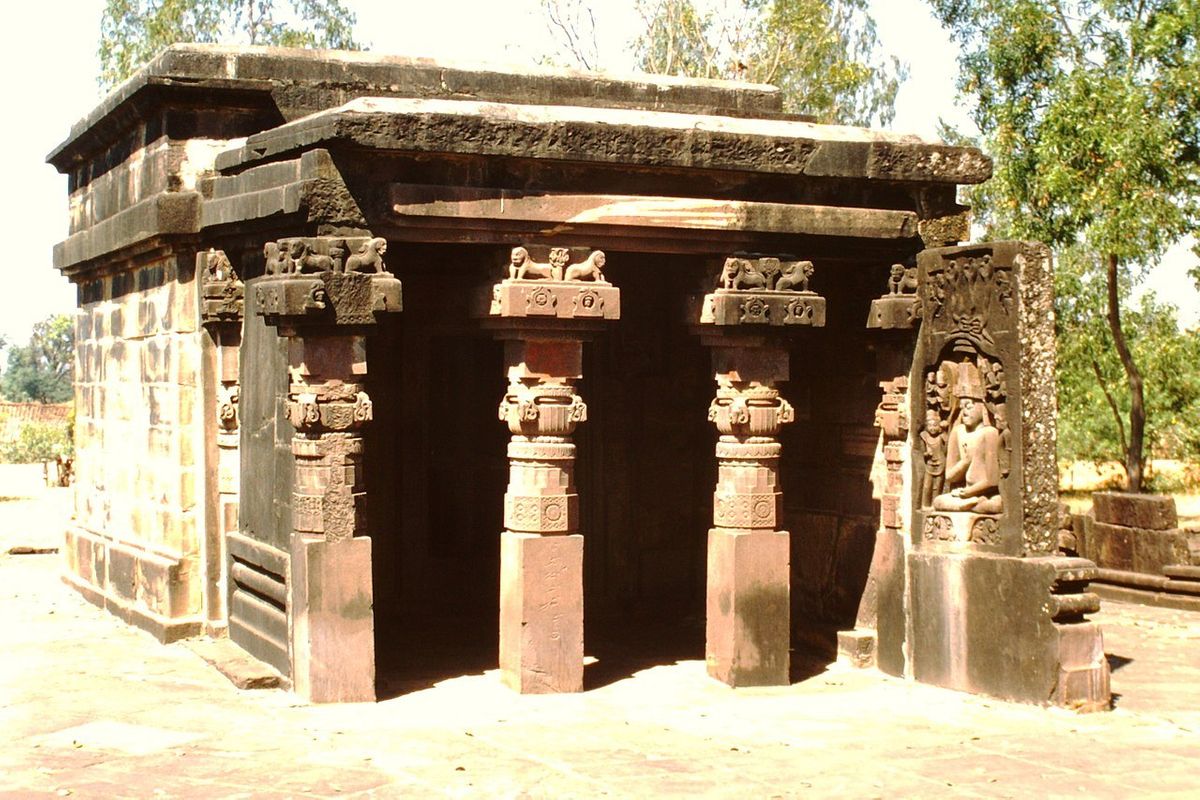 Kankali Devi temple
- The Vishnu Temple is the most complete temple in the Eran complex, with an intact doorway; two mandapa pillars still stand with their corresponding pilasters, though the walls between them have not survived.
- This type introduces, for the first time, an integrated composition of the garbha griha (sanctum) with a single entrance and a porch (mandapa).
- The second type is represented by the Parvati temple at Nachna Kuthara, the Siva temple at Bhumara (both in Madhya Pradesh), and the Lad Khan temple at Aihole — this group displays many characteristic features of the Dravida style.
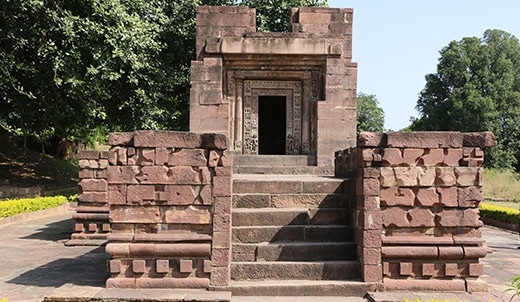 u003cbru003eParvati temple at Nachna Kuthara
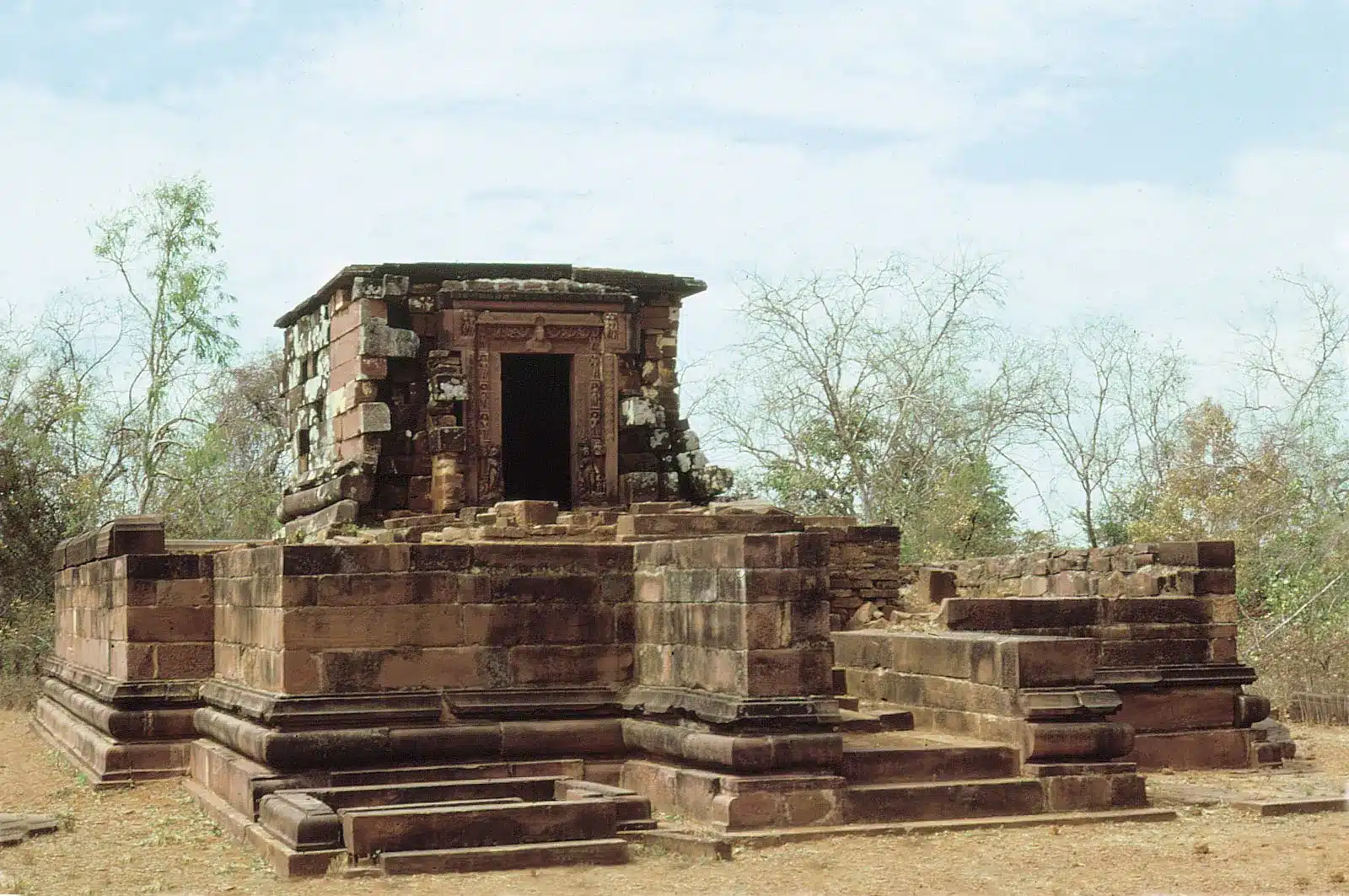 u003cbru003eShiva temple, Bhumara
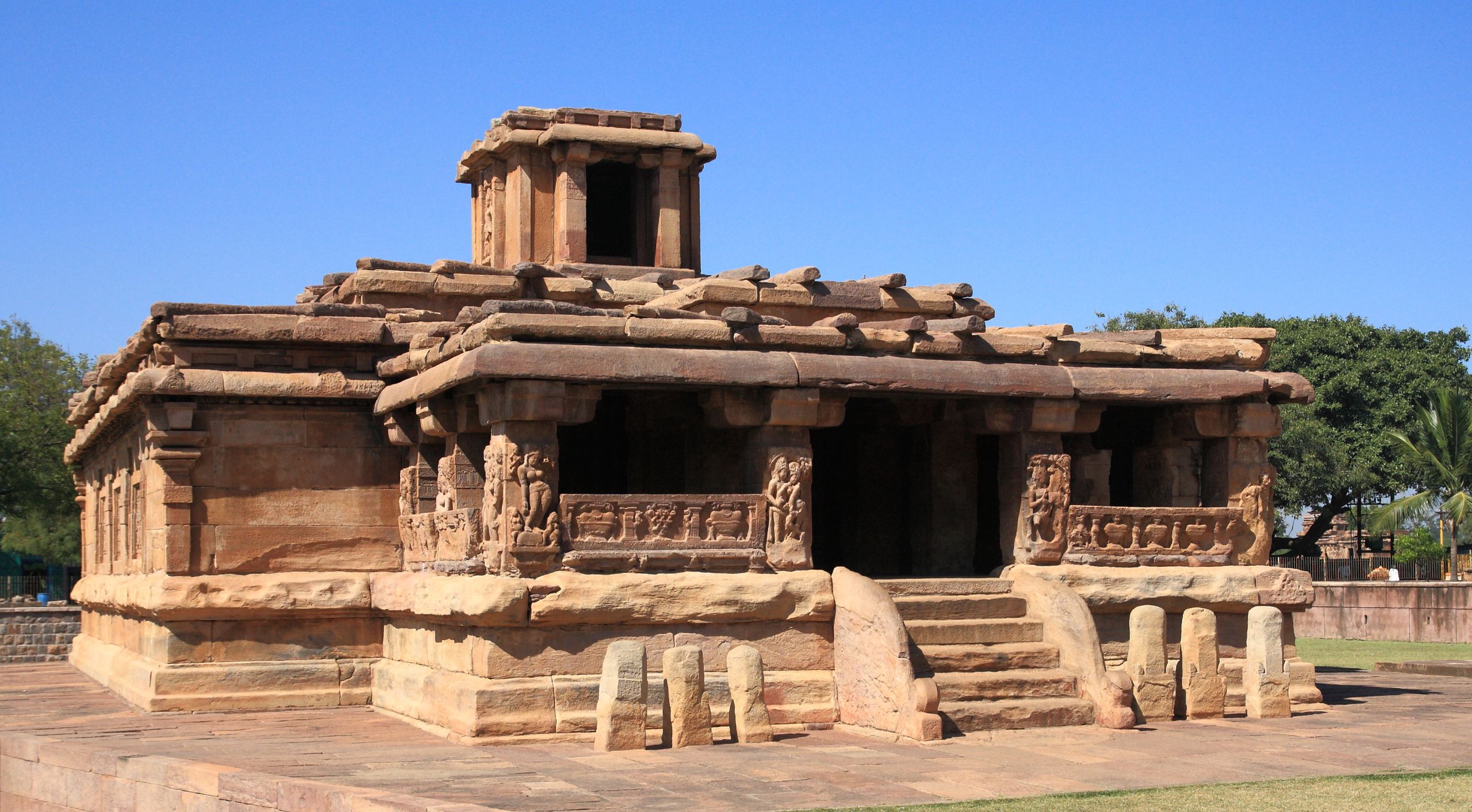 u003cbru003eLad Khan temple of Aihole
- The third type is exemplified by the so-called Dasavatara Temple at Deogarh (Jhansi district — the earliest known Panchayatana temple in North India) and the brick temple at Bhitargaon (Kanpur district).
- The importance of this group lies in the innovation of a shikhara, or tower, capping the sanctum — the defining feature of the Nagara style.
- The Bhitargaon Temple, a terraced brick structure fronted with a terracotta panel, was built in the 6th century and is the oldest surviving terracotta Hindu shrine with a roof and a high sikhara.
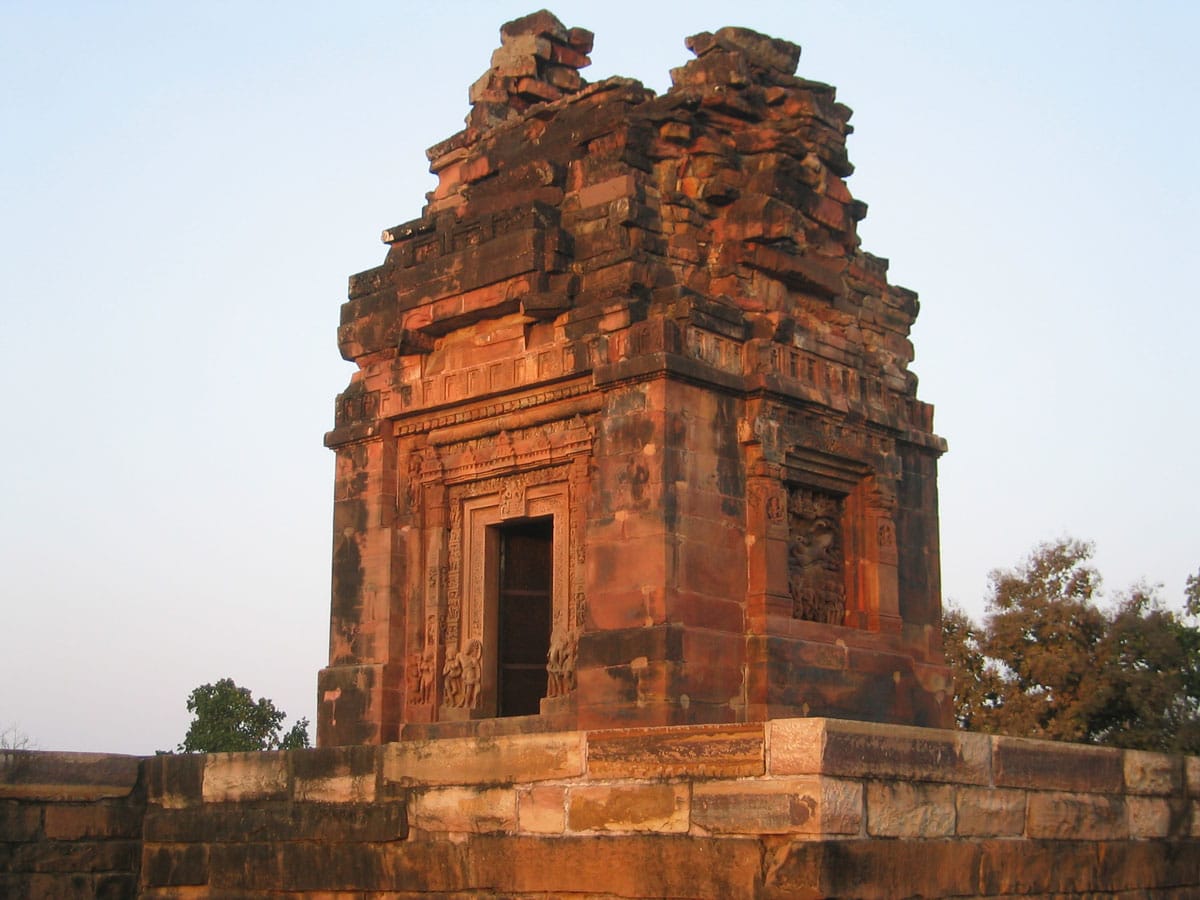 u003cbru003eDasavatara Temple or Vishnu Temple at Deogarh
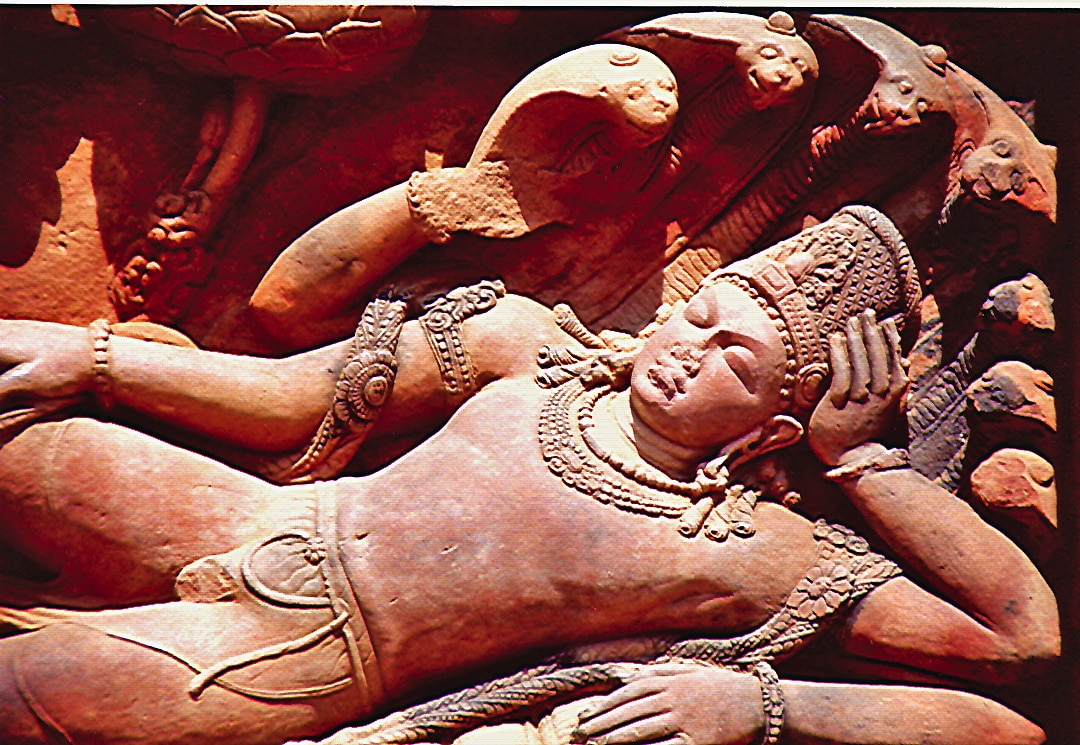 u003cbru003eVishnu reclining on the serpent Shesha (Ananta) on a side panel of the Dasavatar Temple of 5th century
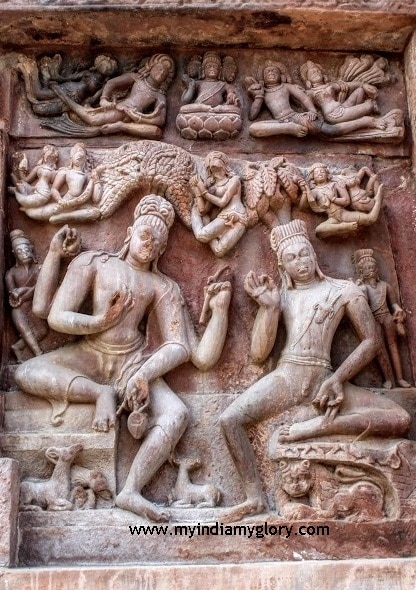 u003cbru003eNara Narayana panel on the eastern wall of the Dasavatar temple
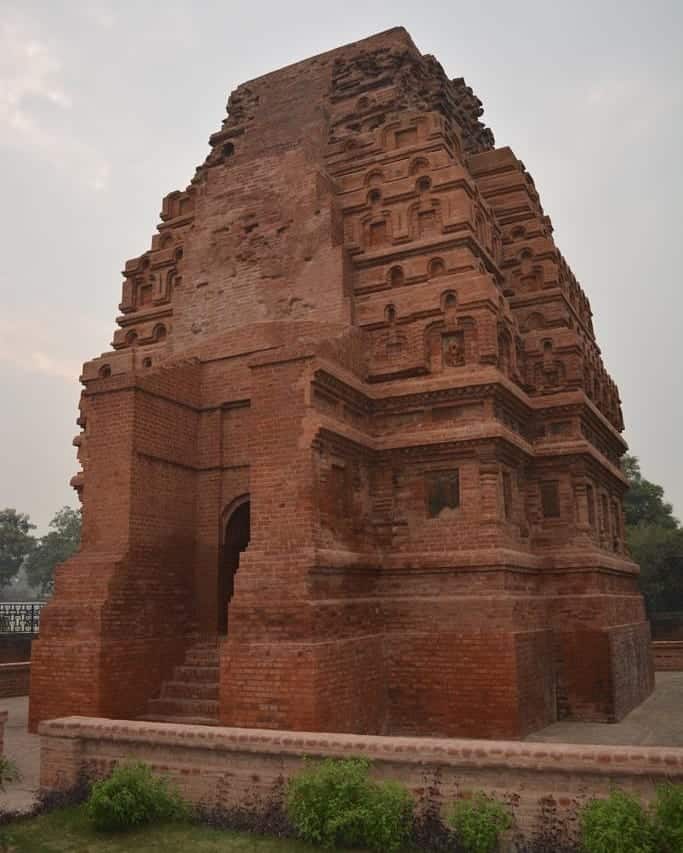 u003cbru003eBrick temple at Bhitargaon
- The fourth type is represented by a temple at Ter (Sholapur district) and the Kapileshvara temple at Aihole.

- The fifth type is represented by a solitary monument, the Maniyar Matha at Rajgir, Bihar.

(b) Rock-Cut Caves
- The rock-cut caves of this period continue older forms to a large extent — some caves at Ajanta and Ellora (Maharashtra), Bagh (Madhya Pradesh), the Kanheri caves (Mumbai, dating from the 1st century BCE to the 10th century CE), and the Elephanta Caves (Mumbai, 5th–8th centuries) may be assigned to the Gupta period.
- In the Elephanta cave, the most important sculpture is the Trimurti, described as a “masterpiece of Gupta-Chalukyan art,” also known as Trimurti Sadashiva or Maheshmurti — its three heads representing creation, protection, and destruction, the essential aspects of Shiva.

- Both Chaitya and Vihara caves were excavated at Ajanta — the Vihara caves No. XVI and XVII and the Chaitya cave No. XIX rank among the finest artistic monuments of the Gupta period.
- The earliest Brahmanical shrines are seen in the group of caves at Udayagiri (Madhya Pradesh).
- The Mogalarajapuram, Undavalli, and Akkana Madanna caves in the Andhra country also belong to the Gupta period.
Mogalarajapuram Caves and Temple
- The Mogalarajapuram Caves in Vijayawada are known for their five rock-cut sanctuaries, dating to around the 5th century, with religious significance owing to the presence of idols of Lord Nataraja and Lord Vinayaka in some of them.
- Nearby, the Mogalarajapuram Temple enshrines a statue of Ardhanarisvara, believed to be the oldest such statue in South India.

Undavalli Caves
- The Undavalli Caves, a monolithic example of Indian rock-cut architecture, are located in Undavalli village, Guntur district (6 km south-west of Vijayawada), near the southern bank of the Krishna River in Andhra Pradesh.
- Carved from solid sandstone in the 4th–5th centuries CE, the largest cave has four storeys, with a huge statue of Vishnu reclining, sculpted from a single block of granite, on the second floor.

- The Undavalli Caves illustrate how many Buddhist artefacts and stupas in Andhra were later converted into Hindu temples and deities — the site was originally a Jain cave, resembling the architecture of Udayagiri and Khandgiri.
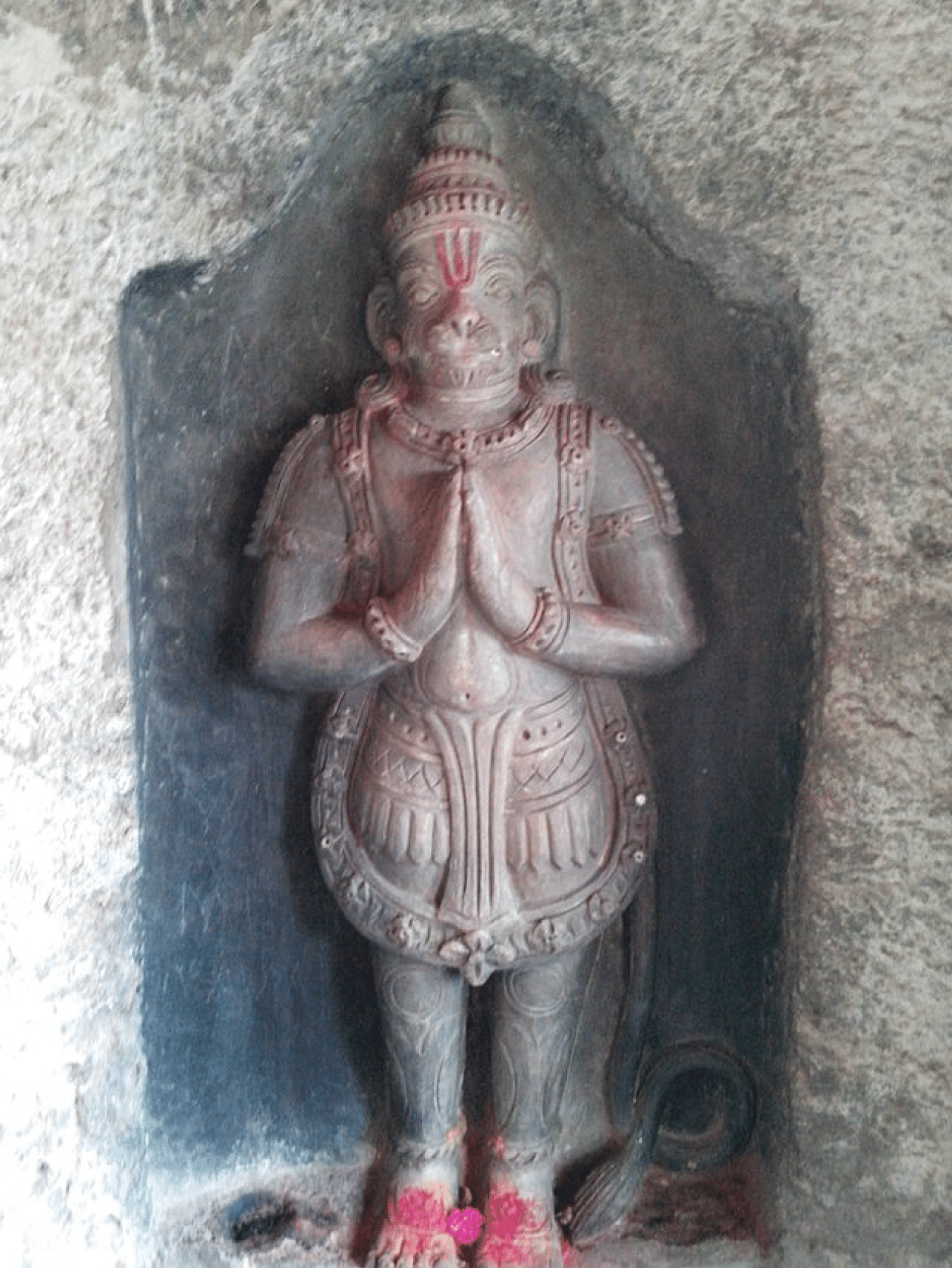 Hanuman on a wall of the caves.
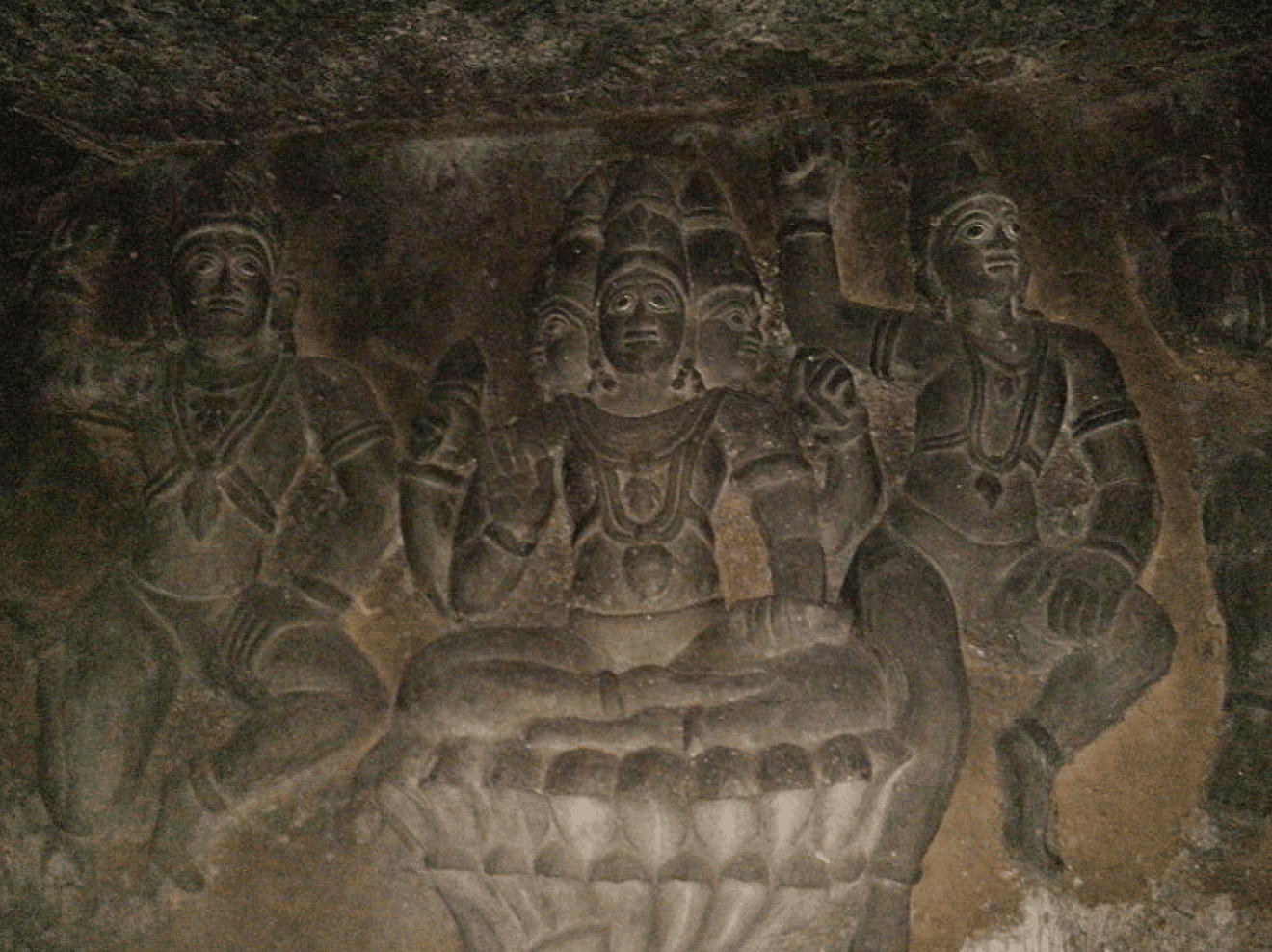 u003cbru003eLord Brahma is carved on the inside walls of the caves
- The main cave is one of the earliest examples of Gupta architecture, primarily consisting of primitive rock-cut monastery cells; initially shaped as a Jain abode, its first-floor level still retains Jain features, including tirthankara sculptures and Jain monastic imagery, while also including Buddhist artwork — the site served as a Bhikkhu monastic complex in ancient times.
- The cave walls display sculptures carved by skilled craftsmen, and the caves are associated with Jain kings ruling between 420 and 620 CE.
Akkana Madanna Cave Temple
- The Akkana Madanna cave temple, located in Vijayawada, was built in the 17th century, though the caves themselves date to the 6th and 7th centuries — with a nearby cave dating even earlier, to the 2nd century BCE.
- The temple houses the Trimurti of Brahma, Vishnu, and Shiva.
(c) Stupas
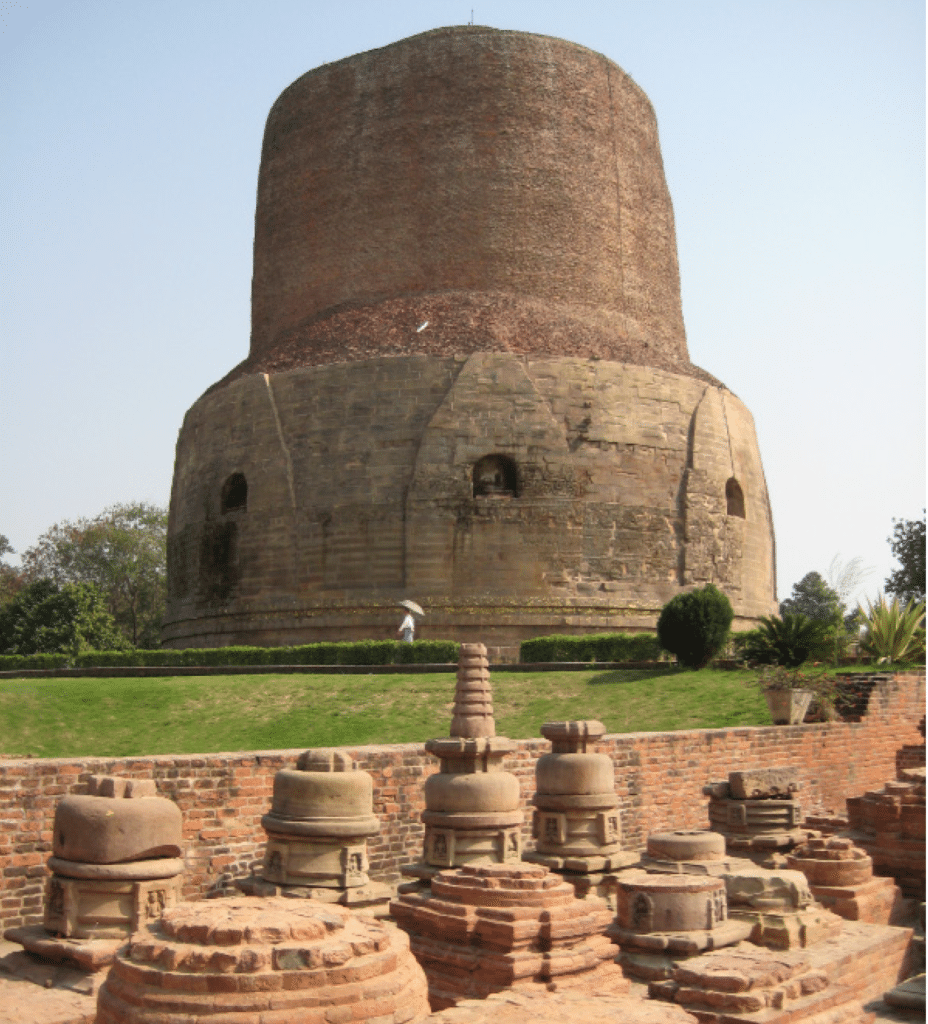
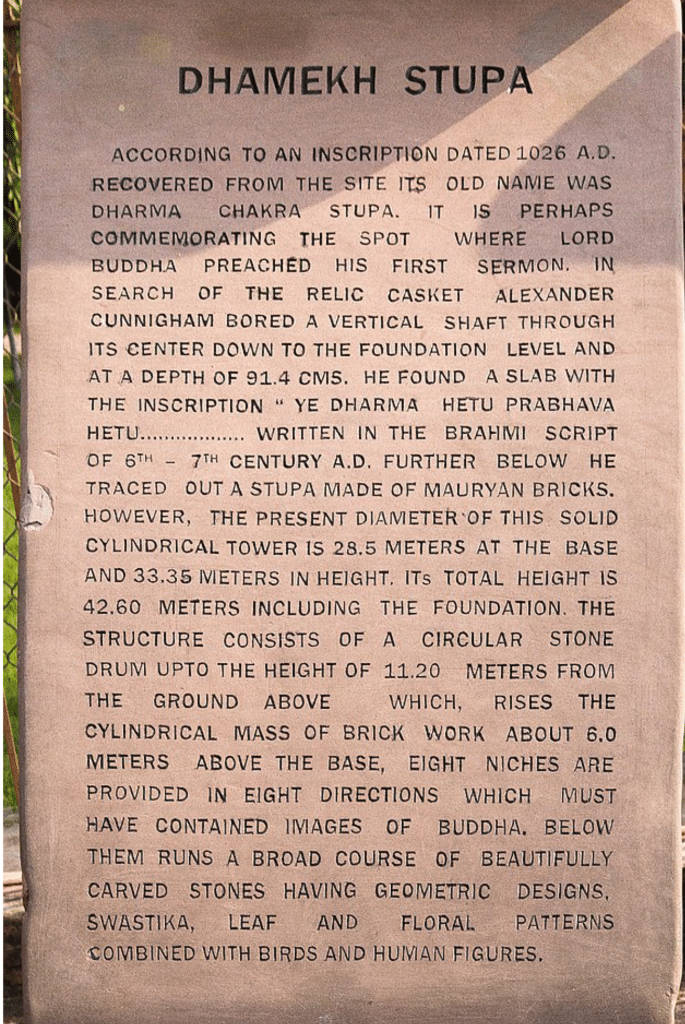
- Stupas were also built in large numbers during this period, with the finest examples found at Sarnath (the Dhamekh Stupa, recorded by Xuanzang during his visit in 640 CE), Rajgir (Jarasandha ki Baithak), Mirpur Khas in Sindh, and Ratnagiri (Orissa).
Paintings
- The art of painting reached its height of glory and splendour in this age. The most important examples of Gupta-era painting survive on the wall frescoes of the Ajanta and Bagh caves — a school of art that became a source of inspiration for half the art of Asia.
- Though these paintings span the period from the 1st century BCE to the 7th century CE, most belong to Gupta times, depicting events from the life of Gautama Buddha and previous Buddhas whose birth stories are related in the Jatakas.
- These paintings remain remarkably lifelike and natural, their colours undimmed even after fourteen centuries.
- Ajanta, now in Maharashtra, lies in the Western Ghats, marking the boundary between the Deccan and Khandesh, along the valley of the Tapti river.
- A hallmark of Ajanta art is its combination of architecture, sculpture, and painting into a single, marvellous unity of conception; the choice of site reflects fine taste, set amid romantic and richly natural scenery, with its mural paintings ranking among the finest examples of Ajanta art.
- The Ajanta tradition provided a foundation for new artistic creations both in India and abroad — examples include the frescoes at Sigiriya in Ceylon, the paintings at Bagh in Gwalior district, and the frescoes in the Sittanavasal temple in Tamil Nadu.
- There is no evidence that the Guptas themselves patronised the Ajanta paintings.
- Cave No. XVI at Ajanta contains the famous scene known as the “Dying Princess,” while Cave No. XVII has been called a picture gallery.

Characteristics of the Gupta Paintings
- Gupta art carried strong religious and spiritual appeal; its artists, known as Shilpa-Yogins, were monks who dedicated their lives to higher pursuits, giving their best in chiselling the scenes of their paintings.
- The style is marked by great simplicity and felicity of expression, with technique and subject blended harmoniously.
- Gupta-period art reveals several defining characteristics: refinement and restraint, reflecting a highly developed cultural taste and aesthetic sensibility, with balance, freedom, and elegance combined in proper measure — a worship of beauty that never comes at the cost of good taste.
- Alongside Buddhist themes, a distinct streak of Hinduism can also be traced in the wall paintings of the Gupta Empire.




