Shams Siraj Afif’s Account: Tarikh-i-Firuz Shahi

- The Tarikh-i-Firuz Shahi, written by Shams Siraj Afif, offers a detailed account of the reign of Sultan Firuz Shah Tughlaq (1351–1388 AD), and stands as one of the most valuable contemporary sources for the study of the later Delhi Sultanate.
- The work was composed some years after Timur’s invasion of Delhi (1398) — that is, after the death of the Sultan himself.
- It functions, in effect, as a continuation of the earlier Tarikh-i Firuz Shahi written by Ziauddin Barani.
- Shams Siraj Afif is said to have written three separate books, chronicling the life history, military expeditions, and administrative achievements of each of the three Tughluq rulers — Ghiyasuddin, Muhammad bin Tughluq, and Firoz Tughluq — of which, however, only the volume on Firoz Tughluq has survived.
- This article examines the Tarikh-i-Firuz Shahi as a source of medieval Indian history, tracing its principal strengths — from its account of agrarian reform to its unusually rich detail on the lives of ordinary people — as well as the genuine limitations historians must bear in mind when using it.
Tarikh-i-Firuz Shahi as a Source of History
A Most Accurate and Authentic Contemporary Account
- The Tarikh-i-Firuz Shahi is widely regarded as the most accurate and authentic contemporary account of its era — Afif himself is known to have interacted personally with the Sultan during his military expeditions.
- Shams Siraj Afif adorned the court of Firoz Tughluq as a scholar, though he notably never accepted formal official employment.
- He wrote, in the true spirit of a historian and biographer, recording the reminiscences of a glorious past for the edification and benefit of posterity, without evident self-interest or prejudice.
- The work covers not only Firoz Tughluq’s political and military activities, but also his broader administrative policy, with particular attention to his public welfare initiatives.
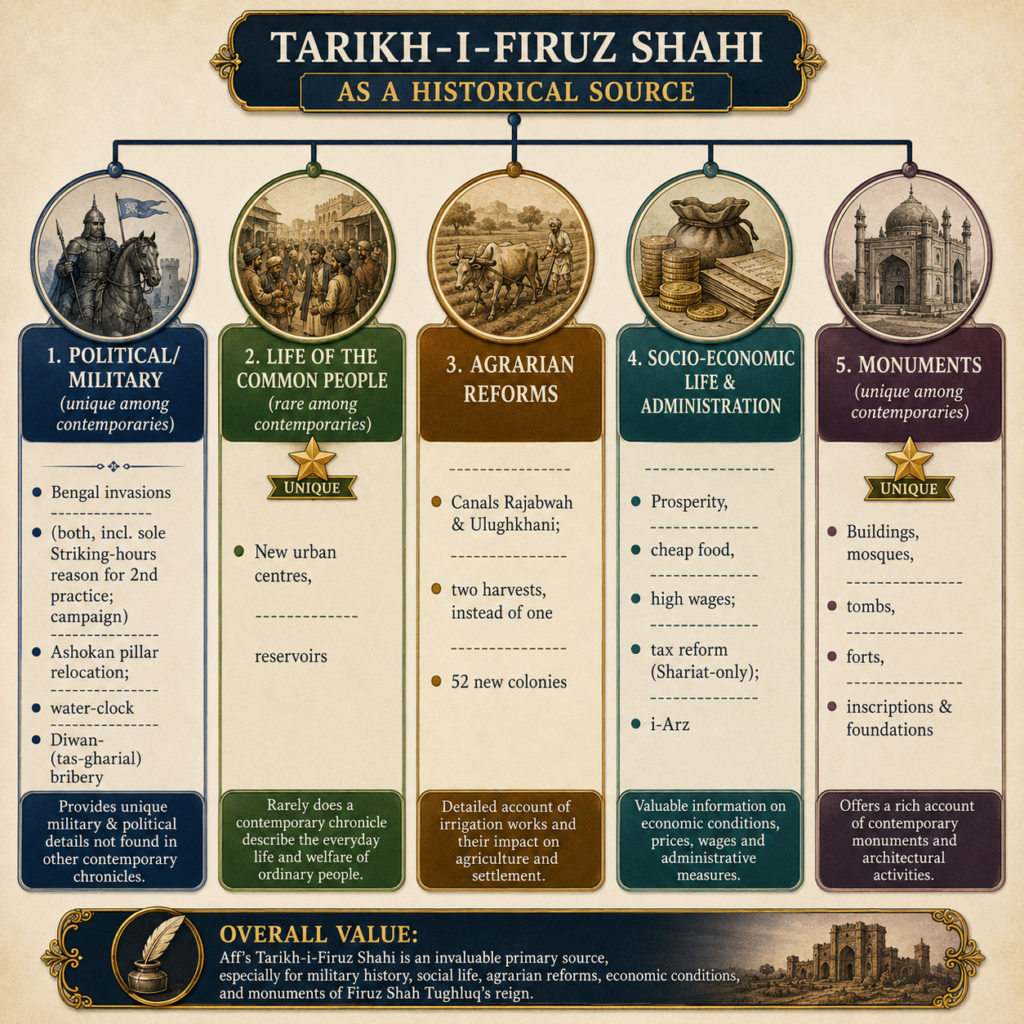
- Both of Firuz Shah’s Bengal invasions ultimately ended in failure, and Afif provides a detailed account of both campaigns — the first against Sultan Shamsuddin Ilyas Shah, and the second against Ilyas Shah’s son, Sikandar Shah.
- Notably, Afif is the sole authority to explain the specific reasons behind Firuz Shah’s second expedition to Bengal.
Describing the Life and Condition of the People
- The Tarikh-i-Firuz Shahi is genuinely unique in that it also describes the life and condition of the people at large — an aspect of contemporary society that most other chroniclers of the period tended to ignore.
- Afif also provides valuable detail on the founding of new urban centres, the construction of water reservoirs, and various administrative reforms undertaken during Firoz’s reign.
Agrarian Reforms of Firuz Shah
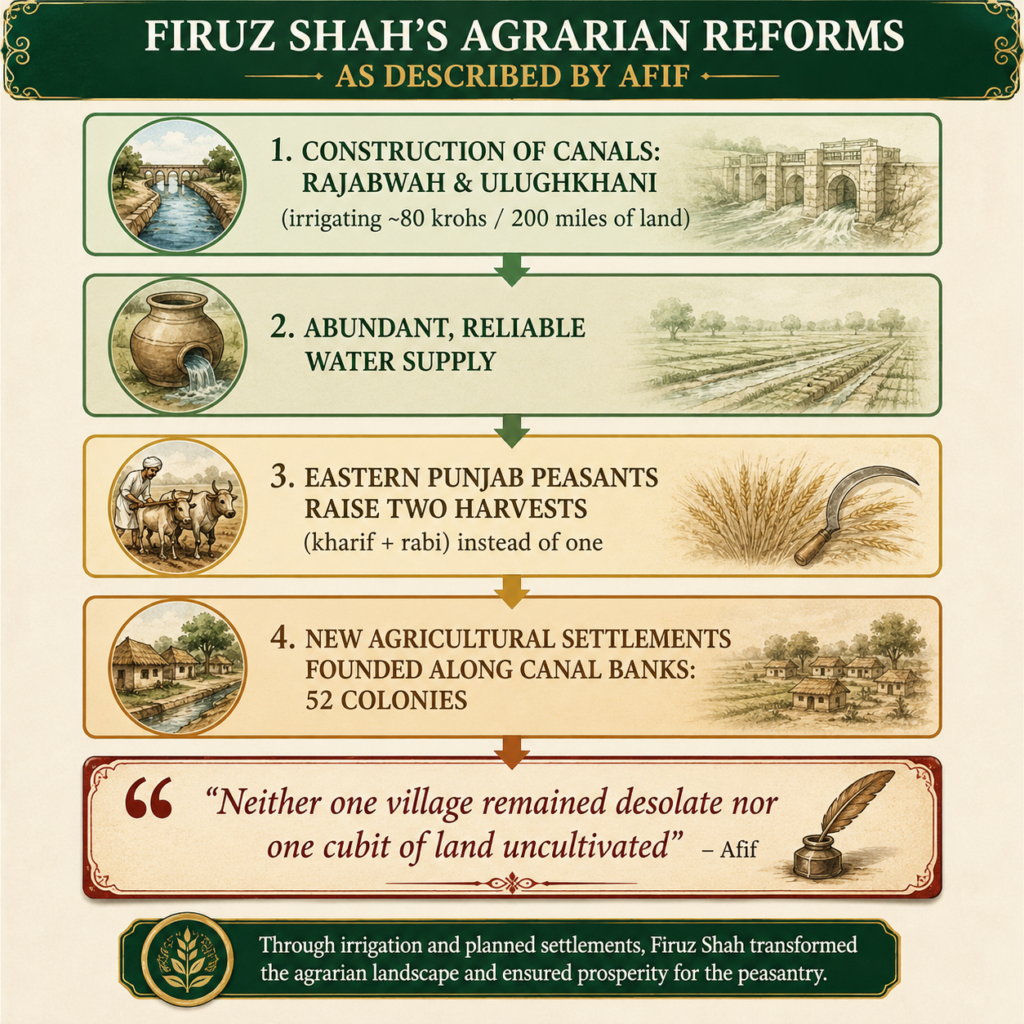
- Afif provides a detailed account of Firuz Shah’s agrarian reforms, including the extension of agriculture and improvements in cropping patterns.
- He describes a long stretch of land — roughly 80 krohs (about 200 miles) — irrigated by the canals Rajabwah and Ulughkhani.
- As a direct result of this abundant water supply, peasants in eastern Punjab were able to raise two harvests (kharif and rabi) annually, where previously only one had been possible.
- This expansion of irrigation gave rise to entirely new agricultural settlements along the canal banks — as many as 52 such colonies sprang up in the areas served by the canal network.
- Afif comments with genuine enthusiasm that, as a result, “neither one village remained desolate nor one cubit of land uncultivated.”
Socio-Economic Life under Firuz Shah
- Afif offers invaluable information on the socio-economic life of the period, describing daily life and culture during the second half of the 14th century — noting general prosperity, cheap food prices, and high wages during Firuz’s reign.
- He also records that Firuz abolished all taxes not sanctioned by the Shariat, and notes that land revenue was collected not on the basis of formal measurement, but through jama, an assessment based on actual produce.
- Afif further describes the lavish lifestyle of the nobility, drawing a clear picture of the sharp economic contrast between different classes of contemporary society.
Administrative Abuses and Corruption
- Afif does not shy away from describing genuine abuses and corruption within the administration.
- For example, in the Diwan-i-Arz (military department), officials are recorded as taking a bribe of one tanka per horse at the time of the annual muster.
- He also hints at a broader degeneration within the central army during this period.
Monuments
- Shams Siraj Afif provides genuinely valuable information on monuments, a subject largely neglected by other contemporary writers such as Minhaj and Ziauddin Barani.
- Afif records the introduction of the practice of striking hours, and offers a vivid, graphic description of how several Ashokan pillars were transported to their present sites from Topra (Haryana) and Meerut (Uttar Pradesh).
- The water-clock is likewise documented in Afif’s account, describing the installation of a tas-gharial (water-clock) by Sultan Firuz Shah Tughlaq at Firozabad.
Limitations of Afif’s Account
- Afif portrays Firuz Shah as a saintly, ideal Muslim ruler — a characterisation that is only partially accurate.
- Of Afif’s original three books, only the Tarikh-i-Firuz Shahi has survived, and even this surviving text contains missing portions.
- Afif’s tendency toward exaggeration is clearly visible in his description of contemporary prosperity — he claims, for instance, that none of the peasant women were without ornaments, and that “in every peasant’s house there were clean bed-sheets, excellent bed-cots, many articles, and much wealth.”
- The account also suffers from genuine problems of chronology.
- Afif’s narrative, moreover, clearly reflects his own religious and personal preferences, rather than offering a fully neutral account.
- Despite these acknowledged faults, Elliot judged that Afif’s work nonetheless provides a better overall view of the internal condition of India under a Muslim sovereign than almost any other contemporary text — with the sole exception of the Ain-i-Akbari.
Conclusion
- Shams Siraj Afif’s Tarikh-i-Firuz Shahi occupies a genuinely distinctive place among Delhi Sultanate–era chronicles — not for grand political narrative alone, but for its unusually rich attention to agrarian policy, everyday socio-economic life, administrative abuse, and monuments, subjects most contemporary historians left largely unexamined.
- Read critically — with due allowance for Afif’s evident exaggeration, chronological inconsistencies, and personal bias toward Firuz Shah — the text remains, in Elliot’s assessment, one of the richest surviving windows into the internal life of Sultanate India, rivalled only by the Ain-i-Akbari.