Persian Literature, Literature in the Regional Languages of North India, and Literature in the Languages of South India

- The Sultanate period witnessed the flowering of a genuinely rich literary corpus — an era in which new languages emerged alongside remarkable growth across the broader sphere of culture and literature.
- This cultural and literary synthesis is visible both in the origin and growth of a genuinely synthetic language like Urdu, and in the deepening interchange between Persian and Sanskrit.
- The regional languages and literature of this period, considerably shaped by both Sanskrit and Persian, mirrored the religious, social, and popular attitudes of their time.
- The Hindi works of Muslim writers such as Amir Khusrau and Jayasi, alongside the Bengali Vaishnavite poems composed by Bengali Muslims, further highlight the ongoing process of cultural synthesis that defined this era.
- This article surveys three interlinked literary traditions: Persian (and Arabic) literature, the continued production of Sanskrit literature, and the remarkable growth of regional-language literature across both North and South India.
Part I: Arabic and Persian Literature
Arabic Literature
- Although the largest body of Muslim literature was composed in Arabic — the language of the Prophet, and the language of literature and philosophy stretching from Spain to Baghdad — the Turks who arrived in India were far more deeply influenced by Persian, which had become the dominant literary and administrative language across Central Asia and Iran from the tenth century onward.
- As a consequence, the production of Arabic literary works in India was largely confined to a small circle of Islamic scholars and philosophers.
- Over time, digests of Islamic law were also prepared in Persian, with the assistance of Indian scholars — the best known of these being the Fiqh-i-Firuzshahi, compiled during the reign of Firuz Tughlaq.
- During Iltutmish’s reign, several Arabic scholars sought refuge in Delhi following the sack of Bukhara by Chengiz Khan.
- Sultan Feroz Shah Tughluq (1351–1388) patronised numerous Arabic scholars, and it was under his patronage that the great Arabic dictionary — the Qamus, by Majduddin Ferozabadi — was produced.
- After the disintegration of the Delhi Sultanate, rulers of various provincial kingdoms similarly patronised Arabic learning, with several new centres of Arabic scholarship emerging during this period.
- Arabic legal digests continued to be compiled — the most famous being the Fatawa-i-Alamgiri (“Digest of Laws”), prepared by a group of jurists during the reign of Aurangzeb.
Persian Literature
- With the arrival of the Turks in India, a new language — Persian — was introduced to the country, coinciding with a genuine resurgence of Persian in Iran and Central Asia from the tenth century onward.
- The Turks adopted Persian from the outset as the language of both literature and administration, and through it, India developed close cultural relations with Central Asia and Iran.
- Over time, Persian became not merely the language of administration and diplomacy, but the language of the upper classes and their dependants — first in North India, and later, as the Delhi Sultanate expanded southward and Muslim kingdoms took root across the country, in almost the entire subcontinent.
Early Phase
- Persian was first introduced to India during the period of Ghaznavid rule in the Punjab, coinciding with a remarkable flowering of Persian literature in Iran and Central Asia from the tenth century onward.
- Great Persian poets such as Firdausi and Sadi composed their major works during this broader period of growth.
- Lahore, the centre of Turkish political authority in India before the 13th century, attracted numerous Persian poets from Iran and Central Asia — for example, Masud Sad Salman (d. AD 1131), whose compositions reflect genuine attachment to Lahore.
- Al-Beruni, who accompanied Mahmud of Ghazni to India, was himself a great scholar of this period.
- The Persian literature produced in India before the establishment of the Delhi Sultanate remained largely derivative in character, adopting literary forms and imagery already prevalent in Iran. It was only after the Sultanate’s establishment that genuine Indian influence began to shape Persian works composed in India.
- Most Delhi Sultans extended patronage to Persian scholars at court, actively encouraging the growth of Persian literature; many Muslim scholars fled Persia and Central Asia to escape the Mongols, finding shelter at the courts of Iltutmish, Balban, and Alauddin Khalji.
- Khwaja Abu Nasr (poetically “Naisiri”), Abu Bakar bin Muhammad Ruhani, Taj-ud-din, and Nur-ud-din Muhammad Awfi were among the notable scholars at Iltutmish’s court.
- Prince Muhammad, Balban’s eldest son, was himself a patron of scholars, extending protection to two of the greatest scholars of his age — Amir Khusrau and Amir Hasan.
- Most Delhi Sultans extended patronage to Persian scholars at court, actively encouraging the growth of Persian literature; many Muslim scholars fled Persia and Central Asia to escape the Mongols, finding shelter at the courts of Iltutmish, Balban, and Alauddin Khalji.
The Contribution of Amir Khusrau (c. 1252–1325)
- The reign of the Khaljis marked a genuinely glorious period for the growth of Persian literature in India.
- The contemporary historian Ziauddin Barani observed: “there lived at Delhi scholars of such eminence and calibre as were not to be found in Bukhara, Samarqand, Tabriz and Isfahan, and in their intellectual accomplishments they equalled Razi and Ghazali. Under every stone lay hidden a precious gem of literary excellence.”
- The most outstanding Persian scholar and poet of this era was Abul Hasan, better known as Amir Khusrau (1253–1325).
- The later Mughal-era historian Badauni, a contemporary of Akbar, praised Khusrau’s contribution to Persian literature, writing that “after the appearance of the cavalcade of the king of poets, the poetry of his predecessors became bedimmed like stars at the rise of the sun.”
- Khusrau’s works have been read and admired well beyond India’s borders — he was popularly known as Tuti-e-Hind (“the Parrot of India”).
- His work represents the beginning of a new trend in Indian-based Persian literature — a growing familiarity with, and influence of, Indian literature upon Persian writing produced in India.
- Khusrau was also an accomplished musician, participating in the religious musical gatherings (sama) organised by the celebrated Sufi saint Nizamuddin Auliya.
- It is said that Khusrau gave up his own life the day after learning of the death of his pir, Nizamuddin Auliya (1325), and was buried within the same compound.
- He served as court poet under Jalaluddin Khalji and Alauddin Khalji, and was connected in various capacities to the courts of no fewer than seven Sultans: Balban, Muhammad, Kaiqubad, Jalaluddin Khilji, Alauddin Khilji, Mubarak Shah Khalji, and Ghiyasuddin Tughlaq.
- Although his poetry was essentially Indian in sentiment, Khusrau followed Persian models in technique — creating, in the process, a new Persian style that came to be known as sabaq-i-Hindi, or the Indian style.
- His five literary masterpieces — collectively dedicated to Alauddin Khalji — were Kutla-ul Anwar, Shirin Khusrau, Laila Majnun, Ayina-i Sikandari, and Hasht Bihisht.
- His five diwans (collections of ghazals) — Tuhfat us Sighar, Wast-ul-Hayat, Ghurrat-ul Kamal, Baqiya Naqiya, and Nihayat-ul Kamal — showcase his considerable lyrical talent.
- Khusrau also composed historical masnavis (narrative poems) of genuine literary and historical value:
- Qiran-us Sa’dain describes the quarrel and eventual reconciliation between Sultan Kaiqubad and his father Bughra Khan.
- Miftah-ul Futuh covers the military successes of Sultan Jalaluddin Khalji.
- Ashiqa tells the romantic story of Khizr Khan (eldest son of Alauddin Khalji) and Deval Rani, daughter of Rai Karan, the Raja of Gujarat.
- Nuh Sipihr (“The Nine Skies”) offers a political account of Sultan Qutbuddin Mubarak Khalji’s reign, alongside references to contemporary social and religious conditions.
- The Tughluq Nama describes Ghiyasuddin Tughluq’s rise to power.
- Khazain-ul Futuh recounts Alauddin Khalji’s conquests in the South.
- While not a historian in the strict sense, Khusrau remains of great historical interest, since he enjoyed the patronage of successive Delhi Sultans and consistently selected genuine historical themes for his masnavis — though, as a court poet, he inevitably viewed events largely through official eyes.
- One particularly remarkable feature of Khusrau’s Persian poetry was his genuine love for his adopted country. He wrote:
- “I have praised India for two reasons: first, because India is the land of my birth and our country. Love of the country is an important obligation… Hindustan is like heaven. Its climate is better than that of Khurasan… it is green and full of flowers all the year round… The Brahmans here are as learned as Aristotle and there are many scholars in various fields…”
- This affection reveals that the Turkish ruling class was no longer prepared to behave as a purely foreign occupying elite, and that genuine ground had been prepared for a cultural rapprochement between rulers and ruled.
- Khusrau also composed verses in Hindavi (an early form of Hindi/Urdu), pointing the way toward the future development of the Urdu language.
Other Persian Poets
- Shaikh Najmuddin Hasan (d. AD 1327), popularly known as Hasan Dehlawi, was another notable Persian poet of the Sultanate period.
- A court poet under Alauddin Khalji and a contemporary of Amir Khusrau, the quality of his ghazals earned him the title “Sa’di of Hindustan.” He composed a Diwan and wrote memoirs of Shaikh Nizamuddin Auliya.
- Badr-ud-Din, a native of Tashkent, served at the court of Muhammad Tughluq, composing odes in his praise — his poetry is notably difficult, heavily loaded with imagery.
- The expansion of the Delhi Sultanate carried Persian literature to various parts of India — a process further reinforced by the rise of provincial kingdoms following the Sultanate’s disintegration. With the founding of the Bahmani kingdom in the Deccan, many Persian poets and scholars migrated to Gulbarga, where they received patronage from the Bahmani Sultans.
Historical Works in Persian
- One of the most significant contributions of Persian literature during (and after) the Sultanate period lay in the field of history-writing, with many historians recording the events of their time in Persian.
- The most famous historians of this period were Minhaj Siraj, Ziauddin Barani, Afif, and Isami. For the history of the Sultanate more broadly, historians remain largely dependent on the accounts of these court chroniclers — accounts that, despite genuine methodological and chronological flaws, and frequent personal and ideological prejudice, remain nonetheless indispensable.
- Important historians of the period include:
- Minhaj-us-Siraj (author of the Tabaqat-i Nasiri), whose style is marked by genuine brevity, boldness, and vigour.
- Isami (author of the Futuh-us Salatin).
- Shams Siraj Afif (author of the Tarikh-i Feroz Shahi), who continued Barani’s earlier work of the same name.
- Afif proved more methodical and careful in his treatment of the subject than Barani, though his work contains considerable unnecessary repetition, and is markedly full of praise for his patron.
- Among the Sultans themselves, Feroz Shah Tughluq authored the Futuhat-i Ferozshahi.
- Ain-ul-Mulk Multani, who held important office under Alauddin Khalji, Muhammad Tughlaq, and Firuz Tughlaq, was a clever and highly accomplished man who wrote several excellent works, including Ain-ul-Mulki and Munshat-i-Mahru (also called Inshai-i-Mahru) — valuable sources on the political, social, and religious conditions of his time.
- Ghulam Yahya bin Ahmad, author of the Tarikh-i-Mubarak Shahi, produced a work valuable for its own period, which in many respects corrects and supplements Minhaj-us-Siraj, Ziauddin Barani, and Shams-i-Siraj Afif.
Ziauddin Barani: The Greatest Historian of the Period
(“Write a short essay on: ‘Ziauddin Barani as a historian.'”)
- Ziauddin Barani, the greatest historian of this era, was the author of the Tarikh-i-Firuz Shahi — a work into which he invested considerable effort, transforming it into a genuine compendium of useful knowledge. Barani enjoyed the patronage of both Muhammad Tughlaq and Firuz Tughlaq.
- His Tarikh-i-Ferozshahi stands as the single most valuable historical work of the period, completed in 1357, when Barani was 74 years old, and named in honour of Feroz Shah Tughluq.
- Since Barani began writing the work at an age when his memory had already begun to fade, the text contains numerous chronological errors; his own personal, ideological, social, and sectarian prejudices also frequently colour his interpretation of events.
- Even so, Barani’s overall contribution to historical writing remains genuinely unparalleled for the period — he broke new ground by refusing to confine himself purely to rulers, courts, and campaigns, instead describing and analysing administrative matters and economic phenomena, and providing an analytical study of conflicts between social groups during his time.
- Barani also authored a second major work, the Fatwa-i-Jahandari (“Rulings on Temporal Government”), which addresses questions of political theory — specifically, the political ideals a Muslim ruler should pursue in order to earn both religious merit and the gratitude of his subjects.
Coverage of the Tarikh-i-Firuz Shahi:
- Barani’s Tarikh-i-Firuz Shahi (1357) is the most important source for the history of the Delhi Sultanate, covering a century-long span — from the accession of Sultan Balban to the first six years of Sultan Firuz’s reign.
- It covers the entire arc of the Sultanate’s consolidation, expansion, and early disintegration, spanning the reigns of Balban, Jalaluddin Khalji, Alauddin Khalji, Ghiyasuddin Tughlaq, Muhammad bin Tughlaq, and Firuz Shah Tughlaq — commenting extensively on their respective policies, achievements, and failures, and describing contemporary polity, economy, and society in considerable detail.
Barani’s Views on History:
- Barani held history in genuine high regard, believing its purpose was to impart moral lessons through the citation of past examples — making him, in effect, a genuine pioneer of the didactic method in medieval historical writing.
- He taught that history was intended to benefit Sultans, wazirs, and nobles, holding no value for “the evil, the base, and the low-born.”
- He considered history a tool for proclaiming the glory of Islam, strengthening the state, and firmly suppressing heterodox movements — regarding history, in this sense, as the “twin brother” of the science of hadis.
Barani as an Authentic Narrator:
- Barani stands as a genuinely authentic narrator of events, having maintained personal contact with both Muhammad bin Tughlaq and Firuz Shah Tughlaq; his own uncle, Ala-ul-Mulk, served as advisor and friend to Alauddin Khalji, and held the post of kotwal of Delhi — connections that gave Barani access to genuinely authentic information.
- Barani himself held a respected position at the courts of Ghiyasuddin Tughlaq and Muhammad Tughlaq, though Firuz Tughlaq eventually grew displeased with him and withdrew his patronage. Even so, Barani remained close to the throne and court for many years, making him a genuine witness to the events of his own era.
Shortcomings in Barani’s Account:
- Barani, preferring the role of court-writer, was generally reluctant to displease any Sultan, and consequently offers excessive praise on occasion.
- As an orthodox Muslim, Barani himself believed in social discrimination based on religion and class — his account has, as a result, been judged biased on several occasions. For example, in the Fatwa-i-Jahandari, Barani openly condoned the segregation of Muslim ashraf (upper classes) from ajlaf (lower classes).
- Barani did not present his account in strict chronological order, and was, in general, careless about noting the specific dates of events he describes.
Sufi Literature in Persian
- This period also produced a substantial body of religious and philosophical literature in Persian, with Sufi writing in particular holding great value from both religious and literary perspectives.
- A distinctive literary genre — the malfuzat (conversations or discourses of leading Sufi masters) — emerged during this era, often containing didactic poetry and instructive anecdotes.
- Amir Hasan Sijzi compiled the malfuzat of the celebrated Chishti master Shaikh Nizamuddin Auliya, known as the Fawaid-ul Fu’ad.
- These works reflected growing popular demand for information on the lives, teachings, and reputed miracles of Sufi saints.
- The Siyaru-ul Auliya of Mir Khwurd stands as the earliest known biographical dictionary of Sufis composed in India.
- The Khair-ul-Majalis records the malfuzat of Shaikh Nasiruddin Mahmud (Chiragh-i-Delhi).
- Beyond spiritual matters, these works often reflect real social and economic realities of their time.
Sanskrit Translations into Persian
- Sanskrit and Persian together functioned as the country’s principal link languages — across politics, religion, and philosophy — and as vehicles for literary production.
- Initially, there was relatively little interchange between the two.
- Zia Nakhshabi (d. 1350) was the first to translate into Persian a set of Sanskrit stories narrated by a parrot to a woman whose husband had gone on a journey.
- This work, the Tuti Nama (“Book of the Parrot”), composed during Muhammad Tughlaq’s reign, drew on Sanskrit source material and proved genuinely popular, later translated from Persian into Turkish and, subsequently, several European languages.
- Nakhshabi also translated the classical Sanskrit sexology treatise, the Kok Shastra, into Persian.
- Amir Khusrau’s own pioneering experiments laid the foundation for this broader project of literary and cultural synthesis.
- Later, under Firuz Shah, Sanskrit texts on medicine and music were translated into Persian; further translation activity followed during the reign of Sikandar Lodi.
- Zain-ul Abedin, the famous 15th-century ruler of Kashmir, commissioned Persian translations of both the Mahabharata and Kalhana’s Rajatarangini.
- Notably, however, little reciprocal effort was made by Sanskrit-knowing non-Muslim scholars to translate Persian or Arabic literature into Sanskrit — an absence of reciprocity indicative of the insular outlook of the Brahmanical elite, an insularity earlier highlighted by Al-Beruni in the eleventh century.
- This limited receptivity to ideas from other cultures and languages may partly explain the broader decadence of Sanskrit literature during this period.
- Persian, in sum, occupied a genuinely important place among the languages of this era — functioning as the official language and language of the ruling elite, introducing fresh social and religious ideas, widening the intellectual horizons of Indian poets, thinkers, and reformers, and, above all, introducing entirely new literary forms and styles.
- Some literature also flourished under provincial patronage — Jaunpur, for instance, became a famous seat of learning, attracting many scholars to the court of Ibrahim.
Part II: Sanskrit Literature
- Sanskrit remained a vehicle for higher thought and a genuine medium of literature throughout this period.
- Although Sanskrit lost the official patronage of the new Persian-speaking ruling class, the Sultanate did not otherwise interfere with the independent production of Sanskrit literary works.
- While Persian replaced Sanskrit as the official language, there was no quantitative decline in Sanskrit literary output — though a clear decline in quality did occur.
- This qualitative decline had already begun before the Sultanate’s establishment, and simply became more pronounced during this period. Much of the Sanskrit writing of this era shows little genuine originality, tending toward the wearisomely repetitive, artificial, and forced.
- The introduction of paper during the Sultanate period, however, gave real impetus to the reproduction and dissemination of already-existing Sanskrit texts, such as the Ramayana and Mahabharata — explaining the absence of quantitative decline.
- A network of specialised schools and academies continued to flourish across the country, including in areas under Muslim rule, largely undisturbed by the Sultanate — many took direct advantage of paper’s introduction to reproduce and circulate older texts. Some of the oldest surviving manuscripts of the Ramayana and Mahabharata, in fact, date from the eleventh or twelfth century onward.
- South India, Bengal, Mithila, and Western India remained the principal centres of Sanskrit literary production.
- Following the great Shankara, works on Advaita philosophy by Ramanuja, Madhava, and Vallabha continued to be composed in Sanskrit — the speed and breadth with which their ideas spread across the country testifies to Sanskrit’s continued vitality.
- Ramanuja wrote commentaries on the Brahma Sutras, explaining his conception of Bhakti.
- Parthasarthi Misra authored the Sastra Dipika.
- Numerous works on Yoga, Nyaya, and Vaisesika philosophy were similarly produced.
- The Chaitanya movement in Bengal and Orissa further contributed to Sanskrit literary output; Jayadeva’s Gita-Govinda stands as an excellent specimen of the poetry of this era.
- Hindu rulers — particularly of Warangal, Vijayanagara, and various Rajput kingdoms — actively encouraged Sanskrit literature, producing works of poetry, drama, philosophy, and religious commentary.
- The Prithvirajavijaya and Hammirmahakavya are among the best known such works.
- Rulers such as Hammir Deva, Kumbha Karna, Prataprudra Deva, Basantraja, Vemabhubhala, Katya Vem, Virupaksha, Narsingh, Krishnadevaraya, and Bhupal, among others, patronised Sanskrit scholars — several were themselves accomplished scholars.
- Beyond philosophy, works of kavya (poetic narrative), drama, fiction, medicine, astronomy, and music continued to be composed.
- Following the great Shankara, works on Advaita philosophy by Ramanuja, Madhava, and Vallabha continued to be composed in Sanskrit — the speed and breadth with which their ideas spread across the country testifies to Sanskrit’s continued vitality.
- A large body of commentaries and digests on Hindu law (Dharmashastras) were prepared between the twelfth and sixteenth centuries.
- Vijnaneshwar’s great Mitakshara (a commentary on Yajnavalkya, composed around the twelfth century) forms one of the two principal schools of Hindu law, remaining the operative law of the land for many centuries.
- Jimuta Vahan authored the Dayabhaga, which formed the basis of the law of inheritance and partition in Bengal for centuries.
- Smriti literature flourished so richly in Mithila that its writers came to be regarded as forming a distinct school; the notable Dharmashastra commentator Chandeshwar of Bihar lived during the fourteenth century.
- Most such works were produced in the South, followed by Bengal, Mithila, and Western India, generally under Hindu royal patronage.
- Sayana wrote his famous commentaries on the Vedas, while Madhava composed the Siva-Gama Stotra; the study of astronomy was advanced by Bhaskaracharya (born 1114 AD).
- A substantial body of drama was also produced: the Harkeli Nataka and Lalitavigraharaja Nataka in the twelfth century, followed by Jayadeva’sPrasanna Raghava, Jaya Singh Suri’sHammir mada-mardana, Ravivarman’sPradyumnabhydaya, Vidyanath’sPratap Rudra Kalyan, and Vamana Bhatta Bana’sParvati Parinaya.
- Jiva Goswami authored as many as 25 books in Sanskrit.
- Jain writers, too, contributed substantially to Sanskrit’s growth — Naga Chandra (also known as Abhinava Pampa) authored the Pampa Ramayana, alongside other notable Jain writers such as Hema Chandra, Prabha Chandra, Asadhara, and Sakalakriti, of whom Hemchandra Suri was the most eminent.
- Kalhana wrote the famous Rajatarangini, chronicling the history of Kashmir; this was followed by two further continuations:
- Jonaraja’s Rajatarangini carried Kashmir’s history from Jayasimha to Sultan Zainul Abedin (1420–1470).
- Srivara’s Rajatarangini extended this history down to AD 1486.
- A large number of semi-historical texts termed Prabandhas were also produced — mostly hagiographic in character, though some carry genuine historical value, such as Merutunga’sPrabandhakasha Chintamani and Rajashekhar’sPrabandhakosha.
- Other important writers of this period include Padma Bhatta, Vidyapati Thakur, and Vachaspati Misra.
- Little effort was made to translate Islamic or Persian works into Sanskrit — the sole exception being a translation of Jami’s Persian love story of Yusuf and Zulaikha, taken as further evidence of the same insularity noted earlier by Al-Beruni.
- Following the conquest of Nagarkot, a Sanskrit manuscript that fell into Firuz Tughlaq’s hands was translated into Persian under the title Dalayal Firuz Shahi.
- Several historical poems were also composed about Muslim rulers — for example, the Rajavinoda, a biography of Sultan Mahmud Begarha of Gujarat, composed by his court poet Udayaraja.
- This general reluctance to engage with contemporary reality may partly explain why much Sanskrit writing of this period remains repetitive, lacking fresh insight or originality.
Part III: Literature in the Regional Languages of North India
- One of the defining features of this period’s literary history is the rapid development of regional-language literature across India. In North India, this included Hindi, Punjabi, Bengali, Assamese, Oriya, Marathi, and Gujarati.
- Each of these languages originated from a corresponding Indo-Aryan Prakrit, in its Apabhramsa stage, a development traceable back to the seventh–eighth centuries; languages such as Hindi, Bengali, and Marathi trace their origins to roughly this same period.
Social Background of Regional Language Development
- During the post-Gupta period, the growth of a “feudal” society, economy, and polity drove the emergence of distinct regional entities and cultures, roughly from the seventh–eighth centuries onward.
- One consequence of this growing regionalism was the emergence of the earliest regional languages from Apabhramsa — the maturation of these languages, and their adoption as vehicles for genuine literary production, stands as a striking feature of the medieval period.
The Decline of Sanskrit and the Rise of Regional Languages
- The qualitative decline of Sanskrit literature, as noted, had begun well before the Delhi Sultanate’s establishment — much of the Sanskrit literature of the 10th–11th centuries lacked genuine spontaneity, and held little appeal beyond a small Brahmanical circle.
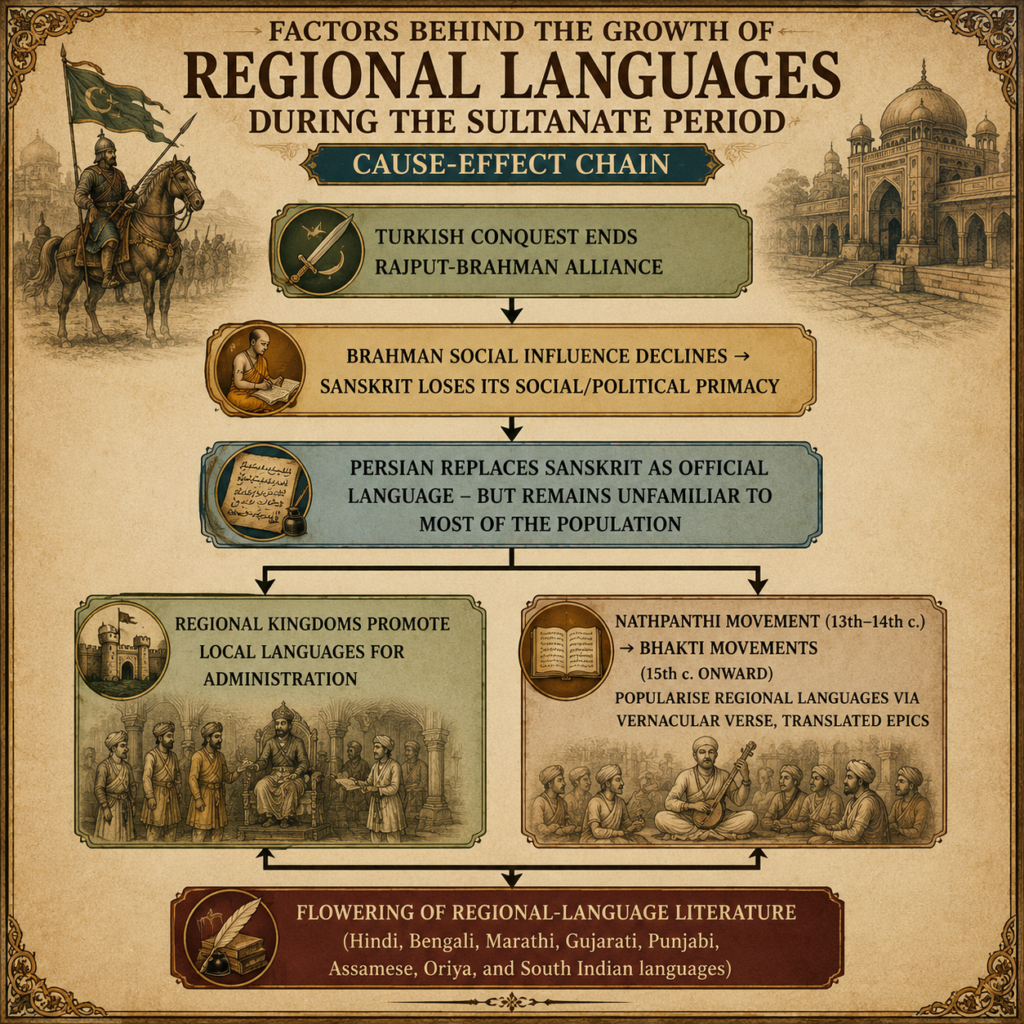
- The replacement of Sanskrit by Persian as the official language during the Sultanate period further intensified this decline. Once Sanskrit lost its central official patronage, many Sultanate-period kingdoms actively promoted regional languages instead, since Persian remained genuinely unfamiliar in large parts of the country.
- Regional languages had, in fact, already been used for administrative purposes alongside Sanskrit in many pre-Turkish kingdoms; even under the Delhi Sultans, there are references to Hindi-knowing officials at the local level.
- The Turkish conquest of North India in the 13th century effectively ended the older Rajput–Brahman alliance, diminishing overall Brahman social influence.
- As upper-caste (Rajput–Brahman) dominance receded, Sanskrit’s own primacy suffered a corresponding setback, and popularly spoken regional languages came to greater prominence.
- The growth of the non-Brahmanical, non-conformist Nathpanthi movement, and subsequently the various Bhakti movements — both conformist and radically monotheistic — played a crucial role in accelerating regional literary growth.
- Even before the Nathpanthis, much of the literature of their predecessors, the Buddhist siddhas, had already been composed in regional languages, including Hindi.
- The Nathpanthi movement, the first real beneficiary of Brahmanism’s diminished influence, reached its cultural peak during the 13th–14th centuries, actively promoting popular regional languages.
- The Bhakti movements, growing across North India from the 15th century onward, played the single most crucial role in regional-language development, driving a genuinely vast corpus of new literature.
- Bhakti saints composed their verses in the languages understood by their followers, drawing on popular idiom, legend, and folk tale.
- Bhakti saints — particularly those within the more conventional stream of the movement — also translated or adapted epics, Puranas, and the Bhagavad Gita from Sanskrit into regional languages, popularising bhakti episodes and rendering complex texts accessible in simple, popular terms.
- Following the disintegration of the Delhi Sultanate, local regional languages — alongside Persian — continued in administrative use across many regional kingdoms.
- Telugu literature, for instance, developed under the patronage of the Vijayanagara rulers; Marathi served as an administrative language within the Bahmani kingdom, and later at the court of Bijapur.
- In time, several Muslim rulers extended patronage to these regional languages for genuinely literary purposes as well — Nusrat Shah of Bengal, for example, commissioned Bengali translations of the Mahabharata and Ramayana, while Maladhar Basu translated the Bhagavata into Bengali under his patronage.
- It appears that many pre-Turkish regional kingdoms had already used languages such as Tamil, Kannada, and Marathi for administrative purposes alongside Sanskrit — a practice that evidently continued under Turkish rule, given the presence of Hindi-knowing revenue accountants in the Delhi Sultanate.
The Development of Hindi Literature
- What is known today as Hindi developed through several regional dialects during the medieval period, including Brajbhasha, Awadhi, Rajasthani, Maithili, Bhojpuri, and Malwi.
- Alongside these, a mixed form known as Khari Boli (originally meaning “rough, crude, or raw speech”) was also developing — the Khari Boli and Brajbhasha dialects, spoken mainly in western Uttar Pradesh, together provided the essential base for Hindi literature’s growth.
First Phase: Veergatha Kala (7th/8th Century to 14th Century)
- Scholars place Hindi’s origin between the 7th and 10th centuries, the period during which it gradually evolved out of Apabhramsa.
- The period from the 7th–8th century to the 14th century — before the rise of Bhakti poetry — is characterised as the “Veergatha Kala” (“Age of Heroic Poetry”), also termed “Adi Kala” (“Early Period”).
- Much of this poetry was composed by court bards, patronised by various Rajput rulers, glorifying their patrons’ chivalry, bravery, and highlighting romantic themes — in essence, symbolising the values and attitudes of the Rajput ruling class, with little concern for the aspirations of ordinary people.
- Most bardic poetical narratives were composed in the Rajasthani dialect of Hindi.
- The most famous of these is the Prithviraja Raso, attributed to Chand Bardai, court minister of Prithviraja, the last Rajput king of Delhi. Other heroic narratives include the Visaldeva Raso, Hammir Raso, and Khumana Raso.
- Sarangdhara authored the Hammir Rasau and Hammir Kavya, recounting the glories of Raja Hammir of Ranthambor.
- The authenticity of most surviving raso narratives in their current form remains genuinely open to doubt — their content appears to have been expanded over later centuries. The Prithviraja Raso, for instance, likely preserves only a nucleus composed in the 12th century, with subsequent interpolations.
- Jagnayak authored the Alha-khanda in Hindi, recounting the deeds of love and war of Alha and Udal, two brave warriors of Parmala of Mahoba.
- Not all Hindi literature of this period, however, belonged to the bardic genre.
- Buddhists, Jains, and the Nathpanthi siddhas had already used the “corrupt languages” (Apabhramsha) and local dialects, in preference to Sanskrit, for their own literary output — the Buddhist siddhas, and later the Nathpanthi yogis, composed religious poetry in an archaic form of Hindi.
- In Western India, Jain scholars similarly composed religious poetry in Rajasthani, highlighting various aspects of religious and social life.
- Amir Khusrau, while contributing substantially to Persian literature, also composed poems in a mixed Hindi form — which he termed hindavi — that eventually developed into Khari Boli, or Hindustani. Some of his Hindi verses survive in the Khaliq Bari, though this work is now widely believed to have been composed considerably later than traditionally ascribed.
Second Phase: Bhakti Kala (14th–15th Centuries Onward)
- Beginning in the 14th–15th centuries and continuing into the Mughal period, this second phase — the “Bhakti Kala” (“Age of Devotion”) — was profoundly shaped by the Bhakti movement.
- Bhakti poets of this era divided broadly into two streams: saguna poets (believing in a personal God with human form and attributes) and nirguna poets (believing in a non-incarnate, absolute God).
Contribution of the Nirguna Bhakti Poets
- This phase began with Kabir, to whom Hindi literature owes an enormous debt.
- Some of Kabir’s sayings survive in the Sakhis and Ramainis. Kabir led the broader movement of nirguna bhakti poets, most of whom belonged to lower castes, and were generally poor and illiterate.
- Though his own mother tongue was Bhojpuri, Kabir composed in a mixed dialect intelligible across much of North India — a style characterised as “rough rhetoric,” combining bluntness with real potency and eloquence, and used to mount a powerful denunciation of empty ritual.
- Another distinctive feature of Kabir’s short poetical utterances is his use of ulatbasi (“upside-down language”) — a technique of paradox and enigma inherited from the Nathpanthis, which Kabir adapted into an effective rhetorical and teaching device.
- Kabir and other “low-caste” monotheistic poets — Sen, Pipa, Dhanna, Raidas, and others — expressed themselves in a genuinely oral style, their poetry forming part of a broader oral literary tradition.
- Their verses were compiled only much later — the earliest surviving written compositions appear in the Adi Granth of 1604.
- Being largely illiterate, these poets had no direct access to Sanskrit literature, expressing themselves instead in the local languages of the people, chiefly through the short, rhymed doha form.
- The poetry of Kabir and other 15th-century nirguna saints thus played the single most important role in transforming Hindi vernaculars into a genuine literary language.
- Guru Nanak similarly composed hymns blending Hindi and Punjabi.
Contribution of the Vaishnava Bhakti Movement
- Poets belonging to the more conventional Vaishnava bhakti movement in North India were mostly Brahmans, well versed in Brahmanical scripture and Sanskrit texts.
- Believing in devotion to a personal God, Vaishnava poets divided into devotees of Rama and devotees of Krishna.
- Rama bhakti poetry in Hindi flourished mainly during the Mughal period — its greatest exponent, and arguably the greatest poet of Hindi literature overall, was Tulsidas (1532–1623), author of the famous Ramcharitmanas, composed in the Awadhi dialect.
- Among the Krishna bhakti poets, Vidyapati Thakur composed verses on the love of Radha and Krishna in Maithili Hindi and Sanskrit toward the end of the fourteenth century — his lyrical influence was strongly felt in Bengal, inspiring several Bengali poets to imitate his songs.
- Vrindavan, near Mathura, emerged as a major centre of Vaishnava bhakti poetry by the end of the Sultanate period — poets here, devotees of Krishna, composed in Braj bhasha.
- The greatest of these was Surdas (c. 1483–1563).
- Another towering figure in Vaishnava bhakti poetry was Mira Bai (c. 1498–1543), a devotee of Krishna who composed her songs in Rajasthani — many were later absorbed into other Hindi dialects, as well as into Gujarati.
Sufi Contribution to Hindi Literature
- Sufi saints and scholars of this period made substantial contributions to Hindi literature’s growth.
- Chishti Sufis made active use of Hindi devotional songs during sama (ecstatic musical) sessions, ascribing genuine Sufi mystical and allegorical meanings to Hindi terms such as “gopis” and “raslila.”
- Sufi poets skilfully combined Islamic mysticism with the imaginative use of Indian love tales, popular legends, and folk stories.
- Writing in Hindi, they conveyed complex Sufi concepts in forms readily accessible to ordinary readers, popularising Persian literary forms such as the masnavi in the process.
- Mulla Daud’s Chandayan (c. 1379) stands as the earliest such work; Kutuban’s Mrigavati (1501) offers a further example of mystical romantic poetry in Hindi.
- Malik Muhammad Jayasi’s Padmavat (1540), composed in Awadhi Hindi, remains the finest example of this genre’s allegorical narrative form.
- These Sufi literary compositions also contributed substantially to the incorporation of Arabic and Persian vocabulary into Hindi — playing a significant role in the broader process of cultural and literary synthesis.
The Origin and Growth of the Urdu Language
- Scholars have proposed several theories to explain Urdu’s origin in the era following the Delhi Sultanate’s establishment — considerable debate persists over precisely which Hindi dialect first received a grafted Persian element, giving rise to the new language.
- Candidates include Brajbhasha, Haryanvi, other dialects spoken near Delhi, and Punjabi — all likely influenced Urdu’s formative development, making it genuinely difficult to isolate a single originating dialect.
- It is nonetheless well established that, by the end of the 14th century, Urdu was emerging as a genuinely independent language — like Hindi, its core structure rested on Khari Boli, a mixture of dialects spoken in and around Delhi.
- Delhi, throughout this era, was ideally positioned for the growth of such a synthetic language — bordered by populations speaking diverse dialects, while simultaneously home to a Persian-speaking ruling elite.
- Urdu accordingly adopted Persian script and literary conventions, while incorporating the core structure of Hindi dialects, ultimately developing a genuine identity of its own.
- The word “Urdu” is itself of Turkish origin, meaning “army” or “camp.” In its earliest form, Urdu appears to have developed as an improvised means of communication, enabling the Persian-speaking Turkish ruling class and soldiery to interact with regional populations, including converts — though it had not yet acquired a formal literary character.
- This general-purpose language took roughly a century to acquire concrete form, coming to be described as “Hindavi” through Amir Khusrau — Hindavi, in this sense, forms the shared foundation of both modern Hindi and Urdu.
- Amir Khusrau composed verses in Hindavi using Persian script, thereby laying the foundation of Urdu literature — though it was in the Deccan that Urdu first acquired a standardised literary form, recognised as Dakhini through the 15th century.
- This form developed first under Bahmani rule, flourishing further within the Bijapur and Golkonda kingdoms.
- Gesu Daraz’s Miraj-ul Ashiqin stands as the earliest surviving work in Dakhini Urdu.
- Until the 18th century, Urdu was known by several names — “Hindavi,” “Dakhini,” “Hindustani,” or “Rekhta” (meaning “mingling many things to produce something new”). In its developed form, Dakhini Urdu eventually travelled back north, becoming genuinely popular during the Mughal era — Urdu literature would go on to reach its greatest heights during the empire’s 18th-century disintegration.
Note: Amir Khusrau on India’s Regional Languages
- Amir Khusrau, regarded primarily as a Persian poet and writer, also composed in Hindi and Urdu, holding firmly that Hindi was not inferior to Persian, and even comparing Arabic grammar and syntax to that of Hindi.
- Writing at the start of the fourteenth century, Khusrau explicitly noted the existence of India’s regional languages, observing:
- “There is at this time in every province a language peculiar to itself, and not borrowed from any other — Sindhi, Lahori, Kashmiri, Kubari (Dogri of the Jammu region), Dhur Samundari (Kannada of Karnataka), Tilangi (Telugu), Gujar (Gujarati), Mabari (Tamil), Gauri (North Bengal), Bengali, Awadh, and Delhi and its environs (Hindavi).”
- He further noted: “These languages have from ancient times applied in every way to the common purposes of life.” (Notably, some modern regional languages — Assamese, Oriya, and Malayalam — go unmentioned in his account.)
- Khusrau’s observation, in sum, points directly to the genuine and significant emergence of India’s modern regional languages during this period.
Punjabi Literature
- Two distinct trends shaped the history of Punjabi literature between the early 13th and early 16th centuries: the growth of Sufi and Bhakti poetry, and the parallel development of heroic ballads and folk literature.
- Sufi poetical compositions attributed to the celebrated Chishti master Baba Farid (Shaikh Fariduddin Ganj Shakar, c. 1173–1265) are regarded as the pioneering contribution to Punjabi-language poetry.
- Guru Nanak’s hymns, composed in the sixteenth century, gave the language its first genuinely proper literary form — these hymns were later incorporated into the Adi Granth by the fifth Sikh guru, Arjun, in 1604. Nanak’s poetry is marked by real chastity of sentiment, and considerable variety of style and diction.
- The second Sikh Guru, Angad, gave Punjabi a distinct script of its own — Gurumukhi.
Bengali Literature
- The folk songs known as charyapads, composed between the 10th and 12th centuries, represent the earliest surviving specimens of the Bengali language.
- The Turkish conquest of Bengal, by the mid-13th century, contributed to Sanskrit’s decline and a corresponding rise in the importance of folk literature.
- By the fifteenth century, three main trends had emerged in Bengali literature:
- Vaishnava bhakti poetry:
- Chandidas (b. 1408 CE) was the first great Vaishnava bhakti poet of Bengal.
- Two Bengali poets, Kavindra and Srikaranandi, translated the Mahabharata into Bengali verse.
- Vidyapati composed his devotional songs in the Maithili dialect, though many were later absorbed into Bengali under the influence of the Vaishnava movement.
- The Chaitanya movement gave further impetus to Vaishnava literature in Bengali — many poets drew direct inspiration from Chaitanya, both during his lifetime and afterward, and some of these Vaishnava poets were themselves Muslim.
- Translations and free adaptations of the epics:
- This second trend, beginning in the early fifteenth century, drew inspiration directly from the epics and other Sanskrit scriptures — patronised by Sultan Husain Shah (1493–1519) and his successor Nusrat Shah (1514–32).
- Kavindra and Srikaranandi rendered the Mahabharata into Bengali verse during these reigns; Kritivasa Ojha produced a Bengali poetic adaptation of Valmiki’s Ramayana.
- Maladhar Basu adapted the Vaishnava Sanskrit Bhagavata Purana into Bengali in the later 15th century, under the title Srikrishnavijaya.
- Another highly popular Bengali rendering of the Mahabharata was produced by Kasirama.
- These translations and adaptations played a genuinely important role in shaping the cultural and religious life of medieval Bengal.
- Mangala kavya:
- This third trend comprised sectarian poetical narratives focused on conflicts and rivalries among gods and goddesses — while also containing genuine humanistic elements, highlighting popular aspiration and suffering.
- Manika Datta and Mukundrama were notable poets of this genre during the later 15th and 16th centuries.
- Vaishnava bhakti poetry:
Assamese Literature
- Hema Sarasvati (late 13th century) was the first poet of the Assamese language, composing the Prahladacharita and Hara-Gauri Samvada. Her contemporary, Harihara Vipra, drew episodes from the Ramayana and Mahabharata for his own poetry.
- From the 14th century, Kamata and Cachar became key centres for Assamese literary development.
- Madhava Kundali, the most important Assamese poet of the 14th century, popularised the Ramayana story in Assam by rendering it into the idiom of the common people — his language was notably less Sanskritised than that of Hema Sarasvati or Harihara Vipra, closer instead to popular speech.
- The Vaishnava bhakti movement under Sankaradeva, in the latter part of the 15th century, made a substantial contribution to Assamese literature.
- The Kirtana Ghosa, a collection of devotional songs largely (though not exclusively) composed by Sankaradeva, is regarded as the most important Vaishnava religious text in Assamese.
- Sankaradeva also wrote numerous dramas (Ankiya Nat) based on Puranic episodes, and composed a new devotional poetic form known as the Bargit (or Bragita).
- His disciple Madhavadeva (1489–1596) similarly enriched the Bargit tradition through his own literary contributions.
Oriya Literature
- The Oriya language assumed a genuinely literary character during the 13th–14th centuries.
- Saraladasa (14th century) was Orissa’s first great poet, composing the Oriya Mahabharata.
- Oriya literature entered a new phase from the early 16th century, as the Vaishnava bhakti movement grew under Chaitanya’s influence — many of Chaitanya’s disciples translated or adapted Sanskrit bhakti texts into Oriya.
- Jagannath Das, a close associate of Chaitanya, became the greatest Oriya literary figure of his era — his Oriya translation of the Bhagavata Purana achieved considerable popularity.
Marathi Literature
- Verse literature in Marathi began to emerge from the later 13th century onward, its early development dominated by Saiva Nathpanthi influence.
- Two texts — the Viveka Darpana and the Gorakhagita — belong to this Nathpanthi tradition, with Mukundaraj, also of the Nathpanthi lineage, the most important poet of this phase, author of the Vivek Sindhu, composed in a chaste, popular idiom.
- A second dominant influence during this formative period came from poets of the Mahanubhava cult, which emerged in the 13th century.
- The Mahanubhava saint-poets helped construct early Marathi devotional literature, contributing significantly to Marathi lexicography, commentary, rhetoric, grammar, and prosody.
- The Varkari bhakti saint-poets of Maharashtra further advanced Marathi bhakti literature.
- Jnanadeva (13th century), the first among them, wrote a commentary on the Bhagavad Gita titled Bhavartha Dipika, popularly known as the Jnaneswari.
- Namdev (1270–1350), also of the Varkari tradition, composed numerous Abhangas (short lyrical poems) in Marathi; he later travelled north, and his verses were subsequently incorporated into the Sikh scripture, the Adi Granth.
- Two further great saint-poets of medieval Maharashtra — Eknath (1548–1600) and Tukaram (1598–1649) — belong chronologically to the Mughal period, though they too made substantial contributions to Marathi literature’s growth.
Gujarati Literature
- Both Rajasthani and Gujarati emerged from old Western Rajasthani.
- The first phase of Gujarati literature lasted until the mid-fifteenth century, during which two main literary forms developed:
- The prabandha, or narrative poem — including heroic romances, poetic romances, and rasas (long poems), typically weaving together historical themes with fiction, popular legend, and Jain mythology.
- The muktaka, or short poem — encompassing forms such as the phagu (poems stressing viraha, or separation), the baramasi, and the chapo.
- The second phase began in the late fifteenth century, with the spread of Vaishnava bhakti poetry.
- Narasimha Mehta (1414–1480), a great Gujarati bhakti poet, used his poetry to actively popularise Vaishnava bhakti across Gujarat.
Part IV: Literature in the Languages of South India
- The three principal South Indian languages — Tamil, Kannada, and Telugu — possess considerably longer literary histories than their North Indian counterparts.
- Tamil’s literary history stretches back to the beginning of the Christian era; Kannada and Telugu, too, boast older literary traditions than most North Indian regional languages.
- Malayalam, by contrast, is the youngest of the South Indian languages, achieving independent literary status only from the fourteenth century onward.
Tamil Literature
- The great classical age of Tamil literature came to a close with the decline of the Chola Empire, though writers and poets continued to make significant contributions.
- Villiputtutar, likely active in the thirteenth century, produced the Tamil version of the Mahabharata, known as the Bharatam, which became genuinely popular among Tamil speakers — he is also credited with introducing the practice of incorporating Sanskrit words and literary expressions into Tamil poetry.
- Arunagirinatha, a contemporary of Villiputtutar, composed the Tiruppagal — a lyrical devotional work in praise of the god Murugan.
- This period is also notable for elaborate commentaries produced by Vaishnava scholars, including detailed commentaries on Sangam-era classics such as the Tolkappiyam and the Kural — commentaries regarded as models of clarity and brevity within medieval Tamil prose.
- Another significant author, Kachiappa Sivachariar, composed the Kanda-puranam, in praise of the god Subramanya.
Telugu Literature
- Telugu literature made considerable progress from the 13th century onward, with numerous Telugu translations and adaptations of Sanskrit works produced during the 13th and 14th centuries.
- Errapragda, the most important Telugu poet of the early 14th century, popularised the champu genre (a mixed form combining verse and prose), composing the Ramayana in this style; he also translated portions of the Mahabharata and the Vaishnava Sanskrit work Harivamsa into Telugu.
- Srinatha (1365–1440), another major Telugu writer, translated Sriharsha’s Naishadha Kavya into Telugu, and composed verses on themes of historical romance that laid the groundwork for the later era of classical prabandhas in Telugu literature.
- Potana, a contemporary of Srinatha, translated the Bhagavata Purana into Telugu.
- Telugu literature reached its highest point in the 16th century, under the reign of Krishnadeva Raya, himself a poet in both Sanskrit and Telugu, and author of Amukta Malyada in Telugu.
- Krishnadeva Raya patronised numerous Telugu poets, most famously Allasani Peddana, author of the Manu Charita.
- A key characteristic of Telugu literature throughout this period was the growing influence of Sanskrit on the language.
Kannada Literature
- The early phase of Kannada literature (up to the 12th century) was dominated by Jain writers.
- From the mid-12th century, Virasaivism — a popular religious movement — began exerting considerable influence over Kannada-speaking society and its literature.
- The religious literary works (Vachanas) of Basava, founder of the Virasaiva movement, and those of his followers, constitute an important contribution to medieval Kannada literature.
- In the 13th century, Harisvara and Raghavanka (both Virasaiva poets) developed new Kannada literary styles that later gained wide popularity.
- The late-14th-century Virasaiva poet Bhima Kavi composed the Basava Purana. The later Hoysala rulers similarly patronised many Kannada poets and writers — for instance, Rudra Bhatta wrote the Jagannatha Vijaya in champu style, an adaptation of the Sanskrit Vishnu Purana.
- The period between the 14th and 16th centuries witnessed further growth of Kannada literature under the patronage of the Vijayanagara kings and their feudatories.
- Kumara Vyasa, one of the greatest poets of this era, composed the Kannada version of the Mahabharata.
Malayalam Literature
- Malayalam, the youngest of the South Indian languages, originated as a dialect of Tamil within the Malabar region, gradually separating from Tamil to acquire independent status by the fourteenth century.
- The political isolation of the Malabar region from Tamil Nadu, along with the introduction of new linguistic forms by foreigners, contributed directly to Malayalam’s development as an independent language.
- Its earliest literature took oral form, comprising songs and ballads; the earliest known literary composition is the Rama Charitam (14th century).
- From the 16th century onward, Malayalam came under the dominant influence of Sanskrit, borrowing extensively from it.
Conclusion
- The literary landscape of the Sultanate period reveals a genuinely remarkable process of linguistic and cultural synthesis — from the rise of Persian as India’s administrative and literary lingua franca, and the towering contribution of figures like Amir Khusrau and Ziauddin Barani, to the continued (if qualitatively diminished) vitality of Sanskrit, and the extraordinary flowering of regional-language literature across the subcontinent.
- Whether through the Bhakti movement’s vernacular translations of Sanskrit epics, the Sufi poets’ fusion of Islamic mysticism with Indian folk idiom, or the gradual emergence of Hindavi/Urdu as a genuinely new synthetic language, this period laid the essential literary foundations for nearly every major modern Indian language — a legacy that would continue to develop, and deepen, well into the Mughal era and beyond.