

UPSC History Optional Map Solution 2018

History Optional Mapping PYQs Solution: Map Based Questions with Solution – 2018 History Optional Mains Examination.
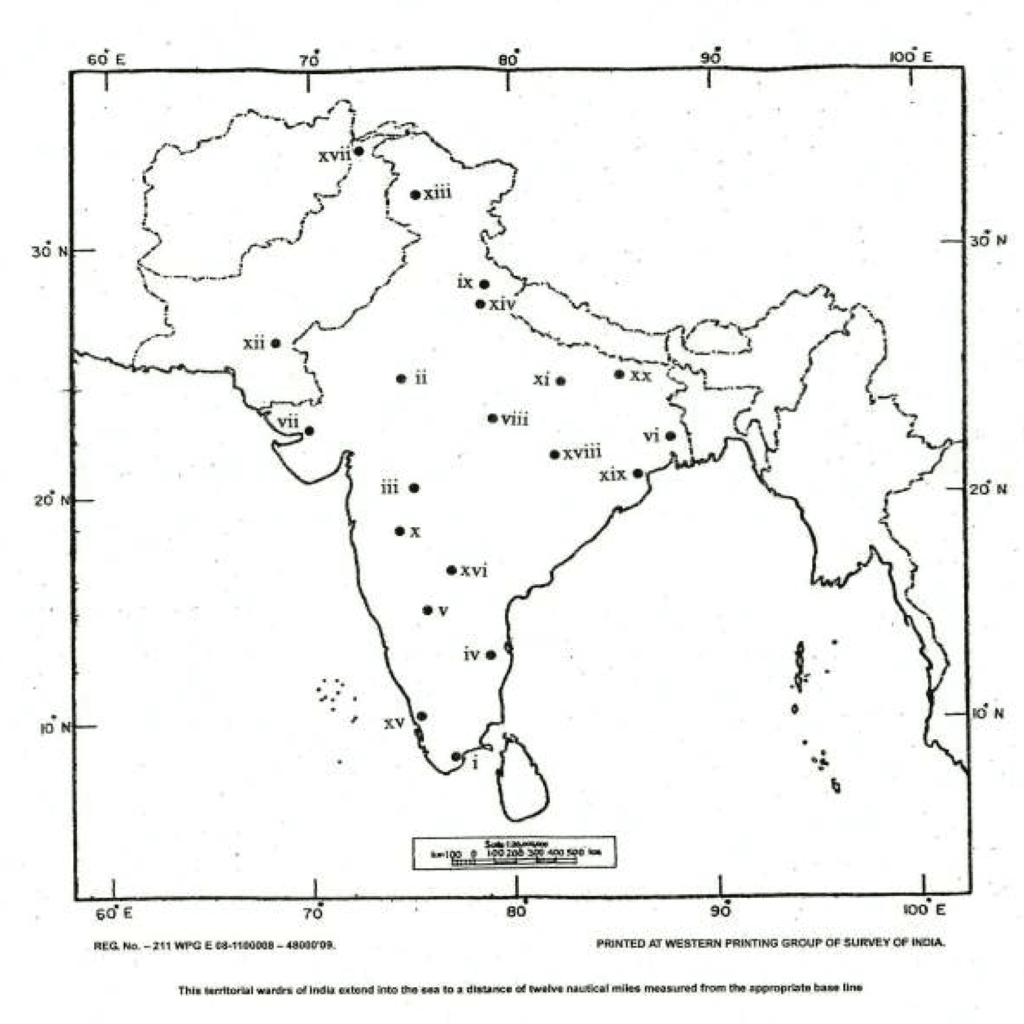
Q. Identify the following places marked on the map supplied to you and write a short note of about 30 words on each of them in your Question-cum-Answer Booklet. Locational hints for each of the places marked on the map are given below seriatim:
- i)Megalithic burial site
- (ii)Chalcolithic site
- (iii)Cave Paintings
- (iv)Paleolithic site
- (v)Political and Cultural centre
- (vi)Terracotta centre
- (vii)Harappan site
- (viii)Vaishnava cultural site
- (ix)Painted Grey Ware site
- (x)Chalcolithic site
- (xi)Early Agricultural centre
- (xii)Early Harappan site
- (xiii)An ancient temple
- (xiv)Political and Cultural centre
- (xv)An ancient sea port
- (xvi)Buddhist centre
- (xvii)Inscriptional site
- (xviii)An ancient capital
- (xix)A Jaina centre
- (xx)An ancient capital
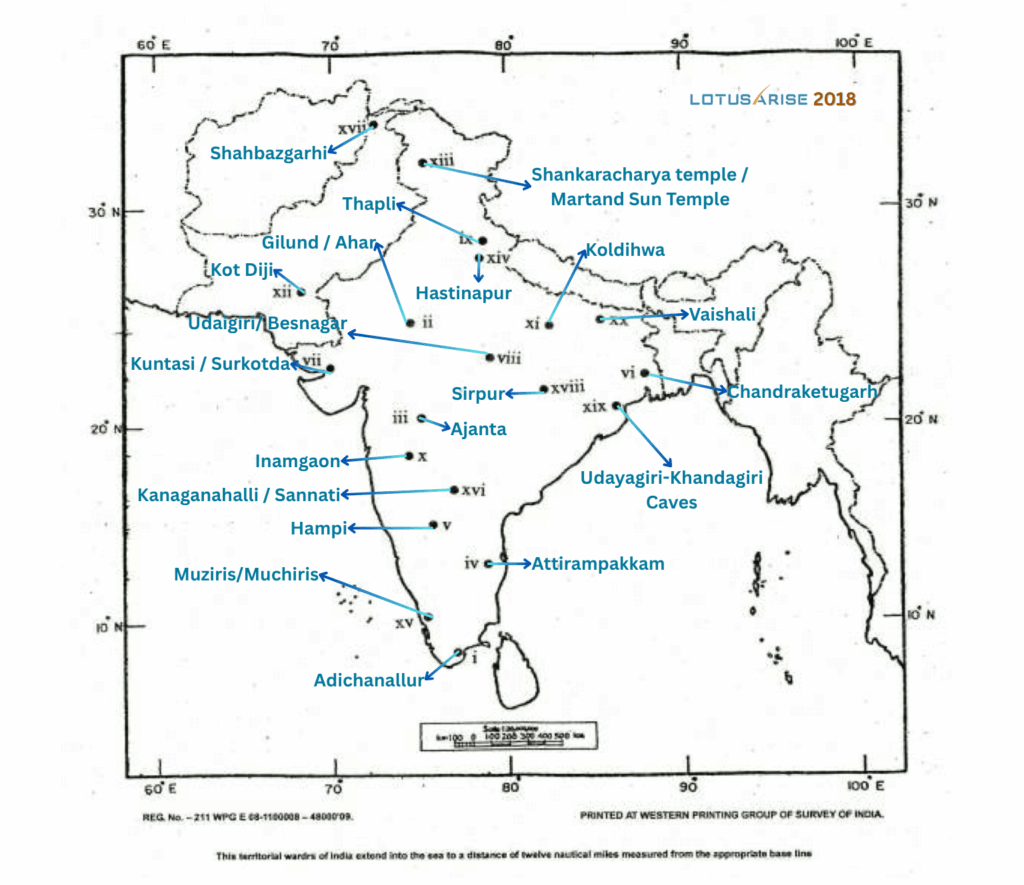
Mapping PYQs Solution 2018:
- Megalithic burial site: Adichanallur
- Chalcolithic site: Gilund / Ahar
- Cave Paintings: Ajanta
- Palaeolithic site: Attirampakkam
- Political and cultural centre: Hampi
- Terracotta centre: Chandraketugarh
- Harappan site: Kuntasi / Surkotda
- Vaishnav cultural site: Udaigiri/ Besnagar
- Painted Grey Ware site: Thapli
- Chalcolithic site: Inamgaon
- Early agricultural centre: Koldihwa
- Early Harappan site: Kot Diji
- An ancient temple: Shankaracharya temple / Martand Sun Temple
- Political and cultural centre: Hastinapur
- An ancient sea port: Muziris/Muchiris
- Buddhist centre: Kanaganahalli / Sannati
- Inscriptional site: Shahbazgarhi
- An ancient capital: Sirpur
- A Jaina centre: Udayagiri-Khandagiri Caves
- An ancient capital: Vaishali
These 20 sites are Question 1 of Paper I in the 2018 History Optional examination — 2.5 marks each, 50 marks in total, with a note of about 30 words expected on every one. Each is solved in full below. The complete 2018 paper is at History Optional Question Paper 2018.
The map is 50 marks. What about the other 450?
You have the map answers on this page, free, for every site UPSC marked in 2018. That is 50 marks dealt with. The other 450 marks of the 2018 papers are still sitting there unanswered — and those are the marks that separate 260 from 320.
The History Optional PYQ Master Pack carries a written model answer for every question the Commission has set since 1985, including every non-map question on the 2018 paper.
- PYQs from 1985 to 2025 — arranged topic-wise, so you revise a theme and see every way it has been asked
- Model answers, not hints — full answers with historians named inside the argument, written to the mark and the word limit
- Map sections solved too — the same quality as this page, for every year, in one offline file
- PDF plus online access — on any device, permanently, not for the length of a subscription
₹1,499 (regular ₹2,500). One-time payment, instant access.
(i) Megalithic burial site
Adichanallur: An Ancient Urn Burial Site
- Location: Situated in the Tuticorin District, Tamil Nadu.
- Significance: Adichanallur is a critically important archaeological site, primarily known for its extensive urn burial site, which provides crucial insights into the funerary practices, material culture, and early Iron Age life in South India.
- Burial Practices (Key Highlight):
- The site is characterized by numerous earthenware urns used for burial.
- Skeletal remains inside the urns are typically found in a crouched position, a distinctive burial custom.
- Archaeologists also uncovered rare instances of double burial, where two individuals were interred together.
- Archaeological Finds:
- Metals: A variety of objects made of bronze and iron have been discovered, indicating the metallurgical skills of the inhabitants.
- Pottery: The site yielded diverse pottery types, including Black-and-Red Ware (BRW), red ware, and black ware.
- Graffiti on Pottery: The presence of graffiti on pottery suggests early forms of symbolic representation or possibly a nascent writing system.
- Iron Implements: Common iron implements found include arrowheads, spearheads, and axes, highlighting their tools and weaponry.
- Copper Ornaments: Decorative copper ornaments were also part of the grave goods.
- Unique Impressions: Notably, impressions of rice husk and cloth were found on an iron sword, providing direct evidence of their agricultural practices (rice cultivation) and textile use.
- Evidence of Industrial Activity:
- The discovery of a potter’s kiln within the habitational site indicates organized industrial activity related to pottery production, suggesting specialized crafts within the community.
(ii) Chalcolithic site
Gilund (or may be Ahar)
Gilund
- Location: Situated in the Rajsamand district of Rajasthan, India, in the Banas River basin.
- Significance: Gilund is an extremely important archaeological site because it is the largest site of the Ahar-Banas Complex, a significant Chalcolithic (Copper Age) culture that flourished in southeastern Rajasthan. Its excavations provide crucial insights into early farming communities, their socio-economic organization, and their interaction with the contemporaneous Indus Valley Civilization.
- Cultural Phases:
- The site reveals evidence of continuous occupation during the Chalcolithic period, from approximately 3000 BCE to 1700 BCE, indicating a long-lived settlement.
- While primarily a Chalcolithic site, there are some later finds, including elements that can be linked to the Late Harappan period, and even early historic periods, though its main significance lies in its Chalcolithic phase.
- Settlement and Architecture:
- Gilund comprises two prominent mounds, an ‘eastern’ and a ‘western’ mound.
- Excavations have uncovered various housing structures, including large buildings with long parallel walls, indicating complex architecture.
- Structures were primarily made from mud-brick and also incorporated burnt bricks, showcasing advanced building techniques for the period.
- There is evidence of an exterior wall surrounding the site, possibly for defense or flood protection from the nearby Banas River.
- Material Culture & Economy:
- Pottery: The site is rich in ceramics, including distinctive white-painted black and red ware, red ware, and grey ware, characteristic of the Ahar-Banas culture.
- Craft Production: Evidence of workshops and refuse heaps suggests small-scale craft production.
- Terracotta Figurines: Numerous terracotta figurines, particularly of bulls or cattle, have been found, possibly holding religious or symbolic significance.
- Tools and Ornaments: Discoveries include stone tools (for various purposes like bead making) and limited copper artifacts, ear spools, studs, and bangles.
- Seals: A remarkable discovery was a large cache of more than 100 seal impressions dating to 2100-1700 BCE. These seals, while often simple in design, show parallels with motifs from both the Indus Civilization and even distant Central Asian cultures (Bactria-Margiana Archaeological Complex), suggesting extensive trade networks and cultural interactions.
- The economy was primarily agro-pastoral, based on farming (likely wheat and barley) and animal husbandry.
Ahar
- Location: Situated on the banks of the Ahar River in southeastern Rajasthan.
- Significance: Ahar is a crucial archaeological site that represents a major center of the Chalcolithic (Copper Age) culture, with evidence also extending into the Late Harappan period. It’s part of the wider Ahar-Banas cultural complex and provides significant insights into early agricultural and metallurgical communities in the region.
- Pottery (Distinctive Feature):
- The site is well-known for its characteristic Black-and-Red Ware (BRW), which is often decorated with linear and dotted designs.
- Common pottery shapes include bowls, bowls-on-stands, and various types of vases.
- Habitation and Architecture:
- The settlement comprised houses of varying sizes, including single, double, and multi-roomed structures.
- Houses could be rectangular, square, or circular in plan, showing diverse architectural approaches.
- Construction primarily utilized stones and mud bricks, with the walls typically being plastered with mud for finishing.
- Subsistence Pattern: The economy of the Ahar people was diversified:
- Cultivation: They practiced agriculture, growing crops like wheat and barley.
- Animal Rearing: Animal husbandry was a significant component, indicating reliance on domesticated animals.
- Hunting: Hunting also formed a part of their subsistence strategy, supplementing their food sources.
- Trade Links:
- Evidence suggests that the Ahar culture maintained trade links with the Harappans, likely exchanging goods, possibly including copper from the rich Aravalli deposits.
(iii) Cave Paintings
Ajanta
- Location: Aurangabad district, Maharashtra, India.
- Significance: The Ajanta Caves are a spectacular complex of Buddhist rock-cut caves, renowned globally for their ancient architecture, sculptures, and especially their vivid mural paintings. They are a UNESCO World Heritage Site, representing one of the finest examples of ancient Indian art.
- Period of Construction:
- The caves were carved out of solid rock over a long period, spanning from the 2nd century BCE to the 7th century CE.
- The 7th-century Chinese Buddhist pilgrim Xuanzang (Hieun Tsang) mentioned these caves in his travel accounts, highlighting their fame even in ancient times.
- Two Major Phases of Construction:
- Phase 1 (Satavahana Period – c. 2nd-1st century BCE): These earlier caves primarily reflect Hinayana (Theravada) Buddhism, which emphasized monastic life and didn’t involve idol worship of the Buddha.
- Phase 2 (Vakataka Period – c. 5th-7th century CE): These later caves, excavated under the patronage of the Vakataka dynasty, are more elaborate and reflect the rise of Mahayana Buddhism, which involved the worship of Buddha and Bodhisattva images.
- Architecture:
- The caves consist of both Chaityas (prayer halls) and Viharas (monastic dwelling cells or monasteries).
- Early Viharas were simpler and typically lacked a shrine or an image of the Buddha.
- Later Viharas became more complex and often included a shrine at the rear center with a statue of Buddha. This architectural change directly reflects the theological shift from Hinayana to Mahayana Buddhism, where the Buddha became an object of devotion and representation.
- Paintings:
- The Ajanta Caves are world-famous for their incredible mural paintings (frescoes), which adorn the walls and ceilings of many caves.
- The paintings primarily depict Buddhist themes, most notably Jataka stories (tales of Buddha’s previous lives), along with scenes from his life, deities, and everyday life.
- These paintings are characterized by their vibrant use of many colors, intricate details, and emotional expressiveness, showcasing the zenith of ancient Indian painting.
(iv) Paleolithic site
Attirampakkam
- Location: Chennai district, Tamil Nadu.
- Time Period: Shows a sequence of Lower, Middle, and Upper Paleolithic cultures. It is among the oldest prehistoric sites in South Asia.
- Type of Site: An open-air Paleolithic site.
- Artefacts:
- Predominantly handaxes, crafted from quartzite stones, indicating material was transported from outside the immediate area.
- Tools were used for butchery and chopping wood.
- The uniform shape and symmetry of the tools suggest organized and collective work.
- Other Finds:
- A set of animal footprints.
- Fossil teeth of animals like horse, water buffalo, and nilgai, suggesting an open and wet landscape during early Paleolithic times.
(v) Political and Cultural centre
Hampi: Capital of the Vijayanagara Empire
- Location: Situated within the ruins of Vijayanagara city, Karnataka.
- Significance: Flourished as the capital of the Vijayanagara Empire. Foreign travelers documented its glory.
- UNESCO Status: Group of Monuments at Hampi is a UNESCO World Heritage Site.
- Architecture: Features religious, civil, and military structures, known for their distinctive Vijayanagara style, blending Dravidian and Indo-Islamic elements. Advanced water management systems (e.g., aqueducts, tanks) supported the large city.
- Religious Buildings (Examples):
- Hazara Rama Temple Complex: Built by Krishnadeva Raya. Features elaborate frescoes and carvings depicting the Ramayana story.
- Vittala Temple Complex: Noted for its iconic stone chariot and musical pillars. Carvings depict various scenes, including foreigners like Persians selling horses, indicating vast trade.
- Virupaksha Temple: Predates the empire’s founding. Dedicated primarily to Lord Shiva.
- Important Civil Architecture (Example):
- Elephant Stable: Used to house the eleven royal elephants of King Krishnadeva Raya’s army. Adjacent building housed the elephant riders.
(vi) Terracotta centre
Chandraketugarh
- Location: North 24 Parganas district, West Bengal.
- Significance: An important archaeological site with continuous occupation from the pre-Mauryan to the Gupta period, suggesting its long-standing importance. It likely functioned as a major port-town in ancient Bengal.
- Key Finds:
- Northern Black Polished Ware (NBPW) found, indicating connections with the early Gangetic urban centers.
- Silver and copper punch-marked coins, some with a ship motif, strongly suggest its identity as a port.
- Various stone and terracotta beads, along with semi-precious stone beads and items of ivory and bone, highlight local craftsmanship and trade.
- Terracotta Art:
- Renowned for its terracotta plaques, showing unusual precision and craftsmanship.
- These plaques share similar motifs and execution styles with those found at sites like Kaushambi and Ahichhatra, indicating widespread artistic traditions and cultural connections.
- A temple structure from the Gupta or post-Gupta period has also been discovered, pointing to later architectural developments.
(vii) Harappan site
Kuntasi (other possibility Surkotda)
Kuntasi
- Location: Morbi district, Gujarat.
- Phases: Mature and Late Harappan site.
- Function:
- Identified as having a jetty and a manufacturing center, indicating its role in maritime trade and industry.
- Architecture:
- Houses built on stone foundations with mud-brick walls, conforming to Harappan proportions but unusually large.
- Notably, no citadel has been found, differing from larger Harappan cities.
- Key Finds:
- Pottery with drawings.
- Two cylindrical stone anchors, providing strong evidence for seaborne activity.
- Lapis Lazuli found in large quantity, which was probably exported to Mesopotamia, highlighting its role in long-distance trade.
Surkotada
- Location: Kutch district, Gujarat.
- Significance: Situated on the land route to Lothal, suggesting a strategic location for inland and coastal trade during the Harappan period.
- Construction: Primarily used mud brick and stone rubble for construction.
- Known for its fortified settlement, indicating a defensive structure.
- Antiquities:
- A terracotta seal with Harappan pictographic script, uniquely without animal motifs.
- Beads of steatite and carnelian.
- Archaeological findings include a horse-like skeleton and elephant bone, which are significant for understanding the fauna associated with Harappan sites and have been subjects of scholarly debate.
- Economy: Evidence points to its involvement in coastal trade during Harappan times.
(viii) Vaishnava cultural site
Udaigiri Caves or Besnagar
Udaigiri Caves
- Location: Near Vidisha, Madhya Pradesh.
- Nature: A complex of ancient rock-cut caves.
- One cave is dedicated to Jainism, and 23 to Hinduism.
- Iconography: Features iconography representing Vaishnavism, Shaktism, and Shaivism.
- Notable is the large relief sculpture of Vishnu in his Man-Boar (Varaha) incarnation, a significant example of Gupta art.
- Inscriptions:
- Contains inscriptions from the Gupta dynasty, belonging to the reigns of Chandragupta II and Kumaragupta I.
- Includes one of the oldest Jain inscriptions, dating to 425 CE.
Heliodorus Pillar (Besnagar Pillar / Garuda Pillar)
- Location: Near Udaygiri, at Besnagar, Madhya Pradesh.
- Nature: A monolithic (single-piece) free-standing stone column.
- It was originally surmounted by a sculpture of Garuda (Vishnu’s vahana/mount).
- Historical Context:
- Erected around 113 BCE by Heliodorus, a Greek ambassador from the Indo-Greek king Antialcidas to the court of the Shunga king Bhagabhadra.
- The inscription states it was raised in honor of god Vasudeva, making it a crucial piece of evidence for the early history of Bhagavatism (Vaishnavism) and Indo-Greek religious interactions.
(ix) Painted Grey Ware site
Thapli
- Location: In Uttarakhand (often associated with the Garhwal region).
- Significance: Identified as an important Painted Grey Ware (PGW) site.
- Cultural Period: Represents the Iron Age in the region (c. 1200-600 BCE), linking it to the Later Vedic period and early urbanisation.
- Finds: Presence of PGW indicates early iron use and a distinct ceramic tradition.
(x) Chalcolithic site
Inamgaon
- Location: Pune district, Maharashtra.
- Significance: A prominent Post-Harappan Chalcolithic site, showing phases of Jorwe and Malwa cultures. It provides insights into early farming communities in the Deccan.
- Habitation:
- Early Chalcolithic: Featured mud and circular houses, with storage pits. A large five-room house possibly belonged to a ruling chief, indicating social hierarchy. A granary was also found.
- Later Chalcolithic: Development of a fortified wall around the settlement.
- Pottery: Characterized by red ware with black designs.
- Artefacts:
- Tools: Stone tools for various purposes. Limited copper tools found, alongside ornaments.
- Ornaments: Beads, bangles, anklets (including later gold finds).
- Specialized Tools/Weapons: Drills, fish hooks, arrowheads.
- Beads: Made from terracotta, semi-precious stones, ivory, and sea shells, suggesting trade.
- Terracotta Figurines: Including toys, bulls, and female goddesses.
- Economy:
- Evidence of trade with other regions.
- Agriculture: Cultivation of wheat, barley, lentils, peas, gram, and beans.
- Animal Husbandry: Bones of both wild and domesticated animals found.
Two minutes per site — could you write this one from memory?
Reading a solved site note is not the same as producing one under a clock. In the hall you get roughly two minutes per identification — locate it, name the period, name the excavator or dynasty, give one distinguishing find, and say why it matters. Miss the significance line and the examiner has nothing to award the second mark for.
That same gap runs through the whole paper. Most candidates know the content and still lose four to six marks per answer because the answer never states a position. The model answers in the Master Pack are written to show the structure, not just the facts.
(xi) Early agricultural centre
Koldihawa: A Multi-Period Site with Early Rice Evidence
- Location: Allahabad district (now Prayagraj), Uttar Pradesh.
- Significance: Reveals a continuous cultural sequence from the Neolithic, through Chalcolithic, to the Iron Age, providing crucial insights into transitions in ancient Indian history.
- Early Rice Evidence:
- One of the earliest sites globally with direct evidence of cultivated rice.
- Remains of rice and impressions of rice husk embedded in burnt clay pieces were found.
- Neolithic Period:
- Tools: Stone blades, polished stone celts, microliths, querns and mullers (grinding stones), and bone tools.
- Pottery: Predominantly hand-made, cord-marked pottery, and Black-and-Red Ware (BRW).
- Chalcolithic Period:
- Pottery: Introduction of wheel-made pottery alongside BRW.
- Habitation: Mud floors with burnt clay and post holes, indicating wattle-and-daub houses.
- Tool Kit: Includes tools made of copper, bone, and stone (microliths).
- Ornaments: Discovery of copper beads, bone tools, beads of semi-precious stones, ring stones, and terracotta.
(xii) Early Harappan site
Kot Diji:
- Location: Sindh, near Amri, on the bank of the Indus River.
- Phases: Reveals both Early and Mature Harappan levels.
- Settlement Features:
- Fortified with a massive wall of limestone rubble and mud-brick.
- Divided into a citadel complex and a lower residential area.
- House walls constructed from stone and mud-brick.
- Artefacts:
- Objects made of stone, shell, and bone.
- Terracotta figurines, including a bull figurine, bangles, and beads.
- Pottery:
- Wheel-made and decorated.
- Distinctive short-necked ovoid pots, painted with designs like the ‘horned deity’, pipal leaves, and ‘fish scales’.
- Transition Event: A burnt deposit found between Early and Mature Harappan levels (also seen at Gumla) suggests a major fire, possibly indicating a significant event or transition.
(xiii) An ancient temple
Martand Sun Temple
- Location: Near Anantnag, Jammu & Kashmir.
- Deity & Period: Dedicated to Surya (Sun God), built in the 8th century CE. Now in ruins.
- Builder: Constructed by Lalitaditya Muktapida of the Karkota dynasty.
- Architecture:
- Stands within a large courtyard, enclosed by a cellular peristyle with fluted columns.
- Temple proper includes a garbhagriha, antarala, and a closed mandapa, accessed by steps.
- Exterior of the sanctum features a ‘three ratha’ plan.
- Entered from the west via a double-chambered gateway.
(xiv) Political and Cultural centre
Hastinapur: Ancient Capital of the Kuru Kingdom
- Location: Meerut district, Uttar Pradesh.
- Historical Significance: Known as the capital of the Kuru kingdom, central to the Mahabharata epic.
- Jain Tradition: Considered a place where Rishabha, the first Tirthankara, lived, and Mahavira visited.
- Cultural Sequence: Shows occupational layers from Ochre Coloured Pottery (OCP) followed by Painted Grey Ware (PGW).
- Early Habitation (PGW Period):
- Structures: Wattle-and-daub and mud huts. Unbaked bricks used.
- Finds: Chert and jasper weights, and horse bones (significant for Vedic period fauna).
- Later Urbanization (2nd century BCE – 3rd century CE):
- Settlement: Evidence of a planned settlement.
- Architecture: Use of burnt bricks and ring wells (for drainage/water).
- Pottery: Dominance of wheel-turned red ware, featuring designs like fish, leaves, flowers, svastikas, triratnas, and geometric patterns.
- Artefacts:
- Objects made of iron, copper, ivory, and terracotta figurines.
- Rings, beads, potsherds, and seals.
- Coins of the Yaudheyas and Kushanas.
- Terracotta: Depictions include a humped bull and a torso identified as the Bodhisattva Maitreya.
(xv) An ancient sea port
Muziris
- Location: Near Cranganore (Kodungallur), Kerala.
- Significance: An ancient port in the Chera kingdom during the Sangam Age. It was a vital hub for maritime trade with the Western world.
- Historical Mentions: Referenced in Sangam literature and by Greek & Roman writers like Pliny and the Periplus of the Erythraean Sea.
- Trade (Key Goods):
- Exports: Spices (especially pepper), semi-precious stones, pearls, diamonds, sapphires, ivory, tortoise shells.
- Imports: Roman gold coins, figured linens, copper, tin, lead, coral, raw glass, wine.
- Modern Recognition: The Muziris Heritage Project has been initiated by the Kerala government for its preservation and promotion.
(xvi) Buddhist centre
Sannati
- Location: Gulbarga District (now Kalaburagi District) of Northern Karnataka.
- Key Discoveries:
- Buddhist Stupa: A significant Buddhist stupa was discovered.
- Ashokan Portrait & Inscription: The site yielded the first inscribed portrait of Emperor Ashoka, where he is explicitly named ‘Raya Ashoka’, a historically crucial find.
- Major Ashokan Rock Edicts: Contains Major Rock Edict fragments (including Edicts 13 and 14) and Separate Rock Edicts 1 and 2.
- Script & Language: Inscriptions are in Prakrit language and Brahmi script.
- Other Significance: Famous for the Chandrala Parameshwari Temple, indicating later religious importance.
(xvii) Inscriptional site
Shahbazgarhi (though given location is bit dislocated)
- Location: Mardan district, Pakistan.
- Significance: Site of Major Rock Edicts of Emperor Ashoka. Located along an ancient trade route.
- Edicts:
- Comprises fourteen major edicts.
- They present aspects of Ashoka’s dharma.
- Carved on two rocks on a hill.
- Script and Language:
- Inscribed in Kharoshthi script, written from right to left.
- The use of Kharoshthi suggests Achaemenid influence in the region.
(xviii) An ancient capital
Sirpur
- Location: Mahasamund district, Chhattisgarh.
- Significance: An ancient site that served as Shreepur, the capital of South Koshal. It is notable for its rich concentration of Hindu, Buddhist, and Jain monuments, showcasing religious harmony and artistic prowess.
- Hindu Monuments:
- Features temples dedicated to Shiva and Vaishnava deities.
- Lakshmana Temple: A prominent brick temple, considered most well-preserved. Built by Vasata in the 7th century CE, dedicated to Lord Vishnu. Its plan includes a garbhagriha, antarala, and a mandapa.
- Other temples include Rama temple and Gandheshwar temple.
- Buddhist Monuments:
- Includes Viharas (monasteries).
- Statues of Buddha, Padmapani, and Avalokiteshvara.
- Some syncretic finds blending Hindu and Buddhist iconography.
- Jain Monuments:
- Ruins of Jain basadi (temples) and monasteries have been found.
- A bronze image of Adinatha (the first Tirthankara) was discovered.
(xix) A Jaina centre
Udayagiri- Khandagiri Caves (though given location is bit dislocated)
- Location: Twin hills of Udayagiri and Khandagiri, near Bhubaneswar, Odisha.
- Significance: A complex of 33 rock-cut caves, primarily serving as dwelling retreats for Jain monks.
- Period & Patronage: Caves were excavated by King Kharavela and his successors in the 2nd century BCE onwards.
- Architectural Features:
- Mostly single-storied, but some are double-storied (e.g., Ranigumpha Cave, which is also the largest).
- Hathigumpha Inscription (Elephant Cave Inscription):
- Located in Udayagiri, this 17-line inscription is by King Kharavela.
- Written in Prakrit language and Brahmi script.
- Content: Details Kharavela’s military conquests, his devotion to Jainism, construction works, liberal religious policies, patronage of arts (music and dance), and his retrieval of a Jina image.
- Historical Importance: This inscription provides the earliest epigraphic reference to image worship in Jainism.
(xx) An ancient capital
Vaishali
- Location: Bihar.
- Significance: Capital city of the Licchavi republic, part of the Vrijji Confederacy Mahajanapada, and considered one of the earliest examples of a republic. It holds immense importance for both Jain and Buddhist religions.
- Jain Connection:
- The 24th Jain Tirthankara, Mahavira, was born and brought up in Kundagrama within the Vaishali republic in 599 BCE.
- Buddhist Connection:
- Gautama Buddha preached his last sermon here in 483 BCE before his Mahaparinirvana.
- The Second Buddhist Council was convened here by King Kalasoka in 383 BCE.
- Mauryan Presence: An Ashokan Pillar topped by a single lion has been found here.
- Foreign Accounts: Mentioned by Chinese pilgrims Faxian (4th century CE) and Xuanzang (7th century CE).
- Cultural Significance: Renowned as the land of Amrapali, the famous courtesan who later became a disciple of Buddha, appearing in folktales and Buddhist literature.
Note:
- Except Kuntasi, all other sites were covered in our LotusArise Map Material.
How to write the map answer in the exam hall
The solutions above are reference notes, not model answers. In the hall you have roughly 45 minutes for all 20 sites — about two minutes each, including the time it takes to find the number on the map. What follows is the structure that reliably earns the full 2.5 marks.
The five-part note that works every time
- Locate it — present-day state, and the river or coast it sits on
- Date it — the period or culture it belongs to (Palaeolithic, Harappan, Satavahana, Mughal)
- Attribute it — the excavator, the founding dynasty, or the ruler associated with it
- Evidence it — one distinguishing find, structure or inscription
- Justify it — one line on why the site matters to the wider historical argument
Four habits that cost marks
- Writing 60 words on the three sites you know and one line on the rest — the marks are the same for each
- Naming the site and stopping — identification alone is half the mark
- Leaving the map question for the end — it is the only section where you cannot think your way to an answer, so bank it first
- Skipping a site entirely — even a location and a period is worth attempting
Practise on a blank outline map rather than by reading. Mark the 20 sites from memory, write your notes, then check them against this page. Every site you missed becomes a flashcard.
Two ways to prepare for the rest of the paper
The map solutions on this site are free and will stay free. If you want the rest of the optional handled the same way, there are two routes, depending on where you are in your preparation.
| PYQ Master Pack | Mains Master Kit 2027 | |
| Best when | Your notes are done and you now need answer-writing | You are still building the subject from the ground up |
| What you get | Model answers to every question since 1985, topic-wise, map sections included | 4,500+ pages of notes, complete mapping coverage, 12 months of article access |
| Covers the map section | Yes — every year solved | Yes — site-wise preparation, not just answers |
| Price | ₹1,499 (regular ₹2,500) | ₹1,770 (regular ₹5,000) |
Both are one-time purchases with permanent access. Aspirants in their second or third attempt usually take the PYQ Master Pack; first-timers usually start with the Kit.
Frequently asked questions
History Optional map solutions — other years
Site types repeat far more often than individual sites. Working through the years below by category is the fastest way to make the 50-mark section reliable.
- UPSC History Optional Map Solution 2025 — all 20 identifications solved with 30-word notes
- UPSC History Optional Map Solution 2024 — all 20 identifications solved with 30-word notes
- UPSC History Optional Map Solution 2023 — all 20 identifications solved with 30-word notes
- UPSC History Optional Map Solution 2022 — all 20 identifications solved with 30-word notes
- UPSC History Optional Map Solution 2021 — all 20 identifications solved with 30-word notes
- UPSC History Optional Map Solution 2020 — all 20 identifications solved with 30-word notes
- UPSC History Optional Map Solution 2019 — all 20 identifications solved with 30-word notes
- UPSC History Optional Map Solution 2017 — all 20 identifications solved with 30-word notes
- UPSC History Optional Map Solution 2016 — all 20 identifications solved with 30-word notes
- UPSC History Optional Map Solution 2015 — all 20 identifications solved with 30-word notes
- UPSC History Optional Map Solution 2014 — all 20 identifications solved with 30-word notes
- UPSC History Optional Map Solution 2013 — all 20 identifications solved with 30-word notes




