UPSC History Optional Map Solution 2022

History Optional Mapping PYQs Solution: Map Based Questions with Solution – 2022 History Optional Mains Examination.
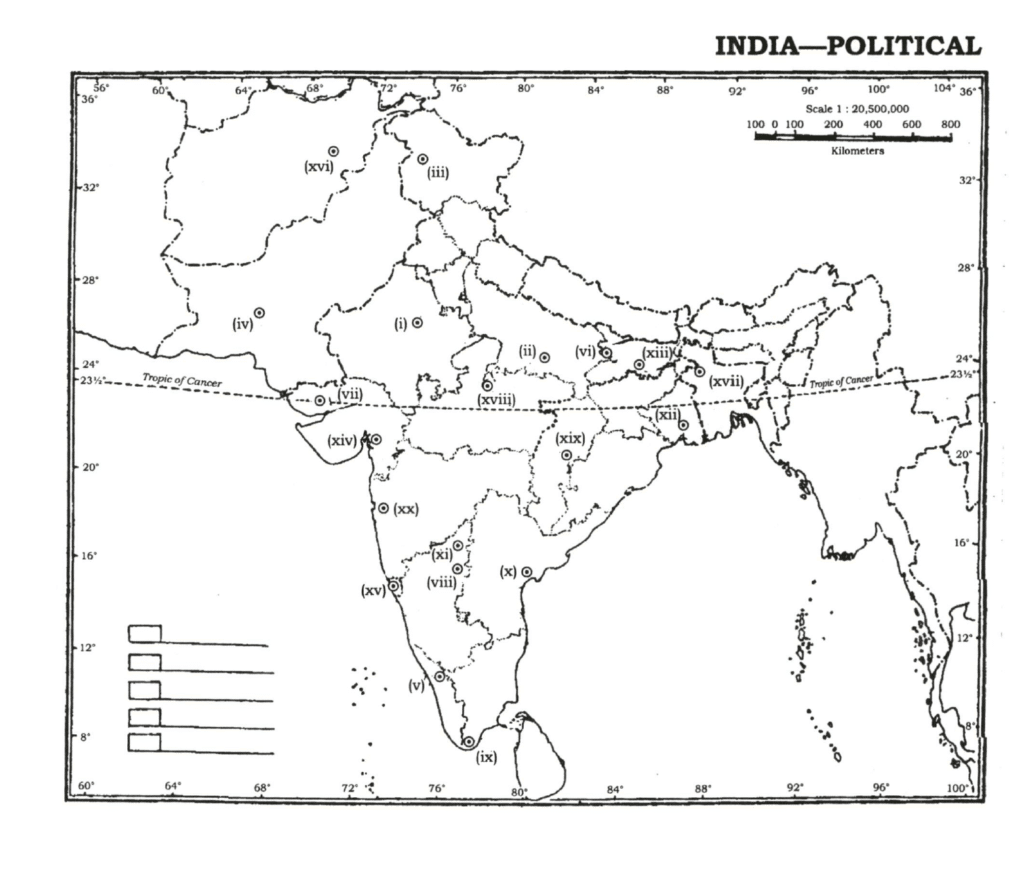
Q. Identify the following places marked on the map supplied to you and write a short note of about 30 words on each of them in your Question-cum-Answer Booklet. Locational hints for each of the places marked on the map are given below seriatim:
- (i) Paleolithic site
- (ii) Mesolithic site with burials
- (iii) Neolithic pit dwelling
- (iv) Early village settlement
- (v) Neolithic site
- (vi) Neolithic-Chalcolithic site
- (vii) Harappan UNESCO site
- (viii) Megalithic burial site
- (ix) Place of Second Sangam
- (x) Earliest Satavahana capital
- (xi) Place of inscribed statue of Ashoka
- (xii) First Gupta hoard of coins
- (xiii) Hoard of metal sculptures
- (xiv) Ancient port
- (xv) Oldest Jesuit church
- (xvi) Centre of Gandhara art
- (xvii) Buddhist Monastery
- (xviii) Place of earliest Vishnu temple
- (xix) Shiva and Buddhist temple complex
- (xx) Earliest Chaitya Griha
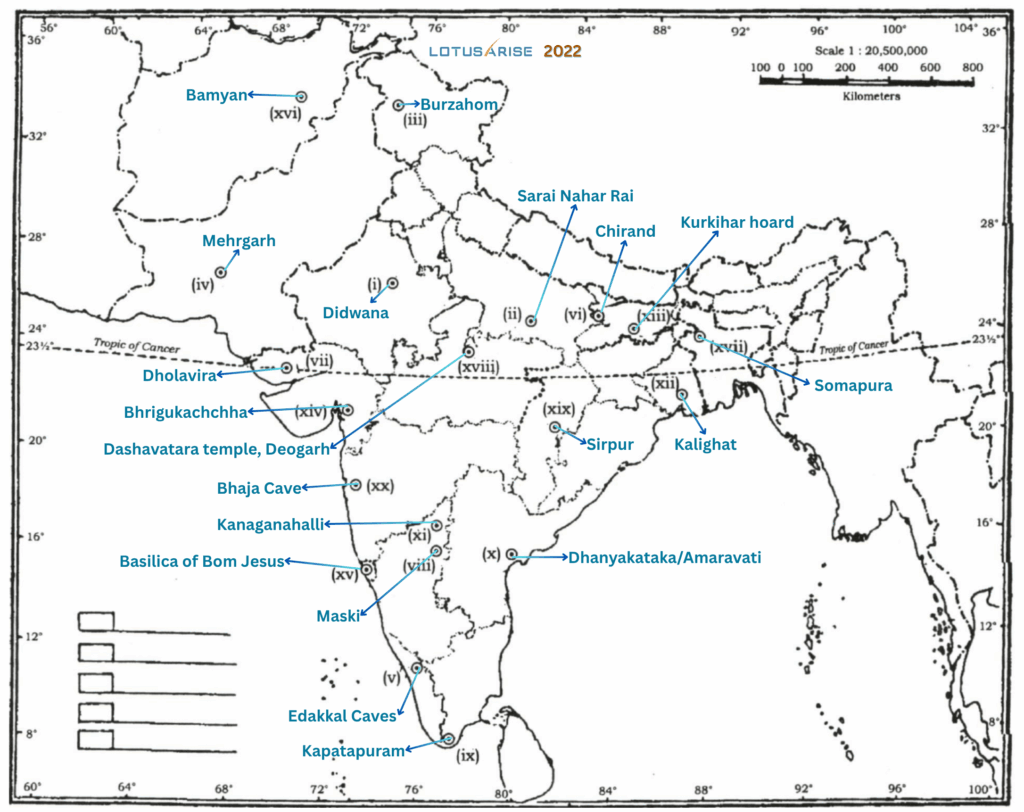
Mapping PYQs Solution:
- Palaeolithic site: Didwana
- Mesolithic site with burials: Sarai Nahar Rai
- Neolithic pit dwelling: Burzahom
- Early village settlement: Mehrgarh
- Neolithic site: Edakkal caves
- Neolithic-Chalcolithic site: Chirand
- Harappan UNESCO site: Dholavira
- Megalithic burial site: Maski
- Place of second Sangam: Kapatapuram
- Earliest Satavahana capital: Dhanyakataka/Amaravati
- Place of inscribed statue of Ashoka: Kanaganahalli
- First Gupta hoard of coins: Kalighat, Kolkata
- Hoard of metal sculptures: Kurkihar hoard, Gaya
- Ancient port: Bhrigukachchha
- Oldest Jesuit church: Basilica of Bom Jesus
- Centre of Gandhara art: Bamyan
- Buddhist Monastery: Somapura
- Place of earliest Vishnu Temple: Dashavatara temple, Deogarh
- Shiva and Buddhist temple complex: Sirpur
- Earliest Chaitya Griha: Bhaja Cave
These 20 sites are Question 1 of Paper I in the 2022 History Optional examination — 2.5 marks each, 50 marks in total, with a note of about 30 words expected on every one. Each is solved in full below. The complete 2022 paper is at History Optional Question Paper 2022.
The map is 50 marks. What about the other 450?
You have the map answers on this page, free, for every site UPSC marked in 2022. That is 50 marks dealt with. The other 450 marks of the 2022 papers are still sitting there unanswered — and those are the marks that separate 260 from 320.
The History Optional PYQ Master Pack carries a written model answer for every question the Commission has set since 1985, including every non-map question on the 2022 paper.
- PYQs from 1985 to 2025 — arranged topic-wise, so you revise a theme and see every way it has been asked
- Model answers, not hints — full answers with historians named inside the argument, written to the mark and the word limit
- Map sections solved too — the same quality as this page, for every year, in one offline file
- PDF plus online access — on any device, permanently, not for the length of a subscription
₹1,499 (regular ₹2,500). One-time payment, instant access.
(i) Paleolithic site
Didwana
- Location: Nagaur district, Rajasthan.
- Significance: Known for yielding significant archaeological evidence from the Paleolithic (Old Stone Age) period.
- Lower Paleolithic:
- Found large tools crafted from quartzite and other hard rocks.
- Includes characteristic tool types such as chopping tools, handaxes, and cleavers.
- Middle Paleolithic:
- Evidence of more refined tools, predominantly smaller, lighter flake tools.
- Lower Paleolithic:
(ii) Mesolithic site with burials
Sarai Nahar Rai
- Location: Pratapgarh district, Uttar Pradesh.
- Significance: It represents one of the most important stratified Mesolithic (Middle Stone Age) settlements in India.
- Tool Finds: Abundant geometric microliths (small, finely worked stone tools) were discovered.
- Other Finds: Evidence of shells and animal bones alongside tools, indicating subsistence activities.
- Human Burials (Key Feature):
- Burials were found within the habitation area, suggesting community living and reverence for the dead.
- Discovered 13 human burials (men, women, and children), consistently placed with their heads oriented westward.
- A notable find included one skeleton with an arrowhead embedded in its ribs, suggesting interpersonal violence or hunting accidents.
- Grave Goods: Microlithic tools, animal bones, and shells were interred with the deceased, hinting at funerary rituals and belief in an afterlife.
- Health Insights: Analysis revealed generally good dental health, but some individuals showed signs of osteo-arthritis, indicating physical stress or aging.
- Settlement Structure:
- Excavations revealed floors made of burnt clay.
- Numerous fire hearths (fireplaces) were found, some containing charred animal bones, indicating cooking and communal eating.
- Faunal Evidence: Presence of bones from many domesticated animal types, suggesting an early stage of animal domestication alongside hunting.
Note: There are many other Mesolithic sites nearby.
(iii) Neolithic pit dwelling
Burzahom
- Location: Northeast of Srinagar, Jammu & Kashmir.
- Significance: It is recognized as the first Neolithic (New Stone Age) site discovered in Kashmir, providing crucial insights into early human settlements in the region.
- Uniquely, a Megalithic culture succeeded the Neolithic phase at this site.
- Distinctive Features of its Neolithic Culture:
- Unlike many other Neolithic sites, the inhabitants here were not primarily agriculturalists.
- They largely sustained themselves through a hunting and fishing economy, adapting to their specific environment.
- Key Archaeological Finds:
- Tools: Abundant use of well-polished bone and stone tools was a hallmark. A large number of bone tools were found, including harpoons, needles, and arrowheads, indicating specialized hunting and crafting.
- Burials: Both human and animal burials have been uncovered.
- Humans were buried in pits, often dug into the house floors, indicating a close connection between the living and the dead.
- Burials were both primary (entire body) and secondary (select bones like skulls and long bones).
- A unique practice was the burial of pet animals (like dogs) alongside their masters, suggesting a deep bond.
- Dwellings: Evidence of dwelling pits and storage pits indicates a distinctive housing and storage system.
- Pottery:
- Early pottery discovered was crude and handmade.
- Later phases show an advancement with the use of wheel-made pottery.
(iv) Early village settlement
Mehrgarh
- Location: Baluchistan province, Pakistan.
- Significance: It is a crucial site representing a transition from early Neolithic (New Stone Age) to Chalcolithic (Copper Age) periods.
- It’s considered a significant precursor to the Indus Valley Civilization (IVC).
- Neolithic Features (Early Farming Village):
- Evidence of a small, planned farming and pastoralist village.
- Dwellings built from mud-brick (later sun-dried bricks).
- Tools primarily included bone tools.
- Initially aceramic (lacked pottery), later phases show pottery.
- One of the earliest sites globally to show clear evidence of:
- Farming: Cultivation of wheat and barley.
- Herding: Domestication and rearing of animals.
- Metallurgy: Early use of metals (copper).
- Also has the earliest known cultivation of cotton.
- Evidence of fishing indicates a diverse subsistence strategy.
- Unique Discovery:
- Remarkable findings point to early forms of dental surgery and related medicinal practices.
- Art and Artifacts:
- Discovery of terracotta figurines, suggesting early artistic or religious expressions.
- Later Abandonment: The site was eventually abandoned, likely as people moved towards the growing urban centers of the mature Harappan Civilization.
(v) Neolithic site
Edakkal Rock Shelter Caves
- Location: Wayanad district, Kerala.
- Description: Consists of two natural caves or rock shelters, formed by a large boulder wedged between two rock formations.
- Significance: Known for its rich pictorial writings (petroglyphs), which are carvings on rock surfaces.
- These carvings provide strong evidence of a prehistoric human settlement in the region.
- The art suggests activity during both the Mesolithic (Middle Stone Age) and Neolithic (New Stone Age) periods.
- Key Findings:
- Depictions include intricate carvings of human and animal figures.
- Illustrations of tools used by early humans are also present, offering insights into their technology and daily life.
- Scripts: The site also contains inscriptions in later scripts like Tamil and Brahmi, indicating continued human presence and artistic activity over millennia.
- Petroglyphs Site: It is a prominent example of a petroglyphs site, where images are created by removing parts of a rock surface, a significant form of ancient communication and art.
(vi) Neolithic-Chalcolithic site
Chirand
- Location: Saran district, Bihar.
- Significance: A unique archaeological site showcasing a continuous sequence of settlements from the Neolithic (New Stone Age), through the Chalcolithic (Copper Age), and into the Iron Age.
- The Neolithic period here predates 2500 BCE.
- Neolithic Period (Key Features):
- Agriculture: Strong evidence of early farming, with remains of crops like wheat, rice, mung, masur, and peas found.
- Tools: Agricultural tools were made of both stone and bone. The abundance of diverse bone tools is a particularly distinguishing feature.
- Subsistence: Besides farming, the inhabitants also practiced hunting, as indicated by bones of both domesticated and wild animals.
- Dwellings: People lived in wattle-and-daub huts, often circular in plan, suggesting early village life.
- Microliths: Small stone tools (microliths) were also found.
- Pottery: Early pottery was hand-made, including ‘red ware’ and Black-and-Red Ware (BRW). Some pottery shows post-firing painting.
- Chalcolithic Culture (c. 1600 BCE):
- Pottery: Continuation of Black-and-Red Ware (BRW).
- Iron Phases: The Chalcolithic period here is notable for two phases:
- An initial phase without the use of iron.
- A later phase where iron appeared, but without the presence of Northern Black Polished Ware (NBPW).
- Later Periods: The site’s later occupation shows the emergence of the Northern Black Polished Ware (NBPW) culture, a hallmark of the early historic period in the Ganga Valley.
(vii) Harappan UNESCO site
Dholavira
- Location: Kutch district, Gujarat, India.
- Significance: One of the largest and most prominent excavated cities of the Indus Valley Civilization (IVC), known for its unique urban planning and water management.
- Urban Planning:
- Its distinct cityscape was divided into three main parts: a heavily fortified ‘citadel’ (upper town), a ‘middle town’, and a ‘lower town’. This tripartite division is unique among major Harappan cities.
- Advanced Water Management:
- Featured a sophisticated water conservation system, including an intricate network of channels and numerous reservoirs, notably built of stone. This system was crucial for survival in the arid Kutch region.
- Unique Constructions:
- Discovery of seven large hemispherical constructions, possibly stupa-like structures or burial mounds.
- Trade Route:
- Served as an important node on a coastal trade route, linking other significant Harappan sites like Lothal (in Gujarat) and Sutkagan Dor (on the Makran coast, present-day Pakistan), facilitating maritime trade.
- Key Archaeological Findings:
- Pottery: Evidence of Painted Black-and-Red Ware (BRW).
- Seals: Found square stamp seals, characteristic of the IVC. Interestingly, some seals were discovered without the Indus script, hinting at different uses or phases.
- Dholavira Signboard: A remarkable find is a large inscription, often called the “Dholavira Signboard,” containing ten large characters of the Indus script. This is the longest inscription discovered to date in the Indus script, offering valuable, though undeciphered, linguistic evidence.
(viii) Megalithic burial site
Maski
- Location: Raichur district, Karnataka.
- Significance: An important archaeological site that shows evidence of continuous human occupation through Neolithic-Chalcolithic (New Stone Age-Copper Age) and Megalithic (large stone monument) cultures.
- It’s most famously known for a Minor Rock Edict of the Mauryan Emperor Ashoka. This was the first Ashokan edict discovered that explicitly mentioned the name “Ashoka” (Devanampiya Piyadasi Asoka) rather than just his titles, providing crucial historical confirmation.
- Archaeological Findings:
- Tools: Discovery of polished stone tools, tiny microlithic blades, and early metal objects like a copper rod.
- Ornaments: Numerous beads made from a variety of materials such as carnelian, agate, chalcedony, shell, coral, glass, and paste, indicating crafting skills and possibly trade networks.
- Pottery: Presence of both Red Ware and Black-and-Red Ware (BRW), with some pieces featuring incised designs.
- Fauna: Finds of animal bones, providing insights into ancient diets and animal domestication.
- Art: Discovery of rock paintings, suggesting prehistoric artistic expression.
- Subsistence Base: The inhabitants of Maski engaged in a mixed economy:
- Agriculture: Practicing farming.
- Animal Domestication: Rearing animals.
- Hunting: Continuing traditional hunting practices.
(ix) Place of Second Sangam
Kapadapuram (Koodal)
- Location: An ancient city, historically believed to be located in South India (exact location now submerged under the sea).
- Significance: Kuadam (also known as Kapadapuram) was the capital of the ancient Pandyan kingdom during a significant period of Tamil history.
- The Second Tamil Sangam:
- Kapadapuram famously hosted the Second of the three historical Tamil Sangams (assemblies of Tamil poets and scholars).
- This Sangam was a grand literary event, said to have had 59 members and 1700 poets participating, lasting for an extraordinary 3700 years.
- 59 Pandyan kings, from Vendercceliyan to Mudattirumaran, are believed to have ruled during this period.
- The Second Sangam was presided over by the sage Tolkappiyar.
- Literary Legacy (Tolkappiyam):
- The only literary work from the Second Sangam at Kapadapuram that is still extant (survives today) is Tolkappiyam.
- Authored by Tolkappiyar, it is considered the earliest known work of Tamil literature.
- Beyond being a seminal text on Tamil grammar, Tolkappiyam also offers invaluable insights into the political and socio-economic conditions of the ancient Tamil land during its time of composition.
- Current Status: Like its predecessor, the First Sangam’s location, Kapadapuram is believed to have been submerged under the sea, adding to its legendary status in Tamil history.
(x) Earliest Satavahana capital
Dhanyakataka (Amaravati):
- Location: Guntur District, Andhra Pradesh.
- Significance: Known historically as Dhanyakataka, it served as the capital of the Satavahana dynasty, a powerful ruling lineage in the Deccan region from roughly the 1st to 3rd centuries CE.
- Archaeological Timeline: The site shows evidence of various cultural periods, including Megalithic, Black-and-Red Ware (BRW), and Northern Black Polished Ware (NBPW).
- Mauryan Connection: An inscription in Mauryan Brahmi script has been found, indicating its importance even during or soon after the Mauryan period.
- Buddhist Importance:
- Home to a magnificent Buddhist Stupa and Mahachaitya (Great Stupa), adorned with exquisite marble and limestone sculptures.
- These intricately carved panels depict stories from the life of Buddha (Jataka tales and biographical events), making it a significant center for early Buddhist art.
- The renowned Chinese Buddhist pilgrim Hiuen Tsang visited this site in the 7th century CE, highlighting its continued religious prominence.
- Ancient School of Art (Amaravati School):
- It was the cradle of a distinct ancient School of Art, which flourished for nearly six centuries, beginning around 200-100 BCE.
- This art school was primarily patronized first by the Satavahanas and later by the Ikshvakus, who succeeded them in the region.
- Notably, some of the Buddhist sculptures from Amaravati display elements of Greco-Roman influence, showcasing cultural interaction.
Two minutes per site — could you write this one from memory?
Reading a solved site note is not the same as producing one under a clock. In the hall you get roughly two minutes per identification — locate it, name the period, name the excavator or dynasty, give one distinguishing find, and say why it matters. Miss the significance line and the examiner has nothing to award the second mark for.
That same gap runs through the whole paper. Most candidates know the content and still lose four to six marks per answer because the answer never states a position. The model answers in the Master Pack are written to show the structure, not just the facts.
(xi) Place of inscribed statue of Ashoka
Kanganahalli:
- Location: Situated on the left bank of the Bhima River in the Kalaburagi (Gulbarga) district, Karnataka. It is located approximately 3 km from the significant Buddhist site of Sannati.
- Significance: Kanganahalli is home to the remains of an ancient and important Maha Stupa (Great Stupa), making it a prominent Buddhist archaeological site.
- Stupa Construction & Patronage:
- The stupa at Kanganahalli was constructed in the 1st century BCE.
- Inscriptions refer to it as “Hama Chaitya.”
- It received patronage from both Hinayana and Mahayana Buddhism schools during the 3rd and 4th centuries CE, indicating its enduring religious importance.
- The stupa was built using locally available limestone.
- Ashokan Connection:
- The Maha Stupa is referred to as “Adholoka Maha Chaitya” in the inscriptions of Emperor Ashoka, suggesting a direct link to the Mauryan period.
- Uniquely, the Kanaganahalli Maha Stupa features a “veritable gallery” of eminent rulers. It is particularly famous for depicting portraits of King Ashoka and early Satavahana rulers like Simuka and Pulumavi, making it an invaluable source for royal iconography.
- The portrait of Emperor Ashoka is accompanied by an inscription confirming his identity, which is a rare and significant historical find.
- Present Condition:
- While much of the architectural elements and sculptural panels are dislodged from their original positions, the ‘anda’ (dome) portion of the stupa is still identifiable.
- Artistic Influence:
- During the Satavahana period, the renowned Amaravati School of Art had a profound influence on the sculptural and architectural styles observed at Kanganahalli, connecting it to a wider artistic tradition.
(xii) First Gupta hoard of coins
Kalighat, Kolkata: Site of a Significant Gold Coin Hoard
- Location: Kalighat, within the city of Kolkata, West Bengal.
- Significance: While primarily known as a prominent religious site, Kalighat holds archaeological importance due to the discovery of a major gold coin hoard in 1783.
- A fisherman unearthed over 200 gold coins near the area, stored in a brass pot.
- The Kalighat Hoard – Key Findings:
- Unfortunately, most of these valuable coins were melted down, with only a few preserved in museums in England.
- The hoard predominantly featured Archer Type coins from the reign of two prominent Gupta emperors:
- Chandragupta II: Whose coins suggest he may have annexed Bengal into the Gupta Empire.
- Kumaragupta I: Indicating the continued prosperity and Gupta control over the region.
- A significant abundance of coins belonged to the later Gupta rulers, Vishnugupta and Narasimhagupta.
- Importantly, the hoard also contained a few coins from the reign of Shashanka, a powerful and important independent ruler of Gauda (Bengal) who emerged after the Guptas.
- Historical Implication: This discovery provides crucial numismatic evidence that sheds light on:
- The extent of the Gupta Empire into Bengal.
- The chronology and succession of later Gupta rulers.
- The emergence of independent regional powers like Shashanka in post-Gupta Bengal.
(xiii) Hoard of metal sculptures
Kurkihar Hoard, Gaya: A Treasure Trove of Buddhist Bronzes
- Location: Kurkihar, near Gaya district, Bihar.
- Significance: This site is renowned for the discovery of the Kurkihar Hoard, a significant collection of 226 bronze artifacts, along with five other objects.
- These bronzes primarily date to between the 9th and 12th centuries CE, a period coinciding with the flourishing of the Pala dynasty.
- Contents of the Hoard:
- The bronzes mostly depict Buddhist deities and objects, including:
- Various forms of Buddhas
- Bodhisattvas (enlightened beings)
- Miniature Stupas
- Bells
- Other ritual objects used in Buddhist practices.
- The bronzes mostly depict Buddhist deities and objects, including:
- Historical Importance:
- Inscriptions found at Kurkihar strongly suggest that it was once a well-known international Buddhist pilgrimage center, attracting devotees and artisans from afar.
- Besides the bronzes, a number of stone images from the Pala period have also been unearthed, further emphasizing the site’s artistic and religious importance during that era.
(xiv) Ancient port
Bhrigukachha
- Location: Bharuch district, Gujarat, situated at the mouth of the Narmada River.
- Significance: Historically known as Bhrigukachha (modern Bharuch), it was an exceptionally important ancient port and trade center on India’s western coast for millennia.
- Economic Activities:
- It served as a prominent shipbuilding center, highlighting its maritime expertise.
- The port was crucial for overseas trade, especially with Western civilizations. Traders effectively utilized the monsoon winds for navigation across the Arabian Sea.
- Many goods traveling from the Far East reached Bhrigukachha, making it a key terminus for extensive land-sea trade routes that connected vast regions.
- International Connections:
- The port was well-known to ancient Greeks, Romans, and other Western civilizations, as documented in texts like the Periplus of the Erythraean Sea.
- Later, Arab traders frequently entered Gujarat through Bharuch, further enhancing its international links.
- In the early modern period, European powers like the British and the Dutch also established their business centers here, underscoring its continued commercial importance.
(xv) Oldest Jesuit church
Basilica of Bom Jesus, Goa: A UNESCO World Heritage Site and Pilgrimage Center
- Location: Located in Old Goa, within the Konkan region of Goa, India.
- Historical Significance: This Roman Catholic basilica is one of the oldest churches in India, representing a crucial part of India’s colonial and religious history.
- Construction & Consecration:
- Construction of the church began in 1594.
- It was officially consecrated (blessed) in May 1605 by Archbishop Dom Fr. Aleixo de Menezes.
- Architectural Style & Features:
- The Basilica is considered a prime example of Baroque architecture and Portuguese Colonial architecture in India.
- Its interior features elaborate gilded altars, while the overall design is relatively simple.
- The floor is notably crafted from marble inlaid with precious stones, showcasing exquisite craftsmanship.
- Key Importance:
- It holds immense significance as a major pilgrimage center for Christians worldwide.
- The basilica enshrines the mortal remains of St. Francis Xavier, a revered Jesuit missionary and patron saint of Goa.
- It is India’s first minor basilica (a church granted special status by the Pope).
- Recognized for its outstanding universal value, it is part of the Churches and Convents of Goa, a UNESCO World Heritage Site.
(xvi) Centre of Gandhara art
Bamyan
- Location: Situated in central Afghanistan.
- Historical Significance: Historically, Bamyan was a vital part of the Kushan Empire, reflecting its importance in ancient Central Asia.
- It was visited by renowned Chinese Buddhist travelers, Faxian (5th century CE) and Xuanzang (7th century CE), who left valuable accounts of its grandeur.
- Economic & Religious Hub:
- Strategically located on the ancient Silk Route, it flourished as a major center of trade and commerce.
- It also became a significant center of Buddhism, serving as a crucial halting place for travelers and pilgrims journeying along the Silk Road.
- The Bamyan Buddhas:
- The valley was home to two monumental statues of the Buddha, directly carved from the rock face, measuring approximately 175 feet and 120 feet high respectively. These colossal figures were also mentioned by Xuanzang.
- Tragically, these iconic statues were destroyed by the Taliban in 2001. Efforts for their restoration and preservation continue.
- Artistic Discoveries:
- Remarkable 7th-century mural paintings have been found in the caves of Bamyan, notably using oil-based paints, which is one of the earliest known uses of this technique.
- UNESCO World Heritage Site: Recognised for its cultural and historical importance, the Cultural Landscape and Archaeological Remains of the Bamyan Valley are designated a UNESCO World Heritage site.
(xvii) Buddhist Monastery
Somapura Mahavihara: A Grand Buddhist Monastery of the Pala Empire
- Location: Naogaon District, Bangladesh.
- Significance: Somapura Mahavihara is a colossal Buddhist Mahavihara (great monastery), representing one of the most important centers of Buddhist learning and culture in ancient Bengal.
- It is recognized as a UNESCO World Heritage Site.
- Construction & Patronage:
- The Mahavihara was built by the powerful Pala King Dharmapala (reigned c. 781-821 CE). This fact is known from archaeological excavations at Paharpur and through seals bearing inscriptions found at the site.
- The Paharpur pillar inscription further corroborates details about the Pala kings.
- Buddhist Development:
- Somapura Mahavihara provides significant evidence for the rise and flourishing of Mahayana Buddhism in Bengal from the 7th century CE onwards.
- It was particularly a center for the Vajrayana (Tantric) trend within Mahayana Buddhism.
- The “Five Great Mahaviharas”:
- According to ancient Tibetan sources, Somapura Mahavihara was one of the five great Mahaviharas (major monastic universities) of ancient India, alongside:
- Vikramashila
- Nalanda
- Odantapuri
- Jaggadala
- According to ancient Tibetan sources, Somapura Mahavihara was one of the five great Mahaviharas (major monastic universities) of ancient India, alongside:
(xviii) Place of earliest Vishnu temple
Deogarh, Dashavatar Temple
- Location: Lalitpur district, Uttar Pradesh.
- Significance: Deogarh is famous for its Dashavatar Temple, a pivotal monument from the Gupta period (c. 4th-6th centuries CE), marking significant advancements in Hindu temple architecture.
- The Dashavatar Temple (Key Features):
- Dedication: It is primarily dedicated to Lord Vishnu.
- Panchayatana Style: This temple is considered one of the earliest known examples of a Panchayatana temple. This means it has a main shrine (Vishnu) surrounded by four subsidiary shrines, forming a cross-shaped plan.
- Architectural Style: It is an early instance of the Nagara style of temple architecture. Crucially, it represents the beginning of the Shikhara (tower) type of temple, a defining feature of North Indian temples.
- Sculptural Art:
- The doorway to the sanctum sanctorum (main shrine) features beautifully carved figurines of the river goddesses Ganga and Yamuna, symbolizing purity.
- Prominent sculptures include the iconic relief of Anantshayi Vishnu, depicting Lord Vishnu reclining on the cosmic serpent Sheshnag.
- The sculptures throughout the temple showcase the classical Gupta style, characterized by elegance, grace, and serene expressions.
- Other Structures:
- The hill at Deogarh also features a cluster of Jain temples, indicating a broader religious significance of the area beyond just the Dashavatar Temple.
(xix) Shiva and Buddhist temple complex
Sirpur: A Confluence of Ancient Religions
- Location: Mahasamund district, Chhattisgarh.
- Significance: Sirpur, historically known as Shreepur, was the ancient capital of South Kosala. It is a remarkable archaeological site showcasing a rare harmony of Hindu, Buddhist, and Jain monuments in one place.
- Hindu Monuments:
- The site features temples dedicated to both Shaivism (Lord Shiva) and Vaishnavism (Lord Vishnu).
- Lakshmana Temple (Key Highlight):
- Distinguished by its construction primarily from bricks, a notable architectural choice.
- It is the most well-preserved of the Hindu temples at Sirpur.
- Built by Queen Vasata in the 7th century CE, it is dedicated to Lord Vishnu.
- Its architectural plan includes a garbhagriha (sanctum sanctorum), antarala (vestibule), and a mandapa (hall).
- Other Hindu structures include the Rama temple and Gandheshwar temple.
- Buddhist Monuments:
- Evidence of flourishing Buddhism is seen through numerous Viharas (monasteries).
- Statues of Buddha, Padmapani, and Avalokiteshvara have been found, representing different aspects of Buddhist iconography.
- Interestingly, some syncretic finds (blending elements of different religions) between Hindu and Buddhist traditions have been noted.
- Jain Monuments:
- The ruins of a Jain basadi (temple) and monastery have been unearthed.
- A significant find is a bronze image of Adinatha (Rishabhanatha), the first Tirthankara of Jainism.
(xx) Earliest Chaitya Griha
Bhaja Cave:
- Location: Pune district, Maharashtra.
- Significance: A group of 22 rock-cut Buddhist caves dating back to the 2nd century BCE. They are strategically located on an important ancient trade route connecting the Arabian Sea to the Deccan Plateau.
- Buddhist Affiliation: The caves primarily belong to the Hinayana (Theravada) tradition of Buddhism, which predates the development of Buddha images.
- Key Architectural Features:
- Stupas: The caves contain a significant number of stupas (domed structures for relics), which are a prominent feature of the complex.
- Chaityagriha (Prayer Hall): The most important excavation is its large chaityagriha (main prayer hall). This hall is a remarkable example of the early development of rock-cut architecture, directly imitating wooden architecture.
- It features a distinctive vaulted horseshoe ceiling.
- Uniquely, it originally had a wooden ceiling over the chaitya-griha, and the central stupa has a hole on top, likely for inserting a wooden umbrella, further highlighting the wood-to-stone transition.
- Vihara (Monastery): The vihara (monastic residential hall) has a pillared verandah in front, adorned with unique relief carvings.
- Verandah Reliefs: The verandah features interesting wooden reliefs that depict scenes, including royal women driving chariots over a demon.
- Historical Importance: The chaitya hall at Bhaja is considered the earliest surviving rock-cut chaitya hall, providing invaluable insights into the origins of rock-cut architecture in India. The caves, in general, are notable for demonstrating the early sculptors’ awareness and replication of wooden architectural forms.
How to write the map answer in the exam hall
The solutions above are reference notes, not model answers. In the hall you have roughly 45 minutes for all 20 sites — about two minutes each, including the time it takes to find the number on the map. What follows is the structure that reliably earns the full 2.5 marks.
The five-part note that works every time
- Locate it — present-day state, and the river or coast it sits on
- Date it — the period or culture it belongs to (Palaeolithic, Harappan, Satavahana, Mughal)
- Attribute it — the excavator, the founding dynasty, or the ruler associated with it
- Evidence it — one distinguishing find, structure or inscription
- Justify it — one line on why the site matters to the wider historical argument
Four habits that cost marks
- Writing 60 words on the three sites you know and one line on the rest — the marks are the same for each
- Naming the site and stopping — identification alone is half the mark
- Leaving the map question for the end — it is the only section where you cannot think your way to an answer, so bank it first
- Skipping a site entirely — even a location and a period is worth attempting
Practise on a blank outline map rather than by reading. Mark the 20 sites from memory, write your notes, then check them against this page. Every site you missed becomes a flashcard.
Two ways to prepare for the rest of the paper
The map solutions on this site are free and will stay free. If you want the rest of the optional handled the same way, there are two routes, depending on where you are in your preparation.
| PYQ Master Pack | Mains Master Kit 2027 | |
| Best when | Your notes are done and you now need answer-writing | You are still building the subject from the ground up |
| What you get | Model answers to every question since 1985, topic-wise, map sections included | 4,500+ pages of notes, complete mapping coverage, 12 months of article access |
| Covers the map section | Yes — every year solved | Yes — site-wise preparation, not just answers |
| Price | ₹1,499 (regular ₹2,500) | ₹1,770 (regular ₹5,000) |
Both are one-time purchases with permanent access. Aspirants in their second or third attempt usually take the PYQ Master Pack; first-timers usually start with the Kit.
Frequently asked questions
History Optional map solutions — other years
Site types repeat far more often than individual sites. Working through the years below by category is the fastest way to make the 50-mark section reliable.
- UPSC History Optional Map Solution 2025 — all 20 identifications solved with 30-word notes
- UPSC History Optional Map Solution 2024 — all 20 identifications solved with 30-word notes
- UPSC History Optional Map Solution 2023 — all 20 identifications solved with 30-word notes
- UPSC History Optional Map Solution 2021 — all 20 identifications solved with 30-word notes
- UPSC History Optional Map Solution 2020 — all 20 identifications solved with 30-word notes
- UPSC History Optional Map Solution 2019 — all 20 identifications solved with 30-word notes
- UPSC History Optional Map Solution 2018 — all 20 identifications solved with 30-word notes
- UPSC History Optional Map Solution 2017 — all 20 identifications solved with 30-word notes
- UPSC History Optional Map Solution 2016 — all 20 identifications solved with 30-word notes
- UPSC History Optional Map Solution 2015 — all 20 identifications solved with 30-word notes
- UPSC History Optional Map Solution 2014 — all 20 identifications solved with 30-word notes
- UPSC History Optional Map Solution 2013 — all 20 identifications solved with 30-word notes