

UPSC History Optional Map Solution 2017

History Optional Mapping PYQs Solution: Map Based Questions with Solution – 2017 History Optional Mains Examination.
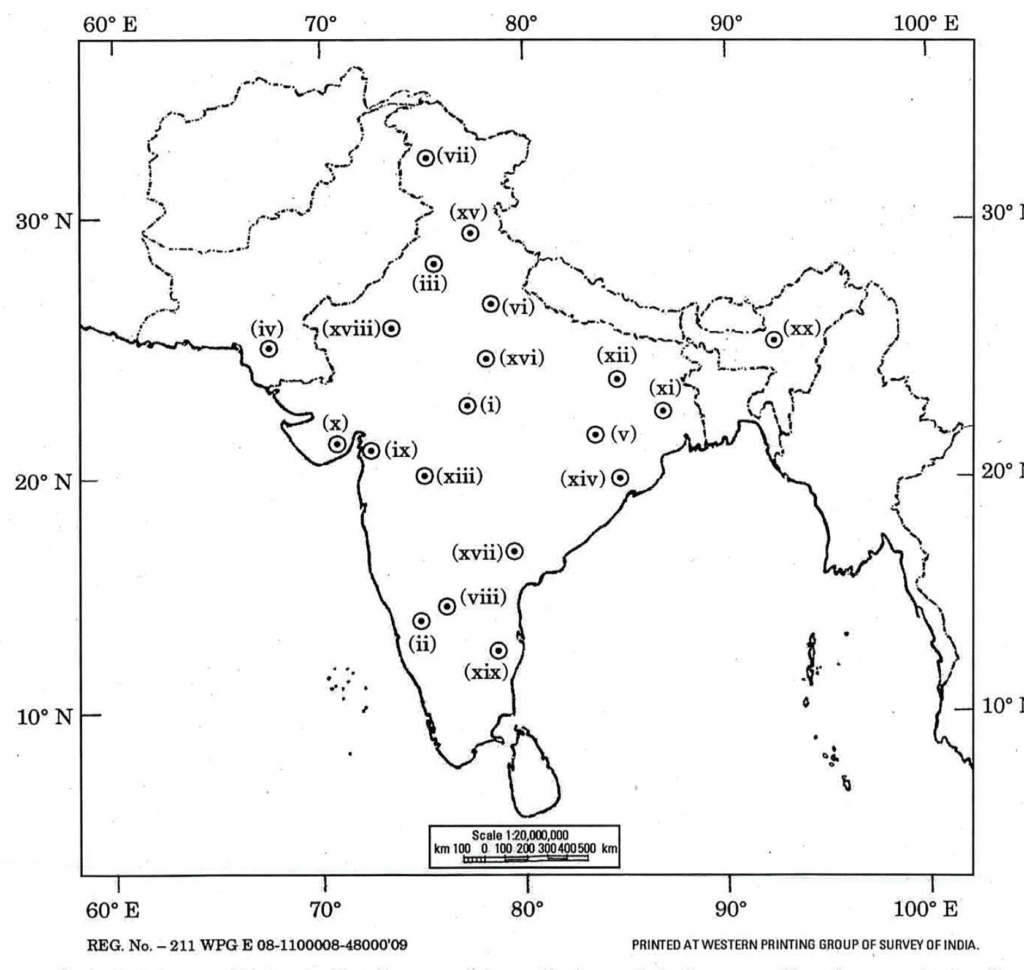
Q. Identify the following places marked on the map supplied to you and write a short note of about 30 words on each of them in your Question-cum-Answer Booklet. Locational hints for each of the places marked on the map are given below seriatim:
- (i) A Prehistoric cave-paintings’ site
- (ii) A Neolithic-Chalcolithic site
- (iii) An Early Harappan site
- (iv) A Harappan site
- (v) An ancient capital city
- (vi) A Painted grey ware site
- (vii) A Neolithic site
- (viii) A site of Ashokan inscriptions
- (ix) An ancient port and trade centre
- (x) A Harappan site
- (xi) A Chalcolithic site
- (xii) An ancient capital city
- (xiii) A Rock-cut cave site
- (xiv) A early fortified city
- (xv) A Rock-cut temple site
- (xvi) An ancient temple site
- (xvii) An ancient capital city
- (xviii) An ancient temple site
- (xix) A Palaeolithic site
(xx) An ancient capital city
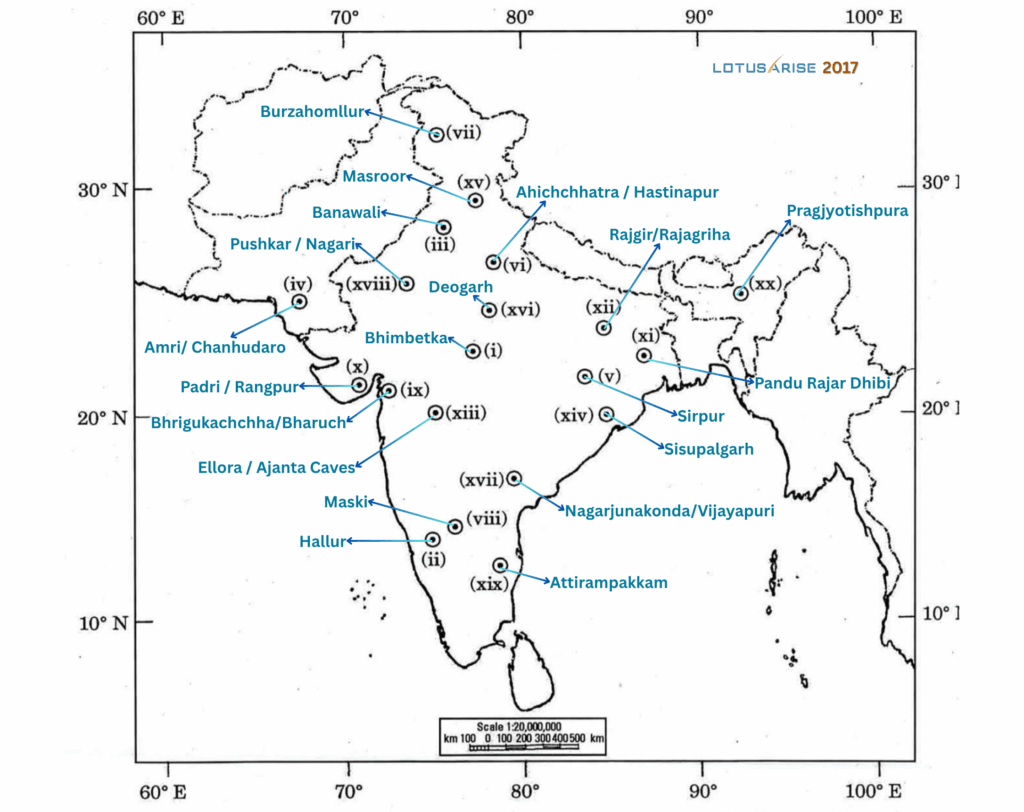
Mapping PYQs Solution 2017:
- A Prehistoric cave-paintings’ site: Bhimbetka
- A Neolithic–Chalcolithic site: Hallur
- An Early Harappan site: Banawali
- A Harappan site: Amri/ Chanhudaro
- An ancient capital city: Sirpur
- A Painted Grey Ware site: Ahichchhatra / Hastinapur
- A Neolithic site: Burzahom
- A site of Ashokan inscriptions: Maski
- An ancient port and trade centre: Bhrigukachchha/Bharuch
- A Harappan site: Padri / Rangpur
- A Chalcolithic site: Pandu Rajar Dhibi
- An ancient capital city: Rajgir/Rajagriha or Patliputra
- A Rock-cut cave site: Ellora / Ajanta Caves
- An early fortified city: Sisupalgarh
- A Rock-cut temple site: Masroor
- An ancient temple site: Deogarh
- An ancient capital city: Nagarjunakonda/Vijayapuri
- An ancient temple site: Pushkar / Nagari
- A Palaeolithic site: Attirampakkam
- An ancient capital city: Pragjyotishpura
These 20 sites are Question 1 of Paper I in the 2017 History Optional examination — 2.5 marks each, 50 marks in total, with a note of about 30 words expected on every one. Each is solved in full below. The complete 2017 paper is at History Optional Question Paper 2017.
The map is 50 marks. What about the other 450?
You have the map answers on this page, free, for every site UPSC marked in 2017. That is 50 marks dealt with. The other 450 marks of the 2017 papers are still sitting there unanswered — and those are the marks that separate 260 from 320.
The History Optional PYQ Master Pack carries a written model answer for every question the Commission has set since 1985, including every non-map question on the 2017 paper.
- PYQs from 1985 to 2025 — arranged topic-wise, so you revise a theme and see every way it has been asked
- Model answers, not hints — full answers with historians named inside the argument, written to the mark and the word limit
- Map sections solved too — the same quality as this page, for every year, in one offline file
- PDF plus online access — on any device, permanently, not for the length of a subscription
₹1,499 (regular ₹2,500). One-time payment, instant access.
(i) A Prehistoric cave paintings’ site
Bhimbetka:
- Location: Raisen District, Madhya Pradesh.
- Significance: Famous for its rock shelters with evidence spanning the Paleolithic and Mesolithic periods. It is a UNESCO World Heritage Site.
- Tools:
- Palaeolithic: Largely made of quartzite and sandstone, generally large in size.
- Mesolithic: Mostly made of chalcedony and of smaller size (microliths).
- Habitation:
- Floors paved with flat stone slabs have been found.
- No human or animal bones have been discovered so far within the shelters, which is unusual for such sites.
- Rock Paintings (Key Feature):
- Acts as a natural art gallery, with numerous layers of rock cave paintings (from Paleolithic to Mesolithic times).
- Themes: Depict hunting scenes, dancing, children playing, women working, and signs of proto-family setups, offering insights into prehistoric life and society.
(ii) A Neolithic-Chalcolithic site
Hallur:
- Location: Haveri district, Karnataka.
- Significance: A critical site showing the transition from Neolithic-Chalcolithic to the Megalithic period, particularly significant for the earliest use of iron in South India (along with Piklihal).
- Tools & Artefacts:
- Stone Tools: Polished tools and microlith blades.
- Chalcolithic Tools: Copper axes and fish hooks.
- Ornaments: Made of carnelian, ceramic, and gold.
- Iron Age Transition: Marked by the appearance of megaliths and diverse iron implements.
- Burial Practices: Evidence of double urn burial.
- Habitation:
- Circular floors made of stone chips and river sand.
- Wattle-and-daub huts with post holes.
- One house found with a circular fireplace, ash, and charcoal.
- Economy (Agriculture & Herding):
- Agriculture: Cultivation of millet, horsegram, and green gram.
- Herding: Bones of cattle, sheep, goat, and horse were found, indicating animal husbandry.
- Pottery:
- Early Phase: Handmade and grey ware.
- Later Phase: Wheel-made and Black-and-Red Ware (BRW).
(iii) An Early Harappan site
Banawali:
- Location: Hissar district, Haryana, near the Rangoi river.
- Phases: Represents Early, Mature, and Late Harappan phases.
- Town Planning:
- Houses built with mud-brick and burnt brick, often with hearths.
- Storage pits found in courtyards.
- A dividing wall created a higher citadel area and a lower town within the fortified settlement.
- Burnt bricks used for wells, bathing pavements, and drains, indicating advanced sanitation.
- A multi-roomed house suggests social stratification, possibly belonging to a wealthy merchant.
- Religious Aspects: Presence of fire altars.
- Artefacts:
- Stone weights and tiny weights.
- Terracotta ploughs (evidence of agriculture).
- Female figurines, potentially of religious significance.
- Beads of gold, lapis lazuli, and carnelian, indicating craftsmanship and trade.
- Decline: City life ended abruptly in the Late Harappan period, though a rich range of artefacts and mud houses are found from this phase.
(iv) A Harappan site
Chanhudaro (less chance of Amri)
Chanhudaro: A Harappan Craft Center
- Location: Sindh, Pakistan.
- Significance: A small Harappan site, primarily representing Mature and Late Harappan phases only. Notable for being a major craft activity center.
- Settlement:
- No fortification (unlike many larger Harappan cities).
- Features mud-brick platforms.
- Streets included covered drains made of burnt bricks.
- Presence of pottery kilns.
- Craft Specialization (Key Highlight):
- Evidence of extensive work with carnelian, agate, amethyst, and crystal, as well as finished and unfinished beads.
- Identified as having a bead factory, predominantly for steatite beads.
- Other crafts included seal making, shell working, and the making of stone weights.
(v) An ancient capital city
Sirpur:
- Location: Mahasamund district, Chhattisgarh.
- Significance: Ancient capital of South Koshal, known as Shreepur. Notable for its concentration of Hindu, Buddhist, and Jain monuments, showcasing religious harmony and architectural development over centuries.
- Hindu Monuments:
- Includes Shiva and Vaishnava temples.
- Lakshmana Temple: A well-preserved brick temple, built by Vasata in the 7th century CE. Dedicated to Lord Vishnu, its plan features a garbhagriha, antarala, and a mandapa.
- Other Hindu monuments include Rama temple and Gandheshwar temple.
- Buddhist Monuments:
- Features Viharas (monasteries).
- Statues of Buddha, Padmapani, and Avalokiteshvara.
- Some syncretic finds combining Hindu and Buddhist elements.
- Jain Monuments:
- Ruins of Jain basadi (temples) and monasteries.
- Discovery of a bronze image of Adinatha (first Tirthankara).
(vi) A Painted grey ware site
Hastinapur (or may be Ahichhatra)
Hastinapur:
- Location: Meerut district, Uttar Pradesh.
- Significance: Historically renowned as the capital of the Kuru kingdom, a central setting in the Mahabharata epic.
- Jain Tradition: Considered sacred as the place where Rishabha, the first Tirthankara, lived, and Mahavira also visited.
- Cultural Sequence: Shows occupational layers from Ochre Coloured Pottery (OCP) followed by Painted Grey Ware (PGW).
- Early Habitation (PGW Period):
- Structures: Wattle-and-daub and mud huts; use of unbaked bricks.
- Finds: Chert and jasper weights; presence of horse bones, which is significant for understanding the fauna of the Later Vedic period.
- Later Urbanization (c. 2nd century BCE – 3rd century CE):
- Settlement: Evidence of a planned settlement.
- Architecture: Use of burnt bricks and ring wells (for water supply and drainage).
- Pottery: Dominance of wheel-turned red ware, adorned with designs such as fish, leaves, flowers, svastikas, triratnas, loops, circles, and other geometric patterns.
- Artefacts:
- Objects made of iron, copper, ivory, and terracotta figurines.
- Rings, beads, potsherds, and seals.
- Coins of the Yaudheyas and Kushana dynasties.
- Terracotta: Depictions include a humped bull and a torso identified as the Bodhisattva Maitreya.
(vii) A Neolithic site
Burzahom:
- Location: Northeast of Srinagar, Jammu & Kashmir.
- Significance: The first Neolithic site of Kashmir, showcasing a unique cultural sequence followed by a Megalithic culture.
- Distinctive Neolithic Features:
- Unlike many Neolithic cultures, inhabitants were not primarily agriculturalists, focusing on a hunting and fishing economy.
- Extensive use of well-polished bone and stone tools.
- Large quantities of bone tools found, including harpoons, needles, and arrowheads.
- Burial Practices (Key Feature):
- Human and animal burials discovered.
- Humans buried in pits, often dug into house floors, both primary and secondary (preferring skulls and long bones in secondary).
- Pet animals (e.g., dogs) were buried alongside their masters, indicating a unique custom.
- Habitation:
- Distinctive dwelling pits and storage pits found.
- Pottery:
- Early pottery: Crude and handmade.
- Later pottery: Wheel-made, showing technological advancement.
(viii) A site of Ashokan inscriptions
Maski:
- Location: Raichur district, Karnataka.
- Cultural Periods: Shows evidence of Neolithic-Chalcolithic and Megalithic cultures.
- Ashokan Edict (Major Significance):
- Discovery of a Minor Rock Edict of Emperor Ashoka.
- This was the first edict of Emperor Ashoka found that explicitly contained his name, ‘Ashoka’, rather than just ‘Devanampriya Priyadasi’.
- Artefacts:
- Tools: Polished stone tools, microlithic blades, and a copper rod.
- Beads: Made from diverse materials like carnelian, agate, chalcedony, shell, coral, glass, and paste.
- Pottery:
- Includes Red Ware and Black-and-Red Ware (BRW).
- Some pottery features incised designs.
- Other Finds: Animal bones and rock paintings have been discovered.
- Subsistence: The economy was based on agriculture, animal domestication, and hunting.
(ix) an ancient post and trade centre
Bhrigu Kachchha (Bharuch):
- Location: Bharuch district, Gujarat, situated at the mouth of the Narmada River.
- Significance: An ancient port and major trade center, crucial for Western Indian trade routes throughout antiquity and later periods. It was also a shipbuilding center.
- Trade Routes:
- Utilized monsoon winds for trade routes to the West.
- Served as a terminus for land-sea trade routes for goods from the Far East.
- International Connections:
- Well-known to Greeks, Romans, and other Western civilizations (mentioned in texts like the Periplus of the Erythraean Sea).
- Arab traders frequently entered Gujarat via Bharuch.
- Later, the British and Dutch established their business centers here.
(x) A Harappan site
Rangpur:
- Location: Saurashtra peninsula, Gujarat.
- Phases: Represents Mature, Late, and Post-Harappan phases, making it crucial for studying the decline and continuity of the Harappan civilization in Gujarat.
- Construction: Evidence of Acacia wood used in building.
- Artefacts:
- Pottery: Dishes, Black-and-Red Ware (BRW), and high-necked jars.
- Craft: Clear evidence of shell working.
- Agriculture:
- Plant remains found, including Bajra, rice, and millet, indicating their agricultural practices.
Two minutes per site — could you write this one from memory?
Reading a solved site note is not the same as producing one under a clock. In the hall you get roughly two minutes per identification — locate it, name the period, name the excavator or dynasty, give one distinguishing find, and say why it matters. Miss the significance line and the examiner has nothing to award the second mark for.
That same gap runs through the whole paper. Most candidates know the content and still lose four to six marks per answer because the answer never states a position. The model answers in the Master Pack are written to show the structure, not just the facts.
(xi) A Chalcolithic site
Pandu Rajar Dhibi:
- Location: Burdwan district, West Bengal.
- Significance: It is the first Chalcolithic culture discovered in West Bengal, providing crucial insights into the region’s prehistoric past. It shows both Neolithic and Chalcolithic phases.
- Key Finds:
- Tools: Microliths, ground stone tools, and bone tools.
- Pottery: Predominantly Black-and-Red Ware (BRW).
- Chalcolithic Period Specifics:
- Presence of copper artefacts.
- Beads of semi-precious stones and terracotta figurines.
- Notably, iron spearheads, points, slag, and ovens were found even in Chalcolithic levels, indicating an early use or knowledge of iron.
- Subsistence: Bones of domesticated animals like cattle, buffalo, goat, and also deer were found, suggesting both animal husbandry and hunting.
(xii) An ancient capital city
Rajagriha/ Rajgir (or may be Patliputra):
Rajagriha:
- Location: Nalanda district, Bihar.
- Significance: Ancient capital of the Magadha kingdom until the 5th century BCE, when Ajatashatru (and later Udayin) moved the capital to Pataliputra. Its location, surrounded by five hills, made it strategically impregnable.
- Religious Importance: Highly significant in both Buddhist and Jain scriptures, closely associated with the lives of Gautama Buddha and Mahavira.
- Gautama Buddha spent considerable time here meditating and preaching.
- It was the venue for the First Buddhist Council.
- Historical Accounts: Mentioned by Chinese Buddhist pilgrims Faxian and Xuanzang.
(xiii) A Rock-cut cave site
Ajanta Caves (may be Ellora):
- Location: Aurangabad district, Maharashtra.
- Significance: A complex of Buddhist rock-cut caves, famous for their architecture, sculpture, and mural paintings. A UNESCO World Heritage Site.
- Period: Created from the 2nd century BCE to the 7th century CE. Mentioned by 7th-century Chinese pilgrim Xuanzang (Huen Tsang).
- Phases of Construction:
- Satavahana Period (c. 2nd-1st century BCE): Earlier caves, reflecting Hinayana Buddhism.
- Vakataka Period (c. 5th-7th century CE): Later, more elaborate caves, reflecting Mahayana Buddhism.
- Architecture:
- Comprises both Chaityas (prayer halls) and Viharas (monasteries).
- Early Viharas were simpler, lacking shrines.
- Later Viharas included a shrine with a Buddha statue at the rear, reflecting the shift from Hinayana to Mahayana.
- Paintings (Key Feature):
- World-renowned mural paintings on walls and ceilings.
- Depict primarily Buddhist themes, notably Jataka stories (Buddha’s previous lives).
- Known for their vibrant use of many colors.
(xiv) an early fortified city
Sisupalgarh:
- Location: Near Bhubaneswar, Odisha.
- Historical Identification:
- Possibly represents Tosali, mentioned in Ashokan edicts at Dhauli.
- Identified by some scholars as Kalinganagara, the capital of King Kharavela in the Hathigumpha inscription.
- Urban Characteristics (Antiquities):
- Abundant iron objects, indicating advanced metallurgy.
- Bangles of glass and ivory, along with semi-precious stones.
- Discovery of a coin-mould, suggesting local coinage.
- Rouletted Ware (associated with Roman trade) and lockets imitating Roman coins indicate significant foreign trade contacts.
(xv) A rock-cut temple site
Masroor:
- Location: Near Kangra, Himachal Pradesh.
- Significance: Famous for a remarkable group of rock-cut temples. It is the only known example of a Nagara-style temple built as a rock-cut construction, making it architecturally unique.
- Complex Details:
- A group of 15 monolithic rock-cut shrines.
- 14 temples are cut only from the outside, but the central temple is also cut from the inside, demonstrating advanced carving.
- Deity & Dedication:
- Now known as Thakurwada, a term for Vaishnavite temples. Idols of Rama, Lakshmana, and Sita are currently in the main sanctum.
- Original dedication was likely to Lord Shiva, suggested by a Shiva figure on the central lintel; it was later converted to a Vaishnava temple.
- Sculptural Details:
- Elaborate sculptural detailing on doors, lintels, walls, shikharas, and column capitals.
- Figurines of gods and goddesses (Shiva, Parvati, Lakshmi, Saraswati) and floral designs.
(xvi) An ancient temple site
Deogarh:
- Location: Jhansi district, Uttar Pradesh.
- Dashavatara Temple (Key Highlight):
- A significant Gupta period temple, dedicated to Lord Vishnu.
- Considered one of the earliest known Panchayatana temples (main shrine surrounded by four subsidiary shrines).
- Exhibits Nagara style and marks the beginning of the Shikhara (tower) type of temples in North India.
- Features carved figurines of river goddesses Ganga and Yamuna on the sanctum doorway.
- Notable sculpture includes Anantshayi Vishnu (Vishnu reclining on a serpent).
- Its sculptures exemplify the classical Gupta style.
- Jain Temples: The fort on the Deogarh hill is also dominated by a cluster of Jain temples, indicating a later or co-existing religious presence.
(xvii) An ancient capital city
Vijayapuri (Nagarjunakonda):
- Location: Guntur district, Andhra Pradesh.
- Early Cultures: Evidence of Neolithic and Megalithic cultures, with post holes indicating early habitations.
- Ikshvaku Capital: Known as Vijayapuri, the capital city of the Ikshvaku kings.
- Buddhist Significance (Key Highlight):
- A prominent center for Buddhism and Buddhist learning.
- Named after Nagarjuna, the renowned Buddhist philosopher.
- Discovery of Maha Stupas, Chaityas, and Viharas (monasteries).
- Inscriptions reveal both royal (by the Ikshvaku queen) and non-royal sponsorship for the construction of temples and monasteries, showing widespread support for Buddhism.
- Socio-economic Aspect: Inhabited by merchants and artisans, who were organized into guilds.
(xviii) An ancient temple site
Nagari:
- Location: Chittorgarh district, Rajasthan.
- Significance: Ancient city known as Madhyamika. It flourished from the Mauryan period to the Gupta period, indicating its long historical importance.
- Inscriptions (Key Highlight):
- Two Vaishnavite inscriptions from the 2nd century BCE, recording the performance of Ashvamedha and Vajapeya sacrifices, providing evidence of early Vedic rituals.
- A third inscription refers to the erection of a Vishnu temple in the 5th century CE.
- Archaeological Periods:
- Excavations distinguished three periods, with the first two pre-dating the stone fortification and lacking baked-brick structures.
- Remains of an older structure found below the enclosure level.
- Architecture & Sculpture:
- A stupa/temple discovered, made of moulded bricks.
- Two carved pillars from the Gupta period with lion and bull capitals.
- Architectural components include the lower part of a human figure seated on a chair, lotus, flying birds, and human heads.
- Pottery:
- Negligible Northern Black Polished Ware (NBPW), though associated red ware was present.
- Red Polished Ware also found.
- Other Finds:
- Punch-marked coins.
- Terracotta human and animal figures in Sunga and Gupta styles, toys, and flesh-rubbers.
- An ivory seal with swastika and taurine symbols, and copper antimony rods and rings.
- Fortification: The fortification likely originated in the Gupta times.
(xix) A Palaeolithic site
Attirampakkam:
- Location: Chennai district, Tamil Nadu.
- Significance: An open-air Paleolithic site revealing a continuous sequence of Lower, Middle, and Upper Paleolithic cultures. It is considered one of the oldest prehistoric sites in South Asia.
- Artefacts:
- Predominantly handaxes, crafted from quartzite stones that were not locally available, suggesting raw material procurement from outside.
- These tools were used for butchery and chopping wood.
- Their uniformity in shape and symmetry indicates organized and collective working.
- Other Discoveries:
- A set of animal footprints.
- Animal fossil teeth of horse, water buffalo, and nilgai, suggesting an open and wet landscape in early Paleolithic times.
(xx) An ancient capital city
Pragjyotishpura: Ancient Capital of Kamarupa
- Location: Guwahati, Assam.
- Significance: Ancient capital of the Kamarupa Kingdom under the Varman Dynasty (350 – 650 A.D.). The name means “city of eastern light.”
- Xuanzang’s Account (7th Century CE):
- The Chinese pilgrim Xuanzang visited during the reign of King Bhaskaravarman.
- He described its natural beauty and good climate.
- Noted the people’s language, temperament, and strong belief in ‘devas’ (Hindu gods), contrasting with a significant lack of Buddhist sangharamas (monasteries), implying limited Buddhist presence.
- Mentioned a large number of temples, confirming its Hindu religious character.
How to write the map answer in the exam hall
The solutions above are reference notes, not model answers. In the hall you have roughly 45 minutes for all 20 sites — about two minutes each, including the time it takes to find the number on the map. What follows is the structure that reliably earns the full 2.5 marks.
The five-part note that works every time
- Locate it — present-day state, and the river or coast it sits on
- Date it — the period or culture it belongs to (Palaeolithic, Harappan, Satavahana, Mughal)
- Attribute it — the excavator, the founding dynasty, or the ruler associated with it
- Evidence it — one distinguishing find, structure or inscription
- Justify it — one line on why the site matters to the wider historical argument
Four habits that cost marks
- Writing 60 words on the three sites you know and one line on the rest — the marks are the same for each
- Naming the site and stopping — identification alone is half the mark
- Leaving the map question for the end — it is the only section where you cannot think your way to an answer, so bank it first
- Skipping a site entirely — even a location and a period is worth attempting
Practise on a blank outline map rather than by reading. Mark the 20 sites from memory, write your notes, then check them against this page. Every site you missed becomes a flashcard.
Two ways to prepare for the rest of the paper
The map solutions on this site are free and will stay free. If you want the rest of the optional handled the same way, there are two routes, depending on where you are in your preparation.
| PYQ Master Pack | Mains Master Kit 2027 | |
| Best when | Your notes are done and you now need answer-writing | You are still building the subject from the ground up |
| What you get | Model answers to every question since 1985, topic-wise, map sections included | 4,500+ pages of notes, complete mapping coverage, 12 months of article access |
| Covers the map section | Yes — every year solved | Yes — site-wise preparation, not just answers |
| Price | ₹1,499 (regular ₹2,500) | ₹1,770 (regular ₹5,000) |
Both are one-time purchases with permanent access. Aspirants in their second or third attempt usually take the PYQ Master Pack; first-timers usually start with the Kit.
Frequently asked questions
History Optional map solutions — other years
Site types repeat far more often than individual sites. Working through the years below by category is the fastest way to make the 50-mark section reliable.
- UPSC History Optional Map Solution 2025 — all 20 identifications solved with 30-word notes
- UPSC History Optional Map Solution 2024 — all 20 identifications solved with 30-word notes
- UPSC History Optional Map Solution 2023 — all 20 identifications solved with 30-word notes
- UPSC History Optional Map Solution 2022 — all 20 identifications solved with 30-word notes
- UPSC History Optional Map Solution 2021 — all 20 identifications solved with 30-word notes
- UPSC History Optional Map Solution 2020 — all 20 identifications solved with 30-word notes
- UPSC History Optional Map Solution 2019 — all 20 identifications solved with 30-word notes
- UPSC History Optional Map Solution 2018 — all 20 identifications solved with 30-word notes
- UPSC History Optional Map Solution 2016 — all 20 identifications solved with 30-word notes
- UPSC History Optional Map Solution 2015 — all 20 identifications solved with 30-word notes
- UPSC History Optional Map Solution 2014 — all 20 identifications solved with 30-word notes
- UPSC History Optional Map Solution 2013 — all 20 identifications solved with 30-word notes




