UPSC History Optional Map Solution 2015

History Optional Mapping PYQs Solution: Map Based Questions with Solution – 2015 History Optional Mains Examination.
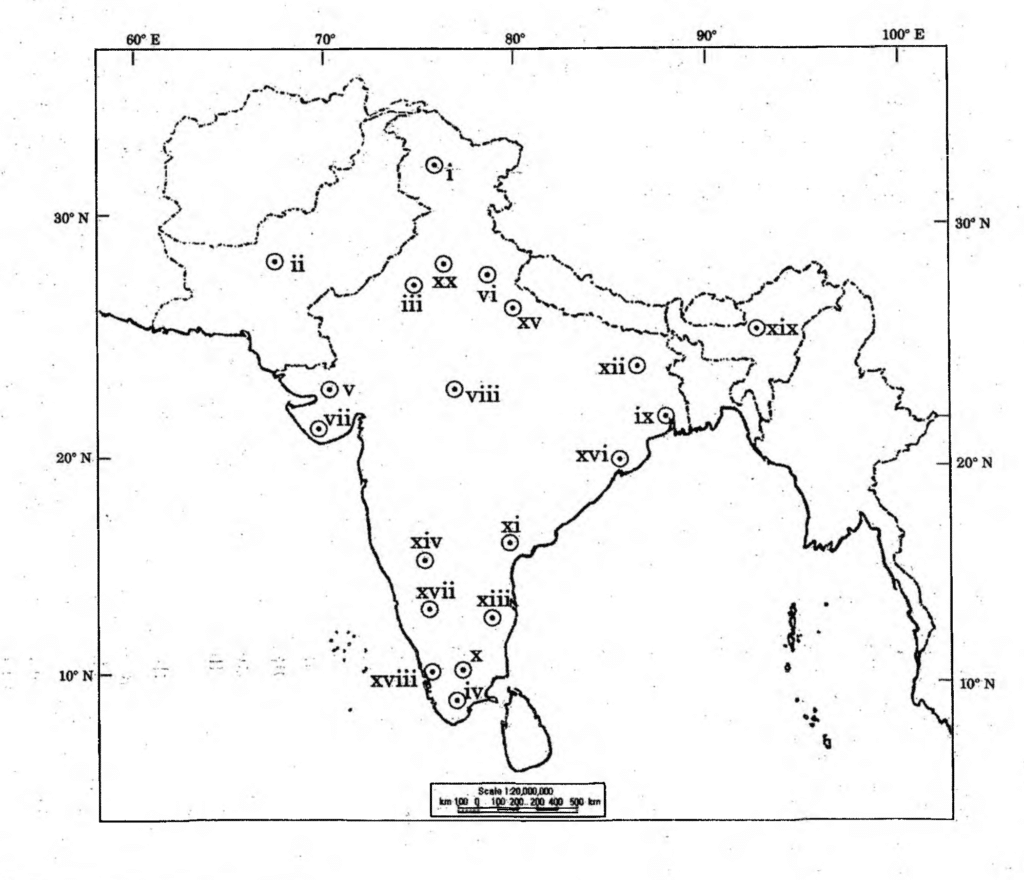
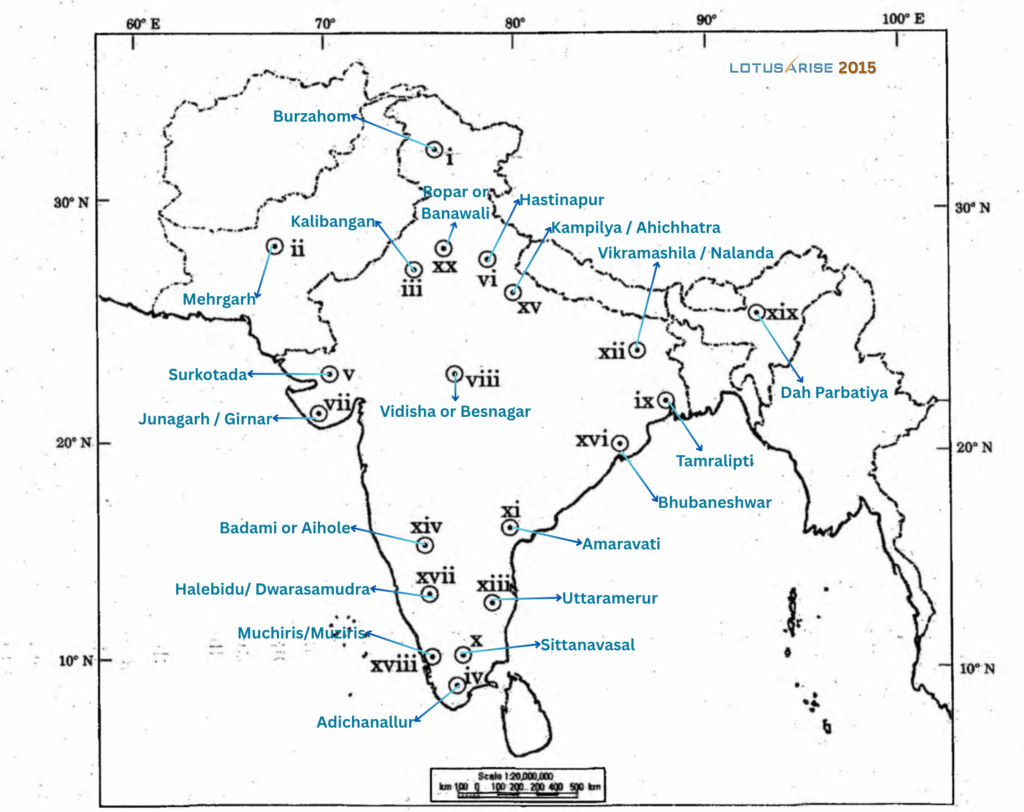
Q. Identify the following places marked on the map supplied to you and write a short note of about 30 words on each of them in your Question-cum-Answer Booklet. Locational hints for each of the places marked on the map are given below seriatim:
- I. A Neolithic site
- II. A Neolithic site
- III. A Harappan site
- IV. A Megalithic site
- V. A Harappan site
- VI. A painted-Grey-ware site
- VII. An inscriptional site
- VIII. An important ancient city
- IX. An ancient port
- X. A site of ancient cave-paintings
- XI. A Buddhist site
- XII. An educational centre
- XIII. Brahroadeya village
- XIV. An ancient capital
- XV. An ancient capital
- XVI. A temple site
- XVII. An ancient capital
- XVIII. An ancient sea-port
- XIX. An archaeological temple site
- XX. Harappan site
Solution:
- A Neolithic site: Burzahom
- A Neolithic site: Mehrgarh
- A Harappan site: Kalibangan
- A Megalithic site: Adichanallur
- A Harappan site: Surkotada
- A Painted-Grey-ware site: Hastinapur
- An inscriptional site: Junagarh / Girnar
- An important ancient city: Vidisha or Besnagar
- An ancient port: Tamralipti
- A site of ancient cave-painting: Sittanavasal
- A Buddhist site: Amaravati
- An educational centre: Vikramashila / Nalanda
- Brahmadeya village: Uttaramerur
- An ancient capital: Badami or Aihole
- An ancient capital: Kampilya / Ahichhatra
- A temple site: Bhubaneshwar
- An ancient capital: Halebidu/ Dwarasamudra
- An ancient sea-port: Muchiris/Muziris
- An archaeological temple site: Dah Parbatiya
- A Harappan site: Rakhigarhi / Ropar or Banawali
These 20 sites are Question 1 of Paper I in the 2015 History Optional examination — 2.5 marks each, 50 marks in total, with a note of about 30 words expected on every one. Each is solved in full below. The complete 2015 paper is at History Optional Question Paper 2015.
The map is 50 marks. What about the other 450?
You have the map answers on this page, free, for every site UPSC marked in 2015. That is 50 marks dealt with. The other 450 marks of the 2015 papers are still sitting there unanswered — and those are the marks that separate 260 from 320.
The History Optional PYQ Master Pack carries a written model answer for every question the Commission has set since 1985, including every non-map question on the 2015 paper.
- PYQs from 1985 to 2025 — arranged topic-wise, so you revise a theme and see every way it has been asked
- Model answers, not hints — full answers with historians named inside the argument, written to the mark and the word limit
- Map sections solved too — the same quality as this page, for every year, in one offline file
- PDF plus online access — on any device, permanently, not for the length of a subscription
₹1,499 (regular ₹2,500). One-time payment, instant access.
(1) A Neolithic site
Burzahom:
- In northeast of Srinagar, J&K.
- First Neolithic site of Kashmir.
- Megalithic culture followed Neolithic culture.
- Certain features differentiate it from other Neolithic cultures:
- For example: people were not acquainted with agriculture and followed hunting and fishing economy.
- Other important feature:
- Use of a large number of well-polished bone and stone tools.
- Large number of bone tools in form of harpoons, needles, arrowheads etc. is found.
- Human and animal burials found.
- Humans were buried both primarily and secondarily in pits, mostly dug into the house oors. In secondary burials skulls and long bones were preferred.=
- Pet animals (e.g. dog) were buried along their masters.
- Dwelling pits and storage pits are found.
- Pottery:
- The early pottery:- crude and handmade.
- Later pottery:- wheel-made.
(2) A Neolithic site
Mehrgarh:
- In Baluchistan, Pakistan.
- A Neolithic and Calcolithic site.
- Neolithic:
- Small farming and pastoralist village:
- Planned ancient farm villages.
- mud brick house (later sun-dried brick)
- bone tools,
- a-ceramic.
- Precursor of IVC.
- It was later abandoned with Harappan urbanisation.
- One of the earliest sites with evidence of farming (wheat and barley), herding and metallurgy.
- One of the earliest cultivation of cotton.
- Evidence of shing.
- Unique discovery:- Dental surgery and related medicinal activities.
- Figurines of terracotta found.
(3) A Harappan site
Kalibangan:
- In Hanumangarh district, Rajasthan, on bank of Ghaggar.
- Pre-Harappan and Harappan.
- Pre-Harappan:
- used copper and produced pottery,
- no writing system,
- lack the orderly layout,
- used sun dried bricks.
- Harappan:
- Cemetery and a fortified citadel.
- lower town also fortied.
- use of mud and burnt bricks
- grid-pattern of town planning,
- Burnt bricks were used in drains, wells, bathing platforms, re-altar.
- Other feature and findings:
- Pottery:
- for household, religious and burial purposes,
- wheel made red pottery.
- Unique fire altars:- suggest re worship
- Ploughed field
- Rectangular as well as cylindrical seals found.
- Terracotta bangles, bull etc. are found.
- Pit burial and urn burial has been found.
(4) A Megalithic site
Adichanallur:
- In Tuticorin District, Tamil Nadu.
- Urn burial site. Earthenware urns.
- Bronze objects, iron objects, potsherds.
- Skeletal remains inside the urns are in crouched position.
- Two examples of double burial.
- Pottery:
- BRW, red ware and black ware.
- Grafti on pottery.
- Iron implements:- arrowheads, spearheads and axe.
- Copper ornaments found.
- Rice husk and cloth impression on Iron sword.
- A potter’s kiln (industrial activity) found in habitational site.
(5) A Harappan site
Surkotda:
- In Kutch district, Gujarat.
- On the land route to Lothal.
- Mud brick and stone rubble used.
- Antiquities:
- Terracotta seal with Harappan pictographic script but without animal,
- beads of steatite and carnelian.
- Horse like skeleton found.
- Elephant bone also found.
- Coastal trade during Harappan time.
(6) A painted-Grey-ware site
Hastinapur:
- In Meerut district, UP.
- Capital of Kuru.
- Jaina tradition:
- Place where Rishabha, the first tirthankara, lived.
- Mahavira visited.
- OCP followed by PGW.
- Habitation:
- Wattle-and-daub and mud huts.
- Unbaked bricks.
- Chert and jasper weights found.
- Horse bones found.
- 2nd century BCE–3rd century CE: (Urbanisation)
- Pottery:
- Wheel-turned red ware.
- Designs such as fish, leaves, flowers, svastikas, triratnas, loops, circles, and other geometric patterns.
- Habitation:
- Planed settlement.
- Burnt brick, ring well found.
- Artefacts:
- Objects: iron, copper, ivory, terracotta figurines.
- rings and beads
- potsherds and seal
- Coins– Yaudheyas and Kushana
- Terracotta:
- Humped bull
- torso of the bodhisattva Maitreya.
- Pottery:
(7) An inscriptional site
Girnar/Junagarh:
- Girnar Hill near Junagadh in Kathiawar of Gujarat.
- Major rock edicts of Ashoka:
- On black granite
- in Brahmi script
- On the same rock there are inscriptions in Sanskrit added around 150 CE by Rudradaman I, the Saka ruler of Malwa, a member of the Western Kshatrapas dynasty:
- earliest Sanskrit inscription
- mentions renovation of Sudarshana Lake which was originally built by Pusyagupta the provincial governor of Chandragupta.
- Another inscription dates from about 450 CE and refers to Skandagupta.
- Many Jain and Hindu temples are located in Girnar.
(8) An important ancient city
Vidisha (or Besnagar):
- Vidisha is an ancient city, situated near Bhopal.
- The city, originally called Besnagar and Bhilsa was capital of the Sunga dynasty.
- Besnagar figures significantly in Buddhist, Jain and Brahmanical literature.
- Heliodorus pillar/ Besnagar pillar/ Garuda pillar:
- Monolithic free standing stone column
- Erected around 113 BCE by Heliodorus, a Greek ambassador of the Indo-Greek king to the court of the Shunga king.
- Surmounted by a sculpture of Garuda.
- Inscription states that it was raised in honour of god Vasudeva by Heliodorous.
- The Udayagiri Caves are situated nearby, just south of Vidisha, is the ancient Buddhist complex of Sanchi.
(9) An ancient port
Tamralipti:
- In Tamluk near the mouth of the Ganges in Midnapur district of West Bengal.
- Emporium of trade.
- Connected to Taxila by land and river on one hand and with south-east Asia by sea on the other.
- Antiquities of Chalcolithic period and NBPW phase found.
- Discovery of Roulette ware and red polished ware of Roman type indicates the trade contact with Roman.
- Urban character is proved by discovery of terracotta gurines, coins, beads or semi-precious stones etc.
(10) A site of ancient cave-painting
Sittanavasal:
- In Pudukkottai district, Tamilnadu.
- Meghalithic and Jain Cave site.
- Burials:
- Stone circles,
- Cist burials
- urn burials,
- Pottery, glass manufacturing site, iron objects,
- Sittanavasal Cave is a Jain caves with painting and sculptures.
- Temple-cave dated to Pallava King Mahendravarman I (580–630 AD).
- Painting:
- Mural painting
- Fresco-secco technique
- Painting depicts:
- lotus pond with lotus flowers,
- people collecting lotuses from the pond,
- dancing figures,
- fish, buffaloes, elephants etc.
Two minutes per site — could you write this one from memory?
Reading a solved site note is not the same as producing one under a clock. In the hall you get roughly two minutes per identification — locate it, name the period, name the excavator or dynasty, give one distinguishing find, and say why it matters. Miss the significance line and the examiner has nothing to award the second mark for.
That same gap runs through the whole paper. Most candidates know the content and still lose four to six marks per answer because the answer never states a position. The model answers in the Master Pack are written to show the structure, not just the facts.
(11) A Buddhist site
Amaravati:
- In Guntur District, Andhra Pradesh.
- Meghalithic, BRW and NBPW site.
- Inscription in Maurya Brahmi found.
- Dhanyakataka – capital of Satavahanas.
- Buddhist stupa:
- Buddhist Stupa and Mahachaityas with marble and limestone sculptures.
- Its carved panels tell the story of Buddha.
- Chinese traveller Hiuen Tsang visited in 7 century.
- Ancient School of Arts:
- Flourished for nearly six centuries commencing from 200-100 BC.
- Patronized first by the Satavahanas and later by the Ikshvakus.
- Some Buddhist sculptures with Greco-Roman inuence.
(12) An educational centre
Vikramsila (Other probability: Nalanda)
Vikramashila
- In Bhagalpur district, Bihar.
- Founded by King Dharmpal of Pala dynasty.
- Buddhist university:
- Around hundred teachers and about one thousand students.
- Produced eminent scholars like Dipankara, who propagated Buddhism in Tibet.
- Most important branch of learning:- Tantrism.
- Other subjects like theology, philosophy, grammar, metaphysics, logic etc. also taught.
- Main stupa is a brick structure.
- A rectangular structure identified as library.
- Antiquities:
- Terracotta, metal, ivory, bone, shell antiquities.
- Stone and bronze sculptures of Buddha, Bodhisattva, Avalokiteshwara, Maitreya, Manjusri, etc.
(13) Brahmadeya Village
Uttaramerur:
- In Kanchipuram district, Tamilnadu.
- Originally existed as a Brahmin settlement. Pallava king Nandivarman II (720–796 CE) established it as a brahamdeya village.
- Inscription on granite stones of the temple dedicated to Shiva (during rule of Parantaka Chola) throw light on the functioning of Chola’s village administration particularly Sabha, the assembly of Brahmin village and shows autonomy enjoyed by villages during Cholas.
(14) An ancient capital
Badami (or Aihole):
Badami
- In Bagalkot district, Karnataka.
- Capital of the Early Chalukyas.
- Founded in 540 AD by Pulakeshi I of Chalukyas.
- Pallavas under Narasimhavarma I destroyed Vatapi and called himself Vatapikonda.
- Temples:
- Sandstone cave temples and structural temples.
- Early styles of the southern Indian architecture.
- Rock-cut Cave Temples:
- Siva (with Parvati), Vishnu and Jains
- Lord Nataraja in dancing poses.
- Muktheeswara temple
- Melagutti Sivalaya.
- Bhutanatha group of temples and Mallikarjuna group of temples.
- Paintings on the ceiling.
- Inscriptions:
- First Sanskrit inscription in old Kannada script dates back to 543 CE, from the period of Pulakeshi I.
- One inscription near the Bhuthanatha temple
- Inscriptions of 12th century in Jain rock-cut temple dedicated to Adinatha.
(15) An ancient capital
Kannauj (Other probability: Ahichhatra)
Kannauj:
- In Uttar Pradesh.
- Capital of the Maukharis and Harshavardhana.
- Chinese pilgrim Faxian and Xuanzang visited.
- Xuanzang described it as a large, prosperous city with many Buddhist monasteries during the reign of Harsha.
- After the death of Harshavardhana in 7 century, Kannuaj remained a focal point for the tripartite struggle between Palas, Pratiharas and Rashtrakutas.
- When Md. Ghori invaded India, it was being ruled by Raja Jaichandra who had enmity with Chauhan ruler Prithviraj.
- In the battle of Kannauj, Sher shah defeated on Humayun.
- It is famous for its Ittar (Perfume).
(16) A temple site
Bhubaneshwar:
- Present capital of Odisha.
- In 7th century, Somavamshi or Keshari dynasty established their kingdom in the area, and constructed a number of temples.
- After the Kesharis, the Eastern Gangas ruled Kalinga area until 14th century CE.
- Called ‘Temple City‘ or ‘Ekamra Kshetra’ with many 6th-13th century
- CE Hindu temples.
- Temples in the Kalinga style.
- Famous temples (mainly of Lord Shiva):
- Lingaraj Temple,
- Muktesvara Temple,
- Rajarani Temple (pancharatha style),
- Ananta Vasudeva Temple- only temple of Lord Vishnu.
- Famous for Classical Odissi dance.
- The twin hills of Khandagiri & Udayagiri – site of an ancient Jain monastery.
- Dhauli hills has major edicts of Ashoka.
(17) An ancient capital
Halebid/ Halebidu/ Dwarasamudra:
- In Hassan district, Karnataka.
- Capital of the Hoysala kings in 10 -12 century.
- Temple complex:
- Two main Hindu temples:
- Hoysaleswara temple
- Two Nandi images on the sides of the Hoysaleswara temple are monoliths.
- Kedareshwara temple
- Two Jain basadi.
- Soapstone was used for the construction of these temples.
- Temple’s walls covered with depictions from Hindu mythology, animals, birds and shilabalikas or dancing figures.
- The Jain basadi are also rich in sculptural detail.
(18) An ancient sea-port
Muziris:
- In Cranganore, Kerala.
- Ancient port in the Chera kingdom in Sangam Age.
- Trade with Arabia, Rome, Greece etc.
- Sangam literature, Greek & Roman writers like Pliny, Periplus mention Muziris.
- Export:
- Spices, semi-precious stones, pearls, diamonds, sapphires, ivory, tortoise shells etc.
- Import:
- Romans gold coins, figured linens, copper, tin, lead, coral, raw glass, wine etc.
- Muziris Heritage Project started by Kerala government.
(19) An archaeological temple site
Dah Parbatia:
- Near Tezpur in Assam.
- Temple:
- Ancient temple of the 5 or 6 century (late Gupta period).
- Carvings on the temple door-frame of stone.
- Carvings of the river Goddesses Ganga and Yamuna.
- During Ahom period, a Shiva temple was built with bricks over the ruins of an ancient Gupta period temple.
- Stone paved layout plan of the sanctum sanctorum and a mandapa.
- Ancient temple of the 5 or 6 century (late Gupta period).
- The excavations revealed many terracotta plaques in which human figures were shown in a sitting position.
(20) A Harappan site
Rakhigarhi (Other probability: Ropar or Banawali)
Rakhigarhi:
- In Hisar District, Haryana.
- Largest site of IVC.
- Early and mature Harappan site.
- Mature Harappan phase:
- Planned township
- mud-brick and burnt-brick houses
- proper drainage system.
- Pottery:
- Red ware,
- dish-on-stand, vase, jar, bowl, beaker, perforated jar.
- Animal sacricial pit and circular re alters:- signifies the ritual system.
- A cylindrical seal with five Harappan characters.
- Other antiquities:
- blades; terracotta and shell bangles;
- beads of semiprecious stones,
- copper objects;
- animal figurines,
- toy cart
- wheel of terracotta;
- bone points;
- inscribed steatite seals and sealings.
How to write the map answer in the exam hall
The solutions above are reference notes, not model answers. In the hall you have roughly 45 minutes for all 20 sites — about two minutes each, including the time it takes to find the number on the map. What follows is the structure that reliably earns the full 2.5 marks.
The five-part note that works every time
- Locate it — present-day state, and the river or coast it sits on
- Date it — the period or culture it belongs to (Palaeolithic, Harappan, Satavahana, Mughal)
- Attribute it — the excavator, the founding dynasty, or the ruler associated with it
- Evidence it — one distinguishing find, structure or inscription
- Justify it — one line on why the site matters to the wider historical argument
Four habits that cost marks
- Writing 60 words on the three sites you know and one line on the rest — the marks are the same for each
- Naming the site and stopping — identification alone is half the mark
- Leaving the map question for the end — it is the only section where you cannot think your way to an answer, so bank it first
- Skipping a site entirely — even a location and a period is worth attempting
Practise on a blank outline map rather than by reading. Mark the 20 sites from memory, write your notes, then check them against this page. Every site you missed becomes a flashcard.
Two ways to prepare for the rest of the paper
The map solutions on this site are free and will stay free. If you want the rest of the optional handled the same way, there are two routes, depending on where you are in your preparation.
| PYQ Master Pack | Mains Master Kit 2027 | |
| Best when | Your notes are done and you now need answer-writing | You are still building the subject from the ground up |
| What you get | Model answers to every question since 1985, topic-wise, map sections included | 4,500+ pages of notes, complete mapping coverage, 12 months of article access |
| Covers the map section | Yes — every year solved | Yes — site-wise preparation, not just answers |
| Price | ₹1,499 (regular ₹2,500) | ₹1,770 (regular ₹5,000) |
Both are one-time purchases with permanent access. Aspirants in their second or third attempt usually take the PYQ Master Pack; first-timers usually start with the Kit.
Frequently asked questions
History Optional map solutions — other years
Site types repeat far more often than individual sites. Working through the years below by category is the fastest way to make the 50-mark section reliable.
- UPSC History Optional Map Solution 2025 — all 20 identifications solved with 30-word notes
- UPSC History Optional Map Solution 2024 — all 20 identifications solved with 30-word notes
- UPSC History Optional Map Solution 2023 — all 20 identifications solved with 30-word notes
- UPSC History Optional Map Solution 2022 — all 20 identifications solved with 30-word notes
- UPSC History Optional Map Solution 2021 — all 20 identifications solved with 30-word notes
- UPSC History Optional Map Solution 2020 — all 20 identifications solved with 30-word notes
- UPSC History Optional Map Solution 2019 — all 20 identifications solved with 30-word notes
- UPSC History Optional Map Solution 2018 — all 20 identifications solved with 30-word notes
- UPSC History Optional Map Solution 2017 — all 20 identifications solved with 30-word notes
- UPSC History Optional Map Solution 2016 — all 20 identifications solved with 30-word notes
- UPSC History Optional Map Solution 2014 — all 20 identifications solved with 30-word notes
- UPSC History Optional Map Solution 2013 — all 20 identifications solved with 30-word notes