

UPSC History Optional Map Solution 2021

History Optional Mapping PYQs Solution: Map Based Questions with Solution – 2021 History Optional Mains Examination.
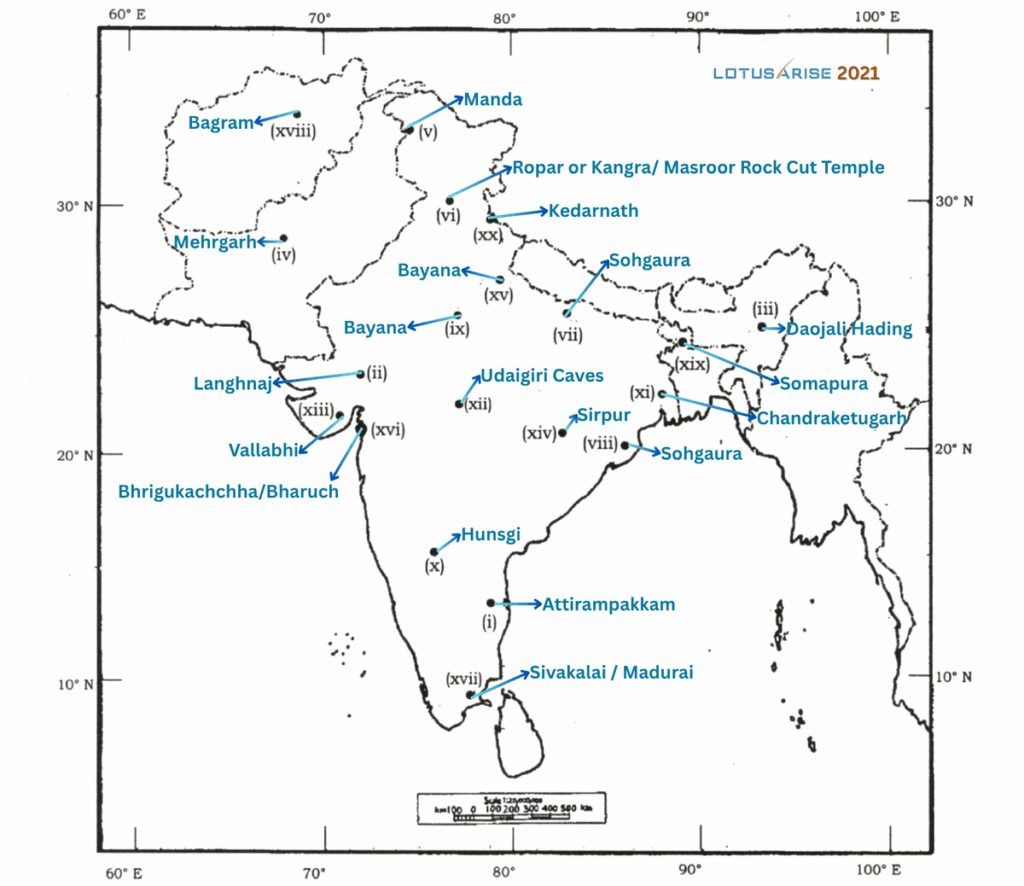
Q. Identify the following places marked on the map supplied to you and write a short note of about 30 words on each of them in your Question-cum-Answer Booklet. Locational hints for each of the places marked on the map are given below seriatim:
- (i) Paleolithic site
- (ii) Mesolithic site
- (iii) Neolithic site
- (iv) Neolithic-Chalcolithic site
- (v) Harappan site
- (vi) Proto-historic and historic site
- (vii) Inscriptional site
- (viii) Jain monastic site
- (ix) Coin hoard
- (x) Paleolithic site
- (xi) Terracotta site
- (xii) Rock-cut caves
- (xiii) Ancient learning centre
- (xiv) Political and cultural centre
- (xv) Buddhist site
- (xvi) Ancient port
- (xvii) Early historic site
- (xviii) Ivory hoard
- (xix) Buddhist monastic centre
- (xx) Temple complex

Mapping PYQs Solution:
- Palaeolithic site: Attirampakkam
- Mesolithic site: Langhnaj
- Neolithic site: Daojali Hading
- Neolithic-Chalcolithic site: Mehrgarh
- Harappan site: Manda
- Proto-historic and historic site: Ropar or Kangra/ Masroor Rock Cut Temple
- Inscriptional site: Sohgaura
- Jain monastic site: Udayagiri-Khandagiri
- Coin hoard: Bayana
- Palaeolithic site: Hunsgi
- Terracotta site: Chandraketugarh
- Rock-cut caves: Udaigiri Caves
- Ancient learning centre: Vallabhi
- Political and Cultural centre: Sirpur
- Buddhist site: Sankissa
- Ancient port: Bhrigukachchha/Bharuch
- Early historic site: Sivakalai / Madurai
- Ivory hoard: Bagram
- Buddhist monastic centre: Somapura
- Temple complex: Kedarnath
These 20 sites are Question 1 of Paper I in the 2021 History Optional examination — 2.5 marks each, 50 marks in total, with a note of about 30 words expected on every one. Each is solved in full below. The complete 2021 paper is at History Optional Question Paper 2021.
The map is 50 marks. What about the other 450?
You have the map answers on this page, free, for every site UPSC marked in 2021. That is 50 marks dealt with. The other 450 marks of the 2021 papers are still sitting there unanswered — and those are the marks that separate 260 from 320.
The History Optional PYQ Master Pack carries a written model answer for every question the Commission has set since 1985, including every non-map question on the 2021 paper.
- PYQs from 1985 to 2025 — arranged topic-wise, so you revise a theme and see every way it has been asked
- Model answers, not hints — full answers with historians named inside the argument, written to the mark and the word limit
- Map sections solved too — the same quality as this page, for every year, in one offline file
- PDF plus online access — on any device, permanently, not for the length of a subscription
₹1,499 (regular ₹2,500). One-time payment, instant access.
(i) Paleolithic site
Attirampakkam
- Location: Chennai district, Tamil Nadu.
- Significance: Attirampakkam is an extraordinarily important open-air Paleolithic (Old Stone Age) site. It is one of the oldest prehistoric sites in South Asia, revealing a rare and complete archaeological sequence of Lower, Middle, and Upper Paleolithic cultures.
- Key Artefacts (Stone Tools):
- The site has yielded a large number of stone tools, predominantly handaxes.
- These tools were primarily made from quartzite stones, which were not locally available, indicating that early humans transported raw materials or had wider movement.
- The tools were utilized for various purposes, including butchery of animals and chopping wood.
- The remarkable uniformity in shape and symmetry of these tools suggests a high level of skill and, importantly, implies a capacity for organized and collective working among early human groups.
- Other Significant Discoveries:
- A rare find includes a set of ancient animal footprints, providing direct evidence of fauna in the prehistoric environment.
- Fossilized animal teeth of species like horse, water buffalo, and nilgai have been discovered. These findings suggest that the region had an open and wet landscape during the early Paleolithic times, contrasting with present-day conditions.
(ii) Mesolithic site
Langhnaj
- Location: Mehsana district, Gujarat.
- Significance: Langhnaj is considered the most extensively studied Mesolithic (Middle Stone Age) site in Gujarat, providing detailed insights into prehistoric human activity in the region.
- Occupational Periods: The archaeological deposits at the site are divided into three periods, with Period I being Mesolithic.
- Key Mesolithic Finds (Period I):
- Microliths: Abundant discovery of microliths (small, finely worked stone tools), characteristic of the Mesolithic age.
- Human Burials: Evidence of human burials, which provides information about their funerary practices and physical anthropology.
- Wild Animal Bones: Presence of bones from wild animals, indicating a strong reliance on hunting.
- Potsherds: Discovery of some potsherds (fragments of pottery), suggesting early use of ceramics, though perhaps limited.
- Skeletal Evidence: Notably, 14 human skeletons were found, some with cut marks on the forehead, which has led to various interpretations regarding ritual or violence.
- Interaction with Harappan Culture:
- Evidence suggests a symbiotic relationship with the later Harappan urban culture.
- It is believed that Mesolithic inhabitants of Langhnaj supplied honey and hunted meat to the urban centers of the Harappan Civilization, indicating early forms of economic exchange between distinct cultural groups.
(iii) Neolithic site
Daojali Hading
- Location: Situated in the North Cachar Hills (now Dima Hasao district), Assam, Northeast India.
- Significance: Daojali Hading is an important Neolithic (New Stone Age) site, providing valuable insights into early settled life and agricultural practices in a less-explored region of India.
- Key Archaeological Finds:
- Stone Tools: A variety of well-crafted stone tools were discovered, including:
- Axes, adzes, and chisels: Indicating woodworking and possibly agricultural activities.
- Hoes: Direct evidence of farming.
- Grinding slabs, querns, and mullers: Tools used for processing grains, confirming agricultural practices.
- Fossil Wood Tools: Tools made from fossil wood were also found, a unique characteristic for the region.
- Distinguishing Absences: Interestingly, the site shows an absence of microliths (small stone tools common in Mesolithic periods), bone tools, and evidence of artificially constructed habitation structures like mud-brick houses. This suggests a unique local development.
- Stone Tools: A variety of well-crafted stone tools were discovered, including:
- Pottery & Subsistence:
- The site yielded various ceramics and kitchen items.
- Pottery was handmade, often featuring distinct cord marks (impressions from cords used in their manufacture) and plain red pottery.
- The presence of grinding tools and pottery strongly suggests that the people living here were actively growing and storing grains, and regularly preparing food, indicating a settled, agricultural lifestyle.
(iv) Neolithic-Chalcolithic site
Mehrgarh
- Location: Baluchistan province, Pakistan.
- Significance: Mehrgarh is a critical archaeological site, showcasing a long cultural sequence from the Neolithic (New Stone Age) to the Chalcolithic (Copper Age).
- It’s widely regarded as a significant precursor to the later Indus Valley Civilization (IVC), demonstrating the early stages of settled life and complex societies in the region.
- Neolithic Period (Early Village Life):
- Settlement Type: It began as a small, organized farming and pastoralist village, representing one of the earliest known examples of such settlements.
- Dwellings: People constructed houses using mud bricks, which later evolved to sun-dried bricks.
- Tools & Technology: Early tools were primarily bone tools. Initially, the site was aceramic (lacked pottery), but pottery developed in later phases.
- Early Innovations: Mehrgarh is one of the earliest sites globally with definitive evidence for:
- Farming: Cultivation of crops like wheat and barley.
- Herding: Domestication and rearing of animals.
- Metallurgy: Early use and working of metals, particularly copper.
- Agriculture & Subsistence: It also holds the distinction of having the earliest known cultivation of cotton. Evidence of fishing indicates a diverse food procurement strategy.
- Unique Discoveries:
- Archaeologists made a remarkable discovery of early dental surgery and related medicinal practices, showcasing advanced knowledge for the period.
- Numerous terracotta figurines have been found, providing insights into their art and possibly religious beliefs.
- Later Transition: The site was eventually abandoned, likely as its inhabitants or their descendants moved towards the evolving urban centers of the mature Harappan Civilization.
(v) Harappan site
Manda
- Location: Situated on the right bank of the Chenab River, in the Jammu district of Jammu and Kashmir, India.
- Significance: Manda holds crucial importance as the northernmost site of the Harappan (Indus Valley) Civilization, defining its geographical extent in the north.
- Archaeological Periods: The excavations at Manda reveal a sequence of cultures:
- Pre-Harappan (Late Harappan/Pre-defense Harappan): Evidence of earlier occupational levels.
- Harappan (Mature Harappan): Presence of typical Harappan cultural material.
- Late Harappan: Indicating continued occupation after the peak of the mature phase.
- Post-Harappan: Including subsequent historical periods.
- Key Discoveries:
- Harappan Pottery: Typical Harappan pottery, including red ware.
- Bronze Objects: A significant find was a bronze pin with a coiled head, similar to artifacts found in Central Asian sites, suggesting possible trade or cultural contacts.
- Bone Arrowheads: Presence of bone arrowheads indicates hunting practices.
- Faience Bangles: Ornaments made of faience (a type of glazed ceramic).
- Mud-brick Houses: Remains of structures made from mud bricks.
- Chalcolithic Pottery: Pottery from the Chalcolithic period was also found.
- Climatic Evidence:
- Discovery of wild grass and barley remains suggests a shift towards a colder climate during the Late Harappan phase, possibly impacting settlement patterns.
(vi) Proto-historic and historic site
Ropar (considering Proto-historic site but not exactly on the given location) OR Kangra/ Masroor Rock Cut Temple (considering location given)
Ropar
- Location: Rupnagar district, Punjab.
- Significance: Ropar (now Rupnagar) is an important archaeological site that showcases a long sequence of human occupation, encompassing the Indus Valley Civilization (IVC), the Painted Grey Ware (PGW) culture, and the Northern Black Polished Ware (NBPW) culture.
- Notably, there is no evidence of an early Harappan level found here.
- Key Archaeological Periods & Finds:
- Indus Valley Civilization (Harappan Phase):
- The site reveals typical Harappan artifacts, indicating its connection to this widespread Bronze Age civilization.
- Transition Period (c. 600–200 BCE):
- This period marks a significant transition from a village settlement to a nascent town.
- It yielded distinctive Northern Black Polished Ware (NBPW), a highly refined pottery type associated with early urbanisation in the Ganga Valley.
- Discovery of punch-marked coins and copper coins, indicating the emergence of a monetary economy.
- A seal with an inscription in Brahmi script was also found, suggesting the development of early writing systems.
- Remains of houses constructed from a mix of stone, mud-brick, and burnt brick were unearthed.
- An iron workshop and agate beads were found in levels associated with the NBPW culture, pointing to advanced craftsmanship and early iron metallurgy.
- Indus Valley Civilization (Harappan Phase):
Masroor Rock Cut Temple
- Location: Near Kangra, Himachal Pradesh.
- Significance: Masroor is renowned for a remarkable group of rock-cut temples, making it a unique archaeological and architectural site in North India.
- It stands out as the only known example of a Nagara-style temple built entirely as a rock-cut construction, where temples are usually structural.
- The Masroor Temple Complex:
- This complex comprises a group of 15 monolithic (carved from a single rock) rock-cut shrines.
- Uniquely, while 14 of these temples are carved only from the exterior, the central temple in the complex is also intricately cut from the inside, demonstrating exceptional craftsmanship.
- Deity & Dedication:
- The complex is currently known as Thakurwada, a term often used for Vaishnavite (Vishnu-dedicated) temples.
- Today, idols of Rama, Lakshmana, and Sita are placed inside the main sanctum-sanctorum.
- However, the presence of a figure of Shiva in the center of the lintel (the beam above a doorway) strongly suggests that the temple was originally dedicated to Lord Shiva. Its conversion to a Vaishnava temple is a more recent historical development.
- Sculptural Detail:
- The temples boast exquisite sculptural detailing on various architectural elements like doors, lintels, walls, shikharas (spires), and column capitals.
- These carvings feature a rich iconography of gods and goddesses, including Shiva, Parvati, Lakshmi, and Saraswati, along with intricate floral designs.
(vii) Inscriptional site
Sohagaura
- Location: Gorakhpur district, Uttar Pradesh.
- Significance: Sohagaura is an important Neolithic (New Stone Age) site in the Ganga plains, providing insights into early agricultural communities. Its most significant discovery is a very early copper plate inscription.
- Pottery Finds:
- Archaeological excavations have revealed various types of pottery:
- ill-fired, handmade pottery with a coarse fabric: Indicating early, less refined ceramic technology.
- Cord-impressed pottery: A distinctive type where cord marks are pressed onto the wet clay, common in early Neolithic cultures.
- Later, the site also shows evidence of more advanced pottery like Black-and-Red Ware (BRW) and Northern Black Polished Ware (NBPW), pointing to continued occupation into the Iron Age.
- Archaeological excavations have revealed various types of pottery:
- Sohagaura Copper Plate Inscription (Key Highlight):
- The site is most famous for the discovery of the Sohagaura copper plate inscription.
- Dating to the 3rd century BCE (roughly Mauryan period), it is inscribed in Brahmi script and the Prakrit language.
- This makes it one of the oldest known Indian copper plate inscriptions, providing invaluable direct epigraphic evidence for early Indian history, especially regarding administrative or famine relief measures.
(viii) Jain monastic site
Udayagiri-Khandagiri
- Location: Twin hills, Udayagiri and Khandagiri, near Bhubaneswar, Odisha.
- Significance: These hills are home to a remarkable group of 33 rock-cut caves, primarily serving as dwelling retreats for Jain monks in ancient times.
- They are a significant site for understanding early Jainism and rock-cut architecture in Eastern India.
- Construction & Patronage:
- The caves were excavated mainly by King Kharavela of the Mahameghavahana dynasty and his successors, primarily during the 2nd century BCE.
- Most caves are single-storied, though some unique double-storied examples exist.
- Notable Caves:
- The Ranigumpha Cave (Queen’s Cave) is particularly famous, being double-storied and the largest among the group, adorned with sculptures.
- Hathigumpha Inscription (Elephant Cave Inscription):
- The most crucial historical source from the site is the Hathigumpha inscription of King Kharavela.
- This 17-line inscription, dating to the 2nd century BCE, is written in Prakrit language using the Brahmi script.
- It provides invaluable information about King Kharavela’s:
- Military conquests and political achievements.
- His strong orientation towards Jainism (though he was religiously liberal).
- His extensive construction works.
- His liberal religious spirit and patronage of various faiths.
- His support for arts like music and dance.
- His act of retrieving an image of a Jina (Jain deity).
- Significantly, this inscription contains the earliest epigraphic (inscriptional) reference to image worship in Jainism, highlighting its historical importance.
(ix) Coin hoard
Bayana: A Hub of Gupta Numismatic Treasures
- Location: Bharatpur district, Rajasthan.
- Ancient Name: Also historically known as the ‘city of Vansasur’.
- Significance – Gupta Coin Hoards: Bayana is most renowned for the discovery of an exceptionally large hoard of Gupta gold coins, providing unparalleled insights into the economic prosperity and artistic achievements of the Gupta period.
- This hoard contained a vast number of unique issues, alongside known varieties of Gupta coinage.
- Diverse Coin Types: The coins showcase a rich variety of designs, depicting Gupta emperors in various activities:
- ‘Lyrist’ type: Showing kings playing musical instruments (e.g., Samudragupta playing a ‘veena’).
- ‘Elephant Rider’ type, ‘Lion Trampler’ type, ‘Rhinoceros Slayer’ type: Highlighting royal prowess and hunting skills.
- ‘Ashwamedha’ type: Commemorating horse sacrifices, signifying imperial power.
- ‘King and Queen’ type: Depicting the royal couple, often symbolizing succession or marital alliances.
- Artistic Depictions: These coins are celebrated for their artistic quality, featuring detailed portrayals of kings in majestic poses, as well as elegant royal or divine women showering coins or interacting with peacocks.
- Metal Composition: The coins from this period were primarily struck in gold, with some issues also found in silver and copper.
- Historical Inscriptions & Structures:
- Bayana Fort: The formidable Bayana Fort was constructed by the Yadav King Vijaypala in the 11th century CE.
- Yaudheya Republic Inscription: A fragmentary inscription, dated to 300 CE, refers to a ‘Maharaja Mahasenapati’ who was elected by the Yaudheya Republic. This discovery provides evidence of republican political structures existing alongside monarchies.
- Bhimlat (Vijay Pillar): Also known as Vijay Pillar, this structure was erected in 371-72 CE. An inscription on it, dated 372 CE (Malwa Samvat 428), records the completion of a ‘Pundarika’ sacrifice (a major Vedic ritual) and the erection of this stone pillar by a ruler named Vishnuvardhana. Vishnuvardhana is believed to have been a feudatory (subordinate ruler) of the powerful Gupta emperor, Samudragupta.
(x) Paleolithic site
Hunsgi
- Location: Yadgir district, Karnataka.
- Significance: Hunsgi is a crucial Paleolithic (Old Stone Age) archaeological site, providing significant evidence of early human activity, particularly tool-making and habitation, in South India.
- Tools and Materials:
- The site yielded a large number of Paleolithic stone tools and weapons.
- These tools were crafted from various locally available raw materials, including limestone, sandstone, quartzite, dolerite, and chert.
- Found tools included blades with sharp edges and many multipurpose instruments, showcasing the technological skills of early hominids.
- Habitation-cum-Factory Site:
- Hunsgi functioned as a unique habitation-cum-factory site. This means it was not just a place where people lived, but also a stone-working site where tools were manufactured from local raw materials.
- These finished tools were then likely transported to other places, indicating a network of early human movement and exchange.
- Archaeologists found few traces of actual habitation structures, suggesting temporary or less durable shelters.
- However, evidence suggests the presence of thatched roof-like structures, offering insights into their rudimentary shelters.
- Social Structure:
- The findings at Hunsgi support the idea that Paleolithic hunter-gatherers lived in a ‘band society’, characterized by small, mobile groups working collectively for survival.
Two minutes per site — could you write this one from memory?
Reading a solved site note is not the same as producing one under a clock. In the hall you get roughly two minutes per identification — locate it, name the period, name the excavator or dynasty, give one distinguishing find, and say why it matters. Miss the significance line and the examiner has nothing to award the second mark for.
That same gap runs through the whole paper. Most candidates know the content and still lose four to six marks per answer because the answer never states a position. The model answers in the Master Pack are written to show the structure, not just the facts.
(xi) Terracotta site
Chandraketugarh
- Location: North 24 Parganas district, West Bengal.
- Significance: Chandraketugarh is a crucial archaeological site in West Bengal, revealing a long history of human occupation and urban development, particularly important for understanding the early historical period of ancient Bengal.
- Archaeological Finds & Periods:
- Pottery: Evidence of Northern Black Polished Ware (NBPW), indicating its importance during the early historical period (c. 6th-2nd century BCE).
- Coinage: Discovery of silver and copper punch-marked coins.
- Some of these coins bear ship motifs, strongly suggesting that Chandraketugarh functioned as an important port-town, facilitating maritime trade.
- Beads & Ornaments: Finds include stone and terracotta beads, as well as beads made from semi-precious stones, and items crafted from ivory and bone, pointing to skilled craftsmanship and trade.
- Terracotta Art (Key Highlight):
- The site is particularly famous for its exquisite terracotta art, which displays an unusual degree of precision and craftsmanship.
- Many terracotta plaques are comparable in style and motifs to those found at other contemporary sites like Kaushambi and Ahichhatra in the Ganga Valley, indicating shared artistic traditions and possibly networks of artisans.
- Architectural Remains:
- Archaeological excavations have uncovered the remains of a temple structure, dating to the Gupta or post-Gupta period, suggesting continuous religious and architectural activity.
(xii) Rock-cut caves
Udaigiri Caves
- Location: Near Vidisha, Madhya Pradesh.
- Significance: Udayagiri Caves are a series of rock-cut caves, primarily from the Gupta period (4th-5th centuries CE), renowned for their early Hindu iconography and inscriptions.
- Cave Distribution:
- The complex comprises 24 caves in total.
- One cave is dedicated to Jainism, while the remaining 23 caves are dedicated to Hinduism, showcasing the religious diversity of the period.
- Hindu Iconography (Key Feature):
- The caves feature rich iconography representing different sects of Hinduism, including Vaishnavism (Vishnu worship), Shaktism (goddess worship), and Shaivism (Shiva worship).
- The most famous relief sculpture is of Vishnu in his Man-Boar (Varaha) incarnation, depicted rescuing the Earth goddess. This panel is a masterpiece of early Gupta art.
- Inscriptional Evidence:
- The caves contain important inscriptions of the Gupta dynasty, specifically from the reigns of powerful emperors like Chandragupta II and Kumaragupta I. These inscriptions provide direct historical evidence.
- Both Jaina and Hindu caves bear inscriptions, including one of the oldest Jain inscriptions dating to 425 CE.
- Nearby Historical Landmark:
- The famous Heliodorus Garuda Pillar (also known as the Besnagar Pillar), dedicated to Vasudeva (Vishnu) by the Indo-Greek ambassador Heliodorus, is located nearby, further emphasizing the region’s ancient religious significance.
(xiii) Ancient learning centre
Vallabhi
- Location: Bhavnagar district (Saurashtra region), Gujarat.
- Significance: Vallabhi was a historically important city, serving as the capital of the Maitraka Dynasty (c. 480-775 CE).
- The city was established by the founder of the dynasty, Senapati Bhatarka.
- Center of Learning:
- Vallabhi flourished as a prominent center of learning, attracting scholars and students.
- It housed numerous Buddhist monasteries, indicating a significant presence of Buddhist scholarship and monastic life.
- This intellectual vibrancy is attested to by visits from renowned Chinese Buddhist pilgrims:
- Xuanzang in the 7th century CE.
- Yijing also in the 7th century CE.
- Jain Significance:
- Vallabhi holds immense importance for Jainism. It was the site of the Second Jaina Council, which took place in the 6th century CE.
- This council was held under the leadership of Devardhi Kshamashramana.
- During this council, the Jaina scriptures (Agamas) were codified and written down, assuming their present form. This was a crucial event for the preservation and standardization of Jain sacred texts.
(xiv) Political and cultural centre
Sirpur
- Location: Mahasamund district, Chhattisgarh.
- Significance: Sirpur, historically known as Shreepur, was the ancient capital of South Kosala. It is a remarkable archaeological site showcasing a rare harmony of Hindu, Buddhist, and Jain monuments existing together.
- Hindu Monuments:
- The site features temples dedicated to both Shaivism (Lord Shiva) and Vaishnavism (Lord Vishnu).
- Lakshmana Temple (Key Highlight):
- Distinguished by its construction primarily from bricks, which is a notable architectural style for the period.
- It is considered the most well-preserved of the Hindu temples at Sirpur.
- Built by Queen Vasata in the 7th century CE, it is dedicated to Lord Vishnu.
- Its architectural plan typically includes a garbhagriha (sanctum sanctorum), antarala (vestibule), and a mandapa (hall).
- Other Hindu structures include the Rama temple and Gandheshwar temple.
- Buddhist Monuments:
- Evidence of flourishing Buddhism is seen through numerous Viharas (monasteries).
- Statues of Buddha, Padmapani, and Avalokiteshvara have been found, representing different aspects of Buddhist iconography.
- Interestingly, some syncretic finds (artifacts blending elements of different religions) between Hindu and Buddhist traditions have been noted.
- Jain Monuments:
- The ruins of a Jain basadi (temple) and monastery have been unearthed.
- A significant find is a bronze image of Adinatha (Rishabhanatha), the first Tirthankara of Jainism.
(xv) Buddhist site
Sankissa
- Location: Farrukhabad district, Uttar Pradesh.
- Significance: Sankissa is an ancient city that gained immense prominence during the time of Gautama Buddha. It is considered one of the eight great places of Buddhist pilgrimage.
- Buddhist Legends: According to Buddhist tradition, it is the place where Buddha descended from Tushita heaven after teaching the Abhidhamma to his mother.
- Ashokan Connection:
- Emperor Ashoka (3rd century BCE), a great patron of Buddhism, installed a pillar at Sankissa to commemorate its significance.
- From this pillar, the distinctive elephant capital still survives, showcasing Mauryan artistic and religious patronage.
- Archaeological Remains:
- The site contains the ruins of old monasteries and various Buddhist monuments, indicating its past as a thriving monastic center.
- Visits by Chinese Pilgrims:
- Sankissa was a crucial stop for renowned Chinese Buddhist pilgrims:
- Faxian (5th century CE)
- Xuanzang (7th century CE)
- Their detailed accounts provide valuable historical information about the site and the state of Buddhism in India during their visits.
- Sankissa was a crucial stop for renowned Chinese Buddhist pilgrims:
(xvi) Ancient port
Bharuch/ Bhrigukachha
- Location: Bharuch district, Gujarat, situated at the mouth of the Narmada River.
- Significance: Known historically as Bhrigukachha, this city was an exceptionally important ancient port and a vibrant center of trade on India’s western coast for many centuries.
- Economic Importance:
- It was a significant shipbuilding center, indicating advanced maritime skills.
- The port played a crucial role in overseas trade, especially with Western civilizations. Traders efficiently used the monsoon winds for voyages across the Arabian Sea.
- Goods from the Far East often reached Bhrigukachha, establishing it as a key terminus for land-sea trade routes that connected vast regions.
- International Connections:
- The port was widely recognized by ancient Greeks, Romans, and other Western civilizations, as documented in various historical texts (e.g., Periplus of the Erythraean Sea).
- Later, Arab traders frequently accessed Gujarat through Bharuch, further cementing its international commercial ties.
- In the early modern period, European trading powers like the British and the Dutch also established their business centers here, highlighting its enduring commercial relevance.
(xvii) Early historic site
Madurai
- Location: Madurai district, Tamil Nadu.
- Significance: Madurai is one of India’s oldest continuously inhabited cities, renowned as the capital of the ancient Pandyan kingdom and a pivotal center for Tamil culture and literature.
- The Third Tamil Sangam:
- It was the prestigious venue for the Third Tamil Sangam (assembly of Tamil poets and scholars). This event played a crucial role in the development and preservation of classical Tamil literature.
- The ancient text ‘Maduraikkanchi’, which is part of the Pattuppattu (Ten Idylls), vividly describes Madurai city, including its grand palace, numerous temples, houses, and bustling markets, offering insights into its ancient urban life.
- Centre of Crafts and Trade:
- Madurai was a flourishing center for various crafts, including:
- Making of gold ornaments.
- Intricate ivory work.
- Detailed inlay work.
- Bangle making.
- Kautilya’s Arthashastra (c. 4th century BCE) specifically mentions Madurai as a significant center for fine cotton textiles, highlighting its economic importance.
- Ancient texts also refer to its traders selling pearls and precious stones, indicating its role in long-distance trade.
- Madurai was a flourishing center for various crafts, including:
- Historical Monuments (Key Highlights):
- Meenakshi Amman Temple: This iconic temple is the heart of Madurai.
- It is dedicated to Goddess Parvati (as Meenakshi) and her consort Shiva (as Sundareswara).
- While ancient in origin, its current magnificent form was largely rebuilt and expanded by the Madurai Nayakas in the 17th century.
- It exemplifies the quintessential Dravidian architectural style, characterized by towering gateways.
- The temple complex is surrounded by numerous elaborate ‘gopurams’ (ornate multi-storeyed tower gates), each intricately covered with thousands of stone figures of animals, gods, and demons.
- The temple also preserves exquisite 17th and 18th-century paintings from the Nayaka period.
- Tirumalai Nayak Palace: Another notable historical monument, reflecting the grandeur of the Nayaka rule.
- Meenakshi Amman Temple: This iconic temple is the heart of Madurai.
(xviii) Ivory hoard
Begram
- Location: Bagram District, Parwan Province, Afghanistan.
- Significance: Begram is the archaeological site of an important ancient city within the Kushana Empire. Its strategic location made it a crucial passage along the Silk Road, connecting ancient India to the West (via Bamyan) and North (via Kushan Pass to Baghlan Valley).
- The Begram Ivories (Key Highlight):
- A remarkable collection of over a thousand decorative plaques, small figures, and inlays, meticulously carved from ivory and bone.
- These exquisite pieces were originally attached to wooden furniture.
- After carving, surfaces were smoothed and lightly polished, with traces of surviving color showing the use of alternating red and blue pigments and highlighting with red or black.
- These ivories are examples of Kushan art from the 1st or 2nd centuries CE, reflecting the sophisticated craftsmanship and the cosmopolitan tastes of the local rulers.
- The Begram Treasure:
- Two walled-up strongrooms were excavated, revealing a vast treasure hoard.
- This hoard included a large number of objects made of bronze, alabaster, glass (with remains of 180 pieces), coins, and ivory objects.
- Significantly, remains of furniture and Chinese lacquer bowls were also unearthed.
- A high percentage of the few surviving examples of Greco-Roman enamelled glass originate from this discovery, highlighting its uniqueness.
- Trade Connections & Cosmopolitanism:
- The diverse nature of the finds (ivories, glass, lacquer) at Begram clearly demonstrates Afghanistan’s extensive trade connections to the Far East (China) and the Roman world (Mediterranean), confirming its role as a major hub for the ancient trade in luxury goods.
(xix) Buddhist monastic centre
Somapura
- Location: Naogaon District, Bangladesh.
- Significance: Somapura Mahavihara is a colossal Buddhist Mahavihara (great monastery), representing one of the most important centers of Buddhist learning and culture in ancient Bengal.
- It is recognized as a UNESCO World Heritage Site.
- Construction & Patronage:
- The Mahavihara was built by the powerful Pala King Dharmapala (reigned c. 781-821 CE). This is known from archaeological excavations at Paharpur and through seals bearing inscriptions found at the site.
- The Paharpur pillar inscription further corroborates details about the Pala kings.
- Buddhist Development:
- Somapura Mahavihara provides significant evidence for the rise and flourishing of Mahayana Buddhism in Bengal from the 7th century CE onwards.
- It was particularly a center for the Vajrayana (Tantric) trend within Mahayana Buddhism.
- The “Five Great Mahaviharas”:
- According to ancient Tibetan sources, Somapura Mahavihara was one of the five great Mahaviharas (major monastic universities) of ancient India, alongside:
- Vikramashila
- Nalanda
- Odantapuri
- Jaggadala
- According to ancient Tibetan sources, Somapura Mahavihara was one of the five great Mahaviharas (major monastic universities) of ancient India, alongside:
(xx) Temple complex
Kedarnath
- Location: Situated in the Garhwal Himalayan range, near the Mandakini River, in Uttarakhand, India.
- Significance: Kedarnath is a revered Hindu temple (shrine) dedicated to Lord Shiva, holding immense religious importance.
- Ancient Origins & Reconstruction:
- According to Hindu legends, the original temple was believed to have been built by the Pandavas from the Mahabharata epic.
- It is said to have been reconstructed by the great philosopher and saint Adi Shankara in the 8th century CE, solidifying its place in Hindu pilgrimage.
- Religious Importance (Jyotirlinga & Char Dham):
- Kedarnath is one of the twelve Jyotirlingas, considered the holiest shrines of Lord Shiva in India, where Shiva is worshipped as a fiery pillar of light.
- The temple is also one of the four major sites in India’s ‘Chota Char Dham’ pilgrimage circuit (along with Badrinath, Gangotri, and Yamunotri), attracting countless devotees annually.
- Architecture & Layout:
- The temple structure features a small hall at the entrance, adorned with images of Parvati (Shiva’s consort) and the five Pandavas.
- The main hall is decorated with statues of various deities, including Lord Krishna, the Pandavas, Draupadi, Nandi (Shiva’s bull), Vidarbha (a guard of Shiva), and other figures from Hindu mythology.
- Inside the main shrine (Garbha Griha), a conical rock structure is worshipped as the Sadashiva form of Shiva.
- The temple’s layout typically includes a ‘Garbha Griha’ (sanctum sanctorum) for worship and a ‘Mandap’ (assembly hall) for pilgrims.
How to write the map answer in the exam hall
The solutions above are reference notes, not model answers. In the hall you have roughly 45 minutes for all 20 sites — about two minutes each, including the time it takes to find the number on the map. What follows is the structure that reliably earns the full 2.5 marks.
The five-part note that works every time
- Locate it — present-day state, and the river or coast it sits on
- Date it — the period or culture it belongs to (Palaeolithic, Harappan, Satavahana, Mughal)
- Attribute it — the excavator, the founding dynasty, or the ruler associated with it
- Evidence it — one distinguishing find, structure or inscription
- Justify it — one line on why the site matters to the wider historical argument
Four habits that cost marks
- Writing 60 words on the three sites you know and one line on the rest — the marks are the same for each
- Naming the site and stopping — identification alone is half the mark
- Leaving the map question for the end — it is the only section where you cannot think your way to an answer, so bank it first
- Skipping a site entirely — even a location and a period is worth attempting
Practise on a blank outline map rather than by reading. Mark the 20 sites from memory, write your notes, then check them against this page. Every site you missed becomes a flashcard.
Two ways to prepare for the rest of the paper
The map solutions on this site are free and will stay free. If you want the rest of the optional handled the same way, there are two routes, depending on where you are in your preparation.
| PYQ Master Pack | Mains Master Kit 2027 | |
| Best when | Your notes are done and you now need answer-writing | You are still building the subject from the ground up |
| What you get | Model answers to every question since 1985, topic-wise, map sections included | 4,500+ pages of notes, complete mapping coverage, 12 months of article access |
| Covers the map section | Yes — every year solved | Yes — site-wise preparation, not just answers |
| Price | ₹1,499 (regular ₹2,500) | ₹1,770 (regular ₹5,000) |
Both are one-time purchases with permanent access. Aspirants in their second or third attempt usually take the PYQ Master Pack; first-timers usually start with the Kit.
Frequently asked questions
History Optional map solutions — other years
Site types repeat far more often than individual sites. Working through the years below by category is the fastest way to make the 50-mark section reliable.
- UPSC History Optional Map Solution 2025 — all 20 identifications solved with 30-word notes
- UPSC History Optional Map Solution 2024 — all 20 identifications solved with 30-word notes
- UPSC History Optional Map Solution 2023 — all 20 identifications solved with 30-word notes
- UPSC History Optional Map Solution 2022 — all 20 identifications solved with 30-word notes
- UPSC History Optional Map Solution 2020 — all 20 identifications solved with 30-word notes
- UPSC History Optional Map Solution 2019 — all 20 identifications solved with 30-word notes
- UPSC History Optional Map Solution 2018 — all 20 identifications solved with 30-word notes
- UPSC History Optional Map Solution 2017 — all 20 identifications solved with 30-word notes
- UPSC History Optional Map Solution 2016 — all 20 identifications solved with 30-word notes
- UPSC History Optional Map Solution 2015 — all 20 identifications solved with 30-word notes
- UPSC History Optional Map Solution 2014 — all 20 identifications solved with 30-word notes
- UPSC History Optional Map Solution 2013 — all 20 identifications solved with 30-word notes





Thik hai