UPSC History Optional Map Solution 2019

History Optional Mapping PYQs Solution: Map Based Questions with Solution – 2019 History Optional Mains Examination.
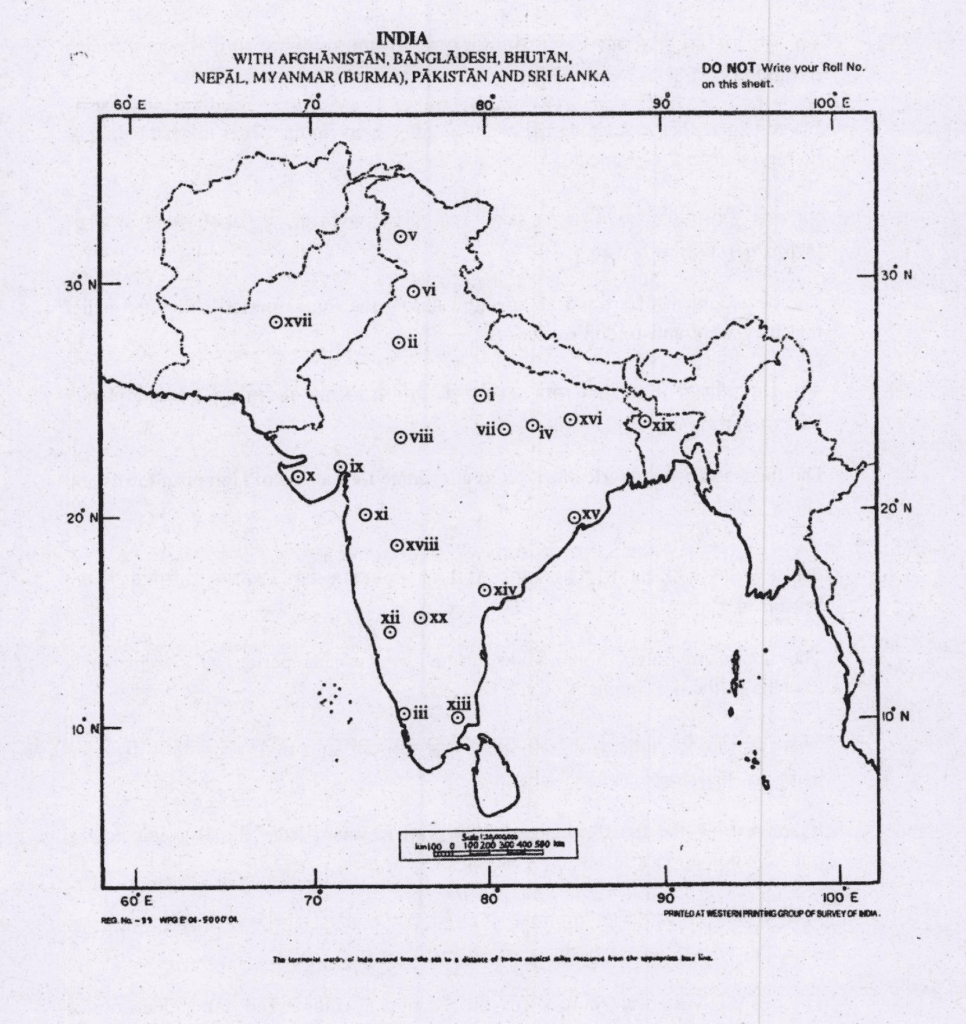
Q. Identify the following places marked on the map supplied to you and write a short note of about 30 words on each of them in your Question-cum-Answer Booklet. Locational hints for each of the places marked on the map are given below seriatim:
- (i) Brick temple site
- (ii) Early Harappan site
- (iii) Ancient seaport and trade centre
- (iv) Stone age site
- (v) Neolithic site
- (vi) Archaeological site
- (vii) Ancient capital city
- (viii) Ancient capital
- (ix) Harappan site
- (x) Ancient inscriptions site
- (xi) A Rock-cut cave site
- (xii) Ancient capital city
- (xiii) Famous temple site
- (xiv) Centre of School of art
- (xv) Ancient inscriptional site
- (xvi) Ancient education centre
- (xvii) pre-Harappan site
- (xviii) Chalcolithic period site
- (xix) Early inscriptional site
- (xx) Ancient petroglyphs site
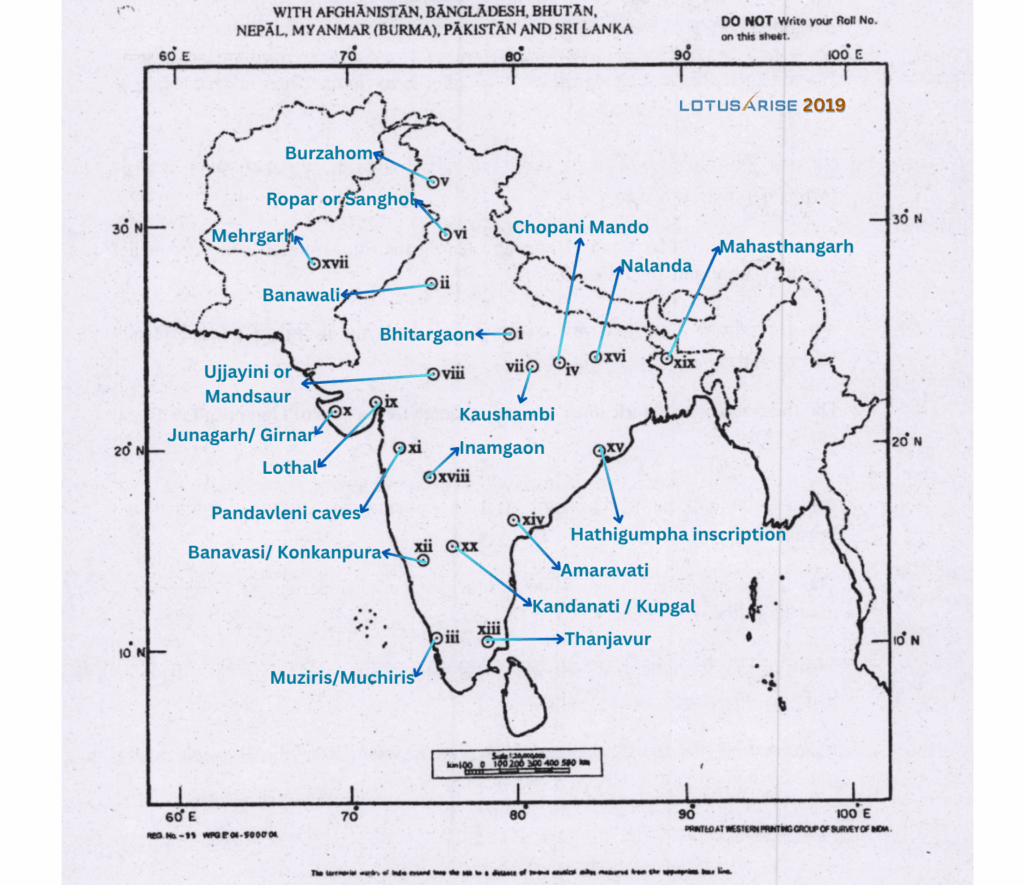
Mapping PYQs Solution 2019:
- Brick temple site: Bhitargaon
- Early Harappa site: Banawali
- Ancient seaport and trade centre: Muziris/Muchiris
- Stone Age site: Chopani Mando
- Neolithic site: Burzahom
- Archaeological site: Ropar or Sanghol
- Ancient capital city: Kaushambi
- Ancient capital: Ujjayini or Mandsaur
- Harappan site: Lothal
- Ancient inscriptional site: Junagarh/ Girnar
- A Rock-cut cave site: Pandavleni caves
- Ancient capital city: Banavasi/ Konkanpura
- Famous temple site: Thanjavur
- Centre of School of art: Amaravati
- Ancient inscriptional site: Hathigumpha inscription
- Ancient education centre: Nalanda
- Pre-Harappan site: Mehrgarh
- Chalcolithic-period site: Inamgaon
- Early inscriptional site: Mahasthangarh
- Ancient Petroglyphs site: Kandanati / Kupgal
These 20 sites are Question 1 of Paper I in the 2019 History Optional examination — 2.5 marks each, 50 marks in total, with a note of about 30 words expected on every one. Each is solved in full below. The complete 2019 paper is at History Optional Question Paper 2019.
The map is 50 marks. What about the other 450?
You have the map answers on this page, free, for every site UPSC marked in 2019. That is 50 marks dealt with. The other 450 marks of the 2019 papers are still sitting there unanswered — and those are the marks that separate 260 from 320.
The History Optional PYQ Master Pack carries a written model answer for every question the Commission has set since 1985, including every non-map question on the 2019 paper.
- PYQs from 1985 to 2025 — arranged topic-wise, so you revise a theme and see every way it has been asked
- Model answers, not hints — full answers with historians named inside the argument, written to the mark and the word limit
- Map sections solved too — the same quality as this page, for every year, in one offline file
- PDF plus online access — on any device, permanently, not for the length of a subscription
₹1,499 (regular ₹2,500). One-time payment, instant access.
(i) Brick temple site
Bhitargaon
- Location: Kanpur district, Uttar Pradesh.
- Significance: The Bhitargaon Temple is an exceptionally important Hindu shrine, built during the Gupta period (5th century CE). It stands out as one of the earliest and finest surviving examples of a brick or terracotta temple with a roof and a high shikhara (spire) in India.
- Architectural Features (Key Highlights):
- Material: It is a terraced brick building, unique for its extensive use of bricks and terracotta panels as the primary building materials.
- Age and Survival: Despite some damage to its upper chamber in the 18th century, it remains the oldest intact brick/terracotta Hindu shrine with a substantial roof and a high shikhara.
- Plan: The temple is constructed on a square plan with double-recessed corners, and it faces east, following traditional Hindu architectural orientation.
- Shikhara: It features a tall pyramidal spire (shikhara) over its garbhagriha (sanctum sanctorum), marking an early development of this iconic North Indian temple style.
- Terracotta Decoration: The outer walls are richly decorated with intricate terracotta panels, depicting various mythological figures and scenes, including aquatic monsters, Lord Shiva, and Lord Vishnu, showcasing the artistic excellence of the Gupta era.
(ii) Early Harappan site
Banawali
- Location: Hissar district, Haryana, situated near the now-dry Rangoi river (a tributary of the ancient Ghaggar-Hakra system).
- Significance: Banawali is an important archaeological site that showcases the continuous evolution of the Harappan (Indus Valley) Civilization, with distinct levels representing the Early, Mature, and Late Harappan phases.
- Town Planning & Architecture:
- The settlement featured houses constructed using both mud-bricks and burnt bricks, often equipped with hearths (chulhas).
- Storage pits were found in the courtyards of houses, indicating food storage.
- A notable feature is the divided fortification: a wall separated the fortified area into two distinct sections – a higher citadel area (likely for elite or administrative functions) and a lower town (for common residents), reflecting sophisticated urban planning.
- Burnt bricks were specifically used for constructing wells, bathing pavements, and drains, highlighting advanced sanitation and water management.
- A multi-roomed house was excavated, suggesting it might have belonged to a wealthy merchant, indicating social stratification.
- Religious and Cultural Aspects:
- The presence of fire altars suggests specific ritualistic practices, common in some Harappan sites.
- Terracotta ploughs indicate agricultural practices.
- Female figurines were found, which may hold religious significance, possibly relating to a mother goddess cult.
- Artefacts:
- Discoveries include standard Harappan stone weights, beads of gold, lapis lazuli, and carnelian, and tiny weights, pointing to organized trade and standardized systems.
- Decline:
- Evidence suggests that the city life at Banawali ended abruptly in the Late Harappan period. Despite the sudden abandonment, the remains of mud houses and a rich variety of artefacts from this phase indicate that the site was still thriving before its decline.
(iii) Ancient seaport and trade centre
Muziris
- Location: Near Cranganore (Kodungallur), Kerala.
- Significance: Muziris was a historically pivotal ancient port city in the Chera kingdom during the Sangam Age (roughly 3rd century BCE to 3rd century CE). It served as a vital maritime gateway between South India and the Western world.
- Extensive Trade Network:
- Muziris was a bustling hub for trade with Arabia, Rome, Greece, and other regions, indicating its significant role in ancient global commerce.
- Its importance is well-documented in Sangam literature (classical Tamil texts) as well as by prominent Greek and Roman writers like Pliny the Elder and the anonymous author of the Periplus of the Erythraean Sea.
- Key Traded Goods:
- Exports from Muziris: The port was famous for exporting valuable commodities such as spices (especially black pepper), semi-precious stones, pearls, diamonds, sapphires, ivory, and tortoise shells.
- Imports to Muziris: In return, it received goods like Roman gold coins (attesting to a favorable balance of trade for India), figured linens, copper, tin, lead, coral, raw glass, and wine.
- Modern Recognition:
- To preserve and promote its rich history, the Muziris Heritage Project has been initiated by the Government of Kerala, focusing on archaeological excavations, conservation, and cultural tourism in the region.
(iv) Stone age site
Chopani Mando
- Location: Allahabad district (now Prayagraj), Uttar Pradesh.
- Significance: Chopani Mando is a highly important archaeological site as it reveals a continuous sequence of human occupation, encompassing all three major stages of the Stone Age: Paleolithic, Mesolithic, and Neolithic. It provides crucial evidence for the transition from hunting-gathering to early food production in the Ganga plains.
- Paleolithic Period (Old Stone Age):
- Tools: The earliest inhabitants used stone tools primarily made from chert.
- Fauna: Discovered bones included those of wild cattle, sheep, and goats, suggesting that hunting these animals was a primary activity. This period also potentially represents an early stage of animal domestication.
- Mesolithic Period (Middle Stone Age):
- Tools: This phase is characterized by the presence of both geometric and non-geometric microliths (small, finely worked stone tools), such as blades, points, and scrapers, mostly crafted from chert.
- Pottery: Handmade pottery was found, along with hammer stones and ring stones.
- Subsistence & Dwellings: Bones of wild cattle and sheep/goats continued to be found. Significantly, pieces of burnt clay with reed impressions indicate that people lived in wattle-and-daub huts (structures made of woven branches and mud).
- Early Agriculture/Gathering: The presence of wild rice is reported, suggesting that it was a part of their diet, either through gathering or very early stages of cultivation.
(v) Neolithic site
Burzahom
- Location: Situated in the northeast of Srinagar, Jammu & Kashmir.
- Significance: Burzahom is the first Neolithic (New Stone Age) site discovered in Kashmir, offering unique insights into early human settlements in the Himalayan region. It also shows a clear transition to a subsequent Megalithic culture.
- Distinctive Neolithic Features:
- Unlike many other Neolithic cultures that were primarily agricultural, the people of Burzahom were not acquainted with extensive agriculture. Instead, their economy largely revolved around hunting and fishing.
- Tools: A significant feature is the widespread use of a large number of well-polished bone and stone tools.
- An abundance of bone tools was found, including specialized items like harpoons (for fishing), needles, and arrowheads, showcasing their adaptation to the environment.
- Burial Practices (Key Highlight):
- Evidence of both human and animal burials has been found.
- Humans were buried in pits, which were often dug into the floors of their houses. Both primary (complete body) and secondary (partial remains) burials were practiced. In secondary burials, skulls and long bones were frequently chosen.
- A unique and poignant feature is the practice of burying pet animals (e.g., dogs) along with their masters, reflecting a special bond.
- Dwelling Structures:
- The site features distinctive dwelling pits, which are circular or oval pits dug into the ground, often lined with plaster. These served as homes.
- Storage pits were also found, indicating efforts to store food or other resources.
- Pottery:
- The early pottery discovered was crude and handmade, reflecting nascent ceramic technology.
- Later pottery showed advancements, being wheel-made, indicating technological progression over time.
(vi) Archaeological site
Ropar (Rupnagar) / Sanghol
- Location: Situated in the Rupnagar district, Punjab. Both Ropar and Sanghol are significant archaeological sites in close proximity, reflecting similar cultural sequences.
- Cultural Sequence: These sites showcase a long and diverse history of human occupation, encompassing major cultural periods:
- Indus Valley Civilization (IVC) / Harappan Culture: Evidence of mature Harappan occupation is found.
- Painted Grey Ware (PGW) Culture: Associated with early Iron Age settlements.
- Northern Black Polished Ware (NBPW) Culture: Indicative of early urbanisation and the Mahajanapada period.
- Notably, no early Harappan level has been identified at Ropar, distinguishing its Harappan phase as primarily Mature and Late.
- Transition from Village to Town:
- The period around 600–200 BCE at these sites marks a crucial transition from a village-based settlement to a nascent urban center (town).
- During this phase, finds include:
- Northern Black Polished Ware (NBPW): A distinct, glossy pottery associated with burgeoning urbanism in the Ganga Valley.
- Punch-marked and copper coins: Indicating the emergence of a monetary economy and organized trade.
- A seal with an inscription in Brahmi script: Providing evidence of early writing systems.
- Architectural and Material Culture:
- Houses were constructed using a mix of materials, including stone, mud-brick, and burnt brick, reflecting evolving building techniques.
- An iron workshop found in the NBPW levels signifies early iron metallurgy and craft specialization.
- The discovery of agate beads further points to a sophisticated craft industry and potential trade networks.
(vii) Ancient capital city
Kaushambi
- Location: Kashambi district, Uttar Pradesh.
- Significance: Kaushambi was a strategically important ancient city, serving as the capital of Vatsa, one of the sixteen powerful Mahajanapadas (great kingdoms/republics) that flourished in India around the 6th century BCE. It was a major political, economic, and religious center.
- Historical and Religious Connections:
- Ashokan Pillars: The presence of Ashokan Pillars at Kaushambi indicates its importance during the Mauryan Empire (3rd century BCE) and Emperor Ashoka’s patronage of Buddhism.
- Buddhist and Jain Significance: It was a significant center for both Buddhism (Buddha is said to have visited) and Jainism (birthplace of the 6th Jain Tirthankara, Padmaprabha).
- Chinese Pilgrim: The renowned Chinese Buddhist pilgrim Xuanzang (Hieun Tsang) visited Kaushambi in the 7th century CE, leaving detailed accounts of its prosperity and religious sites.
- Archaeological Discoveries:
- Ancient Settlements: Excavations have revealed deep settlement layers, with archaeological evidence dating back to the 2nd millennium BCE, suggesting a very long history of human habitation.
- Later Vedic Settlement: The presence of Painted Grey Ware (PGW) pottery and traces of iron points to its occupation during the later Vedic period (c. 1000-600 BCE), linking it to the formative stages of North Indian urbanism.
- Centre of Trade: Its strategic location on ancient trade routes made it a thriving center of trade and commerce.
(viii) Ancient capital
Ujjaini (or may be Mandsaur)
Ujjain
- Location: Situated on the banks of the River Shipra, in Madhya Pradesh, India.
- Significance: Ujjain, historically known as Ujjaini, was the prominent northern capital of the Avanti Mahajanapada in the 6th century BCE. It has a rich and continuous history as a political, religious, and intellectual center.
- Historical Evolution:
- Mahajanapada Period: As the capital of Avanti, it was one of the powerful kingdoms of ancient India.
- Mauryan Empire: With the rise of Magadhan power, Ujjain came under the Magadhan Empire. During the reign of Mauryan King Bindusara, Ashoka served as the provincial governor of Ujjain, highlighting its administrative importance.
- Trade Routes: The city was a crucial trade hub. Northern Black Polished Ware (NBPW), originating from the Gangetic plains, found its way to the northern Deccan through Ujjain, indicating its role in connecting distant regions.
- Later Dynasties: Coins of the Kshatrapas (Western Satraps) and Kushanas found here attest to its political control by various dynasties.
- Vikramaditya Association: Ujjain is strongly associated with a legendary king who called himself Vikramaditya. He is credited with defeating the Sakas and initiating the Vikram Samvat Era in 58 BCE, a widely used Hindu calendar.
- Kalidasa’s Connection: The great classical Sanskrit poet and dramatist Kalidasa is traditionally believed to have been associated with Ujjain, suggesting its prominence as a center of arts and literature.
- Mughal and Maratha Periods: During the Mughal era, Maharaja Sawai Jai Singh (of Jaipur) constructed an astronomical observatory (Jantar Mantar) here, reflecting Ujjain’s ancient reputation as a center for astronomy. Most of the famous temples in Ujjain were built or renovated during the Maratha period.
- Crafts: There is also evidence of bead manufacturing at Ujjain, indicating local craftsmanship.
- Religious Importance (Key Highlights):
- Mahakaleshwar Temple: Ujjain is home to the revered Mahakaleshwar Temple, which is one of the twelve Jyotirlingas, considered among the holiest shrines of Lord Shiva.
- Kumbh Mela: The city is one of the four sites for the grand Kumbh Mela, a massive Hindu pilgrimage and festival held every twelve years, attracting millions of devotees.
(ix) Harappan site
Lothal
- Location: Ahmedabad district, Gujarat, India.
- Significance: Lothal is one of the most prominent and extensively excavated sites of the Indus Valley Civilization (Harappan). It played a crucial role as a harbour, industrial center, and trade hub, connecting the Harappan heartland to maritime trade routes.
- Pre-Harappan Phase:
- Initially, the site was a small village before the flourishing of the mature Harappan city.
- Mature Harappan City (Key Features):
- Economic Specialization: It was a major center for:
- A bustling harbour/dockyard (a highly debated but significant feature, interpreted by many as an artificial basin for ships).
- Cotton and rice-growing, indicating advanced agricultural practices.
- A thriving bead-making industry.
- Town Planning: The city was well-planned, divided into a citadel (acropolis/upper town) and a lower town, similar to other major Harappan cities.
- Construction: Buildings were primarily made of fire-dried bricks with lime and sand mortar.
- Drainage System: The remains reveal a highly sophisticated drainage system, a hallmark of Harappan urban planning.
- Economic Specialization: It was a major center for:
- Important Findings (Evidence of Urban Life & Trade):
- Dockyard: The most famous discovery, suggesting a major maritime trading facility.
- Persian Gulf Seals: Indicating direct trade contacts with the Mesopotamian and Persian Gulf regions.
- Workshops: Dedicated shops for a shell ornaments maker, bead maker, and metal worker, highlighting specialized crafts.
- Fire Altars: Suggesting ritualistic practices.
- Warehouse: A large structure identified as a warehouse, crucial for storage of trade goods.
- Merchant House: Evidence of well-organized merchant houses.
- Terracotta figurine of a house: Providing insights into domestic architecture.
- Impression of cloth on some sealings: Suggesting the use and trade of textiles.
- Twelve bathrooms in the citadel area: Indicating attention to hygiene and public facilities.
- An ivory scale: Featuring the smallest-known decimal divisions in the Indus Civilization, demonstrating advanced measurement systems.
- Connectivity: Lothal was connected to other Harappan cities through river routes and a coastal trade route that linked sites like Dholavira to Sutkagan Dor on the Makran coast, facilitating extensive regional and international trade.
- Later Harappan Culture (Decline & Transformation):
- Lothal continued to be inhabited even after the decline of the mature Harappan phase.
- However, the later settlement had a much smaller population and was largely devoid of the earlier urban influences.
- Trade and resources of the city were significantly diminished.
- Despite the decline, the people retained several Harappan traditions in terms of writing (though less common), pottery styles, and types of utensils, showing cultural continuity.
(x) Ancient inscriptions site
Junagarh/ Girnar
- Location: Junagadh district, Gujarat, with the historical site centered around the Girnar Hill near the city of Junagadh.
- Significance: Girnar is a place of immense historical and religious importance, famous for its unique rock inscriptions by several major ancient Indian rulers and its cluster of Jain and Hindu temples.
- Major Rock Edicts of Ashoka (Key Highlight):
- On a large rock outcrop, a set of Major Rock Edicts of Emperor Ashoka (3rd century BCE) are inscribed.
- These edicts are carved on black granite in the Brahmi script, proclaiming Ashoka’s Dhamma (moral law) and his policies.
- Inscriptions of Rudradaman I (Earliest Sanskrit Inscription):
- On the very same rock, a significant inscription in Sanskrit was added around 150 CE by Rudradaman I, the powerful Saka (Western Kshatrapa) ruler of Malwa.
- This inscription is celebrated as the earliest known extensive inscription entirely in classical Sanskrit.
- It mentions the renovation of the Sudarshana Lake, an ancient reservoir. Importantly, it states that this lake was originally constructed by Pusyagupta, the provincial governor under Chandragupta Maurya (founder of the Mauryan Empire), and later improved by Ashoka’s governor.
- Inscription of Skandagupta:
- Another crucial inscription on the same rock dates from about 450 CE and refers to the Gupta Emperor Skandagupta, detailing further repairs to the Sudarshana Lake, showcasing its continued importance through centuries.
- Religious Significance:
- Girnar Hill is a revered pilgrimage site, dominated by a cluster of Jain temples at its summit, considered sacred by both Digambara and Svetambara Jain traditions.
- Numerous Hindu temples are also located on the hill, including those dedicated to Dattatreya, Amba Mata, and a revered Shiva temple.
Two minutes per site — could you write this one from memory?
Reading a solved site note is not the same as producing one under a clock. In the hall you get roughly two minutes per identification — locate it, name the period, name the excavator or dynasty, give one distinguishing find, and say why it matters. Miss the significance line and the examiner has nothing to award the second mark for.
That same gap runs through the whole paper. Most candidates know the content and still lose four to six marks per answer because the answer never states a position. The model answers in the Master Pack are written to show the structure, not just the facts.
(xi) A Rock-cut cave site
Pandav Leni Caves
- Location: Nashik district, Maharashtra.
- Significance: The Pandav Leni Caves (also known as Trirashmi Caves) constitute an important Buddhist cave site, showcasing early rock-cut architecture and monastic life.
- Period of Excavation: These 24 caves were carved predominantly between the 1st century BCE and the 3rd century CE, indicating a flourishing period of Buddhist patronage.
- Architectural Features:
- The complex includes both Chaityas (prayer halls), which are usually characterized by stupas, and Viharas (monastic dwelling cells/monasteries) for monks.
- The caves were carved and generously donated by various kings, mainly the Satavahanas, along with merchants and other devotees.
- Sculptural & Iconographic Elements:
- The caves feature images of Buddha and Bodhisattvas, reflecting Buddhist religious iconography.
- Interestingly, sculptures also depict ordinary people like kings, farmers, and merchants, offering glimpses into the social fabric of the time.
- Unique Features:
- Some of the caves are interconnected by stone-cut ladders, demonstrating intricate planning and accessibility within the monastic complex.
- The site boasts an excellent ancient water management system, including several water tanks carved into the rock, essential for supporting the monastic community.
(xii) Ancient capital city
Banavasi/ Konkanpura
- Location: Uttara Kannada District, Karnataka.
- Significance: Banavasi, historically known as Konkanapura, holds immense importance as the ancient capital of the Kadamba dynasty. They established their rule here in 345 CE and governed parts of South India for at least two centuries, making it one of the earliest indigenous kingdoms of Karnataka.
- Ancient Temple Town:
- Banavasi is a significant ancient temple town, reflecting its long religious and cultural heritage.
- The Madhukeshwara Temple, built in the 9th century CE and dedicated to Lord Shiva, is a prominent example of its enduring architectural legacy.
- Historical Connections:
- The Chinese pilgrim Xuanzang (Hiuen Tsang) visited Konkanapura in the 7th century CE, leaving valuable accounts of its prosperity and religious life.
- A significant archaeological find is a 5th-century copper coin of a Kadamba king, discovered here, bearing an inscription in the Kannada script, which is one of the earliest epigraphic evidences for the language.
- Pampa, one of the greatest poets of the Kannada language, composed his renowned epics while residing in Banavasi, highlighting its role as a literary center.
- Cultural Legacy:
- Today, Banavasi continues its cultural traditions. The annual Kadambothsava, a vibrant cultural festival, is held here every December, celebrating the heritage of the Kadambas.
- It remains an important cultural center, especially for the traditional folk art form of Yakshagana, a unique blend of dance, music, costume, and dialogue from Karnataka.
(xiii) Famous Temple Site
Thanjavur
- Location: Thanjavur District, Tamil Nadu.
- Significance: Thanjavur (formerly Tanjore) was the glorious capital of the Chola Empire, one of the most powerful and influential dynasties in South Indian history. It became an incredibly important center of religion, art, and architecture, especially during the Chola period.
- Chola Temples (UNESCO World Heritage):
- The magnificent Chola temples in and around Thanjavur are recognized as UNESCO World Heritage Monuments, testifying to their outstanding universal value.
- Brihadeeswara Temple (Peruvudaiyar Kovil) – Key Highlight:
- This iconic temple is the crown jewel of Chola architecture.
- It was built in the 11th century CE by the great Chola emperor, Raja Raja Chola I.
- Dedicated to the Hindu god Shiva, it is a monumental testament to Chola devotion and engineering.
- A massive sculpture of Nandi (Shiva’s bull mount), carved out of a single block of granite, guards the entrance to the sanctuary, and is considered the second largest Nandi in India.
- The interior walls of the sanctum are adorned with remarkable wall paintings from both the Chola and later Nayaka periods, depicting religious narratives and royal life.
- The architectural brilliance of the Brihadeeswara Temple was so profound that it was replicated in the Gangaikonda Cholesvarar Temple, built by Raja Raja’s son, Rajendra Chola I, to commemorate his victories.
- Tanjore Painting:
- Thanjavur is also famous for a unique art form known as Tanjore painting, which dates back to the early 17th century, coinciding with the period of the Nayakas of Thanjavur.
- These vibrant paintings typically depict episodes from religious texts, though secular subjects were also occasionally portrayed. They are characterized by rich colors, gold foil, and intricate details.
- Historical Records:
- The region has yielded numerous epigraphs (inscriptions), coins, and other artifacts belonging to various kings, providing valuable historical data about different ruling dynasties and their impact on the area.
(xiv) Centre of School of art
Amaravati
- Location: Guntur District, Andhra Pradesh.
- Significance: Amaravati is an ancient site with a rich history, showing occupation from the Megalithic period and later yielding pottery like Black-and-Red Ware (BRW) and Northern Black Polished Ware (NBPW). It was a significant political and religious center, particularly famous for its spectacular Buddhist stupa and unique art school.
- Political Importance:
- Amaravati was historically known as Dhanyakataka, which served as the capital of the Satavahana dynasty, a powerful ruling family in the Deccan region (c. 2nd century BCE – 3rd century CE).
- An inscription in Mauryan Brahmi script found here suggests its importance even earlier, possibly in the Mauryan period.
- Buddhist Stupa and Mahachaitya (Key Highlight):
- The site is renowned for its magnificent Buddhist Stupa and Mahachaityas. These structures were elaborately decorated with exquisite marble and limestone sculptures.
- Its intricately carved panels tell the stories of Buddha’s life (Jataka tales) and Buddhist doctrines, making it a visual narrative of the faith.
- The Chinese Buddhist traveller Xuanzang (Hiuen Tsang) visited Amaravati in the 7th century CE, further highlighting its importance as a Buddhist pilgrimage and monastic center.
- Ancient School of Arts (Amaravati School of Art):
- Amaravati is one of the three major ancient schools of Indian art (along with Mathura and Gandhara). This school flourished for nearly six centuries, commencing from around 200-100 BCE.
- It was primarily patronized first by the Satavahanas and later by the Ikshvakus, who succeeded the Satavahanas in the region.
- The sculptures of the Amaravati school are known for their elegant, elongated figures, dynamic compositions, and narrative richness.
- Interestingly, some Buddhist sculptures here show Greco-Roman influence, suggesting cultural exchange, though the style is largely indigenous and distinct from Gandharan art.
(xv) Ancient inscriptional site
Hathigumpha inscription (but location is not exact so may be Dhauli or Jaugada)
Hathigumpha Inscription
- Location: Inscribed on a natural cavern called Hathigumpha (Elephant Cave) on Udayagiri Hill, near Bhubaneswar in Odisha. This location is significant as it faces the famous Rock Edicts of Ashoka at Dhauli, which is situated nearby.
- The Inscription:
- It consists of seventeen lines of text.
- It was inscribed by King Kharavela, the powerful ruler of Kalinga, in the 2nd century BCE.
- The inscription is written in the Prakrit language and incised in the Brahmi script.
- Content and Significance (Key Insights): The Hathigumpha inscription is a crucial historical document as it details the extensive reign and achievements of King Kharavela, including:
- Military Conquests: It provides a chronological account of his numerous military campaigns and conquests, highlighting his prowess as a formidable ruler.
- Jainism: It reveals his strong orientation towards Jainism, indicating his patronage and devotion to the religion.
- Construction Works: It describes his various construction projects, including public works and perhaps religious edifices.
- Liberal Religious Spirit: Despite his inclination towards Jainism, the inscription also showcases his liberal religious spirit, implying tolerance towards other faiths.
- Patronage of Arts: Kharavela’s interest in arts is evident as it mentions his favors to art forms like music and dance.
- Retrieval of a Jina Image: A particularly significant detail is his claim of retrieving an image of a Jina (Jain deity) from Magadha, which had been taken away earlier.
- Earliest Reference to Image Worship: This claim makes the Hathigumpha inscription the earliest epigraphic (inscriptional) reference to image worship in Jainism, providing vital evidence for the antiquity of this practice within the faith.
(xvi) Ancient education centre
Nalanda (Odantpuri is also nearby but prefer to write more famous site which is Nalanda)
- Location: Nalanda district, Bihar, India.
- Significance: Nalanda was one of the greatest Buddhist monastic universities (Mahaviharas) of ancient India, a renowned center of learning that attracted scholars and students from across Asia for centuries. It is now a UNESCO World Heritage Site.
- Early History & Foundation:
- According to the 17th-century Tibetan Lama Taranatha, the 3rd century BCE Mauryan Emperor Ashoka built a great temple at Nalanda, suggesting its early origins as a sacred site.
- However, a seal found at the site identifies Sakraditya (believed to be Gupta Emperor Kumaragupta I of the the 5th century CE) as the founder of the Mahavihara as a major university complex.
- Period of Flourishing:
- Nalanda reached its peak and flourished during the reigns of the Gupta, Harsha, and Pala dynasties. These rulers generously patronized the institution.
- Accounts of Chinese Pilgrims:
- Renowned Chinese Buddhist pilgrims, Xuanzang (Hiuen Tsang) in the 7th century CE and I-tsing later in the same century, both studied at Nalanda and left detailed accounts of its academic rigor, vastness, and vibrant intellectual life.
- I-tsing noted that revenues from 200 villages (an increase from 100 in Xuanzang’s time) were assigned for the maintenance of Nalanda, highlighting its economic endowment.
- Academic Curriculum:
- The university offered a wide range of subjects, including religious studies (primarily Mahayana Buddhism), as well as secular disciplines such as grammar, logic, literature, astrology, astronomy, and medicine.
- During the Pala period, there was a growing influence of Vajrayana (Tantric) Buddhism in its teachings.
- Library:
- Nalanda housed a colossal multi-storeyed library known as Dharmaganja (Treasury of Dharma), which was a repository of countless manuscripts.
- Destruction:
- The Mahavihara was tragically destroyed around 1200 CE by Bakhtiyar Khilji, a Turkish invader, marking a major blow to Buddhist monastic traditions and learning in India.
(xvii) pre-Harappan site
Mehrgarh
- Location: Situated in Balochistan, Pakistan, near the Bolan Pass.
- Significance: Mehrgarh is one of the most important archaeological sites in South Asia, representing a continuous sequence of human occupation from the Neolithic (New Stone Age) through the Chalcolithic (Copper Age) periods. It is considered a crucial precursor to the Indus Valley Civilization (IVC), providing earliest evidence of settled life, farming, and pastoralism in the region.
- Neolithic Period (Key Features):
- Early Farming and Pastoralism: Mehrgarh was an early small farming and pastoralist village. It showcases some of the earliest evidence of farming (cultivation of wheat and barley) and animal herding in South Asia, dating back to around 7000 BCE.
- Planned Village: The site indicates planned ancient farm villages, suggesting a degree of organized communal living.
- Dwellings: Early houses were made of mud bricks, which later evolved to include sun-dried bricks.
- Tools: Finds include bone tools, reflecting early craftsmanship.
- A-ceramic Phase: The earliest levels are a-ceramic, meaning they did not use pottery, highlighting its very early Neolithic status.
- Early Cotton Cultivation: Remarkably, Mehrgarh provides some of the earliest evidence for the cultivation of cotton in the world, suggesting early textile production.
- Fishing: Evidence of fishing indicates a diverse subsistence strategy.
- Unique Discoveries:
- Dental Surgery: A highly significant and unique discovery is the evidence of dental surgery and related medicinal activities, found on ancient human teeth, showcasing advanced knowledge for the period.
- Terracotta Figurines: Numerous figurines of terracotta (baked clay) have been found, providing insights into their artistic expression and possibly religious beliefs.
- Transition and Abandonment:
- Mehrgarh also shows early signs of metallurgy (copper working).
- The site was eventually abandoned with the rise of Harappan urbanization, as major population centers shifted towards the Indus river plains, leading to the development of larger cities like Mohenjo-Daro and Harappa.
(xviii) Chalcolithic period site
Inamgaon
- Location: Situated in the Pune district of Maharashtra.
- Significance: Inamgaon is a crucial Post-Harappan Chalcolithic (Copper Age) archaeological site that offers detailed insights into the life and economy of early farming communities in the Deccan region. It reveals multiple cultural phases, particularly the Jorwe culture and earlier Malwa Culture.
- Habitation & Settlement Patterns:
- Early Chalcolithic Phase:
- Dwellings were predominantly mud and circular houses.
- Storage pits were common within or near houses for grains.
- A notably large house with five rooms was discovered, suggesting it belonged to the ruling chief, indicating social hierarchy.
- The presence of a granary points to organized food storage and surplus.
- Later Chalcolithic Phase:
- A significant development was the construction of a fortified wall around the settled area, suggesting increased security concerns or a more organized community.
- Early Chalcolithic Phase:
- Pottery:
- The pottery found is distinctive, typically red in color with intricate black designs, characteristic of the Chalcolithic period in the region.
- Artefacts & Technology:
- Tools: Inhabitants used stone tools for cutting plants, meat, and various other purposes.
- Copper: While stone tools were prevalent, a few copper tools and ornaments were also found, indicating the early stages of metal use.
- Ornaments: The discovery of beads, bangles, and anklets suggests a penchant for personal adornment. Later finds also include gold ornaments, pointing to increasing prosperity or trade.
- Specialized Tools & Weapons: Tools and weapons like drills, fish hooks, and arrowheads demonstrate their diverse subsistence and craft activities.
- Beads: Beads were crafted from a variety of materials, including terracotta, semi-precious stones, ivory, and sea shells, indicating extensive craft and possibly long-distance trade.
- Terracotta Figurines: Numerous terracotta figurines were unearthed, depicting toys, bulls, and female goddesses, offering insights into their daily life, beliefs, and artistic expression.
- Trade: Evidence suggests trade connections with other parts of the country, facilitating the exchange of goods and ideas.
- Subsistence & Economy:
- Agriculture: The community practiced agriculture, cultivating various crops such as wheat, barley, lentils, peas, gram, and beans.
- Animal Husbandry: Bones of both wild and domesticated animals indicate a mixed economy of hunting, gathering, and animal husbandry.
(xix) Early inscriptional site
Mahastanagarh
- Location: Situated in Bogra District, Bangladesh.
- Significance: Mahasthangarh is one of the oldest archaeological sites in Bangladesh, historically known as Pundranagar, which served as the capital city of the ancient Pundra kingdom. Its long history of continuous occupation, spanning from the 4th century BCE to the 18th century CE, makes it a crucial site for understanding the ancient history and urban development of Bengal.
- Political Importance:
- It was a significant provincial capital under several powerful dynasties that ruled over large parts of India and Bengal, including the Mauryans, the Guptas, and the Palas. This highlights its strategic and administrative importance through various historical periods.
- Archaeological Finds (Artefacts): Excavations at Mahasthangarh have yielded a rich array of artifacts, indicating its prosperity and cultural diversity:
- Coinage: Silver punch-marked coins (early currency), copper cast coins, and Gupta period coins have been found, reflecting its economic activity and political affiliations over centuries.
- Pottery: Various shards (fragments of pottery) provide insights into daily life and ceramic traditions.
- Terracotta Plaques: Exquisite terracotta plaques are a common find, showcasing the artistic skills of the period, often depicting religious figures, animals, or daily life scenes.
- Sculptures: The site has yielded impressive sculptures, including:
- Buddha stone sculptures and Buddha bronze sculptures, indicating a strong Buddhist presence.
- A unique Lokesvara stone sculpture, which represents a blending of Vishnu (Hindu deity) and Avalokiteshvara (Buddhist Bodhisattva), highlighting syncretic religious practices.
- Architectural Fragments: Discoveries of sandstone door-frames, pillars, and lintels (beams above doorways) point to elaborate ancient structures.
- Inscriptions: Various inscriptions have been found, providing valuable epigraphic evidence about the rulers, religious practices, and socio-economic life of the ancient city.
(xx) Ancient petroglyphs site
Kandanathi (may be Kupgal)
- Location: Kurnool district, Andhra Pradesh.
- Significance: Kandanathi is the biggest petroglyph (rock engraving) site in Andhra Pradesh, offering a rich collection of rock art that spans multiple prehistoric periods. The site is located at the foot of a hillock, where art is depicted on large blocks and boulders, mostly facing east.
- Types of Rock Art:
- The rock art at Kandanathi comprises both paintings/pictographs (images made with pigment) and petroglyphs (images carved, pecked, or bruised into the rock surface).
- Nearly 200 engravings, peckings, and bruisings have been identified.
- Dating and Subject Matter:
- The art predominantly features humped bulls and human figures, with depictions dating back to the Mesolithic, Neolithic, and broader prehistoric periods.
- Most depictions are outlined, while a few use a “flat wash” (filled-in color).
- The figures include a diverse range of animals such as tigers (single or a streak), leopards, camels, bulls, elephants, and horses.
- Scenes vividly portray riders on bulls, camels, and horses, as well as hunting scenes with bow and arrow, sword, and dagger, offering insights into ancient subsistence and weaponry.
- Unique Depictions:
- A fascinating carnival scene shows humans playing musical instruments like the ‘dolu’ (drum) and ‘kommu’ (horn), suggesting early communal celebrations.
- There are numerous depictions of bulls with varying sizes of horns and humps, often associated with riders, highlighting their importance in ancient life.
- A particularly striking depiction is a robust bull in flat wash, measuring 50 cm by 50 cm, with a high hump and an erected organ, dating to the Neolithic and prehistoric periods, possibly indicating fertility rites or symbolic power.
Note:
- The 19 out of 20 sites have been asked from LotusArise Map Material (except Kandanathi)
How to write the map answer in the exam hall
The solutions above are reference notes, not model answers. In the hall you have roughly 45 minutes for all 20 sites — about two minutes each, including the time it takes to find the number on the map. What follows is the structure that reliably earns the full 2.5 marks.
The five-part note that works every time
- Locate it — present-day state, and the river or coast it sits on
- Date it — the period or culture it belongs to (Palaeolithic, Harappan, Satavahana, Mughal)
- Attribute it — the excavator, the founding dynasty, or the ruler associated with it
- Evidence it — one distinguishing find, structure or inscription
- Justify it — one line on why the site matters to the wider historical argument
Four habits that cost marks
- Writing 60 words on the three sites you know and one line on the rest — the marks are the same for each
- Naming the site and stopping — identification alone is half the mark
- Leaving the map question for the end — it is the only section where you cannot think your way to an answer, so bank it first
- Skipping a site entirely — even a location and a period is worth attempting
Practise on a blank outline map rather than by reading. Mark the 20 sites from memory, write your notes, then check them against this page. Every site you missed becomes a flashcard.
Two ways to prepare for the rest of the paper
The map solutions on this site are free and will stay free. If you want the rest of the optional handled the same way, there are two routes, depending on where you are in your preparation.
| PYQ Master Pack | Mains Master Kit 2027 | |
| Best when | Your notes are done and you now need answer-writing | You are still building the subject from the ground up |
| What you get | Model answers to every question since 1985, topic-wise, map sections included | 4,500+ pages of notes, complete mapping coverage, 12 months of article access |
| Covers the map section | Yes — every year solved | Yes — site-wise preparation, not just answers |
| Price | ₹1,499 (regular ₹2,500) | ₹1,770 (regular ₹5,000) |
Both are one-time purchases with permanent access. Aspirants in their second or third attempt usually take the PYQ Master Pack; first-timers usually start with the Kit.
Frequently asked questions
History Optional map solutions — other years
Site types repeat far more often than individual sites. Working through the years below by category is the fastest way to make the 50-mark section reliable.
- UPSC History Optional Map Solution 2025 — all 20 identifications solved with 30-word notes
- UPSC History Optional Map Solution 2024 — all 20 identifications solved with 30-word notes
- UPSC History Optional Map Solution 2023 — all 20 identifications solved with 30-word notes
- UPSC History Optional Map Solution 2022 — all 20 identifications solved with 30-word notes
- UPSC History Optional Map Solution 2021 — all 20 identifications solved with 30-word notes
- UPSC History Optional Map Solution 2020 — all 20 identifications solved with 30-word notes
- UPSC History Optional Map Solution 2018 — all 20 identifications solved with 30-word notes
- UPSC History Optional Map Solution 2017 — all 20 identifications solved with 30-word notes
- UPSC History Optional Map Solution 2016 — all 20 identifications solved with 30-word notes
- UPSC History Optional Map Solution 2015 — all 20 identifications solved with 30-word notes
- UPSC History Optional Map Solution 2014 — all 20 identifications solved with 30-word notes
- UPSC History Optional Map Solution 2013 — all 20 identifications solved with 30-word notes