

UPSC History Optional Map Solution 2013

History Optional Mapping PYQs Solution: Map Based Questions with Solution – 2013 History Optional Mains Examination.
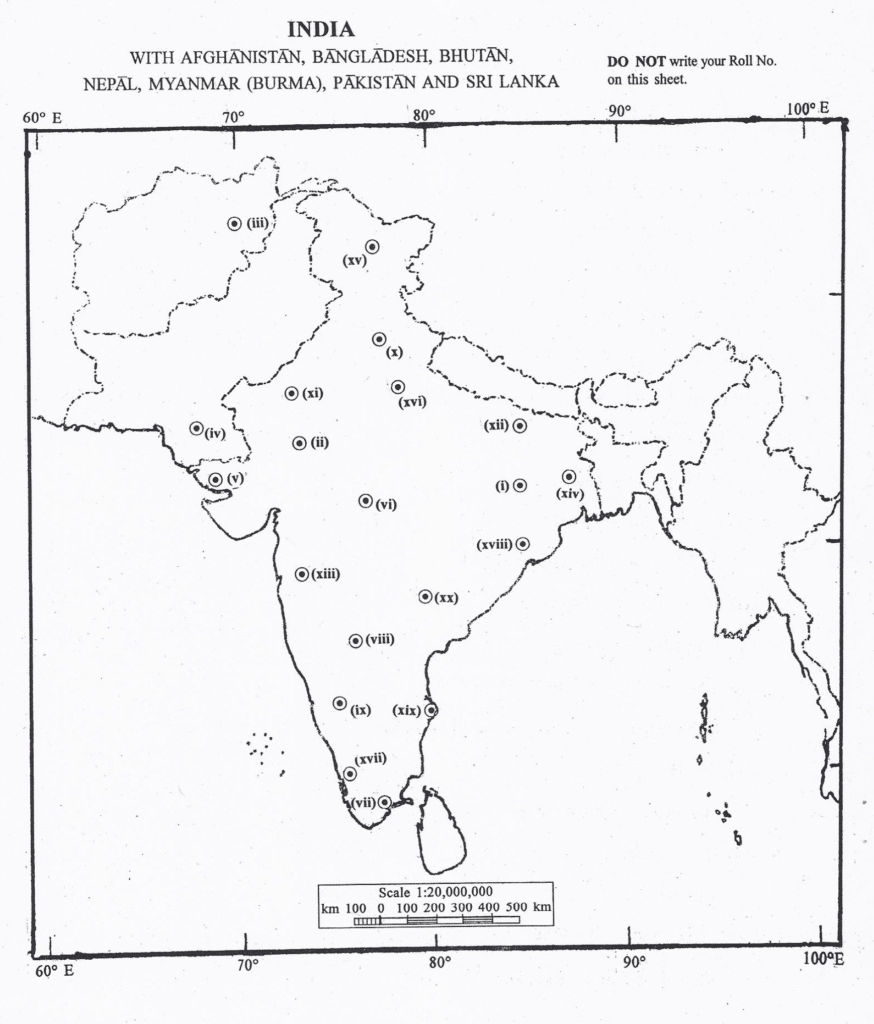
Q. Identify the following places marked on the map supplied to you and write a short note of about 30 words on each of them in your Question-cum-Answer Booklet. Locational hints for each of the places marked on the map are given below seriatim:
- (i) A Paleolithic and Mesolithic site
- (ii) A Mesolithic site
- (iii) An important halting place.
- (iv) A Pre-Harappan site.
- (v) An important Harappan site
- (vi) Site of important fossils
- (vii) A Seat port
- (viii) A Paleolithic site
- (ix) A Neolithic, Megalithic a Chalcolithic site.
- (x) A Harappan site.
- (xi) A Palaeolithic site.
- (xii) A Neolithic Site.
- (xiii) A Chalcolithic site
- (xiv) A Chalcolithic Site
- (xv) A site of Buddhist Monastery.
- (xvi) Painted Grey Ware site.
(xvii) Site related to a famous Indian Philosopher. - (xviii) Historical Rock cut caves.
- (xix) Famous Fort.
- (xx) Capital of famous Kingdom
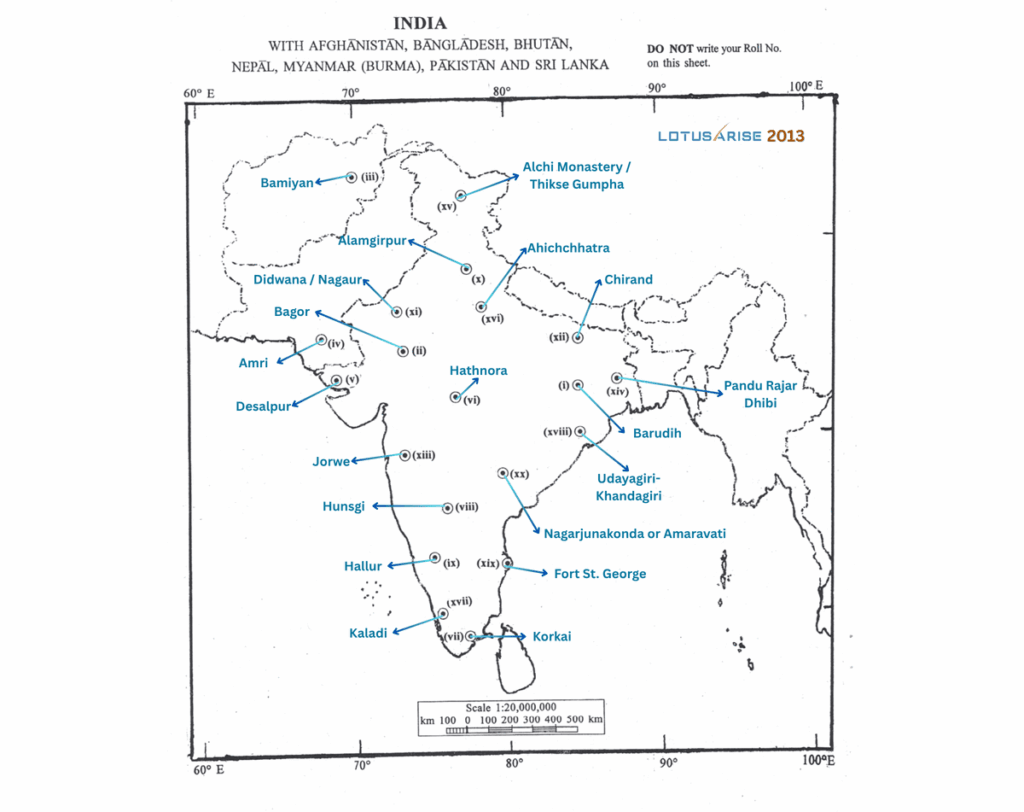
Soultion:
- A Palaeolithic and Mesolithic site: Barudih
- A Mesolithic site: Bagor
- An important halting place: Bamiyan
- A pre-Harappan site: Amri
- An important Harappan site: Desalpur
- Site of important fossils: Hathnora
- A Sea-port: Korkai
- A Palaeolithic site: Hunsgi
- A Neolithic, Megalithic and Chalcolithic site: Hallur
- A Harappan site: Alamgirpur
- A Palaeolithic site: Didwana / Nagaur
- A Neolithic site: Chirand
- A Chalcolithic site: Jorwe
- A Chalcolithic site: Pandu Rajar Dhibi
- A site of Buddhist Monastery: Alchi Monastery / Thikse Gumpha (Thikse Monastery)
- Painted Grey Ware site: Ahichchhatra
- Site related to a famous Indian Philosopher: Kaladi
- Historical Rock-cut caves: Udayagiri-Khandagiri
- Famous Fort: Fort St. George
- Capital of famous Kingdom: Nagarjunakonda or Amaravati
These 20 sites are Question 1 of Paper I in the 2013 History Optional examination — 2.5 marks each, 50 marks in total, with a note of about 30 words expected on every one. Each is solved in full below. The complete 2013 paper is at History Optional Question Paper 2013.
The map is 50 marks. What about the other 450?
You have the map answers on this page, free, for every site UPSC marked in 2013. That is 50 marks dealt with. The other 450 marks of the 2013 papers are still sitting there unanswered — and those are the marks that separate 260 from 320.
The History Optional PYQ Master Pack carries a written model answer for every question the Commission has set since 1985, including every non-map question on the 2013 paper.
- PYQs from 1985 to 2025 — arranged topic-wise, so you revise a theme and see every way it has been asked
- Model answers, not hints — full answers with historians named inside the argument, written to the mark and the word limit
- Map sections solved too — the same quality as this page, for every year, in one offline file
- PDF plus online access — on any device, permanently, not for the length of a subscription
₹1,499 (regular ₹2,500). One-time payment, instant access.
(i) A Paleolithic and Mesolithic site
- Baridih: (Write standard stuffs about Paleolithic and Mesolithic)
(ii) A Mesolithic site
Bagor
- In Bhilwara district of Rajasthan.
- One of the best documented mesolithic sites.
- Three occupational levels: mesolithic, chalcolithic and evidence of iron.
- Microliths:
- Microliths made of locally available chert and quartz, were found.
- A large number of geometric microliths such as triangles and trapezes.
- House:
- House floors paved with stone slabs were found.
- Circular arrangements of stone.
- Stone-paved areas with a large number of animal bones were butchering areas.
- Burial:
- Only one burial was uneartherd and there was no evidence of grave goods.
- Bones of wild and domesticated animals.
- Other discoveries:
- Ring stones (used as hammer stones to make microliths), and rubbing stones (for grinding food).
- Small bits of pottery of microlith phase found.
(iv) A pre-Harappan site
Amri:
- In Sindh, Pakistan on the bank of the Indus.
- Early Harappan, mature Harappan.
- Mud-brick, stone structures.
- Artefacts:
- chert blades, stone balls,
- bone tools,
- fragments of copper and bronze.
- Cellular compartments used for storing grain.
- Pottery:
- Wheel-made wares
- painted designs, mostly geometric.
- monochrome or polychrome.
(v) An important Harappan site
Desalpur:
- In Kutch district, Gujarat.
- A small mature Harappan and late Harappan phase. No early Harappan phase.
- very large forti cation:- constructed of stones with mud lling inside.
- BRW pottery.
- The occupation continued during post-Harappan period.
(vi) Site of important fossils
Hathnora:
- In Sehore district, MP.
- A fossilized fragment skull cap along with some fossils of vertebrates and
- a Acheulian tools was found by Arun Sonakia.
- The skull fragment belonged to a woman about 30 years old who
- represented an advanced variety of Homo erectus.
- A hominid clavicle (collar bone) along with animal fossils and palaeolithic
- tools found by A. R. Sankhyan.
- Two sets of human fossils found may belong to the same woman.
- Estimated dates:- 0.5 to 0.2 mya.
(vii) A sea port
Korkai:
- In Tirunelveli district, near the mouth of the Vaigai,.
- Early capital of Early Pandya.
- Pandya port, celebrated for its pearls in Sangam poems and Greek accounts.
- Important pearl fishing centre- excavation evidence and mentioned in the Arthashastra
- BRW and locally made rouletted ware with Brahmi letters belonging to c.
- 200 BCE–200 CE.
(viii) A Paleolithic site
Hunsgi:
- In Yadgir district, Karnataka.
- Palaeolithic tools found.
- It contained stone tools and weapons made from chelime stone, sandstone, quartzite, dolerite, and chert.
- Tools found included blades with sharp edges and many multipurpose instruments.
- Habitation-cum factory sites:
- Stone working site where tools of local raw material were made and sent to other places.
- Few traces of habitation structures of early hominids.
- Evidence of thatched roof-like structures.
- Palaeolithic hunter-gatherers lived in a ‘band society’.
(ix) A Neolithic, Megalithic and Chalcolithic site
Hallur:
- In Haveri district, Karnataka.
- Neolithic-chalcolithic and Megalithic site
- Earliest use of iron in South India at Piklihal and Hallur.
- Tools:
- Polished tools
- Microlith blades.
- Ornaments made of carnelian, ceramic and gold found.
- Chalcolithic blade tools
- copper axes
- fish hooks
- Transition to the Iron Age period is marked by megaliths and iron implements.
- Ash-mounds
- Double urn burial
- Agriculture – millet and horsegram, Green Gram
- Pottery:
- Early phase: Handmade and grey ware.
- Later phase: wheel made, BRW
- Herding – Cattle, Sheep, Goat.
- Animal bones of cattle, sheep, goat and horse were found.
- Habitation:
- Circular floors made of stone chips and river sand.
- Wattle and doab huts, post hole,
- One house with circular fireplace and ash and charcoal.
(x) A Harappan site
Alamgirpur
- In Saharanpur district, UP.
- Easternmost Harappan site
- Mature and Late Harappan site.
- No early Harappan level.
- Burnt bricks, copper objects found in late Harappan period.
- PGW preceded by a late Harappan level.
- Break in occupation between Late Harappan and PGW.
Two minutes per site — could you write this one from memory?
Reading a solved site note is not the same as producing one under a clock. In the hall you get roughly two minutes per identification — locate it, name the period, name the excavator or dynasty, give one distinguishing find, and say why it matters. Miss the significance line and the examiner has nothing to award the second mark for.
That same gap runs through the whole paper. Most candidates know the content and still lose four to six marks per answer because the answer never states a position. The model answers in the Master Pack are written to show the structure, not just the facts.
(xi) A Palaeolithic site
Nagaur or Didwana:
Didwana:
- Didwana in Nagaur district of Rajasthan.
- It yielded Lower and Middle Paleolithic stone tools.
- Lower palaeolithic:
- Large tools made of quartzite or other hard rocks.
- Include chopping tools, handaxes, and cleavers.
- Middle Paleolithic:
- Smaller, lighter ake tools.
(xii) A Neolithic site
Chirand:
- In Saran district of Bihar.
- Neolithic, Chalcolithic and Iron Age settlements.
- Neolithic period was earlier than 2500 B.C.
- Practiced agriculture with evidence of wheat, rice, mung, masur, peas found.
- The agricultural tools were made of stone and bone.
- Bone tools are special feature
- They practised hunting also.
- Bones of domesticated and wild animals are found.
- People lived in wattle and daub huts, circular in plan.
- Microliths are also found.
- Pottery:
- Hand-made, ‘red ware’ and BRW.
- Post firing painting on pottery.
- Chalcolithic culture: 1600 BCE
- BRW pottery found.
- Two phases:
- The first phase is without iron.
- Second has iron without NBPW.
- Later period shows the emergence of the N.B.P.W. culture.
(xiii) A Chalcolithic site
Jorwe:
- In Ahmednagar district, Maharashtra.
- Settlement: Large rectangular houses with wattle and daub walls and thatched roofs.
- Agriculture, animal herding, hunting, fishing.
- Crop rotation.
- Buried dead inside the house with head towards north.
- Pottery: Black painted.
- Bangles found.
(xiv) A Chalcolithic site
Pandu Rajar Dhibi:
- In Burdman district of West Bengal.
- Neolithic and Chalcolithic site.
- First chalcolithic culture discovered in the West Bengal.
- It reveals microliths, ground stone tools, bone tools, and pottery.
- In Chalcolithic Period, there were a few copper artefacts, beads of semiprecious stones, terracotta figurines, iron spearheads and points, slag, and oven.
- Iron artefacts found at chalcolithic levels.
- The pottery included mainly BRW.
- Bones of domesticated cattle, buffalo, goat, and deer.
(xv) A site of Buddhist Monastery
Thikse Gumpha (Thikse Monastery):
- In Ladakh, J&K.
- A gompa (monastery) affiliated with the Gelug sect of Tibetan Buddhism.
- It is a twelve-story complex and houses many items of Buddhist art such as stupas, statues, wall paintings and swords.
- Contains a 15 metres high statue of Maitreya, the largest such statue in Ladakh.
(xvi) Painted Greyware site
Ahichchhatra:
- In Bareilly district, Uttar Pradesh.
- Capital of Northern Panchala, Mahajanapada.
- A brick fortication excavated.
- PGW was rst identied at Ahichchhatra.
- PGW was followed by NBPW Period.
- Panchala and Kushana coins have been found here.
(xvii) Site related to a famous Indian philosopher
Kaladi:
- In Ernakulam district, Kerala.
- Birthplace of 8th century Indian philosopher Adi Shankara.
- A popular destination for Hindu pilgrims.
- Many temples, including shrines dedicated to Sri Sankara, Sri Krishna and Sri Ramakrishna.
(xviii) Historical rock cut caves
Udaigiri-Khandagiri:
- Twin hills Udayagiri and Khandagiri near Bhubaneswar, Odisha.
- 33 rock cut caves on both the hills.
- Mostly single storied but some double storied.
- Dwelling retreats of the Jaina monks.
- Caves were excavated by king Kharavela and his successors.
- Ranigumpha caves- double storied and the largest.
- Hathigumpha inscription (17 line) of king Kharavela (2nd century BCE)-
- In Prakrit incised in a Brahmi script.
- Talks about:
- military conquests of Kharvela,
- his orientation towards Janism,
- his construction works,
- his liberal religious spirit,
- his favors to art like music and dance etc.
- his retrieving an image of a jina.
- This is the earliest epigraphic reference to image worship in Jainism.
(xix) Famous fort
Fort St George:
- In Madras (Chennai), Tamilandu.
- First British fortress in India, founded in 1644.
- Named after St. George, a British saint.
- It briefly passed into the possession of the French from 1746 to 1749 after the first Carnatic War, but was restored to Britain under the Treaty of Aix-la-Chapelle.
- Currently houses the Tamil Nadu legislative assembly
(xx) Capital of famous kingdom
Nagarjunakonda or Amaravati (though both are not at the exact location)
Nagarjunakonda (Vijayapuri)
- In Guntur district of A.P.
- Neolithic and Megalithic culture.
- Post holes found.
- Known as Vijaypuri- capital of the Ikshvaku kings.
- Buddhist site:
- A centre of is Buddhism and Buddhist learning.
- Named after Nagarjuna, a Buddhist philosopher.
- Maha Stupa, Chaitya, vihara etc found.
- The inscriptions show royal (by queen of Ikshvaku) and non-royals sponsership of construction of temples and monasteries.
- Inhabited by merchants and artisans organized in guilds.
Amaravati
- In Guntur District, Andhra Pradesh.
- Meghalithic, BRW and NBPW site.
- Inscription in Maurya Brahmi found.
- Dhanyakataka – capital of Satavahanas.
- Buddhist stupa:
- Buddhist Stupa and Mahachaityas with marble and limestone sculptures.
- Its carved panels tell the story of Buddha.
- Chinese traveller Hiuen Tsang visited in 7 century.
- Ancient School of Arts:
- Flourished for nearly six centuries commencing from 200-100 BC.
- Patronized first by the Satavahanas and later by the Ikshvakus.
- Some Buddhist sculptures with Greco-Roman influence.
How to write the map answer in the exam hall
The solutions above are reference notes, not model answers. In the hall you have roughly 45 minutes for all 20 sites — about two minutes each, including the time it takes to find the number on the map. What follows is the structure that reliably earns the full 2.5 marks.
The five-part note that works every time
- Locate it — present-day state, and the river or coast it sits on
- Date it — the period or culture it belongs to (Palaeolithic, Harappan, Satavahana, Mughal)
- Attribute it — the excavator, the founding dynasty, or the ruler associated with it
- Evidence it — one distinguishing find, structure or inscription
- Justify it — one line on why the site matters to the wider historical argument
Four habits that cost marks
- Writing 60 words on the three sites you know and one line on the rest — the marks are the same for each
- Naming the site and stopping — identification alone is half the mark
- Leaving the map question for the end — it is the only section where you cannot think your way to an answer, so bank it first
- Skipping a site entirely — even a location and a period is worth attempting
Practise on a blank outline map rather than by reading. Mark the 20 sites from memory, write your notes, then check them against this page. Every site you missed becomes a flashcard.
Two ways to prepare for the rest of the paper
The map solutions on this site are free and will stay free. If you want the rest of the optional handled the same way, there are two routes, depending on where you are in your preparation.
| PYQ Master Pack | Mains Master Kit 2027 | |
| Best when | Your notes are done and you now need answer-writing | You are still building the subject from the ground up |
| What you get | Model answers to every question since 1985, topic-wise, map sections included | 4,500+ pages of notes, complete mapping coverage, 12 months of article access |
| Covers the map section | Yes — every year solved | Yes — site-wise preparation, not just answers |
| Price | ₹1,499 (regular ₹2,500) | ₹1,770 (regular ₹5,000) |
Both are one-time purchases with permanent access. Aspirants in their second or third attempt usually take the PYQ Master Pack; first-timers usually start with the Kit.
Frequently asked questions
History Optional map solutions — other years
Site types repeat far more often than individual sites. Working through the years below by category is the fastest way to make the 50-mark section reliable.
- UPSC History Optional Map Solution 2025 — all 20 identifications solved with 30-word notes
- UPSC History Optional Map Solution 2024 — all 20 identifications solved with 30-word notes
- UPSC History Optional Map Solution 2023 — all 20 identifications solved with 30-word notes
- UPSC History Optional Map Solution 2022 — all 20 identifications solved with 30-word notes
- UPSC History Optional Map Solution 2021 — all 20 identifications solved with 30-word notes
- UPSC History Optional Map Solution 2020 — all 20 identifications solved with 30-word notes
- UPSC History Optional Map Solution 2019 — all 20 identifications solved with 30-word notes
- UPSC History Optional Map Solution 2018 — all 20 identifications solved with 30-word notes
- UPSC History Optional Map Solution 2017 — all 20 identifications solved with 30-word notes
- UPSC History Optional Map Solution 2016 — all 20 identifications solved with 30-word notes
- UPSC History Optional Map Solution 2015 — all 20 identifications solved with 30-word notes
- UPSC History Optional Map Solution 2014 — all 20 identifications solved with 30-word notes




