UPSC History Optional Map Solution 2025

History Optional Mapping PYQs Solution: Map-Based Questions with Solution – 2025 History Optional Mains Examination.
Q. Identify the following places marked on the map supplied to you and write a short note of about 30 words on each of them in your Question-cum-Answer Booklet. Locational hints for each of the places marked on the map are given below seriatim:
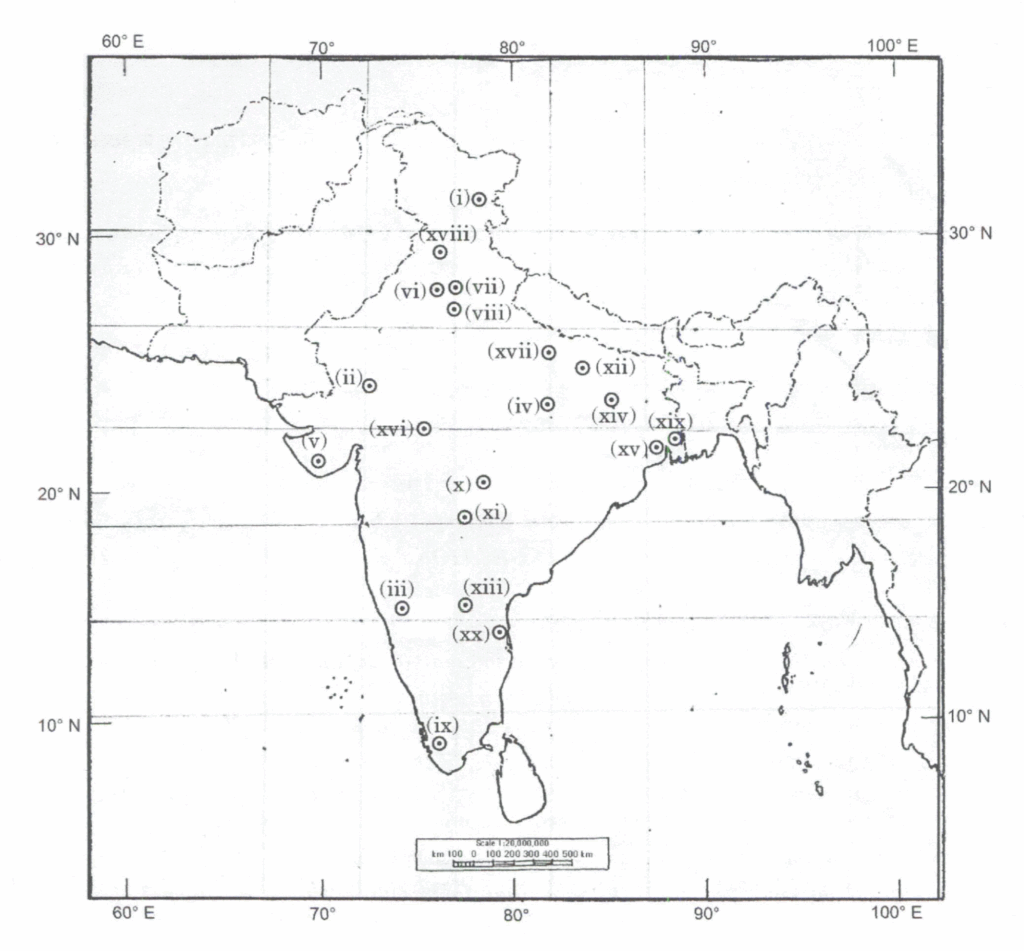
- (i) Neolithic site
- (ii) Mesolithic site
- (iii) Paleolithic site
- (iv) Neolithic site with stone artefacts
- (v) Site of Indus Valley Civilization
- (vi) Early Harappan site with a fire-pit
- (vii) Late Harappan site
- (viii) The Ochre Coloured Pottery (OCP) site
- (ix) Mesolithic site
- (x) Megalithic site
- (xi) Mahajanapada of South India
- (xii) Buddha’s Mahaparinirvana
- (xiii) Major Rock Edict of Asoka
- (xiv) Asokan Minor Rock Edict
- (xv) Commercial centre of the Mauryas
- (xvi) Saka-Kushan coin hoard
- (xvii) An inscription mentioning Ashvamedha Sacrifice
- (xviii) Site of Post-Mauryan period burnt brick house
- (xix) Terracotta craft centre of Post-Mauryan period
- (xx) Important port of the Pallava period
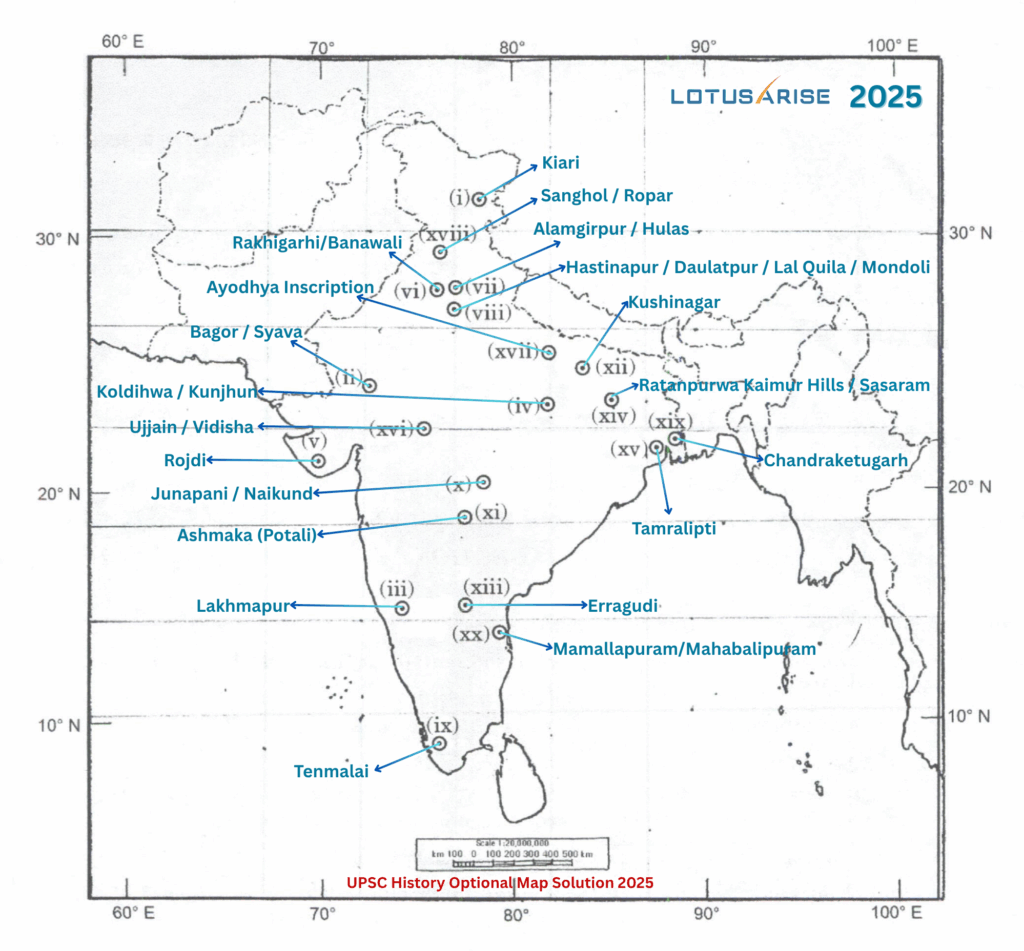
History Optional Map PYQs Solution 2025:
- Neolithic site: Kiari
- Mesolithic Site: Bagor / Syava
- Paleolithic Site: Lakhmapur
- Neolithic site with stone artefacts: Koldihwa / Kunjhun
- Site of Indus Valley Civilization: Rojdi
- Early Harappan site with a fire-pit: Rakhigarhi/Banawali
- Late Harappan site: Alamgirpur / Hulas
- The Ochre Coloured Pottery (OCP) site: Hastinapur / Daulatpur / Lal Quila / Mondoli
- Mesolithic site: Tenmalai
- Megalithic site: Junapani / Naikund
- Mahajanapada of South India: Ashmaka (Potali)
- Site of Buddha’s Mahaparinirvana: Kushinagar
- Major Rock Edict of Asoka: Erragudi
- Asokan Minor Rock Edict: Ratanpurwa Kaimur Hills / Sasaram
- Commercial centre of the Mauryas: Tamralipti
- Saka-Kushan coin hoard: Ujjain / Vidisha (Ancient Besnagar)
- An inscription mentioning the Ashvamedha Sacrifice: Ayodhya Inscription
- Site of Post-Mauryan period burnt brick house: Sanghol / Ropar
- Terracotta craft centre of Post-Mauryan period: Chandraketugarh
- Important port of the Pallava period: Mamallapuram/Mahabalipuram
These 20 sites are Question 1 of Paper I in the 2025 History Optional examination — 2.5 marks each, 50 marks in total, with a note of about 30 words expected on every one. Each is solved in full below. The complete 2025 paper is at History Optional Question Paper 2025.
The map is 50 marks. What about the other 450?
You have the map answers on this page, free, for every site UPSC marked in 2025. That is 50 marks dealt with. The other 450 marks of the 2025 papers are still sitting there unanswered — and those are the marks that separate 260 from 320.
The History Optional PYQ Master Pack carries a written model answer for every question the Commission has set since 1985, including every non-map question on the 2025 paper.
- PYQs from 1985 to 2025 — arranged topic-wise, so you revise a theme and see every way it has been asked
- Model answers, not hints — full answers with historians named inside the argument, written to the mark and the word limit
- Map sections solved too — the same quality as this page, for every year, in one offline file
- PDF plus online access — on any device, permanently, not for the length of a subscription
₹1,499 (regular ₹2,500). One-time payment, instant access.
1. Neolithic site
Kiari
- Kiari is an important Neolithic site in the union territory of Ladakh, India, where a culture flourished between roughly 6000 and 3000 BC.
- Excavated in the early 1990s by Japanese archaeologists, the site reveals a Neolithic population that lived in pit houses, cultivated crops like barley and lentils, raised livestock, and produced pottery and stone tools.
- The discovery of Kiari, along with the nearby Giak site, provides significant evidence of early human settlement and adaptation to the trans-Himalayan environment.
- Key Findings:
- Pit Houses:
- Excavations uncovered evidence of pit houses, which were partially sunken, oval-shaped structures with stone and mudbrick walls and thatch roofs.
- Agriculture and Pastoralism:
- The people cultivated crops like barley, wheat, and lentils, and also engaged in animal husbandry, raising domestic sheep and goats.
- Artifacts:
- Stone tools such as axes, chisels, and pounders were found, along with handmade pottery. The red pottery found at Kiari is comparable to that of the Burzahom Neolithic Period II.
- Pit Houses:
2. Mesolithic Site
Bagor(Largest Microlithic site in India)
- In Bhilwara district of Eastern Rajasthan, close to Kothari River.
- One of the best documented mesolithic sites.
- It has also provided the earliest evidence of animal domestication in India, dating back to around 5000 BCE.
- Three occupational levels: mesolithic, chalcolithic and evidence of iron.
- Microliths:
- Microliths made of locally available chert and quartz, were found.
- A large number of geometric microliths such as triangles and trapezes.
- House:
- House floors paved with stone slabs were found.
- Circular arrangements of stone.
- Stone-paved areas with a large number of animal bones were butchering areas.
- Domestication: Animals bones of domesticated animals sheep/ goat, cattle have been found.
- Only one burial was uneartherd and there was no evidence of grave goods.
- Other discoveries:
- Ring stones (used as hammer stones to make microliths), and rubbing stones (for grinding food).
- Small bits of pottery of microlith phase found.
Syava
- Syava is a Mesolithic site located in Sirohi, Rajasthan, discovered during explorations near the medieval site of Chandravati in 2016.
- It falls under the Chandravati Archaeological Research Project, a joint venture by the Rajasthan State Government’s Archaeology Department and JRN Rajasthan Vidyapeeth.
- Preliminary observations from the site provide insights into the Mesolithic period.
3. Paleolithic Site
Lakhmapur
- Lakhmapur is a Paleolithic site in the Kaladgi Basin of Peninsular India, known for its Lower and Middle Paleolithic lithic assemblages.
- The site contains surface scatters and buried stone lines of artifacts, primarily made from quartzite and chert, found in relation to extinct springs and ancient watercourses.
- Lakhmapur, along with other sites like Anagwadi and Kavalli, is important for understanding the technological continuity and shifts between the Acheulian (Lower Paleolithic) and Middle Paleolithic cultures in the region.
Malprabha- Ghatprabha Valley
- The Kaladgi Basin shows artefacts from all the three periods of Palaeolithic age.
- Important sites are Anagwadi, Kavalli, Lakhmapur.
- Tools made up of stone like quartzite, chert etc have been excavated.
4. Neolithic site with stone artefacts
Koldihawa
- Located in Prayagraj district, Uttar Pradesh, on the Belan River in the Vindhyan foothills.
- Dated to around 7000–6000 BCE.
- One of the oldest Neolithic sites in the Indian subcontinent.
- Cultural continuity from Neolithic to Iron Age.
- Remains of rice and impression of rice husk embedded in pieces of burnt clay found.
- People familiar with both wild and domesticated rice (oryza sativa).
- Other discoveries included stone blades, polished stone celts, microliths, querns and mullers (for grinding) and Bone tools also found.
- Handmade pottery of 3 kinds- cord marked pottery, plain red pottery, black and red ware(BRW).
- Cattle pen with hoof marks of cattle discovered.
- Chalcolithic period:
- Pottery:
- Introduction of wheel-made pottery,
- BRW.
- Mud floors with burnt clay and post holes, remnants of wattle-and-daub houses.
- The tool kit includes copper, bone and stone tools.
- Microlithic tools used.
- Copper beads and bone tools.
- Beads of semi-precious stones, ring stones and terracotta found.
- Pottery:
Kunjhun
- Kunjhun (also spelled Kunjun) in the Sidhi district is a significant Neolithic site in the Middle Son Valley, known for its stone artifacts, particularly those that were subjected to high heat before shaping.
- The site is important for its contribution to understanding the Vindhyan Neolithic tradition, as evidenced by radiocarbon dates, a range of lithic (stone) and ceramic finds, and evidence of early agriculture and animal domestication.
- Artifacts:
- The site has yielded various artifacts, including:
- Stone Tools: Ground stone tools such as hammer stones, rubber stones, and other tools made from materials like chalcedony, agate, and quartz have been found.
- Pottery: Handmade, poorly fired pottery, sometimes with cord impressions and rice husk as tempering agents, has been discovered.
- The site has yielded various artifacts, including:
- Evidence of Early Agriculture and Animal Husbandry:
- Charred grains of rice, wheat, mung, masoor, and millet found at the site indicate early cultivation.
- Bones of domestic animals like cattle, buffalo, and potentially sheep and goats, along with bones of wild animals such as deer, elephants, and rhinoceros, point to animal husbandry.
5. Site of Indus Valley Civilization
Rojdi
- Location:
- Situated on the northern bank of the Bhadar River in the Gondal taluka of Rajkot district, in the Saurashtra region Gujarat, India.
- Chronology:
- Continuously occupied from about 2500 BCE to 1700 BCE, with identified periods as Rojdi A (2500-2200 BCE), Rojdi B (2200-1900 BCE), and Rojdi C (1900-1700 BCE).
- Excavation:
- Conducted by a joint team from the Gujarat State Department of Archaeology and The University Museum at the University of Pennsylvania between 1982 and 1995.
- Architecture:
- Features houses built on stone foundations, with mud walls above.
- Absence of Bricks and Drainage:
- Unlike many other Harappan sites, no bricks (baked or unbaked) were found at Rojdi, nor were there any signs of wells, bathing platforms, or street drains.
- Significance
- Rojdi provides insights into the cultural and technological aspects of the Indus Valley Civilization in Saurashtra.
- Its distinctive features, such as the stone foundations and lack of certain common urban elements, highlight the regional variations within the civilization.
6. Early Harappan site with a fire-pit
Rakhigarhi
- Location
- In Hisar district, Haryana.
- Largest Indus Valley Civilization site (approx. 550 hectares) — bigger than Mohenjo-Daro.
- Cultural Phases
- Evidence of Early and Mature Harappan phases.
- Continuous habitation from 5000 BCE to 1900 BCE.
- Urban Features
- Grid-pattern township with planned layout.
- Mud-brick and burnt-brick houses.
- Advanced drainage system.
- Pottery
- Red ware pottery.
- Includes dish-on-stand, vase, jar, bowl, beaker, and perforated jars.
- Craft Production
- Presence of a jewelry-making unit (copper, bronze, gold ornaments).
- Terracotta figurines, seals, semi-finished beads, and toy carts.
- Inscribed steatite seals and sealings.
- Artefacts
- Cylindrical seal with five Harappan characters.
- Blades, bone points, terracotta and shell bangles.
- Animal figurines, terracotta wheel, copper objects.
- Religious/Ritual Evidence
- Animal sacrificial pit and circular fire altars — ritual significance.
- Subsistence
- Cultivation of wheat, barley, peas.
- Domesticated cattle and buffalo.
- Genetic Significance
- DNA from human remains suggests genetic continuity since 10,000 BCE.
- Challenges older theories of massive migrations into the subcontinent.
7. Late Harappan site
Alamgirpur
- Location:
- Situated in Meerut district, Uttar Pradesh, on the left bank of the Hindon River.
- Cultural Phase:
- Mature and Late Harappan site.
- Easternmost extent of the Indus Valley Civilization.
- No Early Harappan level found.
- Settlement Nature:
- No fortifications or public buildings—indicating a rural or craft-based outpost.
- Likely functioned as a satellite settlement rather than a major urban center.
- Archaeological Finds:
- Burnt bricks, copper objects (in Late Harappan phase).
- Typical Harappan pottery, terracotta bangles, beads, faience objects.
- Evidence of textile production—spindle whorls and yarn impressions.
- Cultural Transition:
- Harappan layer is overlain by PGW and NBPW deposits.
- Indicates a break in occupation between Late Harappan and PGW phase.
- Important site for tracing the cultural transition to early historic Ganga plains.
Hulas
- Hulas is a significant archaeological site in Uttar Pradesh, India, that was part of the Late Harappan Phase of the Indus Valley Civilization, dating from around 2000–1700 BCE.
- Situated in the Saharanpur district near the Hindon River, the site offers evidence of a cultural adaptation to changing conditions during the civilization’s later period, with evidence of millet cultivation.
- Excavations at Hulas have revealed a Chalcolithic Culture Phase that extended across the Ganga-Yamuna Doab.
- Evidence of Adaptation:
- Archaeobotanical data from Hulas and other sites in the region suggest a cultural shift towards millets, which were better suited to a prolonged period of drought or a weakening of the monsoons during this time.
8. The Ochre Coloured Pottery (OCP) site
Hastinapur / Lal Quila
- Location:
- In Meerut district, Uttar Pradesh
- Situated on the right bank of the old bed of the Ganga River
- Lies in the fertile upper Ganga–Yamuna doab region
- Cultural Sequence:
- Excavated by B.B. Lal in the 1950s
- Shows continuous occupation:
- Ochre Coloured Pottery (OCP)
- Painted Grey Ware (PGW)
- Northern Black Polished Ware (NBPW)
- Dates from the Vedic to early historic period
- Vedic and Epic Associations:
- Identified as the capital of the Kuru Kingdom mentioned in the Mahabharata
- Excavation revealed PGW pottery, fire altars, rice husks, indicating:
- Vedic domestic life
- Ritual practices aligned with Shatapatha Brahmana
- Supported by later texts and Puranic tradition
- Material Culture (PGW Phase):
- Pottery:
- PGW bowls and dishes
- Wheel-turned red ware with designs: fish, leaves, flowers, svastikas, triratnas, loops, circles, and other geometric patterns
- Houses:
- Made of wattle-and-daub and mud
- Use of unbaked bricks
- Tools & Implements:
- Iron tools, copper objects
- Weights made of chert and jasper
- Animal remains:
- Horse bones found, suggesting domestication and use
- Pottery:
- Post-PGW Continuity & Urbanization:
- Evidence of flood layer over PGW stratum
- Possibly explains the abandonment of Hastinapur and rise of Kaushambi
- Later (2nd century BCE–3rd century CE):
- Planned urban settlement
- Burnt brick structures
- Ring wells used for water management
- Evidence of flood layer over PGW stratum
- Artefacts (Early Historic Phase):
- Terracotta figurines: humped bull, torso of Bodhisattva Maitreya
- Iron, ivory, copper objects
- Rings, beads, potsherds, and seals
- Coins:
- Issued by Yaudheyas
- Kushana coins also found
- Religious Significance (Jain Tradition):
- Rishabha, the first Tirthankara, is believed to have lived here
- Mahavira is said to have visited the site
- Archaeological Importance:
- A rare site where archaeological findings correlate with Vedic literature
- Critical to the historicisation of the Mahabharata and epic traditions
9. Mesolithic site
Tenmalai
- Location:
- A rockshelter and open-air site in Tenmalai, Quilon District (Kollam), Kerala, situated in the foothills of the Chendurni Hills.
- Artifacts:
- The site is noted for its stone tools made from quartz, including various types of microliths and larger macrolithic tools.
- Cave Art:
- The site contains unique Mesolithic cave paintings featuring parallel and diagonal lines, which are believed to be a form of identification system or signboards. There are also rock engravings on the exterior of the rock shelter.
- Habitation Evidence:
- Evidence of Mesolithic occupation includes circular arrangements of stones, fire hearths, and charred bones, all found within the rock-shelter and its immediate surroundings.
- Significance:
- The discovery of the Tenmalai site contributes significantly to the understanding of Mesolithic culture and life in South India.
10. Megalithic site
Junapani
- Location
- Situated in Nagpur district, Maharashtra.
- Part of the Vidarbha megalithic cultural zone.
- Chronology
- Dates to the Iron Age, approx. 1000 BCE to 300 BCE.
- Burial Features
- Megalithic stone circle burials.
- Over 150–300 stone circles found.
- Circles made of aligned stone pebbles or cairns.
- Urn or pit burials under stone circles.
- Some contain double urn burials.
- No cremation—indicates primary burial of the dead.
- Megalithic stone circle burials.
- Material Culture
- Iron objects: rings, chisels, horse-bits, flat axes.
- Pottery:
- Predominantly Black-and-Red Ware (BRW).
- Red pottery with graffiti.
- Bead making centre: semi-precious stone beads found.
- Animal bones and charcoal remains suggest funerary rituals.
- Astronomical Features
- Some cup-marked stones within circles.
- Believed by scholars to have astronomical alignments, possibly used for calendrical or ritual purposes (still debated).
- Cultural Significance
- Represents a regionally distinct megalithic tradition of central India.
- Indicates ritual complexity, funerary practices, and iron-working technology.
- Shows deep symbolism in space, death, and memory.
- Junapani is declared an ASI National Important Monument.
Two minutes per site — could you write this one from memory?
Reading a solved site note is not the same as producing one under a clock. In the hall you get roughly two minutes per identification — locate it, name the period, name the excavator or dynasty, give one distinguishing find, and say why it matters. Miss the significance line and the examiner has nothing to award the second mark for.
That same gap runs through the whole paper. Most candidates know the content and still lose four to six marks per answer because the answer never states a position. The model answers in the Master Pack are written to show the structure, not just the facts.
11. Mahajanapada of South India
Ashmaka
- Location: Located in the Godavari river valley, in the modern states of Telangana and Maharashtra.
- Historical Significance:
- Ashmaka was the only Mahajanapada situated south of the Vindhya mountain range.
- Its capital was Pratisthan (modern-day Paithan) or Potana/Potali. The kingdom, situated in parts of present-day Telangana and Maharashtra, was known for being the only Mahajanapada located south of the Vindhya mountains.
- Mentioned in Buddhist and Jain texts, Ashmaka’s existence highlights the spread of political and cultural developments to the southern regions of the Indian subcontinent during the 6th century BCE.
12. Site of Buddha’s Mahaparinirvana
Kushinagar
- Location: Situated in the Kushinagar district of Uttar Pradesh.
- Historical Significance:
- Kushinagar is one of the four most sacred sites for Buddhists as it is the place where Gautama Buddha attained Mahaparinirvana (final emancipation) and was cremated.
- Kushinagar was known as Kushinara and was the capital of the Malla dynasty when the Buddha achieved Mahaparinirvana.
- The site features the Mahaparinirvana Stupa and the Mahaparinirvana Temple, which house a reclining Buddha statue.
- It was a major pilgrimage centre from the time of the Mauryas and was visited by Chinese pilgrims like Xuanzang.
13. Major Rock Edict of Asoka
Erragudi
- (Also spelled Yerragudi)
- In Kurnool district, Andhra Pradesh.
- Major and Minor Rock Edict of Ashoka.
- Inscriptions in Brahmi Script and Prakrit language.
- Ashoka was referred to Piyadasi and the Beloved of Gods.
- Inscriptions contained on nine rocks advocated that:
- one should be obedient to one’s parents,
- one should likewise be obedient to one’s elders,
- one should be kind to living beings,
- one should speak truth,
- one should propagate the attributes of dharma,
- no-living being be slaughtered for sacrifices.
- The rock edict also mention welfare work of Ashoka like planting of tress, digging wells for the enjoyment of animals and men.
14. Asokan Minor Rock Edict
Ratanpurwa Kaimur Hills
- Location: It is situated in the Ghurhupur (Ratanpurwa) area of the Kaimur Hills of Bihar, about 60 km from Varanasi.
- The edict was discovered in 2009 by K. K. Thaplyal and reported in a monograph by Jnana-Pravaha.
- Historical Significance:
- The discovery of an Asokan Minor Rock Edict in the Kaimur Hills is significant as it indicates the reach of the Mauryan Empire into the tribal and forested regions.
- These minor edicts were often placed in remote areas to directly address local populations and officials, reaffirming Ashoka’s commitment to spreading dhamma across his empire.
Sasaram Rock Edict
- Location: Sasaram, Rohtas district, Bihar, India.
- Type: A Minor Rock Edict, predating the Major Rock Edicts.
- Issuer: Mauryan emperor Ashoka (c. 269–232 BCE).
- Purpose: To proclaim Ashoka’s commitment to Buddhist principles and dhamma (law).
- Discovery: Discovered in 1839 by E. L. Ravenshaw.
- Current Status: Declared a nationally protected monument by the Archaeological Survey of India (ASI) in 1917.
- Significance:
- The inscription is an early piece of evidence showing the spread of Buddhism.
- It helps understand the evolution of Ashoka’s dhamma policy.
- As a minor rock edict, it provides personal and declarative insights into Ashoka’s personal devotion to Buddhism and dhamma.
15. Commercial centre of the Mauryas
Tamralipti
- Location:
- Situated in Tamluk, near the confluence of the Rupnarayan and Hooghly rivers in Purba Medinipur district, West Bengal.
- Close to the Bay of Bengal, at the eastern end of the Gangetic trade route.
- Historical Significance:
- Functioned as the principal eastern seaport of ancient India.
- Flourished from the Mauryan period to the Gupta era.
- Mentioned in:
- Periplus of the Erythraean Sea.
- Accounts of Fa-Hien and Hiuen Tsang.
- Trade and Connectivity:
- Connected by land and river to Taxila, and by sea to Southeast Asia and Sri Lanka.
- Key player in the maritime Silk Route.
- Traded:
- Exports: Textiles, spices, metals.
- Imports: Luxury goods including Roman items.
- Religious and Cultural Role:
- Associated with Buddhism.
- Tradition holds Ashoka’s children, Mahendra and Sanghamitra, departed from here to spread Buddhism to Sri Lanka.
- Associated with Buddhism.
- Archaeological Findings:
- Antiquities from the Chalcolithic period and NBPW phase.
- Rouletted ware and Red polished ware of Roman origin — evidence of Roman contact.
- Terracotta figurines, coins, semi-precious stone beads, and brick structures — indicating urban character.
- Seals and stamped pottery also found.
- Historical Importance:
- Highlights the economic and religious vitality of coastal Bengal.
- Illustrates the role of riverine-maritime integration in fostering long-distance trade and cultural exchange across Asia.
16. Saka-Kushan coin hoard
Vidisha (Ancient Besnagar)
- Location: Situated in the Vidisha district of Madhya Pradesh.
- Historical Significance:
- Ancient Vidisha (Besnagar) was a prominent urban center on the trade routes connecting North and South India.
- The discovery of a Saka-Kushan coin hoard here highlights the city’s economic importance during the post-Mauryan period and its connections with the Central Asian rulers who controlled much of North and Central India at the time.
- The site is also famous for the Heliodorus Pillar, which attests to the influence of Greek culture.
17. An inscription mentioning the Ashvamedha Sacrifice
Ayodhya Inscription
- Location: Located in the city of Ayodhya in the state of Uttar Pradesh.
- The “Ayodhya inscription” most commonly refers to the Dhanadeva-Ayodhya inscription, a Sanskrit inscription from the Brahmi script detailing King Dhanadeva’s building of a shrine to his father, Phalgudeva.
- It is significant for mentioning his ancestor, Pushyamitra Sunga, and proving the Shunga dynasty’s control over Ayodhya and Pushyamitra’s performance of the Ashvamedha Yajna ritual twice.
- Historical Significance:
- The Ayodhya Inscription is a short but historically significant inscription from the Sunga period.
- It mentions that King Dhanadeva, a local ruler, performed two Ashvamedha sacrifices in Ayodhya.
- The inscription provides crucial evidence for the revival of Vedic rituals during the Sunga dynasty, which followed the decline of the Mauryan Empire.
18. Site of Post-Mauryan period burnt brick house
Sanghol
- Location: Situated in the Fatehgarh Sahib district of Punjab.
- Historical Significance:
- Sanghol is a key archaeological site with a continuous cultural sequence from the Harappan to the late Kushan period.
- It is particularly known for its extensive findings from the post-Mauryan and Kushan periods, including a well-preserved burnt-brick house complex.
- The site’s terracotta sculptures and a significant number of Kushan coins indicate its role as a flourishing urban center and a hub of Buddhist art and craft.
Ropar
- In Rupnagar district, Punjab, on left bank of Sutlej river
- IVC, PGW and NBPW.
- No early Harappan level.
- Transition from village to town in period c. 600–200 BCE, and yielded NBPW and punch-marked and copper coins.
- A seal with an inscription in Brahmi.
- Houses made of stone, mud-brick and burnt brick.
- Iron workshop and agate beads in NBPW.
19. Terracotta craft centre of Post-Mauryan period
Chandraketugarh
- Location: Situated in the North 24 Parganas district of West Bengal.
- Historical Significance:
- Chandraketugarh was a thriving urban and port town from the pre-Mauryan to the Gupta periods.
- It is renowned for its exceptional terracotta art, which shows an unusual degree of precision and craftsmanship.
- Its terracotta plaques and other artifacts reflect a rich artistic tradition and a thriving economy, with many objects showcasing daily life and religious motifs.
- Excavations revealed a vast collection of terracotta figurines and plaques depicting daily life and religious practices, showcasing the artistic skill of the people.
- Key findings include women with elaborate decorations, likely a reflection of ritualistic importance and local cult practices.
20. Important port of the Pallava period
Mamallapuram/Mahabalipuram
- In Chengalpattu district, Tamil Nadu.
- Developed by the Pallava King Narsimhavarman Mamalla and Rajasimhavarman in the 7 century AD.
- The site is famous for its monolithic temples (Rathas) and rock-cut caves, which represent the pinnacle of Pallava art and architecture.
- Cave temples, monolithic rathas, sculpted reliefs and structural temples built.
- UNESCO World Heritage Site.
- Famous monuments:
- Descent of the Ganges – a giant open-air rock relief
- Pancha Rathas (Five Chariots) –
- Of the nine monolithic temples found in Mahabalipuram, the most important are Five Rathas known after the famous five Pandava brothers of the Mahabharata fame.
- Each of these is carved from one single large piece of granite stone.
- Shore Temple, a structural temple along the Bay of Bengal with the entrance from the western side away from the sea.
- Pallavas used the port to launch trade and diplomatic missions to Sri Lanka and Southeast Asia.
How to write the map answer in the exam hall
The solutions above are reference notes, not model answers. In the hall you have roughly 45 minutes for all 20 sites — about two minutes each, including the time it takes to find the number on the map. What follows is the structure that reliably earns the full 2.5 marks.
The five-part note that works every time
- Locate it — present-day state, and the river or coast it sits on
- Date it — the period or culture it belongs to (Palaeolithic, Harappan, Satavahana, Mughal)
- Attribute it — the excavator, the founding dynasty, or the ruler associated with it
- Evidence it — one distinguishing find, structure or inscription
- Justify it — one line on why the site matters to the wider historical argument
Four habits that cost marks
- Writing 60 words on the three sites you know and one line on the rest — the marks are the same for each
- Naming the site and stopping — identification alone is half the mark
- Leaving the map question for the end — it is the only section where you cannot think your way to an answer, so bank it first
- Skipping a site entirely — even a location and a period is worth attempting
Practise on a blank outline map rather than by reading. Mark the 20 sites from memory, write your notes, then check them against this page. Every site you missed becomes a flashcard.
Two ways to prepare for the rest of the paper
The map solutions on this site are free and will stay free. If you want the rest of the optional handled the same way, there are two routes, depending on where you are in your preparation.
| PYQ Master Pack | Mains Master Kit 2027 | |
| Best when | Your notes are done and you now need answer-writing | You are still building the subject from the ground up |
| What you get | Model answers to every question since 1985, topic-wise, map sections included | 4,500+ pages of notes, complete mapping coverage, 12 months of article access |
| Covers the map section | Yes — every year solved | Yes — site-wise preparation, not just answers |
| Price | ₹1,499 (regular ₹2,500) | ₹1,770 (regular ₹5,000) |
Both are one-time purchases with permanent access. Aspirants in their second or third attempt usually take the PYQ Master Pack; first-timers usually start with the Kit.
Frequently asked questions
History Optional map solutions — other years
Site types repeat far more often than individual sites. Working through the years below by category is the fastest way to make the 50-mark section reliable.
- UPSC History Optional Map Solution 2024 — all 20 identifications solved with 30-word notes
- UPSC History Optional Map Solution 2023 — all 20 identifications solved with 30-word notes
- UPSC History Optional Map Solution 2022 — all 20 identifications solved with 30-word notes
- UPSC History Optional Map Solution 2021 — all 20 identifications solved with 30-word notes
- UPSC History Optional Map Solution 2020 — all 20 identifications solved with 30-word notes
- UPSC History Optional Map Solution 2019 — all 20 identifications solved with 30-word notes
- UPSC History Optional Map Solution 2018 — all 20 identifications solved with 30-word notes
- UPSC History Optional Map Solution 2017 — all 20 identifications solved with 30-word notes
- UPSC History Optional Map Solution 2016 — all 20 identifications solved with 30-word notes
- UPSC History Optional Map Solution 2015 — all 20 identifications solved with 30-word notes
- UPSC History Optional Map Solution 2014 — all 20 identifications solved with 30-word notes
- UPSC History Optional Map Solution 2013 — all 20 identifications solved with 30-word notes