UPSC History Optional Map Solution 2020

History Optional Mapping PYQs Solution: Map Based Questions with Solution – 2020 History Optional Mains Examination.
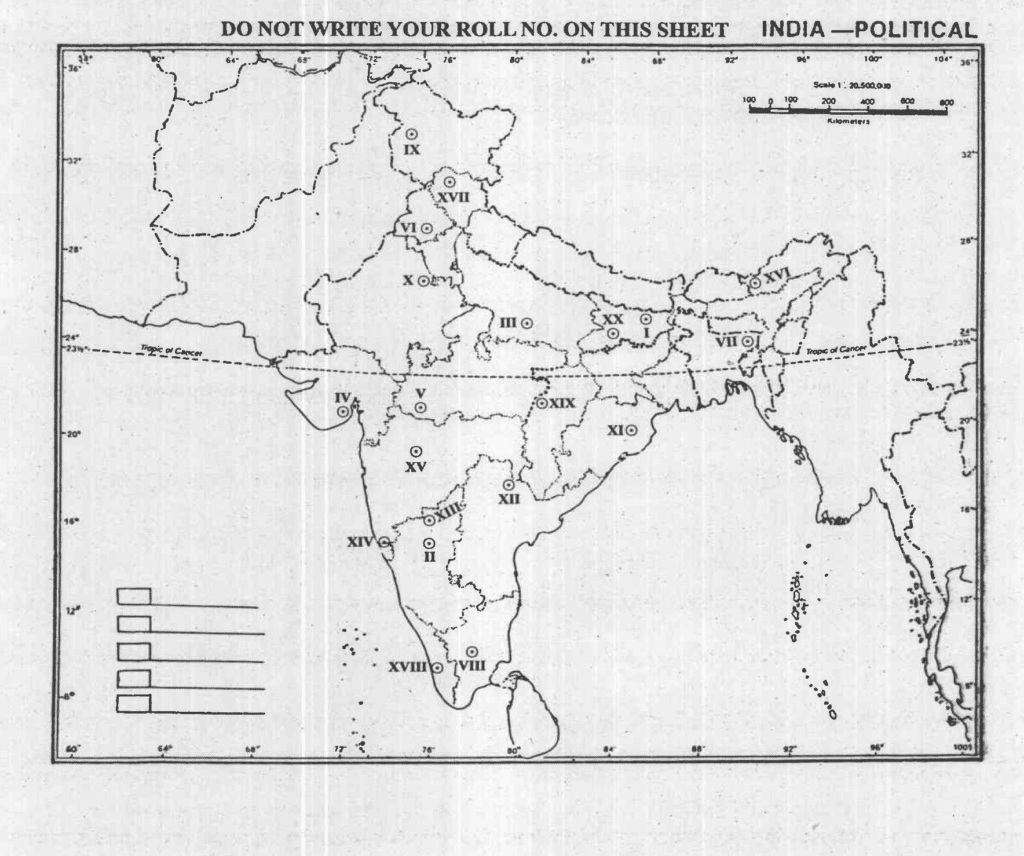
Q. Identify the following places marked on the map supplied to you and write a short note of about 30 words on each of them in your Question-cum-Answer Booklet. Locational hints for each of the places marked on the map are given below seriatim:
- (i) Paleolithic site
- (ii) Paleolithic Factory site
- (iii) Neolithic site
- (iv) Early and Mature Harappan site
- (v) Chalcolithic site
- (vi) Site of Coin and Seal Moulds
- (vii) Ancient Administration Centre
- (viii) Ancient Political Headquarter
- (ix) Ancient Temple site
- (x) Pre and Proto Historic site
- (xi) Ancient Capital City
- (xii) Place of Shaiva Temple
- (xiii) World Heritage Centre of Temple complex
- (xiv) An Inscriptional site
- (xv) Place of Jain Temple
- (xvi) Largest Buddhist Monastery
- (xvii) Ancient Temple Complex
- (xviii) Place of oldest Mosque
- (xix) Temple Complex dedicated to Shiva
- (xx) Ancient Education Centre
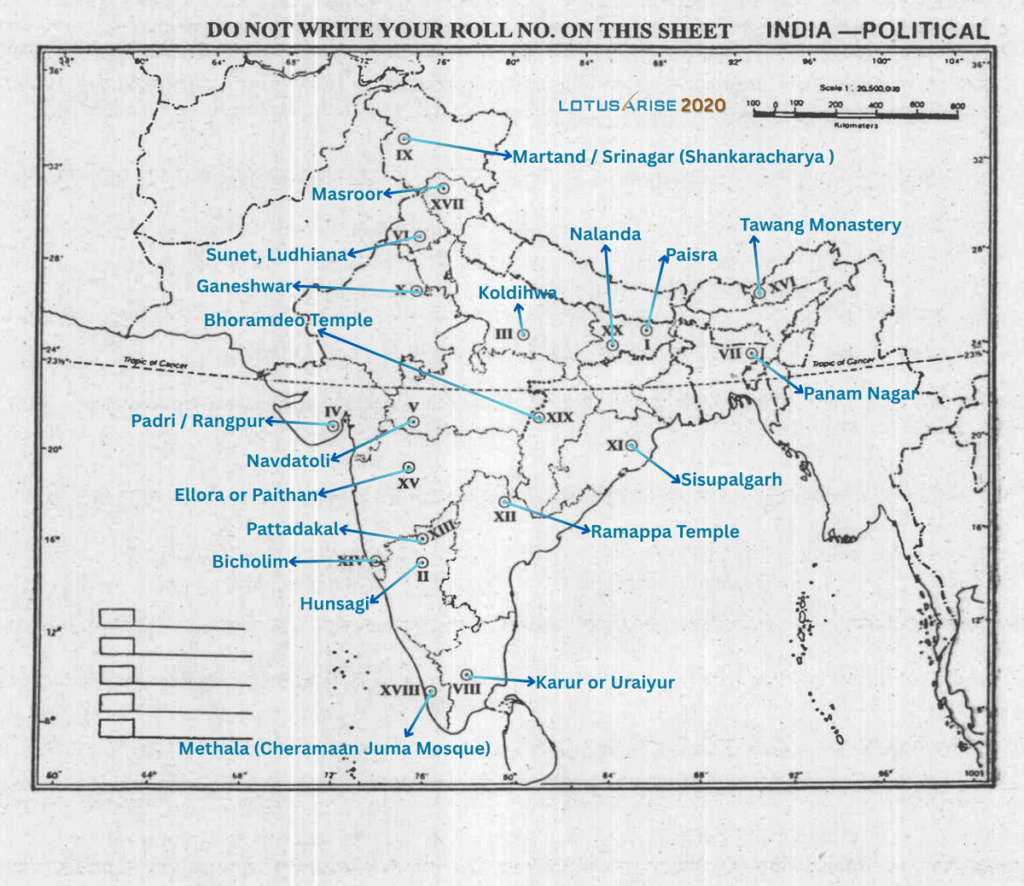
Mapping PYQs Solution:
- Palaeolithic site: Paisra
- Palaeolithic factory site: Hunsagi
- Neolithic site: Koldihwa
- Early and mature Harappan site: Padri / Rangpur
- Chalcolithic site: Navdatoli
- Site of Coin and Seal Moulds: Sunet, Ludhiana
- Ancient Administration centre: Panam Nagar / Some site in Sylhet district
- Ancient Political Headquarter: Karur or Uraiyur
- Ancient Temple site: Martand / Srinagar (Shankaracharya temple)
- Pre and Proto Historic site: Ganeshwar
- Ancient capital city: Sisupalgarh
- Place of Shaiva Temple: Ramappa Temple / Kaleshwaram Mukteshwara Swamy Temple
- World Heritage Centre of Temple complex: Pattadakal
- An inscriptional site: Bicholim
- Place of Jain Temple: Ellora or Paithan
- Largest Buddhist Monastery: Tawang Monastery
- Ancient Temple Complex: Masroor
- Place of oldest Mosque: Methala (Cheramaan Juma Mosque)
- Temple complex dedicated to Shiva: Bhoramdeo Temple
- Ancient Education Centre: Nalanda
These 20 sites are Question 1 of Paper I in the 2020 History Optional examination — 2.5 marks each, 50 marks in total, with a note of about 30 words expected on every one. Each is solved in full below. The complete 2020 paper is at History Optional Question Paper 2020.
The map is 50 marks. What about the other 450?
You have the map answers on this page, free, for every site UPSC marked in 2020. That is 50 marks dealt with. The other 450 marks of the 2020 papers are still sitting there unanswered — and those are the marks that separate 260 from 320.
The History Optional PYQ Master Pack carries a written model answer for every question the Commission has set since 1985, including every non-map question on the 2020 paper.
- PYQs from 1985 to 2025 — arranged topic-wise, so you revise a theme and see every way it has been asked
- Model answers, not hints — full answers with historians named inside the argument, written to the mark and the word limit
- Map sections solved too — the same quality as this page, for every year, in one offline file
- PDF plus online access — on any device, permanently, not for the length of a subscription
₹1,499 (regular ₹2,500). One-time payment, instant access.
(i) Paleolithic site
Paisra
- Location: Munger district, Bihar.
- Significance: Paisra is an important archaeological site that showcases human activity during both the Paleolithic (Old Stone Age) and Mesolithic (Middle Stone Age) periods.
- Key Discoveries – Stone Tools:
- It served as a prominent stone working site, with numerous finished and semi-finished tools discovered. This indicates a focus on tool production.
- Evidence suggests that the raw material (stone) for tool-making was likely heated before flaking, a technique used to improve the quality of tools.
- Habitation & Lifestyles:
- Archaeological findings include evidence for the construction of huts and temporary shelters, suggesting a degree of organization in early human settlements.
- Apart from microliths (small, refined stone tools typical of the Mesolithic), numerous fireplaces were found, indicating cooking and warmth.
- The relatively thin layer of Mesolithic habitation suggests that people probably did not reside at this specific location for extended periods, implying a more mobile or seasonal occupation.
- Limitations in Finds:
- Significantly, no organic remains (like bones or plant matter) have been reported from Paisra, which limits direct insights into the diet or specific animal/plant life of the inhabitants.
(ii) Paleolithic Factory site
Hunsgi
- Location: Yadgir district, Karnataka.
- Significance: Hunsgi is an extremely important Paleolithic (Old Stone Age) archaeological site, providing critical insights into early human life, particularly tool production and settlement patterns, in South India.
- Tool Manufacturing & Raw Materials:
- The site yielded an abundance of Paleolithic stone tools and weapons.
- These tools were skillfully crafted from various locally available raw materials, including limestone, sandstone, quartzite, dolerite, and chert.
- Found tools encompass blades with sharp edges and many multipurpose instruments, showcasing the diverse technological capabilities of early hominids.
- Habitation-cum-Factory Site:
- Hunsgi functioned uniquely as a habitation-cum-factory site. This means it served both as a place where people lived and as a significant stone-working center.
- Tools were manufactured here from local raw materials and were likely distributed to other areas, suggesting early networks of movement and exchange.
- While there are few elaborate habitation structures, evidence points to the presence of simpler thatched roof-like structures, indicating their early forms of shelter.
- Social Organization:
- The findings at Hunsgi support the understanding that Paleolithic hunter-gatherers often lived in a ‘band society’, characterized by small, mobile groups working cooperatively for survival.
(iii) Neolithic site
Koldihawa
- Location: Allahabad district (now Prayagraj), Uttar Pradesh.
- Significance: Koldihawa is a crucial archaeological site that reveals a continuous sequence of human occupation, spanning from the Neolithic (New Stone Age), through the Chalcolithic (Copper Age), and into the Iron Age. It’s especially famous for very early evidence of rice cultivation.
- Neolithic Period (Key Features):
- Earliest Rice Evidence: The site is globally significant for the discovery of remains of rice and impressions of rice husk embedded in pieces of burnt clay. This indicates very early rice cultivation.
- Tools: The tool kit included stone blades, polished stone celts (axes), microliths (small stone tools), and querns and mullers (grinding stones), reflecting agricultural and processing activities.
- Bone Tools: Bone tools were also found, highlighting diverse material use.
- Pottery: Characterized by hand-made, cord-marked pottery (with impressions from cords) and early forms of Black-and-Red Ware (BRW).
- Chalcolithic Period (Transition & Advancements):
- Pottery: This period saw the introduction of wheel-made pottery, indicating technological advancements, alongside the continued use of Black-and-Red Ware (BRW).
- Dwellings: Evidence of mud floors with burnt clay and numerous post holes points to the presence of wattle-and-daub houses (structures made of woven branches and mud), indicating more settled living.
- Tool Kit Expansion: The tools included a mix of copper, bone, and stone tools, showing the emergence of metal use.
- Ornaments: Finds of copper beads, beads of semi-precious stones, ring stones, and terracotta objects indicate early forms of ornamentation and craft.
(iv) Early and Mature Harappan site
Padri (or may be Rangpur)
Padri:
- Location: Kerala-no-dhoro, also known as Padri, is an archaeological site located on the southern coast of the Saurashtra region in Gujarat.
- Significance: Padri is an important Harappan site that reveals evidence of settlements from both the Early Harappan and Mature Harappan periods, providing insights into the evolution of the civilization in a coastal context.
- Key Discoveries:
- Copper Fish Hooks: Uniquely, exceptionally large copper fish hooks were found, suggesting a significant reliance on marine resources and advanced fishing techniques.
- Storage Jars: The site yielded well-made, sturdy storage jars, which are believed to have been used for transporting salt, indicating a specialized economic activity.
- Decorated Pottery: One notable jar is decorated with a distinctive buffalo horn motif and features a large figure in a ragged skirt, also wearing a pair of buffalo horns, possibly hinting at local beliefs or iconography.
- Early Harappan Features:
- In the Early Harappan levels, symbols resembling Harappan writing were discovered, suggesting early stages of the script’s development.
- Houses were rectangular, and some had multiple rooms and dedicated workshops, indicating structured living and craft specialization.
- Mature Harappan Features:
- During the Mature Harappan period, houses were typically constructed of mud bricks.
- Floors were often plastered with a mixture of lime and dung, a common practice for durability and hygiene.
- These houses included dedicated storage spaces and hearths for cooking, reflecting well-organized domestic life.
(v) Chalcolithic site
Navdatoli
- Location: West Nimar district, Madhya Pradesh.
- Significance: Navdatoli is a pivotal archaeological site, encompassing Chalcolithic (Copper Age) and Late Harappan cultural phases. It is notably the largest settlement associated with the Malwa culture, a significant Chalcolithic culture in Central India.
- Habitation & Settlement Features:
- The ancient village was inhabited through four distinct stages of occupation.
- Dwellings were typically of circular or rectangular shape.
- Evidence suggests the construction of circular wattle-and-daub houses (made of interwoven branches and mud), indicated by numerous post holes for supporting structures.
- House floors were often plastered with lime, suggesting attention to cleanliness and durability.
- Within the houses, chulhas (clay hearths/stoves) and large storage jars were found, indicating organized domestic life and food storage practices.
- Pottery:
- The site yielded significant pottery, including Black-and-Red Ware (BRW) and grey ware, often decorated with painted designs, characteristic of the Malwa Chalcolithic period.
- Subsistence & Tools:
- Evidence points to the domestication of animals, indicating a pastoral component to their economy.
- The presence of microliths (small, finely worked stone tools) suggests a continued use of sophisticated stone tool technology alongside early metal use.
(vi) Site of Coin and Seal Moulds
Sunet, Ludhiana
- Location: A village in Ludhiana West tehsil, Ludhiana district, Punjab, located in the Sutlej valley.
- Historically, modern Sunet is believed to be the ancient Saunetra, mentioned by the revered grammarian Panini in his Ashtadhyayi.
- Numismatic Significance:
- Sunet is renowned for the discovery of a large number of seals and thousands of coin moulds, particularly of the Yaudheyas (an ancient republican tribe).
- Coins of various rulers and periods have also been found, including those of Indo-Greek king Hermaeus, Indo-Parthian king Gondopharnes, and Gupta emperors Chandragupta and Samudragupta.
- The abundance of coins, pearls, and seals, some dating as early as the 1st century CE, strongly suggests that Sunet was once a significant ‘taksal’ (mint), explaining the sheer volume of numismatic finds.
- Other Archaeological Discoveries:
- A number of ancient earthen mounds indicate layers of past human habitation.
- Other artifacts include a barrel-shaped bead, pieces of terracotta, and a toy cart wheel, offering glimpses into daily life and crafts.
- Harappan Connection:
- Archaeological digging has revealed that Sunet was inhabited in ancient times and surprisingly showed signs of Harappan Civilization, indicating its deep historical roots extending to the Bronze Age.
(vii) Ancient Administration Centre
Panam Nagar
- Location: Sonargaon Upazila, Narayanganj District, Bangladesh. It is located near the ancient capital of Sonargaon, about 37 km southeast of Dhaka.
- Historical Significance: Panam Nagar has a long history, with its origins tracing back to the late 13th century. While it was part of the earlier Hindu and Muslim capitals of Sonargaon, the visible settlement today primarily dates from the 19th to early 20th century.
- Built by Wealthy Hindu Merchants: The existing structures of Panam Nagar were built by wealthy Hindu merchants, particularly those involved in the muslin and cotton fabric trade, during the British colonial period. It flourished as a major commercial hub for textiles.
- Architecture:
- The city is built along a single, narrow street, approximately 600 meters long, with buildings lined up on both sides.
- The architecture is a fascinating blend of Mughal and European (British colonial) styles, showcasing ornate details, arched openings, symmetrical facades, verandas, and balconies.
- Construction primarily utilized bricks, often plastered or intricately decorated with stucco.
- Abandonment:
- Panam Nagar began to decline in the early 20th century due to shifts in trade routes and transportation.
- It was largely abandoned after a series of racial riots during the Partition of Bengal in 1947 and especially during the Indo-Pak War of 1965, which led to the migration of its Hindu inhabitants to India.
- It is now an entirely abandoned city, often referred to as the “Ghost City” or “City of the Dead.”
- Current Status & Preservation:
- In 2006, the World Monument Fund declared Panam Nagar as one of the 100 most endangered historical establishments globally.
- The Department of Archaeology, Bangladesh, has since taken control of the site, freed it from unauthorized occupation, and declared it a protected heritage site. Restoration efforts are ongoing.
(viii) Ancient Political Headquarter
Karur or Uraiyur
Kuravur/Karur
- Location: Tiruchirapalli district, Tamil Nadu.
- Significance: Anciently known as Kuravur, modern Karur was the crucial inland capital of the early Chera dynasty during the Sangam Age (c. 3rd century BCE to 3rd century CE). It functioned as both a significant political center and a bustling hub of crafts and trade.
- Archaeological Finds:
- Pottery: Excavations have yielded various types of pottery, including Black-and-Red Ware (BRW), indicative of local traditions. Importantly, finds of Roman amphorae (large storage jars) and locally made rouletted ware (a type of pottery with impressed designs) confirm extensive trade connections, especially with the Roman world.
- Coinage (Key Highlight):
- Discovery of Roman copper coins underscores its international trade links.
- More significantly, numerous copper coins bearing Chera symbols like the bow and arrow, along with silver portrait coins, have been found. This strong evidence suggests that a Chera mint may have been located at Karur, signifying its economic and administrative importance.
- Crafts: Literary sources from the Sangam period refer to jewel making as a prominent craft in the region. This is corroborated by archaeological discoveries of finger rings with various carved motifs, demonstrating the skilled artistry of the inhabitants.
Uraiyur
- Location: Situated in Tiruchirapalli, Tamil Nadu.
- Significance: Uraiyur holds immense historical importance as the ancient capital of the early Chola dynasty, one of the most powerful ruling families in South India during the Sangam Age.
- Mention in Sangam Literature:
- Sangam poems vividly describe Uraiyur as a great fortified city, highlighting its strategic and political prominence.
- These texts also mention burial grounds full of stones on its outskirts, likely referring to megalithic (large stone) burial sites, which are common in this period.
- Centre of Fine Textiles:
- Uraiyur was particularly famous for its fine textiles. This is attested not only in Tamil Sangam texts but also in Graeco-Roman texts, indicating its reputation in international trade networks.
- Archaeological Finds:
- Pottery: Excavations have yielded a diverse range of pottery, including:
- Black-and-Red Ware (BRW).
- Russet-coated painted ware.
- Rouletted ware and Arretine ware (both indicative of trade with the Roman world, particularly from the Mediterranean region).
- Red-slipped ware.
- Inscriptions: Discovery of graffiti and inscriptions in Brahmi script provides valuable epigraphic evidence for the period.
- Other Structures: A rectangular cistern has also been found, suggesting ancient water management systems.
- Pottery: Excavations have yielded a diverse range of pottery, including:
(ix) Ancient Temple site
Martand Sun Temple:
- Location: Near Anantnag, Jammu & Kashmir.
- Significance: The Martand Sun Temple is a majestic Hindu temple, now in ruins, dedicated to Surya (the Sun God). Built during the 8th century CE, it represents a pinnacle of early Kashmiri architecture and artistic achievement.
- Builder: It was constructed by Lalitaditya Muktapida, a powerful ruler of the Karkota dynasty, who significantly expanded the Kashmiri empire.
- Architectural Features:
- Layout: The main temple stands in the middle of a large courtyard, which is enclosed by a cellular peristyle (a continuous porch with a row of columns), featuring characteristic fluted columns.
- Temple Plan: The temple itself contains a garbhagriha (sanctum sanctorum), an antarala (vestibule), and a closed mandapa (hall), accessed by a grand flight of steps.
- Exterior Design: Exteriorly, the sanctum is notable for its ‘three ratha’ plan, referring to the three projections or offsets on its wall, a typical feature of North Indian temple architecture.
- Entrance: The temple is entered from the west through a double-chambered gateway that shares the same width as the main temple building.
- Current State: Though largely in ruins today, the impressive scale and intricate carvings of the Martand Sun Temple still convey its past grandeur and significance.
(x) Pre and Proto Historic site
Ganeshwar:
Ganeshwar-Jodhpura
- Location: Situated in the north-eastern part of Rajasthan. The site complex includes Ganeshwar and Jodhpura.
- Significance: Ganeshwar is particularly important for its role as a major copper-producing and manufacturing center during the Chalcolithic period. The site of Jodhpura shows evidence of both Chalcolithic and Painted Grey Ware (PGW) cultures, linking it to later historical periods.
- Pottery:
- The pottery found here is typically red in color, exhibiting both handmade and wheel-made varieties.
- It often features incised designs.
- Common shapes include the dish-on-stand, a distinctive pottery form.
- Three Cultural Phases (Ganeshwar):
- Period I (Hunting-Gathering): Characterized by a primary hunting-gathering economy, with the presence of microliths (small stone tools).
- Period II (Beginning of Metallurgy): Marks the beginning of metallurgy, with early use of copper. Evidence includes circular huts, continued use of microliths, and a notable presence of animal bones, suggesting a mixed economy.
- Period III (Copper Working Centre): This phase shows a strong emphasis on copper. Many copper objects were found, confirming it as a significant copper working center. There is a lesser number of microliths and animal bones compared to the previous period, indicating a shift in subsistence or a more specialized industrial activity.
- Contact with Harappan Sites:
- Ganeshwar shows clear evidence of contact with Harappan sites, primarily through the discovery of similar potteries and copper objects. This suggests a possible trade relationship, where Ganeshwar supplied copper to the Indus Valley cities.
Two minutes per site — could you write this one from memory?
Reading a solved site note is not the same as producing one under a clock. In the hall you get roughly two minutes per identification — locate it, name the period, name the excavator or dynasty, give one distinguishing find, and say why it matters. Miss the significance line and the examiner has nothing to award the second mark for.
That same gap runs through the whole paper. Most candidates know the content and still lose four to six marks per answer because the answer never states a position. The model answers in the Master Pack are written to show the structure, not just the facts.
(xi) Ancient Capital City
Sisupalgarh:
- Location: Khurda district, Odisha.
- Significance: Sisupalgarh is a remarkable archaeological site, featuring a massive ruined fortification. It stands as one of the largest and best-preserved early historic fortifications in India, offering invaluable insights into urban planning and defense in ancient times.
- Historical Identifications (Debated):
- Tosali: Some scholars suggest it likely represents Tosali, an important city mentioned in the edicts of Emperor Ashoka at Dhauli (also in Odisha).
- Kalinganagara: It is also identified by certain scholars with Kalinganagara, noted as the capital of the powerful King Kharavela in his famous Hathigumpha inscription found at Udayagiri cave (Odisha).
- Evidence of Urban Characteristics: The archaeological findings at Sisupalgarh strongly indicate its urban nature and economic vibrancy:
- Iron Objects: Plenty of iron objects were discovered, signifying advanced metallurgy and daily utility.
- Ornaments: Finds include bangles of glass and ivory, along with semi-precious stones, suggesting local craftsmanship and trade in luxury items.
- Coin-moulds: The presence of coin-moulds indicates local currency production, a hallmark of urban centers.
- Foreign Trade Contacts:
- The discovery of Rouletted Ware (a type of pottery) which is associated with Roman trade, and lockets imitating Roman coins, strongly suggests extensive trade contacts with foreign countries, highlighting its role as a commercial hub.
(xii) Place of Shaiva Temple
Kaleshwaram Mukteshwara Swamy Temple
- Location: Kaleshwaram, Jayashankar Bhupalpally district, Telangana, India. It is strategically located at the confluence of the Godavari River and its tributary, the Pranahita River, a sacred meeting point.
- Significance: This ancient Hindu temple is a highly revered shrine dedicated to Lord Shiva. It is especially renowned for its unique and rare feature of having two Shiva Lingams (Kaleshwara and Mukteshwara) on a single pedestal (Panavattam). This dual representation symbolizes the interconnectedness of life (Kaleshwara, representing Lord Yama/God of Death) and liberation/salvation (Mukteshwara, representing Lord Shiva), making it a profound site for pilgrims seeking relief from the cycle of birth and rebirth.
- History & Legends:
- The temple’s origins are ancient, with historical records suggesting foundations laid during the Chalukya dynasty (6th-12th centuries CE).
- Later, the Kakatiya rulers also contributed to its expansion and architectural elements.
- Legends associated with the temple, particularly from the Skanda Purana, narrate how Lord Yama performed penance to Lord Shiva, leading to the installation of the Kaleshwara Linga next to the already existing Mukteshwara Linga. This explains the dual nature and the belief that worshipping both grants salvation.
- Architectural Features:
- The temple showcases elements of Kakatiya style architecture, similar to structures found in the Sri Ramappa temple complex.
- The sanctum sanctorum has four entrances from four directions, symbolizing its welcoming nature.
- The most unique architectural element is the single pedestal holding the two Shiva Lingams.
- A fascinating mystery of the Mukteshwara Linga is that it has a hole (sometimes described as two nostrils) on top, into which water poured during Abhishekam (ritual bathing) mysteriously never overflows or fills up. It is believed to drain into an underground passage connected to the Godavari River.
- The temple complex also houses shrines for other deities like Goddess Saraswati (Proudah Saraswati), Lord Ganesha, Lord Brahma, Surya, and Sri Rama. An interesting sculpture of a fish idol is also found.
(xiii) World Heritage Centre of Temple complex
Pattadakal:
- Located on the west bank of the Malaprabha River in Bagalakote district.
- The Group of monuments in Pattadakal designated as UNESCO World Heritage.
- They cover a remarkable series of nine Hindu temples, as well as a Jain sanctuary in northern Karnataka.
- Eight temples dedicated to Shiva, a ninth shaivite sanctuary called the Papanatha Temple, and a Jain Narayana temple.
- In this group of temples, the Virupaksha Temple, built c. 740 by Queen Lokamahadevi to commemorate her husband’s (King Vikramaditya II) victory over the Pallava kings from the south, is considered the most outstanding architectural edifice.
- These are a remarkable combination of temples built by the Chalukya Dynasty in the 6th to the 8th century at Aihole, Badami and Pattadakal.
- The temples represent a remarkable fusion of the architectural features of Nagara and Dravida style.
- The friezes in the Hindu temples display various Vedic and Puranic concepts, depict stories from the Ramayana, the Mahabharata, the Bhagavata Purana, as well as elements of other Hindu texts, such as the Panchatantra and the Kiratarjuniya.
(xiv) An Inscriptional site
Bicholim
- Location: North Goa district, Goa.
- Significance: Bicholim, though a smaller location in archaeological terms compared to some major historical sites, holds importance for its specific historical finds.
- It is primarily known for the discovery of ancient inscriptions on a slab of stone.
(xv) Place of Jain Temple
Ellora or Paithan
Ellora:
- In Aurangabad district, Maharashtra.
- Rock-cut cave (6th century AD onward).
- Buddhist, Hindu and Jain rock-cut temples and Viharas,
- Built during Kalachuri, Chalukya and Rashtrakuta.
- The Jagannatha Sabha– Jain Digambara cave temples (built by Rashtrakuta).
- Viharas
- One chaitya griha of the Buddhist caves.
- Hindu Architecture:
- Kailasanatha temple
- Built by Rashtrakuta king Krishna III in 8th century.
- Dravidian architecture.
- Looks like Mount Kailash
- free standing,
- multi-storeyed temple,
- carved out of one single rock.
- Dashavatara Cave- monolithic mandapa.
- Sculptural panels including the ten avatars of Vishnu.
- Kailasanatha temple
- Inscription:
- Of grant of Dantidurga of Rashtrakuta.
- Inscriptions on the Kailash temple.
- Jain cave Jagannatha Sabha has inscriptions that give the names of monks and donors.
- Cave paintings are also seen at Ellora.
Paithan
- In Aurangabad district, Maharashtra.
- Capital of the Satavahanas (2nd century BC to 2nd century AD).
- Mentioned in 1st century AD Greek book, Periplus of Erythrian Sea and in Ashokan Rock Edict.
- Emporium of trade.
- Home of saint Eknath.
- Famous today for Paithani silk saris.
- Paithan is a well known ancient Digambar Jain atishay kshetra, meaning a Pilgrimage place of miracles.
- This temple is dedicated to Munisuvrata, the 20th Jain tirthanakar.
(xvi) Largest Buddhist Monastery
Tawang Monastery
- It is located in Tawang city of Tawang district in Arunachal Pradesh.
- is the largest monastery in India and second largest in the world after the Potala Palace in Lhasa, Tibet.
- It is situated in the valley of the Tawang Chu,
- The Monastery is known as the Tawang Ganden Namgyal Lhatse i.e., the celestial paradise of divine site chosen by the horse was founded by Merag Lodroe Gyamtso in the year 1680-81.
- The Dalai Lama gave him a painting of goddess Palden Lhamo to be kept in the monastery.
- It belongs to the Gelug school of Vajrayana Buddhism and had a religious association with Drepung Monastery of Lhasa.
- The monastery is three stories high. It is enclosed by a 282 m long compound wall. Within the complex there are 65 residential buildings. The library of the monastery has valuable old scriptures, mainly Kangyur and Tengyur.
- The 8 m high glided statue of Lord Buddha dominates the sanctum.
- The great rotating prayer wheels, priceless thangkas, the drone of monks in prayer, sputtering butter lamps are an evocative vision.
- The Tawang Monastery has a residential building for the monks, a library, a museum and school for the basic education.
- Pierced atop a hill dominating everything around and below it is an enormous yellow-roofed Tawang monastery which was originally a large and fortified complex strategically sited where the caravan routes from Tibet, Bhutan and West Kameng met.
- The place is also famous with the legend of 7th Century A.D., King Kalawangpo and Khandro Drowa Zangmo.
(xvii) Ancient Temple Complex
Masroor Rock Cut Temple
- Near Kangra, Himachal Pradesh.
- Famous for remarkable group of rock cut temples.
- Only example of Nagara style temple built as the rock-cut construction.
- Masroor temple complex:
- A group of 15 monolithic rock cut shrines;
- 14 temples are cut only from the outside, but central temple in this complex is also cut from the inside.
- Now known as Thakurwada, a term for Vaishnavite temples.
- Idols of Rama, Lakshmana and Sita are placed inside main sanctum-sanctorum.
- Sculptural detailing on the doors, lintels, walls, shikharas, and column capitals on the main shrine and other smaller temples consist of figurines of gods and goddesses such as Shiva, Parvati, Laksmi and Saraswati, and floral designs.
- Presence of the figure of Shiva in the centre of the lintel suggest that the Temple was originally dedicated to Lord Shiva but it was converted into a Vaishnava temple in recent history.
(xviii) Place of oldest Mosque
Methala (Cheramaan Juma Mosque)
- The Cheramaan Juma Mosque is a mosque in Methala, Kodungallur Taluk, Thrissur District in Kerala.
- It is known by various other names also such as Cherman Perumal Masjid, Cheraman Palli, Cheraman Mosque.
- It was built in 629 AD (during the last years of the life of Prophet Mohammed), which makes it the oldest mosque in the Indian subcontinent which is still in use.
- It was built by Malik Deenar, Persian companion of the Islamic Prophet Muhammad, on the orders of the successor of Cheraman Perumal, the Chera King.
- The mosque was constructed in Kerala style with hanging lamps.
- Ancient Kerala-style oil lamp is said to have been kept burning continuously since the inception of the Masjid.
- The mosque was destroyed by the Portuguese in 1504 when Lopo Soares de Albergaria attacked the port of Kodungallur.
- The old building was built some time after the 1504 attack.
- The restoration of this historic mosque is being carried out as part of the Muziris Heritage Project.
(xix) Temple Complex dedicated to Shiva
Bhoramdeo Temple:
- Bhoramdeo Temple is a complex of Hindu temples dedicated to the Lord Shiva in Bhoramdeo, in Chhattisgarh in Kabirdham district.
- The temple is artificially situated between the mountain ranges, it was built during the period from 7th to 11th century.
- It comprises a group of four temples of which the earliest is a brick-temple.
- The main temple is the Bhoramdeo temple built in stone.
- The temple’s face is east.
- The temple is a beautiful example of the civilian style.
- The temple can be entered from three sides.
- The temple is built on a five feet high dive.
- From the three entrances can be entered directly in the temple pavilion.
- The length of the pavilion is 60 feet and the width is 40 feet.
- There are 4 pillars in the middle of the pavilion and there are 12 pillars on the side, which have kept the terrace of the pavilion.
- All pillars are very beautiful and artistic.
- On each pillar there is a keecha, which is handled by the roof.
- The architectural features with erotic sculptures has given a distinct style akin to the Khajuraho temple and hence the Bhoramdeo complex is known by the sobriquet the “Khajuraho of Chhattisgarh“.
- Another temple within Bhoramdeo complex is the Madwa Mahal, meaning marriage hall.
- It was built in 1349 during the reign of Ramchandra Deo of the Nagavanshi dynasty and has a unique Shiva Linga erected over 16 pillars.
(xx) Ancient Education Centre
Nalanda
- Location: Nalanda district, Bihar, India.
- Significance: Nalanda was one of the greatest Buddhist monastic universities (Mahaviharas) of ancient India, a renowned center of learning that attracted scholars and students from across Asia for centuries. It is now a UNESCO World Heritage Site.
- Early History & Foundation:
- According to the 17th-century Tibetan Lama Taranatha, the 3rd century BCE Mauryan Emperor Ashoka built a great temple at Nalanda, suggesting its early origins as a sacred site.
- However, a seal found at the site identifies Sakraditya (believed to be Gupta Emperor Kumaragupta I of the 5th century CE) as the founder of the Mahavihara as a major university complex.
- Period of Flourishing:
- Nalanda reached its peak and flourished during the reigns of the Gupta, Harsha, and Pala dynasties. These rulers generously patronized the institution.
- Accounts of Chinese Pilgrims:
- Renowned Chinese Buddhist pilgrims, Xuanzang (Hiuen Tsang) in the 7th century CE and I-tsing later in the same century, both studied at Nalanda and left detailed accounts of its academic rigor, vastness, and vibrant intellectual life.
- I-tsing noted that revenues from 200 villages (an increase from 100 in Xuanzang’s time) were assigned for the maintenance of Nalanda, highlighting its economic endowment.
- Academic Curriculum:
- The university offered a wide range of subjects, including religious studies (primarily Mahayana Buddhism), as well as secular disciplines such as grammar, logic, literature, astrology, astronomy, and medicine.
- During the Pala period, there was a growing influence of Vajrayana (Tantric) Buddhism in its teachings.
- Library:
- Nalanda housed a colossal multi-storeyed library known as Dharmaganja (Treasury of Dharma), which was a repository of countless manuscripts.
- Destruction:
- The Mahavihara was tragically destroyed around 1200 CE by Bakhtiyar Khilji, a Turkish invader, marking a major blow to Buddhist monastic traditions and learning in India.
How to write the map answer in the exam hall
The solutions above are reference notes, not model answers. In the hall you have roughly 45 minutes for all 20 sites — about two minutes each, including the time it takes to find the number on the map. What follows is the structure that reliably earns the full 2.5 marks.
The five-part note that works every time
- Locate it — present-day state, and the river or coast it sits on
- Date it — the period or culture it belongs to (Palaeolithic, Harappan, Satavahana, Mughal)
- Attribute it — the excavator, the founding dynasty, or the ruler associated with it
- Evidence it — one distinguishing find, structure or inscription
- Justify it — one line on why the site matters to the wider historical argument
Four habits that cost marks
- Writing 60 words on the three sites you know and one line on the rest — the marks are the same for each
- Naming the site and stopping — identification alone is half the mark
- Leaving the map question for the end — it is the only section where you cannot think your way to an answer, so bank it first
- Skipping a site entirely — even a location and a period is worth attempting
Practise on a blank outline map rather than by reading. Mark the 20 sites from memory, write your notes, then check them against this page. Every site you missed becomes a flashcard.
Two ways to prepare for the rest of the paper
The map solutions on this site are free and will stay free. If you want the rest of the optional handled the same way, there are two routes, depending on where you are in your preparation.
| PYQ Master Pack | Mains Master Kit 2027 | |
| Best when | Your notes are done and you now need answer-writing | You are still building the subject from the ground up |
| What you get | Model answers to every question since 1985, topic-wise, map sections included | 4,500+ pages of notes, complete mapping coverage, 12 months of article access |
| Covers the map section | Yes — every year solved | Yes — site-wise preparation, not just answers |
| Price | ₹1,499 (regular ₹2,500) | ₹1,770 (regular ₹5,000) |
Both are one-time purchases with permanent access. Aspirants in their second or third attempt usually take the PYQ Master Pack; first-timers usually start with the Kit.
Frequently asked questions
History Optional map solutions — other years
Site types repeat far more often than individual sites. Working through the years below by category is the fastest way to make the 50-mark section reliable.
- UPSC History Optional Map Solution 2025 — all 20 identifications solved with 30-word notes
- UPSC History Optional Map Solution 2024 — all 20 identifications solved with 30-word notes
- UPSC History Optional Map Solution 2023 — all 20 identifications solved with 30-word notes
- UPSC History Optional Map Solution 2022 — all 20 identifications solved with 30-word notes
- UPSC History Optional Map Solution 2021 — all 20 identifications solved with 30-word notes
- UPSC History Optional Map Solution 2019 — all 20 identifications solved with 30-word notes
- UPSC History Optional Map Solution 2018 — all 20 identifications solved with 30-word notes
- UPSC History Optional Map Solution 2017 — all 20 identifications solved with 30-word notes
- UPSC History Optional Map Solution 2016 — all 20 identifications solved with 30-word notes
- UPSC History Optional Map Solution 2015 — all 20 identifications solved with 30-word notes
- UPSC History Optional Map Solution 2014 — all 20 identifications solved with 30-word notes
- UPSC History Optional Map Solution 2013 — all 20 identifications solved with 30-word notes