

UPSC History Optional Map Solution 2014

History Optional Mapping PYQs Solution: Map Based Questions with Solution – 2014 History Optional Mains Examination.
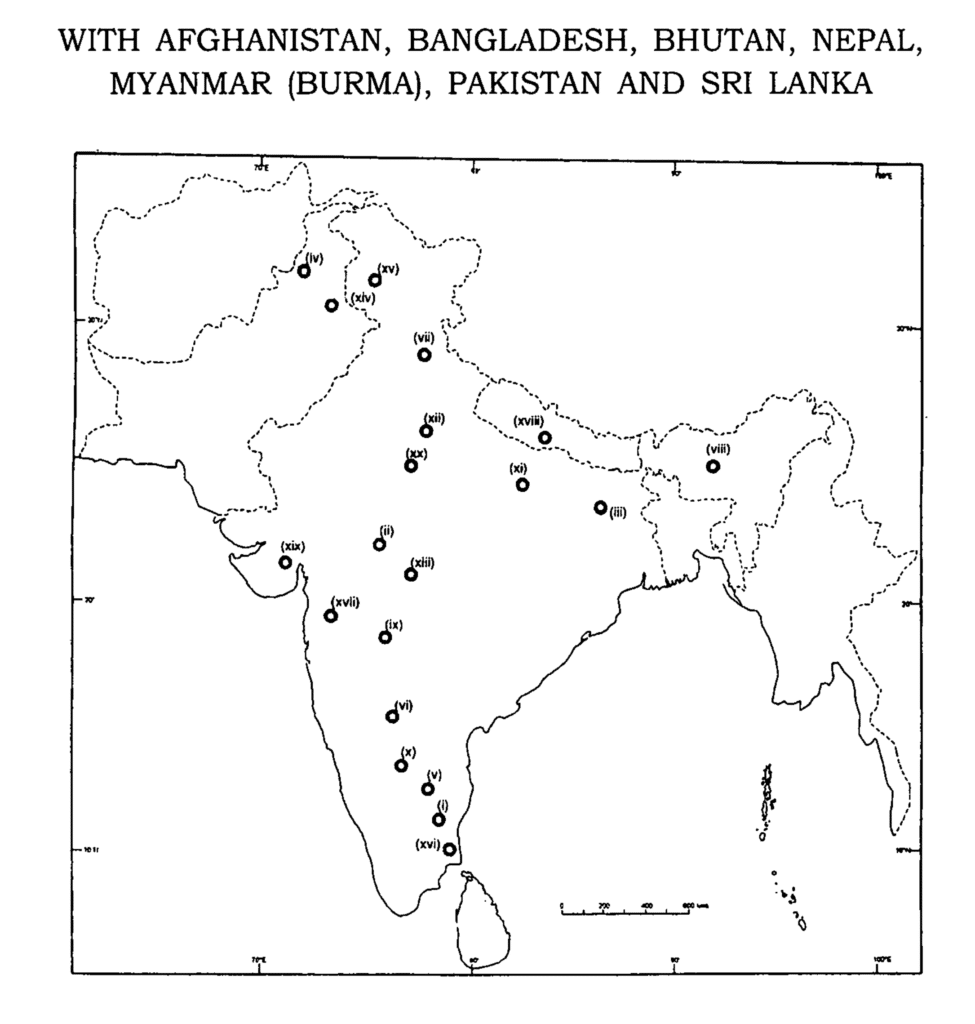
Q. Identify the following places marked on the map supplied to you and write a short note of about 30 words on each of them in your Question-cum-Answer Booklet. Locational hints for each of the places marked on the map are given below seriatim:
- (i) An ancient capital
- (ii) A Palaeolithic site
- (iii) A cultural centre
- (iv) An ancient capital
- (v) A Palaeolithic site
- (vi) A historical site
- (vii) A Harappan site
- (viii) An ancient capital
- (ix) A political and cultural centre
- (x) A Megalithic site
- (xi) A Mesolithic site
- (xii) A Chalcolithic site
- (xiii) A prehistoric site
- (xiv) A political and cultural centre
- (xv) An ancient
- (xvi) A lost port
- (xvii) Rock-cave art centre
- (xviii) An ancient capital
- (xix) A political and cultural centre
- (xx) An ancient town
Solution:
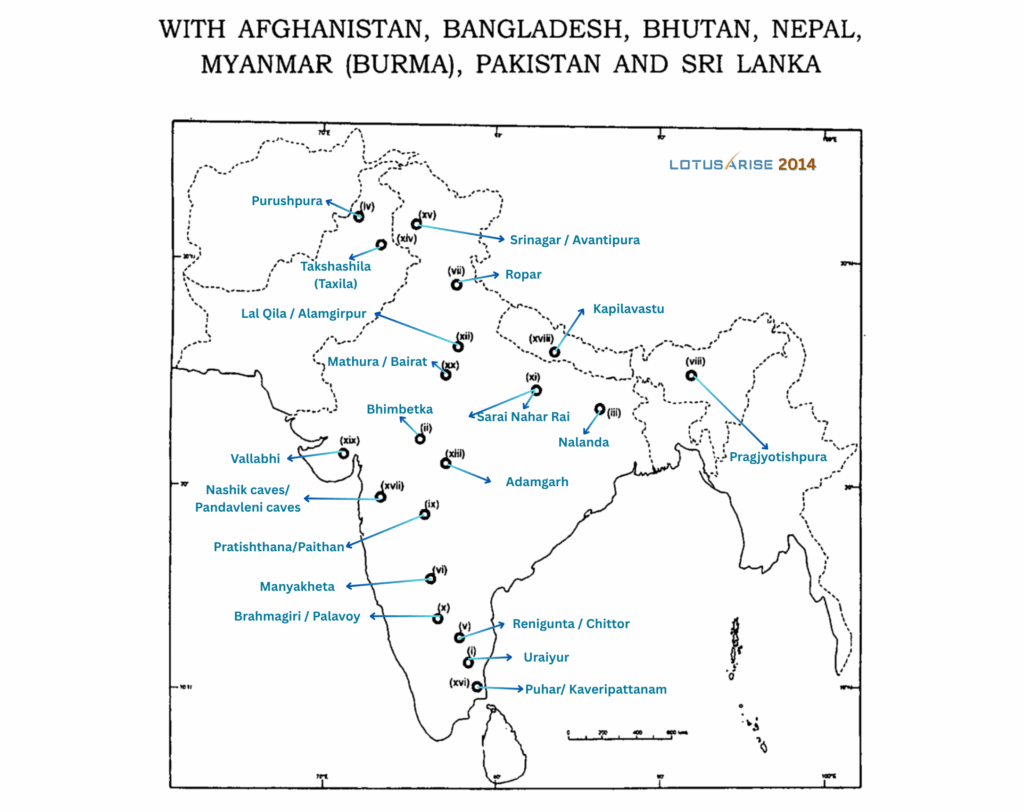
- An ancient capital: Uraiyur / Gangaikondacholapuram
- A Palaeolithic site: Bhimbetka
- A cultural centre: Nalanda
- An ancient capital: Purushpura
- A Palaeolithic site: Renigunta / Chittor
- A historical site: Manyakheta
- A Harappan Site: Ropar
- An ancient capital: Pragjyotishpura
- A political and cultural centre: Pratishthana/Paithan
- Megalithic site: Brahmagiri / Palavoy
- A Mesolithic site: Sarai Nahar Rai
- A Chalcolithic site: Lal Qila / Alamgirpur
- A prehistoric site: Adamgarh
- A political and cultural centre: Takshashila (Taxila)
- An ancient capital: Srinagar / Avantipura
- A lost port: Puhar/ Kaveripattanam
- Rock-cave art centre: Nashik caves/ Pandavleni caves
- An ancient capital: Kapilavastu
- A political and cultural centre: Vallabhi
- An ancient town: Mathura / Bairat (Viratnagar)
These 20 sites are Question 1 of Paper I in the 2014 History Optional examination — 2.5 marks each, 50 marks in total, with a note of about 30 words expected on every one. Each is solved in full below. The complete 2014 paper is at History Optional Question Paper 2014.
The map is 50 marks. What about the other 450?
You have the map answers on this page, free, for every site UPSC marked in 2014. That is 50 marks dealt with. The other 450 marks of the 2014 papers are still sitting there unanswered — and those are the marks that separate 260 from 320.
The History Optional PYQ Master Pack carries a written model answer for every question the Commission has set since 1985, including every non-map question on the 2014 paper.
- PYQs from 1985 to 2025 — arranged topic-wise, so you revise a theme and see every way it has been asked
- Model answers, not hints — full answers with historians named inside the argument, written to the mark and the word limit
- Map sections solved too — the same quality as this page, for every year, in one offline file
- PDF plus online access — on any device, permanently, not for the length of a subscription
₹1,499 (regular ₹2,500). One-time payment, instant access.
(i) An ancient capital
Gangaikondacholapuram: (not exactly the same location but there is no other choice)
- In Ariyalur district, Tamilnadu.
- Capital of the Cholas.
- Founded by Rajendra Chola to commemorate his victory over the Palas.
- The name means the town of the Chola who led great victorious march to river Ganges.
- He established the Gangaikondaan temple
- Temple of Siva.
- Dravida Style
- Complex carvings on the hard granite stones.
- Figures of dancing Nataraja and Ardhanareshwara.
(ii) A Palaeolithic site
Bhimbetka:
- Rock shelters in the Raisen District in Madhya Pradesh.
- Mainly Paleolithic and Mesolithic period.
- A World Heritage site.
- Tools:
- Earlier (Palaeolithic) tools were largely made of quartzite and sandstone and were of large size.
- Mesolithic tools were most often of chalcedony and of smaller size.
- Floors paved with at stone slabs found.
- No bones have been found so far.
- Rock cave paintings:
- A natural art gallery with rock cave paintings.
- Numerous layers (Paleolithic-Mesolithic) of paintings with themes like hunting by men, dancing, children paying, women working, sign of proto-family set up etc.
(iii) A cultural centre
Nalanda:
- In Nalanda district, Bihar.
- Taranatha, the 17 century Tibetan Lama, states that the 3 century BCE Mauryan Emperor, Ashoka, built a great temple at Nalanda.
- Mahavihara (University):
- Flourished during Gupta, Harsha and Pala times.
- A seal identifies Sakraditya (Kumargupta of 5 century) as founder.
- 7th century Chinese Pilgrims like Hieun Tsang and I-tsing studied here.
- I-tsing notes that revenues from 200 villages (as opposed to 100 in Hieun Tsang’s time) assigned toward the maintenance of Nalanda.
- Library called Dharmaganja.
- Teaching of religious (mainly Mahayana) and other subjects like grammar, logic, literature, astrology, astronomy, and medicine.
- Influence of Vajrayana during Palas.
- Destroyed by Bakhtiyar Khilji in 1200 CE.
(iv) An ancient capital
Purushpura:
- Modern Peshawar in NWF province of Pakistan.
- Capital of Kushana ruler Kanishka (2 century AD).
- Kushana period:
- Sculptures,
- Buddhist stupa,
- Buddhist Chaitya.
- Trade centre as it lied on old silk route.
- Centre of Buddhist learning.
- Mentioned by Chinese pilgrim Faxian and Xuanzang.
(v) A Palaeolithic site
Chittor:
- (Write standard stuffs of Paleolithic sites)
(vi) A historical site
Manyakheta
- Modern Malkhed in Gulbarga district, Karnataka.
- Founded by Rashtrakutas (whose founder was Dantidurga) and subsequently became the capital of Rashtrakutas in 9 and 10 century.
- The capital was moved to Manyakheta by Amoghavarsha.
- Later it came under the control of Western Chalukyas.
- It was a centre of Saivism and Vaisnavism.
(vii) A Harappan site
Ropar:
- In Rupnagar district, Punjab.
- IVC, PGW and NBPW.
- No early Harappan level.
- Transition from village to town in period c. 600–200 BCE, and yielded NBPW and punch-marked and copper coins.
- A seal with an inscription in Brahmi.
- Houses made of stone, mud-brick and burnt brick.
- Iron workshop and agate beads in NBPW.
(viii) An ancient capital
Pragyajyotishpura:
- In Guwahati, Assam.
- Capital of Kamarupa Kingdom under Varman Dynasty (350 – 650 A.D).
- ‘Prag’ means ‘Eastern’ and ‘Jyotisa’ means ‘light’. ‘Pragjyotispur’ means “the city of eastern light”.
- Xuanzang visited Pragjyotispura at the time of king Bhaskaravarman. He described:
- Natural beauty and good climate.
- People, their language, temperament and their belief in ‘devas’ (as opposed to Buddhism).
- Large number of temples and the absence of any ‘sangharama’ i.e. lack of Buddhism.
(ix) A political and cultural centre
Paithan/ Pratisthana
- In Aurangabad district, Maharashtra.
- Capital of the Satavahanas (2 century BC to 2 century AD).
- Mentioned in 1 century AD Greek book, Periplus of Erythrian Sea and in Ashokan Rock Edict.
- Emporium of trade.
- Home of saint Eknath.
- Famous today for Paithani silk saris.
(x) Megalithic site
Palavoy: or Brahmagiri:
- In Chitradurg district, Karnataka.
- Neolithic-Chalolithic and Megalithic site.
- Wattle-and daub huts with post holes.
- Polished stone tools,
- Microlithic blades, and
- Handmade grey pottery.
- Copper–bronze objects in later period.
- Burials:
- Extended burials of adults
- urn burials of children.
- Megalithic monuments have been found.
- Agriculture and domestication of animal.
- Draft animal used.
- Ashokan edicts denotes the southernmost extent of the Mauryan Empire.
Two minutes per site — could you write this one from memory?
Reading a solved site note is not the same as producing one under a clock. In the hall you get roughly two minutes per identification — locate it, name the period, name the excavator or dynasty, give one distinguishing find, and say why it matters. Miss the significance line and the examiner has nothing to award the second mark for.
That same gap runs through the whole paper. Most candidates know the content and still lose four to six marks per answer because the answer never states a position. The model answers in the Master Pack are written to show the structure, not just the facts.
(xi) A Mesolithic site
Sarai Nahar Rai:
- In Pratapgarh district of U.P.
- It is stratied Mesolithic settlements.
- Geometric microliths along with shells and animal bones found.
- Human burials:
- Within the habitation area.
- 13 burials of men, women and child with heads westward.
- One of the buried skeletons had an arrow embedded in its ribs.
- Microlithic tools, animal bones, and shells were placed as grave goods.
- An analysis reveals good dental health but some of them suffered from osteo-arthritis.
- Floor of made of burnt clay and has several re hearths some with charred bones.
- Many animals are domesticated type.
(xii) A Chalcolithic site
Alamgirpur: or may be Lal Qila (not Red Fort) Alamgirpur:
- In Saharanpur district, UP.
- Easternmost Harappan site
- No early Harappan level.
- Burnt bricks, copper objects found in late Harappan period.
- PGW preceded by a late Harappan level.
- Break in occupation between Late Harappan and PGW.
(xiii) A prehistoric site
Adamgarh:
- In Hoshangabad district, Madhya Pradesh.
- Famous for the pre-historic rock shelters and paintings.
- Palaeolithic and Mesolithic tools found.
- Microliths found here. Geometric microliths (triangles and trapezes) were very common.
- Animal bones- wild and domestic.
- Pottery at microlithic level found.
(xiv) A political and cultural centre
Taxila: (but not at exact location)
- In Rawalpindi district, Pakistan.
- Ancient political, commercial and cultural centre.
- Commercial centre:
- At junction of 3 major trade routes: West Asia, northern India and Central Asia.
- Centre of artisanal production.
- Centre of education:
- Amongst the earliest universities.
- Many do not consider it a university as:
- teachers did not have official membership of particular colleges, and
- there was no purpose-built lecture halls and residential quarters, like Nalanda University.
- Charaka, Chanakya, Jivaka, Panini etc are related to Taxila University.
- Political centre:
- Capital of Gandhara satrapy, under Achaemenian.
- Alexander received submission of ruler of Taxila, Ambhi.
- Taxila became a provincial capital of Mauryas.
- Capital of Indo-Parthian Kingdom, and one of the capitals of Kushanas.
- The Chinese pilgrims Fa Hian (5 century) and Hieun Tsang (7 century) visited Taxila. In ruin during Huen Tsang.
(xv) An ancient capital
Avantipura
- In Pulwama district, Jammu & Kashmir.
- Kalhana’s Rajatarangini:
- Temples dedicated to Shiva and Vishnu:- built by King Awantivarman (AD 855- 883) of Utpala dynasty when he chose the site as his capital.
- Avantishvara temple :
- Dedicated to lord shiva.
- Built by Avantivarman.
- Panchayatana type.
- Gateway is double chambered.
- Devoid of any ornamentation.
- Main sanctum is raised on a high platform.
- The ruins of temples constructed by Lalitaditya of Karkota dynasty located here.
(xvi) A lost port
Kaveripattinam / Puhar:
- In Nagapattinam district, Tamilnadu.
- Sea port of Cholas during the Sangam age.
- Centre of trade- foreign trade.
- Capital of the early Chola kings.
- Near Kaveri River.
- Mentioned in the Periplus of Ereythrean Sea and Silapathikaram.
- Medieval Chola coins found:- continued to be an important port in later times as well.
- Ancient Pottery found.
(xvii) Rock-cave art centre
Pandavleni caves or Nasik caves:
- In Nashik district, Maharashtra.
- Buddhist cave site
- 24 caves carved mainly between the 1st century BCE and the 3nd century CE.
- Has Chaityas and Viharas.
- Carved and donated by various kings mainly- the Satavahanas.
- Images of Buddha, Bodhisattva, sculptures representing the King, farmers, merchants.
- Some caves connected by stone-cut ladders to the other caves.
- An excellent ancient water management system and water tanks.
(xviii) An ancient capital
Kapilvastu:
- In Kapilvastu ditrict, Nepal (25 km northwest of Lumbini).
- UNESCO World Heritage Site.
- Capital of the Shakya kingdom.
- King Suddhodana and Queen Mayadevi of Shakya kingdom gave birth to Gautam Buddha.
- Chinese pilgrims Faxian and Xuanzang made pilgrimages to the site .
- Ancient trade centre.
(xix) A political and cultural center
Vallabhi:
- In Bhavnagar district (Saurashtra), Gujarat.
- Capital of the Maitraka Dynasty (480-775 CE).
- Established by the founder of the dynasty, Senapati Bhatarka.
- Centre of learning, Buddhist monasteries.
- Visited by the Chinese pilgrim Xuanzang and Yijing in 7th century.
- Second Jaina council under Devardhi held in 6th century CE when Jaina scriptures assumed their present form.
(xx) An ancient town
Mathura: or may be Bairat (Viratnagar):
Mathura:
- In Mathura district, UP.
- Centre of craft and trade.
- Textile
- Junction of trade route: Uttarpatha and dakshinapatha.
- Religious centre:
- Buddhism,
- Jainism, and
- early Hinduism.
- Southern capital of the Kushana/
- Mathura School of Arts under the patronage of the Kushanas.
- BRW, PGW, NBPW
- At Sonkh, near Mathura, PGW, BRW and grey ware found.
- Post-holes and a double ditch.
- Beginnings of urbanization during Kushana period.
- NBPW: Coins came and specialized crafts such as the manufacture of terracotta figurines, copper and iron working, and bead making.
How to write the map answer in the exam hall
The solutions above are reference notes, not model answers. In the hall you have roughly 45 minutes for all 20 sites — about two minutes each, including the time it takes to find the number on the map. What follows is the structure that reliably earns the full 2.5 marks.
The five-part note that works every time
- Locate it — present-day state, and the river or coast it sits on
- Date it — the period or culture it belongs to (Palaeolithic, Harappan, Satavahana, Mughal)
- Attribute it — the excavator, the founding dynasty, or the ruler associated with it
- Evidence it — one distinguishing find, structure or inscription
- Justify it — one line on why the site matters to the wider historical argument
Four habits that cost marks
- Writing 60 words on the three sites you know and one line on the rest — the marks are the same for each
- Naming the site and stopping — identification alone is half the mark
- Leaving the map question for the end — it is the only section where you cannot think your way to an answer, so bank it first
- Skipping a site entirely — even a location and a period is worth attempting
Practise on a blank outline map rather than by reading. Mark the 20 sites from memory, write your notes, then check them against this page. Every site you missed becomes a flashcard.
Two ways to prepare for the rest of the paper
The map solutions on this site are free and will stay free. If you want the rest of the optional handled the same way, there are two routes, depending on where you are in your preparation.
| PYQ Master Pack | Mains Master Kit 2027 | |
| Best when | Your notes are done and you now need answer-writing | You are still building the subject from the ground up |
| What you get | Model answers to every question since 1985, topic-wise, map sections included | 4,500+ pages of notes, complete mapping coverage, 12 months of article access |
| Covers the map section | Yes — every year solved | Yes — site-wise preparation, not just answers |
| Price | ₹1,499 (regular ₹2,500) | ₹1,770 (regular ₹5,000) |
Both are one-time purchases with permanent access. Aspirants in their second or third attempt usually take the PYQ Master Pack; first-timers usually start with the Kit.
Frequently asked questions
History Optional map solutions — other years
Site types repeat far more often than individual sites. Working through the years below by category is the fastest way to make the 50-mark section reliable.
- UPSC History Optional Map Solution 2025 — all 20 identifications solved with 30-word notes
- UPSC History Optional Map Solution 2024 — all 20 identifications solved with 30-word notes
- UPSC History Optional Map Solution 2023 — all 20 identifications solved with 30-word notes
- UPSC History Optional Map Solution 2022 — all 20 identifications solved with 30-word notes
- UPSC History Optional Map Solution 2021 — all 20 identifications solved with 30-word notes
- UPSC History Optional Map Solution 2020 — all 20 identifications solved with 30-word notes
- UPSC History Optional Map Solution 2019 — all 20 identifications solved with 30-word notes
- UPSC History Optional Map Solution 2018 — all 20 identifications solved with 30-word notes
- UPSC History Optional Map Solution 2017 — all 20 identifications solved with 30-word notes
- UPSC History Optional Map Solution 2016 — all 20 identifications solved with 30-word notes
- UPSC History Optional Map Solution 2015 — all 20 identifications solved with 30-word notes
- UPSC History Optional Map Solution 2013 — all 20 identifications solved with 30-word notes




