History Optional · Paper II · World History
Industrialization Notes · PYQs · Solved Answers
Free notes, every previous year question and the solved answers for Industrialization (Paper II, World History), arranged so you can read a topic and immediately see how UPSC has asked it. Syllabus: English Industrial Revolution, industrialization in Germany, USA, Russia and Japan, industrialization and globalization.
23
Solved PYQs
1985–2025
Years covered
26
Questions listed
6
Free notes
On this page
Free notes Previous year questions Solved answers All History Optional units
Paper II · Unit 18
Industrialization notes
Topic-wise notes for this unit in syllabus order. Read a topic, then open its previous year questions below.
Free notes
Free practice
Previous year questions: Industrialization
Every question UPSC has asked from this unit, year-wise, with a link to its solved answer.
Topic-wise question list
Year-wise question papers
-
UPSC History Optional Question Paper 2026
-
UPSC History Optional Question Paper 2025
-
History Optional Question Paper: 2024
-
History Optional Question Paper: 2023
-
History Optional Question Paper: 2012
-
History Optional Question Paper: 2011
-
History Optional Question Paper: 2013
-
History Optional Question Paper: 2014
-
History Optional Question Paper: 2015
-
History Optional Question Paper: 2016
-
History Optional Question Paper: 2017
-
History Optional Question Paper: 2018
-
History Optional Question Paper: 2019
-
History Optional Question Paper: 2021
History PYQ Master Pack
Solved PYQ answers: Industrialization
Topic-wise model answers, newest exam year first. Members open the full answer; everyone else sees the question and can join the pack.
PYQ Solutions
-
Examine the impact of the links between scientific education and industrial expansion on German society in the early 20th century.
-
The state was the most important factor in the industrialization of Russia. Comment.
-
The course of the English industrialization was too long drawn to be considered a revolution. Comment.
-
The impact of industrial revolution on the middle class world view is reflected in the views of Adam Smith, Thomas Malthus and Jeremy Bentham. Comment.
-
Do you agree then the economic effects of the Industrial Revolution were to add enormously to wealth and capital on the one hand and to degrade the masses to permanent poverty as the other ? Elucidate.
-
Critically examine the following statement in about 150 words: There were many reasons why the industrial revolution first happened in England.
-
“Industrial Revolution had far reaching social and political consequences with the advent of assembly line factories, urbanization and rise of the urban working class.”
-
How did the policies of governments facilitate the process of industrialization in Europe?
-
Discuss how Japan industrialized after the Meiji Restoration. What were the consequences for its neighbours?
-
Critically examine: “The Industrial Revolution put mobility in the place of stability.”
-
Explain why England became the harbinger of Industrial Revolution. Also throw light on its social consequences.
-
“The process of industrialization in some other countries of Europe was different from that in England.” Critically examine.
-
“Whoever says Industrial Revolution, says cotton.” Comment.
-
What was the extent of industrialization in western Europe by the end of the nineteenth century?
-
The Years 1853-1894 witnessed the transformation of Japan. Explain.
-
The Industrial Revolution brought about great changes in the social and economic life of Europe. Explain.
-
The Industrial Revolution “Changed England in character & culture.” Comment.
-
To what extent were the advances in scientific knowledge in the sixteenth and seventeenth centuries a product of the needs of a changing society?
-
‘Protestantism contributed substantially to the rise of capitalism.” Comment.
-
‘The Industrial Revolution put mobility in the place of stability.’ Comment.
-
How did Japan develop between 1868 and 1894? Did the ‘Restoration of Meiji’ mark a sharp break with the past?
-
‘The novelty in sixteenth-century mercantilism its extension from city to nation and the transfer of its chief agency from local guilt to national monarch.’ Comment in about 200 words.
-
Trace the growth of capitalism in Britain in the seventeenth and eighteenth centuries. Why was France, as compared to Britain, late in developing the capitalist spirit and the institutional framework of capitalism?
Premium content · how to get access
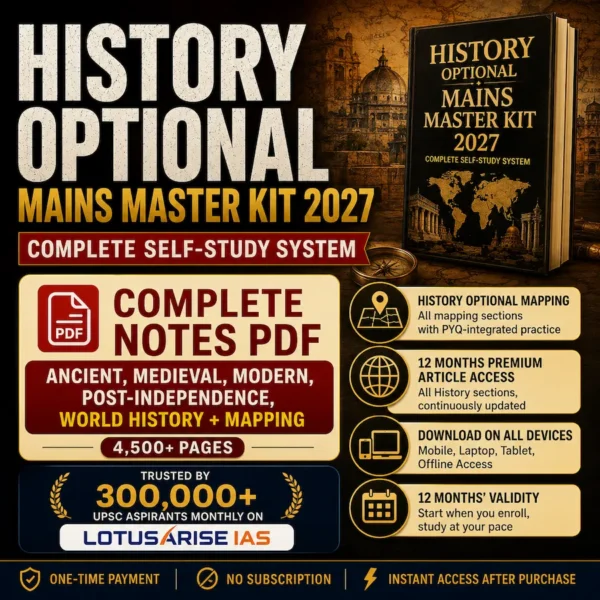
This page is part of the History Optional PYQ Master Pack.
Every model answer below opens with one enrolment. One-time payment, no subscription, access from the moment your payment is confirmed.
- 1,390+ topic-wise model answers (1985–2025), Paper I and Paper II
- Historiography, primary sources and map references built into each answer
- Access on phone, laptop or tablet
Full pack
₹1,499 ₹2,500 40% off
One-time payment · instant access · UPI, cards, RuPay