UPSC Optional · History
History Optional Notes · PYQs · Solved Answers
Everything for History Optional in one place: free unit-wise notes for Ancient, Medieval, Modern and World History, every previous year question since 1980 arranged by syllabus unit, and the solved model answers. Pick a unit below to start.
51
Syllabus units
470+
Free notes
1391+
Solved PYQs
1980–2025
Years covered
Jump to
Paper I units Paper II units PYQs and solutions Strategy and books Courses
Paper I
Ancient India
Sources: Archaeological, Literary, Foreign Accounts, Pre-history and Proto-history, Indus Valley Civilization, Megalithic Cultures, Aryans and Vedic Period, Period of Mahajanapadas, Mauryan Empire, Post-Mauryan Period, Early State and Society in Eastern India, Deccan and South India, Guptas, Vakatakas and Vardhanas, Regional States during Gupta Era, Themes in Early Indian Cultural History. Each unit page has the free notes, the year-wise questions and the solved answers together.
Unit 01
Sources: Archaeological, Literary, Foreign Accounts
Archaeological sources, literary sources (indigenous and foreign), historiography of ancient India.
Unit 02
Pre-history and Proto-history
Geographical factors, hunting and gathering, the beginning of agriculture (Neolithic and Chalcolithic).
Unit 03
Indus Valley Civilization
Origin, date, extent, characteristics, decline, survival and significance, art and architecture.
Unit 04
Megalithic Cultures
Distribution of pastoral and farming cultures outside the Indus, community life, settlements, agriculture, crafts.
Unit 05
Aryans and Vedic Period
Expansion of Aryans, Vedic literature, transformation from Rig Vedic to later Vedic, polity, society, religion.
Unit 06
Period of Mahajanapadas
Formation of states, republics and monarchies, rise of urban centres, Iranian and Macedonian invasions, Jainism and Buddhism, Magadha.
Unit 07
Mauryan Empire
Foundation, Chandragupta, Kautilya, Ashoka and dhamma, administration, economy, art, disintegration.
Unit 08
Post-Mauryan Period
Indo-Greeks, Sakas, Kushanas, Western Kshatrapas; contact with the outside world; economy, coinage, religions, Sanskrit literature, art.
Unit 09
Early State and Society in Eastern India, Deccan and South India
Kharavela, the Satavahanas, Tamil states of the Sangam age; administration, economy, land grants, coinage, trade guilds, urban centres.
Unit 10
Guptas, Vakatakas and Vardhanas
Polity and administration, economic conditions, coinage, land grants, decline of urban centres, Indian feudalism, caste, women, education, literature, art.
Unit 11
Regional States during Gupta Era
Kadambas, Pallavas, Chalukyas of Badami; polity and administration; Vaishnava and Saiva religions; Tamil Bhakti; temple institutions.
Unit 12
Themes in Early Indian Cultural History
Languages and texts, major stages in art and architecture, philosophical schools, ideas and institutions.
Paper I
Medieval India
Early Medieval India, 750-1200, Cultural Traditions in India, 750-1200, The Thirteenth Century, The Fourteenth Century, Society, Culture and Economy in the 13th and 14th Centuries, The Fifteenth and Early Sixteenth Century: Political History, The Fifteenth and Early Sixteenth Century: Society and Culture, Akbar, Mughal Empire in the Seventeenth Century, Economy and Society in the 16th and 17th Centuries, Culture during Mughal Empire, The Eighteenth Century. Each unit page has the free notes, the year-wise questions and the solved answers together.
Unit 13
Early Medieval India, 750-1200
Major political developments, origin of Rajputs, the Cholas, Arab conquest of Sind, feudalism, agrarian economy, trade, society.
Unit 14
Cultural Traditions in India, 750-1200
Philosophy, religion, literature, art and architecture, temple styles, Bhakti and Sufi traditions.
Unit 15
The Thirteenth Century
Ghurian invasions, foundation of the Delhi Sultanate, Iltutmish and Balban, consolidation, the Mongol threat.
Unit 16
The Fourteenth Century
The Khalji revolution, Alauddin Khalji, Muhammad Tughluq, Firuz Tughluq, decline of the Sultanate, foreign contacts.
Unit 17
Society, Culture and Economy in the 13th and 14th Centuries
Rural and urban society, women, religious classes, caste and slavery, Bhakti and Sufi movements, culture, economy and trade.
Unit 18
The Fifteenth and Early Sixteenth Century: Political History
Provincial dynasties, Vijayanagar and Bahmani kingdoms, Lodis, Babur, Humayun, Sur empire, Portuguese colonial enterprise.
Unit 19
The Fifteenth and Early Sixteenth Century: Society and Culture
Regional cultural specificities, literary traditions, provincial architecture, society, culture, literature and arts in Vijayanagar.
Unit 21
Mughal Empire in the Seventeenth Century
Major administrative and religious policies of Jahangir, Shahjahan and Aurangzeb; nature of the Mughal state; late 17th-century crisis and revolts; Ahom and Maratha kingdoms.
Unit 22
Economy and Society in the 16th and 17th Centuries
Population, agriculture, crafts and towns, commerce with Europe, fiscal and monetary system, mercantile classes, peasants, women, Sikh community.
Unit 23
Culture during Mughal Empire
Persian histories and literature, Hindi and religious literature, Mughal architecture, painting, provincial styles, classical music, science and technology.
Unit 24
The Eighteenth Century
Decline of the Mughal empire, regional principalities, Marathas, Afghan power, Panipat, politics and economy on the eve of British conquest.
Paper II
Modern India
European Penetration into India, British Expansion in India, Early Structure of the British Raj, Economic Impact of British Colonial Rule, Social and Cultural Developments, Social and Religious Reform Movements in Bengal and Other Areas, Indian Response to British Rule, Early Indian Nationalism, Rise of Gandhi and the Gandhian Era, Other Strands in the National Movement, Politics of Separatism, Constitutional Developments in Colonial India, 1858-1935. Each unit page has the free notes, the year-wise questions and the solved answers together.
Unit 01
European Penetration into India
Early European settlements, Portuguese, Dutch, English and French; Carnatic wars; conflict with the Nawabs of Bengal.
Unit 02
British Expansion in India
Bengal, Mysore, the Marathas, the Punjab, paramountcy over the princely states.
Unit 03
Early Structure of the British Raj
Regulating Act, Pitt's India Act, Charter Acts, the English utilitarians and India.
Unit 04
Economic Impact of British Colonial Rule
Land revenue settlements, commercialization of agriculture, drain of wealth, deindustrialisation, railways, famine, modern industry.
Unit 05
Social and Cultural Developments
Indigenous education, western education, Orientalist-Anglicist controversy, press, literature, science, missionaries.
Unit 06
Social and Religious Reform Movements in Bengal and Other Areas
Ram Mohan Roy, Brahmo, Young Bengal, Vidyasagar, Arya Samaj, Ramakrishna, Theosophy, Islamic revivalism, Sikh and Parsi reforms.
Unit 07
Indian Response to British Rule
Peasant and tribal uprisings, the Great Revolt of 1857, peasant movements after 1857.
Unit 08
Early Indian Nationalism
Factors, political associations, the Congress, Moderates and Extremists, Swadeshi, Surat split, Home Rule, Lucknow Pact.
Unit 09
Rise of Gandhi and the Gandhian Era
Gandhi's ideas, Non-Cooperation, Civil Disobedience, constitutional negotiations, Quit India, INA, transfer of power.
Unit 10
Other Strands in the National Movement
The Revolutionaries, the Left, peasant and working class movements, women in politics.
Unit 11
Politics of Separatism
Muslim League, Hindu Mahasabha, communalism and the politics of partition, Communal Award.
Unit 12
Constitutional Developments in Colonial India, 1858-1935
Acts of 1858, 1861, 1892, 1909, 1919 and 1935, Viceroy's councils.
Paper II
Post-Independence India
Consolidation as a Nation, Caste and Ethnicity after 1947, Economic Development and Political Change. Each unit page has the free notes, the year-wise questions and the solved answers together.
Unit 13
Consolidation as a Nation
Integration of princely states, linguistic reorganisation, national language, regionalism, foreign policy.
Unit 14
Caste and Ethnicity after 1947
Backward castes and tribes in electoral politics, Dalit movements.
Unit 15
Economic Development and Political Change
Land reforms, politics of planning, ecology and environment, science in post-independent India.
Paper II
World History
Enlightenment and Modern Ideas, Origins of Modern Politics, Industrialization, Nation-State System, Imperialism and Colonialism, Revolution and Counter-Revolution, World Wars, The World after World War II, Liberation from Colonial Rule, Decolonization and Underdevelopment, Unification of Europe, Disintegration of the Soviet Union and the Rise of the Unipolar World. Each unit page has the free notes, the year-wise questions and the solved answers together.
Unit 16
Enlightenment and Modern Ideas
Major ideas of Enlightenment (Kant, Rousseau), spread to the colonies, socialist ideas up to Marx and Marxian socialism.
Unit 17
Origins of Modern Politics
European state system, American Revolution and constitution, French Revolution, American Civil War, British democratic politics 1815-1850.
Unit 18
Industrialization
English Industrial Revolution, industrialization in Germany, USA, Russia and Japan, industrialization and globalization.
Unit 19
Nation-State System
Rise of nationalism, state-building in Germany and Italy, Eastern Question, disintegration of empires.
Unit 20
Imperialism and Colonialism
South and South-East Asia, Latin America, South Africa, Australia, imperialism and free trade, neo-imperialism.
Unit 21
Revolution and Counter-Revolution
19th-century European revolutions, the Russian Revolution, Chinese Revolution, fascist and Nazi counter-revolution.
Unit 22
World Wars
World War I and II as total wars, causes, events, impact, League of Nations, interwar politics.
Unit 23
The World after World War II
Emergence of two power blocs, the Third World and non-alignment, UNO and global disputes, Middle East.
Unit 24
Liberation from Colonial Rule
Latin America, Arab world, Africa, South-East Asia: colonisation and decolonisation.
Unit 25
Decolonization and Underdevelopment
Factors constraining development in Latin America and Africa.
Unit 27
Disintegration of the Soviet Union and the Rise of the Unipolar World
Collapse of Soviet communism, political changes in Eastern Europe, end of the Cold War, the unipolar world.
Premium content · how to get access
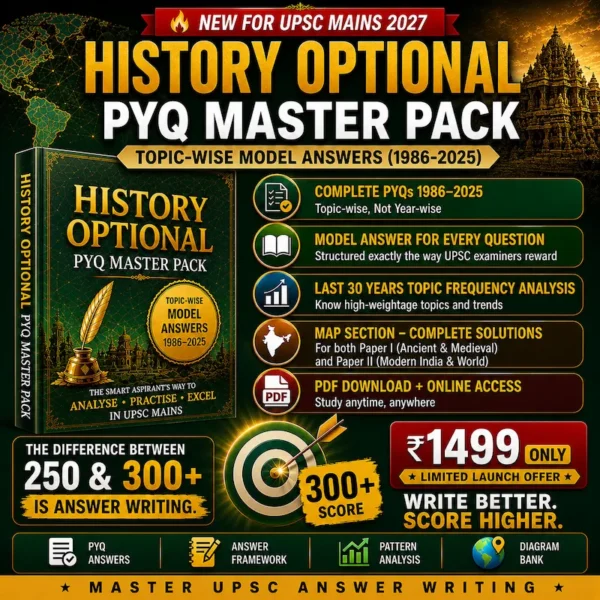
This page is part of the History Optional PYQ Master Pack.
Every model answer below opens with one enrolment. One-time payment, no subscription, access from the moment your payment is confirmed.
- 1,390+ topic-wise model answers (1985–2025), Paper I and Paper II
- Historiography, primary sources and map references built into each answer
- Access on phone, laptop or tablet
Full pack
₹1,499 ₹2,500 40% off
One-time payment · instant access · UPI, cards, RuPay
Previous year questions
PYQs and solutions
Start with the papers, then read the solved answers unit by unit.
Question papers
Every History Optional paper, Paper I and Paper II, with topic-wise question lists.
History PYQ Master Pack
Topic-wise model answers to 1,380+ previous year questions, unit by unit.
Strategy
Strategy, books and practice
How toppers plan the optional, what to read, and where to practise.
How to approach History Optional Preparing with PYQs Best PYQ book and solved papers All History Optional notes Optional success rates Syllabus Booklist