History Optional · Paper II · Modern India
Early Structure of the British Raj Notes · PYQs · Solved Answers
Free notes, every previous year question and the solved answers for Early Structure of the British Raj (Paper II, Modern India), arranged so you can read a topic and immediately see how UPSC has asked it. Syllabus: Regulating Act, Pitt's India Act, Charter Acts, the English utilitarians and India.
17
Solved PYQs
1986–2024
Years covered
18
Questions listed
8
Free notes
On this page
Free notes Previous year questions Solved answers All History Optional units
Paper II · Unit 03
Early Structure of the British Raj notes
Topic-wise notes for this unit in syllabus order. Read a topic, then open its previous year questions below.
Free notes
Free practice
Previous year questions: Early Structure of the British Raj
Every question UPSC has asked from this unit, year-wise, with a link to its solved answer.
Topic-wise question list
Year-wise question papers
-
UPSC History Optional Question Paper 2026
-
UPSC History Optional Question Paper 2025
-
History Optional Question Paper: 2024
-
History Optional Question Paper: 2023
-
History Optional Question Paper: 2012
-
History Optional Question Paper: 2011
-
History Optional Question Paper: 2013
-
History Optional Question Paper: 2014
-
History Optional Question Paper: 2015
-
History Optional Question Paper: 2016
-
History Optional Question Paper: 2017
-
History Optional Question Paper: 2018
-
History Optional Question Paper: 2019
-
History Optional Question Paper: 2021
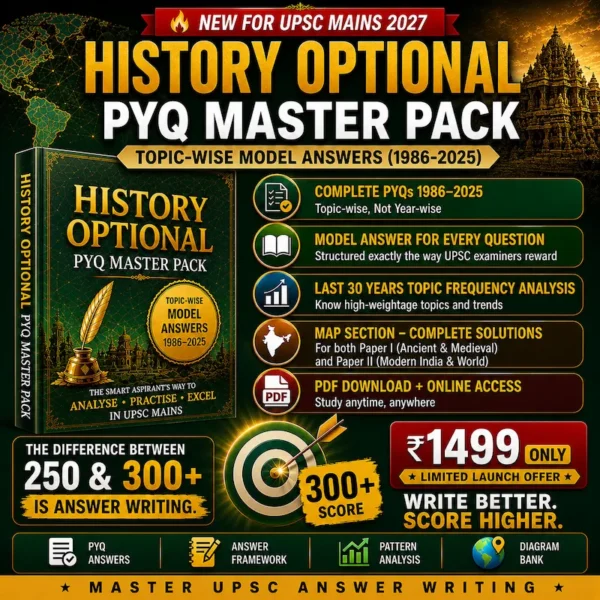
History PYQ Master Pack
Solved PYQ answers: Early Structure of the British Raj
Topic-wise model answers, newest exam year first. Members open the full answer; everyone else sees the question and can join the pack.
PYQ Solutions
-
The values of utilitarianism prompted the Company administration to attempt reform of Indian society.
-
Can you explain how, after acquiring Diwani, the government of the East India Company functioned like ‘an Indian ruler’?
-
How did the English utilitarian thinking impact India in the British era?
-
“The need to impose greater parliamentary control over the Company’s affairs increased during the decades (1773-1853) after Plassey.” Elucidate.
-
How far is it correct to say that if Clive was the founder of the British Empire in India, Warren Hastings was its administrative organiser?
-
“Peace hath her victories no less renowned than war.” Examine this statement with reference to Lord William Bentinck.
-
“James Mill, the apostle of utilitarian philosophy, proposed a revolution of Indian society through the ‘weapon of law’ solely. But in actual policy framing, other influences and considerations weighed much more than the colonial State.” Elucidate.
-
“The Regulating Act (1773), the Pitt’s India Act (1784) and eventually the Charter Act of 1833 left the East India Company as a mere shadow of its earlier political and economic power in India.” Critically examine.
-
“The Dual System of Government was a complete failure from the outset. In the first place, the abuse of the private trade reached a greater height than ever. In the second place, the demands of the Company for the increase led to gross oppression of the peasantry.” Examine.
-
“The Charter Act of 1833 rung down the curtain on the Company’s trade and introduced a new concept of government in India.” Substantiate.
-
“Sprung from paternalism, the English Utilitarian philosophy as introduced in India rejected its human warmth between rulers and the ruled.” Comment.
-
“The object of the Act (Regulating) was good, but system that it established was imperfect.” Comment.
-
The British Indian State experienced the wind of change with the arrival of Lord William Bentinck. Comment.
-
What kind of administrative change were introduced in India under the East India Company?
-
Assess the impact of the utilitarian ideas in moulding the British attitude towards India. How did the utilitarian try to solve the problem of land revenue?
-
‘The national democratic awakening of the Indian people found expression of white racism.’ Comment in about 200 words.
-
Discuss the basic features of the judicial administration under the East India Company. Did the British introduce the modem concept of the rule of law in India?
Premium content · how to get access
This page is part of the History Optional PYQ Master Pack.
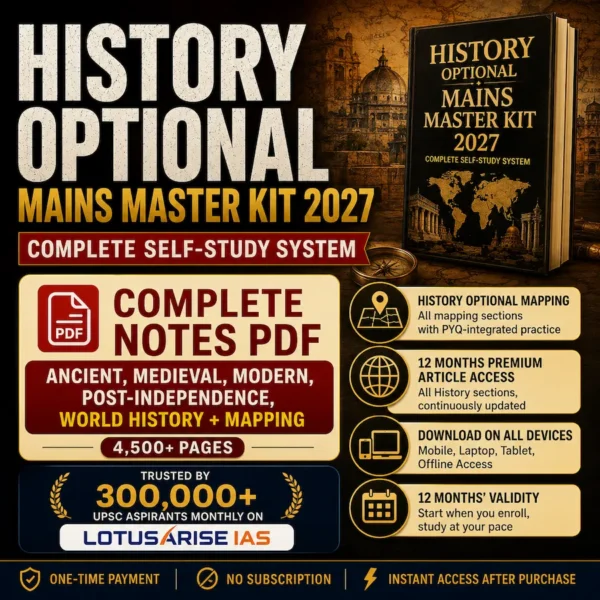
Every model answer below opens with one enrolment. One-time payment, no subscription, access from the moment your payment is confirmed.
- 1,390+ topic-wise model answers (1985–2025), Paper I and Paper II
- Historiography, primary sources and map references built into each answer
- Access on phone, laptop or tablet
Full pack
₹1,499 ₹2,500 40% off
One-time payment · instant access · UPI, cards, RuPay