History Optional · Paper I · Ancient India
Post-Mauryan Period Notes · PYQs · Solved Answers
Free notes, every previous year question and the solved answers for Post-Mauryan Period (Paper I, Ancient India), arranged so you can read a topic and immediately see how UPSC has asked it. Syllabus: Indo-Greeks, Sakas, Kushanas, Western Kshatrapas; contact with the outside world; economy, coinage, religions, Sanskrit literature, art.
20
Solved PYQs
1986–2025
Years covered
21
Questions listed
9
Free notes
On this page
Free notes Previous year questions Solved answers All History Optional units
Paper I · Unit 08
Post-Mauryan Period notes
Topic-wise notes for this unit in syllabus order. Read a topic, then open its previous year questions below.
Free notes
-
Indo-Greeks, Sakas, Kushanas, Western Kshatrapas
-
Kanva Dynasty (75 BCE – 30 BCE)
-
Post-Mauryan Period: Art, Architecture, Culture
-
Post-Mauryan Period: Contact with Outside World
-
Post-Mauryan Period: Development of Religions
-
Post-Mauryan Period: Literature and Science
-
Post-Mauryan Period: Society (Social Conditions)
-
Post-Mauryan: Growth of Urban Centres, Economy, Coinage
-
Sunga Dynasty
Free practice
Previous year questions: Post-Mauryan Period
Every question UPSC has asked from this unit, year-wise, with a link to its solved answer.
Topic-wise question list
Year-wise question papers
-
UPSC History Optional Question Paper 2026
-
UPSC History Optional Question Paper 2025
-
History Optional Question Paper: 2024
-
History Optional Question Paper: 2023
-
History Optional Question Paper: 2012
-
History Optional Question Paper: 2011
-
History Optional Question Paper: 2013
-
History Optional Question Paper: 2014
-
History Optional Question Paper: 2015
-
History Optional Question Paper: 2016
-
History Optional Question Paper: 2017
-
History Optional Question Paper: 2018
-
History Optional Question Paper: 2019
-
History Optional Question Paper: 2021
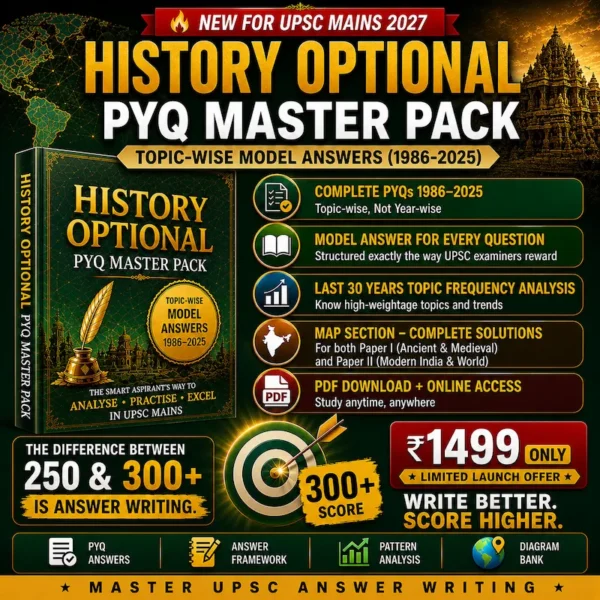
History PYQ Master Pack
Solved PYQ answers: Post-Mauryan Period
Topic-wise model answers, newest exam year first. Members open the full answer; everyone else sees the question and can join the pack.
PYQ Solutions
-
Examine the nature and impact of India’s contacts with Central Asia during the 1st to 3rd century CE. How did these interactions influence India’s political, cultural and economic spheres?
-
Western Kshatrapas are known for their socio-economic contribution, particularly in trade, agriculture, and urbanization. Examine the statement.
-
Analyze the significance of external influences and indigenous development on post-Mauryan art.
-
Evaluate the significant political features of the Post Mauryan Northern India. What are the main sources of it?
-
The flourishing international trade during the Kushana period gave tremendous impetus to the development of art. Discuss.
-
“The development of art and architecture during the Sunga period belies the belief that they were anti-Buddhist.” Discuss.
-
What was the impact of trans-regional and trans-continental trade in the post Mauryan period on social and cultural life of India?
-
The period of Indian History from 3rd century B.C.E. to 5th century C.E. was the period of innovation and interaction. How will you react?
-
How does the numismatic evidence of the period reflect the political and economic outlook of the Kushanas and the Satavahanas?
-
Review critically the evolution of different schools of art in the Indian subcontinent between the second century BCE and the third century CE, and evaluate the socio-religious factors responsible for it.
-
Justify Pliny’s statement that Rome was being drained out of its gold by India during the first century of the Christian era.
-
Examine the significance of the deities depicted on the coins of the Kushanas.
-
How justified are we in characterizing the post-Mauryan five centuries as the “Dark Period” of Indian History? Give reasons in support of your answer.
-
Furnish a critical and comparative account of various schools of art in the Post-Mauryan period (c. 200 B.C.-c. 300 A.D.)
-
“The centuries between c. 200 B.C. and c. A.D. 300 constitute a landmark in the socioreligious history of India.” Analyse the proposition.
-
Write brief essay on Buddhist writing in Sanskrit in the post – Maurya period.
-
Write brief essay on Origins, chronology, characteristics and geographical spread of Gandhara art.
-
Write short essay of not more than 200 words on: Indian participation in the silk trade through Central Asia.
-
Bring out the salient features of the religious developments in the Post-Maurya period. How was contemporary art influenced by it?
-
Write short essay of not more than 200 words on; The role of guilds in the economic life of India from c. 200 B. C. to c. A. D. 300.
Premium content · how to get access
This page is part of the History Optional PYQ Master Pack.
Every model answer below opens with one enrolment. One-time payment, no subscription, access from the moment your payment is confirmed.
- 1,390+ topic-wise model answers (1985–2025), Paper I and Paper II
- Historiography, primary sources and map references built into each answer
- Access on phone, laptop or tablet
Full pack
₹1,499 ₹2,500 40% off
One-time payment · instant access · UPI, cards, RuPay