

History Optional Notes PDF — Complete Download Guide
Good History optional notes PDF for UPSC should cover Ancient, Medieval, Modern Indian History and World History in a structured, exam-oriented format — not just copied textbook text. Free PDFs circulating online are often outdated, incomplete, or riddled with factual errors, so the smarter approach is knowing exactly what to look for, where reliable notes actually come from, and how to use them alongside standard reference books rather than as a replacement for them.
1. Why “Just Find a PDF” Is the Wrong First Question
Every year, thousands of History optional aspirants search for a single “complete PDF” that will supposedly cover the entire syllabus. The uncomfortable truth: no PDF, however well-made, substitutes for understanding the syllabus structure, reading standard books at least once, and writing practice answers regularly. Notes are a revision and organization tool, not a shortcut around the reading itself.
That said, well-structured notes genuinely save enormous time during revision — the goal of this guide is to help you find and use notes correctly, not to pretend they’re a magic bullet.
2. What Good History Optional Notes Actually Look Like
Before downloading anything, know what quality actually looks like. Strong History optional notes typically have:
- Syllabus-mapped structure — organised exactly by UPSC’s Paper I and Paper II sub-topics, not by the chapter order of a random textbook.
- Point-form content with linking analysis — facts listed clearly, but also short analytical paragraphs connecting causes to consequences (Mains needs argument, not just facts).
- Updated historiography — reflects current academic consensus (e.g., recent reassessments of the 1857 Revolt, debates on deindustrialization, subaltern perspectives on peasant movements), not decades-old textbook framing.
- Dates and names double-checked — this sounds basic, but a large share of free circulating PDFs contain factual errors that get copied forward for years.
- Diagrams/timelines/maps — especially useful for World History and Ancient Indian polity/administration topics.
- Model answer extracts or answer-writing pointers — the best notes show you how a fact becomes a Mains-worthy paragraph, not just the fact itself.
If a PDF is missing most of these, it’s a bare-bones summary at best — useful for quick revision, not for building answer-writing skill.
3. Types of Notes Aspirants Use
| Note Type | Best Use | Watch Out For |
|---|---|---|
| Coaching institute notes | Structured, syllabus-aligned, good starting point | Quality varies a lot between institutes; some are outdated |
| Topper’s handwritten/typed notes | Shows real exam-oriented prioritization | Personalized to that topper’s strengths; may have gaps |
| NCERT-based notes (11th–12th) | Solid foundational base, especially for Ancient/Medieval India | Too basic alone for Mains-level answer writing |
| Standard reference book notes (e.g., condensed from Satish Chandra, Bipan Chandra, R.S. Sharma) | Reliable, academically sound | Longer to read; needs your own summarizing |
| Thematic/current-debate notes | Good for the analytical, historiography-heavy parts of Paper I | Rare to find good ones for free; often need paid or curated sources |
Most well-prepared aspirants use a combination: one structured base (coaching or curated notes) plus their own handwritten additions from books and answer-writing practice — not a single downloaded PDF used in isolation.
4. Where to Find Quality History Optional Notes (and What to Avoid)
Reliable sources:
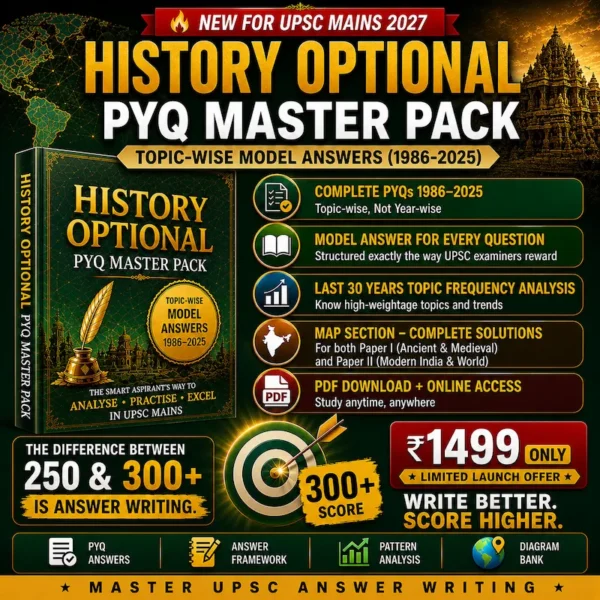
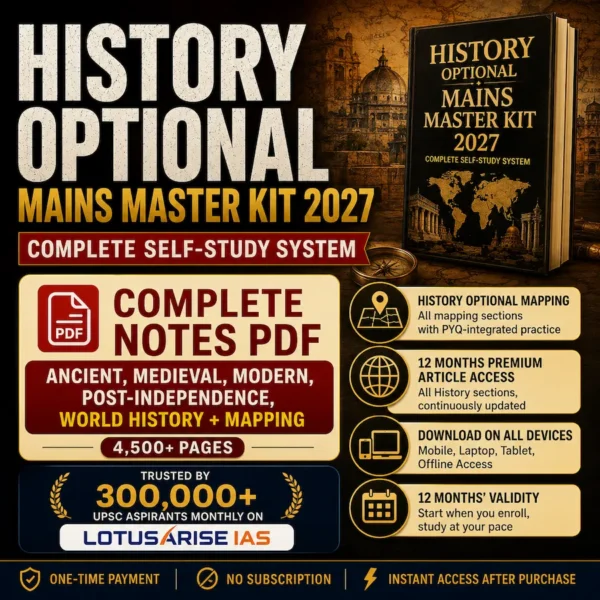
- Structured, updated notes from established UPSC optional coaching platforms — for example, LotusArise’s History Optional Course materials are built directly around the current syllabus and updated for recent trends in the exam. [ LotusArise History Optional Course page]
- NCERT textbooks (Class 11–12 History, Ancient India, Medieval India, Modern India) — free, official, and a genuinely strong foundation.
- Standard reference books’ own summary sections and chapter conclusions, which you can convert into your own notes.


Sources to be cautious with:
- Random Telegram channels and file-sharing groups — notes here are frequently years out of date, missing recent additions to the syllabus interpretation, or contain uncredited errors copied from one aspirant to another with no fact-checking.
- Free “complete syllabus in 100 pages” PDFs — if a PDF claims to cover the entire History optional syllabus in a tiny page count, treat it as a quick-revision aid only, never as your primary material. Depth cannot be compressed that much without losing the analytical content Mains actually rewards.
- Pirated copies of paid coaching material — beyond the ethical and legal issues, these are often outdated versions the original institute has since revised.
5. How to Evaluate Any PDF Before You Trust It
Run this quick checklist on any notes PDF before relying on it:
- Check the date. Is it explicitly updated for recent years, or is it an old file being recirculated?
- Cross-check 3–4 facts against a standard textbook (e.g., a date, an author’s viewpoint, a treaty term). If even a couple are wrong, be skeptical of the rest.
- Look for analysis, not just facts. If it’s purely a list of dates and names with zero connecting analysis, it will help Prelims recall but won’t build your Mains answer-writing skill.
- See if it matches the actual UPSC syllabus wording. Notes that drift from the syllabus structure often reflect a generic history course, not an exam-tailored one.
6. How to Actually Use Notes to Improve Your Answers
- Don’t just read — convert. After reading a notes PDF section, close it and write a 150-word answer from memory on that topic. This is where actual retention and answer-writing skill come from.
- Layer, don’t replace. Use notes as your revision layer on top of at least one full reading of standard books — not as a substitute for that reading.
- Add your own margin notes. When you read something in a book that a PDF missed, add it in. Over months, your own annotated version becomes more valuable than any downloaded file.
- Use notes to build answer frameworks, not just to memorize facts — e.g., a note on “Causes of 1857 Revolt” should help you structure political, economic, social, and military causes as distinct paragraphs in an actual answer.
7. Common Mistakes Aspirants Make With Notes
- Collecting 5–6 different PDFs on the same topic and never finishing any of them.
- Treating notes as sufficient without ever attempting a full-length Mains answer on the same topic.
- Not updating notes when new historiographical viewpoints or NCERT revisions come out.
- Relying on someone else’s notes-taking priorities instead of adapting them to your own strengths and weak areas.
8. Using Notes Alongside Previous Year Questions (PYQs)
Notes are most useful when you test them against real UPSC patterns. A few representative PYQ-style questions to check your notes against:
- “Discuss the significance of the Bhakti and Sufi movements in fostering communal harmony in medieval India.” — Good notes should let you build four to five distinct points (social reform, syncretism, literature, regional impact) rather than a vague paragraph.
- “Critically examine the economic impact of colonial rule on Indian handicrafts and industries.” — Test whether your notes give you both the “deindustrialization” argument and the counter-arguments some historians raise.
- “Compare the causes of the Russian Revolution of 1917 with those of the French Revolution of 1789.” — This is where World History notes with comparative tables pay off directly; if your notes only list facts about each revolution separately, you’ll struggle to build the comparison UPSC is asking for.
If your notes let you outline a confident four-to-five-point answer structure for questions like these within a few minutes, they’re doing their job.
FAQs
Conclusion
The search for a single downloadable PDF that “covers everything” is understandable, but the aspirants who actually score well in History optional treat notes as one part of a larger system — reading, notes, and consistent answer writing working together. Prioritize notes that are syllabus-mapped, analytically rich, and regularly updated, cross-check anything you download for free, and always convert passive reading into active answer practice.
If you’d rather skip the guesswork of piecing together scattered free PDFs, LotusArise’s History Optional Course provides structured, updated, syllabus-mapped notes alongside mentor-guided answer writing practice — built specifically around what UPSC actually tests.