History Optional · Paper I · Ancient India
Aryans and Vedic Period Notes · PYQs · Solved Answers
Free notes, every previous year question and the solved answers for Aryans and Vedic Period (Paper I, Ancient India), arranged so you can read a topic and immediately see how UPSC has asked it. Syllabus: Expansion of Aryans, Vedic literature, transformation from Rig Vedic to later Vedic, polity, society, religion.
31
Solved PYQs
1985–2024
Years covered
32
Questions listed
5
Free notes
On this page
Free notes Previous year questions Solved answers All History Optional units
Paper I · Unit 05
Aryans and Vedic Period notes
Topic-wise notes for this unit in syllabus order. Read a topic, then open its previous year questions below.
Free notes
Free practice
Previous year questions: Aryans and Vedic Period
Every question UPSC has asked from this unit, year-wise, with a link to its solved answer.
Topic-wise question list
Year-wise question papers
-
UPSC History Optional Question Paper 2026
-
UPSC History Optional Question Paper 2025
-
History Optional Question Paper: 2024
-
History Optional Question Paper: 2023
-
History Optional Question Paper: 2012
-
History Optional Question Paper: 2011
-
History Optional Question Paper: 2013
-
History Optional Question Paper: 2014
-
History Optional Question Paper: 2015
-
History Optional Question Paper: 2016
-
History Optional Question Paper: 2017
-
History Optional Question Paper: 2018
-
History Optional Question Paper: 2019
-
History Optional Question Paper: 2021
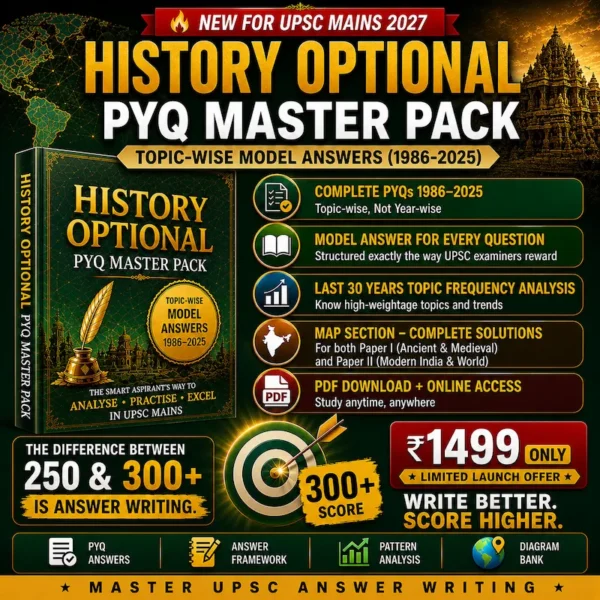
History PYQ Master Pack
Solved PYQ answers: Aryans and Vedic Period
Topic-wise model answers, newest exam year first. Members open the full answer; everyone else sees the question and can join the pack.
PYQ Solutions
-
Discuss the evolution of the State institution and taxation system from the Rigvedic period to the later Vedic period.
-
How do the comparative study of languages, archaeological sources and vast corpus of Vedic literature helps to determine the Aryan problem in Indian history. Discuss.
-
Do you consider that the Upanishadic principles embody the high point of Vedic religious thought? Comment.
-
Throw light on the nature of religion and classification of gods mentioned in the Rigveda.
-
Puranas were the innovative genre of literature to popularise and revive Vedic religion. Elaborate with examples.
-
“There are no literary sources for the Harappan culture and no archaeological evidence for the Vedic period.” Explain the phenomenon.
-
Examine how the transformation of the Varna System from the Rigvedic to the Later-Vedic period affected the position of women.
-
Critically examine various views regarding the Vedic-Harappan relationship in light of the latest discoveries.
-
In what way was the egalitarian character of the early vedic society changed during the later vedic period?
-
“Archaeology knows of no Aryans; only literature knows of Aryans.” Examine critically.
-
“The Upanishadic principles embody the epitome of the Vedic thought.” Discuss.
-
“The varna concept may always have been largely a theoretical model and never an actual description of society.” Comment in the context of Ancient India.
-
Evaluate various views regarding human settlements as gleaned from the Vedic sources.
-
Evaluate the conceptual basis of the Vedic deities.
-
Examine the view that the sacrifice was a ritual and a form of social exchange in Vedic India.
-
Evaluate the various approaches to the understanding of Vedic religion.
-
Describe the social life of the later Vedic people. How was it different from the Rigvedic life?
-
Give a brief account of the social and economic conditions of the Later Vedic Aryans. What role did iron play in changing their political and economic life?
-
Write brief essay on Vedic rituals.
-
Write brief essay on Vedic literature.
-
Describe the distinguishing features of important archaeological cultures of the Indian subcontinent datable between c. 2000 B.C. and c. 500 B.C.
-
Bring out the elements of change and continuity between the Early Vedic and Later Vedic Cultures.
-
Write brief essay on: The Vedic Gods of the terrestrial region.
-
Analyse the differences and similarities between Indus Valley and Vedic Cultures.
-
‘The Indus civilization did not have an abrupt appearance.’ Discuss the statement. How does the Indus civilization stand, in view of its geographical expansion and chronology, in relations to the Vedic civilization?
-
Write short essay of not more than 200 words on: The formulation of social system in the later Vedic period.
-
Discuss briefly the development of religious ideas and rituals in the Vedic age. Do they show any parallelism with the religion of the Indus Civilization?
-
Write short essay of not more than 200 words on: Position of women in the Rigvedic society.
-
Compare the economic, social and religious life of the Indus Valley (Harappan) people with that of the early Vedic people and discuss the relative chronology of the Indus and the early Vedic cultures.
-
Write short essay of not more than 200 words on: Democratic elements in the political system of the early Vedic period.
-
Discuss the geographical area known to the Rigvedic people. Were they familiar with the sea?
Premium content · how to get access
This page is part of the History Optional PYQ Master Pack.
Every model answer below opens with one enrolment. One-time payment, no subscription, access from the moment your payment is confirmed.
- 1,390+ topic-wise model answers (1985–2025), Paper I and Paper II
- Historiography, primary sources and map references built into each answer
- Access on phone, laptop or tablet
Full pack
₹1,499 ₹2,500 40% off
One-time payment · instant access · UPI, cards, RuPay