History Optional · Paper I · Medieval India
Society, Culture and Economy in the 13th and 14th Centuries Notes · PYQs · Solved Answers
Free notes, every previous year question and the solved answers for Society, Culture and Economy in the 13th and 14th Centuries (Paper I, Medieval India), arranged so you can read a topic and immediately see how UPSC has asked it. Syllabus: Rural and urban society, women, religious classes, caste and slavery, Bhakti and Sufi movements, culture, economy and trade.
34
Solved PYQs
1985–2025
Years covered
37
Questions listed
6
Free notes
On this page
Free notes Previous year questions Solved answers All History Optional units
Paper I · Unit 17
Society, Culture and Economy in the 13th and 14th Centuries notes
Topic-wise notes for this unit in syllabus order. Read a topic, then open its previous year questions below.
Free notes
-
Amir Khusrau and His Contribution
-
Educational development during Sultanate Period
-
Lekhapaddhati as a Source of History
-
Painting, Music, Evolution of Composite Culture in 13th & 14th Centuries
-
Persian Literature, Literature in the regional languages of North India, Literature in the languages of South India
-
Sultanate Architecture and New structural forms in 13th & 14th Centuries
Free practice
Previous year questions: Society, Culture and Economy in the 13th and 14th Centuries
Every question UPSC has asked from this unit, year-wise, with a link to its solved answer.
Topic-wise question list
Year-wise question papers
-
UPSC History Optional Question Paper 2026
-
UPSC History Optional Question Paper 2025
-
History Optional Question Paper: 2024
-
History Optional Question Paper: 2023
-
History Optional Question Paper: 2012
-
History Optional Question Paper: 2011
-
History Optional Question Paper: 2013
-
History Optional Question Paper: 2014
-
History Optional Question Paper: 2015
-
History Optional Question Paper: 2016
-
History Optional Question Paper: 2017
-
History Optional Question Paper: 2018
-
History Optional Question Paper: 2019
-
History Optional Question Paper: 2021
History PYQ Master Pack
Solved PYQ answers: Society, Culture and Economy in the 13th and 14th Centuries
Topic-wise model answers, newest exam year first. Members open the full answer; everyone else sees the question and can join the pack.
PYQ Solutions
-
“Religious themes inspired a large section of literature in provincial languages in late medieval India.” Comment.
-
Compare and contrast the position of Hindu and Muslim women in 13th and 14th century India.
-
The establishment of large number of urban settlements in North India in the thirteenth century was principally owing to the deployment of Turkish garrisons across the lands. Comment.
-
Identify the different categories of Persian Literature which emerged during the Delhi Sultanate, (in about 150 words)
-
Some new crafts production were introduced by the Turks. Comment.
-
How did international trade support urbanisation in North India during the 13-14th century CE. (in 150 words)
-
Critically evaluate the Muslim Nobility during the period of Tughlaq dynasty, (in 150 words)
-
Delineate the state of agriculture during the Sultanate period.
-
Describe the new architectural features added by successive Sultans in the construction of Tombs in India.
-
Discuss the advancement made in Textile Technology under the Delhi Sultans.
-
Discuss evidence on slavery provided by Ibn Batuta with special reference to female slaves.
-
Delineate non-agricultural production and urban economy in the 13th and 14th centuries C.E.
-
Evaluate the contents of the Tabaqat-i-Nasiri as a source of medieval history.
-
Discuss in brief the land – revenue system and judicial administration of the Delhi Sultanate.
-
“Sufis and medieval mystic saints failed to modify either the religious ideas and practices or the outward structure of Islamic / Hindu societies to any appreciable extent.” Comment for / against.
-
Trace the technological and stylistic development in the architecture of the Sultanate period.
-
Evaluate the contribution of Vaishnava saints to the growth of medieval Bhakti literature. (150 words)
-
Assess the Lekhapaddhati as an important source for evaluating the society and economy of the thirteenth century CE with special reference to Gujarat.
-
Evaluate critically the conditions of labour from 1200 – 1500 CE on the basis of historical sources.
-
Critically evaluate the educational development during the Sultanate period.
-
Evaluate the conditions of industries in India from 1200-1500 CE.
-
Evaluate the Malfuzat texts as sources of medieval history.
-
Bhakti and mysticism of Lai Ded emerged as a social force in Kashmir. Comment.
-
Analyse the racial composition and the role of nobility under the successors of Iltutmish. How did it affect the contemporary politics?
-
Examine the increasing importance of maritime trade of India during thirteenth to fifteenth centuries.
-
Identify the main factors that sustained the expansion of urban economy in the Delhi Sultanate.
-
Give a critical assessment of the contributions of Amir Khusrau and Barani to Indo-Persian literature.
-
Write brief essay- Amir Khusro was an eminent poet not a historian.
-
Throw light on the Land Revenue System of Sultanate period.
-
Growth of regional languages and literature during the medieval period.
-
Write brief essay on Meaning and features of the Maharashtra Dharma.
-
Write brief essay: Indo – Islamic architecture during the Khalji and Tughluq period.
-
‘The period of Delhi Sultans witnessed the emergence of Indo-Persian culture.’ Discuss the statement with reference to developments in the fields of language, literature, art and social life.
-
Where, when and how did Urdu originate? Write a short answer of not more than 200 words. (1985)
Premium content · how to get access
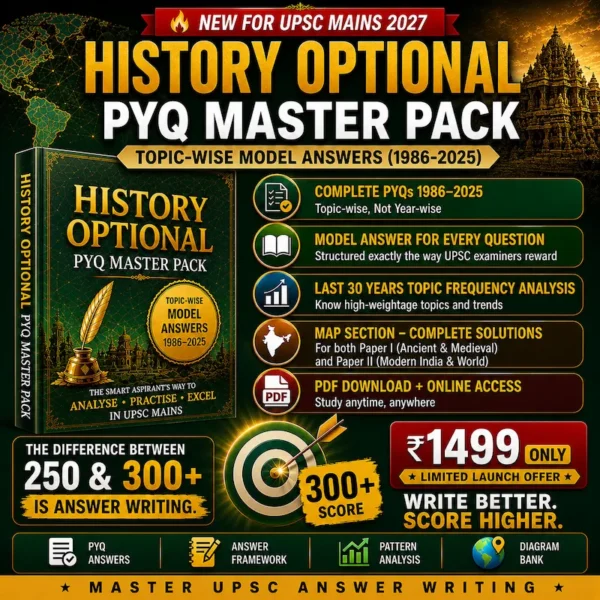
This page is part of the History Optional PYQ Master Pack.
Every model answer below opens with one enrolment. One-time payment, no subscription, access from the moment your payment is confirmed.
- 1,390+ topic-wise model answers (1985–2025), Paper I and Paper II
- Historiography, primary sources and map references built into each answer
- Access on phone, laptop or tablet
Full pack
₹1,499 ₹2,500 40% off
One-time payment · instant access · UPI, cards, RuPay