- Economic geography is the branch of human geography that studies the spatial organisation of economic activities: where agriculture, industry, trade and services take place, why they are located there, and how those patterns change.
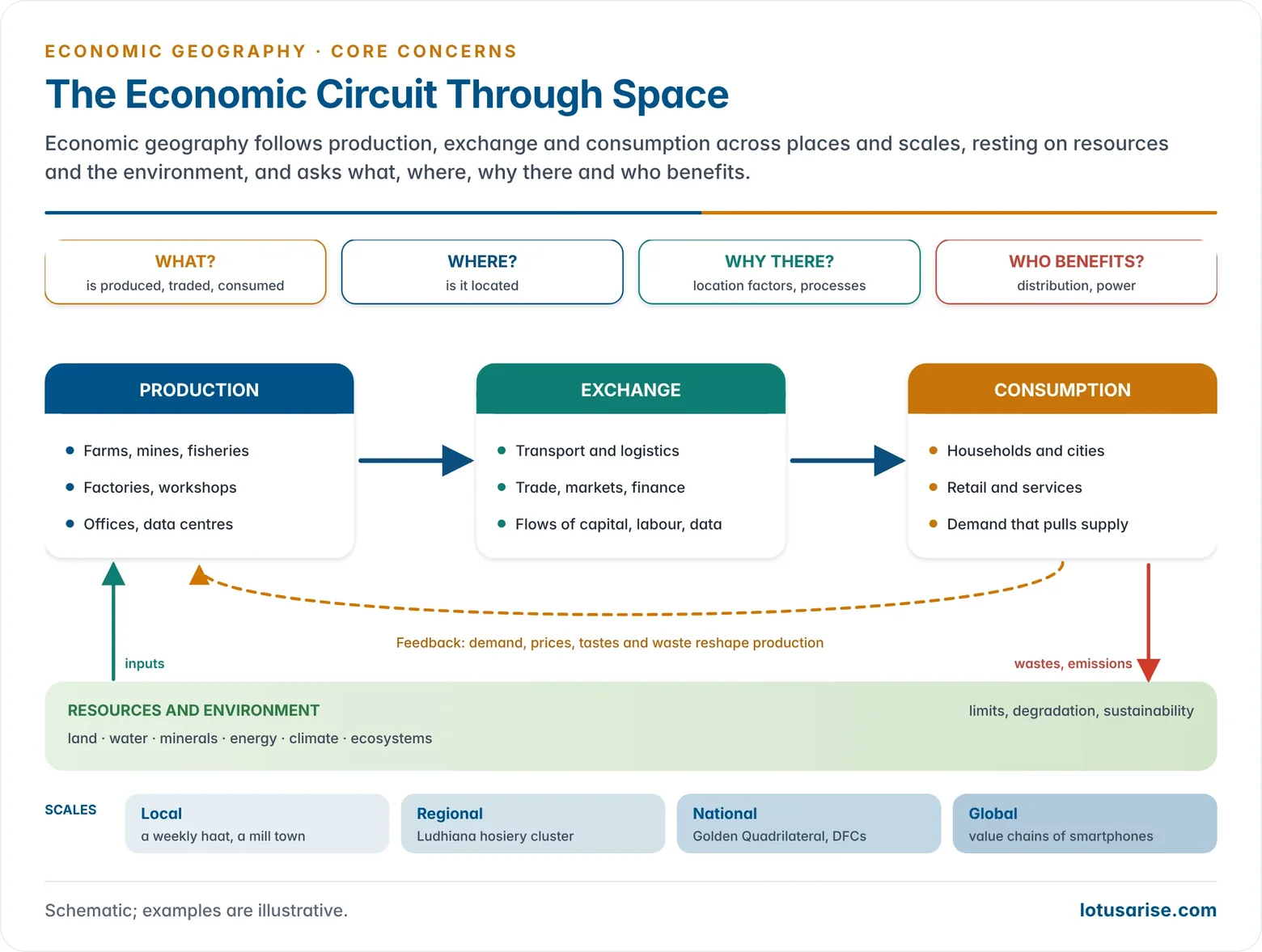
- It looks at how people use resources, produce goods and services, exchange them and consume them at local, regional, national and global scales.
- Economy and space work on each other: economic processes shape places and regions, and places in turn decide what economic activity is possible and profitable.
Meaning and Definitions

Classical Definitions
| Scholar | Definition (gist) | Emphasis |
|---|---|---|
| Wilhelm Götz (1882) | A scientific study of world areas in their direct influence on the production of goods | Production; set apart from commercial geography |
| George G. Chisholm | A plausible forecast of the future course of commercial development, so far as geographical conditions affect it | Commerce and trade |
| J. McFarlane | The influence of the physical environment (landforms, climate, relative location of regions) on economic activity | Environment |
| L. Dudley Stamp | The geographical and other factors that influence man’s productivity, so far as they bear on production and trade | Productivity |
| Erich W. Zimmermann | The economic life of man in relation to his environment | Man–environment |
| R. E. Murphy | Similarities and differences from place to place in the ways people make a living | Livelihoods |
| N. J. G. Pounds | The distribution of man’s productive activities over the surface of the earth | Distribution |
| Truman A. Hartshorn and John W. Alexander | The spatial variation on the earth’s surface of activities related to producing, exchanging and consuming goods and services, with the aim of building generalisations and theories | Spatial variation and theory |
- Other classical writers widened the scope: Clarence F. Jones and Gordon G. Darkenwald (why certain places stand out in the production and export of particular items), Ellsworth Huntington (all the resources, activities, customs and aptitudes through which people earn a living), Nels A. Bengtson and Willem Van Royen, and R. N. Brown and E. B. Shaw (the influence of the physical environment on the use of resources and on human activity).
Modern Understanding
- The definition has moved from environmental influence to spatial variation, and then to processes and power.
- The idea of areal (spatial) variation in Hartshorn and Alexander’s definition marks the change from a descriptive subject to one that seeks explanation and theory.
- Today the subject rests on the concepts of space, place and scale, and asks four questions:
- What is produced, exchanged and consumed?
- Where does it happen, and why there?
- Who benefits?
- How do these patterns change over time?
- It is a dynamic and often contested field that draws on economics, sociology, political science and ecology. Economics asks how scarce resources are allocated, often in a world without space; economic geography asks where, and why there.
Nature and Scope
Nature
- Spatial science: it studies areal differences and spatial interaction in economic life, such as flows of goods, capital, labour and information.
- Integrating discipline: it links the physical base (climate, soil, water, minerals) with human factors (labour, capital, technology, policy, culture).
- Both idiographic and nomothetic: it describes unique regional economies and also looks for general laws and models of location.
- Dynamic: its focus moves with the economy, from colonial commerce to industrialisation, globalisation, digital platforms and the green transition.
- Applied: it feeds into regional planning, location decisions, trade policy and resource management.
Two Continuums
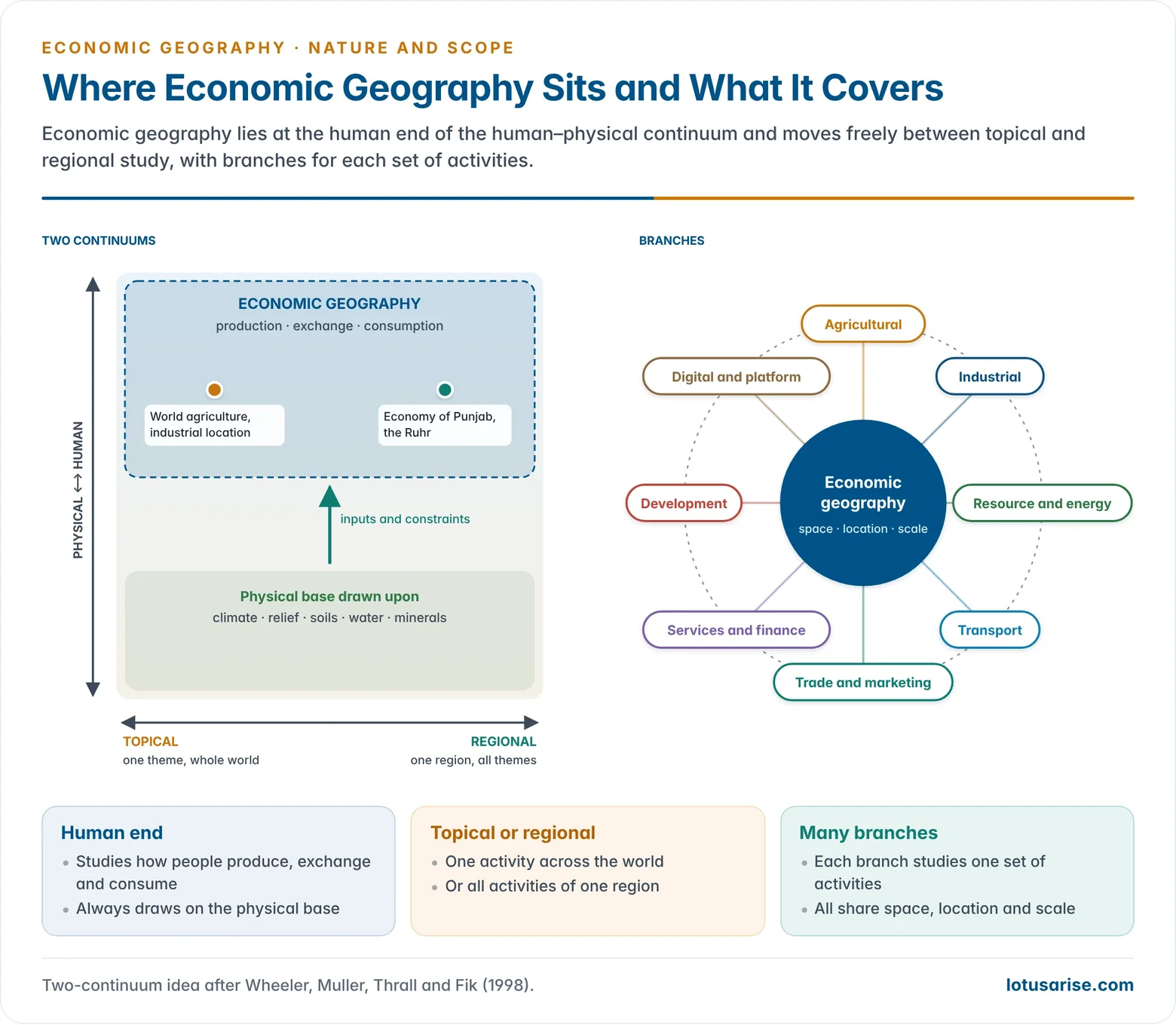
- James O. Wheeler, Peter O. Muller, Grant I. Thrall and Timothy J. Fik (1998) placed economic geography on two continuums.
- Human–physical: it lies towards the human end because it studies production, distribution and consumption, but it always draws on climate, soils, relief and hydrology.
- Topical–regional: it can study one region at a time (the economy of Punjab or the Ruhr) or one theme across the world (world agriculture, industrial location, world trade).
Scope
- Productive activities in all sectors of the economy:
- primary: agriculture, forestry, fishing and mining;
- secondary: manufacturing, processing and fabrication;
- tertiary and higher: transport, trade, finance, insurance and knowledge-based services.
- Resources and environment: the distribution of world resources, their use and conservation, the energy crisis, and the debate on the limits to growth.
- Development and inequality: how world economic development is measured, and the uneven development, core–periphery relations and regional imbalances found at every scale.
- Agriculture and food: the types of agricultural regions, agricultural inputs and productivity, food and nutrition problems, food security and famine.
- Location and spatial organisation: why industries cluster, how market areas form, and how trade routes and corridors develop.
- Exchange and interaction: patterns of world trade, transport networks, foreign investment and labour migration.
Branches
| Branch | Studies | Example |
|---|---|---|
| Agricultural geography | Crop and livestock systems, agricultural regions, productivity | Derwent Whittlesey’s agricultural regions |
| Industrial geography | Location and agglomeration of manufacturing | Iron and steel belt of Chotanagpur |
| Resource geography | Distribution, use and conservation of resources | Critical-mineral supply chains |
| Transport geography | Networks, flows, accessibility | Dedicated Freight Corridors |
| Geography of trade and marketing | Trade patterns, market areas, retail | India–UAE CEPA trade flows |
| Geography of services and finance | Offices, IT, finance, tourism | Bengaluru’s IT cluster |
| Development geography | Spatial patterns of development and poverty | North–South divide |
Evolution of Economic Geography
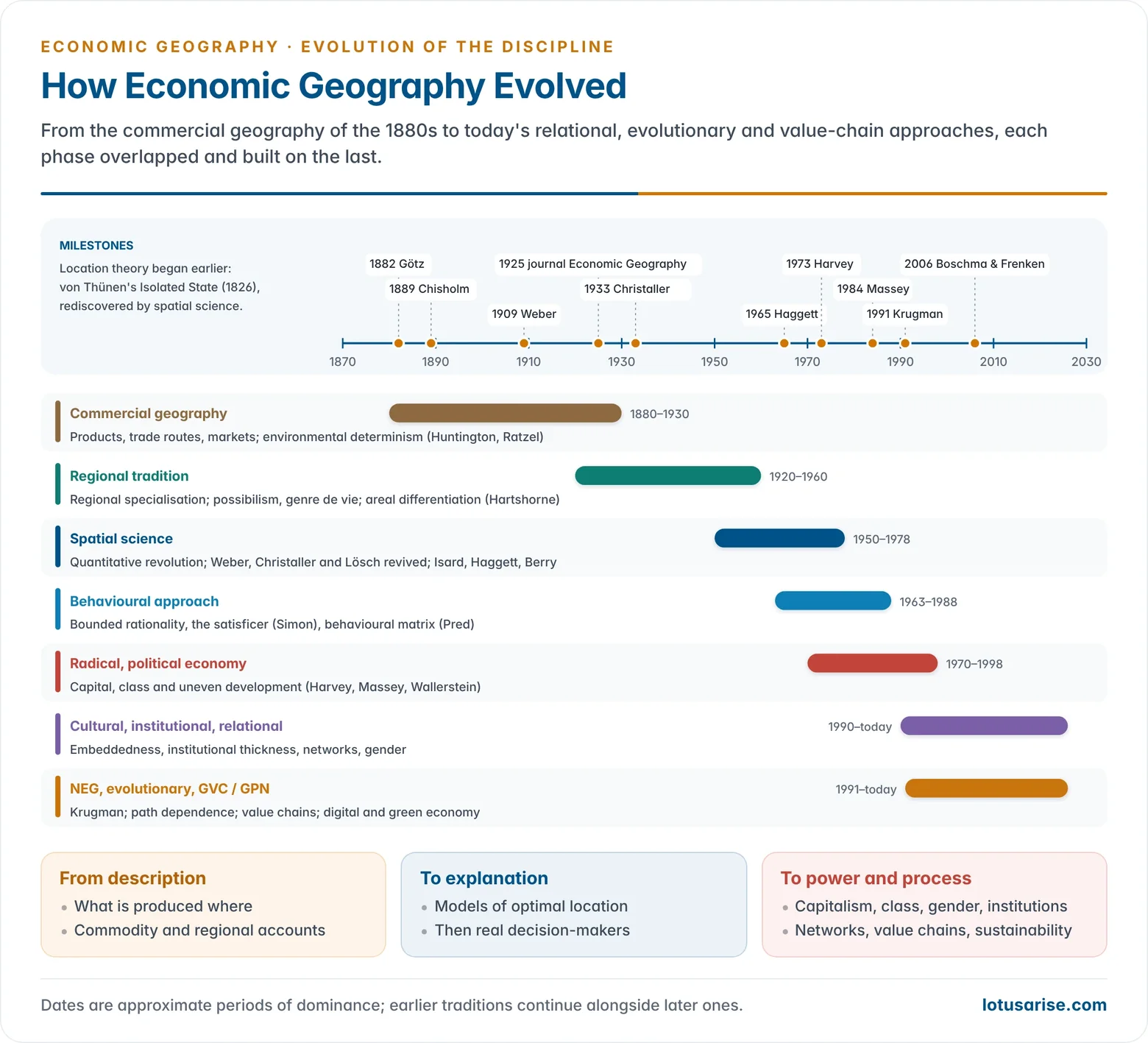
Commercial Geography (Late 19th to Early 20th Century)
- Economic geography grew out of commercial geography, a practical survey of world products, trade routes and markets for merchants of an expanding colonial economy.
- Wilhelm Götz’s 1882 paper separated economic geography from commercial geography.
- George G. Chisholm’s Handbook of Commercial Geography (1889) set the pattern of commodity-by-commodity description.
- In the USA, the journal Economic Geography (Clark University, 1925) gave the subject its own identity.
- Explanation was environmentally deterministic: Ellsworth Huntington tied climate to human energy and productivity.
Regional Tradition (1920s to 1950s)
- Economic geography became part of regional geography, describing how each region specialised in particular activities.
- Paul Vidal de la Blache’s possibilism held that human culture turns natural possibilities into actual economic landscapes.
- Richard Hartshorne’s areal differentiation made the region the unit of study.
Spatial Science and Location Theory (1950s to 1960s)
- The quantitative revolution turned economic geography into a spatial science that looked for laws.
- It revived the German location theories: Johann Heinrich von Thünen (1826) on agricultural land use, Alfred Weber (1909) on least-cost industrial location, and Walter Christaller (1933) and August Lösch (1940) on central places and market areas.
- Walter Isard’s regional science and Peter Haggett’s Locational Analysis in Human Geography (1965) made models and statistics central.
- Under positivism, space was treated as an isotropic surface and people as a rational “economic man” seeking the optimal location. Environmental determinism gave way to an economic determinism drawn from neoclassical economics.
Behavioural and Radical Critiques (1960s to 1980s)
- Behavioural geographers replaced the optimiser with real decision-makers who have imperfect information and mixed goals.
- Allan Pred’s behavioural matrix (1967) and Herbert Simon’s “satisficer” explained why firms and farmers often settle for a “good enough” location or crop.
- Radical geographers argued that location models ignored power, class and capitalism.
- David Harvey (The Limits to Capital, 1982) explained uneven development as an outcome of capital accumulation, and Doreen Massey (Spatial Divisions of Labour, 1984) showed how firms exploit regional differences in labour.
Cultural, Institutional and Contemporary Approaches (1990s Onwards)
- Post-structuralist thought questioned grand theories, and new approaches studied how economic life is embedded in society:
- the cultural turn: culture, social networks, gender and identity;
- the institutional turn: rules, norms, trust and the “institutional thickness” of regions (Ash Amin and Nigel Thrift, 1994);
- the relational approach: networks of firms, workers and places (Harald Bathelt and Johannes Glückler, 2003).
- Paul Krugman’s New Economic Geography (1991) brought increasing returns and transport costs into mainstream economics to explain agglomeration.
- Evolutionary economic geography (Ron Boschma and Koen Frenken, 2006) traces how regional economies change through path dependence, related variety and lock-in.
- Current research follows global value chains and production networks, the green transition and the supply-chain shocks of the pandemic and of geopolitics.
Approaches in Economic Geography
- Several approaches are used side by side. The commodity, regional and systematic approaches differ in what they take as the unit of study; the later ones differ in theory, and most rest on one of the theoretical perspectives in economic geography.
| Approach | Core idea | Typical question | Example |
|---|---|---|---|
| Commodity | One product traced across the world | Where is coffee grown and traded? | World coffee belt |
| Regional | All economic activities of one region | Why is Punjab agriculturally richer than western Rajasthan? | Regional economic profiles |
| Systematic (topical) | One activity at the global scale, seeking patterns | How is the world iron and steel industry distributed? | World cotton textile pattern |
| Principles / spatial analysis | Models and laws of location and interaction | Where is the least-cost location? | Weber’s model |
| Behavioural | Decisions shaped by perception and risk | Why do farmers not adopt the most profitable crop? | Pred’s behavioural matrix |
| Humanistic | Values, experience and sense of place | Why do artisans stay in traditional clusters? | Moradabad brassware |
| Radical / Marxist | Capitalism, class and uneven development | Who gains from the global coffee trade? | Coffee farmers vs roasters |
| Political economy / institutional | States, institutions and policy | How do WTO rules and sanctions reshape trade? | Effect of tariffs on supply chains |
| Ecological / environmental | Economy–environment interaction | What is the ecological cost of mining? | Coal mining in Jharia |
Regional and Systematic Approaches
- The regional approach studies “all about one”: every activity of one region and how resources, environment and culture combine there. It rests on areal differentiation and is idiographic, interested in what makes a place unique.
- The systematic approach studies “one about all”: one activity across the world, looking for patterns and processes rather than regional peculiarities. It is nomothetic, interested in general laws.
- Fred K. Schaefer’s paper “Exceptionalism in Geography” (1953) attacked Hartshorne’s view that geography could only describe unique regions, and opened the way to law-seeking spatial science. The systematic versus regional debate was never fully settled, and most economic geographers now use both.