What “Wildlife” Actually Means

Wildlife traditionally refers to undomesticated animal species, but the term has broadened considerably: it now conventionally includes all plants, fungi, and other organisms that grow or live wild in an area without having been introduced there by humans. This expanded definition matters for the Geography optional, because it folds wildlife conservation directly into the same conceptual family as biogeography, ecosystem ecology and biodiversity — rather than treating it as a narrow zoology topic.
Wildlife can be found in every ecosystem on Earth: deserts, forests, rainforests, plains, grasslands, and even the most developed urban areas each support distinct forms of wildlife. While popular culture usually imagines wildlife as untouched by human factors, most scientists agree that virtually all wildlife today is affected, directly or indirectly, by human activity — a point that runs through every section of this article, from causation to conservation response.
How Much Life Is Out There
Biologists estimate that between 5 and 15 million species of plants, animals and micro-organisms exist on Earth today — yet only about 1.5 million have actually been formally described and named. This gap between estimated and described diversity is itself an important exam point: it means humanity is losing species we have not even catalogued, let alone studied.
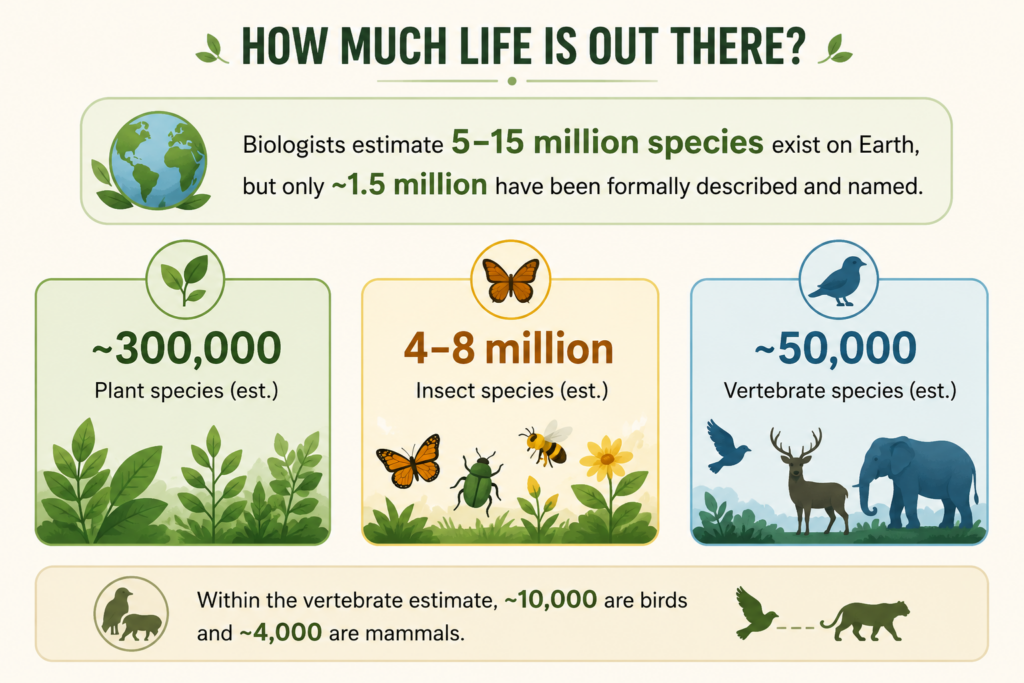
Within the vertebrate estimate, approximately 10,000 are birds and 4,000 are mammals — figures worth memorising precisely, since UPSC questions on biodiversity frequently test exact orders of magnitude rather than vague impressions.
The Scale of the Crisis
- Today, about 23% (1,130 species) of mammals and 12% (1,194 species) of birds are considered threatened by the IUCN.
- According to various surveys and reports, the planet has lost more than 58% of its wildlife since 1970, and is now understood to be experiencing what scientists call the sixth mass extinction.
- The 2016 Living Planet Report (WWF, using data compiled with the Zoological Society of London’s Living Planet Index) revealed the troubling extent of this and other environmental crises worldwide, while also highlighting practical pathways to protect and rehabilitate what remains. The index measuring the abundance of biodiversity was down 58% from 1970 to 2012, and was projected, on trends then observable, to fall by 67% by 2020.
- In response to mounting concern, the Government of India passed the Wild Life (Protection) Act in 1972.
- In 1980, the World Conservation Strategy was developed by the International Union for Conservation of Nature and Natural Resources (IUCN), with assistance from the United Nations Environment Programme (UNEP) and the World Wildlife Fund (WWF), and in collaboration with the Food and Agriculture Organisation (FAO) and UNESCO.
Unlike the five previous mass extinctions in Earth’s history — which were driven by natural events such as asteroid impacts, volcanism, and glaciation (the most famous being the Cretaceous–Paleogene extinction that ended the dinosaurs, ~66 million years ago) — the sixth mass extinction is understood by scientists to be driven overwhelmingly by a single species: humans. This anthropogenic causation is precisely what distinguishes modern conservation biogeography from the study of past extinction events.
Sixth Extinction
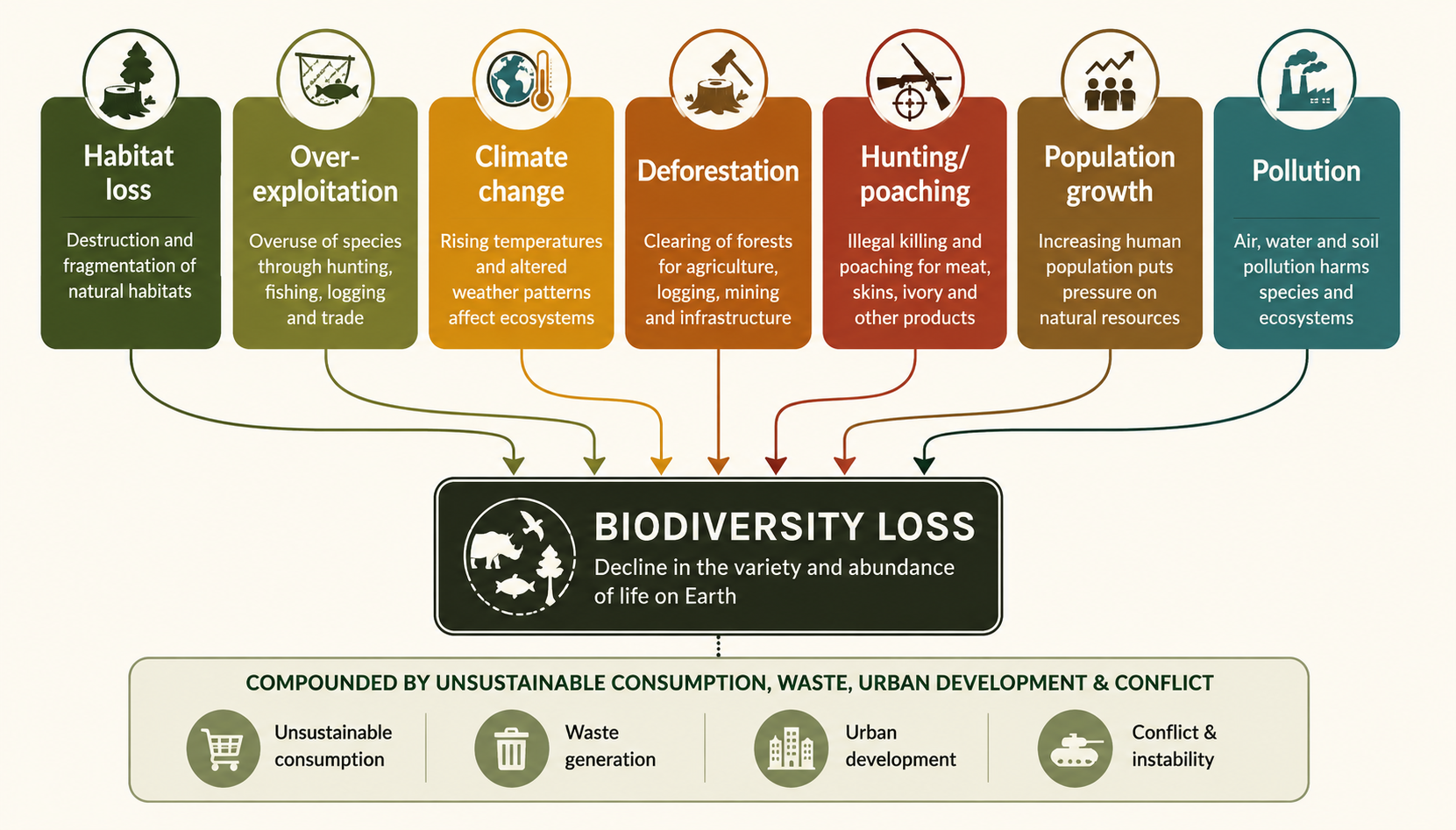
Drivers of Biodiversity Loss: The Overview
Global biodiversity is being lost much faster than the natural (background) rate of extinction, due to changes in land use, unsustainable use of natural resources, invasive alien species, climate change, and pollution, among other pressures.
- Land conversion by humans, resulting in natural habitat loss, is most evident in tropical forests and comparatively less intensive in temperate, boreal and Arctic regions.
- Pollution from atmospheric nitrogen deposition is most severe in northern temperate areas close to urban centres.
- The introduction of damaging alien (invasive) species is usually brought about through patterns of human activity — trade, travel, and deliberate or accidental transport.
Species loss is further compounded by:
- The ongoing growth of human populations and unsustainable consumer lifestyles
- Increasing production of waste and pollutants
- Urban development
- International conflict
Habitat Loss, Fragmentation & Degradation
Habitat loss due to destruction, fragmentation, and degradation is the primary threat to the survival of wildlife. Fewer natural wildlife habitat areas remain each year, and the habitat that does remain has often been degraded to the point that it bears little resemblance to the wild areas that existed in the past.
- Destruction — the outright, complete removal of natural habitat (e.g., clear-felling of forest for agriculture or settlement).
- Fragmentation — the breaking-up of large, continuous habitat into smaller, isolated patches, disrupting the movement, gene flow and breeding opportunities of species that depend on large contiguous ranges.
- Degradation — the reduction in habitat quality without necessarily its complete removal, e.g., through pollution, invasive species, or altered fire/hydrology regimes.
Fragmentation is best explained using the theory of island biogeography (MacArthur & Wilson): fragmented habitat patches behave like ecological “islands,” where smaller patch size and greater isolation from other patches both independently reduce the number of species a patch can sustainably support — and increase local extinction risk through edge effects and reduced gene flow.
Climate Change and Wildlife
Global warming is making hot days hotter, rainfall and flooding heavier, hurricanes stronger, and droughts more severe. This intensification of weather and climate extremes is, and will increasingly be, the most visible impact of global warming in everyday life — and it is also causing dangerous changes to the landscape of the world, adding stress to wildlife species and their habitats.
- Since many types of plants and animals have specific habitat requirements, climate change could cause a disastrous loss of wildlife species wherever those requirements can no longer be met locally.
- Even a slight drop or rise in average rainfall translates into large seasonal changes on the ground.
- Hibernating mammals, reptiles, amphibians and insects are particularly harmed and disturbed by shifting seasonal cues, since their life cycles are finely timed to temperature and photoperiod.
- Plants and wildlife are highly sensitive to moisture change, and will therefore be harmed by any significant change in moisture levels.
- Natural phenomena — floods, earthquakes, volcanic eruptions, lightning, and forest fires — also affect wildlife, and several of these (floods, fires) are themselves intensified in frequency or severity by climate change.
For examination purposes, it is useful to note the two broad biogeographical responses species show to these pressures: range shifts (poleward and upslope migration in search of suitable climatic envelopes) and, where such shifts are not possible — because of geographic barriers, habitat fragmentation, or simply the pace of change outstripping dispersal ability — local extinction.
Unregulated Hunting & Poaching
Unregulated hunting and poaching constitute a major threat to wildlife. This problem is significantly worsened by mismanagement within forest departments and among forest guards, whose enforcement capacity often falls short of what is needed to police vast and remote habitat areas effectively.
Pollution
Pollutants released into the environment are ingested by a wide variety of organisms. The widespread use of pesticides and toxic chemicals renders the environment toxic to certain plants, insects, and rodents, with effects that frequently cascade up the food chain through bioaccumulation.
Over-Exploitation
Over-exploitation is the overuse of wildlife and plant species by people for food, clothing, pets, medicine, sport, and many other purposes. People have always depended on wildlife and plants for food, clothing, medicine, shelter and numerous other needs — but today, more resources are being consumed than the natural world can sustainably supply.
- The danger is that if too many individuals of a species are removed from their natural environment, the species may eventually no longer be able to sustain a viable population.
- The loss of a single species can affect many other species within the same ecosystem, through the web of ecological interactions it participates in.
- The hunting, trapping, collecting and fishing of wildlife at unsustainable levels is not a new phenomenon:
- The passenger pigeon was hunted to extinction early in the last century.
- Over-hunting nearly caused the extinction of the American bison.
- Over-hunting nearly caused the extinction of several species of whales.
Deforestation
Humans are continually expanding and developing, leading to an invasion of wildlife habitats. As human populations continue to grow, forested land is cleared to create more space for settlement, agriculture and infrastructure. This stresses wildlife populations directly, since there are correspondingly fewer homes and food sources available for wildlife to survive on.
Human Population Growth
The increasing population of human beings is itself a major threat to wildlife. More people on the globe means greater consumption of food, water and fuel, and therefore more waste generated — so major threats to wildlife are directly related to the growth of the human population. Conversely, a low human population results in less overall disturbance to wildlife, which is why population pressure is treated as a root, systemic driver underlying most of the other threats discussed above, rather than a separate, independent cause.
Human–Wildlife Conflict (Related Concept)
As habitat shrinks and fragments and human settlements expand into former wildlife range, direct human–wildlife conflict has emerged as an increasingly significant conservation challenge in its own right — particularly in India, where elephant corridors, tiger reserve buffer zones, and leopard-inhabited peri-urban landscapes regularly see conflict incidents involving crop damage, livestock predation, and occasionally human casualties. Conflict management (compensation schemes, corridor protection, early-warning systems) is now recognised as inseparable from species conservation strategy, since local community hostility toward wildlife directly undermines protection efforts on the ground.
Mass Extinctions in Context
Placing the current crisis in deep-time perspective sharpens its significance for an exam answer. Earth has experienced five previous mass extinction events in its geological history, each eliminating a substantial fraction of existing species over a geologically short interval, driven by natural causes such as asteroid impact, massive volcanism, and severe glaciation. The scientific consensus that the world is now living through a sixth mass extinction is distinguished from all five predecessors by a single fact: its cause is a single biological species — Homo sapiens — acting through the seven drivers, rather than an external geophysical or astronomical event.
The IUCN
- The International Union for Conservation of Nature (IUCN) is a membership union uniquely composed of both government and civil society organisations.
- It was created in 1948, and is the global authority on the status of the natural world and on the measures needed to safeguard it.
- It is headquartered in Gland, Switzerland.
- The IUCN Red List of Threatened Species is the world’s most comprehensive inventory of the global conservation status of plant and animal species.
- The Red List uses a set of quantitative criteria to evaluate the extinction risk of species; these criteria are designed to be relevant to most species and all regions of the world, allowing consistent, comparable assessment globally.
- It is recognised as the most authoritative guide to the status of biological diversity worldwide.
- It also serves as a key indicator for the Sustainable Development Goals (SDGs) and, historically, the Aichi Biodiversity Targets.
The IUCN Red List & Its Nine Categories
The IUCN Red List Categories define the extinction risk of assessed species. There are nine categories, extending from NE (Not Evaluated) to EX (Extinct). Species classified as Critically Endangered (CR), Endangered (EN), and Vulnerable (VU) are collectively considered to be “threatened with extinction.”
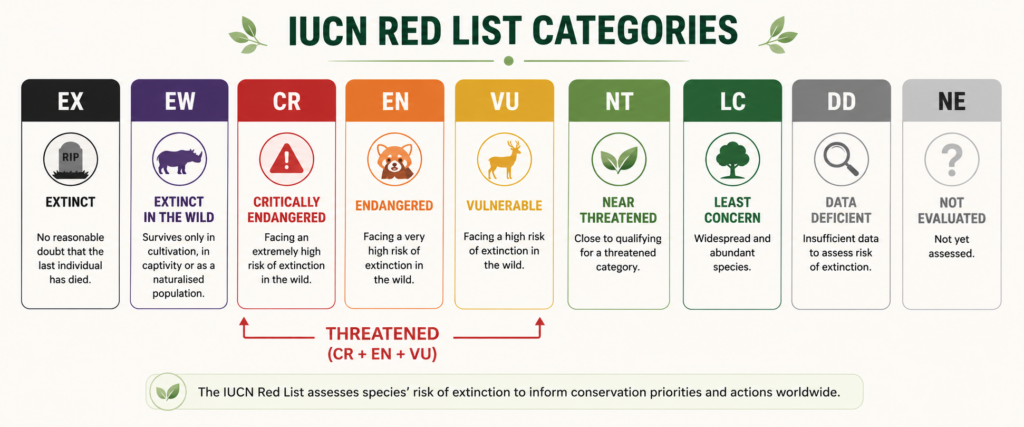
| Category | Meaning |
|---|---|
| EX — Extinct | No reasonable doubt the last individual has died |
| EW — Extinct in the Wild | Survives only in cultivation, captivity, or as a naturalised population well outside its past range |
| CR — Critically Endangered | Extremely high risk of extinction in the wild |
| EN — Endangered | Very high risk of extinction in the wild |
| VU — Vulnerable | High risk of extinction in the wild |
| NT — Near Threatened | Close to qualifying for, or likely to qualify for, a threatened category soon |
| LC — Least Concern | Widespread and abundant; does not qualify for any higher-risk category |
| DD — Data Deficient | Inadequate information to make a direct or indirect assessment of extinction risk |
| NE — Not Evaluated | Not yet assessed against the criteria |
The threatened categories (CR/EN/VU) are assigned using five quantitative criteria (A–E), any one of which is sufficient to qualify a species: (A) population size reduction over a specified time period, (B) restricted geographic range combined with fragmentation/decline/fluctuation, (C) small and declining population size, (D) very small or geographically restricted population, and (E) quantitative extinction-probability analysis (e.g., Population Viability Analysis).
CITES & the Global Wildlife Trade Regime
The Convention on International Trade in Endangered Species of Wild Fauna and Flora (CITES) works to prevent the global trade of wildlife that threatens species survival — but it is important to note honestly that many species remain unprotected from illegal trade or over-harvesting, since CITES coverage depends on species being formally listed on one of its Appendices:
| Appendix | Coverage |
|---|---|
| Appendix I | Species threatened with extinction; commercial international trade is prohibited (trade permitted only in exceptional, non-commercial circumstances) |
| Appendix II | Species not necessarily currently threatened, but trade must be controlled to avoid utilisation incompatible with survival |
| Appendix III | Species protected in at least one country, which has asked other CITES Parties for assistance in controlling trade |
Other Key International Conventions
CBD (1992)
The Convention on Biological Diversity, agreed at the Rio Earth Summit, with three objectives: conservation of biodiversity, sustainable use of its components, and fair/equitable sharing of benefits from genetic resources. Its post-2020 successor targets are set out in the Kunming-Montreal Global Biodiversity Framework, which replaced the earlier Aichi Targets.
CMS / Bonn Convention (1979)
The Convention on the Conservation of Migratory Species of Wild Animals protects species that cross international boundaries during their life cycle (e.g., migratory birds, whales, sea turtles) — recognising that no single national jurisdiction can conserve a migratory species alone.
Ramsar Convention (1971)
An intergovernmental treaty for the conservation and wise use of wetlands, given their disproportionate importance as wildlife habitat (waterbirds, fisheries) relative to their global land area.
World Heritage Convention (1972)
UNESCO mechanism protecting sites of “outstanding universal value,” including natural sites of exceptional biodiversity significance (several Indian national parks and sanctuaries are inscribed as Natural World Heritage Sites).
The World Conservation Strategy, 1980
The World Conservation Strategy was developed in 1980 by the International Union for Conservation of Nature and Natural Resources (IUCN), with advice, cooperation and financial assistance from the United Nations Environment Programme (UNEP) and the World Wildlife Fund (WWF), and in collaboration with the Food and Agriculture Organization (FAO) and UNESCO. The Strategy’s stated aim was to “provide an intellectual framework and practical guidance for conservation actions.”
- This thorough guidebook covers everything from the intended “users” of the strategy to its very priorities for action.
- It even includes a dedicated map section, identifying areas of large seafood consumption that are consequently endangered by overfishing — an early, and prescient, example of linking human consumption patterns directly to conservation risk mapping.
The World Conservation Strategy is historically significant as one of the first documents to formally articulate what later became known as “sustainable development” — predating the Brundtland Commission’s popularisation of the term by seven years.
India’s Legal & Institutional Framework
In 1972, the Government of India enacted the Wild Life (Protection) Act, laying the statutory foundation for wildlife conservation in the country. The Act’s key architecture, useful to know beyond what a general reading would suggest:
- Schedules I–VI — species are graded by the degree of protection afforded, with Schedule I species (e.g., tiger, snow leopard, several vulture species) receiving the highest protection and the most stringent penalties for violation; Schedule VI covers specified plants prohibited from cultivation/trade.
- Protected Area categories created/recognised under the Act:
- National Parks — highest protection; no human activity/rights permitted without special permission.
- Wildlife Sanctuaries — slightly more permissive; certain regulated human activities may continue.
- Conservation Reserves — buffer/connector zones, often on government land adjacent to protected areas, declared after consulting local communities.
- Community Reserves — declared on private or community land, where the community itself volunteers to conserve wildlife and habitat.
- Biosphere Reserves — while not created under the Wild Life (Protection) Act itself (they fall under UNESCO’s Man and Biosphere Programme framework as adapted by India’s National Biosphere Reserve Programme), they operate alongside this legal architecture and are structured into a core zone (strict protection), buffer zone (regulated use), and transition zone (sustainable use by local communities).
Institutionally, India’s conservation architecture is supported by the National Board for Wildlife (NBWL), chaired by the Prime Minister, which approves projects affecting protected areas and wildlife corridors, and the Wildlife Institute of India (WII), Dehradun, an autonomous research and training institution under the Ministry of Environment, Forest and Climate Change.
Species-Specific Conservation Projects
| Project | Launched | Focus |
|---|---|---|
| Project Tiger | 1973 | Tiger reserves under a core-buffer strategy; among the world’s most prominent single-species flagship conservation programmes |
| Project Elephant | 1992 | Elephant habitat and corridor protection, human–elephant conflict mitigation, anti-poaching (ivory) |
| Project Snow Leopard | 2009 | High-altitude Himalayan landscape conservation across a multi-country transboundary approach |
| Vulture conservation / breeding programmes | 2000s onward | Response to catastrophic vulture population collapse caused by the veterinary drug diclofenac |
Approaches & Concepts in Conservation
Wildlife conservation is the practice of protecting wild plant and animal species and their habitat. Wildlife plays an important role in balancing the ecosystem and provides stability to the different natural processes of nature. The goal of wildlife conservation is to ensure that nature will remain available for future generations to enjoy, and to recognise the importance of wildlife and wilderness for humans and other species alike.
- Many nations maintain government agencies and NGOs dedicated specifically to wildlife conservation, helping to implement protective policies.
- Numerous independent non-profit organisations also promote various wildlife conservation causes.
- Wildlife conservation has become an increasingly important practice precisely because of the negative effects of human activity on wildlife.
- An endangered species is defined as a population of a living species that is in danger of becoming extinct, either because the species has a very low or falling population, or because it is threatened by adverse environmental or other parameters.
1. In-Situ vs Ex-Situ Conservation
| Feature | In-situ conservation | Ex-situ conservation |
|---|---|---|
| Definition | Protecting species within their natural habitat | Protecting species outside their natural habitat |
| Examples | National parks, sanctuaries, biosphere reserves, community/conservation reserves | Zoos, botanical gardens, seed banks, gene banks, captive breeding programmes |
| Advantage | Preserves the whole ecosystem and natural evolutionary processes, not just the target species | Allows intensive, controlled intervention for critically small populations (e.g., vulture breeding centres) |
| Limitation | Vulnerable to habitat-scale threats (climate change, large-scale land conversion) | Does not conserve habitat or the broader ecosystem; reintroduction can be difficult |
2. Species Concepts Used in Conservation Planning
- Keystone species — a species whose impact on its ecosystem is disproportionately large relative to its abundance; its removal triggers cascading ecosystem change (e.g., sea otters in kelp-forest ecosystems).
- Flagship species — a charismatic species used to raise public awareness and funding for a broader conservation cause (e.g., the tiger as India’s flagship species).
- Umbrella species — a species whose habitat requirements are large enough that protecting it automatically protects many co-occurring species (e.g., protecting tiger landscapes also protects prey species and forest habitat generally).
- Indicator species — a species whose presence, absence or condition reflects the overall health of an ecosystem (e.g., lichens as air-quality indicators, amphibians as wetland-health indicators).
Biodiversity Hotspots (Related Concept)
Given finite conservation resources, Norman Myers’ concept of biodiversity hotspots — regions with exceptionally high levels of endemic species that have also lost a very large proportion (conventionally, 70% or more) of their original habitat — provides a prioritisation framework used globally by Conservation International and national agencies alike. Of the 36 recognised global biodiversity hotspots, four touch Indian territory: the Western Ghats, the Himalaya, Indo-Burma, and Sundaland (the last via the Nicobar Islands) — making India one of the few countries hosting multiple global hotspots within its borders.
Comparative Note: The US Endangered Species Act
In the United States, the Endangered Species Act of 1973 protects domestic species that were in danger from overexploitation, functioning as the American legal counterpart to India’s Wild Life (Protection) Act, 1972 — both enacted within a year of each other, reflecting the same early-1970s global surge in conservation legislation that also produced CITES (1973) and the Ramsar Convention (1971).