

Conservation Reserves and Community Reserve
- Conservation reserves and community reserves are terms denoting protected areas in India under the Wildlife (Protection) Act, 1972, which typically act as buffer zones to or connectors and migration corridors between established national parks, wildlife sanctuaries, and reserved and protected forests of India.
- Such areas are designated as conservation areas if they are uninhabited and completely owned by the Government of India, but used for subsistence by communities, and community areas if part of the land is privately owned.
- These protected area categories were first introduced in the Wildlife (Protection) Amendment Act of 2002 − the amendment to the Wildlife Protection Act of 1972.
- It added two new categories under Sections 36A to 36D of the Wildlife Protection Act, 1972, to strengthen participatory conservation outside traditional protected areas.
- Amendments to the Wildlife protection act in 2003, provided a mechanism for recognition and legal backing to the community initiated efforts in wildlife protection.
- It provides a flexible system to achieve wildlife conservation without compromising community needs.
- These categories were added because of reduced protection in and around existing or proposed protected areas due to private ownership of land and land use.
- These categories roughly correspond to IUCN Category V (conservation reserves) and VI (community reserves) protected areas.
Key Differences: Community Reserve vs. Conservation Reserve
| Feature | Conservation Reserve | Community Reserve |
|---|---|---|
| Land Ownership | Entirely owned by the Government. | Owned by individuals or a community. |
| Legal Basis | Wildlife (Protection) Amendment Act, 2002. | Wildlife (Protection) Amendment Act, 2002. |
| Location | Usually areas adjacent to National Parks or Sanctuaries (buffer zones). | Any private or community land outside of existing protected areas. |
| Management | Managed by a Committee (includes locals) but led by the Forest Department. | Managed by a Community Reserve Management Committee (CRMC) nominated by the community. |
| Primary Goal | To protect landscapes/seascapes and act as wildlife corridors. | To protect biodiversity while preserving traditional and cultural values. |
| Declaration | Declared by State Government after consulting local communities. | Voluntary; declared only when the local community or owner agrees. |
| Human Rights | Existing rights of people are generally not affected. | Communities can continue traditional practices like collecting non-timber forest produce. |
Objectives: Community Reserve & Conservation Reserve
| Objective Category | Community Reserves | Conservation Reserves |
|---|---|---|
| Stakeholder Engagement | To promote participatory conservation by engaging local stakeholders. | To involve local communities, NGOs, and panchayats in habitat management. |
| Land & Habitat Protection | To protect biodiversity-rich private or community lands outside government reserves. | To protect critical ecosystems not covered under existing national parks or sanctuaries. |
| Connectivity & Corridors | To serve as ecological corridors linking protected areas. | To preserve biological corridors between core habitats. |
| Socio-Economic Goals | To encourage sustainable livelihoods and eco-development practices. | To promote eco-tourism and environmental awareness programs. |
| Conflict & Culture | To strengthen traditional conservation ethics among local people. | To reduce man-animal conflicts near protected areas. |
Examples: Conservation Reserves & Community Reserve
The Examples for Conservation Reserves in India include:
- Kutch Desert Wildlife Conservation Reserve, Gujarat: Acts as a buffer zone for the Indian Wild Ass Sanctuary.
- Tsarap Chu Conservation Reserve, Himachal Pradesh: India’s largest conservation reserve, located in Spiti Valley.
- Tiruppadaimarathur Conservation Reserve, Tamil Nadu: The first conservation reserve declared in the country.
- Jawai Bandh Forests Conservation Reserve, Rajasthan: Declared by the Rajasthan government in 2012.
The Examples for Community Reserves in India include:
- Keshopur-Miani Community Reserve, Punjab: A pioneering wetland reserve known for its biodiversity, this was the first Community Reserve in India.
- Senchal Community Reserve, West Bengal: Located near Darjeeling, this reserve involves local communities in managing forests and wildlife.
- Ziro Community Reserve, Arunachal Pradesh: Focused on conserving the unique agro-biodiversity of the Apatani plateau through traditional rice-fish cultivation.
- Khonoma Nature Conservation and Tragopan Sanctuary, Nagaland: Managed by the Angami tribe to protect species like the Blyth’s Tragopan.
- Boriya-Kharadi Community Reserve, Maharashtra: Established by the local panchayat to help increase the population of the Great Indian Bustard.
Tillari Conservation Reserve
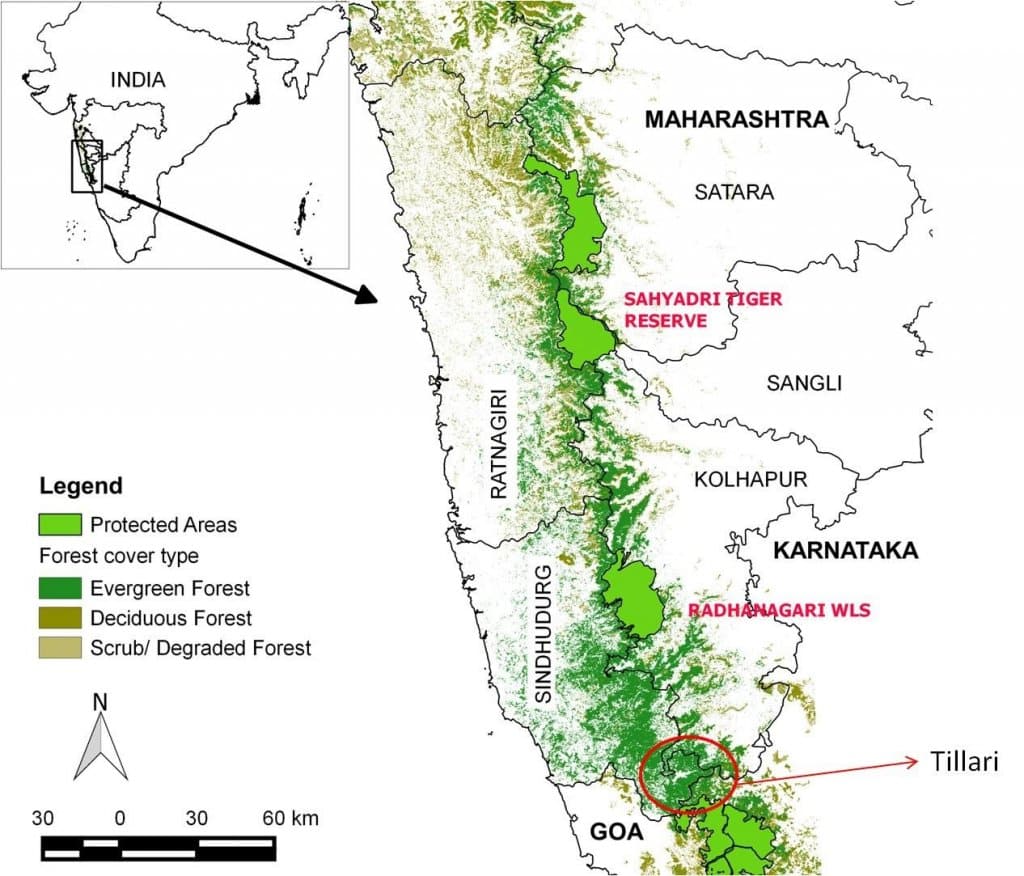
- The Maharashtra Government has declared 29.53 sq km area of Dodamarg forest range in Sindhudurg district as ‘Tillari Conservation Reserve’. (Jul 2020)
- Tillari is the seventh wildlife corridor in the state to be declared as a ‘conservation reserve’.
- The area covering nine villages in the forest range is known to serve as a corridor and even as a habitat for the population of tigers and elephants moving between the three states of Goa, Karnataka, and Maharashtra.
- It connects the Mhadei sanctuary in Goa and Bhimgad in Karnataka.
- It has semi-evergreen forests, tropical moist deciduous forests, and a number of unique trees, butterflies, and flowers.
List of Indian Conservation Reserves
| S.No. | Name of Conservation Reserve | State |
| 1 | Chharidhandh Conservation Reserve | Gujarat |
| 2 | Bir Bara Ban Conservation Reserve | Haryana |
| 3 | Saraswati Plantation Conservation Reserve | Haryana |
| 4 | Khiram Conservation Reserve | Jammu and Kashmir |
| 5 | Panyar Conservation Reserve | Jammu and Kashmir |
| 6 | Khanagund Conservation Reserve | Jammu and Kashmir |
| 7 | Shikargah Conservation Reserve | Jammu and Kashmir |
| 8 | Khrew Conservation Reserve | Jammu and Kashmir |
| 9 | Khonmoh Conservation Reserve | Jammu and Kashmir |
| 10 | Brain-Nishat Conservation Reserve | Jammu and Kashmir |
| 11 | Khimber/Dara/Sharazbal Conservation Reserve | Jammu and Kashmir |
| 12 | Wangat/Chatergul Conservation Reserve | Jammu and Kashmir |
| 13 | Ajas Conservation Reserve | Jammu and Kashmir |
| 14 | Naganari Conservation Reserve | Jammu and Kashmir |
| 15 | Zaloora, Harwan Conservation Reserve | Jammu and Kashmir |
| 16 | Sudhmahadev Conservation Reserve | Jammu and Kashmir |
| 17 | Jawahar Tunnel Conservation Reserve | Jammu and Kashmir |
| 18 | Thein Conservation Reserve | Jammu and Kashmir |
| 19 | Bahu Conservation Reserve | Jammu and Kashmir |
| 20 | Sabu Conservation Reserve | Jammu and Kashmir |
| 21 | Boodh Karbu Conservation Reserve | Jammu and Kashmir |
| 22 | Hokera (Ramsar Site) (WL) Conservation Reserve | Jammu and Kashmir |
| 23 | Narkara (WL) Conservation Reserve | Jammu and Kashmir |
| 24 | Manibugh (WL) Conservation Reserve | Jammu and Kashmir |
| 25 | Chatlam, Pampore (WL) | Jammu and Kashmir |
| 26 | Mirgund (WL) Conservation Reserve | Jammu and Kashmir |
| 27 | Shallabugh (WL) Conservation Reserve | Jammu and Kashmir |
| 28 | Ajas (WL) Conservation Reserve | Jammu and Kashmir |
| 29 | Hygam (WL) Conservation Reserve | Jammu and Kashmir |
| 30 | Malgam (WL) Conservation Reserve | Jammu and Kashmir |
| 31 | Gharana (WL) Conservation Reserve | Jammu and Kashmir |
| 32 | Pargwal (WL) Conservation Reserve | Jammu and Kashmir |
| 33 | Kukarian (WL) Conservation Reserve | Jammu and Kashmir |
| 34 | Nanga (WL) Conservation Reserve | Jammu and Kashmir |
| 35 | Sangral-Asa Chak (WL) Conservation Reserve | Jammu and Kashmir |
| 36 | Tsomoiri (Ramsar Site) (WL) Conservation Reserve | Jammu and Kashmir |
| 37 | Norrichain (WL) Conservation Reserve | Jammu and Kashmir |
| 38 | Bankapur Peacock Conservation Reserve (Bird) | Karnataka |
| 39 | Jayamangali Black Buck Conservation Reserve | Karnataka |
| 40 | Afghanashini Conservation Reserve | Karnataka |
| 41 | Bedthi Conservation Reserve | Karnataka |
| 42 | Basur Amruth Mahal Kaval Conservation Reserve | Karnataka |
| 43 | Hornbill Con Res Conservation Reserve | Karnataka |
| 44 | Shalmale Ripariam Bio-System Conservation Reserve | Karnataka |
| 45 | Thungabhadra Otter Conservation Reserve | Karnataka |
| 46 | Ankasamudra Birds | Karnataka |
| 47 | Kappathagudda | Karnataka |
| 48 | Magadi Kere | Karnataka |
| 49 | Melapura Bee Eater Bird | Karnataka |
| 50 | Puttenahalli Lake Birds | Karnataka |
| 51 | Thimlapura Conservation Reserve | Karnataka |
| 52 | Ummathur Conservation Reserve | Karnataka |
| 53 | Anjneri Conservation Reserve | Maharashtra |
| 54 | Kolamarka Conservation Reserve | Maharashtra |
| 55 | Mamdapur Conservation Reserve | Maharashtra |
| 56 | Muktai Bhavani Conservation Reserve | Maharashtra |
| 57 | Toranmal Conservation Reserve | Maharashtra |
| 58 | Bhorkada Conservation Reserve | Maharashtra |
| 59 | Beas River Conservation Reserve | Punjab |
| 60 | Rakh Sarai Amanat Khan Conservation Reserve | Punjab |
| 61 | Ranjit Sagar Conservation Reserve | Punjab |
| 62 | Roper Wetland Conservation Reserve | Punjab |
| 63 | Bisalpur Conservation Reserve | Rajasthan |
| 64 | Jor Beed Gadwala Bikaner Conservation Reserve | Rajasthan |
| 65 | Sundha Mata Conservation Reserve | Rajasthan |
| 66 | Gudha Vishnoi Conservation Reserve | Rajasthan |
| 67 | Shakambhari Conservation Reserve | Rajasthan |
| 68 | Umedganj Bird Conservation Reserve | Rajasthan |
| 69 | Jawai Band Leopard Conservation Reserve | Rajasthan |
| 70 | Gogelao Conservation Reserve | Rajasthan |
| 71 | Rotu Conservation Reserve | Rajasthan |
| 72 | Bir Jhunjhunu Conservation Reserve | Rajasthan |
| 73 | Khetri Bansyal | Rajasthan |
| 74 | Sling Dong Fairreanum Orchid | Sikkim |
| 75 | Thiruppudai- maruthur Birds Conservation Reserve | Tamil Nadu |
| 76 | Suchindrum-Theroor-Managudi Conservation Reserve | Tamil Nadu |
| 77 | Asan Barage Wetland Conservation Reserve(Bird) | Uttarakhand |
| 78 | Jhilmi Jheel Conservation Reserve (Bird) | Uttarakhand |
| 79 | Pawalgarh Conservation Reserve | Uttarakhand |
| 80 | Naina Devi Himalayan Bird | Uttarakhand |
| 81 | Darlaghat Conservation Reserve | Himachal Pradesh |
| 82 | Shilli Conservation Reserve | Himachal Pradesh |
| 83 | Shri Naina Devi Conservation Reserve | Himachal Pradesh |
| 84 | Deul Conservation Reserve | West Bengal |
| 85 | Garpanchkot Conservation Reserve | West Bengal |
| 86 | Hijli Conservation Reserve | West Bengal |
| 87 | Mukutmanipur Conservation Reserve | West Bengal |
| 88 | Tekonia Conservation Reserve | West Bengal |
| … | … | … |
Government Initiatives: Community Reserves & Conservation Reserves
Several Government initiatives serve as a pathway to promote and support the Community Reserves and Conservation Reserves in India. A few of them are:
- Wildlife (Protection) Amendment Act, 2002: Introduced legal framework for declaring community and conservation reserves.
- National Biodiversity Action Plan (NBAP) 2014: Promotes community-led conservation as part of biodiversity governance.
- National Wildlife Action Plan (2017-2031): Emphasizes landscape-level management and integration of local communities.
- Integrated Development of Wildlife Habitats (IDWH) Scheme (MoEFCC): Provides financial support for reserve creation and management.
- Green India Mission (GIM): Encourages restoration of degraded ecosystems, including those managed as community reserves.
- UNDP-GEF Small Grants Programme: Supports community-led biodiversity projects, especially in the Northeast.
thank you Amit Sengupta sir, only you can provide such holistic information.