

- Ecology is the science of the relationships between organisms and their environment: between living things and their physical surroundings on the one hand, and among the living things themselves on the other.
- Charles J. Krebs (1972) framed it as the study of the interactions that determine the distribution and abundance of organisms; for Eugene P. Odum, it is the study of the structure and function of nature.
- A set of basic ecological principles explains how life works at every scale: how organisms meet the limits set by their environment, how species arise, spread and go extinct, how populations grow and are checked, and how species help, harm or ignore one another.
- Above these sit the principles of the whole ecosystem: the one-way flow of energy and the cycling of matter.
Ecology: Meaning, Branches and Levels of Organisation

Origin and growth of the idea
- The word was coined by the German zoologist Ernst Haeckel as oecologie (1866), from the Greek oikos (house, dwelling) and logos (study): the study of organisms “at home”.
- In 1869 he called it the science of the “economy of nature”: an animal’s whole relation to its inorganic and organic surroundings, including its friendly and hostile relations with other organisms, the interdependences Charles Darwin had called the struggle for existence.
- Earlier and rival terms show the idea was in the air:
- Isidore Geoffroy Saint-Hilaire used ethology (1859) for the relations of organisms within the family, society and community.
- St George Jackson Mivart proposed hexicology (1882) for the relations of organisms to the locality they frequent, its temperature and light, and to other organisms as enemies, rivals or benefactors.
- Darwin’s theory of evolution by natural selection (1859), which rests on the interaction between organisms and their habitat, was the keystone for all these terms.
- Ecology matured in the 20th century through the ecosystem concept of Arthur George Tansley (1935), the trophic-dynamic work of Raymond Lindeman (1942) and the systems ecology of the Odum brothers (Eugene and Howard).
Branches of ecology
- Autecology studies the ecological relations of a single species or individual with its environment, such as the tolerance of sal to frost.
- Synecology studies groups of organisms (communities) and their habitats together, such as the structure of a shola forest.
| Basis | Branches |
|---|---|
| Level of study | Autecology, synecology; population, community, ecosystem and landscape ecology |
| Habitat | Terrestrial, freshwater, marine, estuarine ecology |
| Organism | Plant, animal and microbial ecology |
| Time | Palaeoecology (past ecosystems from fossils and pollen) |
| Applied | Conservation, restoration, agricultural and urban ecology |
| Human | Human ecology, cultural ecology, political ecology |
- Landscape ecology, a term of Carl Troll (1939), studies the spatial pattern of patches, corridors and mosaics, and links ecology most directly to geography.
- Human ecology, which Harlan Barrows (1923) proposed as the core of geography, applies ecological concepts to the man–environment relationship.
Levels of ecological organisation
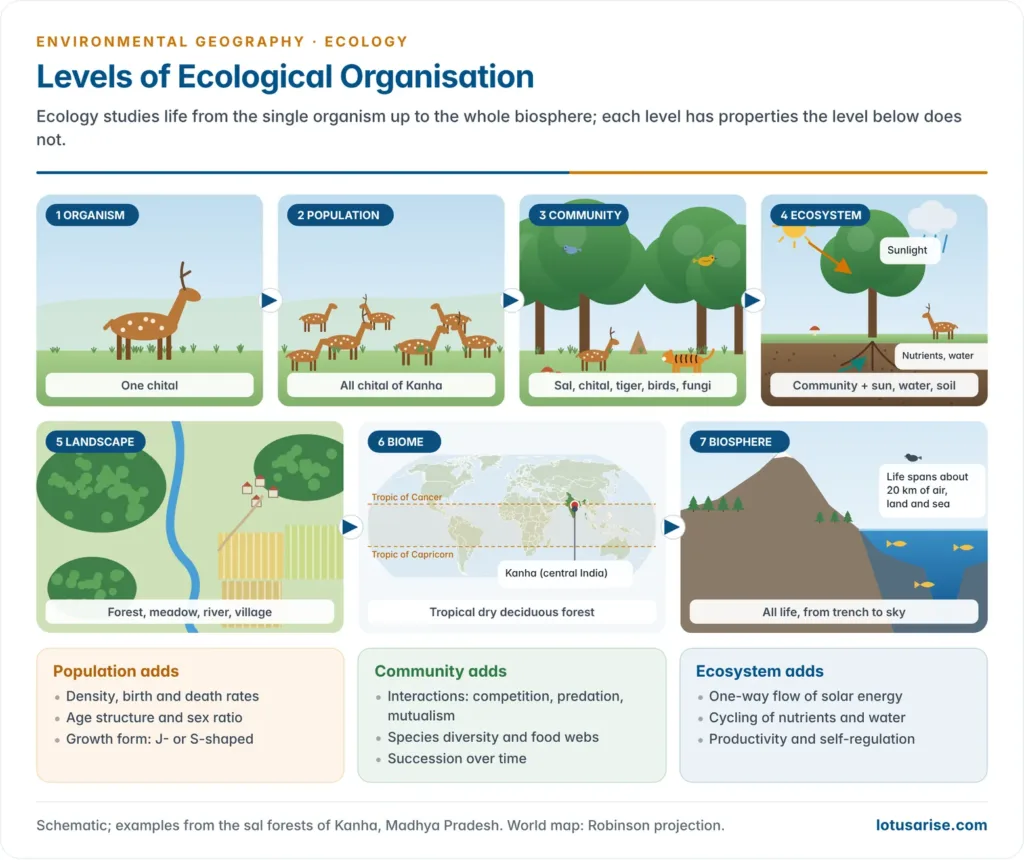
- Life is organised in a hierarchy. Ecology begins at the organism and works upwards, with each level showing emergent properties absent from the level below.
| Level | Meaning | Example |
|---|---|---|
| Organism | A single living individual | One chital |
| Population | Individuals of one species in an area at a given time | All chital of Kanha |
| Community | All interacting populations of an area | Sal trees, chital, tigers, termites, fungi of Kanha |
| Ecosystem | Community plus its abiotic environment | The Kanha sal-forest ecosystem |
| Landscape | A mosaic of interacting ecosystems | Forest, meadows, streams and villages of the Maikal hills |
| Biome | A regional complex of similar ecosystems shaped by climate | Tropical dry deciduous forest |
| Biosphere | All life on Earth with the air, water and soil that support it | The global ecosystem |
- Population, community and ecosystem are the three levels at which most ecological principles operate.
- Above the ecosystem, the landscape and biome add geography’s concern with spatial pattern; the biomes of the world are the largest regional units below the biosphere.
Organisms and the Environment
- Organisms are individual living things. Despite their diversity, all share two basic needs: energy and matter, and both must come from the environment.
- Organisms are therefore open systems: they depend on, and are shaped by, their environment, and they change it in turn.
- The environment is the sum of all external conditions and influences acting on an organism. It has abiotic and biotic parts.
Biotic and abiotic components
- Biotic components are all living organisms and the products of living or once-living matter: bones, shells, coral skeletons, feathers, hair, teeth, wastes and fossils.
- Fossil fuels (peat, lignite, bituminous coal, anthracite and petroleum) are biotic in origin, formed from buried organic matter.
- “Living” is a subset of “biotic”: biotic technically includes once-living matter, though the two are often used interchangeably.
- Abiotic components are the non-living physical and chemical factors: sunlight, temperature, water, air, soil minerals, relief, and natural events such as lightning and fire.
Is soil biotic or abiotic?
- Soil is a complex mixture of both:
- abiotic: mineral particles, water and air;
- biotic: a vast living community of roots, bacteria, fungi, earthworms and arthropods;
- non-living organic matter: fresh litter and humus.
- Humus, the dark, stable organic substance left after decomposition, is biotic in origin but usually counted as abiotic:
- it has lost the characteristics of living tissue during decomposition;
- it is resistant to further microbial breakdown, which proceeds only very slowly;
- ecologists list such dead organic compounds (humic substances, proteins, carbohydrates) among the abiotic components of an ecosystem, for simplicity of classification.
- Soil properties such as texture, pH and organic matter are therefore among the strongest edaphic controls on life.
Ecological factors
- Any element of the environment that affects an organism’s life is an ecological factor. Factors act together, never singly.
| Group | Factors | Examples of effect |
|---|---|---|
| Climatic | Light, temperature, water (rainfall, humidity), wind, atmospheric gases | Photoperiod times flowering and bird migration; frost sets the poleward limit of mangroves |
| Edaphic | Soil texture, structure, pH, nutrients, soil water and air | Tea needs acidic, well-drained soils; halophytes on saline flats of the Rann |
| Topographic (physiographic) | Altitude, slope, aspect, relief | South-facing Himalayan slopes are drier; oak and conifers on cooler north faces |
| Biotic | Plants, animals, microbes and humans as competitors, predators, partners, grazers | Grazing keeps the Banni grasslands open; fire set by people maintains savannas |
| Pyric | Fire | Fire-adapted sal and teak forests of peninsular India |
- Light: plants are heliophytes (sun-loving) or sciophytes (shade-tolerant); photoperiodism controls flowering, breeding and migration.
- Temperature: controls enzyme activity, so it sets the latitudinal and altitudinal limits of most species.
- Water: divides plants into hydrophytes, mesophytes and xerophytes, each with its own adaptations.
- These factors explain much of the world distribution of plants and animals.
Limiting factors and the laws of tolerance
Liebig’s law of the minimum
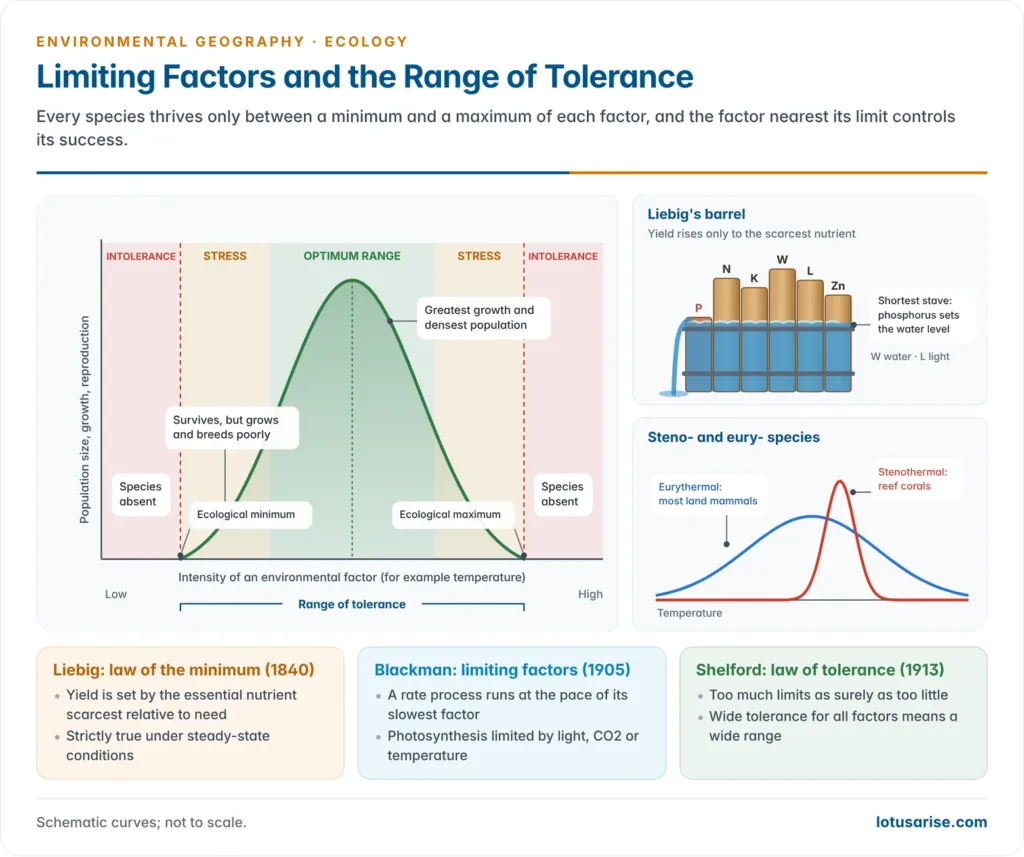
- Justus von Liebig (1840), a German agricultural chemist, observed that crop yield is controlled not by the nutrient present in the largest quantity but by the essential nutrient in shortest supply relative to need. (The idea had been stated by Carl Sprengel in 1828.)
- Adding more of any other nutrient does not raise yield until the scarce one is supplied, an idea often pictured as a barrel with staves of unequal height: water can rise only to the shortest stave.
- Limits of the law:
- it applies strictly under steady-state conditions, when inflows and outflows balance;
- factors interact, and one can partly substitute for another (strontium for calcium in some molluscs).
Blackman’s law of limiting factors
- Frederick Frost Blackman (1905) extended the idea to rate processes such as photosynthesis: when a process depends on several factors, its rate is set by the factor nearest its minimum.
- Raising light intensity increases photosynthesis only until carbon dioxide or temperature becomes limiting.
Shelford’s law of tolerance
- Victor Ernest Shelford (1913) added that too much of a factor limits an organism just as too little does. Each species has an ecological minimum and maximum with a range of tolerance between them.
- Zones of the tolerance curve:
- optimum range: growth and reproduction are greatest and populations densest;
- zones of physiological stress: on either side, organisms survive but grow and breed poorly;
- zones of intolerance: beyond the limits, the species is absent.
- Corollaries:
- a species may have a wide range for one factor and a narrow range for another;
- species with wide ranges for all factors are the most widely distributed;
- the reproductive stage (seeds, eggs, larvae) usually has the narrowest tolerance, so it often limits a species;
- when one factor is sub-optimal, tolerance of others narrows (grasses need more water at low nitrogen).
- The combined concept of limiting factors joins Liebig and Shelford: the presence and success of an organism depend on a complex of conditions, and any condition that approaches or exceeds the limits of tolerance is limiting.
| Prefix | Wide tolerance (eury-) | Narrow tolerance (steno-) |
|---|---|---|
| Temperature | Eurythermal: most land mammals, desert pupfish | Stenothermal: reef-building corals, polar fish |
| Salinity | Euryhaline: salmon, eel, mangroves | Stenohaline: most marine invertebrates, freshwater fish |
| Water | Euryhydric | Stenohydric: amphibians of moist forests |
| Food | Euryphagic: crows, jackals | Stenophagic: koala (eucalyptus), giant panda (bamboo) |
| Habitat | Euryoecious: house sparrow, rats | Stenoecious: Nilgiri tahr of montane grasslands |
Geographic consequences of tolerance
- Range limits: the edges of a species’ geographic range trace the lines where some factor crosses its tolerance limit.
- Reef-building corals need warm, clear, sunlit, saline water, so India’s coral reefs are confined to the Gulf of Kachchh, Gulf of Mannar, Palk Bay, Lakshadweep and the Andaman and Nicobar Islands; the silt and fresh water of the big rivers keep them off most of the mainland coast.
- Mangroves are killed by frost, so they are confined to tropical and subtropical coasts.
- Sal is limited by frost and waterlogging; tea by alkaline or waterlogged soils.
- Indicator species: stenoecious species signal particular conditions, such as lichens for clean air and certain mayfly and stonefly larvae for unpolluted streams.
- Climate change shifts the zones of tolerance, so species shift their ranges upslope and poleward.
Habitat
- Habitat is the physical place in which an organism lives, the environment that provides for its needs. Each species lives where its requirements are met.
- The habitat of an elephant is a forest; the habitat of a tapeworm is the human gut. Forests, oceans and rivers are habitats of many organisms.
- A habitat’s character is set mainly by abiotic factors such as temperature and rainfall, which also shape the traits of its inhabitants.
- Earth has four major habitats: terrestrial, freshwater, estuarine and marine.
- A habitat’s structural components are space, food, water and shelter (cover).
- Microhabitat is a small, uniform part of a habitat, such as the underside of a log or a tree hole.
Habitat and environment
- Life: a habitat always contains life; an environment, the overall physical and chemical surroundings, need not. All habitats are environments, but not all environments are habitats.
- Scale: a habitat is described from the viewpoint of a species, the conditions it needs; an environment is a broader area that contains many habitats and is shared by many species.
- Influence: the environment largely sets the conditions of a habitat (desert climate makes desert habitats); a single habitat rarely governs the wider environment.
Ecotone and edge effect
- An ecotone is a zone of transition between two or more distinct communities, a tension zone where they meet and blend.
- It may be narrow (a forest edge) or broad (a savanna between rainforest and desert).
- It holds species of both adjoining communities plus some found only in the ecotone.
- An ecocline is a gradual gradient of change, with no sharp boundary, along an environmental gradient such as altitude or moisture.
- Edge effect: ecotones usually hold greater species variety and often greater density than either adjoining community, a tendency named by Aldo Leopold (1933). Species that thrive there are edge species.
- Examples:
- Mangroves and estuaries between land and sea, as in the Sundarbans;
- the shola–grassland mosaic of the Nilgiris and Anamalais;
- the Terai between the Shivalik foothills and the Gangetic plain;
- the Sahel between the Sahara and the Sudan savanna;
- the treeline, where forest gives way to alpine meadow.
- Where habitats are fragmented, man-made edges have a negative edge effect: hotter, drier microclimates, more nest predators and invasive weeds.
Niche
- The niche is one of the central concepts of ecology: the role of a species in its ecosystem, including all the ways it interacts with the biotic and abiotic factors of its environment.
- What a species eats and how it gets its food are two key aspects; each species eats different food or obtains it differently.
- It is the sum of all the activities and relationships through which a species uses the resources of its habitat to survive and reproduce.
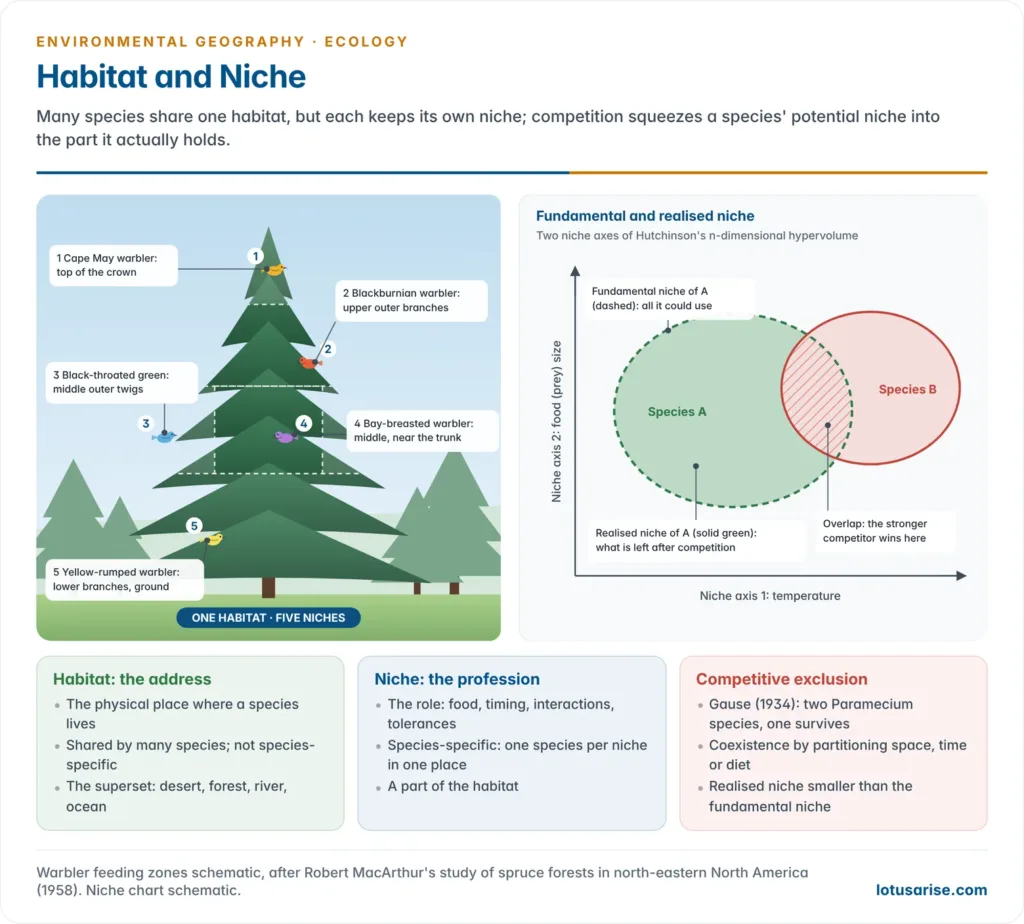
- The habitat is a species’ address; the niche is its profession.
Development of the niche concept
| Ecologist | Year | Concept | Emphasis |
|---|---|---|---|
| Joseph Grinnell | 1917 | Habitat (spatial) niche | The place and conditions a species occupies; studied with the California thrasher |
| Charles Sutherland Elton | 1927 | Functional (trophic) niche | What the species does in the community: its food and its enemies |
| G. Evelyn Hutchinson | 1957 | n-dimensional hypervolume | Every factor (temperature, food size, pH and so on) is an axis; the niche is the volume where the species can persist |
- Fundamental niche: the full range of conditions and resources a species could use in the absence of competitors and enemies.
- Realised niche: the smaller part actually occupied once competition, predation and other interactions act.
- Joseph H. Connell (1961) showed this on the rocky shores of the Isle of Cumbrae, Scotland: the barnacle Chthamalus could live throughout the intertidal zone, but the larger Balanus crowded it out of the lower zone, confining it to the upper shore.
- Niche breadth: generalists have broad niches (crows, rats); specialists have narrow ones (the koala, the fig wasp).
Competitive exclusion and niche differentiation
- No two species can occupy the same niche in the same place for long. This is the competitive exclusion principle, demonstrated by Georgy Frantsevich Gause (1934).
- When he grew Paramecium aurelia and P. caudatum together on a limited food supply, P. aurelia always drove P. caudatum to extinction, though each thrived alone.
- Two species that compete for the same scarce resource will compete until one is displaced; a vacant niche is soon filled by another organism.
- Coexistence by resource partitioning: similar species avoid exclusion by dividing resources in space, time or diet.
- Robert MacArthur (1958) found that five species of warblers in the same spruce trees in north-eastern North America fed in different parts of the canopy, so they did not exclude one another.
- On African savannas, zebra, wildebeest and gazelle graze different parts of the same grass sward in succession.
- Character displacement: where two related species overlap, their traits (such as beak size) diverge, reducing competition.
- Niche and conservation: a species can be conserved in its native habitat only when its niche requirements are known; the loss of a niche partner such as a pollinator can doom a plant.
Habitat and niche compared
| Basis | Habitat | Niche |
|---|---|---|
| Meaning | The place or part of an ecosystem where a species lives | The role of a species within its ecosystem |
| Nature | A physical space | A set of activities and relationships |
| Content | Living place and its conditions | Diet, reproduction, interactions with other species, abiotic tolerances |
| Sharing | Supports many species at once | Held by one species at a time in a given place |
| Specificity | Not species-specific | Species-specific |
| Relation | The superset | A part of the habitat |
| Competition | Species with different niches share a habitat | Species with the same niche compete until one is excluded |
| Example | Desert, ocean, forest, river, mountain | Honeybees gather nectar and pollinate flowers; a bird nesting in the same tree does neither |
Adaptation
- An adaptation is a structural, physiological or behavioural trait that enables an organism to survive and reproduce in its particular environment: the shape of a bird’s beak, thick or thin fur, gills and fins in fish, thorns, and the evergreen or deciduous habit of trees.
- Three kinds, with examples:
- Morphological: thick cuticles, succulent leaves, sunken stomata and leaves reduced to spines in desert plants; the large ears of elephants that shed heat; under Allen’s rule, shorter limbs and ears in warm-blooded animals of cold climates (polar bears, penguins) and longer ones in hot climates.
- Physiological: the kangaroo rat of North American deserts meets its water needs from metabolic water produced by oxidising its food and passes very concentrated urine; at high altitude the human body raises breathing rate and red blood cell and haemoglobin production, a short-term adjustment called acclimatisation.
- Behavioural: desert lizards bask to warm up and retreat to shade; rodents burrow; wildebeest, zebra and gazelle make the Great Migration through the Serengeti and Masai Mara following the rains.
- Hibernation (winter dormancy of bats, ground squirrels, hedgehogs and some bears) and aestivation (summer dormancy of the African lungfish in its mucus cocoon, snails and some frogs) are both physiological and behavioural.
- Extremophiles push tolerance furthest. Archaea thrive in hot springs, hydrothermal vents, salt pans and acid pools because their cell membranes are built of ether-linked lipids, often in a single layer, that stay stable where ordinary membranes fall apart.
- Once grouped with bacteria in the kingdom Monera, archaea were recognised as a distinct lineage by Carl Woese (1977) and are now one of the three domains of life.
- Dieback in sal, red sanders and silk-cotton seedlings, in which the shoot dies back from the tip each dry season while the root survives, helps them endure drought and fire.
Species and Speciation
Species
- A species is a group of actually or potentially interbreeding natural populations that produce fertile offspring and are reproductively isolated from other such groups. This is the biological species concept of Ernst Mayr (1942).
- A tiger, a lion, a lotus and a rose are different species; each has its own set of genetic characteristics.
- The concept fails for asexual organisms and fossils, so morphological and phylogenetic species concepts are also used.
- Earth may hold about 8.7 million eukaryotic species (a 2011 estimate), of which only about 2.1 million have been described, spread very unevenly across hotspots and centres of endemism.
The raw material: variation
- Variation arises from changes in the genetic make-up, through mutation and recombination, and builds up over time under the influence of climate change and geographical barriers.
- Mutation is a sudden, heritable change in the DNA caused by copying errors, radiation or chemicals. It creates new alleles, the ultimate raw material of evolution.
- Recombination reshuffles existing alleles during meiosis and fertilisation. It creates no new genes but produces new combinations of traits; hence siblings differ though they share parents.
- Skin colour, hair form, eye colour and blood group express such variation within the human species.
- Phenotypic plasticity is the ability of one genotype to produce different phenotypes in different environments, without any genetic change.
- Sun leaves are smaller and thicker, shade leaves thinner and broader; skin tans under ultraviolet light; the Arctic fox and snowshoe hare turn white in winter and brown in summer; high altitude raises red blood cell production.
Mechanisms of evolution
- Evolution is the change in the heritable traits of populations over generations, producing new adaptations and, in time, new species.
- Natural selection: individuals with favourable heritable variations survive and reproduce more, so those variations become commoner in the next generation.
- Charles Darwin and Alfred Russel Wallace proposed it independently (1858); Darwin set it out in On the Origin of Species (1859). Longer-necked giraffes reaching more leaves in droughts is the classic illustration.
- Genetic drift: random changes in allele frequencies from one generation to the next. It is strongest in small, isolated populations and can fix or lose alleles by chance.
- Gene flow: movement of alleles between populations by migration. It keeps populations alike; its interruption allows them to diverge.
- Hugo de Vries (1901) stressed sudden mutations as a source of new forms.
- Neo-Darwinism (the Modern Synthesis), named by Julian Huxley (1942), joined natural selection with Gregor Mendel’s laws of inheritance and population genetics:
- mutation creates new genetic variation;
- recombination reshuffles it into new combinations;
- natural selection acts on this variation, so favourable traits increase in frequency, while drift and gene flow also change allele frequencies;
- accumulated change turns populations into new forms and, with isolation, new species.
Isolation
- Geographical isolation: a barrier (a mountain range, sea, river or desert) separates populations so they cannot meet to interbreed.
- Ecological isolation: populations in the same region occupy different habitats or conditions (temperature, humidity, pH) and seldom meet.
- Reproductive isolation: any mechanism that prevents interbreeding or makes it fail:
- pre-zygotic: different breeding seasons, courtship songs or displays, incompatible genitalia or pollinators;
- post-zygotic: hybrids die, or survive but are sterile, like the mule (horse × donkey).
Speciation
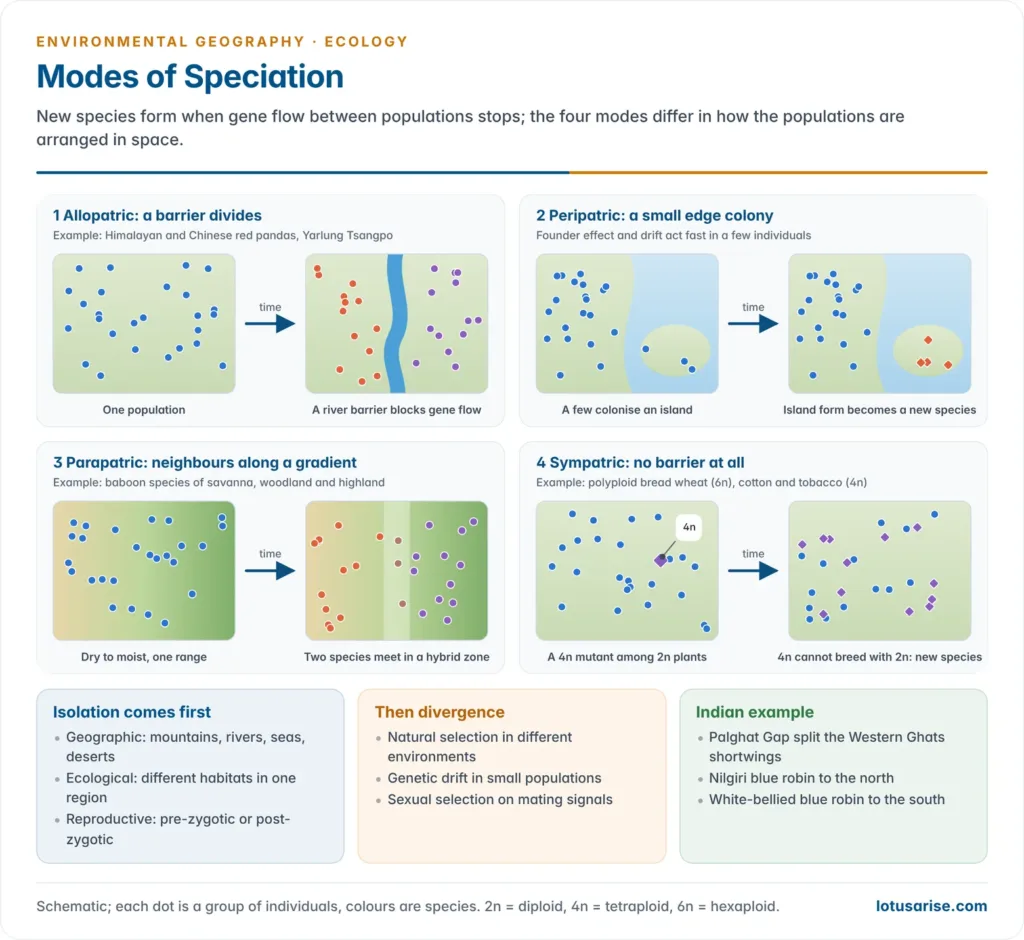
- Speciation is the process by which one population splits into two or more reproductively isolated species. It happens when gene flow stops, through geographic barriers or the use of different niches, and genetic differences accumulate.
- Drivers of divergence: natural selection in different environments, genetic drift in small isolated groups, and sexual selection through changed mating preferences.
| Mode | Geography of the populations | Driver | Example |
|---|---|---|---|
| Allopatric | Separated by a physical barrier | Selection and drift with no gene flow | Himalayan and Chinese red pandas, split by the Yarlung Tsangpo |
| Peripatric | A small group isolated at the edge of the range | Founder effect and drift | Island colonists such as Darwin’s finches |
| Parapatric | Adjacent ranges with a shared border | Strong environmental gradient; little gene flow | Baboon species of neighbouring savanna, woodland and highland |
| Sympatric | Same area, no barrier | Polyploidy; disruptive selection on different niches | Bread wheat, cotton, tobacco, seedless banana |
Allopatric (geographic) speciation
- A barrier isolates subpopulations; over a long period they diverge through selection and drift until they can no longer interbreed, even if the barrier later disappears. This is the commonest mode.
- Examples:
- Red pandas: genome studies in 2020 split them into the Himalayan and Chinese red panda, with the Yarlung Tsangpo (Siang) river as the dividing line.
- Shortwings (Sholicola) of the Western Ghats: the Palghat Gap has separated the Nilgiri blue robin to its north from the white-bellied blue robin to its south.
- Masai giraffes on either side of the Gregory Rift in Kenya and Tanzania show little gene flow and marked genetic divergence, though they are not yet treated as separate species.
- Ensatina salamanders of California form a ring species around the Central Valley: neighbouring forms interbreed, but the two ends of the ring, meeting in the south, do not.
Peripatric speciation
- A small population at the edge of the range is cut off, often by colonising an island. Founder effect and drift act quickly in so few individuals, and divergence is fast.
Parapatric speciation
- Populations in adjacent areas are only partly separated. Strong differences in environment across the boundary limit gene flow, and the populations diverge, interbreeding only in a narrow hybrid zone where their ranges meet, as with neighbouring baboon species.
Sympatric speciation
- New species arise within the same area, without a physical barrier, through disruptive selection on different foods, niches or mating preferences, or through polyploidy.
- Polyploidy is the heritable possession of more than two complete sets of chromosomes (3n, 4n, 6n). A polyploid usually cannot breed with its diploid parents, so it is isolated at a single step.
- It is common in plants and occurs in some fish, amphibians (certain frogs and salamanders) and leeches.
- Bread wheat is hexaploid; cotton and tobacco are tetraploid hybrids; the cultivated banana is triploid and seedless.
Hybrid speciation
- Hybridisation, the mating of two species, usually ends in sterile offspring such as the mule: a dead end, not a new species.
- Occasionally hybrids found new species:
- Spartina anglica, a cord-grass, arose in southern England in the 1890s when a sterile hybrid doubled its chromosomes.
- On Daphne Major in the Galápagos, a hybrid finch that arrived in 1981 founded the “Big Bird” lineage, which now breeds only within itself.
- Speciation can also be seen as the evolution of barriers to genetic recombination: within a species alleles combine freely, but alleles of different species cannot be brought together.
Adaptive radiation
- Adaptive radiation is the rapid diversification of one ancestral form into many species, each adapted to a different niche, when new opportunities open (new islands, empty habitats after an extinction).
- Darwin’s finches of the Galápagos Islands (about 18 species) evolved from a single ancestor. Differences in beak size and shape let them specialise as seed-eaters, insect-eaters, cactus-feeders and even tool-users, reducing competition. Long-term studies by Peter and Rosemary Grant recorded beak size changing within years after droughts.
- Other cases are the Hawaiian honeycreepers, the cichlid fishes of the East African lakes and the marsupials of Australia. Remote islands, with few competitors and many empty niches, are the classic stage.
Extinction
- Extinction is the disappearance of a species. Its causes are environmental change and biological competition: most species die out when they cannot adapt fast enough.
- Background extinction goes on all the time; mass extinctions have struck five times in Earth’s history.
- Present losses, driven by habitat loss, overexploitation, invasive species, pollution and climate change, are often called the sixth mass extinction. The IPBES Global Assessment (2019) found about one million species threatened with extinction.
Populations and Population Interactions
- A population is a group of freely interbreeding individuals of the same species living in a given area at a given time.
- A city of 50,000 people is a population; all human populations together make up the species Homo sapiens.
Population attributes
| Attribute | Meaning |
|---|---|
| Density | Number of individuals per unit area (or volume) at a given time, such as tigers per 100 km² |
| Natality | Birth rate: individuals added by reproduction per unit of population per unit time |
| Mortality | Death rate: individuals lost per unit of population per unit time |
| Dispersal | Immigration (moving in) and emigration (moving out) |
| Sex ratio | Proportion of males to females |
| Age structure | Proportion of pre-reproductive, reproductive and post-reproductive individuals |
| Biotic potential | Maximum rate of increase under ideal conditions |
- Population density changes through four processes: N(t+1) = N(t) + (births + immigration) − (deaths + emigration).
- Natality and immigration add to it; mortality and emigration reduce it.
- Age structure reveals the trend, as in the human age–sex pyramid:
- a growing population has a large share of young and reproductive individuals (a broad-based pyramid);
- a stable one has an even spread of age groups (bell-shaped);
- a declining one has a large share of old, post-reproductive individuals (urn-shaped).
- Biotic potential (the intrinsic rate of natural increase, r) is never fully realised, because of environmental resistance: every factor, such as food shortage, predators, disease and space, that checks growth.
Population growth: J-shaped and S-shaped curves
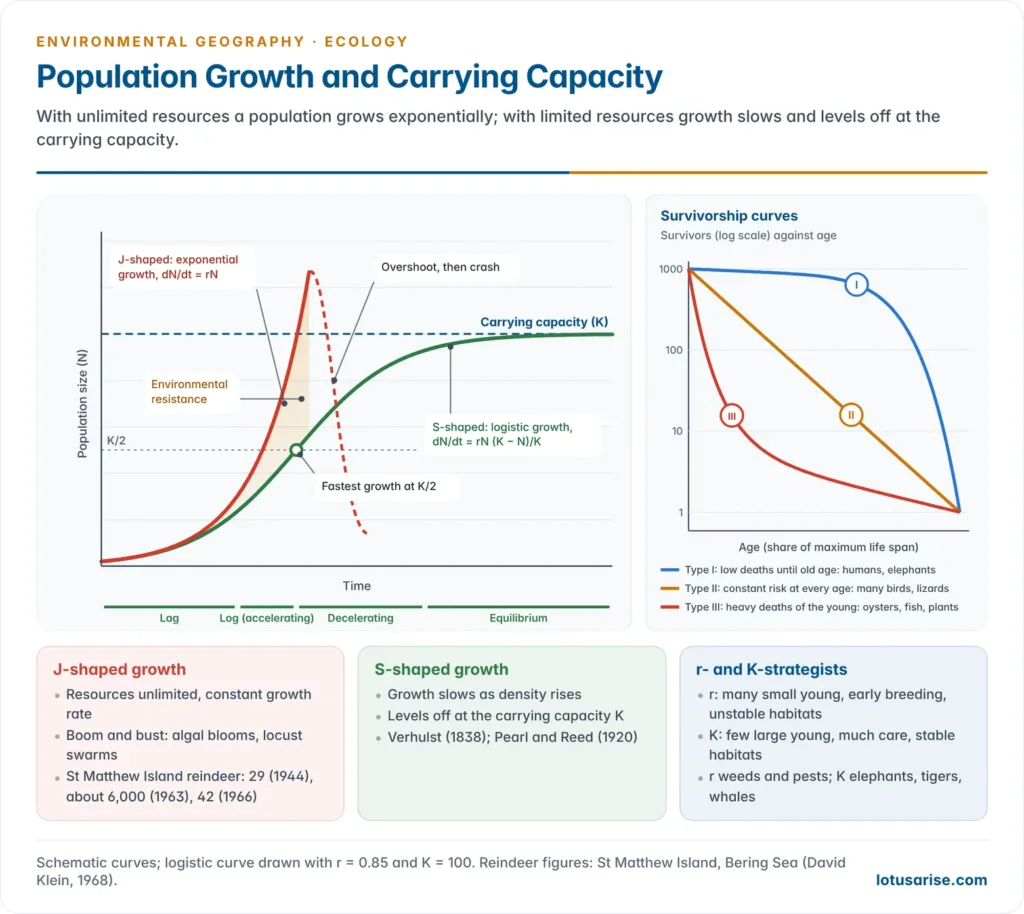
- Exponential (J-shaped) growth: with unlimited resources, a population grows by a constant proportion, dN/dt = rN.
- Numbers rise slowly, then explode, and usually crash when resources run out or the season changes.
- Seen in algal blooms, insect outbreaks and species invading empty habitat. Thomas Robert Malthus saw the same tendency in human numbers, which inspired Darwin; the Malthusian theory applies it to food supply.
- Logistic (S-shaped) growth: with limited resources, growth slows as numbers approach the carrying capacity (K), the maximum population an environment can support indefinitely.
- dN/dt = rN (K − N)/K: the term (K − N)/K is the environmental resistance, shrinking to zero at K.
- Phases: a lag phase, an accelerating (log) phase, an inflection point at K/2 where growth is fastest, a decelerating phase, and an equilibrium (plateau) at K.
- The model was proposed by Pierre-François Verhulst (1838) and rediscovered by Raymond Pearl and Lowell Reed (1920).
- Overshoot and dieback: a population can overshoot K, damage its resource base and crash below it.
- On St Matthew Island (Bering Sea), 29 reindeer introduced in 1944 multiplied to about 6,000 by 1963, ate out the lichen and crashed to 42 by 1966.
- Regulation:
- density-dependent factors (competition, predation, disease, parasitism) intensify as density rises and pull populations back towards K;
- density-independent factors (droughts, floods, frost, fire) strike regardless of density and cause sudden swings.
- Indian illustrations:
- The Asiatic lions of Gujarat rose from 674 (2020) to 891 (2025). Gir is close to its carrying capacity, so lions have dispersed into farmland, coastal scrub and other districts of Saurashtra.
- The desert locust outbreak of 2019–20, the worst in nearly three decades, swept from Rajasthan and Gujarat into central India: a J-shaped boom after unusually wet breeding seasons.
- Mautam: the bamboo Melocanna baccifera of Mizoram and adjoining states flowers together about every 48 years. The glut of seed sets off a rat population explosion that devastates crops, as in 1958–59 and again in 2006–08.
Life-history variation
- Under a given set of selection pressures, organisms evolve the most efficient reproductive strategy for their habitat, maximising reproductive (Darwinian) fitness.
- Traits such as how many offspring, how large, how often and how much parental care evolve under the constraints of the abiotic and biotic environment.
- Semelparous species breed once and die (Pacific salmon, bamboo, agave); iteroparous species breed repeatedly (most birds and mammals).
- r- and K-selection, from Robert MacArthur and Edward O. Wilson (1967) and developed by Eric Pianka (1970), sets two ends of a continuum:
| Trait | r-strategists | K-strategists |
|---|---|---|
| Environment | Unstable, unpredictable, often newly opened | Stable, predictable, crowded |
| Population | Fluctuating, often far below K; boom and bust | Near carrying capacity |
| Body size and life span | Small, short-lived | Large, long-lived |
| Maturity | Early | Late |
| Offspring | Many, small, little or no care | Few, large, much parental care |
| Mortality | High, density-independent | Lower, density-dependent |
| Examples | Insects, weeds, rodents, many fish, bacteria | Elephants, tigers, whales, great apes, humans, oaks |
- r-strategists are the colonisers of disturbed land and the pests and weeds of farms; K-strategists dominate mature, stable communities and are the most vulnerable to extinction, since they recover slowly.
- Survivorship curves show the matching patterns of death:
- Type I: low mortality until old age (humans, elephants);
- Type II: a constant risk of death at every age (many birds, lizards);
- Type III: very high mortality of the young, then few deaths (oysters, most fish, many plants).
Population interactions
- The biological community is a complex network of interactions.
- Interaction among individuals of the same species is intraspecific; interaction between different species is interspecific.
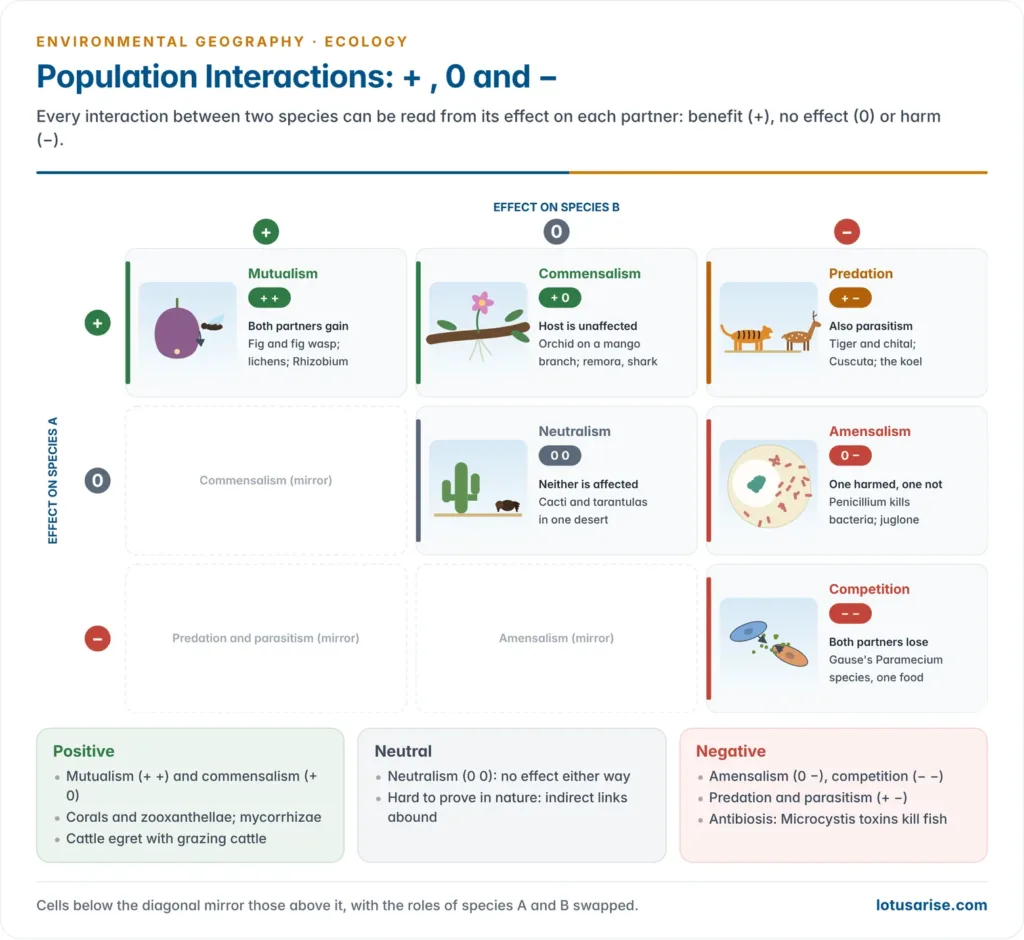
- Each species gains (+), loses (−) or is unaffected (0) by the interaction:
| Interaction | Species A | Species B | Nature |
|---|---|---|---|
| Mutualism | + | + | Both benefit; often obligate |
| Commensalism | + | 0 | One benefits; the host is unaffected |
| Neutralism | 0 | 0 | Neither affects the other |
| Amensalism | − | 0 | One is harmed; the other is unaffected |
| Competition | − | − | Both are harmed by sharing a scarce resource |
| Predation | + | − | Predator kills and eats prey |
| Parasitism | + | − | Parasite lives on or in a host and harms it, usually without killing it quickly |
Positive interactions
- Mutualism (+ +): a close association in which both species benefit.
- Honeybees and flowers: the bee gets nectar, the flower is pollinated.
- Obligate mutualisms, in which neither partner can live without the other: fig and fig wasp, yucca and yucca moth, lichens (a fungus with an alga or cyanobacterium), mycorrhizae (fungi on plant roots) and Rhizobium in legume root nodules.
- Corals and zooxanthellae: the algae feed the coral by photosynthesis and receive shelter and nutrients; their loss under heat stress is coral bleaching.
- Symbiosis strictly means any close, long-term living together of two species, whether mutualistic, commensal or parasitic; it is often used loosely for obligate mutualism.
- Commensalism (+ 0): one species, the commensal, gains shelter, transport or food; the host is neither harmed nor helped.
- The remora clings to a shark with the sucker on its head, getting protection, a free ride and scraps.
- An orchid growing as an epiphyte on a mango branch; barnacles on whales; the cattle egret catching insects flushed by grazing cattle.
Neutral interaction
- Neutralism (0 0): two species share an area but do not affect each other’s fitness, such as a rainbow trout and a dandelion in a mountain valley, or cacti and tarantulas in a desert.
Negative interactions
- Amensalism (− 0): one species harms or restricts another without being affected itself.
- Antibiosis is its chemical form: the mould Penicillium secretes penicillin, which kills bacteria around it.
- Allelopathy is the plant form: juglone from the roots of the black walnut stunts nearby plants; the field bindweed (Convolvulus arvensis) checks the growth of wheat; Prosopis juliflora and eucalyptus suppress undergrowth.
- Blooms of the blue-green alga Microcystis release microcystins, liver toxins that kill fish and poison cattle drinking from the pond.
- Competition (− −): two populations need the same scarce resource (light, water, nutrients, growing space, pollinators or prey), and both are harmed.
- Interference competition is direct (fighting, territories); exploitation competition is indirect, through using up the resource.
| Basis | Interspecific competition | Intraspecific competition |
|---|---|---|
| Between | Members of different species | Members of the same species |
| Overlap of needs | Partial: one or a few resources | Complete: all requirements are identical |
| Intensity | Usually less severe | Usually more severe |
| Outcome | One species suppressed or excluded, or niches partitioned | Regulates population size and composition; drives natural selection |
- Predation (+ −): the predator captures, kills and eats the prey, as owls hunt mice and tigers hunt chital. Herbivory is a form of predation on plants.
- Predators keep prey populations within the carrying capacity and maintain diversity by preventing any one prey species from dominating.
- Predator and prey numbers oscillate: the equations of Alfred Lotka (1925) and Vito Volterra (1926) model the cycle, seen in the roughly ten-year cycle of lynx and snowshoe hare in Canada’s fur-trade records.
- Prey defend themselves by camouflage, warning colours, spines and chemicals: Calotropis leaves carry poisonous cardiac glycosides that cattle and goats avoid.
- Biological control uses predators: the moth Cactoblastis cactorum, released in Australia in 1926, destroyed the prickly pear that had overrun millions of hectares.
- Parasitism (+ −): the parasite, usually small, lives on or in the host and draws nourishment and often shelter from it.
- Ectoparasites (lice, ticks) live outside; endoparasites (roundworm, tapeworm, the malaria parasite Plasmodium, many bacteria, fungi and viruses) live inside.
- Cuscuta (dodder) is a leafless stem parasite of plants; Loranthus is a partial parasite of trees.
- Brood parasitism: the Asian koel lays its eggs in the nests of house crows, which raise the young.
Geographic effects of interactions
- Range limits: competitors, predators and parasites often set the edges of a species’ range where the climate alone would allow more (Connell’s barnacles; malaria and sleeping sickness limiting people and cattle in parts of tropical Africa).
- Co-evolution and distribution: an obligate mutualist can live only where its partner lives, so figs and their wasps, and orchids and their pollinators, share ranges.
- Invasions: species carried beyond their range escape their natural enemies and spread explosively.
- Lantana camara now covers over 40% of the forests in India’s tiger range (about 1.54 lakh km², 2020 study), and water hyacinth and Prosopis juliflora (in the Banni grasslands of Kachchh) displace native species.
- Releasing a specialist enemy, as with Neochetina weevils on water hyacinth in Indian lakes, can restore control.
- Cascading effects: removing a predator or a mutualist ripples through the community through keystone species and trophic cascades.
- Community change over time: interactions such as facilitation by lichens and competition among later arrivals drive plant succession.
Principles of Ecology: A Summary
- Unity and interaction:
- the ecosystem is the basic unit of ecological study, since it joins the abiotic and biotic components;
- organisms and their environment are mutually reactive, and organisms interact within and between species in positive, negative and neutral ways;
- physical and biological processes are uniform through time: those at work today worked in the past.
- Energy and matter:
- solar energy, fixed by green plants in photosynthesis, drives almost all ecosystems;
- energy obeys the laws of thermodynamics: it is neither created nor destroyed but is transformed, and is partly lost as heat at each transfer, so its flow is one-way and loss rises at higher trophic levels;
- matter cycles through biogeochemical cycles, its total mass almost constant;
- primary productivity depends on the solar energy available and plants’ efficiency in using it, so it generally declines from the equator to the poles (with water and nutrients as further limits).
- Limits and regulation:
- every organism lives within limits of tolerance, and the factor in shortest supply controls its success;
- populations grow towards the carrying capacity of their environment and are regulated by density-dependent and density-independent factors;
- natural ecosystems have self-regulating (homeostatic) mechanisms that restore balance after disturbance, but stress beyond their resilience makes them unstable.
- Change:
- species evolve through variation, natural selection and isolation, and new ones arise by speciation;
- communities change in a sequence (succession) towards a relatively stable climax;
- no two species can share one niche for long.
- Humans and conservation:
- humans are the most active agents of ecological change: they clear forests, replace natural vegetation with crops, introduce exotic species, use herbicides and pesticides, alter habitats and build roads, towns and canals, and so reduce diversity and stability: the human influence on ecology now rivals natural forces;
- the ultimate goal of applied ecology is to conserve ecological resources by keeping diversity and ecosystem stability; as John Terborgh (1974) argued, every nation needs an inventory of its biological endowment to manage it for future generations.
- Barry Commoner’s four laws of ecology (1971) put the same ideas in popular form:
- everything is connected to everything else;
- everything must go somewhere (there is no “away” for waste);
- nature knows best (sweeping man-made change is likely to harm the system);
- there is no such thing as a free lunch (every gain has a cost).
Previous Year Questions
2026How does the annual variations in temperature and precipitation influence plants growth, development and distribution? How do animals cope up with variations in climate?2022Plants and animals that exist in a particular ecosystem are those that have been successful in adjusting to their habitat and environmental conditions. Elucidate with examples.2020“Human ecology is the study of mutual relationship of people and their environment both natural and social.” Discuss in detail using ecological concepts.2019Amensalism is a biotic factor that determines the geographic limits of species. Explain.





 History Optional PYQ Master Pack: Topic-wise Model Answers (1985–2025) by LotusArise IAS
 History Optional Mains Master Kit 2027 Complete Self-Study System — Notes, Mapping & Premium Articles by LotusArise IAS
hello sir
kindly add diagrams
kindly give application of the concept in real time
Tank you for providing us with such good notes.I world be excellent if provided with real time examples.
thank u so much sir..
Excellent notes. Thank you
Sir thanks for giving us like this notes this is very useful to us and please add diagram to this notes sir
Yes
Ecosystem Rehabilitation
Its really worth it
A little correction needed in Nitrogen cycle :
Ammonia to Nitrite (NO₂⁻):
Nitrosomonas and Nitrococcus are both ammonia-oxidizing bacteria (AOB).
They convert ammonia (NH₃) to nitrite (NO₂⁻).
Nitrite to Nitrate (NO₃⁻):
his step is carried out by nitrite-oxidizing bacteria (NOB) like Nitrobacter or Nitrospira, not by Nitrosomonas or Nitrococcus.
Revised Statement:
“Ammonia is converted into nitrite by Nitrosomonas and Nitrococcus bacteria, and nitrite is further converted into nitrate by Nitrobacter or Nitrospira bacteria.”
This accurately reflects the nitrification process in the nitrogen cycle.