Geography Optional Strategy by Pratham Kaushik AIR-5 (327 Marks)
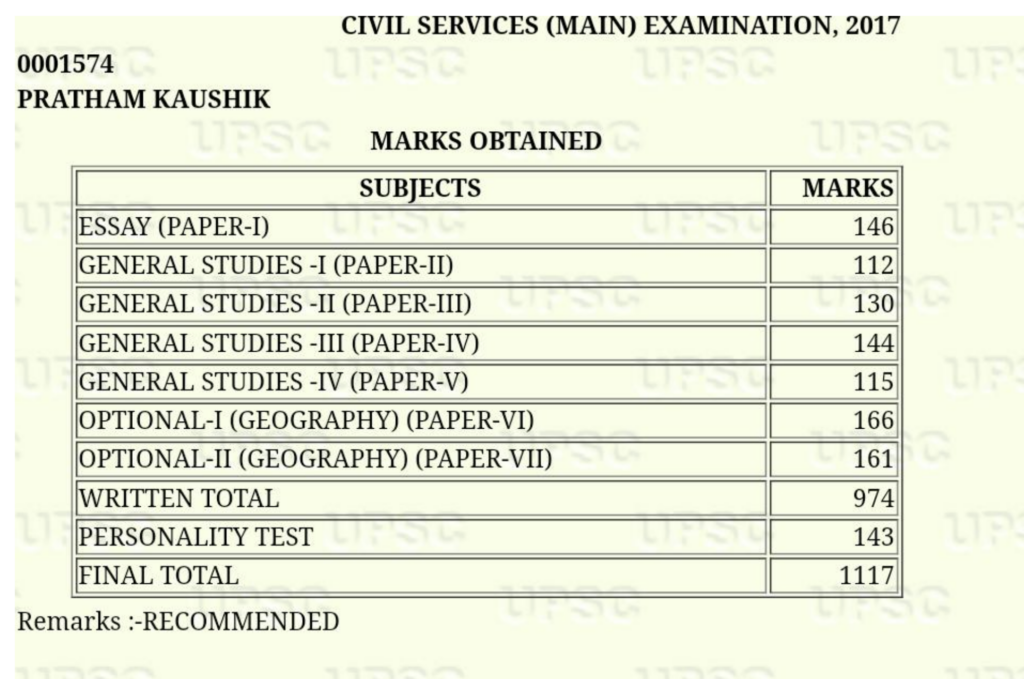
- Pratham Kaushik (AIR 5, CSE 2017) secured 327 marks in Geography Optional (166 + 161), which is considered a very high and balanced score.
- His strategy becomes particularly important because:
- Geography syllabus is vast, interdisciplinary, and dynamic.
- Questions are becoming increasingly analytical and unconventional.
- The approach shared is not prescriptive, but a tested framework that aspirants can adapt as per their needs.
General Overview of Preparation Strategy
1. Mastering the Syllabus: The Foundation of Preparation
- Thoroughly read, understand, and internalise the entire syllabus before starting preparation.
- Treat the syllabus as a “lighthouse” or guiding framework, ensuring:
- Every topic you study is mapped directly to the syllabus.
- You avoid unnecessary or irrelevant content accumulation.
- Develop a mental map of interlinkages between topics (e.g., climatology ↔ agriculture ↔ settlement).
2. Limited Sources with Maximum Revision
- Restrict your preparation to 2–3 sources per topic, ideally:
- One standard textbook (conceptual clarity).
- One classroom/coaching material (exam-oriented consolidation).
- Avoid the trap of multiple sources, which leads to:
- Information overload.
- Lack of revision.
- Emphasize iterative revision cycles:
- First reading → understanding.
- Second reading → consolidation.
- Third+ readings → retention and answer enrichment.
- Remember: Depth through revision is more important than breadth through sources.
3. Integration of Previous Year Questions (PYQs)
- After completing each unit, immediately refer to PYQs (e.g., topic-wise compilations like LotusArise or New Vishal).
- Practice:
- Framing structured answers.
- Identifying recurring themes and examiner’s focus areas.
- This helps in:
- Understanding the demand of questions.
- Assessing your current level of preparation.
- Example Insight:
- In Geomorphology, questions often revolve around Exogenetic processes, indicating examiner preference.
4. Smart Note-Making Strategy
- Avoid making notes for every topic, as it:
- Consumes excessive time.
- Reduces revision efficiency.
- Instead:
- Rely primarily on class notes as the base material.
- Enrich them with value additions (current affairs, examples, diagrams).
- Practical approach:
- Use A4 sheets or notebooks with wide margins for easy additions.
- Maintain dynamic notes, not static ones.
- Prepare separate self-notes only for difficult or abstract topics (e.g., models, theories).
5. Strategic Focus in Paper 1
- Paper 1 consists of:
- Physical Geography.
- Human Geography.
- Develop specialization in one section:
- Decide beforehand from which section you will attempt 3 questions.
- Pratham Kaushik’s approach:
- Focused more on Human Geography as it:
- Is relatively dynamic and analytical.
- Allows incorporation of current examples and case studies.
- Focused more on Human Geography as it:
- However, ensure:
- Basic conceptual clarity in both sections.
- Ability to attempt balanced answers across topics.
6. Targeted Preparation for Paper 2 (Indian Geography)
- Focus on frequently repeated themes and topics.
- Prepare short, crisp, bullet-point notes from standard sources.
- Emphasize:
- Contemporary relevance (e.g., urbanization issues, regional disparities).
- Case studies and examples specific to India.
- Ensure your notes are:
- Quick to revise before the exam.
- Structured for answer writing, not just reading.
7. Regional Approach through Maps (Key for Paper 2)
- Prepare region-wise maps of India incorporating multiple dimensions:
- Physical features (relief, drainage).
- Resource distribution (minerals, energy).
- Agricultural patterns.
- Industrial regions.
- This approach helps in:
- Developing a holistic geographical understanding.
- Writing multi-dimensional answers.
- Maps should not be isolated:
- Integrate them with theoretical and analytical content.
8. Interlinking Paper 1 and Paper 2
- One of the most crucial strategies is integration between both papers.
- Study overlapping themes simultaneously for both papers, such as:
- Climatology.
- Population Geography.
- Settlement Geography.
- Regional Planning.
- Use cross-paper examples in answers:
- Apply theories from Paper 1 in Indian context (Paper 2).
- Use Indian case studies to enrich theoretical answers.
- This ensures:
- Analytical depth.
- Better marks through value addition.

Sources and Preparation Methodology for Geography Optional – Paper 1
1. Geomorphology
Sources
- Geomorphology by Savinder Singh
- Focus selectively, as the book is extensive with low cost-benefit ratio.
- Avoid duplication:
- Skip geomorphology portion of Physical Geography by Savinder Singh if already covered here.
- Class Notes / 500+ Notes (Himanshu Sir)
- Use as supplementary material, but be selective due to excessive detailing.
Preparation Strategy
- Restrict preparation strictly to syllabus-oriented topics:
- Focus especially on:
- Fundamental Concepts in Geomorphology
- Theories of Landform Development
- Focus especially on:
- Develop conceptual clarity rather than rote memorization, supported by:
- Short pointers and structured notes.
- Emphasize diagram-based learning:
- Topics requiring deep preparation:
- Geomorphic cycles.
- Landscape evolution models.
- Erosion surfaces.
- Slope development theories.
- Topics requiring deep preparation:
- Answer writing enrichment:
- Use comparative diagrams (e.g., Davis vs Penck vs King).
- Highlight limitations and criticisms—this adds analytical depth.
- Adopt a selective + analytical approach rather than exhaustive reading.
2. Climatology and Oceanography
Sources
- Physical Geography by Savinder Singh (core source).
- Climatology by D. S. Lal
- Use only for specific topics requiring deeper conceptual clarity.
- Class Notes / 500+ Notes (Himanshu Sir) for consolidation.
Preparation Strategy
- Build strong conceptual understanding of processes:
- Atmospheric circulation, jet streams, monsoons.
- Ocean currents and their climatic significance.
- Focus on:
- Interlinkages (e.g., ENSO ↔ Indian Monsoon).
- Enhance answers with:
- Diagrams, flowcharts, and maps.
- Avoid excessive theory accumulation—prioritize application in answer writing.
3. Biogeography and Environmental Geography
Sources
- 500+ Notes (Himanshu Sir) – primary consolidation material.
- Class Notes & Test Series Notes (Shabbir Sir).
- Environmental Geography by Savinder Singh (strictly syllabus-based reading).
- Internet for:
- Contemporary topics like Social Forestry, Environmental Management.
Preparation Strategy
- Prepare Ecology in great detail, as it forms the conceptual base.
- Develop:
- Interdisciplinary understanding (link ecology with human impact).
- Focus on:
- Applied and current themes:
- Sustainability.
- Environmental degradation.
- Resource management.
- Applied and current themes:
- Prepare short pointers for dynamic topics from the internet.
- Use case studies and examples for answer enrichment.
4. Perspectives in Human Geography (Geographical Thought)
Importance
- One of the most scoring and decisive sections in Paper 1.
- Strong command over this topic can significantly boost marks.
Sources
- Test Series Notes (Shabbir Sir) – for building:
- Chronology.
- Conceptual overview.
- Geographical Thought by R. D. Dixit
- Focus on: Chapters 1–8 and 11.
- Fundamentals of Geographical Thought by Sudeepta Adhikari
- Focus on: Chapters 11, 13–16.
- 500+ Notes (Himanshu Sir) (if needed for reinforcement).
Preparation Strategy
- Follow a chronological approach:
- Evolution from determinism → possibilism → modern paradigms.
- Use:
- Original thinkers’ quotes and concepts:
- Hartshorne, Febvre, Semple, etc.
- Original thinkers’ quotes and concepts:
- Enrich answers with:
- Names of books, theses, and theories.
- Flowcharts showing evolution of thought.
- Prepare linkages with other topics:
- HDI → Welfare Geography.
- Language & Religion → Cultural Landscape & Diffusion.
- Prepare structured pointers for abstract topics:
- Example:
- Time Geography:
- Hägerstrand → Space-time prism.
- Evolutionary perspectives.
- Contemporary paradigms:
- Humanist Geography.
- Feminist Geography.
- Radical Geography.
- Time Geography:
- Example:
- Focus on analytical and interpretative answers, not just theoretical recall.
5. Economic Geography and Regional Planning
Sources
- Class Notes / 500+ Notes (Himanshu Sir) (including RDP material).
- Class Notes (Shabbir Sir).
- NCERT Class 11 & 12 for foundational clarity.
Preparation Strategy
- Focus on:
- Concepts + contemporary applications.
- Use:
- World maps extensively:
- For industrial location, trade patterns, resource distribution.
- World maps extensively:
- Incorporate:
- Current examples to make answers dynamic.
- Maintain clarity in:
- Theories of location.
- Regional disparities and planning approaches.
6. Population and Settlement Geography
Sources
- 500+ Notes (Himanshu Sir).
- Class Notes & Test Series Notes (Shabbir Sir).
- Models in Geography by Majid Husain.
- Indian Geography by D. R. Khullar (for Indian examples).
Preparation Strategy
- This is a highly scoring and relatively easier section, but requires:
- Excellent presentation.
- Focus on:
- Precise definitions with thinkers’ names:
- Conurbation, Metropolitan region, Slums, Satellite towns, RUF.
- Precise definitions with thinkers’ names:
- Use:
- Diagrams in settlement geography.
- Maps in population geography.
- Prepare:
- Relevant statistics for answer enrichment.
- Special attention to:
- Dynamic syllabus terms:
- Social well-being.
- Quality of life.
- Population as social capital.
- Dynamic syllabus terms:
- Ensure:
- Use of current examples and global perspectives.
- Anticipation of repeated and diversified questions.
7. Models and Theories in Geography
Sources
- Models in Geography by Majid Husain (primary source).
Importance
- Second most important topic after Geographical Thought.
- Offers high scoring potential through presentation.
Preparation Strategy
- Prepare each model with:
- Postulates, assumptions, criticisms.
- Use:
- Diagrams, flowcharts, and maps extensively.
- Important models:
- Heartland & Rimland theories.
- Von Thünen model.
- Rostow’s stages.
- Boundaries and frontiers.
- Link models with:
- Their respective sub-topics.
- Prepare:
- Short notes and pointers for each model.
- Memorize key postulates and diagrams.
Systems Analysis (Emerging Focus Area)
Sources
- Class notes + Majid Husain + selective internet support.
Preparation Strategy
- UPSC is increasingly focusing on:
- Application-based questions.
- Prepare:
- Concepts:
- Geographical systems.
- Types and components.
- Applications:
- Environmental systems.
- Human-environment interaction.
- Concepts:
- Enrich answers using:
- Flowcharts and system diagrams.
- Avoid overloading content:
- Focus on clarity + presentation rather than excessive value addition.
Sources and Preparation Methodology for Paper 2 (Indian Geography)
1. Core Source: Static Foundation
Primary Book
- India: A Comprehensive Geography by D. R. Khullar
- This book is sufficient as the core static source for Paper 2 preparation.
- There is no need to diversify into multiple books, which often leads to confusion and lack of revision.
- LotusArise Notes for Geography Optional Paper-1
Preparation Strategy
- Convert the bulky content into concise, exam-oriented notes:
- Focus on:
- Specific pointers instead of lengthy descriptions.
- Short definitions of key concepts.
- Map-based understanding of topics.
- Focus on:
- Adopt an active reading approach:
- Pick a sub-topic directly from the syllabus.
- Read the corresponding section in Khullar.
- Underline/highlight important content.
- Simultaneously simplify and condense the material:
- Write notes in margins or separate sheets.
- Prefer integrating notes within the book itself for quick revision.
- Aim to develop:
- Multi-dimensional understanding (physical + economic + social aspects).
- Ability to recall quickly during answer writing.
2. Role of Current Affairs Integration
Sources
- Vision PT 365
- Use primarily for:
- Examples and factual enrichment.
- Use primarily for:
- Vision Mains 365
- Focus selectively on:
- Topics directly aligned with Geography Optional syllabus.
- Focus selectively on:
Preparation Strategy
- Do not treat current affairs as a separate subject:
- Instead, integrate them within static topics.
- Use current affairs to:
- Add contemporary relevance.
- Provide recent examples and data points.
- Example applications:
- Floods → recent flood events.
- Urbanization → smart cities, AMRUT mission.
- Maintain a separate repository of examples categorized topic-wise.
3. Case Studies: Value Addition Tool
Sources
- Standard magazines:
- Yojana
- Kurukshetra
- Geography and You
Preparation Strategy
- Prepare concise and impactful case studies:
- Each case study should be:
- Limited to 4–5 lines.
- Focused on problem → intervention → outcome.
- Each case study should be:
- Maintain:
- At least 8–10 ready-to-use case studies.
- Characteristics of good case studies:
- Should be:
- Simple and widely known, not obscure.
- Directly relevant to syllabus topics.
- Easily adaptable across multiple questions.
- Should be:
- Usage in answers:
- Incorporate as:
- Elaborated examples, not separate paragraphs.
- Helps in:
- Demonstrating applied understanding.
- Enhancing credibility and originality of answers.
- Incorporate as:
4. Maps: The Backbone of Paper 2
Conceptual Understanding
- Maps in Geography answers are:
- Explanatory and indicative, not data-heavy.
- Tools to enhance clarity and presentation.
Preparation Strategy
- Avoid memorizing exact statistical data (rainfall, population density, etc.).
- Instead, simplify maps using:
- Relative categorization:
- Low / Medium / High.
- Below / At / Above national average.
- Visual techniques:
- Shading specific regions.
- Arrows to show:
- Migration.
- Trade flows.
- Diffusion patterns.
- Relative categorization:
- Examples:
- Use thick vs thin arrows to depict trade imbalance.
- Use expanding arrows for growth and contracting arrows for decline.
Answer Writing Application
- Maps should be:
- Rough, quick, and pen-drawn in the exam hall.
- Practiced regularly at home for speed and accuracy.
- Practice:
- Partial maps where required:
- Western India → Indira Gandhi Canal.
- Northern/NE India → border disputes.
- Partial maps where required:
- Ensure:
- Proper labelling of all features.
- Approximate correct boundaries of India and states:
- Avoid unrealistic shapes (e.g., rectangular states).
- Overall goal:
- Use maps as a differentiator in answer presentation.
5. Preparation of Contemporary Issues
Nature of Topics
- Includes recurring and dynamic themes such as:
- Floods and droughts.
- Epidemics.
- Deforestation.
- Soil erosion.
- River linking projects.
Preparation Strategy
- Prepare short, structured notes beforehand:
- Cover:
- Causes.
- Impacts.
- Regional dimensions.
- Solutions/way forward.
- Cover:
- Importance:
- These topics are:
- Frequently asked.
- Difficult to articulate spontaneously within 150–200 words.
- These topics are:
- Without preparation:
- Answers tend to become:
- Lengthy but ineffective.
- Lacking structure and clarity.
- Answers tend to become:
- With preparation:
- You can deliver:
- Concise, well-organized, and high-quality answers.
- You can deliver:
Conclusion
- Paper 2 demands a balanced integration of static knowledge, current affairs, maps, and case studies.
- The core strategy revolves around:
- Single source consolidation (Khullar) + value addition layers.
- Map-based presentation and regional understanding.
- High scoring answers in Paper 2 are characterized by:
- Clarity, structure, examples, and visual representation (maps/diagrams).
How to Enrich Your Answers in Geography Optional
1. First Rule of Presentation: Use Maps and Diagrams in Every Answer
- Always prioritize visual representation through maps and diagrams, as they significantly enhance answer quality and fetch extra marks by improving clarity and examiner engagement.
- Ideally, try to include:
- At least one map or diagram per answer, and sometimes even one per page if the question demands elaboration.
- Ensure that:
- Diagrams are relevant, neat, and conceptually correct, not decorative.
- Maps are indicative rather than data-heavy, focusing on explanation.
- Ideally, try to include:
- Even in questions where diagrams are not directly applicable, maps can almost always be incorporated, making your answer visually enriched and geographically grounded.
- Illustrative Applications:
- For a question on religious minorities in border states:
- Draw a map of India:
- Shade border states.
- Mark relevant UTs and cities.
- Draw a map of India:
- For biological deserts:
- Draw a world map:
- Indicate deep ocean regions.
- Highlight Arctic and Antarctic zones.
- Draw a world map:
- For regional variation in energy crisis:
- Use a world map with zonation:
- Severe crisis regions.
- Moderate crisis regions.
- Low crisis regions.
- Use a world map with zonation:
- For a question on religious minorities in border states:
- Over time, develop the habit of:
- Practicing quick, rough maps.
- Using maps as a default enrichment tool rather than optional addition.
2. Second Rule of Presentation: Integrate Physical and Human Dimensions
- In most Geography answers, especially in Paper 2, avoid writing in isolation (purely physical or purely human).
- Instead, ensure a holistic approach by integrating both dimensions.
- Even in questions primarily based on physical geography, try to incorporate:
- Human implications.
- Economic and administrative relevance.
- Illustrative Example:
- Question: Difference between Himalayan and Peninsular drainage
- Beyond physical differences, enrich answer by adding:
- Cropping pattern variations.
- Industrial usage of river water.
- Socio-economic implications.
- Beyond physical differences, enrich answer by adding:
- Question: Difference between Himalayan and Peninsular drainage
- This approach ensures:
- Administrative orientation, which is highly valued in UPSC evaluation.
- Transformation of answers from:
- Purely academic → Applied and policy-relevant.
- Note:
- Only a few topics (e.g., Geographical Thought) require pure theoretical orientation.
- Majority of answers should reflect an administrative-geographical perspective.
3. Third Rule of Presentation: Structure Answers Along Syllabus Dimensions
- One of the most effective ways to generate multi-dimensional and content-rich answers is to structure them using core syllabus themes.
- Standard framework to be used:
- Terrain (Geomorphology).
- Drainage.
- Climate (Climatology).
- Soil/Vegetation (Biogeography).
- Environmental issues.
- Population and settlement.
- Agriculture and industries.
- Development and planning.
- This approach helps in:
- Generating 7–8 diverse points even for general questions.
- Ensuring balanced coverage of the topic.
- Avoiding unstructured and monotonous answers.
Illustrative Application: Role of Small Towns in Regional Development
- Instead of writing randomly, structure the answer using syllabus dimensions:
- Population & Settlement Perspective:
- Small towns act as counter-magnets, reducing migration pressure on metropolitan cities.
- Facilitate reverse migration and balanced urbanization.
- Regional Development & Planning (RDP):
- Function as growth centres and planning nodes.
- Useful for:
- Pilot development projects.
- Application of growth foci concept (R. P. Misra).
- Resource Perspective:
- Promote efficient resource utilization and conservation at regional scale.
- Industrial Perspective:
- Support MSMEs and footloose industries.
- Provide:
- Cheaper labour.
- Decentralized industrial base.
- Example:
- Mini steel plants in small towns aiding industrial decentralization.
- Agricultural Linkages:
- Act as market linkages between rural hinterland and urban centres.
- Facilitate:
- Agricultural marketing.
- Food processing industries.
- Political Geography Dimension:
- Strengthen Panchayati Raj institutions.
- Enable grassroots-level planning and decentralization.
- Transport and Trade:
- Improve:
- Connectivity between raw materials and markets.
- Integration of road and rail networks.
- Example:
- Trade towns evolving into major urban centres (e.g., Surat).
- Improve:
- Cultural Dimension:
- Promote social cohesion and cultural integration.
- Population & Settlement Perspective:
- Further enrichment:
- Add environmental angle:
- Role in sustainable practices like agroforestry.
- Add map-based illustration:
- Example: NCR region with surrounding small towns and migration flows.
- Add environmental angle:
- Outcome:
- Answer becomes:
- Structured, multi-dimensional, and analytically rich.
- Answer becomes:
4. Handling Unconventional Questions
- UPSC has increasingly introduced unconventional and abstract questions, which are:
- Difficult for all candidates, not just you.
- Strategy:
- Do not panic if unfamiliar:
- Attempt the question using:
- Logical reasoning.
- Basic conceptual understanding.
- Attempt the question using:
- Always try to:
- Write something relevant.
- Include a rough diagram or flowchart.
- Do not panic if unfamiliar:
- Illustrative Example:
- Question on Pseudovulcanism:
- Break the term:
- “Pseudo” → fake or similar.
- Relate to:
- Processes like mudflows, earthflows, geysers, hot springs.
- Even if partially correct:
- You secure partial marks instead of zero.
- Break the term:
- Question on Pseudovulcanism:
5. Intelligent Attempt Strategy
- It is crucial to attempt every question, even if knowledge is limited:
- Writing a few logical points ensures:
- Examiner has scope to award marks.
- Writing a few logical points ensures:
- However, maintain selectivity:
- In compulsory questions:
- Always attempt with logical reasoning.
- In optional questions (choices available):
- Avoid questions you do not know at all.
- Attempt those where:
- You can provide structured and quality answers.
- In compulsory questions:
- Balance:
- Avoid:
- Leaving questions blank.
- Writing irrelevant content.
- Aim for:
- Minimum assured marks in weak areas + maximum marks in strong areas.
- Avoid:
Conclusion
- High-scoring answers in Geography Optional are not just about knowledge, but about:
- Presentation, structure, and analytical depth.
- The core pillars of answer enrichment include:
- Maps and diagrams.
- Human + physical integration.
- Syllabus-based structuring.
- Logical handling of unknown questions.
Coaching and Test Series Strategy for Geography Optional
1. Overall Approach to Coaching and Test Series
- The preparation strategy was built on a balanced combination of self-study and guided programs, rather than over-dependence on coaching institutions.
- Core pillars included:
- Standard books for conceptual clarity.
- Value-added programs for content enrichment.
- Test series exposure for answer writing orientation.
- Core pillars included:
- Key aspect of the approach:
- Focus was more on content building and conceptual strengthening, rather than:
- Writing a large number of tests.
- Test series were used primarily as:
- Learning tools, not just evaluation platforms.
- Focus was more on content building and conceptual strengthening, rather than:
- Selective test writing strategy:
- Instead of attempting all tests:
- Only 2–3 tests were written seriously (e.g., under Shamim Sir).
- Emphasis remained on:
- Understanding answer structure and content demand rather than quantity of tests.
- Instead of attempting all tests:
2. Guidance IAS 500+ Program and Test Series (Himanshu Sir)
Nature of the Program
- An integrated program combining content coverage with test series, making it:
- A comprehensive preparation package for Geography Optional.
Advantages
- Provides extensive and syllabus-oriented content coverage:
- Each sub-topic is covered in a question–answer format, aligning closely with UPSC demand.
- Question papers:
- Designed to closely resemble actual UPSC pattern, helping aspirants adapt to real exam conditions.
- Answer booklets:
- Structured in UPSC format, aiding in familiarity with exam presentation.
- Revision-friendly:
- Since content is already in Q&A format, it:
- Reduces the burden of separate note-making.
- Allows quick revision before the exam.
- Since content is already in Q&A format, it:
- Can act as:
- A substitute for classroom notes, especially for most topics.
Limitations
- Answer copies:
- Not checked personally by Himanshu Sir.
- However:
- He reviews answers and provides guidance.
- Students can approach him personally for doubt resolution and feedback.
- Requires:
- Selective usage, as content may be extensive.
3. Vajiram Test Series (Shabbir Sir)
Nature of the Program
- A test series integrated with selective classroom discussions, focusing more on:
- Answer writing orientation.
- Analytical understanding of topics.
Advantages
- Strong emphasis on:
- Approach-building and conceptual clarity.
- Understanding how to structure answers effectively.
- Test series class notes:
- Highly valuable for:
- Selective topics.
- Providing focused and exam-oriented coverage.
- Highly valuable for:
- Even if not enrolled:
- It is beneficial to:
- Access these notes through alternative means.
- Use them for overview and reinforcement of important topics.
- It is beneficial to:
Limitations
- Answer copies:
- Not evaluated directly by Shabbir Sir.
- However:
- He may review answers personally if approached.
- Coverage:
- Limited to selected topics only, as:
- The program is primarily a test series, not full-fledged coaching.
- Limited to selected topics only, as:
- Requires:
- Supplementation with standard books and other notes.
4. Shamim Sir’s Test Series
Nature of the Program
- A pure test series program, with focus on:
- Evaluation and feedback rather than teaching content.
Advantages
- Answer evaluation:
- Copies are checked personally by Shamim Sir, ensuring:
- Reliable and realistic marking.
- Copies are checked personally by Shamim Sir, ensuring:
- Approach:
- Provides a simple and practical way of tackling difficult questions.
- Helps in:
- Improving clarity and precision in answers.
Limitations
- Question papers:
- Have lower resemblance to actual UPSC pattern, which may limit exam simulation.
- Content enrichment:
- Minimal, as:
- The program is evaluation-focused, not content-focused.
- Minimal, as:
- Should be used:
- Primarily for testing and feedback, not as a core content source.
5. Key Takeaways for Aspirants
- Coaching and test series should be:
- Supplementary tools, not substitutes for self-study.
- Focus on:
- Content mastery + answer presentation, rather than:
- Blindly attempting multiple tests.
- Content mastery + answer presentation, rather than:
- Ideal strategy:
- Use:
- One content-rich program (e.g., 500+).
- One approach-oriented test series.
- One evaluation-focused test series (optional).
- Use:
- Always ensure:
- Active engagement with feedback.
- Continuous improvement in answer quality.
Conclusion
- The effectiveness of coaching lies not in:
- The number of programs joined,
- But in:
- How selectively and intelligently they are utilized.
- A well-balanced approach combining:
- Self-study + value addition + limited but meaningful test practice
- is key to scoring high marks in Geography Optional.