- Environmental conservation is the protection, preservation, management or restoration of natural environments and the ecological communities that live in them.
- It also covers the management of human use of natural resources, so that they give present benefit and remain available for sustainable social and economic use later.
- At its root, conservation is the planned management of humankind’s surroundings to prevent their exploitation, destruction or neglect. It means wise use, not hoarding: renewal of what can be renewed, and recovery, recycling and reuse of what has been extracted.
- It draws its tenets from ecology, the science of the interrelationships between living things and their environment.
- Natural resources fall into two groups, and conservation treats them differently:
- Renewable resources: forests, pastures, wildlife, fish and fresh water are replaced by natural processes and are inexhaustible if properly managed.
- Non-renewable resources: minerals, metals, coal and oil exist in fixed amounts. Soil also behaves as non-renewable, because a few centimetres take centuries to form.
- Why conservation is urgent: population and its demand on land, water and energy are growing fast; resources are being used up faster than renewable ones regenerate; pollution keeps increasing; and some damage, such as an extinct species, is irreversible.
Concept, Aims and Principles of Conservation

Meaning of conservation
- Conservation is a broad concept with scientific, ethical, moral, economic and political sides, and each profession reads it in its own way:
| Perspective | Meaning of conservation |
|---|---|
| Petroleum engineer | Minimising waste from incomplete extraction; maximising recovery |
| Forester | Sustained yield: harvesting only the annual increment of wood |
| Economist (general definition) | Maximising, over time, the net social benefit in goods and services from resources |
| Comprehensive definition | The highest sustainable quality of living for humankind through rational use of the environment, protection of nature and control of pollution |
| Ecologist | Keeping a natural area in its natural state for study, enjoyment and an understanding of ecological laws |
- The World Conservation Strategy (1980), prepared by IUCN with UNEP and WWF, gave the definition that is now standard: conservation is “the management of human use of the biosphere so that it may yield the greatest sustainable benefit to present generations while maintaining its potential to meet the needs and aspirations of future generations.”
- It named three objectives: maintain essential ecological processes and life-support systems; preserve genetic diversity; and ensure the sustainable utilisation of species and ecosystems.
- This framing fed directly into the idea of sustainable development popularised by the Brundtland Report (1987).
- Conservation is a positive programme of management and the collective responsibility of governments, industries and individuals: what is harvested is replaced, what is damaged is restored, and what is protected is studied and appreciated.
Preservation, conservation and restoration
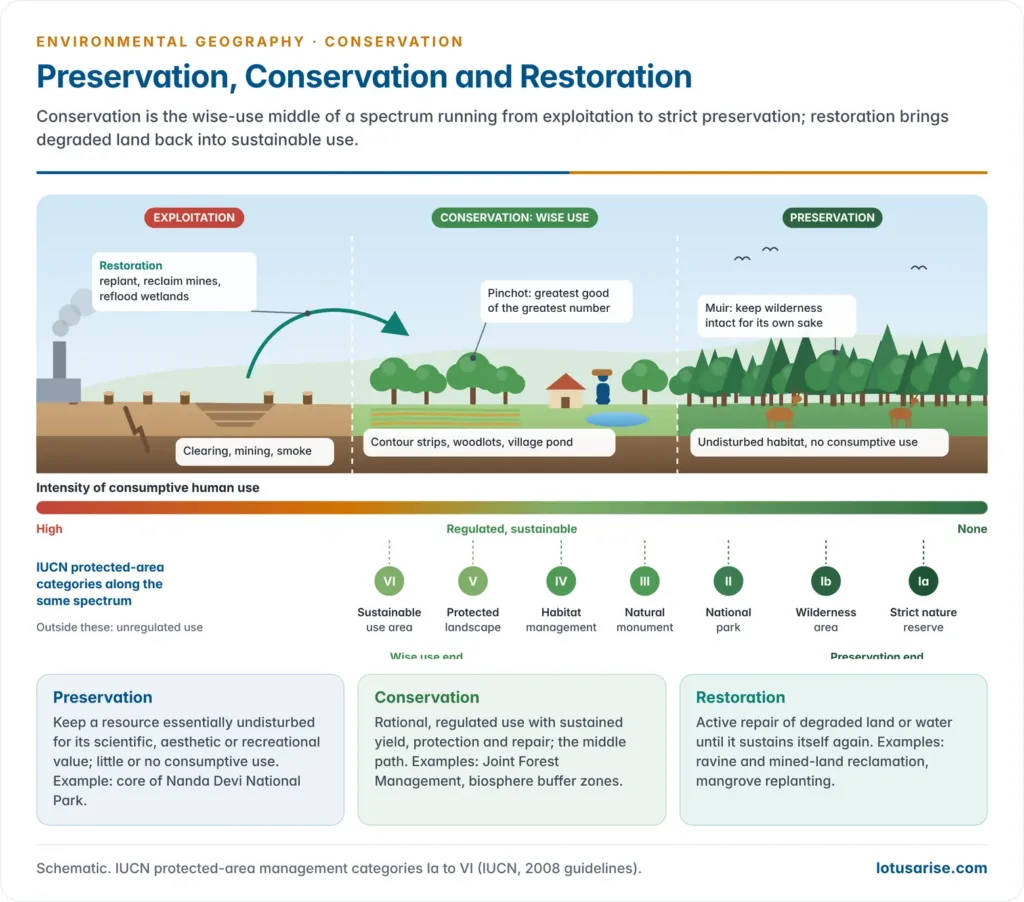
- Preservation keeps a resource in an essentially undisturbed condition for its scientific interest, aesthetic appeal or recreational value: little or no consumptive use is allowed.
- Conservation is broader. It includes rational use for commodity or recreation, sustainable harvesting and restoration alongside protection: the pragmatic middle path between unchecked exploitation and strict preservation.
- Restoration is the active repair of a degraded system, such as replanting a cleared slope or reflooding a drained wetland, until it can again sustain itself. At landscape scale it is now a global priority under the UN Decade on Ecosystem Restoration (2021–2030).
- The historical debate: the two words took their modern meanings in a quarrel in the USA.
- Gifford Pinchot, first chief of the US Forest Service (1905), defined conservation as the wise use of resources for “the greatest good of the greatest number in the long run”.
- John Muir, founder of the Sierra Club (1892), argued for preserving wilderness for its own sake.
- Their clash over damming the Hetch Hetchy valley (approved in 1913) became the classic use versus preservation dispute. The ethical side later deepened, from the land ethic of Aldo Leopold (1949) to the deep ecology of Arne Næss (1973).
| Basis | Preservation | Conservation | Restoration |
|---|---|---|---|
| Core idea | Leave nature undisturbed | Use wisely, without exhausting | Repair what has been damaged |
| Human use | None or non-consumptive | Regulated, sustainable | Limited until recovery |
| Value base | Intrinsic, aesthetic, scientific | Utilitarian, long-term | Ecological, utilitarian |
| Typical tool | Strict nature reserve, core zone | Sustained-yield forestry, buffer zone | Afforestation, wetland and mine reclamation |
| Indian example | Core of Nanda Devi National Park | Joint Forest Management forests | Chambal ravine and mined-land reclamation |
- IUCN’s protected-area categories run along the same spectrum, from Ia and Ib (strict nature reserve, wilderness area) at the preservation end, through II–IV (national park, natural monument, habitat/species management area), to V and VI (protected landscape, sustainable-use area) at the wise-use end.
Evolution of the conservation idea
- Traditional India held a strong ethic of restraint toward nature:
- Kautilya’s Arthashastra provided for abhayaranya, forests where animals could not be killed, and Ashoka’s fifth pillar edict (3rd century BCE) protected listed animals and forbade burning forests;
- sacred groves (devrai in Maharashtra, kavu in Kerala, sarna in Jharkhand, law kyntang in Meghalaya) protected patches of forest through religious taboo;
- the Bishnoi sect, founded by Guru Jambheshwar in 1485, made the protection of trees and animals part of its 29 rules.
- Colonial forestry turned forests into a state resource: the Imperial Forest Department (1864), under Dietrich Brandis, sought a sustained yield of timber, and the Indian Forest Acts of 1865, 1878 and 1927 curtailed the customary rights of forest communities.
- Global milestones: Yellowstone (1872), the first national park; Silent Spring (1962) by Rachel Carson; the Stockholm Conference (1972); and the World Conservation Strategy (1980), the Brundtland Report (1987) and the Rio Earth Summit (1992), which joined conservation to development.
From fortress conservation to people’s conservation
- Fortress conservation treats protected areas as people-free zones, fenced off from local communities. It produced early successes but also displacement, loss of forest rights and conflict with forest dwellers, as when villages were relocated from tiger reserves.
- Community-based conservation gives local people a stake and a voice. Indian expressions include:
- Joint Forest Management (1990), which shares usufruct with village committees;
- conservation and community reserves under the 2002 amendment of the Wildlife (Protection) Act;
- community forest resource rights under the Forest Rights Act (2006);
- long-standing sacred groves and the Bishnoi ethic.
- Women manage fuel, fodder and water in most rural homes and keep much of the knowledge of seeds and forest plants, which makes gender a core dimension of biodiversity conservation.
Aims of conservation
- Preservation of a quality environment that serves aesthetic and recreational as well as material needs.
- A continuous yield of useful plants, animals and materials, through a balanced cycle of harvest and renewal.
- Both aims rest on keeping ecological processes, genetic diversity and life-support systems intact.
Principles of conservation
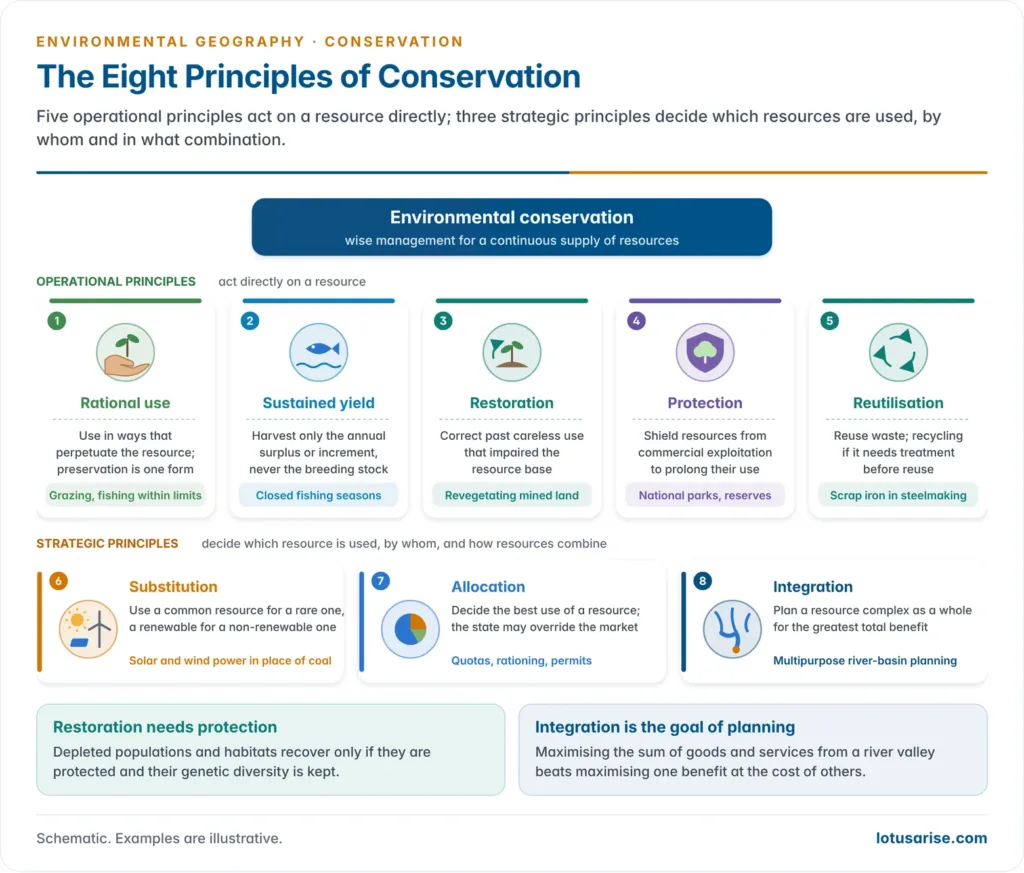
- Conservation works through measures that increase the longevity of a resource and improve the pattern of its use. Eight principles form the framework:
| Principle | What it means | Example |
|---|---|---|
| Rational use | Use resources in ways that perpetuate them; preservation is one form, direct use another | Harvesting forest crops, grazing and fishing within limits |
| Sustained yield | Harvest only the annual surplus or increment, never the breeding stock | Fishing seasons and closed seasons; felling cycles in working plans |
| Restoration | Correct past careless use that has impaired the resource base | Revegetating deforested and mined land; recovery of protected populations |
| Protection | Shield resources from commercial exploitation to prolong their use | National parks, reserves, watershed forests |
| Reutilisation | Reuse waste; it becomes recycling if the waste needs treatment first | Reusing cooled industrial water; scrap iron in steelmaking |
| Substitution | Use a common resource instead of a rare one, or a renewable instead of a non-renewable one | Solar and wind power for coal; bamboo for timber |
| Allocation | Decide the best use of a resource; the state may override the market | Quotas, rationing, permits, water allocation in a basin |
| Integration | Plan a resource complex as a whole for the greatest total benefit | Multipurpose river-basin and watershed planning |
- The first five principles are operational: they act directly on a resource. The last three are strategic: they decide which resource is used, by whom and in what combination. Restoration depends on protection, and integration is the central objective of planning.
Conservation of Natural Resources
Soil conservation
- Soil is lost through accelerated erosion, salinisation, waterlogging, nutrient mining and pollution. About 29.8% of India’s land was undergoing degradation in 2018–19.
- Measures follow the conservation principles:
- biological: afforestation, shelter belts, grass barriers and controlled grazing;
- agronomic: contour ploughing, strip and cover cropping, mulching, crop rotation and zero tillage;
- mechanical: contour bunds, bench terraces, check dams and gully plugs.
Water conservation
- Why it matters: India has about 18% of the world’s people but about 4% of its fresh water, and per-capita availability keeps falling as population grows. Groundwater is over-drawn across the north-west and the hard-rock south.
- Principles applied to water:
- Rational use and allocation: drip and sprinkler irrigation; crop choice matched to water; pricing and metering.
- Reutilisation: recycling treated wastewater for industry, gardens and flushing.
- Integration: planning a river basin or watershed as one unit, from ridge to valley, as in watershed management.
- Rainwater harvesting captures runoff where it falls: rooftop collection, recharge pits, farm ponds, percolation tanks and check dams.
- Traditional systems embody centuries of local knowledge:
| System | Region | How it works |
|---|---|---|
| Johad | Rajasthan, Haryana | Crescent-shaped earthen dam that holds runoff and recharges wells |
| Kund / tanka | Thar desert | Covered underground tank fed by a sloping catchment |
| Kuhl | Himachal Pradesh, Jammu | Gravity channel diverting glacier and stream water to terraces |
| Zabo | Nagaland | Combined forest, pond, cattle and paddy system on slopes |
| Eri (tank) | Tamil Nadu | Chains of village tanks storing monsoon runoff |
| Bamboo drip | Meghalaya | Bamboo pipes carrying spring water to plantations |
| Baoli / vav | Gujarat, Delhi, Rajasthan | Stepwell reaching down to the water table |
- Indian endeavours to augment water conservation:
- the National Water Mission (2009), which aims to raise water-use efficiency by 20%;
- Pradhan Mantri Krishi Sinchayee Yojana (2015), with its “more crop per drop” component;
- Atal Bhujal Yojana (2019), for community-led groundwater management in seven states;
- Jal Shakti Abhiyan (2019) and its “Catch the Rain” campaign;
- Mission Amrit Sarovar (2022), with 75 water bodies per district, of which more than 68,000 had been completed by 2025;
- Namami Gange (2014) for river rejuvenation.
- Community success stories:
- Tarun Bharat Sangh, led by Rajendra Singh, revived johads in Alwar from the mid-1980s; the seasonal Arvari and other rivers began to flow again.
- Ralegan Siddhi and Hiware Bazar (Maharashtra) combined watershed treatment with bans on free grazing and felling, and water budgeting.
Forest and vegetation conservation
- Status: the India State of Forest Report 2023 put forest cover at 21.76% and tree cover at 3.41% of the country, a total of 25.17%. The National Forest Policy (1988) target is 33%.
- Causes of deforestation: conversion to farms and settlements, mining, dams and roads, overgrazing, fire and shifting cultivation on shortened cycles.
- Conservation measures:
- Protection: reserved and protected forests; diversion of forest land only with central approval under the Forest (Conservation) Act, 1980, renamed the Van (Sanrakshan Evam Samvardhan) Adhiniyam by its 2023 amendment.
- Sustained yield: working plans that fix felling cycles to growth.
- Restoration: compensatory afforestation through the CAMPA funds (Act of 2016); the Green India Mission (2014); MISHTI (2023) for mangroves; the Aravalli Green Wall Project (2025).
- People’s participation: Joint Forest Management, community forest rights, Van Mahotsav and Ek Ped Maa Ke Naam (2024). Joint Forest Management grew from the Arabari experiment in West Bengal (early 1970s), where villagers protected sal forest in return for a share of its produce.
Social forestry and environmental conservation
- Social forestry means raising trees outside traditional forests, by and for the people. The term was popularised in India by the National Commission on Agriculture (1976).
- It has three forms: farm forestry on private land, community forestry on village commons, and extension forestry along roads, canals and railways.
- Conservation gains:
- it takes pressure off natural forests by supplying fuelwood, fodder and small timber;
- it checks soil erosion and wind erosion, and recharges groundwater;
- it greens degraded commons and stores carbon.
- Limits: early schemes favoured fast-growing eucalyptus monocultures that suited markets more than villagers, and benefits often went to large farmers.
Wetland, coastal and marine conservation
- Wetlands purify water, recharge aquifers, buffer floods and support fisheries and migratory birds, yet they are drained, filled and polluted faster than most other ecosystems.
- India’s measures: 103 Ramsar sites by October 2026; the Wetlands (Conservation and Management) Rules, 2017; Amrit Dharohar (2023) for eco-tourism and livelihoods around Ramsar sites; the Coastal Regulation Zone notification (latest 2019); and marine protected areas such as the Gulf of Mannar Marine National Park.
- Mangroves shield coasts from cyclones and storm surges, as Bhitarkanika and the Sundarbans showed; MISHTI (2023) plants them on suitable mudflats and salt pans.
- Coral reefs of the Gulf of Mannar, Gulf of Kachchh, Lakshadweep and the Andaman and Nicobar Islands suffer repeated bleaching in marine heatwaves.
Conservation of energy and minerals
- Non-renewable resources are conserved mainly by efficiency, substitution and reutilisation:
- Efficiency: the Energy Conservation Act (2001), the Bureau of Energy Efficiency, star labels and the Perform, Achieve and Trade scheme (2012).
- Substitution: renewable energy in place of coal and oil, with a target of 500 GW of non-fossil capacity by 2030.
- Reutilisation: the Steel Scrap Recycling Policy (2019) and extended producer responsibility for plastic, e-waste and batteries.
- Minerals: scientific mining, use of low-grade ores and by-product recovery.
Wildlife conservation
- Wildlife means non-domesticated animals and plants living in their natural habitat. India is megadiverse, with four of the world’s 36 biodiversity hotspots.
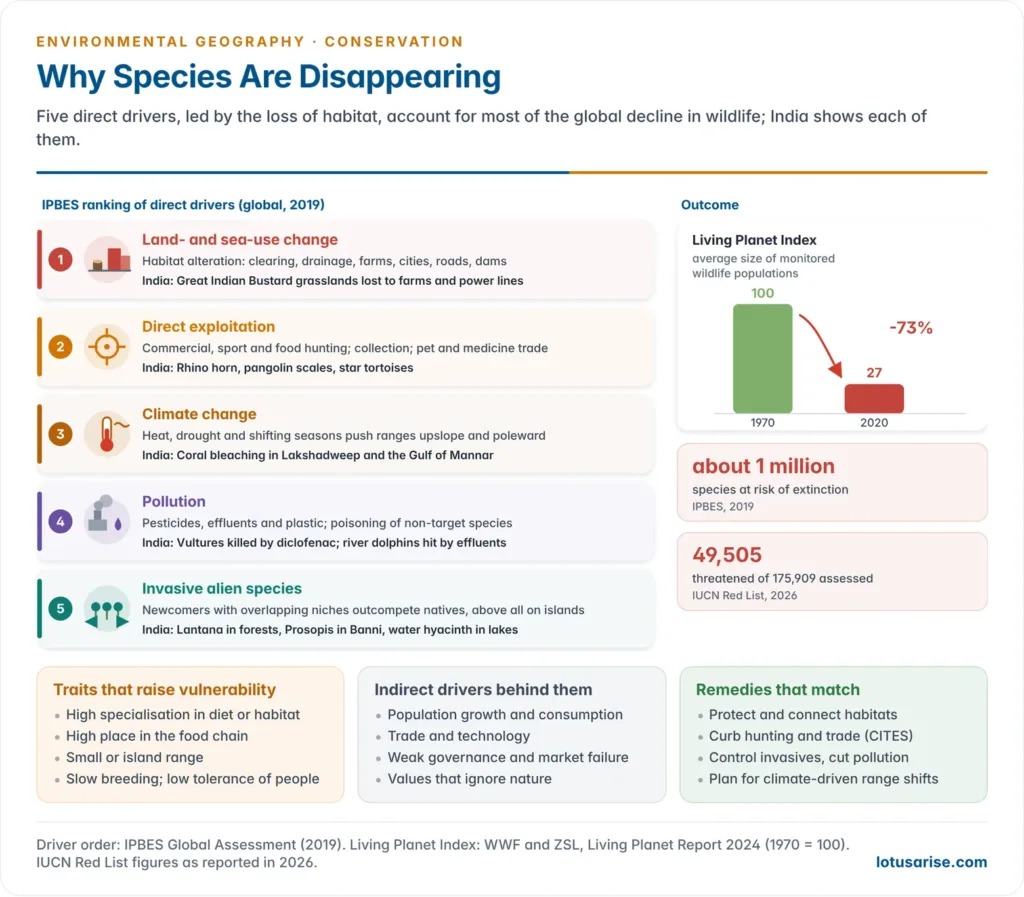
- Global decline: the Living Planet Index (2024) shows a 73% average fall in monitored wildlife populations since 1970, and the IUCN Red List counted about 49,500 threatened species out of nearly 1,76,000 assessed (2026).
Threat categories
- The IUCN Red List places species in categories by their risk of extinction:
| Category | Meaning | Examples |
|---|---|---|
| Extinct (EX) | No individual left anywhere | Dodo, passenger pigeon |
| Extinct in the Wild (EW) | Survives only in captivity | Père David’s deer (reintroduced since in China) |
| Critically Endangered (CR) | Extremely high risk; survives only with human help | Great Indian Bustard, gharial, California condor |
| Endangered (EN) | Very high risk | Tiger, blue whale, whooping crane, Asian elephant |
| Vulnerable (VU) | High risk | Greater one-horned rhinoceros, snow leopard, sloth bear |
| Near Threatened / Least Concern | Lower risk now | Blackbuck and chital (both Least Concern) |
- A species can also be extinct regionally: the cheetah was declared extinct in India in 1952, though it survives in Africa and Iran.
Why species go extinct
- Extinction comes from economic, political and psychological forces acting together. The principal human causes, with Indian examples, are:
- habitat alteration: clearing, drainage, farms, cities, highways and dams, as in the loss of Great Indian Bustard grasslands to farms and power lines;
- hunting for meat, fur, horns and trophies, such as rhino poaching in Assam;
- alien species that outcompete natives, such as water hyacinth in lakes and Lantana in forests;
- pest and predator control that poisons non-target species: Gyps vultures crashed after eating cattle carcasses treated with diclofenac;
- collection and trade of live animals and plants, and pollution entering food chains, as with the Ganges river dolphin.
- Biological traits raise vulnerability: high specialisation, a high position in the food chain, a small or island range, a low reproductive rate and low tolerance of human presence.
- The IPBES (2019) ranks the global direct drivers as land- and sea-use change first, then direct exploitation, climate change, pollution and invasive alien species.
Why conserve wildlife
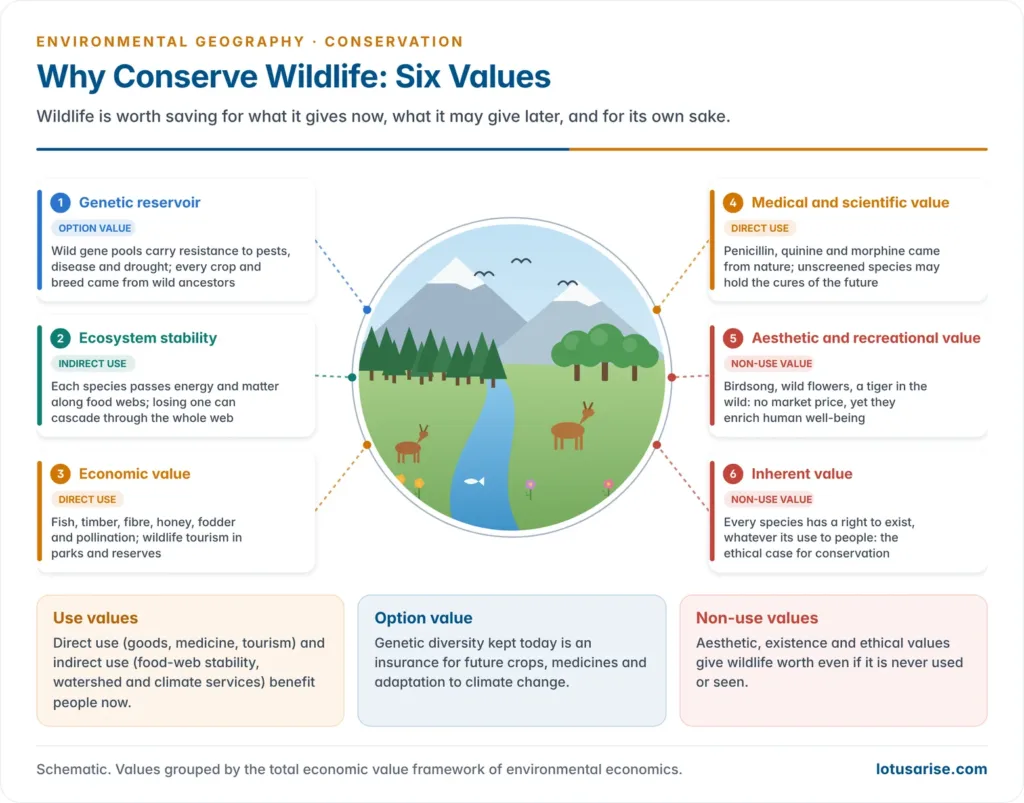
- Use and option values: wild relatives of crops and livestock form a genetic reservoir of resistance to disease and drought; species keep ecosystems stable by moving energy and materials through the web of life; and wildlife gives fisheries, timber, tourism, pollination and medicines such as penicillin, quinine and morphine.
- Non-use values: birdsong or a tiger in the wild has no market price yet enriches human well-being, and every species has an inherent right to exist, regardless of its use to people.
Saving endangered species
- Wildlife management works at three overlapping levels: technical (habitat management, captive breeding), legal (laws, bans and enforcement) and personal (awareness and behaviour). Habitat management is the most efficient technique, because populations respond sensitively to their habitat.
- An integrated species management programme attacks all the causes of extinction together: protecting critical habitats and breeding grounds, curbing hunting and trade (with international cooperation through CITES), controlling alien species and toxins, captive breeding and public awareness.
- The systems approach focuses these techniques on one target species, including translocation to suitable empty habitat: under Indian Rhino Vision 2020, rhinos were moved from Kaziranga and Pobitora to Manas from 2008.
- Conservation breeding: after diclofenac poisoning cut India’s Gyps vultures by more than 95%, the drug was banned for veterinary use in 2006 (ketoprofen and aceclofenac in 2023), and centres such as Pinjore (Haryana) breed vultures for release.
- Rising contact between recovering wildlife and people makes human–wildlife conflict part of conservation planning.
Wildlife conservation in India
| Year | Milestone | Significance |
|---|---|---|
| 1936 | Hailey National Park (now Corbett) | India’s first national park |
| 1972 | Wildlife (Protection) Act; Gir lion project | Legal basis for protected areas and bans on hunting |
| 1973 | Project Tiger (1 April) | Nine tiger reserves at the start |
| 1976 | India joins CITES | Control of trade in endangered species |
| 1992 | Project Elephant | Now 33 elephant reserves |
| 2022 | Project Cheetah, Kuno; Wildlife Act amended | First intercontinental reintroduction of a large carnivore; schedules cut to four |
| 2023 | International Big Cat Alliance launched | India-hosted alliance for seven big cats; in force 2025 |
- Flagship species counts: tigers 3,682 (2022), about 75% of the world’s wild tigers; Asiatic lions 891 in the Gir landscape (2025), up from 523 in 2015; snow leopards 718 (2019–23); and Ganges and Indus river dolphins 6,327 (2025).
- Project Cheetah: cheetahs came from Namibia (2022), South Africa (2023) and Botswana (2026), and Gandhi Sagar in Madhya Pradesh became the second site.
Protected areas
- Protected areas (PAs) are the core of in-situ conservation. The Wildlife (Protection) Act recognises national parks, wildlife sanctuaries and, since 2002, conservation reserves and community reserves; ex-situ conservation in zoos and gene banks backs them up.
- India’s network had over 1,000 PAs by 2026, including 106 national parks and about 574 sanctuaries, covering about 5.3% of the country. Tiger and elephant reserves overlay them, and India’s 18 biosphere reserves (thirteen in UNESCO’s World Network) follow a core–buffer–transition zoning.
- PAs give a scientific baseline for measuring human damage, keep catchment stream flow steady, support well-being and tourism, and make it easier to monitor populations and stop poaching.
Project Tiger
- Background: India may have had about 40,000 tigers around 1900, but the 1972 census found only 1,827.
- Launch: Project Tiger began on 1 April 1973 in nine reserves. Its aim was a viable tiger population, large enough to keep its genetic diversity, and the preservation of areas of biological importance as a national heritage.
- Course: the pugmark-based 1989 count of 4,334 was later shown to be inflated. When Sariska lost all its tigers to poaching (2004–05), the 2006 amendment created the National Tiger Conservation Authority, and camera-trap estimation found only 1,411. Numbers then rose to 2,226 (2014), 2,967 (2018) and 3,682 (2022).
- Now there are 58 tiger reserves (the 58th, Madhav, notified in March 2025). Concerns: relocation of villages from core areas, human–tiger conflict at reserve edges, and corridors cut by roads, canals and mines.
Challenges and the way forward
- Development pressure: roads, railways, mines, dams and transmission lines claim forest land and fragment habitats.
- The 2023 forest-law amendment exempted some strategic projects near the borders and narrowed protected “deemed forests”; in 2024 the Supreme Court directed that the broad dictionary meaning of “forest” from the Godavarman case (1996) must continue to apply.
- Poor compensation: compensatory afforestation is often done on poor land with monocultures that cannot replace natural forests.
- Fragmentation and conflict: wildlife recovering inside isolated reserves spills into farms and villages while corridors are cut.
- Invasive species: Lantana camara in forest understoreys and Prosopis juliflora in the Banni grasslands of Kachchh.
- Climate change shifts species ranges upslope and intensifies forest fires, so fixed protected boundaries may no longer hold the species they were drawn for.
- The way forward: plan at landscape scale, joining PAs through corridors and other effective area-based conservation measures (OECMs) such as sacred groves; secure community rights and benefit sharing; monitor with camera traps, the M-STrIPES app and environmental DNA; and make conservation climate-smart.
Public Awareness and People’s Movements
Public awareness for environmental conservation
- No law or PA succeeds without public support, compliance and participation. Formal environmental education builds awareness from basic environmental literacy in school to the training of professionals at university.
- Adult education should aim at collective action through practical content such as clean wells and ponds, water saving, tree planting, biogas and recycling. Rural women, who manage fuel, fodder and water, must have a place in these decisions.
- Institutional mechanisms in India: the National Green Corps and school eco-clubs; Van Mahotsav, begun by K. M. Munshi in 1950; Mission LiFE (Lifestyle for Environment, 2022); and the Green Credit Programme (2023), which rewards voluntary actions such as tree planting.
- Civil society and courts: the Bombay Natural History Society (1883) and the Centre for Science and Environment (1980) research and campaign, while public interest litigation such as the T. N. Godavarman Thirumulpad and M. C. Mehta cases, and the National Green Tribunal (2010), keep conservation in the public eye.
- Awareness changes behaviour only when it reshapes perception, attitude, value and emotion, the four components of PAVE theory.
Major conservation movements in India
| Movement | Place and year | Issue | Outcome |
|---|---|---|---|
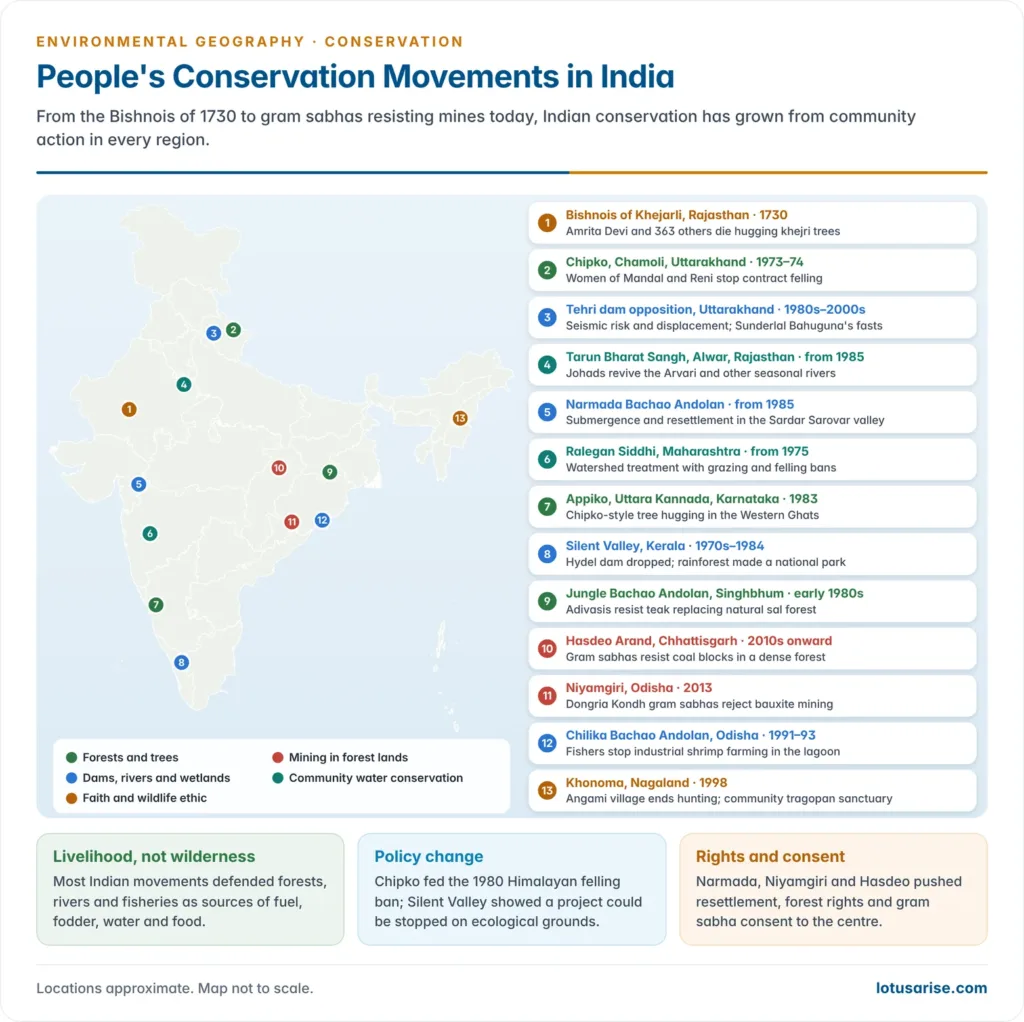
| Bishnoi sacrifice | Khejarli, Jodhpur, 1730 | Amrita Devi and 363 Bishnois died hugging khejri trees against felling | Royal decree banned felling and hunting in Bishnoi villages |
| Chipko | Mandal and Reni, Chamoli (Uttarakhand), 1973–74 | Villagers, led at Reni by Gaura Devi‘s women, hugged trees to stop contractors | 15-year ban (1980) on green felling in the UP Himalaya |
| Silent Valley | Palakkad, Kerala, 1970s–1984 | Kunthipuzha hydel dam threatened an evergreen rainforest | Project shelved; national park declared in 1984 (opened 1985) |
| Jungle Bachao Andolan | Singhbhum (Jharkhand), early 1980s | Adivasis opposed replacing natural sal forest with teak | Forest policy debate on people’s rights |
| Appiko | Salkani, Uttara Kannada (Karnataka), 1983 | Chipko-style tree hugging against felling in the Western Ghats | Felling curbed; awareness of Ghats ecology |
| Narmada Bachao Andolan | Narmada valley, from 1985 | Submergence and displacement by Sardar Sarovar and other dams | World Bank withdrew (1993); fed into the World Commission on Dams (2000) |
| Tehri dam opposition | Tehri Garhwal, 1980s–2000s | Seismic risk and displacement | Safety reviews; the dam was built |
| Chilika Bachao Andolan | Chilika, Odisha, 1991–93 | Fishers against industrial shrimp farming | Project withdrawn |
| Niyamgiri | Odisha, 2013 | Dongria Kondh gram sabhas against bauxite mining | All twelve gram sabhas said no; clearance rejected |
- Leaders: Chipko grew out of the Dasholi Gram Swarajya Sangh of Chandi Prasad Bhatt, and Sunderlal Bahuguna carried it across the Himalaya; Panduranga Hegde led Appiko (“hug” in Kannada); Medha Patkar, with Baba Amte, led the Narmada Bachao Andolan, which made displacement central to the large-dam debate.
- Silent Valley brought scientists, the Kerala Sasthra Sahithya Parishad and poets such as Sugathakumari together to save the habitat of the lion-tailed macaque.
- Community action continues: Tarun Bharat Sangh in Alwar revived johads and rivers, Khonoma in Nagaland gave up hunting for a community tragopan sanctuary (1998), and gram sabhas at Hasdeo Arand in Chhattisgarh resist coal blocks.
What the movements achieved
- Policy change: Chipko fed the 1980 Himalayan felling ban and the climate in which the Forest (Conservation) Act, 1980 was passed; Silent Valley showed that a project could be stopped on ecological grounds.
- A new idea of conservation: most were an “environmentalism of the poor” that defended forests, rivers and fisheries as livelihoods; in Chipko, women defended the forest as their source of fodder, fuel, water and soil.
- Rights and global reach: they pushed policy toward Joint Forest Management, forest rights and gram sabha consent; Narmada forced a rethink of World Bank dam lending, and Chipko became a world symbol of ecofeminism.
International Framework for Conservation
Organisations
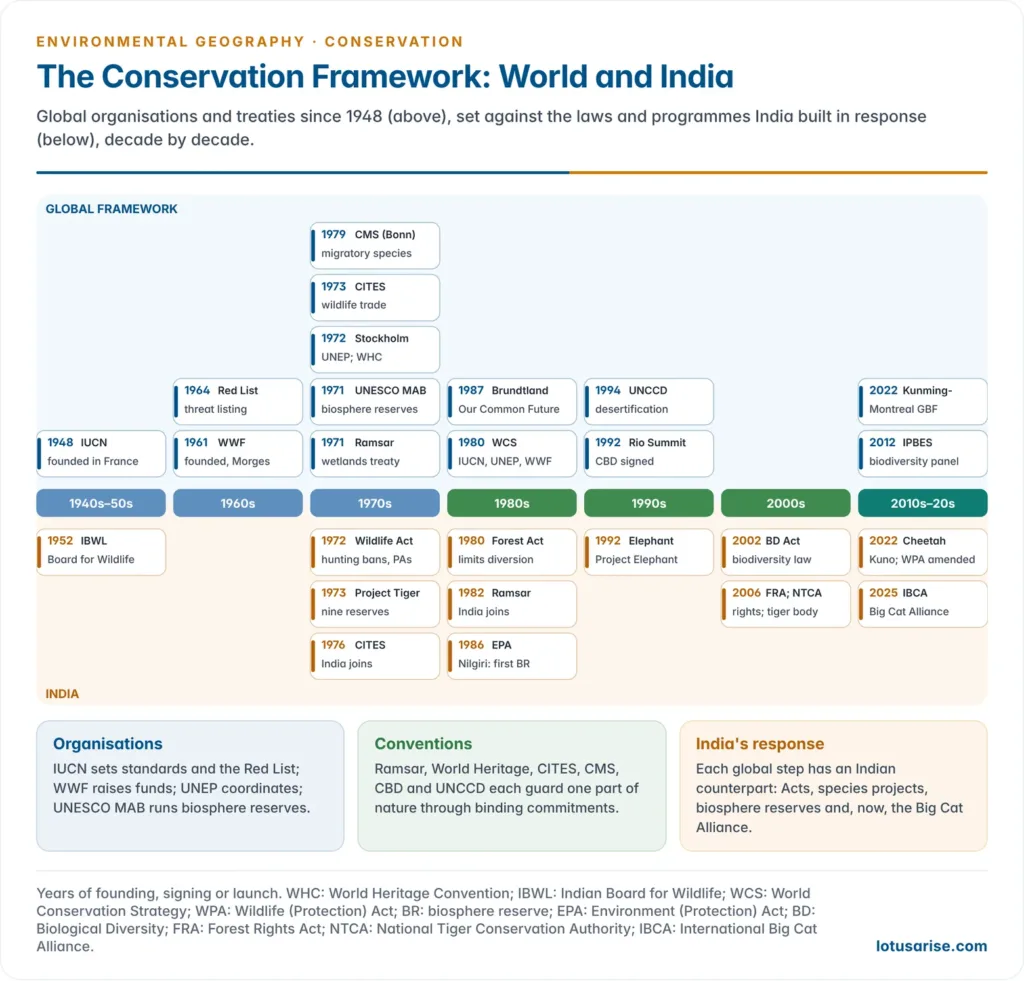
- IUCN (International Union for Conservation of Nature), founded at Fontainebleau in 1948, is a union of governments and NGOs. It keeps the Red List of Threatened Species (since 1964) through its Species Survival Commission (begun in 1949 as the Survival Service Commission) and sets the protected-area categories.
- WWF (World Wide Fund for Nature), founded in 1961 at Morges, Switzerland, to raise funds for IUCN’s work, is active in over 100 countries; WWF-India dates from 1969 and supported Project Tiger at its launch.
- UNEP came out of the Stockholm Conference (1972); UNESCO’s Man and the Biosphere (MAB) Programme (1971) designates biosphere reserves; TRAFFIC (1976) monitors wildlife trade; and IPBES (2012) assesses biodiversity for governments, much as the IPCC does for climate.
Conventions and agreements
| Instrument | Year | Role in conservation |
|---|---|---|
| Ramsar Convention | 1971 | Wetlands of international importance; India joined in 1982 and has 103 sites (October 2026) |
| World Heritage Convention | 1972 | Protects outstanding natural and cultural sites, such as Kaziranga, Manas, Sundarbans and the Western Ghats |
| CITES | 1973 (in force 1975) | Regulates trade in wild species: Appendix I (most threatened, trade banned), II (trade controlled), III (protected by one country); India a party since 1976 |
| CMS (Bonn Convention) | 1979 | Migratory species; India a party since 1983; hosted COP13 in Gandhinagar (2020) |
| World Conservation Strategy | 1980 | First global blueprint linking conservation and development |
| Convention on Biological Diversity | 1992 (in force 1993) | Conservation, sustainable use and fair sharing of benefits from genetic resources |
| UNCCD | 1994 | Desertification and land degradation |
| Kunming-Montreal Global Biodiversity Framework | 2022 | 23 targets for 2030, including 30×30 (protecting 30% of land and of the oceans) |
- India’s response: an updated National Biodiversity Strategy and Action Plan with 23 national targets (2024), the Biological Diversity (Amendment) Act, 2023, and the International Big Cat Alliance.
Previous Year Questions
2018Illustrate with suitable examples the endeavours undertaken in augmenting conservation of water and vegetation in India.2007Write short note: Social Forestry and Environmental Conservation.