

Erosion is the comprehensive natural process of detachment and removal of loosened rock material and soil by exogenetic (surface) processes. When this happens without human interference, it is called geological erosion — a slow, inevitable, and universal component of the natural process of denudation that has shaped landscapes since the Earth’s crust first formed.
Geological erosion is the slow, natural removal of soil that keeps pace with — or is slower than — the rate of new soil formation, causing no net loss of soil over time. Accelerated erosion refers to the abnormally increased rate of erosion triggered by human-induced land-use change; because this is the form of erosion that actually threatens agricultural and ecological sustainability, the term “soil erosion” in common and technical usage almost always refers to this accelerated, man-induced variant.
Geological Erosion vs Accelerated (Man-Induced) Erosion
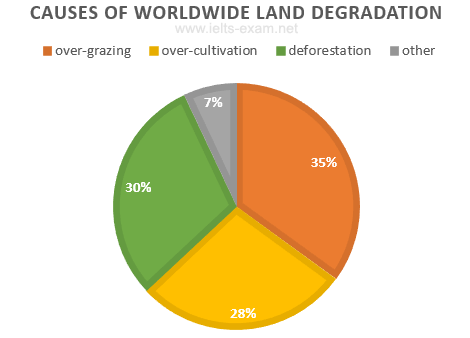
In operational terms, soil erosion is the loosening and displacement of topsoil particles from the land. It may proceed as a slow process (geological erosion) or as a fast process promoted by deforestation, floods, tornadoes, or other human activities. Crucially, soil erosion is best understood as an extreme form of soil degradation, in which the natural geomorphological process is so accelerated that soil is removed at a rate ten to several thousand times faster than under natural vegetation cover — and far faster than the rate at which new soil can form. Accelerated, man-induced erosion is most operative in humid climate regions, where extensive forest clearance, grassland removal, and intensive overgrazing/trampling by livestock have been practised at an alarming rate.
Soil erosion and land degradation together constitute one of the major problems disturbing the ecological balance of the world. The rapid growth of the human population has placed enormous strain on land and soil resources, driving both processes forward simultaneously and at an accelerating pace.
The Mechanics of Erosion: Detachment & Transport

Regardless of the agent involved (water, wind, ice, or gravity), soil erosion always proceeds through two distinct physical processes:
- Loosening and detachment of soil particles from the parent soil mass; and
- Removal and transport of the detached soil particles down-slope (or downwind).
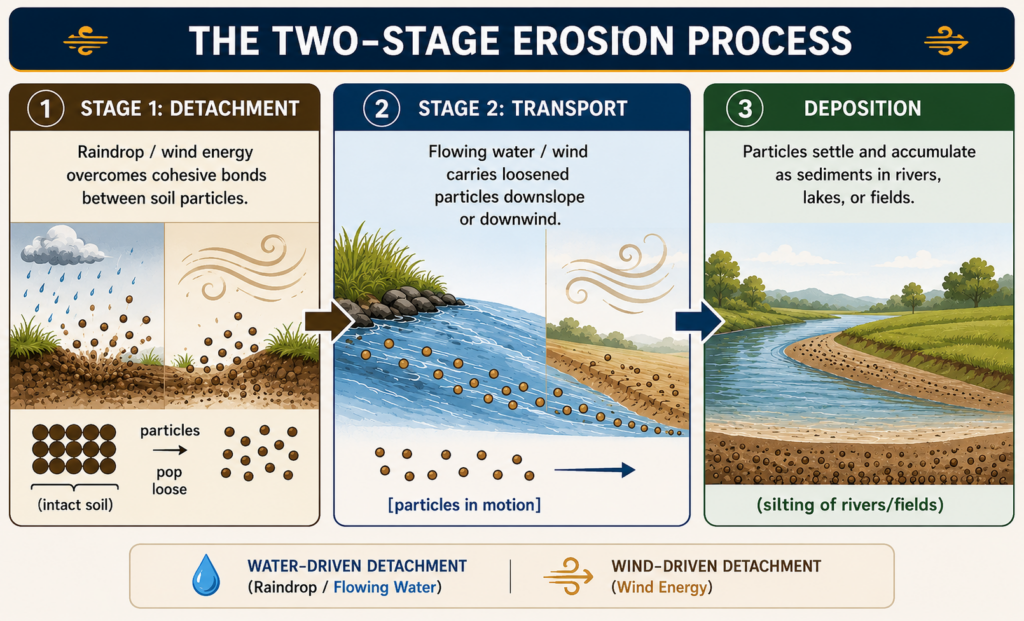
The detachability of soil particles from the soil mass is the crucial rate-limiting factor for erosion. As L.D. Meyer and W.H. Wischmeier established, detachability depends principally on grain size and cohesiveness of the particles: particles with a grain size above 0.2 mm require progressively greater force — supplied by the velocity of moving water — to be detached. In other words, the critical velocity required to detach soil particles increases as grain size increases beyond 0.20 mm, which is why coarse sandy soils, though individually less cohesive, often resist sheet erosion better than fine silty soils at the same flow velocity, up to a point.
At a broader landscape scale, Morisawa (1968) identified two major, largely independent factors that govern the rate and type of soil erosion occurring on hillslopes: climate (rainfall intensity, seasonality, wind regime) and geology (rock type, structural weakness, slope material). These two factors interact with land-use practices to determine whether erosion on a given slope proceeds as gentle sheet wash or destructive gullying.
Water Erosion — Types & Consequences
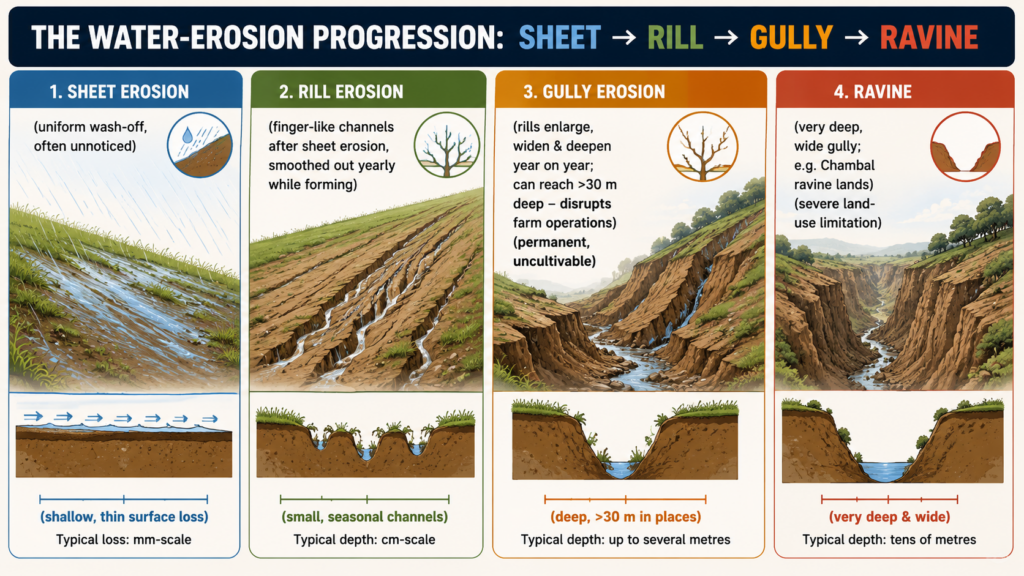
Soil erosion is classified according to the physical agent responsible: water erosion and wind erosion. Running water is the principal agent that carries away soil particles, acting through raindrops, waves, or ice; the intensity and nature of the process gives rise to six recognised subtypes.
| Type | Mechanism | Key Detail |
|---|---|---|
| Raindrop erosion | Raindrops behave like tiny bombs when they strike exposed soil — displacing particles and destroying soil structure on impact. | Average raindrop diameter ≈ 5 mm, hitting the soil at a velocity of about 32 km/hr. Vegetation cover intercepts raindrops before they strike bare soil, which is why vegetated land is protected from this process. |
| Sheet (wash-off) erosion | Detachment and transport of soil particles by a thin, uniform film of flowing rainwater across the land surface. | An extremely slow process that very often goes unnoticed until fertility has already been significantly reduced. |
| Rill erosion | Finger-like channels (“rills”) form on cultivated land once it has already undergone sheet erosion. | Rills are usually smoothed out each year as fresh tillage occurs, but if left unchecked they slowly increase in number, width, and depth every season. |
| Gully erosion | Occurs when rills increase further in size — deep gullies are termed ravines. | Wide, deep gullies sometimes reach depths of 30 metres, severely limiting land use and disrupting normal farm operations entirely. |
| Streambank erosion | Erosion of soil from the banks/shores of streams or rivers due to the force of flowing water. | Beyond simple land loss, this process can actually change the course of a river or stream and damage public roads running alongside it. |
| Landslide-driven erosion | A sudden, mass movement of soil caused by instability or loss of balance of a land mass relative to gravity. | Inhibits farm production and land use outright, and can cause mortality among both animals and humans. |
| Coastal erosion | Occurs along seashores through the wave action of the sea and the progressive inward movement of the sea into the land. | Frequently causes the adjoining land to become covered with sand, altering land use along the coast. |
Consequences of Water Erosion
- Erosion strips away the most fertile part of the soil, leaving behind the less fertile subsoil.
- The fine particles of topsoil — which contain the bulk of the nutrients and organic matter needed by plants — are the first to be lost.
- Erosion may remove seeds or seedlings outright, leaving the soil bare; bare soil is, in turn, even more vulnerable to further erosion by both wind and water — a self-reinforcing cycle.
- Removal of seeds and seedlings also reduces the soil’s ability to store water.
- Sheet, rill, gully, and streambank erosion together cause siltation of rivers, streams, and fields downstream.
- Deposition of this silt damages standing crops and pastures, and causes sedimentation of water bodies such as streams, dams, and reservoirs.
- Sedimentation of water bodies deteriorates water quality and damages aquatic habitats and the organisms living in them.
- Coastal erosion causes adjoining land to become progressively covered by sand.
Wind Erosion — Mechanisms & Consequences
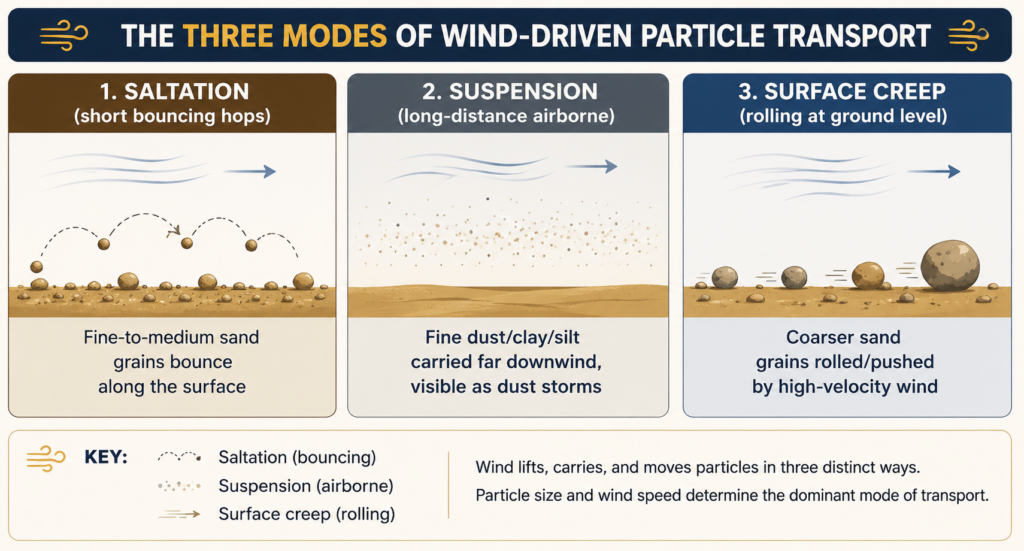
Soil erosion by wind is most common in areas where natural vegetation has been destroyed — typically in arid and dry regions and along the sandy shores of oceans, lakes, and rivers, where there is little to bind loose particles against the force of moving air.
| Mode | Mechanism |
|---|---|
| Saltation | Particles are lifted and blown by the wind in a series of short, repeated bounces close to the ground. |
| Suspension | The finest particles are carried over long distances in the atmosphere as suspended dust — the mechanism responsible for major regional dust storms. |
| Surface creep | Coarser particles are transported at ground level, rolled or pushed along by high-velocity winds without ever becoming fully airborne. |
Consequences of Wind Erosion
- Wind erosion selectively removes the finer soil material — organic matter, clay, and silt — in suspended (colloidal) form, leaving behind coarser, far less fertile material.
- Because most plant nutrients remain chemically bound to the smaller colloidal soil fraction, this selective removal causes the productive capacity of the soil to be lost along with it.
- Wind erosion also damages roads and fertile agricultural fields directly, by depositing large quantities of air-blown soil particles on top of them (burial/sand-drift damage).
Human Activities Accelerating Soil Erosion
Four broad categories of human activity are chiefly responsible for converting slow, geological erosion into the destructive, accelerated form: deforestation, farming practices, mining/economic extraction, and developmental construction work.
1. Deforestation
Deforestation includes the cutting and felling of trees, removal of forest litter, and the browsing and trampling of vegetation by livestock; forest fires also contribute to this process. Deforestation directly leads to erosion, and further compounds into broader land degradation, nutrient loss, and the disruption of the delicate soil–plant relationship that had previously stabilised the ground.
2. Farming
Agriculture is arguably the single largest human activity causing soil erosion. Crops are grown, harvested, and the land re-ploughed, leaving it exposed to wind and rain intermittently — a cycle that prevents the replenishment of soil moisture. Agriculture is responsible for the worst form of erosion on farmland — wash-off/sheet erosion. In arid and semi-arid areas, sand blows and sand shifts act in a manner analogous to sheet erosion, except that wind rather than water is the chief agent; the resulting creeping effect of desertification sets in, and the fertility of the land is lost progressively.
Agricultural Practices That Accelerate Soil Erosion
- Tilling/ploughing — disturbs the natural soil surface and destroys the protective vegetation cover, increasing the chance of erosion.
- Continuous cropping — repeated cultivation of the same land, along with extension of cultivation onto marginal and sub-marginal lands, encourages erosion.
- Cultivation on mountain slopes — without appropriate treatment measures (bunding, terracing, trenching), causes soil erosion and severe loss of soil nutrients.
- Monoculture — planting a single crop variety accelerates erosion in three distinct ways: (i) the entire field is harvested at once, leaving it completely bare and exposed to water and wind; (ii) without any standing vegetation, rainfall is not retained and instead flows rapidly over the surface, carrying away topsoil; (iii) a single disease or pest outbreak can wipe out the entire crop at once, leaving bare soil fully susceptible to erosion.
- Overgrazing — too many animals feeding on a single piece of grassland; trampling and grazing destroy the vegetation, and in its absence the land becomes highly susceptible to both wind and water erosion.
3. Mining and Economic Activities
Soil erosion also occurs as a direct consequence of economic activity. The extraction of useful natural resources — metals, minerals, and fossil fuels — from the land causes serious disturbance, leading to erosion and drastic changes to the surrounding landscape.
4. Developmental Work, Human Settlements & Transport
Soil erosion may also result from developmental activities such as housing, transport, communication infrastructure, and recreational facilities. Building construction actively promotes accelerated soil erosion during the construction of houses, roads, and rail tracks: these activities cause massive disturbance to the land, resulting in erosion and the disruption of the natural drainage system.
Consequences of Soil Erosion (Consolidated)
Drawing together the water- and wind-erosion-specific consequences already discussed, the following consolidated list captures the full range of downstream impacts of unchecked soil erosion:
- Loss of the fine topsoil particles containing the bulk of nutrients and organic matter needed by plants (water erosion) — and the equivalent loss of organic matter, clay, and silt in colloidal/suspended form under wind erosion.
- Removal of seeds/seedlings, leaving soil bare and thus even more vulnerable to further erosion by both wind and water — and reducing the soil’s capacity to store water.
- Siltation of rivers, streams, and fields from sheet, rill, gully, and streambank erosion, damaging crops/pastures and causing sedimentation of dams, reservoirs, and other water bodies — which in turn deteriorates water quality and damages aquatic habitats and organisms.
- Gully erosion causes the loss of large volumes of soil outright; wider, deeper gullies (sometimes reaching 30 m) severely limit land use and disrupt normal farm operations.
- Streambank erosion causes not just loss of land but can actually change the course of a river or stream, while also damaging public roads running along the bank.
- Wind erosion damages roads and fertile agricultural fields by depositing large quantities of air-blown soil particles on top of them.
- Landslides (mass movement of land) inhibit farm production and land use, and can cause mortality among both animals and humans.
- Coastal erosion causes the adjoining land to become progressively covered by sand.
General Prevention of Soil Erosion
- It is essential to retain vegetation cover so that soil is not directly exposed to rain — plant roots hold soil particles together, while plants themselves intercept rainfall and protect the soil from the direct impact of raindrops.
- Cattle grazing should be controlled to prevent destruction of the protective vegetative cover.
- Crop rotation and keeping land fallow (not planting anything for a period) should be adopted to allow the soil to recover structurally and biologically.
- Vegetation and soil management should be improved specifically to increase soil organic matter content.
- To prevent streambank erosion, runoff water should be stored in the catchment for as long as possible, by maintaining vegetation cover and by constructing dams for water storage.
- To prevent or reduce coastal erosion, protective vegetation along beaches should be re-established. The single best method of controlling coastal dune erosion is to not disturb the dunes and the coastal system at all; further, construction of buildings and other development should be located behind the dune system.
- For wind erosion control, vegetation cover over sandy soils should be maintained above 30%, and access of wind to bare soil should be controlled by leaving stubble or mulch on the surface (stubble being the remains of the crop left after harvesting).
- Wind speed itself can be broken or controlled by planting trees in the form of a shelter belt.
Land / Soil Degradation
Degraded land is classified on the basis of the reduction it causes in the land’s productive capacity:
| Class | Reduction in Crop Yield Potential |
|---|---|
| Slight degradation | Crop yield potential reduced by up to 10% |
| Moderate degradation | Yield potential reduced by 10–50% |
| Severe degradation | More than 50% of the land’s potential yield capacity is lost |
Three principal causes of land degradation are recognised: the use of agrochemicals (chemical fertilisers and pesticides), excessive irrigation, and the cultivation of high-yielding varieties (HYVs).
1. Agrochemicals and Their Harmful Effects on Land
Agrochemicals are applied to soil for two main reasons: (i) to replenish or replace soil nutrients using chemical fertilisers, and (ii) to destroy plant pests using toxic chemicals called pesticides.
(i) Adverse Effects of Chemical Fertiliser Use
Plants continuously take up nutrients from the soil, and repeated crop cultivation progressively depletes these nutrients — hence the periodic need for chemical fertiliser augmentation. However, excessive use of chemical fertilisers and pesticides produces several harmful side effects:
- Most chemical fertilisers used in modern agriculture supply the macronutrients nitrogen, phosphorus, and potassium (NPK). Excessive addition of NPK causes plants to absorb correspondingly more micronutrients from the soil to balance their metabolism — depleting the soil of micronutrients like zinc, iron, and copper, and thereby decreasing overall soil productivity.
- Fertiliser that is not taken up by plants is washed down by rainwater into water bodies, causing eutrophication or algal bloom, which leads to the death of aquatic life through oxygen depletion.
- About one-fourth of applied fertiliser is never used by the crop and is instead leached down into the soil and underground water aquifers. Excess nitrates in drinking water are particularly harmful to bottle-fed infants, causing the disease methemoglobinemia (“blue baby syndrome”).
(ii) Adverse Effects of Plant Protection Chemicals (Biocides)
Toxic chemicals used to kill agricultural pests are collectively termed biocides — agents that kill organisms. Biocides are not selective: they kill not only the target pests but frequently also non-target and otherwise useful organisms. Moreover, biocides tend to remain chemically active long after they have destroyed their target organisms (pests, weeds, fungi, or rodents) — it is precisely this persistence in the environment that makes these chemicals so harmful over the long term.
2. Problems Due to Excessive Irrigation
Excessive irrigation of soil can lead to two distinct degradation pathways: waterlogging and the accumulation of salt in the soil. Both degrade the land, though through different mechanisms.
- Waterlogging: Excessive irrigation without proper drainage raises the water table, causing the soil to become drenched or waterlogged. This waterlogged condition cannot support good plant growth because it lacks air — particularly oxygen, which is essential for the respiration of plant roots. Waterlogged soils also lack mechanical strength, and cannot support the weight of plants, which consequently fall over and become logged or submerged in the mud.
- Salt affectation: In areas of high temperature, excessive irrigation usually causes salt to accumulate in the soil, because water evaporates rapidly and leaves behind traces of dissolved salt. As irrigation cycles are repeated, this leftover salt accumulates and eventually forms a thick layer of grey or white efflorescence on the surface. The productivity of salt-affected soil is very low — plants growing in saline soil are unable to absorb nutrients properly and so face water stress even when soil moisture is actually abundant.
3. Impact of High-Yielding Varieties (HYVs)
High Yielding Varieties (HYVs) — man-made varieties of agricultural crops, fodder plants, forest trees, livestock, and fish — have substantially increased food production, but at the same time have significantly impacted the environment. HYVs require adequate irrigation and extensive use of fertilisers and pesticides to be successful, and thereby indirectly drive both the agrochemical and excessive-irrigation degradation pathways already described above.
Conservation Measures & Agricultural Technologies
1. Tree Planting
To prevent wind erosion, trees should be planted so that they physically break the force of the wind. Trees do more than simply shield the soil from sun, wind, and water — their root systems actively help to hold soil particles together, anchoring them against detachment.
2. Cultivation and Farming Techniques
| Technique | Mechanism | Note |
|---|---|---|
| Cultivation direction | Cultivating land at right angles to the direction of the wind reduces soil erosion by wind. | Simple orientation-based defence needing no infrastructure |
| Contour ploughing | Tilling the field at right angles to the slope (rather than up-and-down it); the resulting ridges act like tiny dams, holding water and allowing it to seep into the soil instead of running freely downslope. | Can reduce soil erosion by up to 50% |
| Strip farming | Main crops planted in widely spaced rows, with the spaces filled by another crop to ensure complete ground cover, retarding water flow and allowing it to soak into the soil. | Reduces both runoff velocity and erosion |
| Terracing | Levelling off areas on steep slopes to prevent water flowing directly down the gradient. | Disadvantage: terraces themselves can erode and require substantial ongoing maintenance and repair |
| Timing/season of tillage | Ploughing in autumn/fall leaves soil exposed to erosion for the entire winter; retaining ground cover until spring minimises the time window available for erosion. | A low-cost, purely scheduling-based intervention |
| No-till cultivation | Specialised machinery loosens the soil, plants seeds, and manages weeds simultaneously with minimum soil disturbance. | Adverse effect: weed and insect populations can increase, since they are no longer continuously disturbed/removed, and may compete with or damage crops |
| Polyvarietal cultivation | A field is planted with several varieties of the same crop, which mature and are harvested at different times. | Because the entire field is never bare/exposed all at once, the land remains continuously protected from erosion |
| Addition of organic matter | Achieved by ploughing in crop residues, or growing an entire crop specifically to be ploughed back into the ground. | Soil microbes decompose this organic matter and produce sticky polysaccharides that glue soil particles together, directly increasing resistance to erosion |
3. Agricultural Technologies for Preventing Soil Degradation
- Organic farming / green manures: Instead of applying chemical fertiliser to supplement soil nitrogen, the natural nitrogen-fixation process of bacteria housed in legume root nodules can be harnessed. Alongside this, organic fertilisers such as cow dung and agricultural waste improve the soil’s nutrient status — helping to reduce the excessive and prolonged use of chemical fertilisers and thereby minimising their toxic side-effects.
- Biofertilisers: Micro-organisms are essential constituents of fertile soils — they participate in the development of soil structure, add available nutritional elements, and improve the soil’s physical conditions. A wide variety of micro-organisms are now deployed as biofertilisers to improve the nutritional status of crop fields.
- Biological pest control: The natural predators and parasites of agricultural pests play a significant role in controlling plant pests and pathogens. Farmers increasingly use these biological control agents to manage or eliminate pests; crucially, because they do not enter the food chain or poison other animals, they are unlikely to cause harm to humans, unlike persistent chemical biocides.
Indian Context
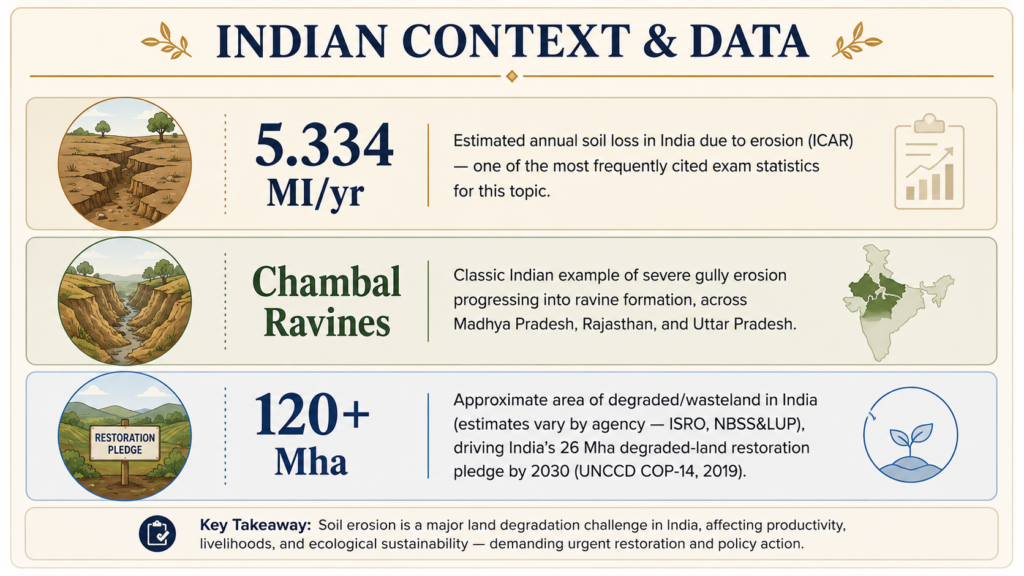
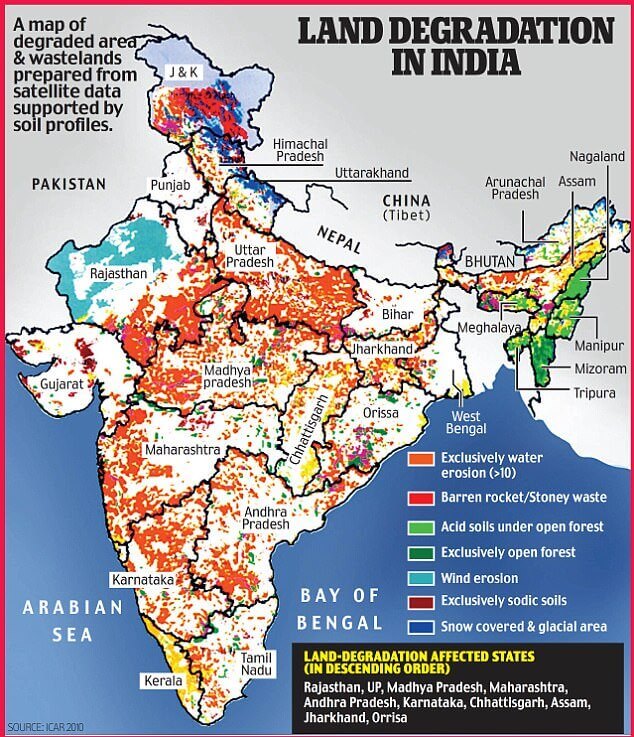
- Jhum (shifting) cultivation in the hill states of North-East India (Nagaland, Mizoram, Manipur) is a classic Indian illustration of “cultivation on mountain slopes without appropriate treatment measures,” accelerating both sheet and gully erosion once the fallow cycle shortens under population pressure.
- Overgrazing-driven wind and sheet erosion is widespread across the semi-arid tracts of western Rajasthan (Thar Desert margins), where the loss of grass cover accelerates desertification.
- Canal-irrigation salinisation — the classic Indian illustration of “salt affectation” from excessive irrigation — affects parts of Punjab, Haryana, and western Uttar Pradesh, producing the locally-named Reh/Kallar/Usar lands.
- Terracing and bench-terrace cultivation in the Himalayan foothills and the Western Ghats represent long-standing indigenous responses to slope-erosion risk, functioning on the same contour-ploughing/terracing principle described in Section 9.2.
- Institutional response: the Integrated Watershed Management Programme (IWMP), Pradhan Mantri Krishi Sinchayee Yojana (PMKSY — “Watershed Development” component), the Soil Health Card Scheme (2015), and India’s National Action Plan on Climate Change together constitute the principal policy architecture addressing soil erosion and degradation.







Sir plz quickly upload rest topics of optional
Ok, Rabindra
sir, your notes are very helpful.
Thanks, Keep reading
Your notes are so helpful to us, who can’t afford to go coaching. Thanks a lot for your condition less support.
Got a foundation for your notes
This is so helpful thank u so much lotusarise 🙏🏻
Sir you’re doing great job for us, we’re highly indebted to your efforts ❤️🙏👏🙌
I’ve a request, can you please add some India related examples in Paper 1 notes (wherever possible) as it helps in linking our answers with Paper 2
thank you sir.