

- Agriculture comes from two words, ager (soil or field) and culture (cultivation). It is the art, science and business of producing crops and livestock for economic purposes.
- Allied activities sit beside it: livestock, fisheries, poultry, horticulture, animal husbandry, dairy and agroforestry.
- Agriculture and its allied sector give India’s huge population both nutrition and livelihood, and link the economy to its monsoon, soils and land resources.
Indian Agriculture
Importance
- Livelihood:
- Older accounts held that two-thirds of the population depends on farming, directly or indirectly, and that 55% of the labour force works in it.
- The current official statement (March 2026) is that the sector employs about 46.1% of the workforce and supports close to 55% of the population.
- Around 1971, some 80% of people lived in rural areas and depended largely on farming.
- Share in output:
- The sector gave about 45% of GDP around 1971, and later 14–17% in older accounts.
- It now gives nearly one-fifth of gross value added at current prices (March 2026).
- Exports:
- An older figure put farm goods at 15% of export earnings.
- Agricultural exports reached USD 51.1 billion in 2024-25, up from USD 34.5 billion in 2019-20.
- Main items include tea, coffee, cashew kernels, raw cotton, oilcakes, tobacco, spices, fruit and vegetables.
- Double link with industry:
- As supplier, farming feeds textiles, sugar, flour mills, jute and apparel.
- As buyer, it needs tractors, harvesters, threshers, fertilisers and pesticides, and farm income creates a market for manufactured goods.
- Food security: rising output underpins the food supply of a large population. Foodgrain output reached a record 357.73 million tonnes in 2024-25, and horticulture 362.08 million tonnes.
- Natural base: broad level plains, rich soils, a high share of culturable land, climatic variety, ample sunshine and a long growing season.
Salient Features of Indian Agriculture
- Subsistence agriculture: most Indian farming is of this type. Output goes mainly to self-consumption, with little or no surplus for the market.
- Commercial agriculture: large-scale farming for the market also exists, such as tea in Assam, coffee in Karnataka and coconut in Keralam (Kerala). Firms sell large output to earn profits.
- Pressure of population on land: the land resource is limited, and the pressure of a growing population rises day by day.
- Urban India reached 31.16% of the population in 2011, and towns take farmland as they spread.
- Mechanisation: machines have spread in farm operations since the Green Revolution.
- Major mechanised areas: Punjab, Haryana, western Uttar Pradesh, and the river valleys of Andhra Pradesh and Tamil Nadu.
- It is now spreading in Uttarakhand, Gujarat and Maharashtra, though machines remain mostly with richer farmers. Farm power tracks this shift.
- Importance of animals: bullocks and other draught animals still plough, irrigate, thresh and carry over much of the country.
- Monsoon dependence: weak irrigation long left two-thirds of farming dependent on monsoon rain.
- Net irrigated area was about 55% of net sown area in 2021-22 (77.92 of 141.01 million hectares), and the gross irrigated share has reached 55.8% (March 2026). The rest still rises and falls with an erratic monsoon.
- Variety of crops: topography, soils (alluvial, red, black cotton and others) and climate differ so widely that tropical and temperate crops both thrive.
- Hill slopes suit tea, and plains suit rice.
- Predominance of food crops: a large population and subsistence habits keep food crops first, in keeping with food security needs.
- Their share of cropped area was about 64% in 2010-11.
- Neglect of fodder: permanent pastures cover only 3.33% of the reporting area (2023-24), so a very large livestock population is poorly fed and gives low yields.
- Seasonal pattern: there are basically three seasons, kharif, rabi and zaid.
- Mixed cropping: common in rainfed areas as insurance against the monsoon, with several crops in one field and as many as 10–15 under jhum. It protects the farmer but lowers per-hectare output, and the wider cropping systems build on it.
- Large cultivated share: net sown area is 45.28% of the reporting area (2023-24), helped by extensive flat land. An older comparison gave the USA 16.3%, Japan 14.9%, China 11.8% and Canada 4.3%.
- Labour intensity: most field work, from ploughing to threshing, still depends on farmers and their animals.
Cropping Seasons in India
- There are three distinct seasons in the northern and interior parts of the country:
- Kharif: these crops need plenty of water, so sowing largely coincides with the onset of the southwest monsoon.
- Rabi: sowing begins with the onset of winter in October–November, and harvest comes in March–April. The festival of Holi is linked with a good harvest in these months.
- Zaid: a short summer season after the rabi harvest, with watermelons, cucumbers, vegetables and fodder crops on irrigated land. Newer varieties have also brought pulses into this season.
- The south lacks such a clear split, because temperatures stay high. The same crop can be grown up to three times a year where moisture allows.
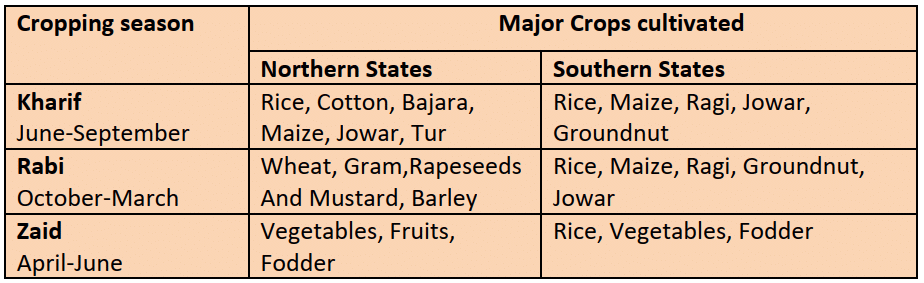
- Some crops are grown in both kharif and rabi, such as maize, jowar and groundnut.
Shifting Cultivation, Land Rotation or Jhumming
- It is called shifting cultivation because the farmer moves on once the soil loses fertility, generally in 2 to 3 years.
- Forest land is cleared and cultivated, usually by slash and burn. It is also called land rotation, because the same crop, generally rice, moves to a different plot.
- Soil productivity falls with repeated cropping on one cleared patch, and the crop then shifts to fresh slashed and burnt land.
- It causes soil erosion, because clearing strips the vegetation that holds the soil.
- It is practised in the north-eastern States, the Chotanagpur plateau of Jharkhand, Madhya Pradesh, and hilly parts of the Himalaya, Western Ghats and Eastern Ghats.
- The figure shows the cycle: forest, cut and burn, crop, fallow, then secondary forest or a fresh cut.

- Regional names:
- Jhum in Assam and the North-East
- Ponam in Keralam
- Podu in Andhra Pradesh and Odisha
- Bewar, Masha, Penda and Bera in parts of Madhya Pradesh
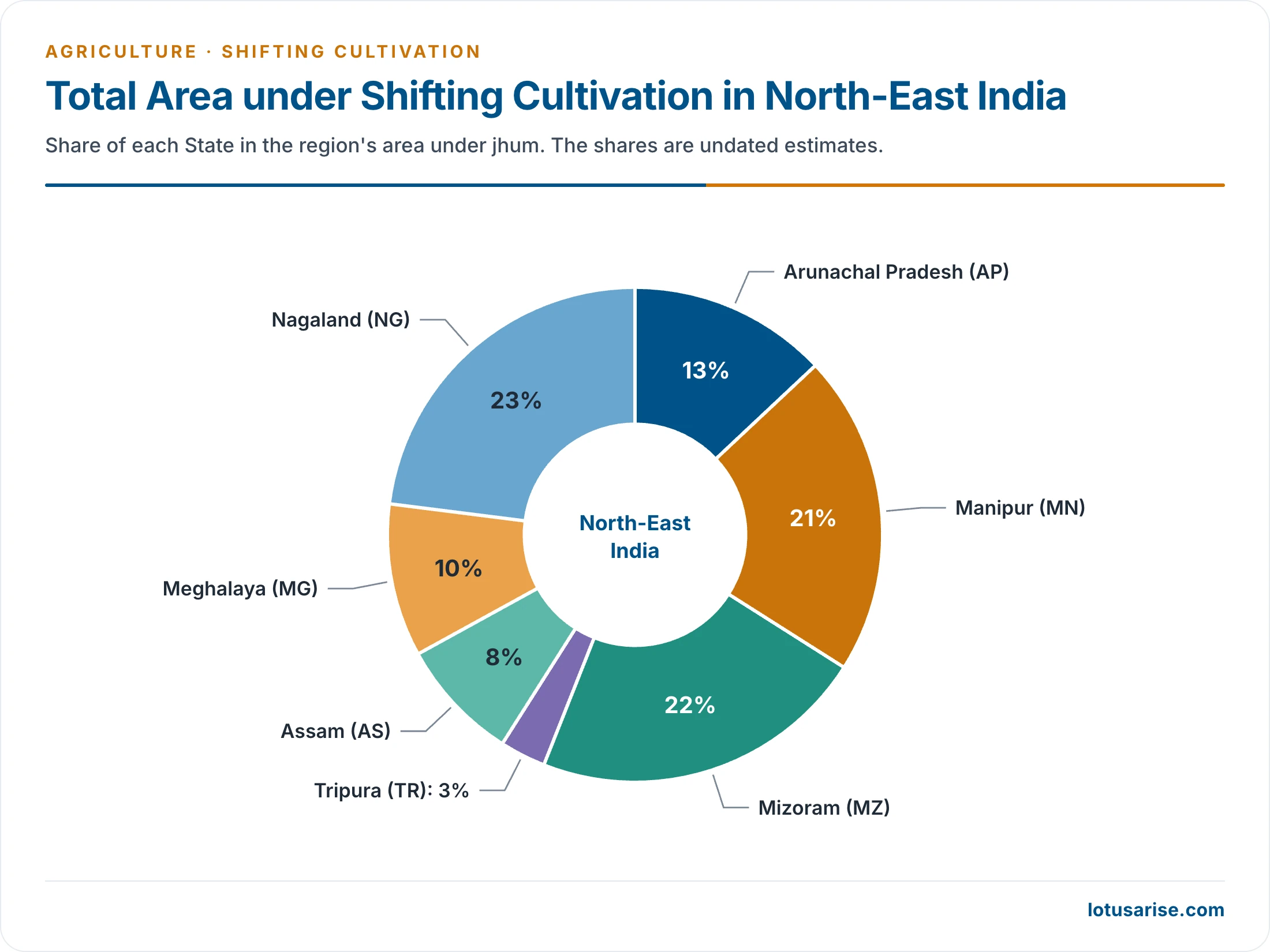
- The chart’s shares are undated estimates. NITI Aayog (2018) asked that jhum be treated as a distinct land use with a long fallow phase, and called for better data, since the area is poorly documented.
Crop Rotation
- Crop rotation is the reverse of land rotation: the land stays fixed, and the crops change.
- It means planting different crops in sequence on one plot to improve soil health, optimise nutrients, and combat pests and weeds.
- Crops and fallows follow a set scientific sequence that conserves fertility.
- Example: malt barley in the first year, spring wheat in the second, potato in the third, then back to malt barley in the fourth.
- Crops differ in their nutrient needs, so the sequence maintains and even improves fertility, and steadies farm income.
- With some crop nearly always on the ground, rotation checks topsoil erosion and conserves moisture.
- Suitable rotation is central to modern scientific farming, which seeks maximum yield while holding soil productivity. Leaving out nitrogen-fixing legumes works against this aim.
Sustainable Agriculture or Eco-Farming
- Why the concept arose:
- Yields from modern techniques have reached a plateau.
- Heavy use of chemicals and fertilisers leaves pesticide residue in the food chain, and brings eutrophication and land degradation that deplete land as a lasting resource.
- Aim: a farming system that meets present food needs without eroding the ecological assets and life-support systems of future generations.
- The word sustainability describes a process that can be kept up indefinitely.
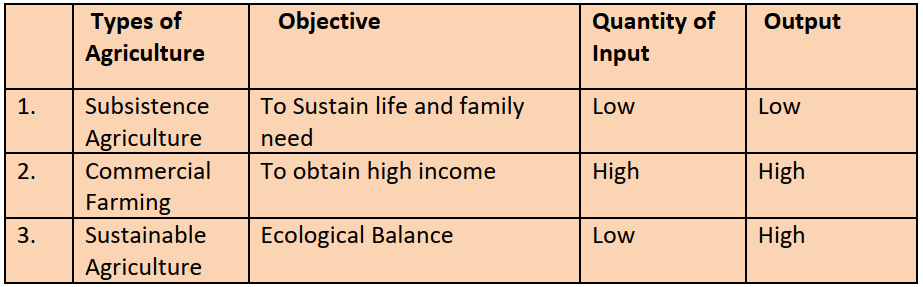
- The table sets out the contrast. Sustainable agriculture aims for low input and high output, while conserving soil and raising land productivity.
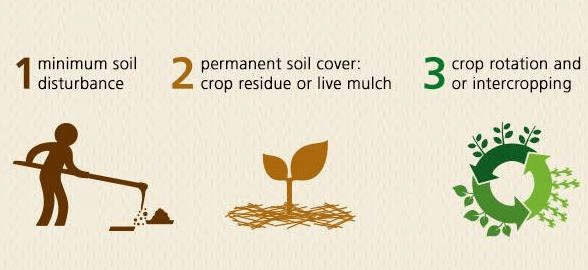
- Practices: manures, crop rotation and minimal tillage, shown below as three principles.
- It also includes agroforestry (trees near crops), multi-level cultivation (trees of different heights in sequence) and integrated animal husbandry (crops raised together with animals).
- Policy: the National Mission for Sustainable Agriculture carries this aim into government programmes.
Zero Tillage or No-Till Farming
- Tillage: preparing land by mechanical agitation, which includes digging, stirring and overturning.
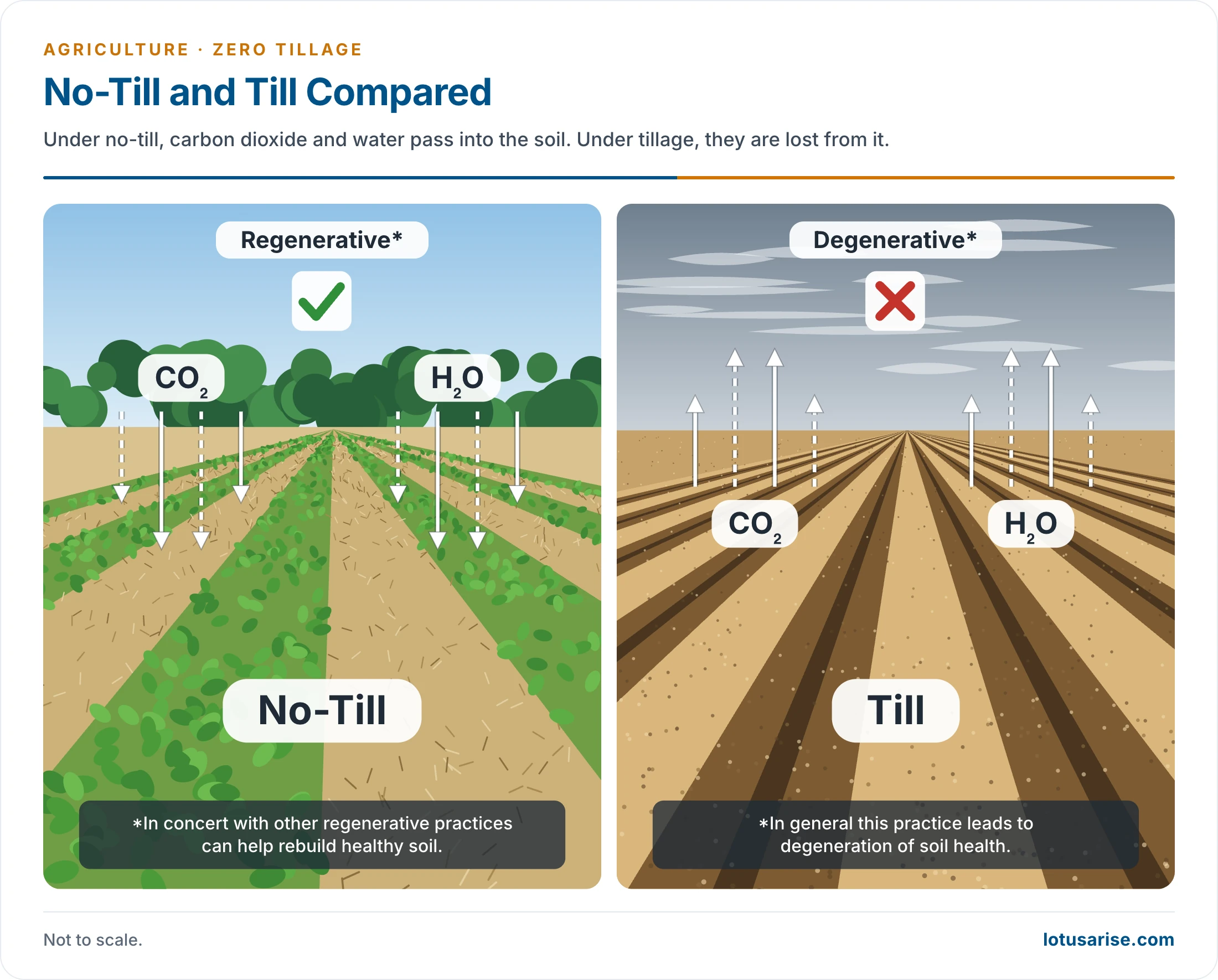
- Zero tillage (also no-tillage or nil tillage): seed is sown by drill without prior land preparation, directly into soil holding the stubble of the previous crop.
- It lowers cultivation cost, soil erosion, crop duration, irrigation need and weed effect compared with tillage.
- It cuts the erosion that tillage causes, especially on sandy, dry soils on sloping terrain.
- USA: no-till is widely used there, and the area keeps growing as costs fall. Fewer machine passes are needed, and crop residue slows evaporation and improves water infiltration.
- India: it has spread for wheat after rice on the rice-wheat belt of the Indo-Gangetic Plain, which covers about 12–13.5 million hectares. The Happy Seeder sows into residue and gives farmers an option other than burning straw.
- Advantages:
- Shorter crop duration, so earlier cropping and higher yields.
- Lower land-preparation cost, by around 80%. Field trials report a 75–80% cut in fuel use.
- Better use of residual moisture, with fewer irrigations.
- Dry matter and organic matter added to the soil.
- Carbon sequestration that lowers the greenhouse effect. Claimed cuts in nitrous oxide emissions are 40–70%, though results vary with soil and moisture.
- Less compaction, less water lost as runoff, and less erosion.
- More useful flora and fauna, since the soil is left undisturbed.
- Disadvantages:
- High initial cost of equipment, which should be recouped through higher yields and savings on fuel and labour.
- Gullies can form in fields, which low-pressure tyres and changing traffic patterns help prevent.
- Greater use of herbicides.
- A learning curve for farmers.
Zero Budget Natural Farming (ZBNF)
- ZBNF drops chemical pesticides, sustains farming with eco-friendly processes, and restores soil fertility and organic matter.
- It is a chemical-free method based on agroecology. “Zero budget” means no net spending on bought inputs, because natural fertilisers, biological pesticides and local seeds replace them.
- The method is linked with Subhash Palekar, a Padma Shri awardee.
- Benefits claimed:
- As a social and environmental programme, it seeks to keep smallholder farming viable by enhancing farm biodiversity and ecosystem services.
- It cuts costs by using in-situ resources to rejuvenate soils, and aims at higher incomes and healthier ecosystems through diverse, multi-layered cropping.
- Its advocates treat dung from local cows as a cure for tired soil, believing one gram holds 300–500 crore beneficial micro-organisms, which break down dried biomass into ready plant nutrients.
- They also claim it needs only 10% of the water and electricity used by chemical and organic farming, and that it helps crops adapt to changing climatic conditions.
- Four wheels of ZBNF:
- Jiwamrita: fermented desi cow dung and urine, jaggery, pulse flour, water and bund soil. It is a source of some 500 crore micro-organisms that turn unavailable nutrients into available ones, and is not itself a fertiliser.
- Bijamrita: desi cow dung and urine, water, bund soil and lime, used to treat seed before sowing.
- Mulching: a layer of dried straw or fallen leaves that conserves moisture and holds root temperature at 25–32°C, so micro-organisms can work.
- Waaphasa: water supplied to keep the moisture-air balance, serving the same end.
| Point | Zero Budget Natural Farming | Organic farming |
|---|---|---|
| Inputs | No external fertilisers | Compost, cow dung and vermicompost |
| Field work | No tilling or mixing; relies on natural ecosystems | Basic methods such as tilling, ploughing and mixing |
| Cost | Low, thanks to local biodiversity | Expensive, because of bulk manures |
- Evaluation and policy:
- The National Academy of Agricultural Sciences (2019) called ZBNF unproven and advised against public spending on it without evidence.
- The Union Cabinet approved the National Mission on Natural Farming on 25 November 2024, with Rs 2,481 crore to reach 1 crore farmers and 7.5 lakh hectares through 15,000 clusters.
Subsistence Farming
- Farmers grow food for themselves and their families on smallholdings, for survival and mostly local needs, with little or no surplus.
- The majority of farmers in the country practise it.
- Features:
- Small and scattered holdings and primitive tools.
- Poor farmers use fertilisers and high-yielding seed less than they should.
- Electricity and irrigation are generally lacking.
- The whole family works the farm, mostly by hand.
- Yields are modest, and the family eats most of the output.
Plantation Agriculture
- Plantation agriculture is commercial farming of a single crop grown through the entire year.
- Major crops: tea, coffee, sugarcane, cashew, rubber, banana and cotton.
- Location: mainly the tropics, on every continent with a tropical climate.
- Examples: rubber in Malaysia, coffee in Brazil, tea in India and Sri Lanka.
- Nature: capital-intensive and export-oriented, needing good management, technical know-how, sophisticated machinery, fertilisers, irrigation and transport.
Dryland and Wetland Farming
- Dryland farming:
- Practised under low rainfall, as in Rajasthan and parts of Gujarat and Maharashtra. Soils are sandy, with low water retention.
- Crops: peas, millets, gram and other drought-resistant crops or varieties.
- It helps in soil and water conservation, and dryland and rainfed farming form a field of their own.
- Wetland farming:
- Practised under high annual rainfall, mainly in river plains, north-east India and the Ghats. Crops needing much water grow easily.
- Crops: rice, sugarcane and jute. Cotton is often listed too, though it is chiefly a crop of black soils and irrigated tracts.

- This table compares dryland with rainfed farming, the next step up the rainfall scale. Wetland farming lies beyond both.
Terrace Cultivation
- Hill and mountain slopes are cut into terraces, and the land is then used as in permanent farming.
- Flat land is scarce on such slopes, so terraces supply small level patches.
- Terracing also checks soil erosion. Rice is the main crop on many hill terraces.

Problems of Indian Agriculture
- The problems are partly natural and partly made by people, and they reinforce one another.
Land and Tenure
- Small and fragmented holdings:
- Net sown and cropped areas look large until they are divided among farmers. The average holding fell from 2.28 hectares (1970-71) to 1.16 (2010-11) and 1.08 (2015-16).
- Keralam, West Bengal, Bihar and eastern Uttar Pradesh are worst placed, with averages under one hectare and pockets under half a hectare.
- Inheritance drives it. Each heir takes a share of every tract, so plots shrink and scatter with each generation.
- Time and labour go in moving between plots, irrigation becomes harder, and boundaries waste good land.
- The remedy is consolidation, which has gone far only in Punjab, Haryana and parts of Uttar Pradesh.
- Land tenancy: where absentee owners hold the land, tillers have little reason to invest, and yields stay low.
- No definite land use policy: with no national or regional plan, farmers choose crops freely, so gluts and shortages follow by turns. Land capability offers one planning guide.
Soil and Water
- Low fertility: long cropping without replenishment has left many soils short of nutrients and humus.
- Soil erosion and degradation: poor practice and reckless tree-felling expose the topsoil to water in wet areas and wind in dry ones. The causes and conservation of this loss form a study of their own. Some 25.55 crore Soil Health Cards had been issued by November 2025.
- Irrigation:
- Assured water is the key input in a tropical monsoon country, as Punjab, Haryana and western Uttar Pradesh show.
- Excess brings its own harm. Salinity, alkalinity and waterlogging have hit tracts of Punjab and Haryana and the Indira Gandhi Canal command.
- Monsoon dependence: rainfall varies most where it is least, and a failure can push prices up and bring famine conditions in extreme cases.
Inputs and Technology
- Seeds: good seed is costly, and public schemes often miss small and marginal farmers.
- Manures, fertilisers and biocides:
- Dung is the best manure, yet much of it is burnt as kitchen fuel, and chemical fertiliser is often beyond poor farmers despite subsidy.
- Rural and urban compost remain under-used, though using them would also solve a waste disposal problem.
- Pests, germs and weeds once took about one-third of field output. Biocides saved crops, but careless use spreads pollution.
- Weak mechanisation and primitive technology: the wooden plough, sickle and hoe, with bullocks, male buffaloes or camels, waste labour on small farms. Machinery reaches mainly richer farmers in a few States, although a large industry now builds tractors, power tillers and harvesters.
Markets and Money
- Marketing:
- Poor farmers cannot wait after harvest, so they make distress sales in the village, often to the moneylender who lent to them.
- Surveys once showed middlemen taking 48% of the consumer’s price for rice, 52% for groundnut and 60% for potato.
- Regulated markets answer this with competitive buying, standard weights and a means of settling disputes.
- Storage:
- Lack of storage forces immediate sale at low prices. An older estimate set post-harvest loss at 9.3%, of which 6.6% came from poor storage.
- The Food Corporation of India, the Central and State Warehousing Corporations, and the rural godown scheme of 1979-80 work on this.
- Transport: many villages still lack good links, and kutcha roads fail in the rains, which ties farmers to the local market.
- Scarcity of capital:
- A farmer’s capital is locked in land and stock, so he must borrow. Moneylenders supplied 68.6% of rural credit in 1950-51 and 43% in 1975-76, at high interest.
- Cooperative and commercial banks have since widened lending, and PM-KISAN had paid out Rs 4.27 lakh crore in 22 instalments by March 2026.
Society and Support
- Tradition: caste-linked occupations and absentee landlords slow the response to new ideas.
- Low status of farming: young people from farm families prefer petty office jobs, rich farmers invest elsewhere, and many migrants end up in urban slums.
- Lack of crop diversification: food crops come first, while fodder and nitrogen-fixing legumes are neglected, to the soil’s cost.
- Low productivity: yields of most crops remain below international standards, and better inputs reach only some regions and richer farmers.
- Government neglect:
- Plans after the first favoured industry, and prices have often been unremunerative. Debt and distress have driven farmer suicides even in richer regions such as Punjab and Maharashtra.
- Later Plans gave agriculture more weight. Crop insurance claims paid exceeded Rs 1.90 lakh crore by March 2026.
- Weak research, training and extension: laboratories and fields are poorly connected, and small farmers seldom hear of new findings, so trained field workers are badly needed.
India’s Position in World Agriculture
- Ranks shift with each year’s data, so the table sets an older listing based on the Food and Agriculture Organization (about 2017) beside the latest official statement (March 2026).
| Commodity | Older listing | Latest dated position |
|---|---|---|
| Milk | Largest | Largest, nearly 25% of world output (2026) |
| Millets | Largest | Largest, 18.59 million tonnes (2024-25) |
| Pulses | – | Largest, 25.68 million tonnes (2024-25) |
| Dry onion | Second, after China | Largest, nearly 25% of world output |
| Rice | Second, after China | Officially second in March 2026; national output of 150.18 million tonnes (2024-25) tops China’s reported 145.28 |
| Wheat | Second, after China | Second, 117.95 million tonnes (2024-25) |
| Sugarcane | Second, after Brazil | Second, 454.61 million tonnes (2024-25) |
| Tea | Second, after China | Second |
| Cotton (cottonseed) | Largest (International Cotton Advisory Committee, ICAC, March 2017) | Cotton second, about 5.05 million tonnes (2024-25) |
| Coconut, spices | – | Largest |
| Fruit and vegetables | – | Second |
| Jute, ginger, banana, mango, papaya, castor seed, safflower seed | Largest | – |
| Potato, garlic, silk | Second, after China | – |
- Cement appears on the older list as well: India is the second largest producer, next to China, though cement is an industrial product.
Previous Year Questions
2026Examine the causes and consequences of crop diversification in India. How can crop diversification contribute to sustainable agriculture?2025How does the agricultural sector of India confront with the contemporary physical and politico-economic changes in the different regions of the country? Elucidate.2023Discuss the significance of organic farming for sustainable agricultural development in India.2018Explain the contemporary agricultural scenario in the context of rapid urbanisation in India.1986Describe the problems of production and distribution of food crops in India from the regional point of view.





To the point and relevant article
Thanks, guys. keep reading
Plz provide total gs notes upsc
thanx sir for exceptional articles with current data.
great job .,, fantastic explanation ……GOD BLESS YOU
Thanks
Sir pls make notes on NDA &CDS syllabus for this websites because I am NDA aspirant and I write notes of UPSC IAS. May be it’s very hard to new and other aspirant. So pls
Thank you so much for all the work you guys do.
No Matter What Sir Please Don’t Ever Stop This Initiative … Sooner or later People Will See The difference and will recognise your efforts and This Will Grow !!💯💯
🧡
Thanks alot sir for your kind help…i am so much delighted to say that it’s very helpful to me in my journey of upsc…may god be with you and may this site get more fame and so many get benefited from this..🙏
Thanks Prince for your kind words 🧡
Really helpful. gratitude from the bottom of the heart.
A well structured content. Thanks @lotus team
Thanks for your all affords to provide such a meaningful and useful information 🙌
Keep Reading, Share with your Friends as well.
Amit sir thank you for the wonderful Content. Helpful.
I m searching many websites but it’s very helpful..thank u