

- Environmental education (EE) is the lifelong, interdisciplinary process through which people come to understand how human behaviour interacts with the biophysical environment, learn to judge that interaction critically, and acquire the values, skills and will to improve it.
- A widely cited UNESCO formulation puts it plainly: EE is a way of implementing the goals of environmental protection. It is not a separate branch of science but a lifelong, interdisciplinary field of study.
- EE works in two directions at once: as education towards the protection and enhancement of the environment, and as an instrument of development that raises the quality of life of human communities.
- The need is urgent. Humans have drawn on nature far beyond its capacity, degrading air, water, soil, biodiversity and climatic stability, and environmental pollution is among the most visible results.
- Environmental awareness has to be built at every level: individual, community, national and global.
- Education and public participation can change the quality of the environment only if the education is purposeful, holistic, interdisciplinary and lifelong.
- In geography, EE is the applied, behavioural end of the man–environment relationship: it turns knowledge of ecosystems and degradation into the perceptions, attitudes and actions on which every policy, law and management plan finally depends.
Concept and Nature of Environmental Education

Classic definitions
- William B. Stapp (1969), who framed the first widely used definition, saw EE as producing a citizenry knowledgeable about the biophysical environment and its problems, aware of how to help solve them, and motivated to work towards their solution.
- The IUCN working meeting at Carson City, Nevada (1970) defined EE as the process of recognising values and clarifying concepts in order to develop the skills and attitudes needed to understand and appreciate the interrelatedness among people, their culture and their biophysical surroundings.
- It added that EE also entails practice in decision-making and in self-formulating a code of behaviour on issues of environmental quality.
- The Tbilisi Declaration (1977) gave the most complete statement: EE, properly understood, is a comprehensive lifelong education, responsive to a rapidly changing world.
- It should prepare the individual for life through an understanding of the major problems of the contemporary world;
- and provide the skills and attributes needed to play a productive role in improving life and protecting the environment, with due regard to ethical values.
How EE differs from conventional education
- EE differs from ordinary science teaching in five ways:
- It is inherently interdisciplinary, drawing at once on ecology, economics, sociology, law, geography and ethics.
- It is lifelong, running well beyond the school years.
- It stresses active participation and problem-solving, not passive acquisition of facts.
- It addresses real, contemporary issues rather than abstract principles alone.
- It links local conditions to global systems, so that a polluted village pond and a warming planet are read as parts of one story.
Three dimensions: about, in and for the environment
- Arthur M. Lucas (1972) separated three strands that are still used to design EE programmes. Two of them, education about and education for the environment, are now accepted everywhere; the third, education in the environment, is the method that joins them.
| Dimension | Nature | What the learner gains | Example |
|---|---|---|---|
| Education about the environment | Cognitive | Ecological principles, causes of pollution, biodiversity loss | A lesson on the carbon cycle |
| Education in (through) the environment | Experiential | First-hand contact; observation and field skills | A nature trail, a stream survey |
| Education for the environment | Affective and action-oriented | Values, skills and commitment to stewardship | An eco-club campaign against single-use plastic |
- The three are mutually reinforcing. Knowledge without values breeds indifference; values without knowledge breed misdirected zeal; field experience is what binds the two.
Key concepts of EE
- Donella H. Meadows, whose systems thinking shaped much of modern environmental teaching, set out in Harvesting One Hundredfold (UNEP, 1989) eight key concepts that any EE curriculum, in any culture, can build on:
- levels of being (from individual to biosphere);
- cycles of matter and energy;
- complex systems and feedback;
- population growth and carrying capacity;
- ecologically sustainable development;
- socially sustainable development;
- knowledge and uncertainty;
- sacredness: the sense of reverence for life that motivates care.
Geography and environmental education
- Geography is a natural home for EE, because its core concern is the relationship between people and their environment across places and scales.
- Spatial perspective: it shows where problems arise, who bears them and how they spread, from an upstream dam to a downstream delta.
- Scale: it moves easily from the village watershed to the global climate, which is exactly Tbilisi’s local-to-global principle.
- Fieldwork: observation, mapping and surveys are geography’s oldest methods and EE’s most effective ones.
- Synthesis: it joins physical processes (climate, soils, vegetation) with human ones (population, economy, culture, policy), the interdisciplinarity EE demands.
- Tools: GIS and remote sensing let students map land-use change, forest loss or urban heat for themselves.
- Indian school geography and EVS textbooks therefore carry much of the EE load, and the geographer’s habit of reading a landscape as a record of human choices is itself an environmental education.
Global Evolution: From Environmental Education to ESD
- The field grew through a chain of conferences and declarations, each widening the one before it.
- It moved from nature study and conservation (1940s–60s), to environmental problems and pollution (1970s), to environment-and-development (1987–92), and finally to education for sustainable development (since 2005).
| Year | Milestone | Significance |
|---|---|---|
| 1948 | IUCN meeting, Paris | Thomas Pritchard is credited with first using the term “environmental education” |
| 1969 | William B. Stapp’s definition | First widely used definition |
| 1970 | IUCN Carson City meeting | Classic definition: recognising values, clarifying concepts |
| 1972 | UN Conference on the Human Environment, Stockholm | Recommendation 96 called for interdisciplinary EE for all; UNEP created |
| 1975 | Belgrade Charter; UNESCO–UNEP International Environmental Education Programme (IEEP) | First global framework: goal, objectives and guiding principles |
| 1977 | Tbilisi Declaration (14–26 October) | First intergovernmental conference on EE; the definitive objectives and principles |
| 1987 | Moscow Congress on EE and Training; Brundtland Report | Strategy for the 1990s; EE reoriented towards sustainable development |
| 1992 | Rio Earth Summit: Agenda 21, Chapter 36 | “Promoting education, public awareness and training” |
| 1997 | Thessaloniki Declaration | EE recast as education for environment and sustainability |
| 2005–2014 | UN Decade of Education for Sustainable Development (DESD) | Proclaimed in 2002; UNESCO the lead agency |
| 2007 | Fourth International Conference on EE, Ahmedabad (Tbilisi+30) | Hosted by CEE; set an agenda for EE within the DESD |
| 2015–2019 | Global Action Programme (GAP) on ESD | Launched at Aichi-Nagoya (November 2014) |
| 2015 | SDG target 4.7 | ESD and sustainable lifestyles written into the global goals |
| 2020–2030 | ESD for 2030 | Adopted by the UNESCO General Conference (2019); Berlin Declaration on ESD (May 2021) |
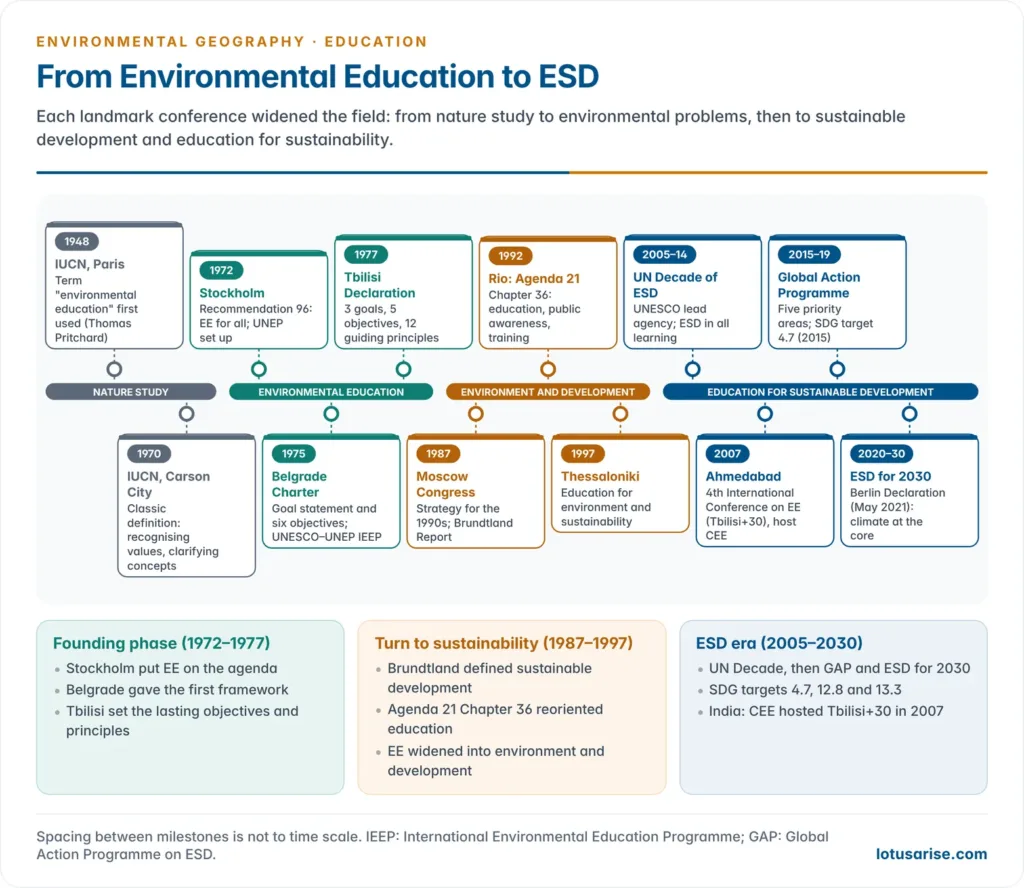
The founding documents
- Stockholm (1972) placed EE on the world’s agenda. Its Recommendation 96 asked UN agencies to build an interdisciplinary EE programme, in and out of school, for all ages.
- UNESCO and UNEP answered with the IEEP (1975), which ran for two decades and organised the meetings that followed.
- The Belgrade Charter (October 1975) produced the first systematic framework.
- Its goal statement sought a world population aware of and concerned about the environment, with the knowledge, skills, attitudes, motivation and commitment to work on current problems and prevent new ones.
- It listed six objectives: awareness, knowledge, attitude, skills, evaluation ability and participation.
- The Tbilisi Declaration (1977), from the first Intergovernmental Conference on Environmental Education organised by UNESCO with UNEP in Tbilisi, Georgia (then in the USSR), consolidated Belgrade into three goals, five categories of objectives and twelve guiding principles.
- It was adopted by acclamation and remains the reference point for EE policy everywhere, including India.
- The Moscow Congress (1987) reviewed the decade since Tbilisi and adopted an international strategy for EE and training for the 1990s, in the year the Brundtland Report defined sustainable development.
- Agenda 21, Chapter 36 (Rio, 1992) treated education, public awareness and training as one cross-cutting means of implementing every other chapter.
- It asked for reorienting education towards sustainable development, increasing public awareness and promoting training.
- At the parallel NGO forum, civil society adopted the Treaty on Environmental Education for Sustainable Societies and Global Responsibility.
Education for Sustainable Development (ESD)
- ESD widens EE from the environment alone to the three pillars of sustainability: environment, society and economy, including poverty, gender, consumption, peace and citizenship.
- UN Decade of ESD (2005–2014): proclaimed by the UN General Assembly in 2002, after the Johannesburg summit, with UNESCO as lead agency. It aimed to integrate the principles, values and practices of sustainable development into all aspects of education and learning.
- Global Action Programme (2015–2019): launched at the UNESCO World Conference at Aichi-Nagoya, Japan (November 2014), with five priority action areas:
- advancing policy;
- transforming learning and training environments (the whole-institution approach);
- building the capacities of educators and trainers;
- empowering and mobilising youth;
- accelerating sustainable solutions at local level.
- ESD for 2030 (2020–2030): adopted by the 40th UNESCO General Conference (2019) and welcomed by the UN General Assembly. It keeps the five priority areas and ties ESD to all 17 SDGs.
- The Berlin Declaration on ESD came out of the UNESCO World Conference on ESD (17–19 May 2021), held online from Berlin. It commits countries to make ESD a core component of education systems at all levels, with climate action at its centre.
- SDG target 4.7 asks that by 2030 all learners acquire the knowledge and skills needed to promote sustainable development, including through ESD and sustainable lifestyles.
- Target 12.8 seeks relevant information and awareness for sustainable development and lifestyles in harmony with nature everywhere.
- Target 13.3 seeks better education and awareness on climate change mitigation, adaptation and early warning.
- Climate education now has its own treaty base: Article 12 of the Paris Agreement and the UNFCCC’s Action for Climate Empowerment (ACE) cover education, training, public awareness, participation and access to information.
- The Greening Education Partnership, launched at the UN Transforming Education Summit (2022), pushes for climate education in every school.
| Basis | Environmental education (EE) | Education for sustainable development (ESD) |
|---|---|---|
| Origin | Stockholm 1972, Belgrade 1975, Tbilisi 1977 | Agenda 21 (1992); UN Decade 2005–2014 |
| Focus | Ecological understanding and environmental problems | Environment, society and economy together |
| Core aim | Awareness, concern and action for the environment | Competences to build a just, sustainable future |
| Themes | Pollution, biodiversity, resources, conservation | Plus poverty, gender, consumption, peace, citizenship |
| Relation | The parent field and ESD’s ecological core | A wider umbrella that contains EE |
Objectives and Principles of Environmental Education
Goals of EE
- The Tbilisi Declaration set three goals:
- to foster clear awareness of, and concern about, the economic, social, political and ecological interdependence of urban and rural areas;
- to give every person opportunities to acquire the knowledge, values, attitudes, commitment and skills needed to protect and improve the environment;
- to create new patterns of behaviour towards the environment among individuals, groups and society as a whole.
The five Tbilisi objectives
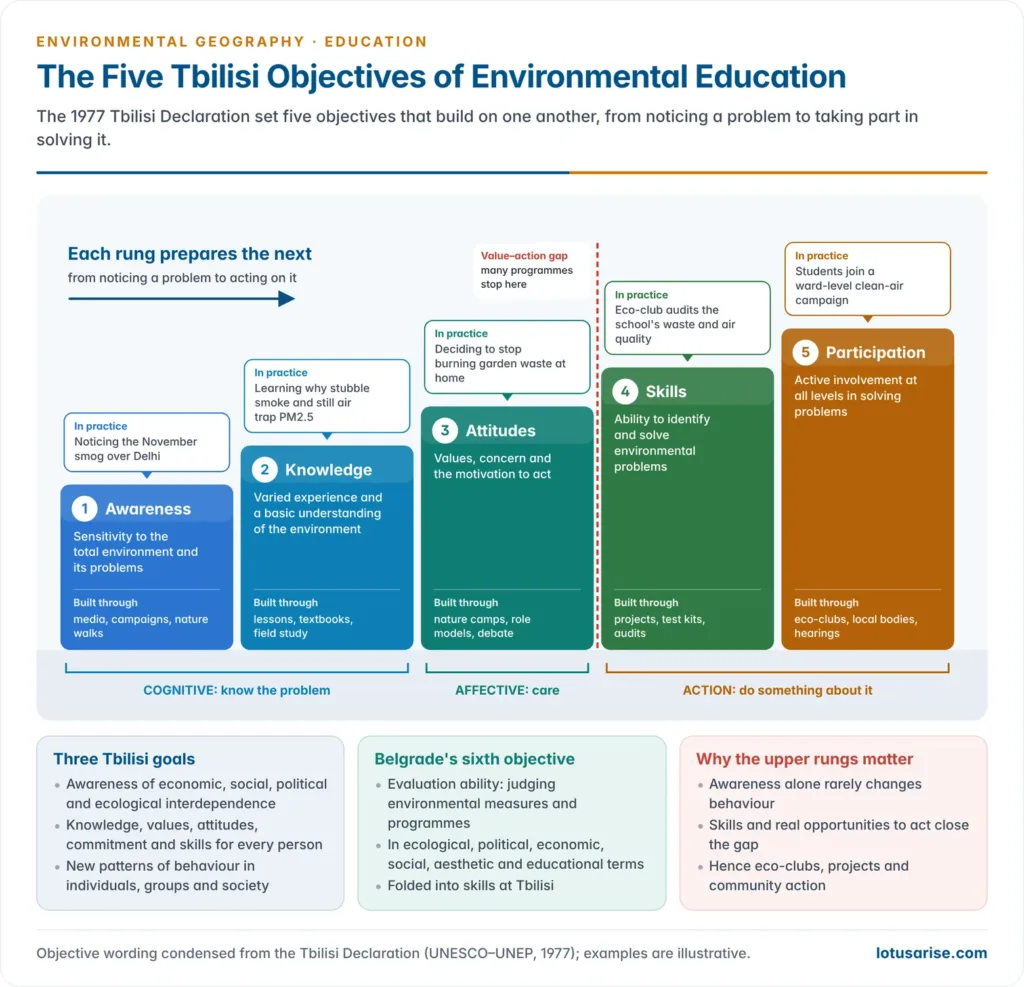
- Tbilisi grouped its objectives into five categories, often remembered as AKASP. They form a logical progression from awareness to action: each rung prepares the next.
| Objective | Tbilisi’s intent | Domain | Example in practice |
|---|---|---|---|
| Awareness | Help social groups and individuals acquire an awareness of and sensitivity to the total environment and its allied problems | Perceptual | Noticing smog, a dying lake, a shrinking grove |
| Knowledge | Help them gain varied experience and a basic understanding of the environment and its problems | Cognitive | Learning why a lake eutrophies |
| Attitudes | Help them acquire values and feelings of concern for the environment and the motivation to take part in improving it | Affective | Caring enough to change one’s own habits |
| Skills | Help them acquire the skills to identify and solve environmental problems | Practical | Testing water quality; mapping a polluted stretch |
| Participation | Give them the opportunity to be actively involved at all levels in resolving environmental problems | Behavioural and civic | Joining a lake-restoration drive; attending a public hearing |
- Awareness and knowledge are the cognitive base; attitudes supply the motive; skills and participation turn motive into change on the ground.
- The Belgrade Charter’s sixth objective, evaluation ability, asks learners to judge environmental measures and programmes in ecological, political, economic, social, aesthetic and educational terms. Tbilisi folded it into skills.
- The sequence explains a familiar failure: programmes that stop at awareness and knowledge produce informed citizens who do not act. This value–action gap, analysed by Anja Kollmuss and Julian Agyeman (2002), is why the upper rungs matter most.
- Its psychology, from perception through attitudes and values to emotion, is the subject of the PAVE framework.
Aims of EE
- UNESCO’s statements on EE add aims that go beyond the five objectives and bring in the societal and international dimensions:
- to show the economic, social, political and ecological interdependence of the modern world, in which one country’s decisions have international repercussions;
- to build a sense of responsibility and solidarity among countries and regions as the basis of an international order that guarantees the conservation and improvement of the environment;
- to help individuals and communities understand the complex nature of natural and built environments, arising from the interaction of their physical, biological, social, economic and cultural elements;
- to give them the knowledge, values, attitudes and practical skills to take part, responsibly and effectively, in anticipating and solving environmental problems and managing environmental quality.
Guiding principles (Tbilisi, 1977)
- The twelve Tbilisi principles describe how EE should be taught. They fall into four groups.
| Group | Environmental education should… |
|---|---|
| Scope | 1. consider the environment in its totality: natural and built, technological and social (economic, political, cultural-historical, ethical, aesthetic); 5. focus on current and potential situations while taking the historical perspective into account; 7. explicitly consider environmental aspects in plans for development and growth |
| Process | 2. be a continuous lifelong process, from pre-school through all formal and non-formal stages; 3. be interdisciplinary, drawing on each discipline for a holistic, balanced perspective |
| Scale | 4. examine major issues from local, national, regional and international points of view; 6. promote the value and necessity of local, national and international cooperation in preventing and solving problems |
| Pedagogy | 8. let learners plan their own learning and make decisions, accepting their consequences; 9. relate sensitivity, knowledge, problem-solving and values to every age, with emphasis on the learner’s own community in the early years; 10. help learners discover the symptoms and real causes of problems; 11. stress the complexity of problems and hence critical thinking and problem-solving; 12. use diverse learning environments and approaches, with practical activities and first-hand experience |
- Two principles carry most weight in practice: interdisciplinarity (EE is a dimension of every subject, not a subject in a corner) and local-to-global scaling (the learner starts with the home landscape and works outwards).
Content principles
- Alongside the Tbilisi principles on how to teach, EE rests on substantive principles on what to teach. These are drawn from resource, soil, wildlife and environmental management.
| Category | Core principles | Implication for teaching |
|---|---|---|
| Resources | Resource use needs long-term planning for truly sustainable development; rational use of a renewable resource is the sensible way to preserve it while drawing maximum benefit; a way of life dependent on rapidly diminishing non-renewable energy is inherently unstable | Scarcity, the renewable–non-renewable divide and the logic of conservation as a basis of development planning |
| Soil | Protecting soils and keeping agriculture sustainable are essential to the survival of civilisations; soil erosion is an irreversible loss and must be prevented; vegetation cover keeps the balance of nature and holds the soil | Soil conservation, watershed management and sustainable farming as core content, above all in agrarian India |
| Wildlife | Wildlife has aesthetic, biological and economic value; nature reserves protect endangered species by protecting habitats; human survival is bound to wildlife’s, since both depend on the same life-support systems | Biodiversity values, protected areas and the human–wildlife relationship |
| Environmental management | Sound management benefits both people and environment; resources must be managed rationally; wastes should be cut through recycling and clean technology; technology can reduce the environment’s capacity to sustain life | Land use, water, waste, pollution control and impact assessment, at higher levels |
| Culture and heritage | People–environment relations are mediated by culture; cultural, historical and architectural heritage needs urgent protection | Culturally sensitive EE that uses indigenous knowledge and heritage alongside scientific ecology |
Environmental Education in India
Constitutional and legal basis
- EE in India draws legitimacy from the provisions added by the 42nd Constitutional Amendment (1976), the core of the constitutional framework for the environment:
- Article 48A (Directive Principle): the State shall endeavour to protect and improve the environment and safeguard forests and wildlife.
- Article 51A(g) (Fundamental Duty): every citizen must protect and improve the natural environment, including forests, lakes, rivers and wildlife, and have compassion for living creatures.
- A duty cannot be performed without knowing what it requires, which is the constitutional logic of EE.
- The courts have read a right to a healthy environment into Article 21. On that reasoning, keeping citizens informed about the environment is an obligation of the government.
The judicial mandate: M.C. Mehta v. Union of India
- The Supreme Court’s orders in the public interest litigation filed by M.C. Mehta (Writ Petition 860 of 1991) are the foundation of compulsory EE in India.
- Order of 22 November 1991. The Court directed that:
- cinema halls, touring cinemas and video parlours must show at least two environment slides free of cost in each show, as a condition of their licence;
- the Ministry of Information and Broadcasting must produce short films on environment and pollution, one to be shown daily in cinemas;
- All India Radio and Doordarshan must broadcast environment programmes daily (five to seven minutes) and a longer one weekly;
- the UGC must ask universities to prescribe a course on the environment and consider making it compulsory at every level of college education;
- state governments and education boards must enforce graded, compulsory environmental education up to matriculation or intermediate level.
- Orders of 18 December 2003 and 13 July 2004. The Court accepted that awareness of the environment and its pollution problems should be taught as a compulsory subject.
- It accepted the model EE syllabus prepared by NCERT for Classes I to XII, directed every state to adopt it, and named NCERT the nodal agency to supervise implementation.
- EE thus became compulsory in schools from the 2004–05 session.
- The same litigation produced several landmark environmental judgments, but the EE orders matter because they treat awareness itself as a legal obligation.
Policy milestones in India
| Year | Policy or programme | Significance |
|---|---|---|
| 1976 | 42nd Amendment: Articles 48A and 51A(g) | Constitutional duty to protect the environment |
| 1982 | ENVIS set up | National network for environmental information |
| 1983–84 | Environment Education, Awareness and Training (EEAT) scheme | India’s first dedicated EE scheme |
| 1984 | Centre for Environment Education (CEE), Ahmedabad | Centre of Excellence for EE |
| 1986 | National Environment Awareness Campaign (NEAC); Environment (Protection) Act | Mass awareness through NGOs and institutions; umbrella environmental law |
| 1988 | National Forest Policy | Awareness and people’s participation in forest management |
| 1991 | M.C. Mehta order | Compulsory EE; cinema slides; radio and television |
| 2001–02 | National Green Corps (NGC) | Eco-clubs in schools: the flagship non-formal programme |
| 2003–04 | NCERT model syllabus; UGC core module | Compulsory EE in Classes I–XII from 2004–05; compulsory environmental studies for undergraduates |
| 2005 | National Curriculum Framework (NCF 2005) | EE infused across subjects; EVS in primary classes |
| 2006 | National Environment Policy | Links environmental management to education and awareness |
| 2017 | Green Skill Development Programme; UGC AECC syllabus | Green jobs training; revised undergraduate course under CBCS |
| 2020 | National Education Policy 2020 | Environment education as part of holistic, multidisciplinary education |
| 2022 | EEARSD scheme; ENVIS renamed EIACP; Mission LiFE | Restructured EE architecture; behaviour change at national scale |
| 2023 | UGC guidelines (June); NCF-SE 2023 | 4-credit EE course for all undergraduates; EE across school stages |
- These policies sit within the wider environmental policy of India, from the 1972 Stockholm moment through the 2006 policy to the climate missions.
Formal environmental education
- Formal education is given in schools, colleges and universities over a fixed period, with a defined, systematic curriculum, certification and assessment.
- The best entry point for any awareness programme is children and youth: they take up new ideas quickly, carry them home, and become the next generation of activists and decision-makers.
- Formal EE should therefore begin at primary school and build progressively up the educational ladder.
| Level | Age | Focus | Approach | Typical content |
|---|---|---|---|---|
| Primary (I–V) | 6–11 | Awareness and emotional bond with nature | Stories, nature walks, observation; EVS as a subject | Local plants and animals, water, waste, seasons |
| Middle (VI–VIII) | 11–14 | Physical, social and aesthetic sides of the environment | Infusion into science and social science; field visits; eco-camps | Food chains, pollution, local ecosystems, conservation |
| Secondary and senior secondary (IX–XII) | 14–18 | Understanding complex issues; managing resources | Projects, case studies, problem-based learning | Biodiversity, climate change, sustainable development, environmental law |
| Undergraduate | 18–21 | Scientific literacy for all graduates; professional basics | Compulsory course; fieldwork; labs | Ecosystems, pollution, policy, case studies |
| Postgraduate and doctoral | 21+ | Specialisation and research | Dissertations, field research, policy analysis | Ecology, toxicology, limnology, environmental economics, law, management |
Approaches to EE in the curriculum
- Schools can place EE in the curriculum in three main ways:
- Infusion (integrated) approach: environmental concepts are woven into existing subjects such as science, geography, economics and languages. It needs no extra timetable space, but EE can get lost.
- Separate (discrete) subject approach: EE is taught as its own subject with its own syllabus and teacher. It gets visibility and assessment, but adds to the load and can become one more subject to memorise.
- Project and activity approach: learners investigate a real local problem, such as waste in the school, water quality in a nearby tank or tree cover in the ward, and present findings. It builds skills and participation best, but needs trained teachers and time.
- The NCERT model syllabus (2004) combined all three along the school ladder:
- Classes I–II: EE through activities and the child’s surroundings;
- Classes III–V: Environmental Studies (EVS) as a separate subject;
- Classes VI–X: infusion into science and social science;
- Classes XI–XII: project work on local environmental issues.
Bodies that run formal EE
- NCERT frames the school curriculum and produces textbooks and teaching material. Its EE syllabus for Classes I–XII was adopted under the Supreme Court’s orders, and it remains the nodal agency for school EE.
- CBSE and state boards implement it with location-specific adaptation.
- NCF-SE 2023 integrates EE across all school stages and gives it a separate area of study at the secondary stage.
- The UGC is responsible for EE in higher education:
- 2003: after the Supreme Court’s direction, a core module syllabus for a compulsory six-month (one-semester) course in environmental studies for all undergraduates;
- 2017: revised as the Ability Enhancement Compulsory Course (AECC) in Environmental Studies under the Choice Based Credit System;
- June 2023: Guidelines for Environment Education at Undergraduate Level, a 4-credit course of eight units plus fieldwork, framed under NEP 2020 and linked to Mission LiFE.
- NEP 2020 names environment education among the components of holistic, multidisciplinary higher education.
- It lists areas such as climate change, pollution, waste management, sanitation, conservation of biological diversity, forest and wildlife conservation, and sustainable development and living.
- IITs, NITs and engineering colleges teach environmental engineering within civil and chemical engineering, with M.Tech. and Ph.D. programmes; AICTE has made environmental science a mandatory non-credit course for engineering students.
- Research institutions of CSIR, ICAR, ICMR and the MoEFCC, such as NEERI (Nagpur), the Wildlife Institute of India and the Indian Council of Forestry Research and Education (ICFRE), offer doctoral research, so formal EE is available up to the highest level.
Present status and the need for specialisation
- Universities and colleges now run hundreds of departments of environmental science and studies, offering diplomas, bachelor’s, master’s and doctoral degrees.
- Postgraduate programmes cover environmental management, chemistry, biology, geology and toxicology, and engineering programmes run up to the M.E., M.Tech. and Ph.D. levels.
- The weakness is breadth without depth. Programmes turn out generalists with broad but shallow knowledge, while the economy needs professionals.
- Restructuring should produce specialists in environmental botany, zoology, chemistry, economics and sociology, with training in forest ecology, limnology, marine ecology, environmental analysis, pollution studies and toxicology.
Non-formal environmental education
- For most of India’s people, and above all those without adequate access to formal education, environmental awareness has to come from outside the formal system.
- Since EE is lifelong, schooling alone can never be enough. This realisation drove the growth of non-formal programmes from the 1980s.
- Non-formal EE covers all organised learning outside schools and universities. It is experience-based, flexible and participatory.
- It engages learners in enquiring, exploring, comparing, inferring, evaluating and deciding about real problems in their own surroundings.
- Flexibility of time, place, content and method is its defining feature.
- It shades into informal EE: the unplanned learning from media, family, religion and community life.
Methods
| Method | What it involves | What learners gain |
|---|---|---|
| Eco-development camps | Identifying local ecological problems and solving them by hand: planting, trenching, fencing, seed banks, cleaning water bodies, hygiene, renewable energy | Practical skills, problem-solving, teamwork |
| Nature camps | Camps in national parks, sanctuaries and tiger reserves | Direct experience of biodiversity; understanding of protected areas |
| Nature clubs and eco-clubs | Regular bird-watching, plant identification, local monitoring | Observation skills, sustained engagement |
| Competitions and environment days | Posters, essays, quizzes and debates around World Wetlands Day (2 February), Earth Day (22 April), Biodiversity Day (22 May), Environment Day (5 June), Ozone Day (16 September), Wildlife Week (1–7 October) | Communication, peer learning |
| Exhibitions and seminars | Waste-to-wealth projects, biodiversity displays, public workshops | Community engagement |
| Mass media and mobile exhibitions | Films, radio, television, vans carrying messages to remote areas; the court-ordered cinema slides | Reach to rural and non-literate audiences |
| Street plays and folk arts | Street theatre, folk song and dance, puppetry, crafts with environmental themes | Cultural ownership of conservation |
| Citizen science and field kits | Water-testing kits, bird counts, biodiversity registers | Scientific skills; data on local pollution |
- Indian illustrations:
- The Vikram Sarabhai Community Science Centre, Ahmedabad, involved children in experiments and surveys; CEE designed a water-monitoring kit for secondary students under the Ganga pollution control programme.
- People’s Biodiversity Registers, prepared by village biodiversity management committees, double as a record of local ecological knowledge and a lesson in it.
- People’s movements such as Chipko, Appiko and Silent Valley were themselves vast exercises in non-formal EE, carried by songs, padayatras and village meetings, and are part of India’s tradition of environmental conservation.
Key institutions and programmes
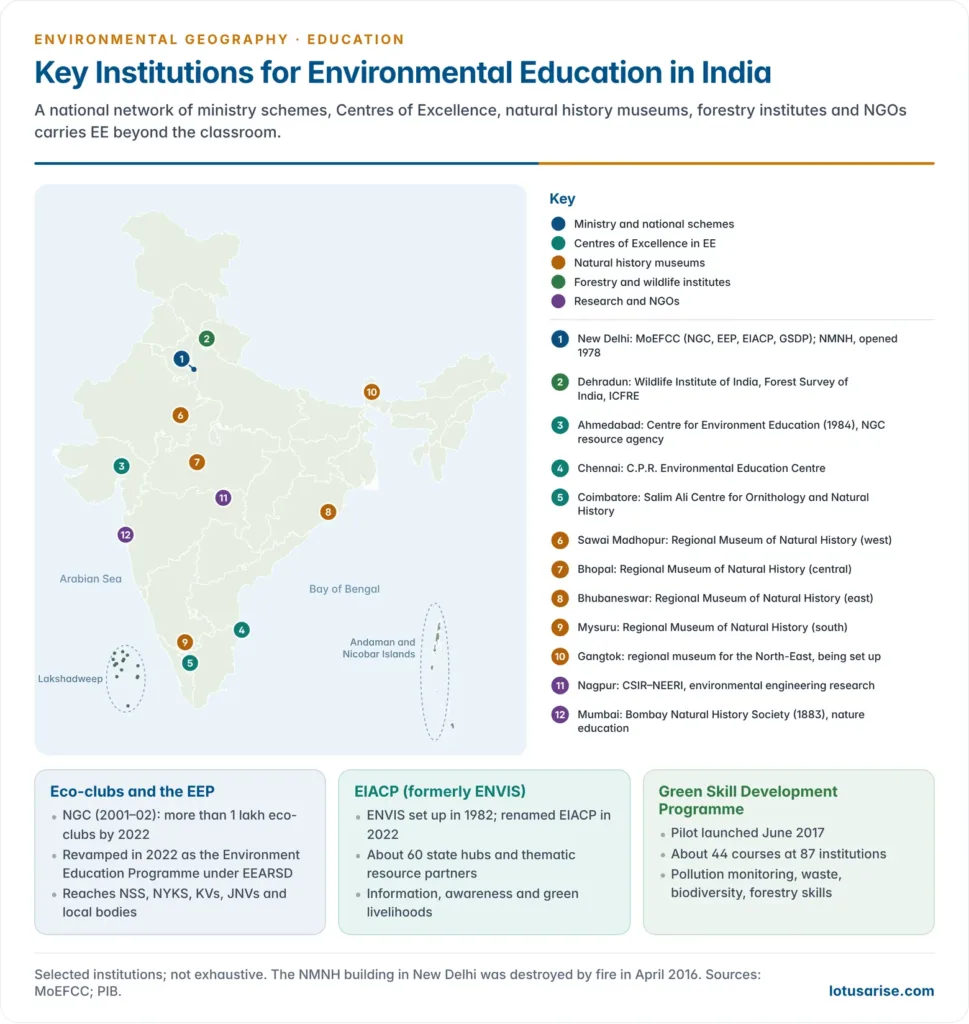
National Green Corps and the Environment Education Programme
- The National Green Corps (NGC), launched by the Ministry of Environment, Forest and Climate Change (MoEFCC) in 2001–02, works through eco-clubs in schools and colleges. It aims to build cadres of young people working for conservation and sustainable development.
- Scale and structure:
- more than 1 lakh eco-clubs had been formed by 2022, one of the largest school conservation networks in the world;
- each club has roughly 30–50 volunteer students under a teacher-in-charge chosen for interest in the environment, supported by district master trainers;
- each club received an annual grant of ₹5,000, with ceilings of 500 school clubs per district and 100 college clubs per state;
- state nodal agencies run it, with CEE as the national resource agency.
- Objectives of NGC:
- to give children hands-on knowledge of their immediate environment, its interactions and problems;
- to inculcate the right attitude towards the environment through community interaction;
- to sensitise them to environment-and-development issues through field visits and demonstrations;
- to promote logical, independent thinking so that they make the right choices in a spirit of scientific enquiry;
- to involve them in action projects for conservation.
| Activity | Examples |
|---|---|
| Awareness events | Environment days; green pledges; Swachh Bharat cleanliness drives |
| Field activities | Nature camps and trails; plantation; school gardens; waste segregation |
| Competitions | Quizzes, debates, posters, essays; Mowgli Bal Utsav |
| Community action | Green Ganesh campaign; water conservation; waste-to-wealth exhibitions |
| Capacity building | Orientation of nodal officers; master-trainer and teacher training; resource material |
- The National Nature Camping Programme (NNCP) paid for camps in protected areas and tiger reserves (up to ₹2,000 per student for a three-day camp).
- Restructuring (2022): the old EEAT scheme was revamped as the Environment Education Programme (EEP), a component of the Environment Education, Awareness, Research and Skill Development (EEARSD) scheme.
- EEP widens the net beyond NGC eco-clubs to eco or youth clubs under other ministries, NSS units, Nehru Yuva Kendra Sangathan clubs, Kendriya Vidyalayas and Navodaya Vidyalayas, child-care institutions and local bodies.
- Its activities now centre on sustainable lifestyles in line with Mission LiFE: workshops, campaigns, nature camps and summer programmes.
- The Department of School Education has also encouraged eco-clubs in about 7.5 lakh schools for LiFE campaigns such as Ek Ped Maa Ke Naam (#Plant4Mother).
Centre for Environment Education (CEE)
- Set up in August 1984 at Ahmedabad under the Nehru Foundation for Development, with MoEFCC support, as a Centre of Excellence in EE.
- It develops curriculum and teaching material, trains teachers, runs public campaigns and acts as the national resource agency for NGC.
- It hosted the Fourth International Conference on EE (Tbilisi+30, November 2007) and is a nodal agency for ESD in India.
- Other MoEFCC Centres of Excellence carry EE into specialised fields, for example the C.P.R. Environmental Education Centre, Chennai (eco-heritage, sacred groves, south Indian ecosystems) and the Salim Ali Centre for Ornithology and Natural History, Coimbatore.
EIACP (formerly ENVIS) and green skills
- The Environmental Information System (ENVIS), set up in 1982, was folded into the EEARSD scheme in 2022 and renamed the Environmental Information, Awareness, Capacity Building and Livelihood Programme (EIACP).
- It runs through a decentralised network of about 60 centres: state-specific hubs in state environment departments and thematic resource partners in research institutions.
- It aims to be a one-stop platform for environmental information, support policy, and create alternative livelihoods through green skilling.
- The Green Skill Development Programme (GSDP), launched as a pilot in June 2017 through the ENVIS network, trains youth for green jobs.
- It offers about 44 courses at 87 institutions, from 80 to 550 hours, in pollution monitoring, operation of effluent and sewage treatment plants, waste management, forest-fire management, para-taxonomy, People’s Biodiversity Registers, mangrove and bamboo management and ecosystem-services valuation.
- Several courses are aligned with the National Skills Qualification Framework.
Museums, research bodies and media
- National Museum of Natural History (NMNH), New Delhi: opened on World Environment Day, 5 June 1978, for non-formal EE through exhibitions, children’s activities and outreach.
- Its Delhi building was gutted by fire in April 2016. Regional Museums of Natural History at Mysuru, Bhopal, Bhubaneswar and Sawai Madhopur carry on the work, and one is being set up at Gangtok.
- Forestry and wildlife institutions, all at Dehradun:
- the Wildlife Institute of India (WII) trains wildlife managers and researchers;
- the Forest Survey of India (FSI) monitors forest cover and publishes the biennial India State of Forest Report;
- ICFRE is the apex body for forestry education, research and extension.
- NGOs and civil society are often more effective than the state at the grassroots.
- The Bombay Natural History Society (1883) pioneered nature education and bird-watching camps; WWF-India (1969) runs school nature clubs; Kalpavriksh (1979) combines campaigns with community research.
- The Centre for Science and Environment (1980) shaped public debate through its citizens’ reports on the state of India’s environment, and runs a Green Schools Programme of school environmental audits.
- Hundreds of local groups run nature camps, clubs and campaigns in regional languages, reaching people that official programmes miss.
- Mass media and digital platforms: environmental programming on Doordarshan and All India Radio (rooted in the 1991 order), SWAYAM courses and campaign portals carry EE to audiences that schools cannot reach.
Other stakeholders
- Local bodies: panchayats and municipalities run waste-segregation, water and greening drives, and the Biodiversity Management Committees created under the Biological Diversity Act carry ecological knowledge into village decisions.
- Religious and cultural institutions: festivals adapted to the environment, such as clay idols in the Green Ganesh campaign, temple groves and river-cleaning traditions, reach people through faith rather than the classroom.
- Industry: environmental sustainability is an eligible activity for corporate social responsibility spending under Schedule VII of the Companies Act, 2013, and firms with ISO 14001 systems must train their workforce in environmental duties.
- Families and peers: children trained in eco-clubs often carry habits such as segregation, saving water and refusing plastic back into the home, the “pester power” on which many campaigns rely.
- Learners themselves: under the Tbilisi principle that learners should plan their own learning, student-led audits and campaigns are now a standard part of good EE practice.
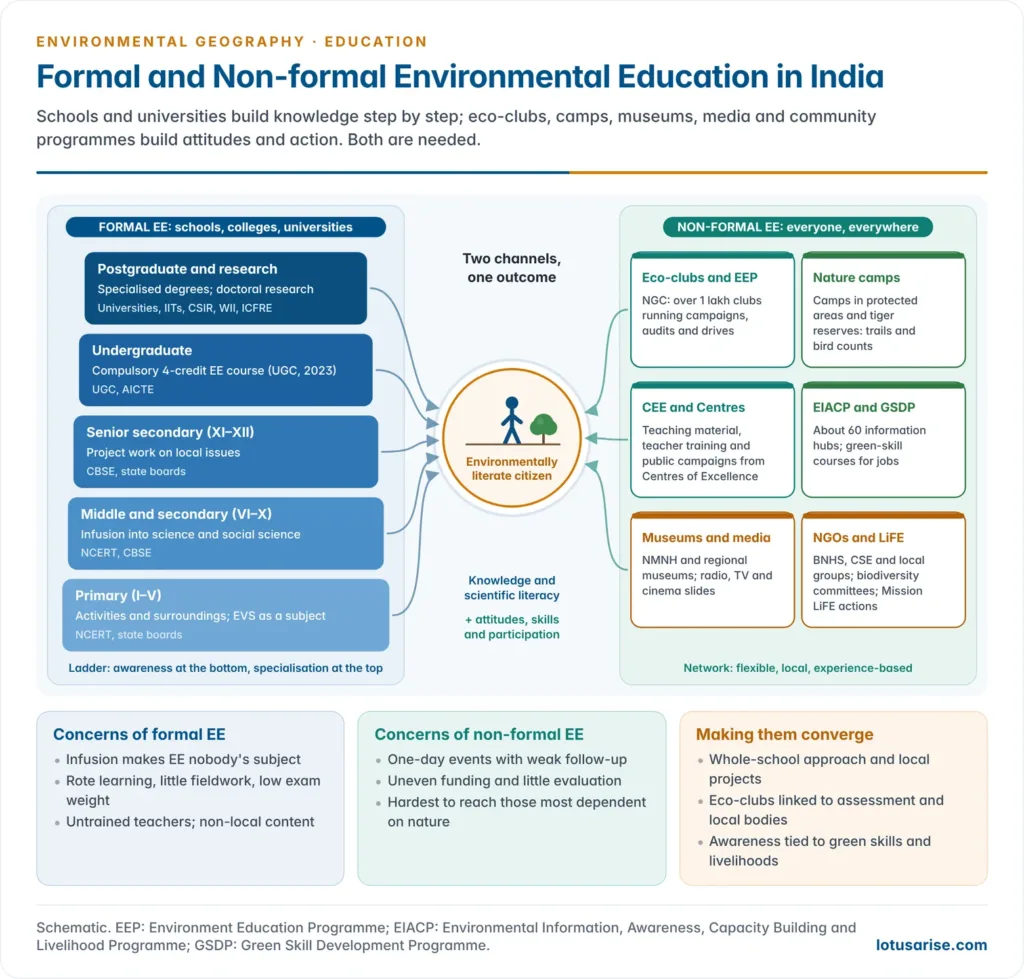
Basic concerns of formal and non-formal EE in India
| Basis | Formal EE | Non-formal EE |
|---|---|---|
| Who it reaches | Enrolled students: about 25 crore in schools and 4 crore in higher education | Everyone else: farmers, workers, women’s groups, out-of-school youth, the public |
| Setting | Classroom, laboratory, campus | Village, forest, river bank, cinema, radio, phone screen |
| Curriculum | Fixed syllabus, assessment, certificate | Flexible, need-based, local |
| Main concern | Too bookish: rote learning, little fieldwork, low exam weightage, untrained teachers | Too episodic: one-day events, uneven funding, weak follow-up, little evaluation |
| What it does best | Builds knowledge and scientific literacy systematically | Builds attitudes, skills and participation in real settings |
| Reform direction | Projects, local case studies, whole-school approach, teacher training | Continuity, community ownership, convergence with livelihoods and local bodies |
- Formal EE: the basic concerns.
- Infusion without ownership: when EE is spread across subjects, it often becomes nobody’s subject, squeezed by examination pressure.
- Teacher capacity: most teachers have no training in EE, especially on new topics such as climate change and biodiversity policy.
- Abstract, non-local content: textbooks describe distant problems more than the learner’s own landscape, against Tbilisi’s principle of starting at home.
- The knowledge–action gap: students pass examinations on the environment without changing behaviour.
- Non-formal EE: the basic concerns.
- Reach and equity: India’s diversity of languages, literacy levels and livelihoods means one message does not fit all; women, tribal communities and the rural poor are hardest to reach yet most dependent on natural resources.
- Continuity: campaigns and environment days rarely lead to sustained practice.
- Livelihood linkage: people adopt conservation when it pays or protects them, which is why programmes now couple awareness with green skills and livelihoods.
- Use of traditional knowledge: sacred groves, community water harvesting and the Bishnoi ethic are a ready-made curriculum, part of India’s environmental ethics, that non-formal EE can build on.
Mission LiFE: EE as behaviour change
- Mission LiFE (Lifestyle for Environment), launched at Kevadia, Gujarat, on 20 October 2022 in the presence of UN Secretary-General António Guterres, turns EE from awareness into everyday behaviour.
- It promotes 75 LiFE actions under seven themes: save energy, save water, reduce single-use plastic, adopt sustainable food systems, reduce waste, reduce e-waste and adopt healthy lifestyles.
- It aims to mobilise at least one billion people in India and abroad as “Pro-Planet People” through individual and collective action, and was written into India’s updated NDC (2022).
- LiFE relies on the institutions EE has built: eco-clubs, NSS, universities, local bodies and the media. Its theory of change, nudging perception, attitude, value and emotion, belongs with the PAVE framework.
Environmental Education, Sustainable Development and Quality of Life
EE as the engine of sustainable development
- EE is foundational, not merely complementary, to sustainable development. It is the mechanism by which sustainability principles move from policy documents into individual and institutional behaviour.
| What EE contributes | How it advances sustainable development | Example |
|---|---|---|
| Environmental literacy | Citizens grasp climate change, biodiversity loss and resource depletion as informed participants | Students who study climate science are more open to climate policy and personal change |
| Critical thinking | People recognise unsustainable practices and weigh alternatives | Farmers who understand erosion adopt conservation tillage or agroforestry |
| Capacity for action | Citizens can monitor, report and take part in governance | Eco-club members testing water and reporting to pollution control boards |
| Changed consumption | Knowledge of hidden environmental costs alters purchases and lifestyles | Reusable bags; energy saving at home |
| Conservation livelihoods | Communities earn from ecosystem services | Trained nature guides and honey collectors in the Sundarbans |
| Green careers | A professional workforce for management, law, engineering and research | Environmental lawyers, impact assessors, natural-capital economists |
- The UN Decade on Ecosystem Restoration (2021–2030) depends on EE for public understanding, political will and technical skill.
- So do India’s own commitments: net-zero emissions by 2070 and 500 GW of non-fossil electricity capacity by 2030 need an environmentally literate public and a large green workforce.
Impact of EE on quality of life
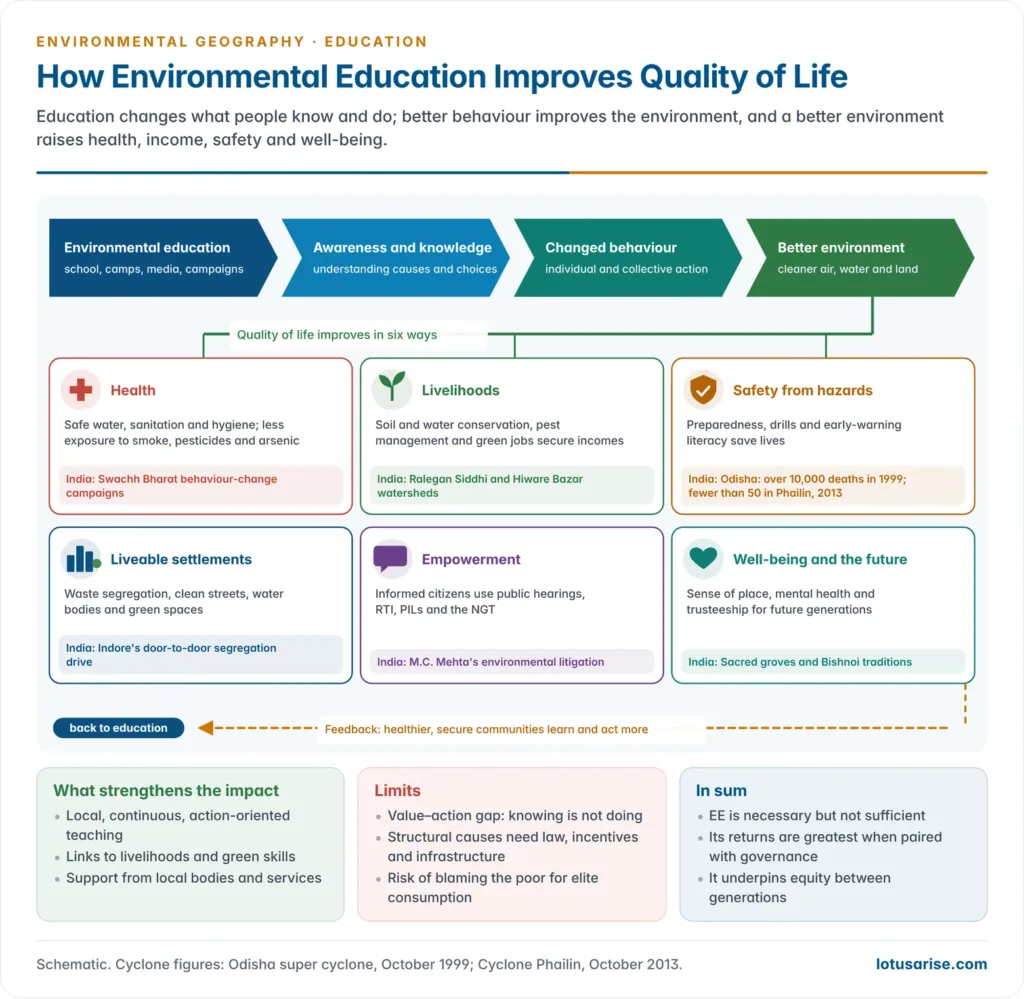
- Quality of life is the overall well-being of people: not income alone, but health, safety, livelihood security, a clean and pleasant surrounding, social participation and peace of mind.
- EE improves it through a chain: awareness → informed choices and collective action → a better environment and better resource use → better health, income, safety and well-being, which in turn sustain further learning.
Dimensions of the impact
- Health:
- awareness of safe water, sanitation and hygiene cuts water-borne disease; the Swachh Bharat Mission relied heavily on behaviour-change communication;
- knowledge of indoor smoke, air pollution, pesticide misuse and arsenic or fluoride in groundwater helps households protect themselves; the wider links are traced in environment and human health.
- Livelihoods and income:
- farmers who learn soil and water conservation, integrated pest management and organic methods cut costs and stabilise yields; watershed villages such as Ralegan Siddhi and Hiware Bazar in Maharashtra rebuilt their economies on community watershed management;
- eco-development committees around the Periyar Tiger Reserve turned former poachers and forest-dependent people into trek guides and protectors;
- green skills (GSDP) open jobs in monitoring, waste management and conservation.
- Resource efficiency and food security:
- households and firms that understand water, energy and material footprints save money through efficient appliances, rainwater harvesting and reduced waste;
- knowledge of soil health, crop diversity and traditional seeds strengthens food and nutrition security, especially for rain-fed farmers facing climate variability.
- Safety from hazards:
- community preparedness, mock drills and early-warning literacy cut cyclone deaths in Odisha from over 10,000 in the 1999 super cyclone to fewer than 50 in Cyclone Phailin (2013). Hazard education is a core part of disaster management.
- Liveable settlements:
- Indore became India’s cleanest city in successive Swachh Survekshan rounds from 2017 by building door-to-door awareness into source segregation of waste;
- Kerala’s Haritha Keralam Mission (2016) linked waste, water and greening campaigns with local bodies.
- Empowerment and participation:
- informed citizens use public hearings, right to information, PILs and the National Green Tribunal; M.C. Mehta’s own litigation is an example of environmental knowledge turned into citizenship;
- women’s groups and eco-clubs gain voice in local decisions.
- Psychological and cultural well-being:
- contact with nature, school gardens and green spaces improves mental health and a sense of place;
- EE revives cultural traditions of conservation (sacred groves, river festivals, Bishnoi practice) that give communities identity.
- Intergenerational equity: EE builds the ethic of trusteeship on which the quality of life of future generations depends, the core of sustainable development.
Limits and critique
- The value–action gap: awareness does not automatically change behaviour, especially when the sustainable choice is costlier or less convenient.
- Structural limits: individual education cannot by itself fix polluting industries, poor infrastructure or policy failure. EE must be paired with regulation, incentives and services, otherwise it shifts the burden onto individuals.
- Elite bias: messages framed for urban consumers can blame the poor, whose footprints are smallest, while ignoring affluent consumption.
- Measurement: outcomes are hard to attribute and rarely evaluated, so programmes count events rather than changes in behaviour or environmental quality.
- The balanced view: EE is a necessary but not sufficient condition for a better quality of life; its impact is greatest when it is local, continuous, action-oriented and linked to livelihoods and governance.
Challenges and reforms
Challenges
- Inadequate time: EE gets little timetable space and little or no examination weightage, so it is treated as peripheral.
- Funding and resources: institutions struggle to fund field equipment, laboratories and field sites; the per-club NGC grant has been small.
- Teacher capacity: few teachers have specialist knowledge, particularly of climate change and biodiversity policy.
- Low motivation: students see little academic or career value in it.
- Non-local content: material is not tailored to local conditions, making it abstract and remote from learners’ lives.
- Generalists over specialists at university level.
- Implementation gap: despite the Supreme Court’s orders and NCERT’s syllabus, delivery is uneven, especially in rural and semi-urban schools.
- Digital divide: online and audio-visual material does not reach many rural households with poor connectivity.
Reforms
- Refresh content: organise EE around big ideas and unifying themes (climate, biodiversity, water, energy, waste) rather than scattered fragments, and connect it to the SDGs.
- Localise the curriculum: use the school’s own landscape, its river, forest, market and waste, as the textbook.
- Train teachers: make pre-service and in-service EE training compulsory for all teachers, not only science teachers, with manuals and workshops.
- Whole-institution approach: green campuses, energy and water audits, waste segregation and school gardens, so that the school practises what it teaches.
- Strengthen specialisation in higher education, and link EE to career pathways.
- Use traditional knowledge: sacred groves, traditional farming, water harvesting and community forest management.
- Use technology: mobile exhibitions, digital platforms, citizen-science apps and community radio.
- Strengthen eco-clubs: larger grants, stronger master-trainer networks, systematic evaluation of outcomes, and links to school assessment.
Careers in the environment
- EE opens a widening range of careers, and environment-related work will grow as India implements the National Action Plan on Climate Change, the Paris commitments and the SDGs.
| Domain | Roles | Background needed |
|---|---|---|
| Law and policy | Environmental lawyers; advisers to pollution control boards; policy staff in the MoEFCC; NGT advocates | Environmental law, standards, policy |
| Engineering | Pollution-control, water-treatment and waste-management engineers; EIA practitioners | Environmental, civil or chemical engineering |
| Economics | Natural-capital valuation; cost–benefit analysis; climate finance | Environmental economics; ecosystem-services valuation; carbon markets |
| Geography and GIS | Remote sensing for monitoring; conservation planning; disaster-risk mapping | GIS, landscape ecology, image analysis |
| Conservation | Wildlife biologists; protected-area managers; biodiversity researchers | Ecology, wildlife science, forestry |
| Education and outreach | Environmental educators; curriculum developers; NGO coordinators | EE pedagogy; interdisciplinary teaching |
| Hazardous waste and safety | Hazardous-waste managers; chemical and radiation safety officers | Toxicology; occupational health and safety |
| Corporate sustainability | ESG analysts; sustainability officers; environmental auditors | Environmental management systems; ISO 14001; SEBI’s BRSR reporting |
- Economists, geographers and social scientists are needed to cost pollution and depletion and design solutions that are socially and economically workable. EE is thus both valuable in itself and a gateway to high-impact careers.





Pls, sir presented in point format….
It is a comprehensive account of the subject. Very useful.My sincere appreciations.
Water Pollution control Environment Education
Very nice explanation to this rarest topic 🙏thank you very much