

- Ocean energy covers all forms of renewable energy drawn from the sea. The three main technologies are wave, tidal and ocean thermal, joined by marine currents and salinity gradients.
- The Ministry of New and Renewable Energy declared in August 2019 that power from tidal, wave and ocean thermal sources counts as renewable energy, usable towards non-solar renewable purchase obligations.
- India has large estimated potential but almost no working capacity. The national capacity table for 31 December 2025 has no ocean energy line, and the current work is at pilot scale.
Forms of Ocean Energy
| Form | Energy tapped | Usual device | Indian example |
|---|---|---|---|
| Wave | Up-and-down motion of swells | Oscillating water column, floating buoy | Vizhinjam, Keralam (Kerala) |
| Current | Flow of marine currents | Underwater turbine | None at scale |
| Tidal | Rise and fall of tides | Barrage with turbines | Gulfs of Khambhat and Kachchh |
| Ocean thermal (OTEC) | Temperature gap between surface and deep water | Heat engine | Kavaratti, Lakshadweep |
| Osmotic | Salinity gap between fresh and salt water | Membrane plant | None at scale |
Wave Energy
- The energy of ocean waves (swells) is turned into electricity. Many designs are still under trial.
- Floating devices on the surface capture the up-and-down motion of the water and the flow of swells.
- In an oscillating water column, a rising water level inside a chamber compresses air, and the air drives a turbine.
- Worldwide, wave power remains largely unexploited, with buoys and navigational aids the classic use.
- Small plants do run. The breakwater plant at Mutriku, Spain (296 kW) has worked since 2011.
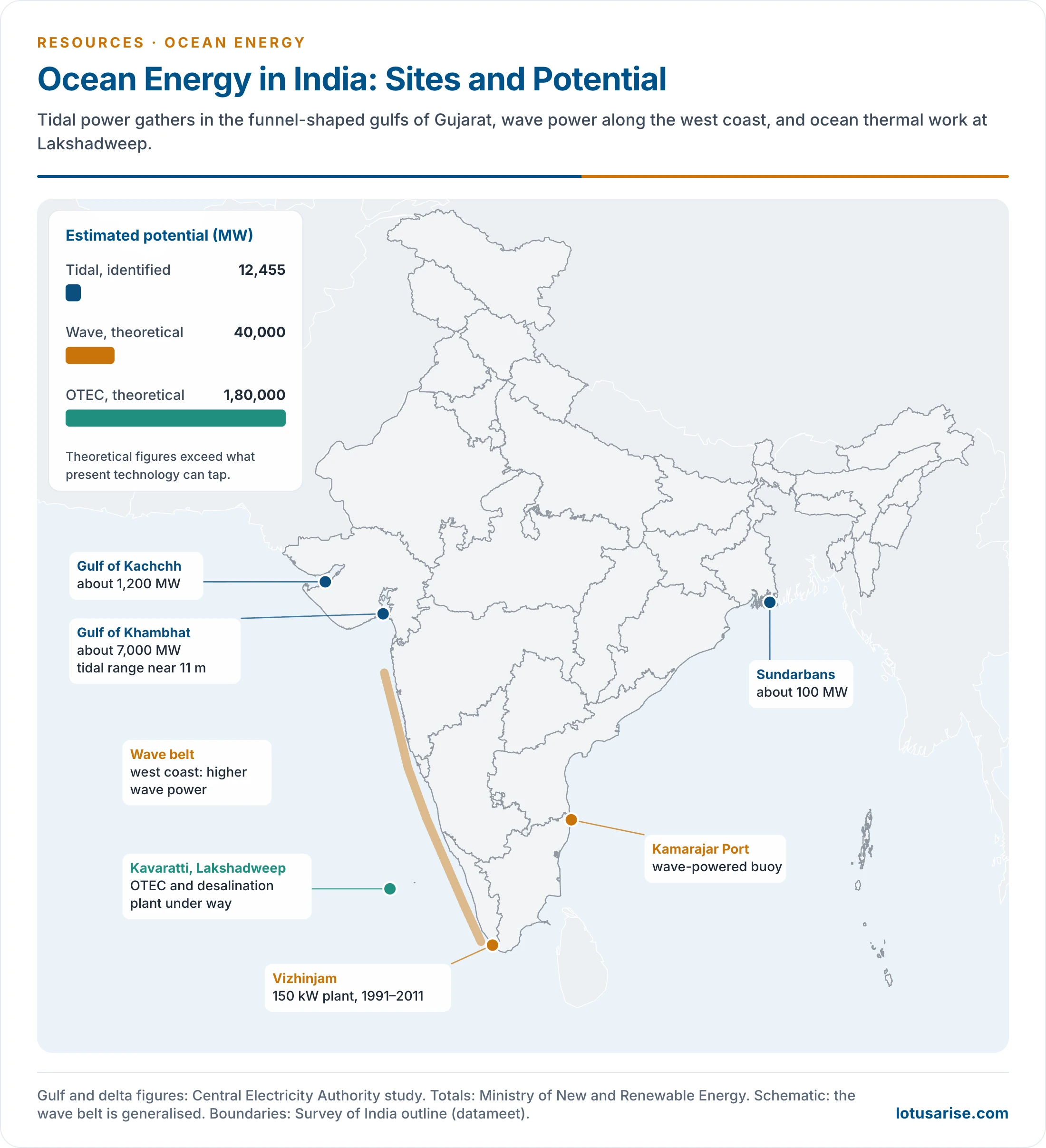
- India’s first plant stood at Vizhinjam near Thiruvananthapuram (Trivandrum), with a capacity of 150 kW.
- Research began in 1983 at IIT Madras, funded by the Department of Ocean Development. The plant followed in 1991.
- Output varied through the year and peaked in the monsoon months. It was later tried for desalination and was decommissioned in 2011.
- The National Institute of Ocean Technology (NIOT) has run a wave-powered navigational buoy near Kamarajar Port, Chennai. IIT Madras has built a point absorber named Sindhuja-I.
- The west coast (Maharashtra, Goa, Karnataka, Keralam) has more wave power than the east, and Kanyakumari the most.
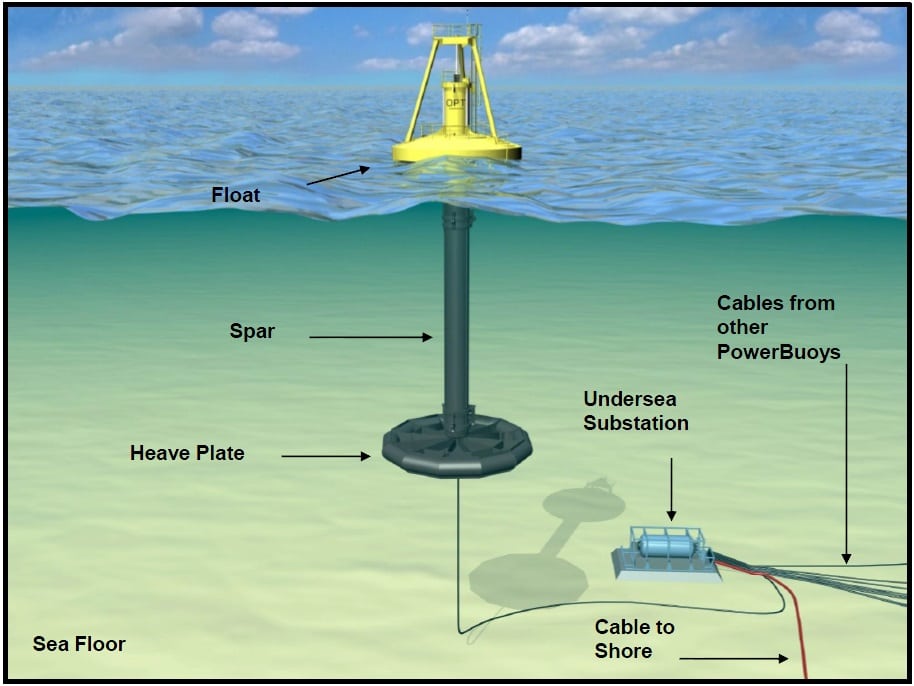
- The figure shows one point absorber, a float on a spar with a heave plate, wired through an undersea substation. It is a different design from the Vizhinjam column.
Current Energy
- It resembles wind power under water. Submerged turbines, big propellers anchored to the sea floor, spin in the flow of marine currents.
- The Intergovernmental Panel on Climate Change (IPCC) sees room for much larger projects, because open-ocean currents are so vast, once machines can work in slower currents.
Tidal Energy
- Tides arise from the gravitational pull of the moon and the sun, raising and lowering sea level in rhythm with their daily rising and setting.
- The rise and fall yields tidal power, much as a hydroelectric dam does.
- A barrage across an estuary encloses a reservoir or basin, and tidal water is held back twice a day.
- Released through turbines in the barrage, the water generates electricity.
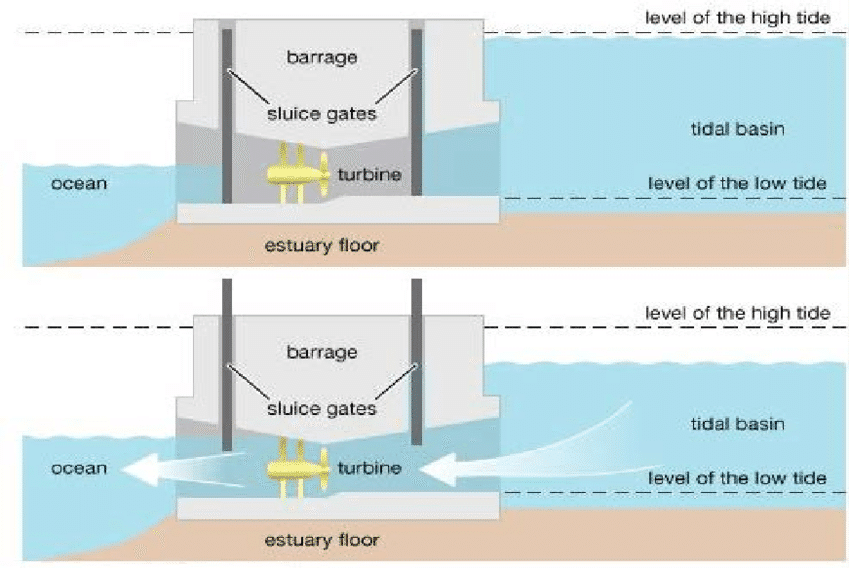
- In this figure, the upper panel holds water in the basin at low tide outside; the lower panel releases it through the turbine.
- The tide must be high enough for a plant to be built and run economically. Funnel-shaped gulfs amplify the range, to a maximum near 11 m in the Gulf of Khambhat and 8 m in the Gulf of Kachchh.
- Sites: the Gulf of Kachchh (Kutch) and Gulf of Khambhat (Cambay) in Gujarat, and the Sundarbans of West Bengal.
- Estimates:
- Long quoted at 8,000–9,000 MW.
- A Central Electricity Authority study gave 7,000 MW for Khambhat, 1,200 MW for Kachchh and 100 MW for the Sundarbans, about 8,300 MW in all. Some accounts put Kachchh at 1,000 MW.
- MNRE’s identified potential is about 12,455 MW.
- Projects have stalled on cost:
- A 900 MW tidal plant in the Gulf of Kachchh, studied in 1987, was later put at Rs 5,000 crore. It remained a proposal.
- A 50 MW plant at Mandvi in Kachchh was sought by the Gujarat Power Corporation.
- A 3.75 MW demonstration plant at Durgaduani Creek in the Sundarbans, sanctioned in 2008, was dropped by West Bengal for its very high cost.
- World examples: Sihwa Lake, South Korea (254 MW, 2011) and La Rance, France (240 MW).
Ocean Thermal Energy
- Seas cover almost 70% of the earth’s surface and act as huge heat reservoirs. The difference in temperature between warm surface water and cold deep water can raise vapour to run a turbine.
- On an average day, the 60 million sq km of tropical seas absorb solar radiation equal to the heat in about 245 billion barrels of oil.
- Ocean Thermal Energy Conversion (OTEC) runs a heat engine on the gap between the surface and depths of about 1,000 m.
- It needs a difference of about 20°C, so it suits tropical seas such as those around India.
- Efficiency is low: real plants often reach only 1–3%.
- Cycles:
- Closed: warm water boils a fluid of low boiling point, such as ammonia, in a sealed loop.
- Open: warm seawater itself flashes to steam under low pressure, and the condensed steam gives fresh water.
- Hybrid: it combines the two.
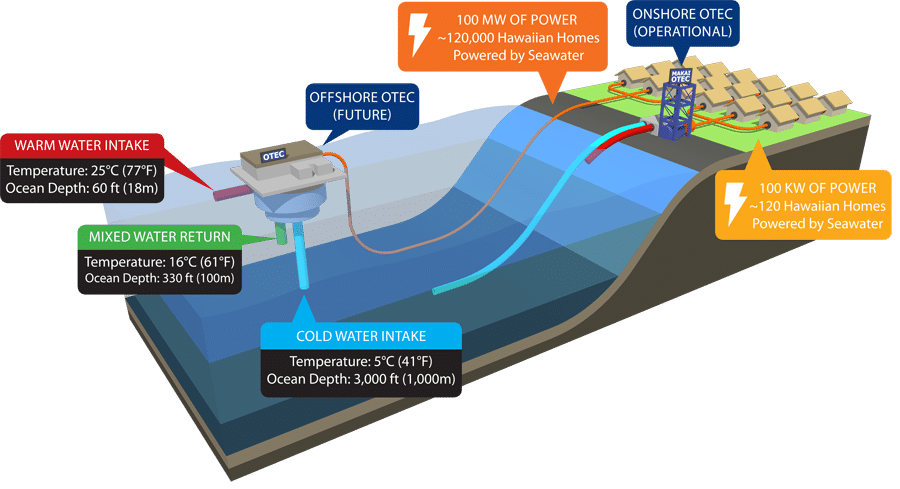
- The figures on this diagram belong to a Hawaiian plant. The onshore unit is a 100 kW plant, and the 100 MW offshore unit is only a future design.
- India:
- Older plans spoke of a 100 MW plant off the Tamil Nadu coast, and NIOT’s 1 MW floating attempt failed after an accident in 2002.
- Low-temperature thermal desalination (LTTD) began at Kavaratti in 2005, and now runs on eight Lakshadweep islands.
- A 65 kW OTEC plant at Kavaratti was reported to Parliament in 2022. The March 2026 review describes a self-powering plant of about 60 kW, giving about one lakh litres of drinking water a day.
- It draws water at about 5°C through a 3.8 km pipeline, against about 29°C at the surface. Lakshadweep now relies wholly on diesel for electricity.
Osmotic Energy
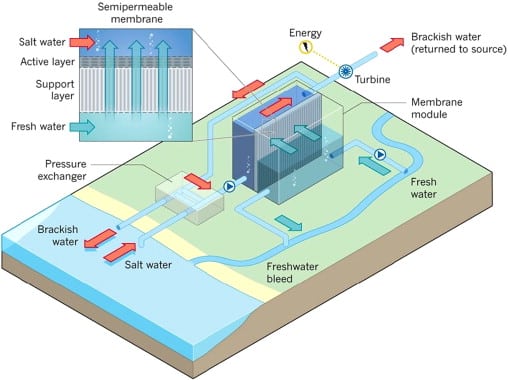
- Also called salinity gradient energy, it runs on water passing through a membrane from a freshwater reservoir towards a saltwater one.
- River mouths are the natural sites, since fresh and salt water meet there.
Ocean Energy in India
Potential
| Form | Older figure | Official estimate | Where |
|---|---|---|---|
| Tidal | 8,000–9,000 MW | 12,455 MW (identified) | Khambhat and Kachchh, large backwaters suited to barrages |
| Wave | 40,000 MW | 40,000 MW (theoretical) | West coast, Kanyakumari |
| OTEC | 50,000 MW | 1,80,000 MW (theoretical) | Tropical seas, subject to new technology |
- An older national estimate of 1,95,000 MW for all non-conventional energy gave about 30% to ocean thermal.
- Wave energy along the Indian coast, at about 5–15 kW per metre of wave front, is less intense than in higher northern and southern latitudes.
- Growth could fuel economic activity, cut the carbon footprint and create jobs, both on the coast and inland along the supply chains. This links ocean energy to the wider marine resources of India.
Salient Features
- Predictable and reliable: tides can be forecast years ahead, unlike wind, and waves are steadier than wind or sunshine. Their constant flows promise a reliable future supply.
- Global presence: tidal streams and ocean currents exist worldwide, though strong, usable flows gather in particular straits and gulfs.
- Energy-rich: water is over 800 times denser than air, and a flow of equal speed carries kinetic energy greater by the same factor.
- Unlimited usage area: land is scarce in many regions, so onshore projects compete for it. The vast and deep oceans remove that competition.
Limitations
- Little is installed in India, and what has been deployed is under-used.
- Research is thin on several technologies, and most remain at the stage of laboratory work, demonstration and early commercialisation.
- Marine risks:
- Corrosion from salt water, and difficult offshore maintenance.
- Harm to coastal landscapes and marine ecosystems, and clashes with fishing and other sea uses.
- Cost has stopped each large tidal scheme. Wave power cost 34–63 euro cents per kWh in a 2014 study, which held that about 10 GW of cumulative capacity is needed before it can compete.
Suggestions
- Use the coast: India’s long coastline, given as 7,516.6 km and re-assessed in 2025 at 11,098.81 km, has estuaries and gulfs that can be developed more fully.
- Scale up tidal streams and currents: these are huge, almost endless resources, and they could yield electricity at scale with relatively little environmental interference.
- Widen research: basic work is led by NIOT, Chennai, which falls under the Ministry of Earth Sciences. Other leading institutions could speed development by joining in.
- Start with islands: Lakshadweep shows the case, where costly diesel makes small plants worthwhile, and power can be paired with drinking water.





 Sociology Optional PYQ Solutions: Topic-wise Solved PYQs (1985–2026) by LotusArise IAS