- Environmental ethics is the branch of moral philosophy that asks whether nature has value of its own and what duties people owe to animals, plants, species, ecosystems and the land.
- Its central question is moral considerability: who or what counts when we decide how to act towards the environment.
- It took shape as a discipline in the 1970s, after the pollution and extinction crises of the post-war boom. The journal Environmental Ethics, founded by Eugene C. Hargrove (1979), gave it an academic home.
- Deep ecology and shallow ecology are the two poles of that debate, named by the Norwegian philosopher Arne Næss (1973).
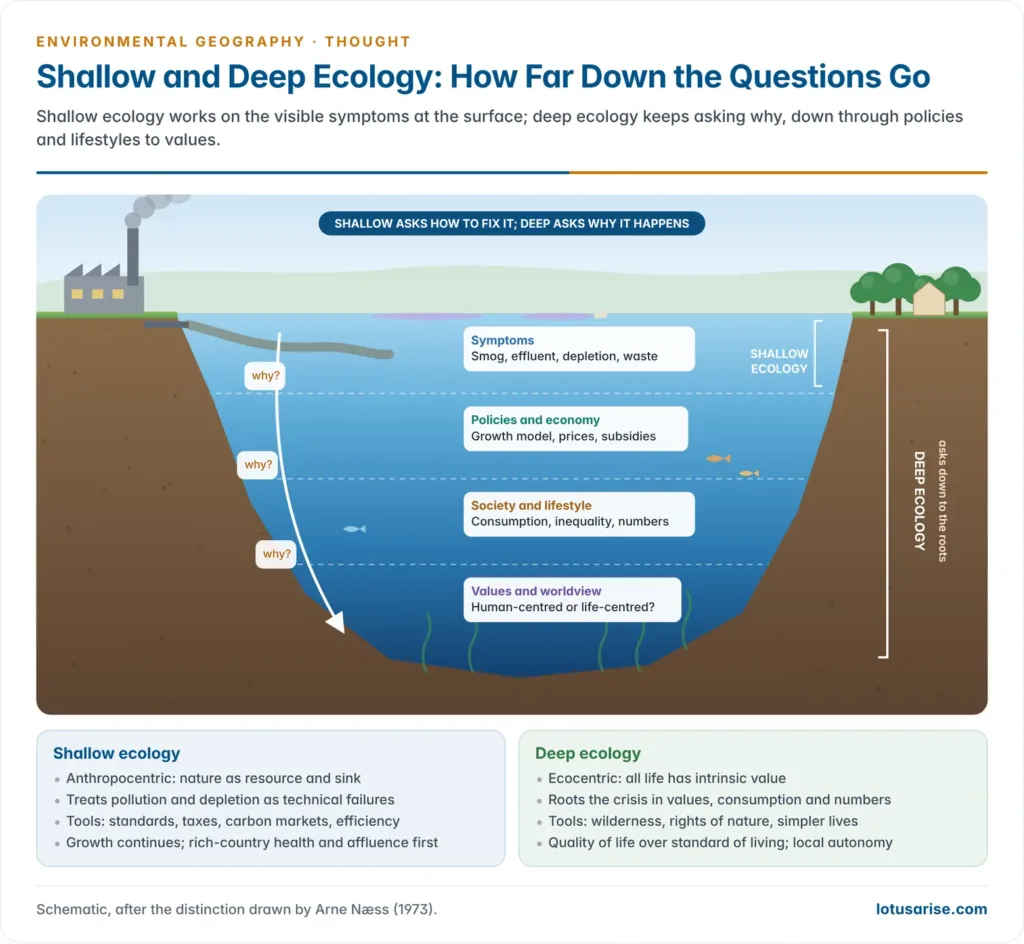
- Shallow ecology fights pollution and resource depletion for the sake of human health and affluence.
- Deep ecology holds that all life has intrinsic value and that the crisis can be solved only by a change in values, lifestyles and social structures.
- For geography, the debate is the ethical layer of the man–environment relationship. It decides whether nature is treated as a resource base for human use or as a community to which humans belong.
Environmental Ethics: The Question of Value

Instrumental and intrinsic value
- Instrumental value is the value a thing has as a means to some other end: a forest is worth its timber, water, carbon storage or tourist income.
- Intrinsic (inherent) value is the value a thing has as an end in itself, whether or not anyone uses it or even knows it exists.
- The value categories of biodiversity run from direct use through option value to existence value, the point at which economic valuation shades into intrinsic value.
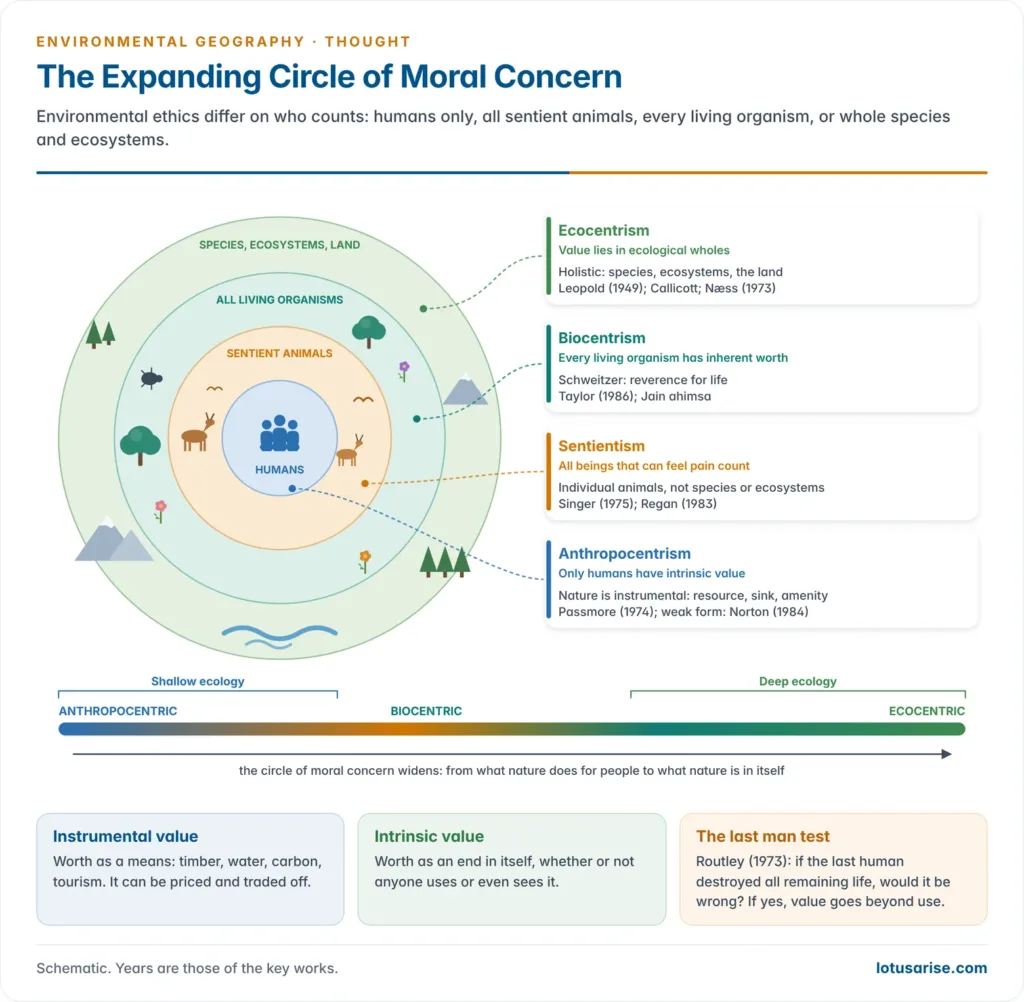
- Moral considerability asks whose interests must be weighed. Each answer draws a wider or narrower circle of moral concern:
- only humans (anthropocentrism);
- all sentient beings that can suffer (sentientism);
- every living organism (biocentrism);
- wholes such as species, ecosystems and the land itself (ecocentrism).
- Richard Routley (1973), later Richard Sylvan, framed the test with his “last man” argument.
- If the last surviving human destroyed every remaining tree and animal, would he do wrong? If the intuition says yes, then nature has value beyond human use, and an ethic confined to humans is incomplete.
Roots of the human-centred view
- Lynn White Jr. (1967), in “The Historical Roots of Our Ecologic Crisis” (Science), traced Western exploitation of nature to the biblical idea of human dominion over creation.
- His critique was contested, but it pushed ethics to the centre of environmental debate.
- The Scientific Revolution turned this attitude into method:
- Francis Bacon cast science as a tool to command nature for human benefit.
- René Descartes split mind from matter and saw animals and nature as machines with no inner value.
- The Industrial Revolution and colonial resource extraction put this mechanistic view into practice at a planetary scale.
- In India, the Indian Forest Act (1878) reserved forests for timber for railways and the navy and curtailed the customary rights of forest communities.
- This long arc, from tribal integration with nature to modern domination, is the evolution of human sensibility towards nature; environmental ethics is its reflective, late-modern phase.
Anthropocentrism, biocentrism and ecocentrism
Anthropocentrism
- Anthropocentrism holds that only humans have intrinsic value. Nature matters instrumentally, for what it provides to present and future people.
- Strong anthropocentrism values nature only for the satisfaction of human preferences, however wasteful.
- Weak anthropocentrism, set out by Bryan G. Norton (1984), values nature for its role in forming considered human ideals and for future generations. It can therefore support strong conservation without granting nature rights.
- Stewardship is its religious and ethical variant: humans are trustees of the earth, answerable for its care.
- John Passmore (1974), in Man’s Responsibility for Nature, argued that no new ethic is needed: the Western tradition, applied prudently, is enough to curb pollution and waste.
- Sustainable development in the Brundtland sense (1987) is anthropocentric. Its justification is intergenerational equity among humans.
Sentientism and biocentrism
- Sentientism extends moral concern to all beings that can feel pain.
- Peter Singer (1975), in Animal Liberation, called the denial of animal interests “speciesism”; Tom Regan (1983) argued that animals are subjects with rights.
- It remains individualist: it protects individual animals, not species or ecosystems.
- Biocentrism (life-centred ethics) grants intrinsic value to every living organism, sentient or not.
- Albert Schweitzer grounded it in “reverence for life”: the will-to-live in every organism deserves respect.
- Paul W. Taylor (1986), in Respect for Nature, argued that each organism is a “teleological centre of life” pursuing its own good, so all organisms have equal inherent worth.
- Indian parallels: the Jain doctrine of ahimsa extends non-violence to the smallest life forms, and Buddhism teaches compassion for all sentient beings.
Ecocentrism
- Ecocentrism (ecosphere-centred ethics) locates value in ecological wholes: species, communities, ecosystems, landscapes and the biosphere.
- It is holistic: the good of the whole can outweigh the good of individual organisms. Culling an invasive species to save an island ecosystem is right on ecocentric grounds, wrong on strict biocentric grounds.
- It rests on ecology’s own picture of the world: ecosystems of interdependent parts linked by energy flow and nutrient cycling.
- Its leading voices are Aldo Leopold, J. Baird Callicott, Holmes Rolston III and the deep ecologists.
| Basis | Anthropocentrism | Biocentrism | Ecocentrism |
|---|---|---|---|
| What has intrinsic value | Humans only | Every living organism | Ecological wholes, and their members |
| Unit of concern | Individual humans, present and future | Individual organisms | Species, ecosystems, land |
| Value of nature | Instrumental | Intrinsic, organism by organism | Intrinsic, systemic |
| Key thinkers | Passmore, Norton, Brundtland | Schweitzer, Taylor | Leopold, Callicott, Rolston, Næss |
| Policy expression | Pollution control, sustainable yield | Animal welfare, anti-cruelty laws | Wilderness, rights of nature |
Aldo Leopold’s land ethic
- Aldo Leopold (1887–1948), an American forester and wildlife ecologist, set out the land ethic in A Sand County Almanac (1949), published a year after he died fighting a grass fire.
- The community concept: ethics has widened through history, from individuals to society. The next step is to enlarge the community to include “soils, waters, plants, and animals, or collectively: the land.”
- The land ethic changes the role of Homo sapiens from “conqueror of the land-community to plain member and citizen of it.”
- The summary maxim: “A thing is right when it tends to preserve the integrity, stability, and beauty of the biotic community. It is wrong when it tends otherwise.”
- “Thinking like a mountain”: Leopold’s essay recalls shooting a wolf and watching the “fierce green fire” die in its eyes.
- Wolf removal let deer multiply and strip the mountain’s vegetation, a lesson in trophic cascades and in seeing the land as a whole system.
- The land pyramid: Leopold pictured the land as a circuit of energy flowing through soils, plants and animals, so that ecological conscience means keeping the circuit intact.
- Evaluation:
- It is the founding text of ecocentrism and of modern conservation biology.
- Tom Regan called its holism “environmental fascism”, because the good of the community could justify sacrificing individuals.
- Callicott’s later defence holds that the land ethic supplements, and does not replace, duties to humans.
Preservation versus conservation
- The ethical split first surfaced in American policy at the turn of the twentieth century.
- John Muir, founder of the Sierra Club (1892), stood for preservation: wild nature should be kept untouched for its own sake and for its spiritual worth.
- Gifford Pinchot, first chief of the US Forest Service (1905), stood for conservation: resources should be used wisely and efficiently, for the greatest good of the greatest number over the longest time.
- The two clashed over the Hetch Hetchy dam in Yosemite National Park, approved in 1913 to supply San Francisco: a victory for utilitarian conservation.
- The split survives as the preservative and conservative approaches to environmental management.
- Preservation is ethically ecocentric but often impractical; conservation, the basis of the World Conservation Strategy (1980), is pragmatic and anthropocentric.
- Deep ecology inherits Muir’s line, and shallow ecology Pinchot’s.
Deep Ecology and Shallow Ecology
Arne Næss and the 1973 distinction
- Arne Dekke Eide Næss (1912–2009) was a Norwegian philosopher who held the chair of philosophy at the University of Oslo from 1939, at 27. He was also a mountaineer: he led the Norwegian expedition that made the first ascent of Tirich Mir (1950)** in the Hindu Kush.
- He left his chair in 1970 to work for the environment. That year he chained himself with other protesters at the Mardøla waterfall to stop a hydroelectric project.
- He first set out the distinction in a lecture at the Third World Future Research Conference, Bucharest (September 1972). It was published as “The Shallow and the Deep, Long-Range Ecology Movement: A Summary” in the journal Inquiry (1973, volume 16, pp. 95–100).
- The shallow movement, in Næss’s one-line definition, is the “fight against pollution and resource depletion“, whose central objective is “the health and affluence of people in the developed countries.”
- The deep movement was characterised by seven points:
- Rejection of the man-in-environment image in favour of a relational, total-field image: organisms are knots in a field of relations, not separate things placed in an environment.
- Biospherical egalitarianism, in principle: “the equal right to live and blossom” for all forms of life. Some killing and exploitation is unavoidable in practice.
- Principles of diversity and symbiosis: “live and let live” is a better ecological principle than “either you or me”. Diversity raises the chances of survival.
- Anti-class posture: the same egalitarian principle applies to conflicts between groups, including those between rich and poor nations.
- Fight against pollution and resource depletion, but as one part of the wider programme, not in isolation.
- Complexity, not complication: respect for the complexity of ecosystems, and integrated, whole-person work instead of fragmented labour.
- Local autonomy and decentralisation: shorter chains of decision reduce vulnerability to distant influences and to big, centralised systems.
Shallow ecology
- Shallow ecology (also reform or light green environmentalism) treats environmental problems as technical and managerial failures of an otherwise sound system.
- Its features:
- Anthropocentric: nature matters as a resource and as a sink for wastes.
- Symptom-focused: it targets pollution, depletion and degradation, not the values that cause them.
- Technological optimism: cleaner technology, efficiency and substitution will solve the problem.
- Market and regulatory tools: emission standards, pollution taxes, tradable permits and the money valuation of ecosystem services.
- Growth-compatible: it accepts economic growth, now as “green growth”, and assumes that richer societies clean up, as the Environmental Kuznets Curve suggests.
- Examples:
- Pollution control standards and India’s National Clean Air Programme.
- Carbon markets, from the Kyoto Clean Development Mechanism to Article 6 of the Paris Agreement and India’s Carbon Credit Trading Scheme (2023): the toolkit of carbon neutrality.
- Sustainable-yield forestry and fisheries.
- “Shallow” is not “useless”. Næss accepted that reforms cut real harm; his objection was that they stop short, leave the causes untouched, and serve mainly the wealthy.
- Timothy O’Riordan (1976), in Environmentalism, gave geography a parallel pair:
- Technocentrism, which trusts science, markets and managers (the “cornucopians” and “accommodators”);
- Ecocentrism, which stresses natural limits, small scale and participation (the “deep ecologists” and “soft technologists”).
Deep ecology: the core ideas
- Deep questioning: the word “deep” refers to the depth of the questions asked. Shallow ecology asks how to reduce pollution; deep ecology keeps asking why we pollute, what a good life is, and what kind of society we want.
- Intrinsic value and biospherical egalitarianism: all life has value independent of its usefulness to humans. No species is the measure of all others.
- Self-realisation and the ecological self:
- Næss’s highest norm was “Self-realisation!”: maturing from the narrow ego, through the social self, to an ecological Self that identifies with all life.
- When the self widens, protecting nature becomes self-defence, not sacrifice; care follows from identification, not from moral duty.
- Warwick Fox (1990) developed this into transpersonal ecology.
- Ecosophy: Næss coined ecosophy for a personal philosophy of ecological harmony. His own was Ecosophy T, named after Tvergastein, his mountain hut in Norway.
- Philosophical roots: Næss drew on Baruch Spinoza (nature as one creative whole) and on Mahatma Gandhi (non-violence and the identification of self with all beings). He also found support in Buddhist and other Asian traditions.
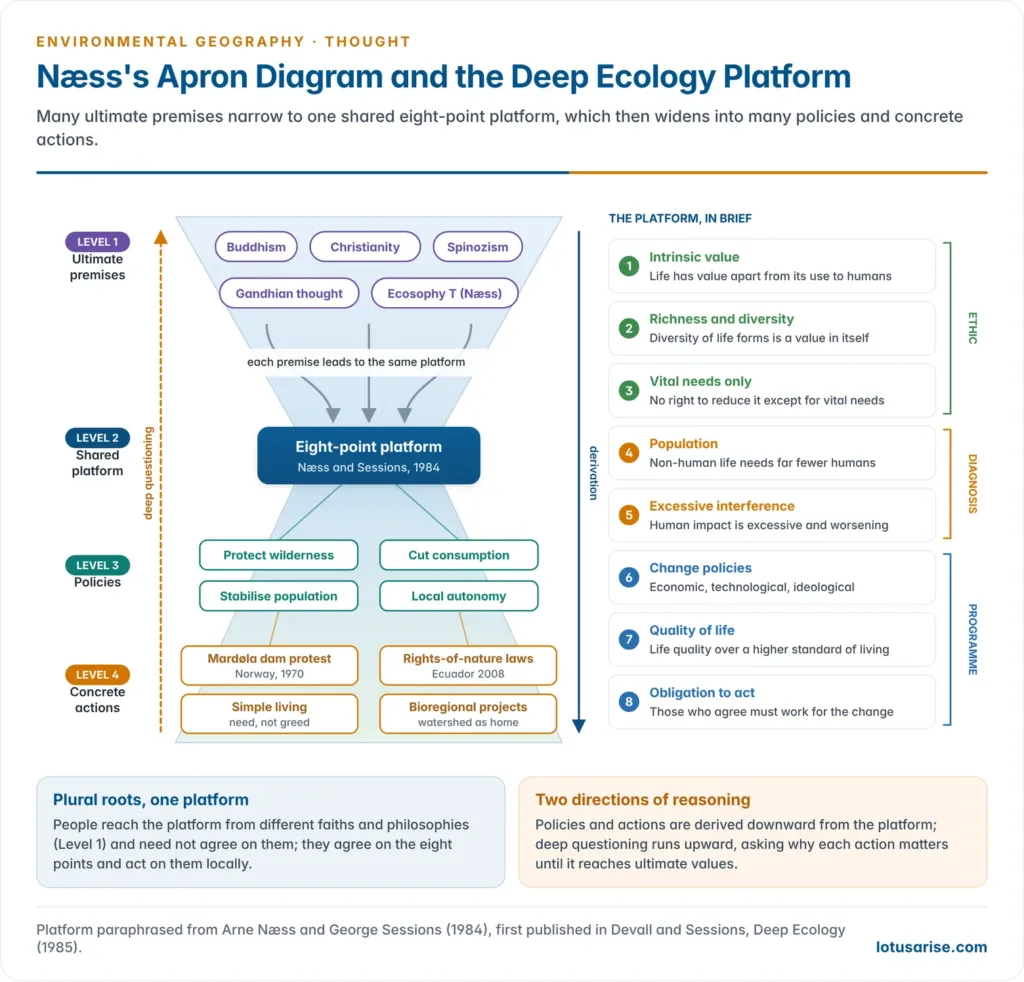
- The apron diagram: Næss set out four levels of reasoning:
- Level 1: many different ultimate premises, religious or philosophical (Buddhism, Christianity, Spinozism, Ecosophy T);
- Level 2: the shared platform that people from all these premises can accept;
- Level 3: the policies derived from the platform;
- Level 4: concrete actions in particular places.
- The movement is therefore plural at the roots and united at the platform.
- The movement’s spread:
- Bill Devall and George Sessions popularised it in Deep Ecology: Living as if Nature Mattered (1985).
- Radical activist groups such as Earth First! (1980) in the United States took up its wilderness ethic.
The eight-point platform (Næss and Sessions, 1984)
- Arne Næss and George Sessions drafted the platform of the deep ecology movement on a camping trip in the American desert in 1984. It was published in Devall and Sessions (1985).
- The eight points, in summary:
- Intrinsic value: the well-being and flourishing of human and non-human life have value in themselves, independent of usefulness to humans.
- Diversity: the richness and diversity of life forms contribute to these values and are values in themselves.
- Vital needs only: humans have no right to reduce this richness and diversity except to satisfy vital needs.
- Population: human life and cultures can flourish with a substantially smaller human population, and non-human life requires such a decrease.
- Excessive interference: present human interference with the non-human world is excessive and rapidly worsening.
- Policy change: policies must change, affecting basic economic, technological and ideological structures.
- Quality of life: the ideological change is to value life quality over an ever-higher standard of living; there is a difference between big and great.
- Obligation to act: those who accept these points have an obligation to work, directly or indirectly, for the changes.
- Reading the platform:
- Points 1–3 state the ethic; points 4–5 the diagnosis; points 6–8 the programme.
- “Vital needs” is left undefined on purpose, so that it can vary with climate, culture and economy.
- Point 4 is the most controversial, and the one critics attack first.
Deep and shallow ecology compared
| Basis | Shallow ecology | Deep ecology |
|---|---|---|
| Ethical base | Anthropocentric | Ecocentric, biospherical egalitarianism |
| Value of nature | Instrumental: resource and sink | Intrinsic: valuable in itself |
| Place of humans | Above and apart from nature | One strand in the web of life |
| Diagnosis | Pollution and depletion as technical failures | Crisis rooted in values, consumption and numbers |
| Remedy | Technology, pricing, regulation | Change in worldview, lifestyle, population and structures |
| Growth | Green growth is possible | Quality of life over standard of living |
| Scale | Centralised, expert-led | Local autonomy, decentralisation |
| Beneficiary | Mainly people in rich countries | All life, present and future |
| Typical tools | Emission standards, carbon markets, EIA | Wilderness, rights of nature, simple living |
- The key difference is the reason, not the target. Both may protect the same forest; shallow ecology does so because the forest serves people, deep ecology because the forest has a good of its own.
- The two are not watertight. A rule such as a ban on felling can be backed on both grounds, and Bryan Norton’s convergence hypothesis (1991) holds that a long-sighted anthropocentrism and an ecocentrism will usually recommend the same policies.
Deep ecology in practice: rights of nature
- Rights of nature are the clearest legal expression of ecocentrism: ecosystems are treated as legal persons with rights that humans can enforce on their behalf.
- Global examples:
- Ecuador’s Constitution (2008), Articles 71–74, gives Pachamama (nature) the right to exist, persist and regenerate.
- Bolivia’s Law of the Rights of Mother Earth (2010).
- New Zealand made the Te Urewera forest (2014) and the Whanganui River, through the Te Awa Tupua Act (2017), legal persons, drawing on Māori relationships with the land.
- Other practices with a deep-ecology spirit:
- wilderness and core-zone protection;
- bioregionalism, organising life around natural regions such as watersheds;
- voluntary simplicity and lower consumption;
- direct action against dams, logging and mining.
Critiques of Deep Ecology
The Third World critique: Ramachandra Guha (1989)
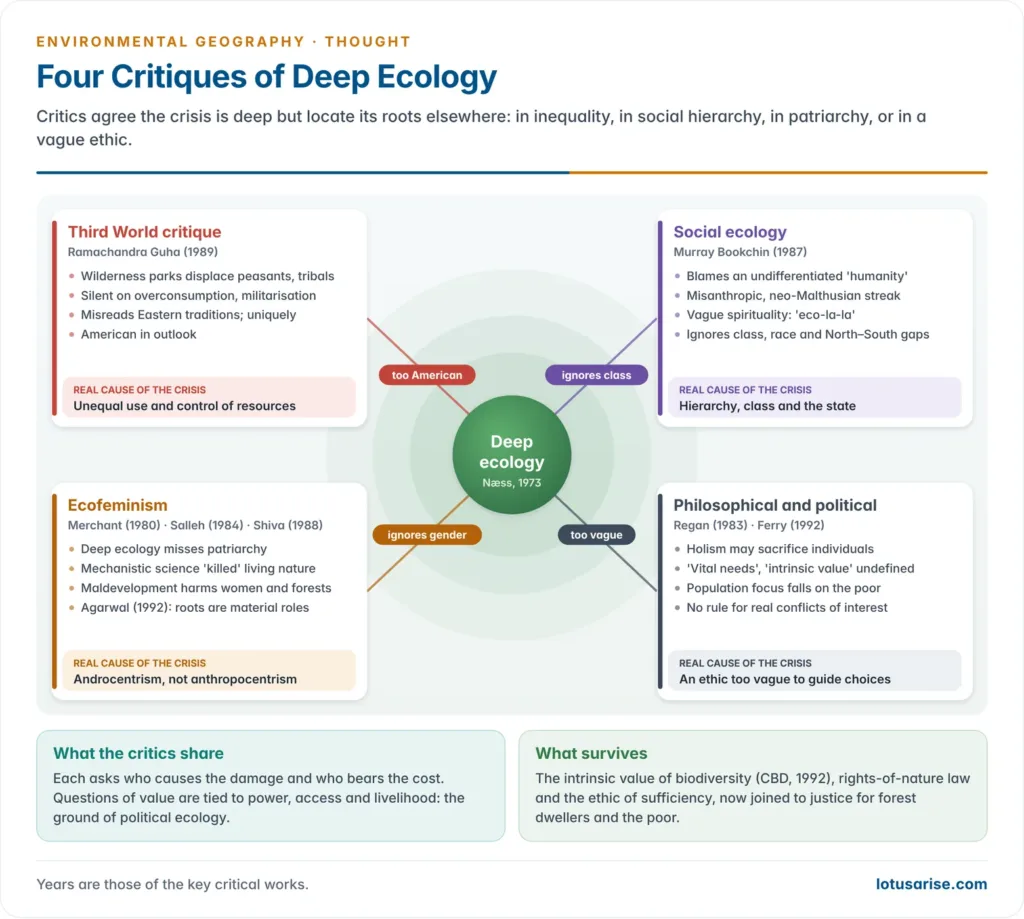
- Ramachandra Guha, in “Radical American Environmentalism and Wilderness Preservation: A Third World Critique” (Environmental Ethics, vol. 11, 1989), made four charges:
- The anthropocentric–biocentric distinction is of little use. The real causes of the global crisis are overconsumption by industrial nations and urban elites and militarisation, which deep ecology hardly mentions.
- The focus on wilderness is harmful when exported. In the Third World, setting aside parks for wild nature displaces peasants, pastoralists and tribal people. Guha cited Project Tiger in India, which put tigers first and forest communities last.
- The appeal to Eastern traditions is a misreading. Hinduism, Buddhism and Taoism are complex, and in Asia they have coexisted with intensive use of nature, not with wilderness worship.
- Deep ecology is uniquely American. It reflects the wilderness ideal of a rich, settled society. German Greens and Indian movements are rooted in livelihood and social justice.
- The environmentalism of the poor:
- For Guha, Indian environmentalism is not biocentric but a fight over who controls and uses natural resources. His history of Chipko, The Unquiet Woods (1989), reads it as a peasant livelihood movement.
- With Joan Martínez-Alier he set this out as Varieties of Environmentalism (1997); Martínez-Alier’s The Environmentalism of the Poor (2002) generalised it.
- Madhav Gadgil and Ramachandra Guha (Ecology and Equity, 1995) divided Indian society into ecosystem people, who live off local resources, omnivores, who draw on resources from far afield, and ecological refugees, displaced by development. The conflict between them is ecological and social at once.
- Why it still matters:
- “Fortress conservation”, protected areas emptied of people, remains contested.
- The 30 by 30 target of the Kunming-Montreal Global Biodiversity Framework (2022) drew warnings of “green colonialism” from Indigenous groups, answered in part by its recognition of Indigenous and traditional territories.
- In India, the Forest Rights Act (2006) recognised the rights of forest dwellers within the wildlife conservation regime.
Social ecology: Murray Bookchin
- Murray Bookchin, an American anarchist thinker, founded social ecology (The Ecology of Freedom, 1982). He attacked deep ecology in “Social Ecology versus Deep Ecology: A Challenge for the Ecology Movement” (1987).
- His charges:
- An undifferentiated “humanity”: deep ecology blames humans as a species, lumping together oppressors and oppressed, rich and poor, North and South.
- Misanthropy: he quoted Earth First! co-founder Dave Foreman, who had said that famine in Ethiopia should be left to take its course, and an Earth First! article that welcomed AIDS as a check on population.
- Neo-Malthusianism: the call for drastic population reduction leans towards authoritarian, even “eco-fascist”, solutions.
- Mystical vagueness: he dismissed its spirituality as “eco-la-la“, a muddle that dissolves human reason and agency into a cosmic Self.
- His thesis: the domination of nature grows out of the domination of human by human: hierarchy, patriarchy, class and the state.
- The remedy is a decentralised, non-hierarchical society of self-governing communities (libertarian municipalism), not a change of consciousness alone.
- The Marxian view on the environment makes a parallel case from political economy: the crisis is rooted in capitalism, not in “human nature”.
Ecofeminism: Merchant, Salleh and Shiva
- Ecofeminism links the domination of nature with the domination of women. The term was coined by Françoise d’Eaubonne (1974).
- Carolyn Merchant (1980), in The Death of Nature, showed how the Scientific Revolution replaced the image of nature as a living, nurturing mother with a mechanical, dead nature open to exploitation.
- Ariel Salleh (1984), in “Deeper than Deep Ecology”, argued that the root problem is androcentrism (male-centredness), not anthropocentrism. Deep ecology, written largely by men, missed patriarchy.
- Val Plumwood (1993) traced a chain of dualisms, such as man/woman, reason/nature and mind/body, in which the first term dominates the second.
- Vandana Shiva, in Staying Alive: Women, Ecology and Survival in India (1988):
- Maldevelopment: Western development is a patriarchal project that destroys nature and marginalises women.
- The feminine principle (Prakriti): the living, creative force in nature and in women is violated by reductionist science and commercial forestry.
- Women and forests: rural women, who gather fodder, fuel and water, bear the first costs of deforestation. Women’s role in Chipko shows them as guardians of nature.
- Ecofeminism and deep ecology share a holistic, anti-mechanistic view, but ecofeminism insists that gender and power must be part of the analysis.
- Critique of ecofeminism:
- Bina Agarwal (1992), in “The Gender and Environment Debate: Lessons from India”, argued that women’s closeness to nature comes from their material roles and the gendered division of labour, not from any feminine essence. She called her alternative feminist environmentalism.
- Indian gender and biodiversity work today follows this material line: land rights, access and voice.
Other criticisms
- Misanthropy and population:
- Platform point 4 seems to put human numbers, especially in poor countries, at the heart of the problem.
- Yet a person in a rich country has a far larger ecological footprint than one in a poor country.
- Eco-authoritarianism: Luc Ferry (1992) warned that ranking ecosystems above individuals could justify illiberal politics. Regan’s “environmental fascism” charge against holism made the same point.
- Philosophical vagueness:
- “Intrinsic value”, “vital needs” and “biospherical egalitarianism” are hard to define or apply.
- If all life has equal worth, deep ecology gives no rule for real conflicts: a farmer and a crop pest, a malaria parasite and a child.
- Impracticability: it offers a vision more than a programme; policy almost everywhere still runs on weak anthropocentrism.
- An elite ethic: wilderness experience and voluntary simplicity are choices open to the affluent; for the poor, simplicity is not chosen.
Evaluation
- Strengths of deep ecology:
- It widened the moral community beyond humans and forced the question of why we protect nature.
- It exposed the limits of technical fixes that leave consumption untouched.
- It anticipated today’s language of planetary limits, sufficiency and degrowth, and inspired rights-of-nature law.
- Weaknesses: a weak social theory of the crisis, a wilderness bias, and silence on inequality, class and gender.
- Strengths of shallow ecology:
- It is practical and measurable: lead-free petrol, the Montreal Protocol and pollution standards have saved millions of lives.
- It can win political consensus.
- Weaknesses: it treats symptoms, assumes endless growth, and risks greenwashing and the rebound effect, where efficiency gains are eaten up by higher consumption.
- The current view:
- Most environmental policy blends both. Ecocentric goals, such as rights of nature and the intrinsic value of biodiversity recognised in the preamble of the Convention on Biological Diversity (1992), are pursued through anthropocentric tools and human guardians.
- For geography, the critiques push the debate towards political ecology and environmental justice, where questions of value are tied to questions of power, access and livelihood. That is the line from the deep–shallow debate to the social production of nature.
Indian Traditions and Environmental Ethics
Philosophical roots
- The Isha Upanishad opens by seeing the whole universe as pervaded by the divine and counsels enjoyment through renunciation (tena tyaktena bhunjitha): take only what is needed.
- The Prithvi Sukta of the Atharva Veda addresses the earth as mother: “Earth is my mother, I am her son” (mata bhumih putro aham prithivyah).
- Jainism and Buddhism extend ahimsa and compassion to all living beings; Jain monks sweep their path so as not to crush insects.
- Mahatma Gandhi criticised industrial civilisation’s endless wants. The saying attributed to him, that the earth provides enough for every man’s need but not for every man’s greed, is the Indian slogan of sufficiency.
- His ideas shaped Næss directly.
- Caution: the presence of reverent texts does not prove that practice was always ecocentric, which is Guha’s point about romanticising Eastern traditions.
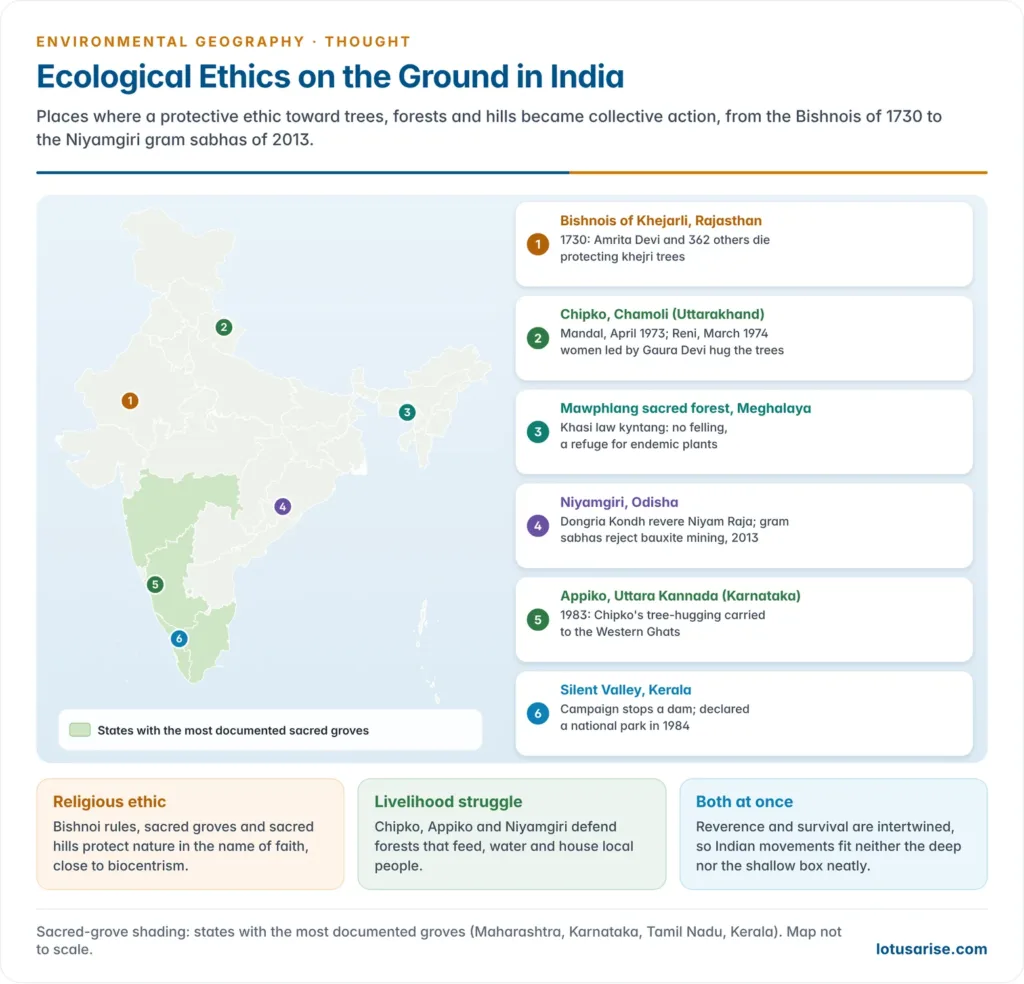
The Bishnois
- The Bishnoi community of western Rajasthan follows the 29 principles (bis + noi, twenty-nine) of Guru Jambheshwar, who founded the sect in 1485 at Samrathal Dhora.
- The principles forbid felling green trees and killing animals, especially the khejri tree (Prosopis cineraria) and the blackbuck and chinkara.
- Khejarli, 1730: when the soldiers of Maharaja Abhay Singh of Jodhpur came to fell khejri trees for lime kilns for a new palace, Amrita Devi hugged a tree and was killed.
- 363 Bishnois died before the Maharaja stopped the felling and protected Bishnoi villages.
- India’s national award for wildlife protection by individuals and communities is named after her.
- The Bishnoi ethic is close to biocentrism, yet it is practical: protected khejri trees give fodder, shade and nitrogen in a desert farming system.
Sacred groves
- Sacred groves are patches of forest protected by local communities in the name of a deity, where felling and hunting are taboo.
- About 13,270 groves have been documented in India, and the true number is estimated at 1 to 1.5 lakh. Maharashtra, Karnataka, Tamil Nadu and Kerala have the most documented groves.
- Regional names: devrai (Maharashtra), devarakadu (Karnataka), kavu and sarpa kavu (Kerala), law kyntang (Meghalaya), orans (Rajasthan), sarna (Jharkhand).
- The Mawphlang sacred forest in the Khasi Hills of Meghalaya is the best-known example.
- Ecological role: sacred groves are refugia for endemic and medicinal plants, protect springs and stream heads, and hold gene pools in degraded landscapes. They are recognised as a form of in-situ conservation and as community reserves.
- Ethic in practice: the protection is religious, but the benefits (water, soil, fruit, medicine) are material, which shows that sacred and utilitarian motives often work together.
Chipko and other people’s movements
- Chipko (“to hug”) began in the Garhwal Himalaya in April 1973 at Mandal (Chamoli), led by Chandi Prasad Bhatt‘s Dasholi Gram Swarajya Sangh, against a sports-goods company’s felling licence.
- At Reni (26 March 1974), Gaura Devi led village women who hugged the trees and turned back the loggers.
- Sunderlal Bahuguna carried the message across the Himalaya. In 1980 the Centre imposed a 15-year ban on green felling in the Himalayan forests of Uttar Pradesh.
- Appiko (1983), in Uttara Kannada, Karnataka, carried the tree-hugging method to the Western Ghats.
- Silent Valley (Kerala): a campaign by scientists, writers and the Kerala Sastra Sahitya Parishad against a hydroelectric dam on the Kunthipuzha saved one of the last tracts of undisturbed tropical evergreen forest. It was declared a national park in 1984.
- Niyamgiri (Odisha): the Dongria Kondh worship the Niyamgiri hills as the seat of Niyam Raja.
- In April 2013 the Supreme Court left the decision on bauxite mining to their gram sabhas, which rejected it; the project was refused clearance in 2014.
- Deep or shallow? These people’s movements are read in two ways:
- Shiva sees Chipko as a feminine, ecocentric defence of living forests.
- Guha sees it as a livelihood and rights struggle against the state and contractors.
- Most scholars accept both: reverence for nature and survival are intertwined, which is why Indian environmentalism fits neither Western box neatly.
Ecocentrism in Indian law
- The Constitution: the 42nd Amendment (1976) added Article 48A (the State shall protect and improve the environment) and Article 51A(g), the citizen’s duty to protect the natural environment and “to have compassion for living creatures“, an ethical clause that reaches beyond humans.
- Supreme Court judgments:
- T.N. Godavarman Thirumulpad v. Union of India (2012, wild buffalo): the Court contrasted anthropocentrism with ecocentrism and endorsed the latter, holding that nature has intrinsic value.
- Centre for Environmental Law, WWF-I v. Union of India (April 2013, Asiatic lion): the Court ordered a second home for the lion at Kuno and adopted a “species best interest” standard, reading a duty to prevent extinction into Article 21.
- Animal Welfare Board of India v. A. Nagaraja (May 2014, jallikattu): the Court recognised that animals have rights under the Prevention of Cruelty to Animals Act.
- Rivers as persons:
- On 20 March 2017 the Uttarakhand High Court declared the Ganga and Yamuna “living entities” with the rights of legal persons. On 30 March it extended this to glaciers, forests and lakes.
- The Supreme Court stayed the river order in July 2017, citing practical and legal difficulties.
- Balancing: in M.K. Ranjitsinh v. Union of India (March 2024) the Court weighed protection of the Great Indian Bustard, killed by power lines in Rajasthan and Gujarat, against solar power transmission. It recognised a right against the adverse effects of climate change under Articles 14 and 21, an anthropocentric right, alongside species protection.
- These judicial doctrines show Indian law moving between the two ethics case by case.
LiFE and the ethic of sufficiency
- Mission LiFE (Lifestyle for Environment), announced at COP26 in Glasgow (2021) and launched on 20 October 2022 at Ekta Nagar, Gujarat, calls for “mindful and deliberate utilisation” in place of “mindless and destructive consumption”.
- Its ethics are mixed:
- Its concern with consumption and lifestyle echoes deep ecology’s quality of life over standard of living.
- Its framing remains anthropocentric and individual: behaviour change within a growth economy.
- How such values become behaviour is the subject of PAVE theory, which links perception, attitude, value and emotion to conservation action.