

- Human geography is the branch of geography concerned with the world’s cultures and how they relate to geographic space. Political geography is its offshoot: it studies the spatial distribution of political processes and how a location shapes them.
- As an academic discipline, it studies the interaction between people’s political activity and integral geographical space, which is made up of physical, economic, social, cultural and political spaces.
- These spaces lie one over another. Their superposition differentiates integral space and creates the socio-economic and natural conditions for all human activity.
- It also creates places with their own character: a unique history, structure of economy and settlement, population make-up, identity, culture and way of life.
- Put simply, the subject deals with the relationship between political activity and the geographical conditions under which that activity develops.
Nature of the Discipline
From a Term to a Discipline
- The term “political geography” has been in use at least since the eighteenth century. It then meant a body of information on the political organisation of countries, on new territories, and on markets drawn into the world or national economy.
- The discipline came much later. Ideas about its content, categories and methods took shape only as geographical knowledge accumulated.
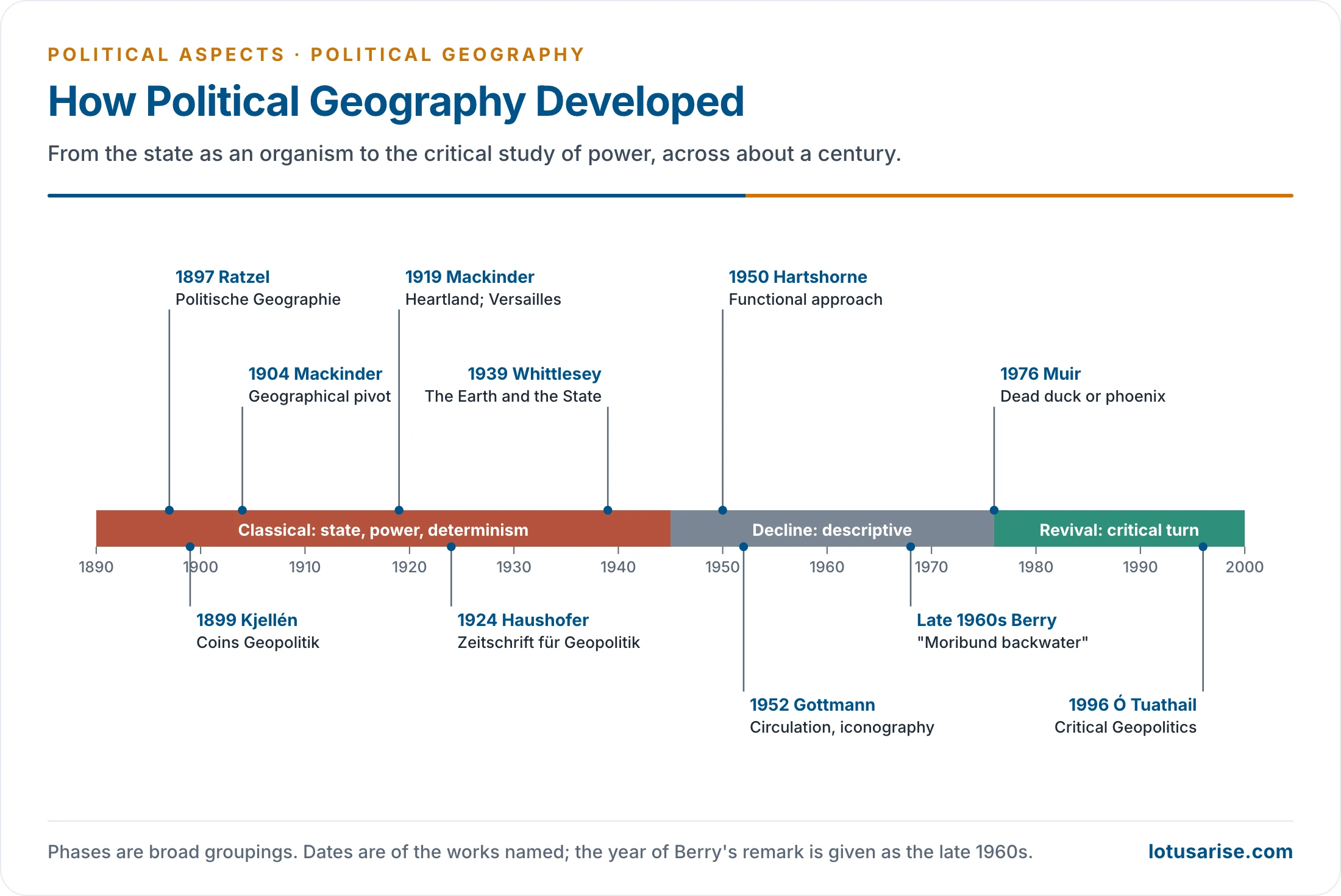
- The publication of Politische Geographie (1897) by Friedrich Ratzel can be taken as the birth of contemporary political geography.
- Any subject that claims the status of a separate branch of knowledge must define its object and the key relation it studies, its methodology and concrete methods, its system of categories and its specific problems. Political geography answers these as follows.
Object, Objective and Political Space
| Element | What it means in political geography |
|---|---|
| Object | Political-territorial systems: linked territorial combinations of elements of the political sphere |
| Objective | To reveal the unity of political activity and the geographical factors of social development |
| Key relation | Political activity interacting with geographical space |
| Political space | The form in which political phenomena and political-geographical objects exist |
- Political-territorial systems take in political and administrative boundaries, states and groups of states, national and supra-national political organisations, and central and local governments.
- Geographical space is a combination of “particular” spaces: physical, economic, social and cultural.
- Their juxtaposition differentiates the whole, and with it the socio-economic and natural conditions for political and other forms of human activity.
- Political space covers the mutual location, coexistence, interaction, relationships and intensity of these objects.
- For political activity, what matters most is the structure of the population, its level and way of life, its political culture and its identity. All of these vary in space and time.
- The spaces change at different rates. Economic change is usually much faster than change in traditions, values, political culture and the political-territorial organisation of society.
- So even a young border between two countries can show up clearly in the cultural landscape, in people’s identity and in their political behaviour.
- India’s Radcliffe boundary of 1947 cut across canals, roads, railways, towns and fields in Punjab.
- Conversely, the basic features of some regional political cultures have proved remarkably stable through radical economic and social change.
- Among the geographical disciplines, political geography is a synthetic branch. It interprets and sums up results from historical geography, cultural geography, the geography of population, economic geography and others.
Scope and Themes
- The state has been the classical unit of study, but the field now works at several scales. Peter J. Taylor, drawing on Immanuel Wallerstein, framed the subject around world-economy, nation-state and locality.
- Its main themes, with the Indian case for each:
| Theme | Question it asks | Indian case |
|---|---|---|
| State and territory | How do territory, people and power make a state hold together? | Basis of Indian federalism |
| Boundaries and frontiers | How are lines drawn, and what do they divide? | India’s land and maritime boundaries |
| Internal political divisions | How are units drawn inside a state? | State reorganisation, new States |
| Identity and region | How does attachment to a region relate to the nation? | Regional consciousness |
| Electoral geography | How do place and society shape voting? | Delimitation of constituencies |
| Resources and conflict | Who controls shared resources? | Inter-State river disputes, international rivers |
| Security | How does terrain affect threats to a state? | Cross-border terrorism |
| Geopolitics | How do position and resources shape the power of states? | Indian Ocean and South Asia, India in world affairs |
- Electoral geography traces back to André Siegfried, whose Tableau politique de la France de l’Ouest (1913) linked voting behaviour to social structures rooted in local geography.
History of Political Geography
Origins
- The origins of political geography lie in those of human geography itself. Early practitioners were concerned mainly with the military and political consequences of the relationships between physical geography, state territories and state power.
- The field was closely tied to two traditions:
- Regional geography, with its focus on the unique characteristics of regions.
- Environmental determinism, with its emphasis on the influence of the physical environment on human activity.
Ratzel and the Organic State
- This association found expression in the German geographer Friedrich Ratzel.
- In Politische Geographie (1897), he built the thinking behind Lebensraum, or living space, which tied the cultural growth of a nation to territorial expansion. He gave the word its place in human geography in an essay of 1901.
- He based a theory of states on Lebensraum and Social Darwinism. States, he argued, were like organisms that needed enough room in which to live.
- The idea was later used to give academic legitimacy to the imperialist expansion of the German Third Reich in the 1930s.
Mackinder and the Heartland
- The British geographer Halford John Mackinder was also heavily influenced by environmental determinism.
- His paper on the “geographical pivot of history” (1904) argued that the era of sea power was ending and that land-based powers were in the ascendant. Whoever controlled the heart of Euro-Asia would control the world.
- The idea stood diametrically opposed to Alfred Thayer Mahan’s thinking on the importance of sea power in world conflict.
- The Heartland theory imagined a huge empire that needed no coastal or transoceanic transport to supply its military-industrial complex, and which the rest of the world, even allied, could not defeat.
- It divided the world into four parts:
| Division | Area |
|---|---|
| Heartland | Interior Eurasia; its 1919 form, in Democratic Ideals and Reality, added Eastern Europe and is often summed up as Eastern Europe and western Russia |
| World Island | Eurasia and Africa |
| Peripheral Islands | British Isles, Japan, Indonesia and Australia |
| New World | The Americas |
- Political use: Mackinder addressed these ideas to the statesmen drafting the Treaty of Versailles in 1919. He proposed a tier of buffer states between Germany and Russia, to stop either from controlling the Heartland.
- The perspective stayed influential through the Cold War, underpinning military thinking on buffer states between East and West in central Europe.
- Mackinder and Ratzel both promoted the idea of a political and geographical science with an objective view of the world.
Geopolitik and the Inter-War Years
- Before the Second World War, political geography was concerned largely with global power struggles and with influencing state policy.
- The word Geopolitik had been coined by the Swedish political scientist Rudolf Kjellén in 1899.
- Karl Haushofer, who founded the Zeitschrift für Geopolitik in 1924, and other German geopoliticians took up these theories.
- They greatly influenced Nazi political theory, perhaps inadvertently. That politics claimed legitimacy from such “scientific” ideas.
- Derwent Whittlesey’s The Earth and the State (1939), subtitled a study of political geography, belongs to the same years.
Decline
- After 1945, the subject’s link with environmental determinism and the freezing of political boundaries during the Cold War brought a marked decline in its perceived importance.
- Brian J. L. Berry, in the late 1960s, called it a “moribund backwater”.
- New approaches were invigorating research in most of human geography at this time: quantitative spatial science, behavioural studies and structural Marxism.
- Political geographers largely ignored them. Their main point of reference remained the regional approach.
- Most texts of the period were descriptive.
- Some conceptual work did continue. Richard Hartshorne’s functional approach (1950) asked what centripetal and centrifugal forces bind or pull apart a state, Jean Gottmann (1952) stressed circulation and iconography, and Stephen B. Jones offered a unified field theory running from idea to area.
- Only in 1976 could Richard Muir argue that political geography was no longer a dead duck but might be a phoenix.
Revival
- World-systems thinking: Peter J. Taylor’s work brought Wallerstein’s ideas to geographers and reconnected political geography with political science.
- Critical geopolitics: Gearóid Ó Tuathail’s Critical Geopolitics (1996) treated geopolitical claims themselves as something to be examined.
- Wider idea of power: the exercise of power is now seen as reaching beyond states and bureaucracies into everyday life.
- Postcolonial work questions the imperial and universalising character of much older political geography.
Previous Year Questions
- No direct PYQ has been asked on this sub-topic yet.




Nice