- PAVE stands for Perception, Attitude, Value and Emotion: the four human dispositions that stand between an environment and what people do to it.
- The framework holds that environmental management is less the management of nature than the management of human behaviour within environmental limits.
- Laws, technologies and protected areas work only when people see a problem, judge it, care about what is at stake and feel moved to act.
- PAVE is a synthesis, not one scholar’s model. No single originator or founding text is established for the label.
- It combines four well-tested bodies of work: environmental perception from behavioural geography, attitude theory and value theory from social and environmental psychology, and the study of emotional bonds with nature.
- It is best read as an integrative, diagnostic framework: it asks which of the four human filters is failing before a manager reaches for regulation.
- Its geographical roots lie in the behavioural and perception approach to the man–environment relationship, which holds that people act on the world as they perceive it, not as it objectively is.
The PAVE Framework: Meaning and Roots

Why environmental management needs a behavioural framework
- Technical fixes fail without human support. A sound rule is ignored, evaded or resisted when the people it governs do not share its premises.
- Protected areas imposed without local consent breed resentment, poaching and conflict.
- Pollution standards stall when citizens do not perceive a risk or do not trust the regulator.
- Most environmental damage is the sum of everyday choices: what people buy, burn, throw away, clear, hunt or plant. These choices are steered by perception, attitude, value and emotion long before any law reaches them.
- The commons debate points the same way. Garrett Hardin (1968) predicted that shared resources would be overused, but Elinor Ostrom (1990) showed that many communities manage forests, pastures and fisheries sustainably through shared norms, trust and local rules, which are behavioural assets.
- Environmental policy has turned behavioural. India’s Mission LiFE (2022), the Swachh Bharat Mission (2014) and the global Kunming-Montreal Global Biodiversity Framework (2022), whose 2050 vision is “living in harmony with nature”, all aim at changing what people value and do, not only at regulating industry.
Intellectual roots
| Component | Parent field | Key contributors |
|---|---|---|
| Perception | Behavioural geography; hazard research | William Kirk (1952, 1963); David Lowenthal (1961); Gilbert F. White; Thomas Saarinen (1966) |
| Attitude | Social psychology | Martin Fishbein and Icek Ajzen (1975); Icek Ajzen (1991) |
| Value | Value and norm theory; environmental sociology | Shalom Schwartz (1992); Paul C. Stern et al. (1999); Riley Dunlap (1978, 2000) |
| Emotion | Humanistic geography; environmental psychology | Yi-Fu Tuan (1974); Edward O. Wilson (1984); Elisabeth Kals et al. (1999); Glenn Albrecht (2005) |
- Yi-Fu Tuan’s Topophilia (1974) carries the subtitle A Study of Environmental Perception, Attitudes, and Values. Three of the four PAVE terms were already joined in humanistic geography, with topophilia (love of place) supplying the fourth, emotion.
- The behavioural approach in geography of the 1960s supplied the core idea of decision-making under bounded rationality; environmental psychology later supplied the measurement scales.
The four components at a glance
| Component | Core question | Nature | Stability | Typical lever |
|---|---|---|---|---|
| Perception | What do people notice and believe is happening? | Cognitive | Changes quickly with information and experience | Risk communication, citizen science, mapping |
| Attitude | Do they judge it good or bad, worth doing or not? | Evaluative | Moderately stable | Participation, incentives, social norms |
| Value | What do they hold important in life? | Normative, deep | Very stable; formed early | Education, culture, faith, law that recognises values |
| Emotion | What do they feel about it? | Affective | Fluctuates, but bonds endure | Stories, place-based campaigns, contact with nature |
The Four Components
Perception: how the environment is seen
Meaning
- Environmental perception is the process by which people sense, select, organise and interpret information about their surroundings to form a mental image of the environment.
- William Kirk (1952, elaborated 1963) separated the phenomenal environment (the real world) from the behavioural environment (the world as perceived). Decisions are taken in the second; their consequences are felt in the first.
- David Lowenthal (1961), in Geography, Experience, and Imagination, argued that every person’s picture of the world is compounded of personal experience, learning, imagination and memory, so no two people inhabit quite the same environment.
Perception of hazards and risk
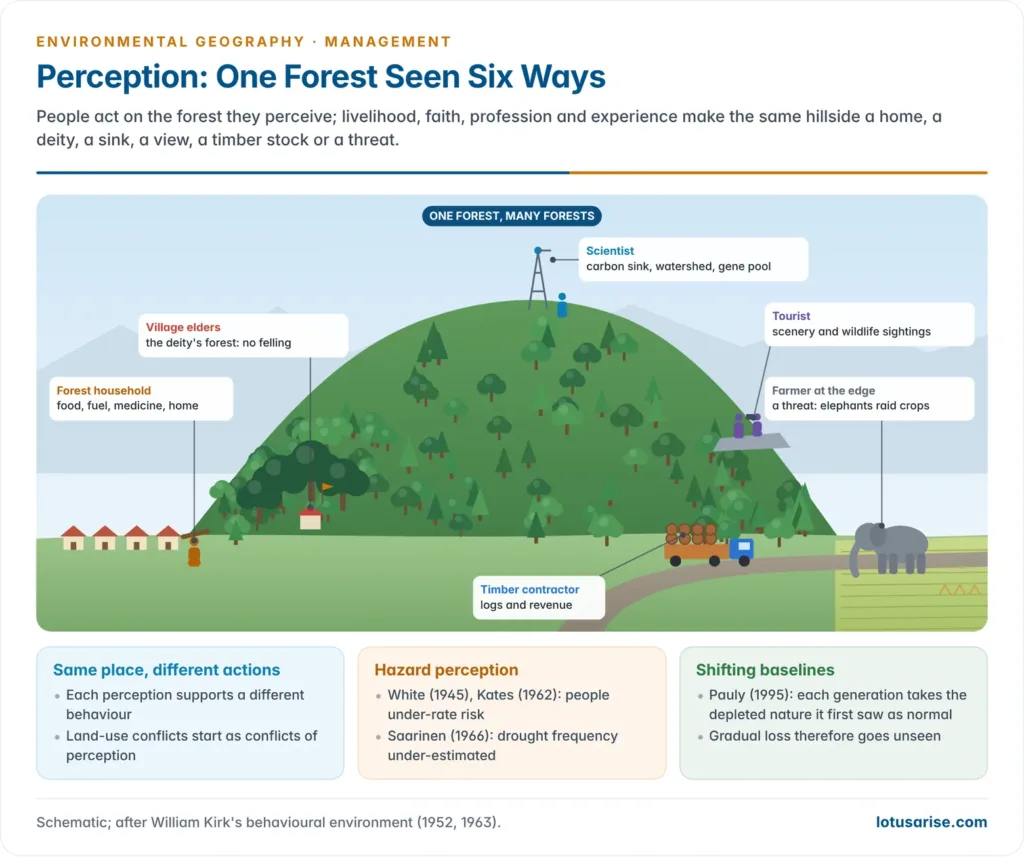
- Gilbert F. White (Human Adjustment to Floods, 1945) and the Chicago school showed that floodplain dwellers under-estimate flood risk and choose adjustments by bounded rationality, not by optimal calculation.
- Robert Kates (1962) found that people are “prisoners of experience”: they expect the future to repeat the floods they have personally seen.
- Thomas Saarinen (1966) found that farmers on the US Great Plains generally under-estimated drought frequency, with sharper perception where drought was more frequent and recent.
- Ian Burton, Robert Kates and Gilbert White (The Environment as Hazard, 1978) mapped the range of responses that follow from perception: bear the loss, reduce it, or change land use. These findings now shape hazard management through risk communication and zoning.
- Paul Slovic (1987) showed that lay people judge risk on dread and unfamiliarity, not on expected deaths. Nuclear accidents are feared more than road crashes or indoor smoke, which kill far more.
- Indian illustration: families on the Kosi floodplain of north Bihar return to fertile, flood-prone land after disasters, weighing silt and livelihood against a risk they perceive as tolerable.
Perception of resources and biodiversity
- The same forest is many forests. A contractor sees timber, a tribal household sees food, fuel, medicine and sacred space, a farmer sees crop-raiding elephants, a scientist sees a carbon sink and a gene pool, and a tourist sees scenery.
- Each perception supports a different behaviour, so conflicts over land use are often conflicts of perception before they are conflicts of interest.
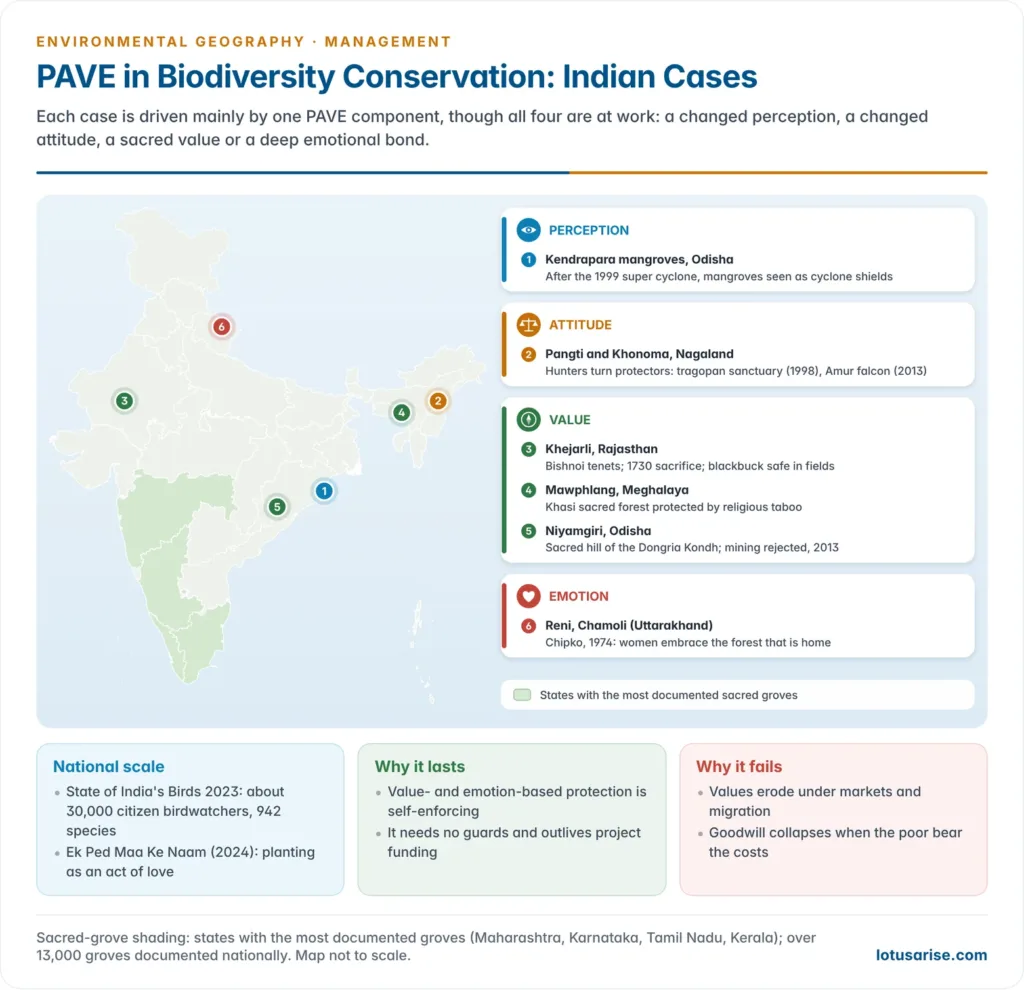
- Utility perceived, protection follows. After the 1999 Odisha super cyclone, Saudamini Das and Jeffrey R. Vincent (2009) found that villages behind wider mangrove belts in Kendrapara district suffered fewer deaths. Mangroves were re-perceived as cyclone shields instead of wasteland, which strengthened the case for coastal restoration.
- Threat perceived, persecution follows. Snakes, wolves, leopards and crop-raiding wild boar perceived as vermin are killed in retaliation, often out of proportion to actual losses.
- Shifting baseline syndrome. Daniel Pauly (1995) observed that each generation of fisheries scientists accepts the depleted stocks it first saw as “natural”. Gradual loss of birds, fish or forest therefore goes unperceived, and conservation targets are set too low.
Factors that shape perception
- Culture and religion: a peepal or a sacred hill is perceived as sacred, not as a resource.
- Livelihood and dependence: those who depend directly on a resource notice its decline first.
- Experience and memory: recent disasters sharpen risk perception; long quiet periods dull it.
- Information and media: satellite images, air-quality index apps and news coverage make invisible problems visible.
- Gender, class and age: women who collect fuelwood and water perceive forest and water scarcity earlier and more sharply.
Attitude: the evaluative disposition
Meaning
- An attitude is a learned, relatively lasting tendency to evaluate an object, person, rule or action favourably or unfavourably.
- The classic tripartite model gives every attitude three parts:
- cognitive: beliefs about the object (“plastic chokes drains”);
- affective: feelings towards it (“dirty streets disgust me”);
- conative or behavioural: a readiness to act (“I will carry a cloth bag”).
- Attitudes are more specific and changeable than values: a person may value nature yet hold a hostile attitude towards a particular tiger reserve.
Theory of planned behaviour
- Martin Fishbein and Icek Ajzen (1975) proposed the theory of reasoned action: behaviour follows intention, which follows attitude and subjective norm.
- Icek Ajzen (1991) extended it into the theory of planned behaviour (TPB) by adding perceived behavioural control:
- Attitude towards the behaviour: is segregating waste good or bad, worthwhile or pointless?
- Subjective norm: do neighbours, family and leaders expect it?
- Perceived behavioural control: is it easy, with bins and collection available?
- The three combine into an intention, which predicts behaviour; control also acts on behaviour directly.
- TPB is the most widely tested model of pro-environmental behaviour, used for recycling, energy saving, water conservation and wildlife tolerance.
Attitudes towards wildlife
- Stephen Kellert’s typology of attitudes towards animals ranges from utilitarian (practical use), naturalistic and ecologistic (interest in wildlife and ecosystems) and moralistic (concern for right treatment) to dominionistic (mastery) and negativistic (fear and avoidance).
- Tolerance is an attitude. Whether a herder retaliates after a leopard kills a goat depends on trust in compensation, the perceived fairness of conservation and local norms, not only on the size of the loss. This makes attitudes central to managing human–wildlife conflict.
The attitude–behaviour gap
- Favourable attitudes often do not become action. Anja Kollmuss and Julian Agyeman (2002) traced this value–action gap to habit, cost, lack of infrastructure, low perceived effect and competing priorities.
- Gregory Guagnano, Paul Stern and Thomas Dietz (1995) captured it in the attitude–behaviour–context (ABC) model: attitudes drive behaviour strongly only when context is neutral. When context makes an action very easy or very hard, it overrides attitude.
- Example: kerbside collection lifts recycling among people with weak attitudes; no collection blocks it even among enthusiasts.
- Indian illustration: Pangti village in Wokha district, Nagaland, trapped an estimated 120,000–140,000 Amur falcons around the Doyang reservoir in 2012. From 2013 a campaign built on village-council bans, eco-clubs, patrols, honoraria for former hunters and falcon tourism turned hunters into protectors, an attitude shift reinforced by changed incentives.
Value: the deep, stable compass
Meaning
- Values are enduring beliefs about what is important in life, which act as guiding principles across situations. They are fewer, more abstract and more stable than attitudes, and they anchor both perception and attitude.
- Shalom Schwartz (1992) identified ten basic human values arranged in a circle of compatible and conflicting motives.
- Self-transcendence (universalism, benevolence) opposes self-enhancement (power, achievement). Universalism explicitly includes protecting the environment and unity with nature.
- People high in self-transcendence act more pro-environmentally; those high in self-enhancement less so.
Value orientations
| Orientation | What is valued | Typical concern | Example motive |
|---|---|---|---|
| Egoistic | Oneself | Cost, health, comfort | “Polluted air will harm my children” |
| Altruistic (social) | Other people | Community, future generations, the poor | “Flooding will ruin downstream villages” |
| Biospheric | Non-human nature | Species, ecosystems, the biosphere | “The river dolphin has a right to survive” |
- Paul C. Stern and Thomas Dietz (1994) showed that biospheric and altruistic orientations predict sustained pro-environmental action better than egoistic ones, which switch off when personal costs rise.
- Relational values form a third category beyond instrumental and intrinsic value. Kai M. A. Chan, Patricia Balvanera and colleagues (2016) argued that people also protect nature for relationships: kinship, identity, care and responsibility towards a place.
- The IPBES Values Assessment (2022) placed this plurality at the centre of global policy. It found that decisions which count only market values underlie the biodiversity crisis, and it distinguished living from, with, in and as nature.
Environmental worldviews
- Dominant Social Paradigm vs New Ecological Paradigm. Riley Dunlap and Kent Van Liere (1978) measured a shift from a worldview of growth, abundance and human mastery towards a New Ecological Paradigm (NEP).
- The revised NEP scale (Dunlap and colleagues, 2000) has 15 items across five facets: limits to growth, anti-anthropocentrism, the fragility of nature’s balance, rejection of human exemptionalism, and the possibility of eco-crisis.
- Technocentrism vs ecocentrism. Timothy O’Riordan (1976) contrasted faith in science, markets and management with a view that nature has its own laws and limits. The ethical end of this spectrum is the deep ecology of Arne Næss (1973).
Value–belief–norm theory
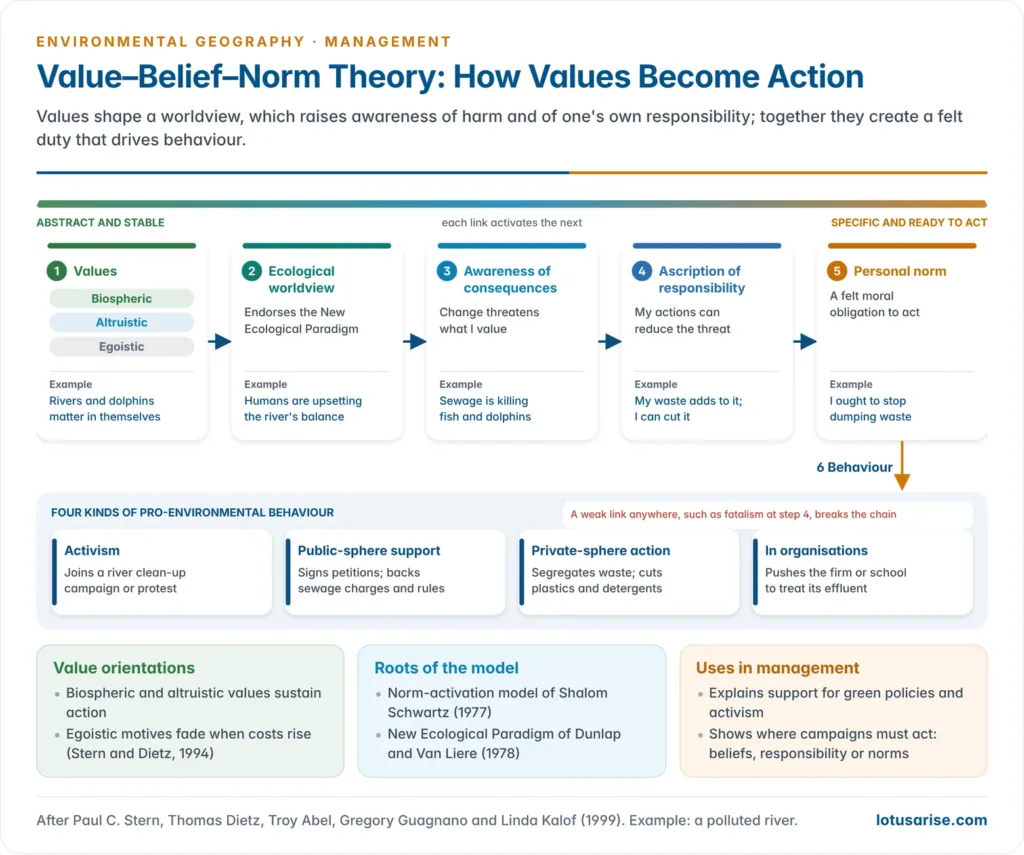
- Paul C. Stern, Thomas Dietz, Troy Abel, Gregory Guagnano and Linda Kalof (1999) built the most cited model of how values become environmental action. It extends the norm-activation model of Shalom Schwartz (1977).
- The causal chain:
- Values: biospheric, altruistic and egoistic orientations.
- Ecological worldview: endorsement of the NEP.
- Awareness of consequences: belief that environmental change threatens things one values.
- Ascription of responsibility: belief that one’s own actions can reduce the threat.
- Personal norm: a felt moral obligation to act.
- Behaviour: environmental activism, non-activist public support (petitions, accepting policies), private-sphere actions (buying, using, disposing) and behaviour within organisations.
- Each link activates the next, so a weak link anywhere, such as fatalism at the responsibility stage, breaks the chain.
- Indian illustration: values that conserve without law.
- The Bishnoi community follows the 29 tenets of Guru Jambheshwar (late 15th century), including bans on felling green trees and killing animals. In 1730 at Khejarli near Jodhpur, Amrita Devi and 363 Bishnois died resisting the felling of khejri trees. Blackbuck and chinkara still graze unharmed in Bishnoi fields.
- Sacred groves (devrai in Maharashtra, devarakadu in Karnataka, kavu in Kerala, orans in Rajasthan, law kyntang in Meghalaya) are forest patches protected by religious taboo. Over 13,000 have been documented across India, many of them refuges for relict and endemic species.
Emotion: the affective bond
Meaning
- Emotions are the feelings that nature, places and environmental change arouse: love, wonder, attachment, pride, fear, anger, grief and guilt.
- Emotion supplies the motivational energy that knowledge alone lacks. Facts about loss rarely move people; a felt bond with a river, a forest or a species often does.
Positive emotional bonds
- Biophilia. Edward O. Wilson (1984) proposed an innate human affinity for living things; Stephen Kellert and Edward O. Wilson (1993) developed it as the biophilia hypothesis.
- Its counterpart, biophobia, the fear of snakes, spiders or large predators, drives persecution and makes some species hard to conserve.
- Topophilia and place attachment. Yi-Fu Tuan (1974) defined topophilia as the affective bond between people and place. People defend places they love, even against economic gain.
- Emotional affinity toward nature. Elisabeth Kals, Markus Schumacher and Leo Montada (1999) showed that a love of nature, formed through childhood contact with nature and with role models who valued it, predicts nature-protective behaviour alongside interest in nature and indignation at its destruction.
- Indian illustration: at Reni in Chamoli in March 1974, Gaura Devi led the village women to embrace the trees and stop contractors felling them. The Chipko movement drew its force from attachment to forests that were home and livelihood.
Negative environmental emotions
- Eco-anxiety: a survey of 10,000 people aged 16–25 in ten countries, India among them, by Caroline Hickman and colleagues (2021) found 59% very or extremely worried about climate change and more than 45% saying the feelings affected their daily lives.
- Solastalgia: Glenn Albrecht (2005) coined the term for the distress of watching one’s home environment degrade while still living in it, first described among residents of open-cut coal-mining districts in New South Wales.
- Ecological grief: mourning for lost species, landscapes and ways of life, increasingly reported among farmers, fishers and indigenous communities facing climate change.
- Emotions cut both ways:
- Fear appeals without a way to act tend to produce denial or apathy, as Saffron O’Neill and Sophie Nicholson-Cole (2009) found with climate imagery.
- Hope, pride and collective efficacy sustain action better.
- Anger and grief can drive movements, but emotion can equally mobilise against conservation when protected areas displace people.
How the Components Work Together
The PAVE chain and its feedbacks
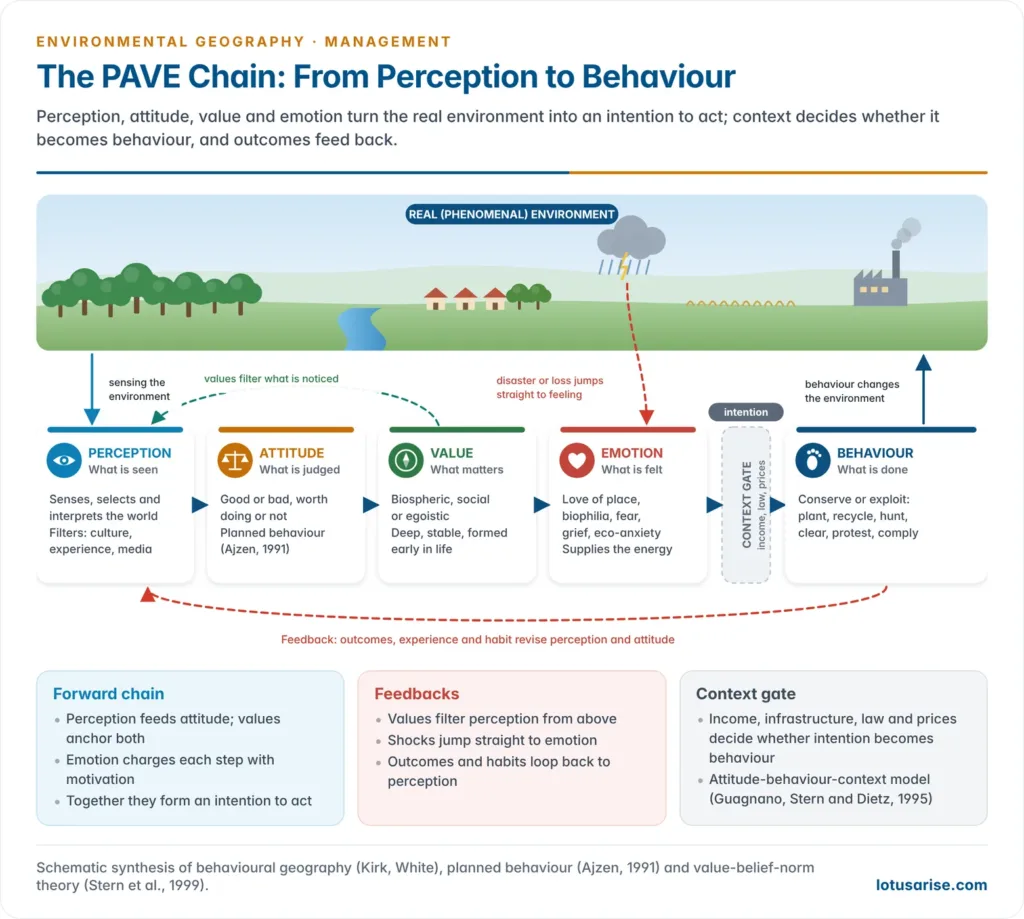
- The forward chain: the real environment is filtered through perception; perceptions are judged into attitudes; attitudes rest on deeper values; emotion charges the whole sequence with motivation; together they form intention and then behaviour.
- Behaviour changes the environment, and the changed environment is perceived anew: a feedback loop of human-environment interaction.
- The links run both ways:
- Values filter perception from above. A person with biospheric values notices the loss of birds that others miss.
- Emotion can short-circuit the chain. A disaster, the death of a loved animal or a striking image can jump straight to feeling and reset attitudes and even values.
- Repeated behaviour reshapes attitudes, as habits of segregating waste make the practice feel right.
- Context gates the final step. Income, infrastructure, prices, law and power decide whether intention becomes action, as the ABC model predicts.
PAVE and the established models
| Model | Emphasises | Gap that PAVE fills |
|---|---|---|
| Theory of planned behaviour (Ajzen, 1991) | Attitude, norms, perceived control, intention | Values and emotion enter only indirectly |
| Value–belief–norm theory (Stern et al., 1999) | Values, beliefs, moral norms | Little on perception of place and on feeling |
| Behavioural geography (Kirk, White) | Perception and decision under uncertainty | Little on moral motivation |
| PAVE | All four dispositions as one checklist | Weaker on prediction and measurement |
Applying PAVE: Biodiversity Conservation and Environmental Management
PAVE in biodiversity conservation
- Most biodiversity survives on shared, used landscapes outside protected areas: farms, community forests, village commons, coasts and sacred sites. Its fate depends on the people who live alongside it.
- Protection by consent outlasts protection by force. Value- and emotion-based conservation is self-enforcing, needs no guards and outlives project funding.
| Component | How it helps conservation | How it harms | Indian case |
|---|---|---|---|
| Perception | Species seen as useful, beautiful or protective are spared | Species seen as pests or dangers are killed | Mangroves as cyclone shields, Odisha |
| Attitude | Tolerance and support for reserves and rules | Hostility to imposed protected areas | Pangti and the Amur falcon, Nagaland |
| Value | Sacred and ethical restraint on use | Purely market valuation of land | Bishnoi blackbuck; sacred groves |
| Emotion | Attachment to place and species | Fear and anger after conflict | Chipko women of Reni |
- Community conserved areas show PAVE in action. In Khonoma (Nagaland) the village council banned hunting and set up the Khonoma Nature Conservation and Tragopan Sanctuary in 1998, after a hunting spree reportedly killed about 300 Blyth’s tragopans.
- Perception of loss, a changed attitude to hunting, clan values and pride in the village combined into a lasting rule.
- Citizen science turns perception into data. The State of India’s Birds 2023 assessed 942 species using about 30 million observations uploaded to eBird by more than 30,000 birdwatchers, and it found many species, raptors and shorebirds among them, in long-term decline.
- Policy is converging on the same view. The Kunming-Montreal Global Biodiversity Framework (2022) calls for whole-of-society participation and respect for indigenous and local knowledge, and India’s biodiversity conservation measures now include community reserves, conservation reserves and recognition of sacred groves.
PAVE in sustainable environmental management
- Diagnose before you prescribe. The manager first asks which filter is failing, because each needs a different remedy.
- People do not see the problem: improve perception through monitoring, maps and local-language risk communication.
- They see it but do not care to act: work on attitudes and norms through participation and fair incentives.
- They care but think it is not their duty: engage values and personal norms through education and community institutions.
- They agree but feel nothing: build emotional bonds through stories, place-based campaigns and direct contact with nature.
- Perception: making the invisible visible.
- Participatory hazard and resource mapping; air-quality index displays; flood hazard zoning communicated in local idiom.
- Citizen science, bird counts and school biodiversity registers that let people see change for themselves.
- Attitude: from offenders to stakeholders.
- Joint Forest Management (1990) and the Forest Rights Act (2006) gave forest users rights and a share of benefits, so that rules became their own.
- Prompt, fair compensation for crop and livestock losses raises tolerance of wildlife.
- Social norms spread behaviour: people conserve more when told that their neighbours do.
- Value: education and recognition.
- Environmental education follows the Tbilisi Declaration (1977), whose objectives (awareness, knowledge, attitudes, skills and participation) map closely onto PAVE.
- Law can recognise community values: in 2013 the Supreme Court left the decision on bauxite mining in Niyamgiri to the gram sabhas, and all twelve rejected it on a hill sacred to the Dongria Kondh.
- Emotion: attachment and hope.
- Campaigns that link nature to personal meaning, such as Ek Ped Maa Ke Naam (launched 5 June 2024), which asks citizens to plant a tree in their mother’s name. Its target of 80 crore saplings by September 2024 was reported met.
- Messages of efficacy and pride rather than doom alone.
- Behaviour: nudges and choice architecture. Richard Thaler and Cass Sunstein (2008) showed that defaults, reminders, labels and feedback change behaviour cheaply. The Bureau of Energy Efficiency’s star labels on appliances are an Indian example.
A worked diagnosis: stubble burning in Punjab and Haryana
- Perception: many farmers see burning as the quickest and cheapest way to clear paddy straw in the short window before wheat sowing; the smoke over Delhi is perceived as distant, and the loss of soil organic matter as invisible.
- Attitude: residue-management machines are judged costly and slow, and fines are resented as unfair to small farmers.
- Value: farmers value timely sowing and family income above an abstract regional air-quality goal; the urban public values clean air but rarely the farmer’s constraints.
- Emotion: being blamed for city smog breeds anger and defensiveness, which hardens resistance.
- The lesson: penalties alone address none of the four. Subsidised machines and custom-hiring centres under the crop residue management scheme (from 2018–19), markets for straw, village-level demonstrations and respectful communication work on several filters at once, which is the PAVE prescription.
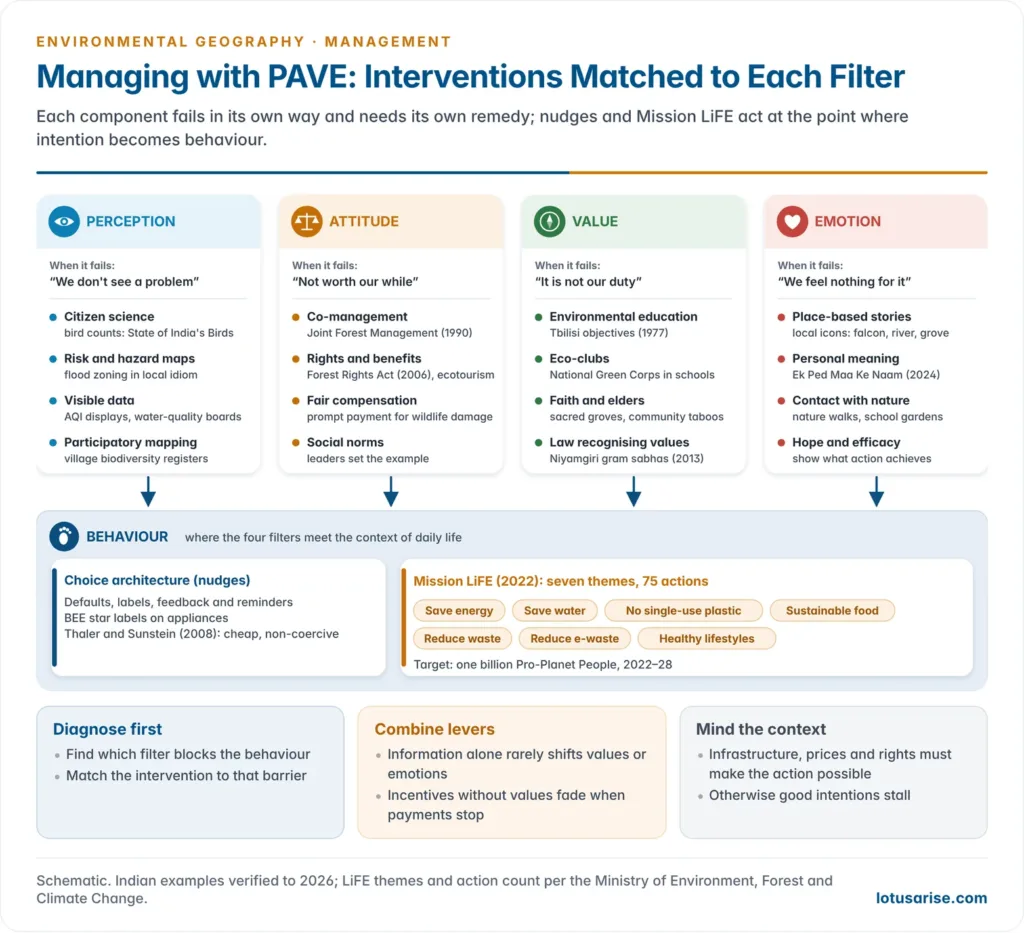
Mission LiFE: a PAVE programme at national scale
- Lifestyle for Environment (LiFE) was introduced by the Prime Minister at COP26 in Glasgow (November 2021) and launched as a mission at Kevadia (Ekta Nagar), Gujarat, on 20 October 2022, in the presence of UN Secretary-General António Guterres.
- Aim: to mobilise at least one billion Indians and other global citizens as Pro-Planet People in 2022–28, and to make at least 80% of villages and urban local bodies environment-friendly by 2028.
- Seven themes: save energy, save water, say no to single-use plastic, adopt sustainable food systems, reduce waste, reduce e-waste and adopt healthy lifestyles, broken down into 75 individual LiFE actions.
- Three phases: change in demand (individual behaviour), change in supply (markets respond) and change in policy.
- The PAVE logic:
- Perception: linking daily choices, such as switching off appliances or carrying bags, to climate outcomes.
- Attitude: “mindful use” presented as smart and modern, not as sacrifice.
- Value: appeals to India’s traditions of thrift, reuse and reverence for nature.
- Emotion: pride in a national movement and identity as a Pro-Planet Person.
- Reach: the UN Environment Assembly adopted an India-led resolution on sustainable lifestyles at its sixth session (Nairobi, March 2024). Related policy, such as the Green Credit Programme (2023), rewards voluntary environmental action and belongs to India’s wider environmental policy.
- Critique: LiFE risks individualising responsibility for problems driven largely by industry, energy systems and the consumption of the rich. Without supply-side and policy change, lifestyle appeals alone cannot close the value–action gap.
Critical evaluation
- Strengths:
- It explains why technically sound rules fail and why some communities conserve without any law.
- It works at every scale, from a household’s waste habits to a nation’s climate pledge.
- It brings the human dimension into ecosystem management and supports participatory, low-cost, self-enforcing conservation.
- It connects geography’s perception tradition with tested psychological models.
- Limitations:
- A label more than a theory. PAVE has no single originator and no unified test, and it adds little that Ajzen and Stern had not already modelled. Its four components overlap: attitudes contain feelings, and values shape perception.
- Measurement is hard. Emotions and values are difficult to quantify and compare across cultures, and most evidence comes from Western, educated, industrialised samples.
- Structure can override psychology. Poverty, prices, land tenure and power often decide behaviour regardless of attitude. Political ecology stresses that the poor degrade resources because they lack alternatives, not because they lack values.
- Values erode. Many sacred groves are shrinking under encroachment, migration and market pressure, and the young may not share their elders’ taboos.
- The intervention must match the barrier. Anne M. van Valkengoed, Wokje Abrahamse and Linda Steg (2022) argue that interventions work only when they target the specific determinant blocking a behaviour; information campaigns alone rarely shift values or emotions.
- The current view: PAVE is necessary but not sufficient. Perceptions, attitudes, values and emotions conserve nature durably only when rights, fair benefit-sharing, compensation and enabling infrastructure make conservation possible for those who bear its costs.
- Wider context: the framework reflects a long shift in human sensibility towards nature, from biocentric kinship through anthropocentric mastery to a new ecological awareness.