

Polity and administration. Economic conditions. Coinage of the Guptas, Land grants, Decline of urban centres, Indian feudalism. Caste system. Position of women. Education and educational institutions; Nalanda, Vlkramshlla and Vallabhl, Literature, scientific literature, art and architecture.
Guptas, Vakatakas and Vardhanas is the largest single unit in Ancient India. UPSC has set 38 questions on it between 1985 and 2026, and it has appeared in eight of the last ten papers. The examiner’s long-running project with this unit is to take apart the “golden age” — and most of the recent questions are built to see whether you will.
Every question the Commission has asked on this topic is listed below, newest first, with a written model answer linked against each one.
| Questions asked (1985–2026) | 38 |
| Appeared in | 8 of the last 10 papers |
| Paper | Paper I, Section A (Ancient India) |
| Usual mark value | 10, 15 or 20 marks |
| Model answers available | 37 of 38 |
PYQs: Guptas, Vakatakas and Vardhanas [1985-2026]

| Year | Question | Answer |
|---|---|---|
| 2026 | "Royal patronage and religious institutions significantly contributed to the development of Nalanda, Vikramashila and Vallabhi into prominent centres of learning." Elucidate. | |
| 2024 | Highlight the contributions of Aryabhatta, Varahamihira, and Brahmagupta in the fields of Astronomy and Mathematics. | View answer |
| 2023 | Evaluate the status of women in the Gupta period as compared to the pre–Gupta era. | View answer |
| 2022 | The economic achievements of the Guptas were the culmination of a process which began during the Kushanas. Comment. | View answer |
| 2020 | ‘Sanskrit literature of classical Gupta Age set standards for the early medieval India’. Evaluate the statement with representative examples. | View answer |
| 2019 | “Do you agree that the system of land grants from the Gupta- Vakataka period was connected with the decentralization of state in any way?" | View answer |
| 2018 | Discuss the experimentations with art and architecture during the Gupta-Vakataka period. | View answer |
| 2017 | The second urbanization gave rise to the organized corporate activities that reached their zenith during the Gupta period. Discuss. | View answer |
| 2016 | Critically evaluate the theory and practice of land revenue system in ancient India. | View answer |
| 2014 | Discuss the provincial and district administrative units of the Gupta Empire with the designations and functions of the officers. | View answer |
| 2014 | What were the privileges granted to the donees in land-grant charters of early India? How far were these charters responsible for integration or disintegration of socio-political milieu? | View answer |
| 2012 | Assess the educational system in early India and identify important educational institutions of the period. | View answer |
| 2011 | Trace the development of urbanization from the third millennium B.C.E. to 6th century B.C.E. | View answer |
| 2011 | Assess Ellora as a unique art centre of the different cultural streams. | View answer |
| 2009 | Give an account of the use of gold coins by commoners in the Gupta period. | View answer |
| 2007 | Throw light on the condition of common man in the Gupta period. | View answer |
| 2006 | Describe the expansion of the Gupta empire under Samudragupta. | View answer |
| 2005 | Assess the status of women in India from 4th century BC to AD 6th century. | View answer |
| 2005 | What are the salient features of the administrative system of the Guptas? | View answer |
| 2003 | Examine the information of Fahien about the political, religious, social and economic conditions of India. Make a comparative study of his account with that of Yuan Chwang. | View answer |
| 2000 | Who were the Maukharis? Discuss their political relations with the Later Guptas of Magadha. | View answer |
| 1999 | ‘Harshvardhan was himself great, but he has been made greater by Ban and Yuan Chiang.’ Critically examine the statement. | View answer |
| 1998 | Highlight the achievements of the Gupta period in the field of literature, science and technology. | View answer |
| 1997 | Write brief essay on Skandagupta's war with the Hunas. | View answer |
| 1997 | Write brief essay on Nalanda Mahavihara. | View answer |
| 1997 | How did Indian culture spread in the South-east Asiatic countries during the Gupta Age? | View answer |
| 1996 | Write brief essay: Factors that led to the Rise and Fall of the Gupta Empire. | View answer |
| 1996 | “Of all the events that had a singular being on the history of India, Harsha's death in 647 A.D. is significant.” Why? Explain. | View answer |
| 1992 | Analyse the characteristic features of the Gupta art and compare them with those of the Mauryan art. | View answer |
| 1991 | Write brief essay on Origins and meaning of the samanta system. | View answer |
| 1991 | In what ways does religion as reflected in the Vedic texts differ from the religion of the Gupta period? | View answer |
| 1990 | Write short essay of not more than 200 words: The economic prosperity in the Gupta period. | View answer |
| 1989 | Discuss critically the role Harsha played in the history of his times. | View answer |
| 1988 | Write short essay of not more than 200 words: The Maukharis paving the way for the glory of Harshavardhana. | View answer |
| 1987 | ‘Harsha owes his greatness largely not to any real achievements but to formulate descriptions by two famous men.’ Discuss. | View answer |
| 1986 | Write short essay of not more than 200 words: The significance of the policy of matrimonial alliances for the expansion and consolidation of the Gupta empire. | View answer |
| 1986 | Harsha is described as ‘the lord of the whole of north India*. Determine the extent of his empire and discuss his political relations with Sasanka, Bhaskaravarman and Pulakesin II. | View answer |
| 1985 | ‘The Gupta period stands at the centre of Indian history. Discuss the development of arts and literature in that Gupta period in the light of this statement. | View answer |
What UPSC keeps asking about the Guptas, Vakatakas and Vardhanas
Forty years of questions on this unit fall into five threads. The political narrative dominated the early papers; the recent ones have moved almost entirely to economy, culture and society.
1. The dynastic narrative: Samudragupta to Harsha (1986, 1987, 1988, 1989, 1996, 1997, 1999, 2000, 2006)
- Nine questions trace political events — Samudragupta’s expansion (2006), Skandagupta against the Hunas (1997), the rise and fall of the empire (1996), the Maukharis and the Later Guptas (1988, 2000), and Harsha himself (1986, 1987, 1989, 1996, 1999).
- The Harsha questions are almost all sceptical in form. Both 1987 and 1999 ask whether his greatness is an artefact of Bana and Xuanzang rather than of achievement, so the answer must weigh the Harshacharita and the Si-yu-ki as interested sources and test his claims against the Aihole inscription of Pulakeshin II.
- This is the thread that has gone quiet: nothing narrowly dynastic since 2006, nothing on Harsha since 1999. Dropping the Vardhanas is a real risk, because a single 15-marker on them would be cheap to prepare and expensive to have skipped.
2. Administration, land grants and the feudalism debate (1991, 2005, 2014, 2016, 2019)
- The administrative questions (2005, 2014) want the structure by name — bhukti under an uparika, vishaya under a vishayapati, and the vishayadhikarana with its nagarasreshthi, sarthavaha, prathamakulika and prathamakayastha. Designations earn marks; generalities do not.
- The land-grant questions (2014, 2019) and the samanta question (1991) are one debate in different clothes. R. S. Sharma reads the fiscal and administrative immunities in the charters as the beginning of Indian feudalism; B. D. Chattopadhyaya and Harbans Mukhia read the same charters as state formation and agrarian expansion at the periphery.
- 2019 is worded to invite the link between grants and a feudal polity, so concede the correlation and then complicate it: grants also integrated tribal tracts, carried Brahmanical ritual outward and created new literate elites. The 2016 question on land revenue is pan-ancient in scope and reaches back to Arthashastra norms.
3. Economy, coinage and the ‘golden age’ question (1990, 2007, 2009, 2011, 2017, 2022)
- This is the live thread. 2022 asks whether Gupta economic achievement was the culmination of a process already under way before them, which is an invitation to argue continuity from the Kushana and Satavahana economies rather than to describe Gupta prosperity in isolation.
- 2009 on gold coins in the hands of commoners and 2007 on the condition of the common man are deliberate counterweights to 1990 on prosperity. The examiner is separating elite wealth from mass welfare: dinaras are high-value, silver and copper issues comparatively scarce, and Sharma reads that as a contracting money economy.
- 2017 carries corporate and guild activity from the second urbanisation to its zenith. The common error is to quote Fahien on plenty and stop, without the counter-evidence of urban decay at Kaushambi and Pataliputra.
4. Art, literature, science and learning (1985, 1992, 1997, 1998, 2011, 2012, 2018, 2020, 2024, 2026)
- The largest thread by count, and the most active since 2018: art and architecture of the Gupta-Vakataka period (2018), Sanskrit literature as the standard for early medieval India (2020), Aryabhata, Varahamihira and Brahmagupta (2024), royal patronage and religious institutions (2026).
- Nalanda (1997) and early educational institutions (2012) belong here too.
- The trap is the “classical age” cliché. Answer with named works, named temples (Deogarh, Bhitargaon, Ajanta under the Vakatakas) and a line on who paid for them.
5. Society, women and the view from below (2003, 2005, 2007, 2023)
- Status of women compared with the pre-Gupta era (2023, and 2005 in longer range); the common man (2007); Fa-Hien’s account (2003).
- Expect the examiner to reward evidence of hardening: declining property and ritual rights for women, early references to sati, the growth of untouchability that Fa-Hien himself records.
The model answers to this unit, in one place
Knowing the questions is half the work. The other half is seeing what a full-mark answer to each one looks like — not a hint or a bullet outline, but a complete answer at the mark and the word limit, with the historians named inside the argument.
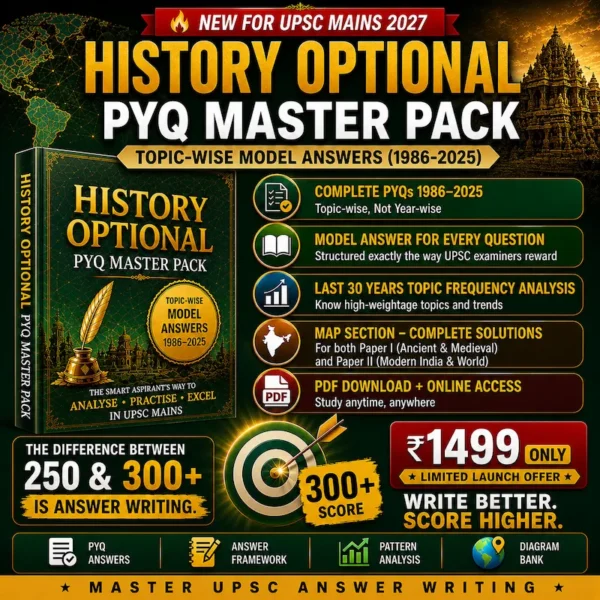
The History Optional PYQ Master Pack carries the same for every question the Commission has set since 1985, across the whole syllabus.
- PYQs 1985–2025, arranged topic-wise — revise a theme and see every way it has been asked
- Model answers with historiography — the debate cited where it belongs, not bolted on
- Map sections solved — the full 50-mark section, every year
- PDF plus online access — any device, permanently, no subscription
₹1,499 (regular ₹2,500). One-time payment, instant access.
How to use this topic list
Reading a question list feels like preparation and is not. Three sittings turn it into marks.
Sitting 1 — sort before you read (30 minutes)
- Copy the questions above into the threads identified in the previous section.
- Note which thread has gone longest without being asked — that is your priority, not the one you find most interesting.
Sitting 2 — write three answers cold (45 minutes)
- Pick the most recent question from three different threads.
- Seven minutes for a 10-marker, fifteen for a 20-marker. Stop when the time is up, even mid-sentence.
- Mark every place you wanted a historian’s name and could not produce one.
Sitting 3 — compare, then rewrite (45 minutes)
- Put your script beside the model answer for the same question.
- Compare structure first: opening claim, evidence, counter-view, judgement.
- Rewrite your weakest answer using that structure and no new content. Most candidates gain four to six marks from structure alone.
Two ways to prepare this optional
Two routes, depending on what is actually missing.
| PYQ Master Pack | Mains Master Kit 2027 | |
| Best when | Your notes are done; answer-writing is the gap | You are still building the subject |
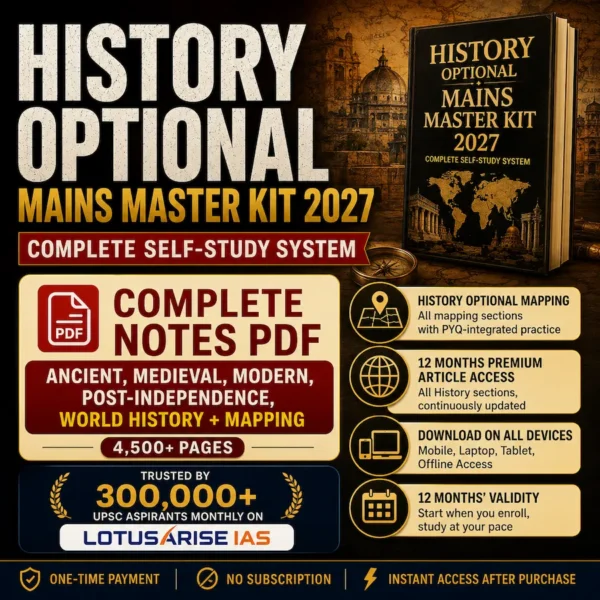
| What you get | Model answers to every question since 1985, topic-wise, map sections included | 4,500+ pages of notes, full mapping coverage, 12 months of article access |
| Price | ₹1,499 (reg. ₹2,500) | ₹1,770 (reg. ₹5,000) |
Frequently asked questions
Related topics
Gupta questions most often cross into these units:
- Post-Mauryan Period
- Regional States during Gupta Era
- Themes in Early Indian Cultural History
- Early Medieval India, 750–1200
- All topics — History Optional PYQs, topic-wise
Prefer to work year by year?
The complete papers, with both papers in full, unit-wise analysis and the official PDFs:
- History Optional Question Paper 2026
- History Optional Question Paper 2025
- History Optional Question Paper 2024
- History Optional Question Paper 2023
- History Optional Question Paper 2022
- History Optional Question Paper 2021
- History Optional Question Paper 2020
- UPSC History Optional Map Solutions (2013–2025)


Thanks for making this available so easily and efficiently. really helped me a lot.
Refer all section here: https://lotusarise.com/optional/upsc-history-optional-question-papers/