

- Environmental legislation is the body of treaties, constitutional provisions, statutes, rules, notifications and judge-made doctrines that regulates how people and enterprises use air, water, land, forests, wildlife and biological resources.
- In India it works at three levels: international agreements that India signs and ratifies, the Constitution, and Acts of Parliament with the rules and notifications issued under them.
- A fourth layer, unusually strong in India, is judicial: the Supreme Court, High Courts and the National Green Tribunal (NGT) have read new rights and principles into the law.
- At the core of environmental legislation in India lie Articles 21, 48A and 51A(g) and the framework Acts on water, air, environment protection, forests and wildlife. Around them sit sectoral rules, notifications, amendments and case law, each with its own institutions.
- Legislation is the hard-law arm of environmental policy in India. The National Environment Policy, 2006 set the principles; the Acts and courts give them teeth.
International and Constitutional Foundations

Why environmental legislation is needed
- Environmental problems have acquired threatening dimensions for human welfare: industrial pollution, deforestation, wildlife trafficking, over-exploitation of resources and climate change.
- No individual, community or single nation can solve them alone.
- Environmental harm spills across boundaries. Its impacts are not confined to the source area.
- Air pollutants travel thousands of kilometres; river pollution crosses state and national borders; ozone depletion and climate change are planetary.
- Markets fail to price nature. Without law, polluters, timber and mining interests and poachers externalise their costs onto society and ecosystems.
- Legislation internalises these costs through standards, permits, penalties, liability and compensation.
- Law creates rights and duties. It gives citizens a remedy (a writ, a citizen suit, an NGT application) and gives the state powers of inspection, closure and prosecution.
- Because the problems are intrinsically global, legislation is needed at the international as well as the national level, and the two must connect through ratification and national enabling Acts.
International environmental law: the framework
- There is no world legislature that can pass binding laws as national parliaments do, and no global enforcement agency to regulate resources.
- International environmental governance therefore rests on the voluntary consent of sovereign states, expressed through declarations, conventions and protocols.
- Soft law vs hard law:
- Declarations (Stockholm 1972, Rio 1992) state principles but do not bind.
- Conventions and protocols bind the states that ratify them.
| Feature | Convention | Protocol |
|---|---|---|
| Nature | Legally binding multilateral agreement; the framework | Separate agreement linked to a parent convention |
| Content | Principles, objectives, general obligations, institutions (COP, secretariat) | Specific targets, timelines and mechanisms |
| Membership | States that ratify become Parties | Needs its own ratification; only parties to the parent can join |
| Domestic effect | Parties adopt national laws to implement it | Tightens obligations, often with compliance procedures |
| Examples | UNFCCC, CBD, Vienna Convention, Ramsar | Kyoto and Paris (under UNFCCC); Montreal (under Vienna); Cartagena and Nagoya (under CBD) |
- The convention creates the framework; the protocol creates the binding mechanisms.
- A state that signs but does not ratify is not legally bound, though it must not defeat the treaty’s object.
- A ratifying state must align its domestic law with the treaty. In India, Article 253 lets Parliament legislate for this, even on State subjects.
- The Stockholm Conference on the Human Environment (June 1972) is the turning point.
- It produced the Stockholm Declaration (Principle 21: states must not cause environmental damage beyond their jurisdiction), set up the United Nations Environment Programme (UNEP) and triggered India’s own constitutional and statutory response.
Ramsar Convention on Wetlands (1971; in force 1975)
- The Convention on Wetlands of International Importance, especially as Waterfowl Habitat, was adopted at Ramsar, Iran, on 2 February 1971 and came into force on 21 December 1975.
- UNESCO is the depositary; the secretariat sits at Gland, Switzerland. India joined in 1981–82.
- It is the oldest of the modern intergovernmental environmental agreements. Its aim is to halt the worldwide loss of wetlands through their conservation and “wise use”.
- Obligations of Parties:
- designate at least one wetland for the List of Wetlands of International Importance (Ramsar Sites);
- promote the wise use of all wetlands in their territory, listed or not, including mangroves;
- set up nature reserves on wetlands and manage them for waterfowl and other dependent species;
- promote training in wetland research, management and wardening;
- consult other Parties over trans-frontier wetlands, shared water systems and shared species.
- India’s status:
- India has 103 Ramsar Sites (October 2026, after Sukhna Lake in Chandigarh and Sauj Jheel in Uttar Pradesh were added), the largest network in Asia.
- Examples: Chilika (Odisha, the first with Keoladeo in 1981), Keoladeo (Rajasthan), Loktak (Manipur), Sundarbans (West Bengal) and Wular (Jammu and Kashmir).
- Keoladeo and Loktak remain on the Montreux Record of sites under threat.
- Indore and Udaipur became India’s first accredited Ramsar Wetland Cities in 2025.
- At home, wetlands are regulated by the Wetlands (Conservation and Management) Rules, 2017 under the Environment (Protection) Act.
- India has 103 Ramsar Sites (October 2026, after Sukhna Lake in Chandigarh and Sauj Jheel in Uttar Pradesh were added), the largest network in Asia.
Vienna Convention and Montreal Protocol (ozone layer)
- UNEP took up ozone depletion in 1977. The Vienna Convention for the Protection of the Ozone Layer (1985; in force 1988) committed states to protect the ozone layer and cooperate in research. It provided for future protocols and dispute settlement.
- The Montreal Protocol on Substances that Deplete the Ozone Layer was agreed in 1987 and came into force in 1989. It aims to reduce and finally eliminate man-made ozone-depleting substances (ODS).
- It was the first UN treaty to win universal ratification (2009).
- It has been amended five times, besides several “adjustments” to phase-out schedules (such as Vienna 1995):
| Amendment | Year | Main change |
|---|---|---|
| London | 1990 | Faster phase-outs; more substances; Multilateral Fund for developing countries |
| Copenhagen | 1992 | Further acceleration; HCFCs and methyl bromide brought under control |
| Montreal | 1997 | Licensing system for ODS imports and exports |
| Beijing | 1999 | Tighter HCFC controls; bromochloromethane added |
| Kigali | 2016 | Hydrofluorocarbons (HFCs) added: ozone-safe substitutes that are potent greenhouse gases |
- The Vienna–Montreal regime is widely regarded as the most successful environmental treaty system.
- The latest scientific assessment (2022) projects recovery of the ozone layer to 1980 values by about 2040 over most of the world, 2045 over the Arctic and 2066 over the Antarctic.
- India and the ozone regime:
- India ratified the Montreal Protocol in 1992 as an Article 5 (developing) country with longer timelines.
- It phased out CFCs by 2010 and is phasing out HCFCs by 2030 under its HCFC Phase-out Management Plan.
- India ratified the Kigali Amendment in 2021. In its group, HFC use freezes in 2028 and falls 10% by 2032 and 85% by 2047 from the 2024–26 baseline.
- This matters for India’s fast-growing refrigeration and air-conditioning sector; the India Cooling Action Plan (2019) plans for it.
Climate regime: UNFCCC, Kyoto Protocol and Paris Agreement
- Global warming, driven mainly by the burning of fossil fuels, is the gravest threat to the planet’s future. The principal greenhouse gases are carbon dioxide, methane, nitrous oxide and the fluorinated gases, with water vapour as a feedback.
- The UN Framework Convention on Climate Change (UNFCCC) was opened for signature at the Rio Earth Summit (June 1992) and entered into force on 21 March 1994.
- Objective (Article 2): stabilise greenhouse gas concentrations at a level that prevents dangerous anthropogenic interference with the climate system, within a time frame that lets ecosystems adapt, protects food production and allows sustainable development.
- It enshrines common but differentiated responsibilities and respective capabilities (CBDR-RC). Annex I (industrialised) countries were to take the lead; non-Annex I countries such as India had no reduction targets. India ratified it in 1993.
- The Kyoto Protocol (adopted December 1997; in force 2005) gave legally binding targets to developed countries:
- First commitment period (2008–12): an average cut of about 5% below 1990 levels.
- Second period (Doha Amendment, 2012): at least 18% below 1990 over 2013–20.
- Flexible mechanisms: emissions trading, Joint Implementation and the Clean Development Mechanism (CDM). India gained heavily from CDM projects (technology, investment and carbon credits).
- India, with no reduction obligation, ratified it in 2002. The Paris Agreement replaced Kyoto for the post-2020 period.
- The Paris Agreement was adopted at COP21 on 12 December 2015 and came into force on 4 November 2016. India ratified it on 2 October 2016.
- Goals (Article 2): hold warming well below 2 °C and pursue 1.5 °C; strengthen adaptation and resilience; align finance flows with low-emission development.
- Bottom-up architecture: each country sets its own Nationally Determined Contribution (NDC), renewed every five years. A global stocktake (the first in 2023) and an enhanced transparency framework check collective progress.
- Article 6 provides for carbon markets, which India is using through its Carbon Credit Trading Scheme (2023).
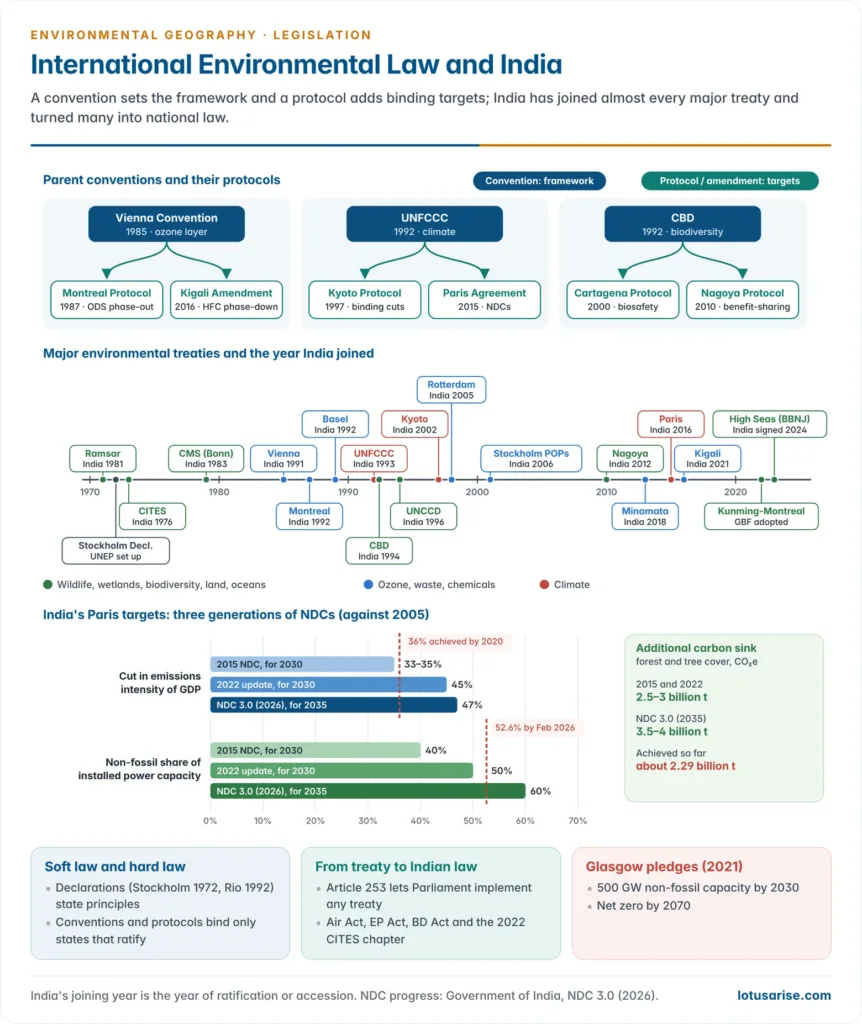
- India’s NDC targets (all against 2005 levels) chart its path to carbon neutrality and net zero:
| Target | First NDC (2015, for 2030) | Updated NDC (2022, for 2030) | NDC 3.0 (2026, for 2035) |
|---|---|---|---|
| Cut in emissions intensity of GDP | 33–35% | 45% | 47% |
| Non-fossil share of installed power capacity | 40% | 50% | 60% |
| Additional carbon sink (forest and tree cover) | 2.5–3 billion t CO₂e | 2.5–3 billion t CO₂e | 3.5–4 billion t CO₂e |
- Progress: India had cut the emissions intensity of its GDP by 36% by 2020. It crossed the 50% non-fossil capacity mark in June 2025, five years early, and reported about 2.29 billion t CO₂e of additional sink.
- The Panchamrit pledges of COP26, Glasgow (2021) added 500 GW of non-fossil capacity by 2030 and net zero by 2070.
Convention on Biological Diversity (1992)
- The Convention on Biological Diversity (CBD) was opened for signature at the Rio Earth Summit on 5 June 1992 and came into force on 29 December 1993. India ratified it in 1994.
- Three objectives: conservation of biological diversity; sustainable use of its components; fair and equitable sharing of benefits from the use of genetic resources.
- It recognises sovereign rights of states over their biological resources and requires each Party to prepare a National Biodiversity Strategy and Action Plan.
- Protocols:
- Cartagena Protocol on Biosafety (2000): regulates transboundary movement of living modified organisms. It shapes India’s debates on Bt cotton, Bt brinjal and GM mustard.
- Nagoya Protocol on Access and Benefit-sharing (2010; in force 2014): puts the third objective into practice. India ratified it in 2012 and implements it through the Biological Diversity Act.
- The Kunming-Montreal Global Biodiversity Framework (COP15, 2022) set 23 targets for 2030, including “30×30”: protect 30% of land and sea and restore 30% of degraded ecosystems. India submitted its updated national plan in 2024, tying biodiversity and sustainable development to national targets.
- India is among the few countries to have hosted COPs of all three Rio Conventions: UNFCCC COP8 (New Delhi, 2002), CBD COP11 (Hyderabad, 2012) and UNCCD COP14 (Greater Noida, 2019).
Other important international instruments
| Instrument | Adopted / in force | Purpose | India |
|---|---|---|---|
| CITES (Washington) | 1973 / 1975 | Controls trade in endangered species through Appendices I, II and III | Party since 1976; implemented by the 2022 amendment of the Wild Life Act |
| Convention on Migratory Species (Bonn) | 1979 / 1983 | Protects migratory species across range states | Party since 1983; hosted COP13 (Gandhinagar, 2020) |
| Basel Convention | 1989 / 1992 | Controls transboundary movement and disposal of hazardous wastes | Ratified 1992; shapes ship-breaking at Alang |
| UN Convention to Combat Desertification | 1994 / 1996 | Land degradation and drought in drylands | Ratified 1996; target of restoring 26 Mha by 2030 |
| Rotterdam Convention | 1998 / 2004 | Prior informed consent for trade in hazardous chemicals and pesticides | Acceded 2005 |
| Stockholm Convention on POPs | 2001 / 2004 | Eliminates or restricts persistent organic pollutants such as DDT and dioxins | Ratified 2006 |
| Minamata Convention | 2013 / 2017 | Controls mercury use and emissions | Ratified 2018 |
| High Seas Treaty (BBNJ) | 2023 / January 2026 | Marine biodiversity beyond national jurisdiction | Signed 2024 |
Constitutional framework
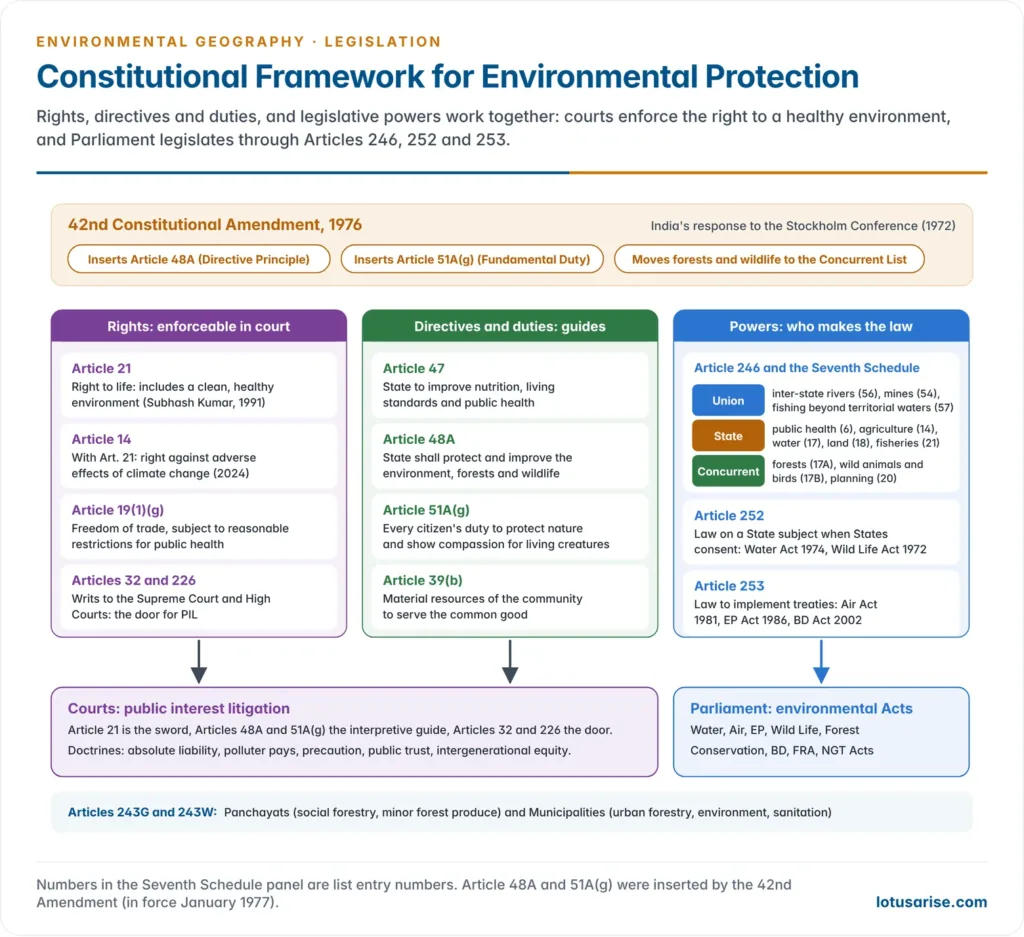
- The Constitution as adopted in 1950 had no direct provision on the natural environment. The Stockholm Conference (1972) prompted the 42nd Constitutional Amendment (1976), which wrote environmental protection into the Directive Principles and the new Fundamental Duties.
- The same amendment moved “Forests” and “Protection of wild animals and birds” from the State List to the Concurrent List (entries 17A and 17B).
| Provision | Category | What it says | Use in environmental law |
|---|---|---|---|
| Article 21 | Fundamental Right | Right to life and personal liberty | Read by the Supreme Court to include a clean and healthy environment (Subhash Kumar, 1991) and, since 2024, a right against the adverse effects of climate change |
| Article 14 | Fundamental Right | Equality before law | Paired with Art. 21 in M.K. Ranjitsinh (2024); arbitrary clearances can be struck down |
| Article 47 | Directive Principle | Duty to raise nutrition and improve public health | Used with 48A to justify pollution control |
| Article 48A | Directive Principle (42nd Amendment) | “The State shall endeavour to protect and improve the environment and to safeguard the forests and wild life of the country.” | Not justiciable by itself, but guides the reading of Art. 21 |
| Article 51A(g) | Fundamental Duty (42nd Amendment) | Duty of every citizen to “protect and improve the natural environment including forests, lakes, rivers and wild life, and to have compassion for living creatures” | Basis for citizen action and court directions such as environmental education |
| Article 246 and Seventh Schedule | Distribution of powers | Water and land in the State List; forests and wildlife in the Concurrent List; inter-state rivers, mines, atomic energy with the Union | Central Acts on forests and wildlife prevail over conflicting State laws |
| Article 252 | Legislation by consent | Parliament can legislate on a State subject for States that pass resolutions | Basis of the Water Act, 1974 and the Wild Life Act, 1972 |
| Article 253 | Treaty implementation | Parliament can legislate for any part of India to implement international agreements | Basis of the Air Act, 1981, EP Act, 1986 and Biological Diversity Act, 2002 |
| Articles 32 and 226 | Writ jurisdiction | Remedies before the Supreme Court and High Courts | Vehicle for public interest litigation (PIL) |
| Articles 243G and 243W | Eleventh and Twelfth Schedules | Panchayats: social forestry, minor forest produce, fuel and fodder; Municipalities: urban forestry, protection of the environment, sanitation | Decentralised environmental functions |
- The Fifth and Sixth Schedules and the Panchayats (Extension to Scheduled Areas) Act, 1996 add community control over natural resources in tribal areas, which the Forest Rights Act, 2006 builds on.
- The result is a rights-based reading of the environment: Article 21 is the sword, Articles 48A and 51A(g) are the interpretive guide, and Articles 32 and 226 are the door to the courts.
Institutions and the evolution of environmental law
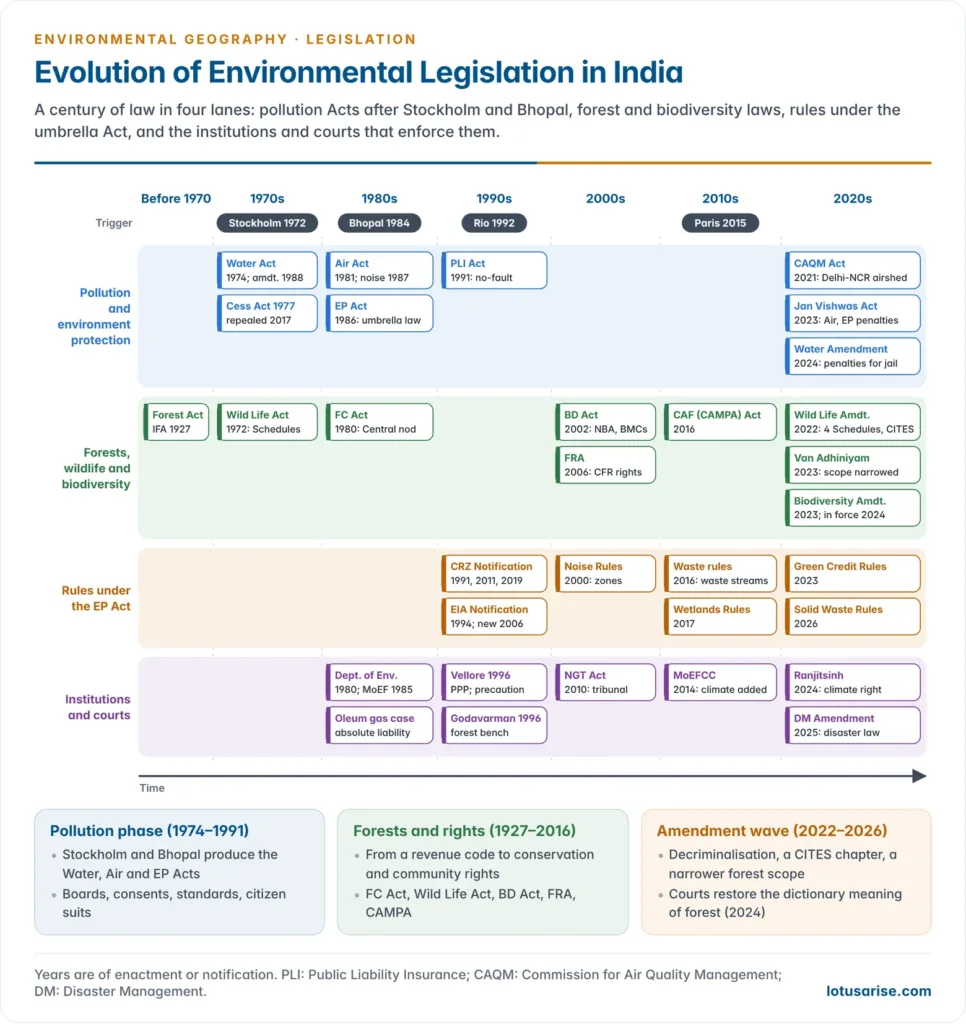
- India’s environmental law has grown over a century: from colonial forest codes (1865, 1878, 1927) to post-Stockholm pollution statutes, the post-Bhopal umbrella Act, rights-based laws after 2000 and a wave of amendments in 2022–24.
- Administrative evolution:
- National Committee on Environmental Planning and Coordination (1972), set up after Stockholm.
- Department of Environment (1980), following the N.D. Tiwari Committee (1980).
- Ministry of Environment and Forests (1985), renamed the Ministry of Environment, Forest and Climate Change (MoEFCC) in 2014. It is the nodal ministry for all environmental Acts.
- Central Pollution Control Board (CPCB) and State Pollution Control Boards (SPCBs) under the Water Act (1974), the NGT (2010) and the Commission for Air Quality Management (2021).
- Phases of legislation:
- Conservation phase (1927–1972): forest revenue and game laws.
- Pollution-control phase (1974–1986): Water, Air and EP Acts after Stockholm and Bhopal.
- Liability and rights phase (1991–2010): Public Liability Insurance Act, Biological Diversity Act, Forest Rights Act, NGT Act.
- Amendment and “ease of compliance” phase (2016–2025): CAMPA, Wild Life (2022), Jan Vishwas (2023), Van Adhiniyam (2023), Biological Diversity (2023), Water (2024).
Environmental Acts by Sector
Pollution-control laws
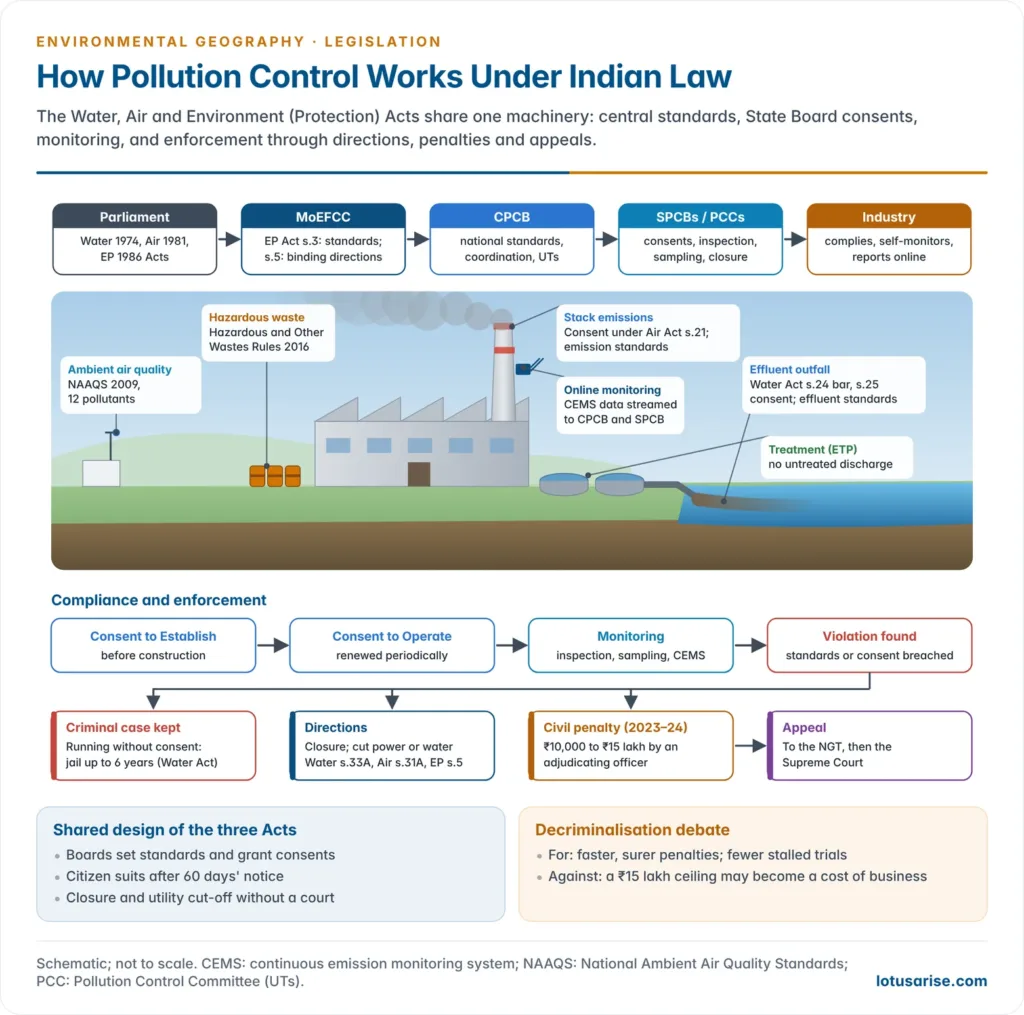
The Water (Prevention and Control of Pollution) Act, 1974
- India’s first modern pollution-control law. It followed Stockholm and was passed under Article 252 after State legislatures consented; it now applies across India.
- Objective: prevent and control water pollution and maintain or restore the wholesomeness of water in streams, wells and on land.
- Institutions:
- CPCB (Section 3): advises the Centre, coordinates SPCBs, lays down standards and acts as the board for Union Territories.
- SPCBs (Section 4): plan state programmes, inspect, set effluent standards and grant consents.
- Key provisions:
- Section 24: bars the knowing discharge of poisonous or polluting matter into a stream, well or sewer.
- Section 25: no industry or treatment plant may be set up or operated, or a new outlet opened, without the SPCB’s consent. This is now issued as Consent to Establish (CTE) and Consent to Operate (CTO).
- Powers of entry, inspection and sampling from any stream, well or effluent.
- 1988 Amendment (major strengthening):
- Section 33A: Boards may close a defaulting unit or cut its power and water by administrative order, without waiting for a court.
- Penalties were made stiffer.
- Citizen suit (Section 49): courts may act on a complaint by any person who has given the Board 60 days’ notice.
- Water (Prevention and Control of Pollution) Amendment Act, 2024:
- Decriminalises most offences: violations of discharge rules now attract a penalty of ₹10,000 to ₹15 lakh, imposed by an adjudicating officer (Joint Secretary to the Centre or Secretary to a State), instead of jail.
- Running a unit without consent still attracts imprisonment up to six years and a fine.
- The Centre may exempt categories of industries from consent and prescribe the manner of nominating SPCB chairpersons.
- Appeals lie to the NGT after depositing 10% of the penalty; penalties go to the Environment Protection Fund.
- Passed again under Article 252, it applied first to Himachal Pradesh, Rajasthan and the Union Territories; other States adopt it by resolution.
- The companion Water Cess Act, 1977 levied a cess on water used by industries to fund the Boards. It was repealed in 2017 when GST subsumed such cesses.
The Air (Prevention and Control of Pollution) Act, 1981
- Passed under Article 253 to implement the Stockholm decisions on air quality. Its design mirrors the Water Act: the same CPCB and SPCBs administer it.
- Key provisions:
- States declare air pollution control areas (Section 19); every industry inside them needs the SPCB’s consent (Section 21).
- SPCBs lay down emission standards for industry and vehicles in consultation with the CPCB, which also sets the National Ambient Air Quality Standards (revised 2009, 12 pollutants).
- Powers of entry, testing of equipment and sampling from chimneys, ducts and outlets.
- 1987 Amendment:
- Boards may close units or cut power and water (Section 31A).
- Citizen suit provision added.
- Noise was brought within the definition of “air pollutant”, giving the Act a role in noise control.
- Jan Vishwas (Amendment of Provisions) Act, 2023: replaced imprisonment for several offences with monetary penalties of ₹10,000 to ₹15 lakh fixed by adjudicating officers, with appeal to the NGT. Operating without consent stays a criminal offence.
- The Commission for Air Quality Management in NCR and Adjoining Areas Act, 2021 created a statutory body for the Delhi airshed. It replaced the court-created Environment Pollution (Prevention and Control) Authority (EPCA, 1998).
- Its rules on stubble burning impose environmental compensation per incident. After a Supreme Court rebuke, the rates were doubled in November 2024 to ₹5,000 (under 2 acres), ₹10,000 (2–5 acres) and ₹30,000 (above 5 acres).
- Together the Water and Air Acts target the main sources of environmental pollution: industrial effluent, sewage, stack emissions and vehicles.
The Environment (Protection) Act, 1986
- The umbrella law. Passed under Article 253 after the Bhopal gas disaster (2–3 December 1984) and to implement Stockholm, it came into force on 19 November 1986. It fills the gaps left by the sectoral Acts and is the parent of most later rules.
- Definitions (Section 2):
- Environment includes water, air and land and the inter-relationships among them and human beings, other living creatures, plants, micro-organisms and property.
- Environmental pollutant: any solid, liquid or gaseous substance present in a concentration that may be injurious to the environment.
- Hazardous substance: any substance or preparation that may harm human beings, other living creatures, plants, micro-organisms, property or the environment.
- Powers of the Central Government:
- Section 3(1): take “all such measures as it deems necessary or expedient” to protect and improve the environment and prevent, control and abate pollution.
- Set standards for environmental quality and for emissions and discharges.
- Restrict the location of industries and processes; lay down procedures for hazardous substances and safeguards against accidents.
- Section 3(3): constitute authorities, such as the Central Ground Water Authority, the coastal zone management authorities and the Central Empowered Committee (made a permanent body in 2023).
- Section 5: issue directions to close, prohibit or regulate any industry, operation or process, or stop its electricity, water or other service. It was the first law to give the Centre such direct power.
- Sections 6–11: make rules; prohibit emissions above standards; regulate handling of hazardous substances; power of entry and sampling.
- Section 3(1): take “all such measures as it deems necessary or expedient” to protect and improve the environment and prevent, control and abate pollution.
- Penalties, before and after 2023:
| Aspect | Original Act (1986) | After the Jan Vishwas Act (in force 1 April 2024) |
|---|---|---|
| Nature | Criminal: prosecution in court | Civil penalty imposed by an adjudicating officer |
| Amount | Up to 5 years’ jail or ₹1 lakh fine, or both; ₹5,000 a day for continuing breach; up to 7 years if it continued beyond a year | ₹10,000 to ₹15 lakh, with further penalty for continuing contravention |
| Who decides | Magistrate | Adjudicating officer; inquiry rules of November 2024 |
| Appeal | Higher courts | NGT |
| Money goes to | Treasury | Environment Protection Fund (new Section 16A) |
- Citizen suit (Section 19): a court may act on a complaint by any person who has given the Centre or the authorised officer 60 days’ notice. It was a significant innovation.
- Main rules and notifications under the Act:
- Environmental Impact Assessment Notification (1994, replaced in 2006);
- Coastal Regulation Zone Notification (1991, 2011, 2019);
- Noise Pollution (Regulation and Control) Rules, 2000;
- Wetlands (Conservation and Management) Rules, 2017;
- Hazardous and Other Wastes (Management and Transboundary Movement) Rules, 2016;
- Plastic Waste Management Rules, 2016 (single-use plastics in 19 categories banned from 1 July 2022);
- E-Waste (Management) Rules, 2022 and Battery Waste Management Rules, 2022, built on extended producer responsibility;
- Solid Waste Management Rules, 2026 (in force 1 April 2026, replacing the 2016 rules);
- Green Credit Rules, 2023, Ecomark Rules, 2024 (replacing the 1991 scheme) and Environment Audit Rules, 2025.
Noise pollution: the legal framework
- India has no separate noise Act. Control rests on several instruments:
- the Air Act (noise is an air pollutant since 1987);
- the Noise Pollution (Regulation and Control) Rules, 2000 under the EP Act: ambient standards in dB(A) Leq for industrial (75 day / 70 night), commercial (65/55), residential (55/45) and silence zones (50/40);
- silence zones cover at least 100 m around hospitals, educational institutions and courts;
- loudspeakers and public address systems are barred between 10 pm and 6 am, except in closed premises; States may relax this to midnight on up to 15 days a year;
- noise limits for generator sets, vehicles and firecrackers, notified under the EP Rules;
- the Motor Vehicles Act (horns and silencers) and the Factories Act (workplace exposure);
- Sections 268 and 290 of the Indian Penal Code (public nuisance), carried into the Bharatiya Nyaya Sanhita, 2023.
- The Supreme Court, in In re: Noise Pollution (2005), held that freedom from noise is part of Article 21 and upheld the night-time loudspeaker curb.
The Public Liability Insurance Act, 1991
- A direct lesson from Bhopal: victims of industrial accidents should not wait years for compensation.
- No-fault liability: the owner handling a hazardous substance must give immediate relief for death, injury or property damage, without proof of negligence.
- Every such owner must take an insurance policy; insurers and owners also pay into an Environment Relief Fund (created by a 1992 amendment). The District Collector processes claims.
- The Environment Relief Fund (Amendment) Scheme, 2024 made the CPCB the fund manager from January 2025, because the fund (about ₹1,062 crore in 2023) had paid out nothing since 2019.
Forest and wildlife laws
The Indian Forest Act, 1927
- A colonial consolidation of earlier forest laws, still in force. It governs forest administration, forest produce, transit and the duty on timber.
- Categories of forest:
- Reserved forests: the highest protection; rights are settled, and unauthorised felling, quarrying, grazing and hunting are offences.
- Village forests: reserved forest assigned to a village community.
- Protected forests: rights recorded but regulated; the state may prohibit felling and removal of produce.
- Control over non-government forests and lands (private forests).
- Its revenue orientation and treatment of forest dwellers as encroachers created the “historical injustice” that the Forest Rights Act later set out to undo.
The Wild Life (Protection) Act, 1972
- India’s core wildlife law, passed under Article 252 in September 1972. It provides for wildlife advisory boards, a ban on hunting of scheduled animals, protected areas and control of trade in wild animals and their products.
- Protected areas: national parks and sanctuaries, joined by conservation reserves and community reserves (2002 amendment) and tiger reserves (2006).
- Major amendments:
- 1991: protection extended to specified plants; hunting of nearly all wild animals banned.
- 2002: National Board for Wildlife; community and conservation reserves.
- 2006: National Tiger Conservation Authority and the Wildlife Crime Control Bureau.
- 2022 (in force 1 April 2023): the most extensive overhaul.
- The Wild Life (Protection) Amendment Act, 2022:
- Schedules cut from six to four; the vermin schedule abolished. The Centre keeps power (Section 62) to declare a species, other than Schedule I, vermin for an area and period.
- New Chapter VB implements CITES: a Management Authority grants trade permits; a Scientific Authority advises on whether trade harms survival. Owners of living CITES-listed animals must register them (rules of February 2024).
- Invasive alien species: the Centre may regulate or prohibit their import, trade, possession or spread.
- The Centre, too, can now notify conservation reserves; people can voluntarily surrender captive animals; captive elephants may be transferred for religious or other purposes.
- Penalties raised: general violations from ₹25,000 to ₹1 lakh; offences on specially protected animals from a minimum of ₹10,000 to ₹25,000, with jail terms of three to seven years.
| Schedule | Before 2022 | After the 2022 Amendment |
|---|---|---|
| I | Highest protection (tiger, elephant, snow leopard, great Indian bustard) | Animals with the highest protection |
| II | Part II with high protection; rest regulated | Animals with lesser protection |
| III and IV | Lesser-protected animals | III: protected plants |
| V | Vermin (crow, fruit bat, rats) | IV: CITES-listed specimens |
| VI | Specified plants | Removed (plants moved to III) |
- Species projects sit alongside the Act: Project Tiger (1973), Project Elephant (1992), Project Dolphin (2020) and Project Cheetah (2022). Poaching, habitat loss and conflict remain the core problems of wildlife conservation that the law has to meet.
The Forest (Conservation) Act, 1980, now the Van (Sanrakshan Evam Samvardhan) Adhiniyam
- Enacted (first as an ordinance of 25 October 1980) to check the rapid loss of forest to dams, mines, roads and farms. It is short but powerful.
- Section 2: no State may, without prior approval of the Central Government:
- de-reserve a reserved forest;
- use forest land for any non-forest purpose;
- lease forest land to a private body;
- clear naturally grown trees to replant.
- An Advisory Committee (Section 3) advises the Centre; diversion requires compensatory afforestation and payment of Net Present Value (NPV).
- T.N. Godavarman Thirumulpad v. Union of India (12 December 1996) widened the Act to every forest “as understood in the dictionary sense”, irrespective of ownership or classification, and to all areas recorded as forest.
- The Forest (Conservation) Amendment Act, 2023 (in force 1 December 2023):
- Renames the Act the Van (Sanrakshan Evam Samvardhan) Adhiniyam, 1980 and adds a preamble linking forests to the carbon sink and net zero by 2070 goals.
- Scope narrowed: the Act covers land notified as forest under the Indian Forest Act or any other law, and land recorded as forest in government records on or after 25 October 1980. Land lawfully converted before 12 December 1996 is excluded.
- Exemptions (subject to central guidelines):
- land within 100 km of international borders, the LoC or LAC for strategic linear projects;
- up to 10 ha for security infrastructure;
- up to 5 ha in Left Wing Extremism-affected areas for defence or public utility projects;
- up to 0.10 ha of roadside or railside strips for access and amenities.
- Zoos, safaris, eco-tourism, silvicultural operations and surveys are treated as forestry activities, not non-forest purposes.
- The Centre may set terms for leasing forest land and issue binding directions to any authority.
- Criticism: it could strip protection from unrecorded “deemed” forests (scrub, community and private forests) recognised under Godavarman. It also weakens scrutiny in fragile border Himalaya and North-East forests and treats zoos and safaris as conservation.
- Supreme Court response (Ashok Kumar Sharma v. Union of India):
- 19 February 2024: until final judgment, all States and UTs must follow the dictionary meaning of forest from Godavarman (1996). States had to share expert-committee records of forest-like land for publication. New zoos and safaris in forest land need the Court’s approval.
- 3 February 2025: no step that reduces forest land may be taken unless compensatory land is provided.
- In re: Zudpi Jungle Lands (22 May 2025): the Court declared Vidarbha’s zudpi (scrub) jungles to be forest land, protecting uses made before 1996 and ordering scrutiny of later allotments.
- Status of forests: the India State of Forest Report 2023 puts forest and tree cover at 25.17% of the geographical area (forest cover 21.76%), but the quality of forests lost to diversion and degradation is not captured by cover alone.
The Compensatory Afforestation Fund Act, 2016
- Background: for years, money collected from forest diversion lay unused with an ad hoc CAMPA set up on the Supreme Court’s orders (2006).
- The Act (in force 30 September 2018, with rules of August 2018) creates a National and State Compensatory Afforestation Funds in the public accounts, interest-bearing and non-lapsable.
- 90% goes to the States and 10% to the Centre.
- The money pays for compensatory afforestation, NPV-funded forest protection, catchment treatment and wildlife management.
- About ₹47,000 crore was transferred to the States in August 2019.
- Criticism: plantations replace natural forests, often as monocultures on scarce land. Gram Sabha consent is not required. Funds have been used for unrelated purposes, and survival of plantations is poorly monitored.
The Forest Rights Act, 2006
- The Scheduled Tribes and Other Traditional Forest Dwellers (Recognition of Forest Rights) Act, 2006 (in force 31 December 2007) recognises rights of those who have lived in and depended on forests for generations. It undoes the “historical injustice” of colonial and post-colonial forest law.
- Eligibility: forest-dwelling Scheduled Tribes, and Other Traditional Forest Dwellers who have lived there for three generations (75 years), in occupation as on 13 December 2005.
- Rights recognised (Section 3):
- Individual rights to land under occupation, up to 4 ha;
- community rights: nistar, grazing, fishing and ownership of minor forest produce (including bamboo and tendu);
- habitat rights of particularly vulnerable tribal groups;
- the right to protect, regenerate, conserve and manage community forest resources (CFR).
- Gram Sabha is the authority that starts the process. Claims pass through sub-divisional and district committees (Section 6).
- Under Section 5, right-holders and Gram Sabhas are empowered to protect wildlife, forests, biodiversity and water catchments.
- Critical wildlife habitats (Section 4(2)) may be kept inviolate only after scientific study, consent and resettlement.
- Landmarks:
- Mendha Lekha (Gadchiroli) was among the first villages to receive CFR rights (2009) and to sell its own bamboo.
- In the Niyamgiri case (2013), the Gram Sabhas’ decision blocked bauxite mining.
- The Act makes communities custodians and allies of conservation; Biodiversity Management Committees often work with FRA Gram Sabhas. Slow recognition of claims remains one of the chief problems of tribal areas.
The Biological Diversity Act, 2002
- India’s law to implement the CBD and later the Nagoya Protocol. It was passed in December 2002, received assent on 5 February 2003, and its rules came in 2004.
- Legislative intent:
- protect India’s biodiversity and associated traditional knowledge from use by foreign entities without sharing benefits;
- check biopiracy, as in the turmeric and neem patent disputes;
- secure fair and equitable benefit-sharing.
- Three-tier structure:
- National Biodiversity Authority (NBA), Chennai (2003): approves access by foreign entities, transfer of research results abroad and intellectual property rights based on Indian biological resources.
- State Biodiversity Boards: regulate commercial use by Indian entities, who must give prior intimation.
- Biodiversity Management Committees in every local body: keep People’s Biodiversity Registers and may levy collection fees.
- Other provisions:
- Free access for local people and communities, vaids and hakims;
- benefit-sharing money goes to the National Biodiversity Fund for the benefit-claimers and conservation in the source areas;
- States may notify Biodiversity Heritage Sites.
- The Biological Diversity (Amendment) Act, 2023 (in force 1 April 2024):
- AYUSH practitioners, users of codified traditional knowledge and cultivated medicinal plants are exempted from prior intimation to State Boards.
- Foreign-controlled Indian companies are treated as foreign entities.
- NBA approval is needed before the grant of a patent, not at the application stage.
- Offences are decriminalised: penalties of ₹1 lakh to ₹50 lakh (up to ₹1 crore more for continuing breach), set by an adjudicating officer.
- Criticism: it eases research and industry but may dilute benefit-sharing and the role of communities and BMCs.
Coastal, wetland and clearance regulation
Coastal Regulation Zone Notification, 2019
- Issued under the EP Act (first in 1991, revised in 2011 and on 18 January 2019, after the Shailesh Nayak Committee). It regulates activity on the coast up to 500 m from the High Tide Line (HTL) and along tidal creeks, backwaters and rivers. India’s long coastline is managed through state Coastal Zone Management Plans.
| Zone | Covers | Main rule |
|---|---|---|
| CRZ I | I-A: ecologically sensitive areas (mangroves, corals, sand dunes, turtle nesting); I-B: intertidal zone | Most development barred; eco-tourism trails allowed |
| CRZ II | Developed land within municipal limits | Building allowed on the landward side of existing structures |
| CRZ III | Rural coast. III-A: population density over 2,161 per km² (No Development Zone 50 m); III-B: other rural areas (NDZ 200 m) | Limited development; temporary tourism facilities |
| CRZ IV | IV-A: sea from the Low Tide Line to 12 nautical miles; IV-B: tidal water bodies | Fishing and navigation; no untreated discharge |
- The 2019 notification eased rules: a smaller NDZ, a 20 m NDZ for islands, and States clear CRZ II and III projects. Critics see a pro-construction tilt on coasts exposed to cyclones and sea-level rise.
Wetlands (Conservation and Management) Rules, 2017
- Notified on 26 September 2017, replacing the 2010 rules. They decentralise management to a State Wetlands Authority in each State and UT, with a National Wetlands Committee to advise.
- Prohibited in notified wetlands: reclamation and encroachment; setting up or expanding industries; handling hazardous substances; dumping solid waste; discharge of untreated effluent; and permanent construction (except boat jetties).
- The rules exclude river channels, paddy fields and human-made water bodies built for drinking water, irrigation or aquaculture. Wetlands inside protected areas fall under the Wild Life Act, and those in the CRZ under the CRZ notification.
Environmental Impact Assessment Notification, 2006
- Issued under the EP Act on 14 September 2006, replacing the 1994 notification. Listed projects need prior environmental clearance (EC):
- Category A from the MoEFCC on the advice of an Expert Appraisal Committee;
- Category B from the State Environment Impact Assessment Authority.
- Four stages: screening, scoping, public consultation (including a public hearing) and appraisal, using the methods of environmental impact assessment such as checklists, matrices and overlays.
- The ex post facto clearance saga:
- A 2017 notification gave violators a six-month window to seek clearance after starting work; a 2021 office memorandum set a standing procedure for such cases.
- Vanashakti v. Union of India (16 May 2025): a two-judge bench struck both down and barred retrospective ECs.
- 18 November 2025: a three-judge bench recalled that judgment by 2:1.
- 29 July 2026: a three-judge bench held that prior EC is the rule. The 2017 notification stands as a narrow, time-bound exception, but the 2021 memorandum is quashed prospectively.
- Disaster law connects here only at the margin: the Disaster Management (Amendment) Act, 2025 (in force 9 April 2025) strengthens disaster databases, plans and urban authorities for environmental hazards such as floods and landslides.
Other important legislation
| Act / rules | Year | Key provisions |
|---|---|---|
| National Environment Tribunal Act | 1995 | No-fault liability tribunal for hazardous accidents; never brought into operation |
| National Environment Appellate Authority Act | 1997 | Heard appeals against ECs; replaced by the NGT in 2010 |
| Energy Conservation Act | 2001 (amended 2022) | Bureau of Energy Efficiency, appliance standards; the 2022 amendment enabled the Carbon Credit Trading Scheme (2023) |
| Scheduled Areas (PESA) Act | 1996 | Gram Sabha control over minor forest produce and minor minerals in Fifth Schedule areas |
| Commission for Air Quality Management Act | 2021 | Statutory airshed body for Delhi-NCR |
| Green Credit Rules | 2023 | Tradable credits for plantation, water conservation and other actions |
| Ecomark Rules | 2024 | Eco-labelling of products, aligned with Mission LiFE |
| Environment Audit Rules | 2025 | Registered third-party environment auditors for compliance checks |
| Solid Waste Management Rules | 2026 | Four-stream segregation, bulk-generator responsibility |
| Disaster Management (Amendment) Act | 2025 | Statutory national and state disaster databases; urban disaster authorities |
The National Green Tribunal
Origin and structure
- Why a green tribunal?
- Environmental cases need speed and scientific expertise that ordinary courts lack.
- Principle 10 of the Rio Declaration (1992) asks states to provide effective access to judicial remedies.
- The Supreme Court suggested environmental courts in the 1980s and 1990s, and the Law Commission (186th Report, 2003) recommended them.
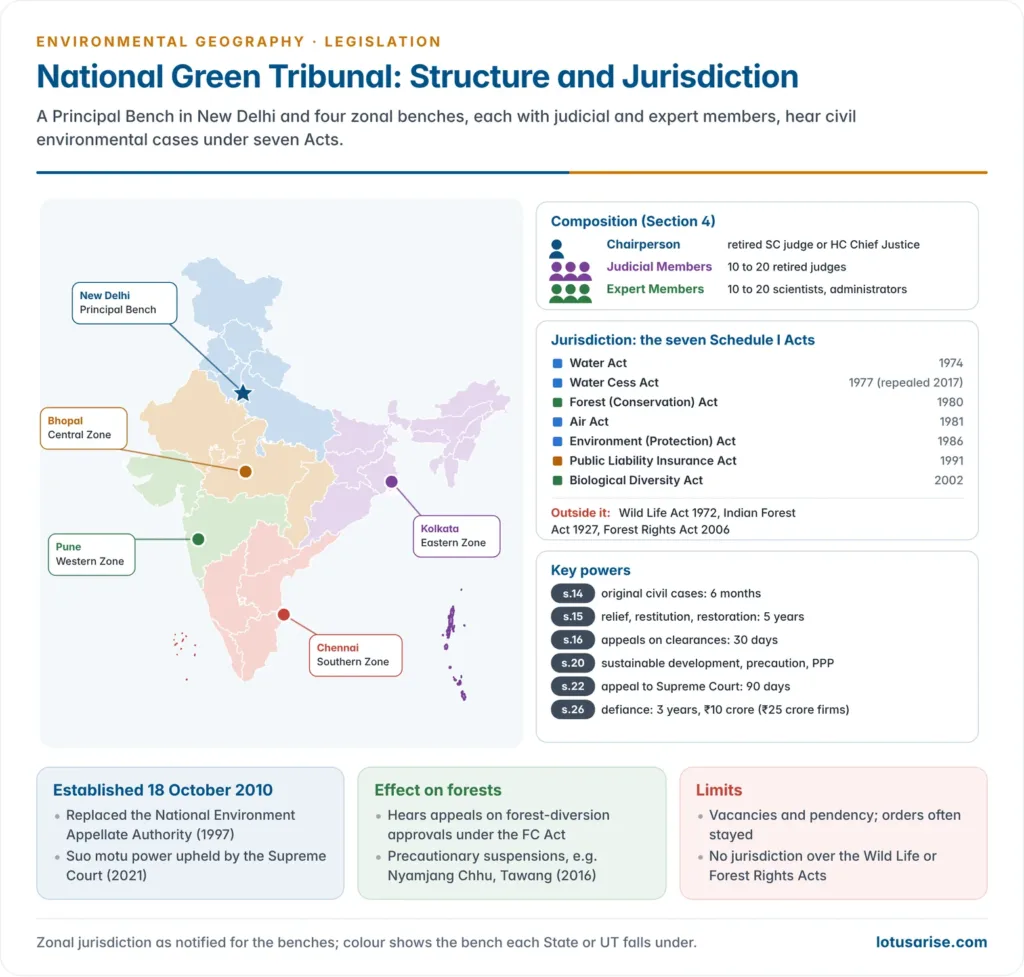
- The National Green Tribunal Act, 2010 (assent 2 June 2010; tribunal set up 18 October 2010) made the NGT a specialised environmental court. It placed India among the few countries with a national green tribunal, alongside Australia and New Zealand.
- It replaced the National Environment Appellate Authority (1997); the National Environment Tribunal (1995) had never been set up.
- Composition (Section 4):
- a full-time Chairperson (a retired Supreme Court judge or High Court Chief Justice);
- 10–20 Judicial Members (retired judges);
- 10–20 Expert Members (scientists and administrators with environmental experience).
- Benches have equal numbers of judicial and expert members.
- Seats: the Principal Bench, New Delhi, and zonal benches at Bhopal (Central), Pune (Western), Kolkata (Eastern) and Chennai (Southern), with circuit sittings in remote areas.
Jurisdiction and powers
- Schedule I (seven Acts): the NGT hears civil cases that raise a “substantial question relating to environment” under:
- the Water Act, 1974; the Water Cess Act, 1977; the Forest (Conservation) Act, 1980; the Air Act, 1981; the Environment (Protection) Act, 1986; the Public Liability Insurance Act, 1991; and the Biological Diversity Act, 2002.
- Not covered: the Wild Life (Protection) Act, 1972, the Indian Forest Act, 1927 and the Forest Rights Act, 2006. Wildlife and forest-rights cases still go to the High Courts and the Supreme Court.
| Section | Power | Limitation |
|---|---|---|
| 14 | Original jurisdiction over civil environmental disputes | 6 months (+60 days) |
| 15 | Relief and compensation to victims, restitution of property, restoration of the environment (heads in Schedule II) | 5 years (+60 days) |
| 16 | Appeals against orders under the Schedule I Acts, including forest diversion approvals and ECs | 30 days (+60 days) |
| 19 | Own procedure: not bound by the Civil Procedure Code or Evidence Act; follows natural justice | – |
| 20 | Must apply sustainable development, the precautionary principle and the polluter pays principle | – |
| 22 | Appeal to the Supreme Court | 90 days |
| 26 | Disobeying an order: up to 3 years’ jail and/or a fine up to ₹10 crore (₹25 crore for companies) | – |
| 29 | Civil courts barred from matters within its jurisdiction | – |
- Section 18 lets any aggrieved person, including NGOs and representative bodies, apply. This broad standing carries the PIL tradition into the tribunal.
- In Municipal Corporation of Greater Mumbai v. Ankita Sinha (2021), the Supreme Court held that the NGT has suo motu powers. It can act on letters and news reports.
Record and impact
- Major orders:
- Diesel vehicles older than ten years and petrol vehicles older than fifteen barred in Delhi-NCR (2015).
- Art of Living event (2016): environmental compensation for damage to the Yamuna floodplain.
- Nyamjang Chhu hydro project, Tawang (2016): clearance suspended to protect the black-necked crane’s wintering habitat.
- Repeated orders on solid waste, sewage, sand mining and river pollution, with heavy environmental compensation levied on States.
- Impact on forest conservation:
- Section 16 appeals let communities and NGOs challenge forest diversion approvals under the FC Act and ECs for mines and dams in forests.
- The precautionary principle under Section 20 has led to suspension of clearances in biodiversity-rich forests where impact studies were weak.
- Orders on illegal mining, sand mining and encroachment in forests, tree felling and the Aravallis protect forest land indirectly.
- Expert members bring ecological evidence into forest cases.
- Limits: no jurisdiction over the Wild Life Act or the Forest Rights Act; Supreme Court stays on many orders; and the Supreme Court’s own Godavarman bench still dominates forest governance.
- Criticism of the NGT:
- vacancies and thin benches, leaving zonal benches idle for long spells;
- poor compliance by States, and orders stayed on appeal;
- charges of judicial overreach: running monitoring committees and fixing compensation without clear norms;
- limited reach for poor and remote litigants.
Judicial Doctrines and Landmark Cases
Environmental doctrines developed by Indian courts
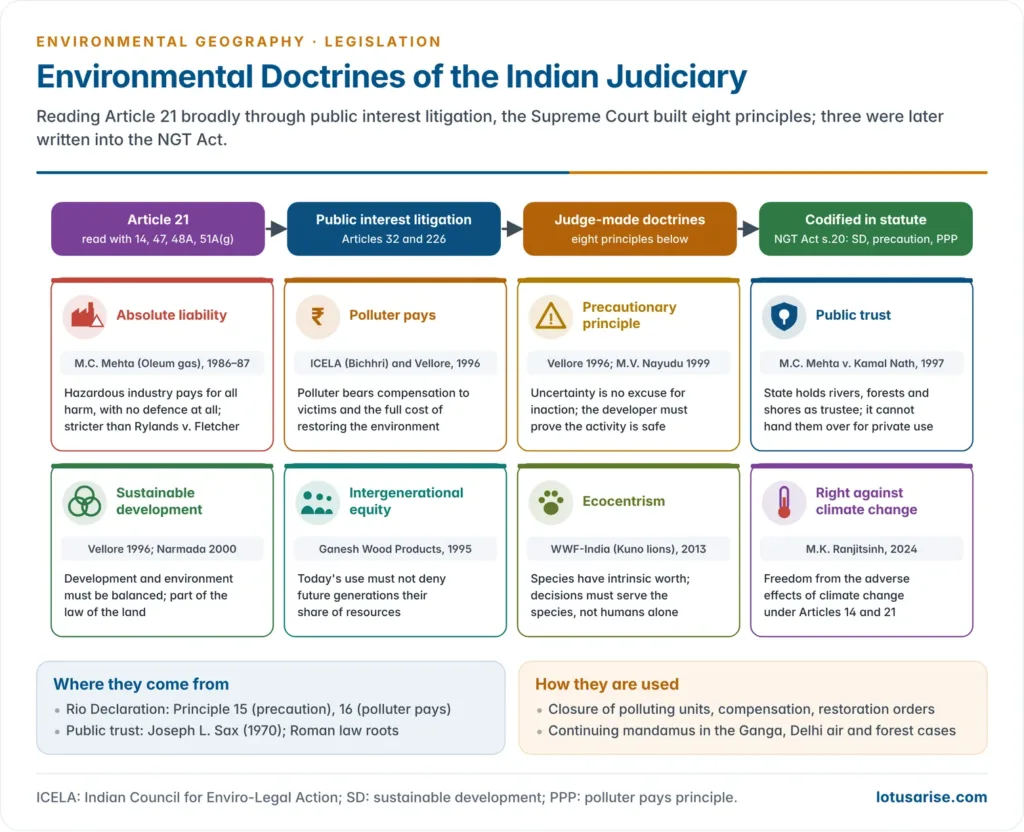
- Through PIL, the Supreme Court has built a body of environmental jurisprudence that in places goes beyond international practice. Section 20 of the NGT Act later codified three of these principles.
| Doctrine | Meaning | Leading case |
|---|---|---|
| Absolute liability | An enterprise engaged in a hazardous or inherently dangerous activity is absolutely liable for harm, with no exceptions, and compensation scales with its size and capacity | M.C. Mehta v. Union of India (Oleum gas leak), 1986–87 |
| Polluter pays | The polluter bears the cost of compensating victims and restoring the environment | Indian Council for Enviro-Legal Action, 1996; Vellore Citizens, 1996 |
| Precautionary principle | Where harm may be serious or irreversible, lack of scientific certainty is no excuse for inaction; the burden of proof is on the developer | Vellore Citizens, 1996; A.P. Pollution Control Board v. M.V. Nayudu, 1999 |
| Public trust | The State holds rivers, forests, seashores and air as trustee for the public and cannot hand them over for private use | M.C. Mehta v. Kamal Nath, 1997 |
| Sustainable development | Development and environment must be balanced; it is part of the law of the land | Vellore Citizens, 1996; Narmada Bachao Andolan, 2000 |
| Intergenerational equity | Present use must not deny future generations their share | State of Himachal Pradesh v. Ganesh Wood Products, 1995 |
| Ecocentrism | Species have intrinsic worth; decisions must serve the species, not only humans | Centre for Environmental Law, WWF-India v. Union of India (Kuno lions), 2013 |
| Right against climate change | People have a right to be free from the adverse effects of climate change under Articles 14 and 21 | M.K. Ranjitsinh v. Union of India, 2024 |
- Absolute liability is stricter than the English rule of strict liability in Rylands v. Fletcher (1868). That rule allowed defences such as an act of God or a third party’s act; the Indian doctrine allows none.
- The polluter pays and precautionary principles come from Principles 16 and 15 of the Rio Declaration. The Court treated them as part of Indian law through Articles 21, 47, 48A and 51A(g).
- The public trust doctrine draws on the American scholar Joseph L. Sax (1970).
Landmark environmental cases
- Rural Litigation and Entitlement Kendra v. State of Uttar Pradesh (1985), the Dehradun quarrying case:
- India’s first major environmental PIL. Limestone quarrying in the Mussoorie hills was closed despite economic loss.
- The Court treated a healthy environment as implicit in Article 21.
- M.C. Mehta v. Union of India, Oleum gas leak (1986–87):
- After a leak of oleum gas from Shriram Food and Fertiliser in Delhi, the Court laid down absolute liability for hazardous industries.
- This became the foundation of India’s environmental tort law.
- M.C. Mehta v. Union of India, Ganga pollution (1987–88):
- The Court closed Kanpur tanneries that lacked effluent treatment and directed municipalities to build sewage treatment plants.
- It began long judicial supervision of river cleaning.
- Subhash Kumar v. State of Bihar (1991):
- The Court held explicitly that the right to life includes the right to pollution-free water and air. A citizen may approach the Court under Article 32 to protect it.
- It also warned that a PIL must not serve private interest, and dismissed this petition on that ground.
- Indian Council for Enviro-Legal Action v. Union of India (1996), the Bichhri case:
- H-acid plants in Bichhri village, Rajasthan, poisoned groundwater with sludge.
- The Court applied absolute liability and the polluter pays principle, making the firms pay for remediation.
- Vellore Citizens’ Welfare Forum v. Union of India (1996):
- Tanneries on the Palar river, Tamil Nadu, had ruined wells and about 35,000 ha of farmland.
- The Court declared the precautionary principle, the polluter pays principle and sustainable development part of Indian law. It ordered common effluent treatment plants and compensation.
- T.N. Godavarman Thirumulpad v. Union of India (1996–ongoing):
- A petition on illegal felling in the Nilgiris grew into the “continuing mandamus” that runs India’s forest governance.
- Forest is read in its dictionary sense. Felling and saw-mills were curbed, NPV was imposed on diversions, and the Central Empowered Committee (2002) was set up.
- M.C. Mehta v. Kamal Nath (1997):
- A motel company (Span Motels) diverted the Beas river near Kullu on leased forest land.
- The Court quashed the lease under the public trust doctrine and ordered the company to restore the area and pay damages.
- M.C. Mehta v. Union of India, Taj Trapezium (1997):
- 292 industries around the Taj Mahal had to switch to natural gas or relocate, to save the marble from sulphur dioxide and particulates.
- A link between heritage and environmental law.
- Narmada Bachao Andolan v. Union of India (2000):
- The Court allowed the Sardar Sarovar dam to proceed, but required resettlement and rehabilitation before submergence.
- It balanced development and rights at the meeting point of EIA and social impact assessment.
- M.C. Mehta v. Union of India, Delhi vehicular pollution (1998–2002):
- The Court ordered Delhi’s public transport to shift to CNG, one of the world’s largest such conversions.
- Centre for Environmental Law, WWF-India v. Union of India (2013):
- The Court ordered Asiatic lions to be translocated from Gir to Kuno as a second home, adopting an ecocentric view.
- Orissa Mining Corporation v. Ministry of Environment and Forests (2013), the Niyamgiri case:
- The Court let the Gram Sabhas of the Dongria Kondh decide whether bauxite mining in the Niyamgiri hills affected their religious and cultural rights under the FRA.
- All twelve Gram Sabhas rejected the project, a landmark for community consent against the environmental impacts of mining.
- M.K. Ranjitsinh v. Union of India (21 March 2024):
- In a case over overhead power lines in the habitat of the great Indian bustard, the Court recognised a right against the adverse effects of climate change under Articles 14 and 21.
- It eased a blanket order on undergrounding lines and set up an expert committee to balance renewable-energy transmission with the bird’s survival.
- Vanashakti v. Union of India (2025–26): the long contest over ex post facto ECs. It ended in July 2026 with prior clearance as the rule and only a narrow statutory exception.
Evaluation
Strengths
- Wide coverage: India has one of the most comprehensive bodies of environmental law among developing countries: sectoral Acts, an umbrella Act, rights-based forest and biodiversity laws and a specialised tribunal.
- Constitutional anchoring: Articles 21, 48A and 51A(g) give environmental protection the force of a fundamental right.
- Innovative jurisprudence: absolute liability, the public trust doctrine and the climate-rights ruling are India’s contributions to global environmental law.
- Access to justice: PIL, citizen suits and the NGT’s broad standing let communities and NGOs enforce the law.
- International alignment: Article 253 lets India turn treaties (Stockholm, CBD, CITES, Montreal) into domestic law quickly.
Weaknesses
- Implementation gap: SPCBs are short of staff, laboratories and independence, and their leadership often lacks environmental expertise.
- Weak deterrence: criminal prosecution was rare and slow. Critics fear the 2023–24 decriminalisation, which replaced jail with fines of at most ₹15 lakh, will make pollution a cost of business. Supporters argue civil penalties are quicker and more certain.
- Dilution by amendment: the Van Adhiniyam 2023, CRZ 2019 relaxations, the Biological Diversity amendment and the ex post facto clearance route show a tilt towards ease of doing business.
- Fragmentation: separate Acts for water, air, forests and wildlife, each with its own authority, make ecosystem-wide management difficult. There is no framework climate law.
- Conflict with community rights: conservation laws often clash with the FRA. Evictions, the slow recognition of CFR rights and “fortress conservation” in protected areas persist.
- Judicial overreach and dependence: courts run forests, rivers and air quality through continuing mandamus. Governance then depends on litigation rather than on accountable regulators.
Way forward
- An independent national environmental regulator, as the Supreme Court suggested in Lafarge Umiam Mining (2011), to appraise and monitor projects.
- Consolidation of environmental laws, as the T.S.R. Subramanian Committee (2014) proposed, while keeping the safeguards of each Act.
- Stronger SPCBs: autonomy, technical staff, continuous emission monitoring and public disclosure.
- Cumulative and strategic EIA for river basins, coasts and the Himalaya, rather than project-by-project clearance.
- Rights-based conservation: implement the FRA and the Biological Diversity Act through Gram Sabhas and BMCs.
- A climate change framework law to give the NDC targets and the Ranjitsinh right a statutory base.
- Public participation and awareness, rooted in Article 51A(g) and environmental education.





Very good information.
♥️