

Nature of Religious Language: Analogical and Symbolic; Cognitivist and Non-cognitive.
Official Syllabus: Paper II, Section B, Unit 10
Religious language is the language people use when they pray, worship, preach, recite scripture and talk about God or the ultimate — Brahman, Allah, nirvāṇa, the Dao. Sentences like “God loves us“, “God created the world” or “Brahman is truth, knowledge, infinity” look like ordinary statements of fact. But their subject is said to be infinite, invisible and wholly other, while our words were made for the finite, visible world. So the philosophical question arises: can such sentences mean anything — and if so, what kind of meaning do they have? This article sets out the problem, the difference between religious and secular uses of language, the many jobs religious speech does, the clash of realism and non-realism, and the map of theories — cognitive, analogical, symbolic and non-cognitive — that the rest of this unit explores.
In simple words
A child who has never left a desert village asks you, “What is the sea like?” You say, “It is like the village pond — but it never ends, it is salty, and it roars.” Every word you use comes from the child’s world (pond, water, sound), yet the thing you describe is beyond that world. The child gets something, but not the sea itself. Religious language is in the same position, only more so: all its words come from our world, while its object is said to be beyond every world.
Context & Problem
What Is the Debate About?
- Language is the chief tool of communication — in science, politics and religion alike. It is through language that ideas and axioms spread. But is there a special language of religion?
- No universal language of religion: a comparative study of the world’s religions shows no single, specific language of religion. Unlike the empirical sciences, religion is fundamentally an experience and awareness of a trans-empirical element — something beyond sense experience — and it borrows ordinary words to speak of it.
- The basic question: “What can be said about God?” The religious-language debate is not about whether God exists, what God is like, or why there is evil. It asks only whether religious language means anything at all.
- The two sides:
- Believers, for centuries, have held that one can speak and write about God, because God is a reality.
- The Logical Positivists and those they influenced hold that statements about God have no meaning, because they do not relate to anything that can be checked in experience.
- Why it matters: when a believer uses religious language, she intends to express something of supreme importance to her. If it is judged meaningless, that does no credit to her faith — or to the effect her words may have on others.
Two Kinds of Language — An Illustration
Read the two columns aloud. The left is from the Psalms; the right states plain facts.
| Religious language (Psalms) | Factual language |
|---|---|
| “The Lord is faithful in all his words, and gracious in all his deeds.” | Badgers have black and white fur. |
| “The Lord upholds all who are falling, and raises up all who are bowed down.” | Squirrels are agile. |
| “The Lord is near to all who call upon him.” | Coal and crude oil are black. |
| “He hears their cry and saves them.” | 2 + 2 = 4 |
- The right-hand sentences can be checked: look at a badger, watch a squirrel, add the numbers.
- The left-hand sentences have the same grammar (“X is Y”, “X does Y”) — yet no one can look and see whether the Lord is near or hears a cry. That is the whole problem in miniature.
Definition and Examples
- Religious language is language used in a religious context. Examples:
- Jesus says, “I am the resurrection and the life.“
- The Ṛgveda‘s Puruṣa hymn says, “The Puruṣa has a thousand heads, a thousand eyes, a thousand feet.“
- The Upaniṣad says, “Brahman is truth, knowledge, infinity” (satyaṃ jñānam anantaṃ brahma).
- The problem of religious language is the set of questions about the nature and meaning of such words and sentences.
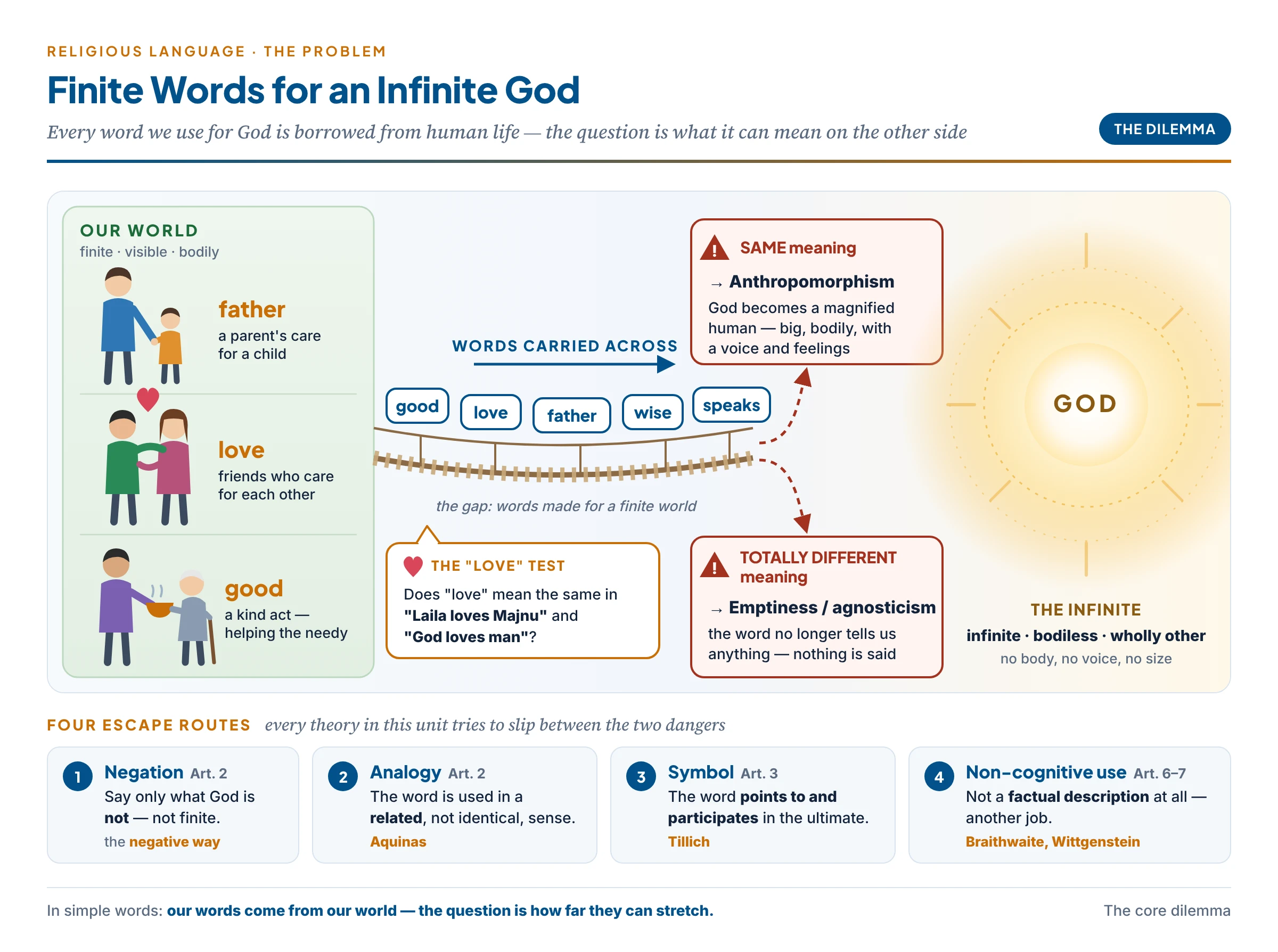
- The “love” test: does “love” carry the same sentiment in “God loves man” and “Laila loves Majnu“? Laila’s love shows in glances, letters, longing, sacrifice — all bodily and in time. If “love” does not mean the same in the religious sentence, in what sense is it used?
- No agreed answer: historically there have been at least four different solutions — analogy, symbol, non-cognitive reinterpretation and the language-game view — and no single solution has been widely accepted.
Core Doctrine
Why Is Religious Language a Problem?
The problem has two roots, which correspond to the two main issues discussed by modern philosophers of religion.
Root 1 — The special sense of words applied to God (the old, medieval problem):
- Religious language makes claims about the unknown, unseen and wholly other, while it is limited to a language made for the physical, known, here-and-now world.
- Every word shifts its meaning when applied to God:
- “Great is the Lord” does not mean that God occupies a large volume of space.
- “The Lord spoke to the prophet” does not mean that God has vocal organs that set sound waves moving towards the prophet’s ear.
- “God is good” does not mean that there is a moral standard outside God by which God is judged, nor that God (like a good person) feels temptation and overcomes it.
- The secular meaning is primary: words like “good”, “loving”, “forgives”, “commands”, “hears”, “speaks”, “wills”, “purposes” were first learnt and defined in human life. Their religious meaning is an adaptation of that secular use.
- The example of love: human love is shown in words, embraces and practical, sacrificial care. But God is said to be “without body, parts or passions“. What is disembodied love — and how could we ever know it exists? The same question arises for every divine attribute.
Root 2 — The basic function of religious language (the modern, analytic problem):
- Do religious sentences that look like factual assertions (“God loves humankind”) state a special kind of fact — a religious fact — or do they do a different job altogether (express feelings, commit to a way of life, play a role in worship)?
- This question was sharpened by twentieth-century analytic philosophy, especially Logical Positivism (Article 4) and the falsification debate (Article 5).
In simple words
A road sign says “Speed limit 50“. You know what it means because you have seen speedometers and roads. Now imagine a sign that says “The Lord of this road loves you“. The grammar is the same as any notice — but what would you look at to check it? Root 1 asks what “loves” can mean here; Root 2 asks whether the sign is even trying to state a fact, or doing something else — comforting, warning, inviting.
The Dilemma: Meaninglessness or Misrepresentation
- A lady says to her friend, “I love you.” He asks, “Do you really mean that?” She replies, “No.” He is speechless — she gives with one hand and takes back with the other.
- Some critics think believers are like this lady:
- Believers attribute to God properties normally attributed to things in the world — goodness, wisdom, power, love.
- But they also insist that God is utterly unlike anything in our experience, and that our words “fail to do Him justice“.
- The dilemma: if God is good in the ordinary sense, we misrepresent God (we make God a magnified human — anthropomorphism). If God is good in a totally different sense, we have said nothing (we fall into agnosticism or meaninglessness). Believers seem caught between two stools.
- Every theory in this unit is an attempt to escape this dilemma:
- Negation — say only what God is not (Article 2).
- Analogy — the word applies in a related sense (Article 2).
- Symbol — the word points to and participates in the ultimate (Article 3).
- Non-cognitive reinterpretation — the sentence is not meant as a factual description at all (Articles 6–7).
Cognitive and Non-cognitive Language
The syllabus pairs “cognitivist and non-cognitive“. These terms must be clear before anything else.
- Cognitive (informative, indicative) language makes factual claims that are either true or false. Examples: “The population of China is over a billion”, “This is a hot summer”, “Two plus two equal four”, “He is not here”.
- Cognitive, realist religious language makes factual assertions that can be proved true or false, or are treated as if they can be — “God exists”, “God loves us”, “God will execute a final judgement”. As Antony Flew put it, if these are meant seriously they are “not crypto-commands, expressions of wishes, disguised ejaculations, concealed ethics, or anything else but assertions“.
- When believers speak this way, they assume that claims about God are made and understood in the same way, or partly in the same way, as “cows exist”, “grass is green” or “I will get my exam results in August”.
- The difficulty: the usual ways of checking a factual claim do not apply — there is no instrument that measures God, and no past experience of a final judgement against which to test the prediction.
- Non-cognitive language is neither true nor false, because it does a different job from describing facts. We do not ask whether a swearword, a command or the baptismal formula (“I baptise thee…”) is true. The swearword vents feelings, the command directs action, the formula performs a baptism.
- Non-cognitive, anti-realist religious language is to be read as symbol, metaphor, ethical command, story or some other non-literal mode — expressing emotions, moral commitments, attitudes or a form of life.
- Much religious language obviously is rich in imagery and symbol.
- But is it nothing more? The cross is a symbol of Christianity — yet for Christians it is more than a symbol: it expresses the full reality of Jesus’ death as well as picturing it. Does it carry any real truth — for example, that Jesus’ death was more significant than the deaths of the two criminals crucified beside him? Here symbol and fact are tangled together.
- Two separate questions must not be confused:
- Are religious sentences intended by their users to be cognitive? — Historically, yes: ordinary Jews, Christians, Muslims and Hindus have believed “God loves humanity” to be not only cognitive but true.
- Is their logical character such that they can be true or false, whatever the intention? — This is what verificationists and falsificationists deny (Articles 4–5).
Common confusion
Does “non-cognitive” mean “meaningless”? No. “Non-cognitive” means not fact-stating — not true or false. A command (“Shut the door”), a promise (“I will come”) or a prayer (“Thy will be done”) is perfectly meaningful but not cognitive. Ayer called religious sentences cognitively meaningless (they state no fact) but allowed them emotive meaning. Braithwaite and Wittgenstein went further and gave them a positive, important meaning — as moral commitment or as part of a way of life. “Non-cognitive” is a claim about the kind of meaning, not a verdict of nonsense.
Three Groups of Theories — the Map of the Unit
Theories of religious language are usually sorted into three groups:
- Cognitive — religious language gives us factual information about a transcendent reality. Statements like “God exists” are true or false; verification and falsification are possible at least in principle (Hick’s eschatological verification, Mitchell, Crombie, Swinburne).
- Quasi-cognitive — analogical and symbolic language gives some sort of vague or imperfect knowledge of God — more than nothing, less than a literal description (Aquinas and Ramsey; Tillich).
- Non-cognitive — religious language gives no factual information. Its sentences are neither analytic (true by definition) nor empirically verifiable; from the cognitive point of view they are meaningless, but they may be meaningful as emotion (Ayer, Carnap), moral policy (Braithwaite), a blik (Hare) or a language-game (Wittgenstein).
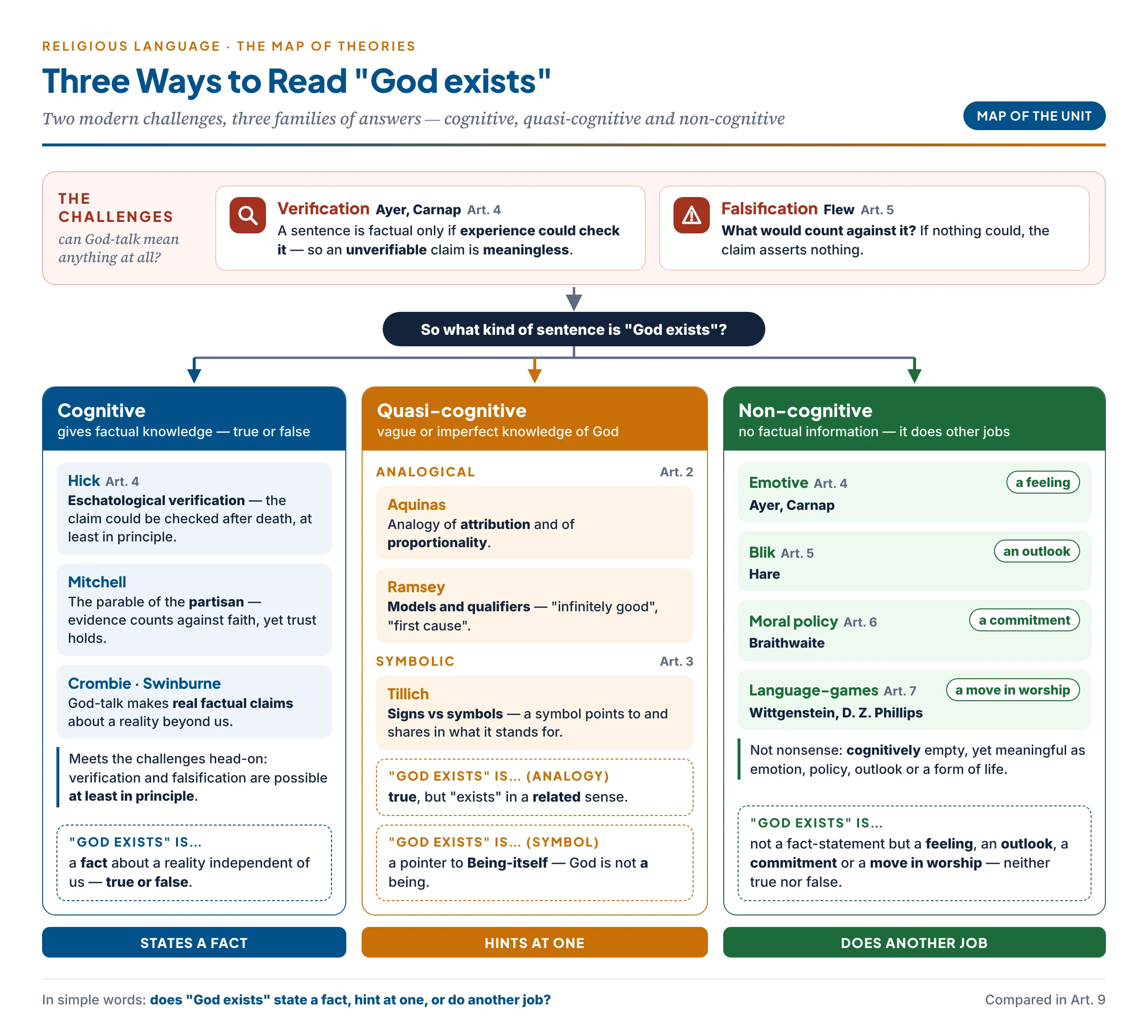
How “God exists” reads under each group (preview of Article 9):
| Group | What “God exists” does | Typical thinker |
|---|---|---|
| Cognitive | States a fact about a reality independent of us — true or false | Hick, Mitchell, Swinburne |
| Analogical | States a truth, but “exists” applies to God in a related, not identical sense | Aquinas |
| Symbolic | Points to and participates in Being-itself; God “exists” only symbolically, since God is not a being | Tillich |
| Emotive | Expresses feeling; states nothing (neither true nor false) | Ayer, Carnap |
| Conative / moral | Declares an intention to live a certain way | Braithwaite |
| Blik | Expresses an unfalsifiable outlook on the whole world | Hare |
| Language-game | A move in worship, an expression of faith; its meaning lies in its use | Wittgenstein, D. Z. Phillips |
Realism and Non-realism
A related distinction concerns truth itself.
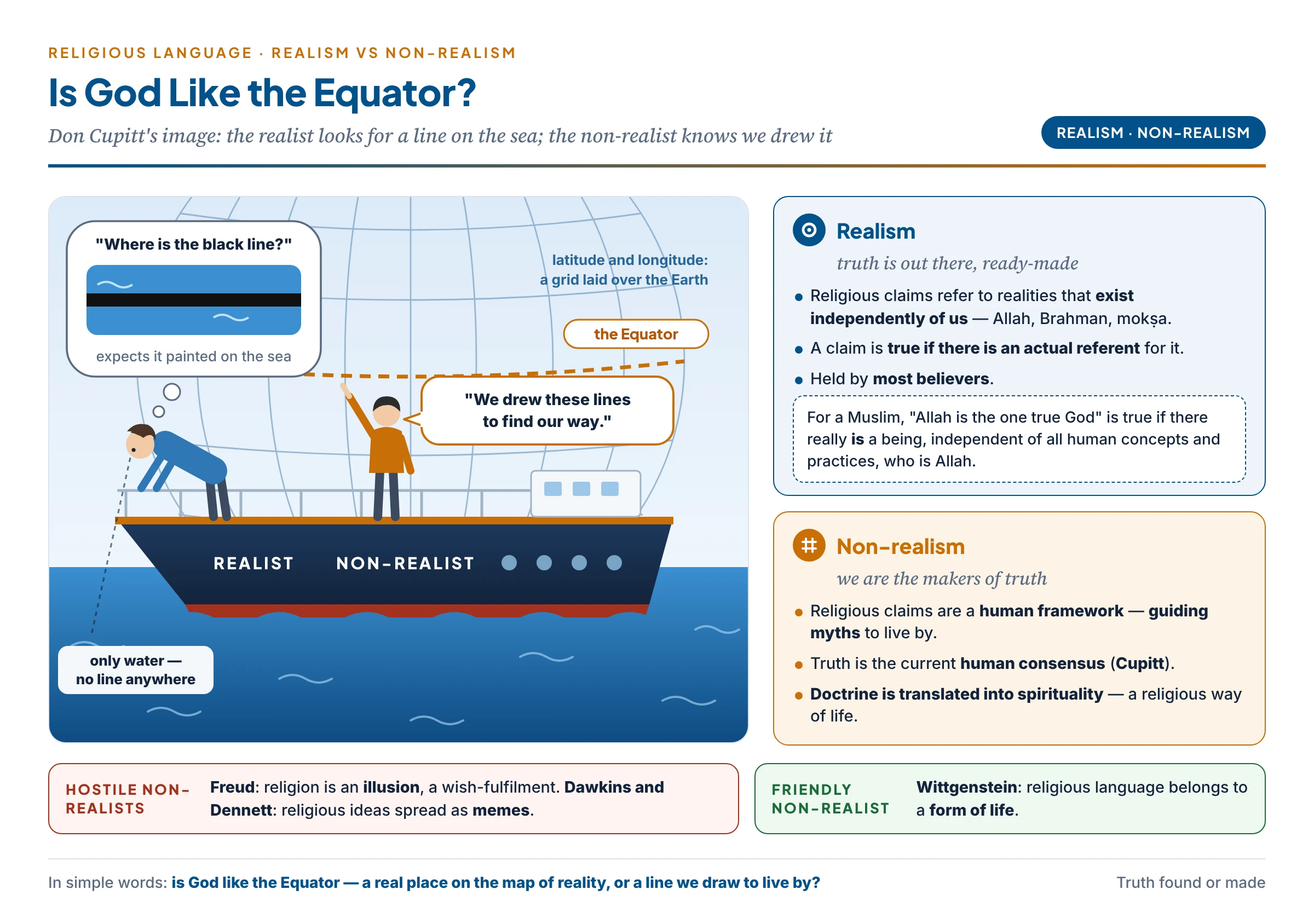
- Religious realism: the vast majority of believers are realists — they hold that their beliefs are about what really exists independently of the people who hold them.
- Claims about Allah, Brahman, salvation, mokṣa or reincarnation are true if there are actual referents for them.
- For a Muslim, “Allah is the one true God” is true if there really is a being, independent of all human concepts and practices, who is Allah.
- Adherents of other religions who are realists likewise believe their claims refer to realities beyond their own beliefs and practices.
- Religious non-realism: a minority view. Religious claims are not about something “out there” beyond human language, concepts and social life.
- A leading non-realist (Don Cupitt) put it in a famous image: “a realist is the sort of person who, when his ship crosses the Equator, looks overboard, expecting to see a big black line across the ocean.” A non-realist sees latitude and longitude as a framework imposed by us to find our way about. For the realist, truth exists ready-made out there; for the non-realist, we are the makers of truth — truth is the current consensus among us.
- In religion, non-realism means accepting that all religious and ethical ideas are human, with a human history. We give up the old metaphysical way of understanding belief and translate dogma into spirituality — a religious life-style.
- Doctrines become guiding myths to live by, as Kant, Kierkegaard and Bultmann began to map out.
- Despite the seeming scepticism, the non-realist insists that non-realist religion can work very well as religion and can even “deliver eternal happiness”.
- Two kinds of non-realists:
- Hostile — Freud: religious ideas are “illusions, fulfilments of the oldest, strongest and most urgent wishes of mankind“; God is the projection of a father image. Richard Dawkins and Daniel Dennett: religious beliefs spread like “memes” — units of cultural imitation that leap from brain to brain like a virus; the “god meme” spreads not because God exists but because it is good at copying itself. Religion is an “accidental by-product — a misfiring of something useful“.
- Friendly — Wittgenstein took religion very seriously (he even considered becoming a priest) but treated religious language as part of a form of life rather than a description of a supernatural world (Article 7).
In simple words
Two pilgrims stand before a temple image. The first says, “Kṛṣṇa is really present here; he hears me.” The second says, “This image gathers our love and our ideals; that is what ‘Kṛṣṇa’ means.” Both bow, both sing the same bhajan, both use the same words. The difference is not in what they say but in what they think their words are about. The first is a realist, the second a non-realist — and the philosophy of religious language is largely about which of them understands the words correctly.
Is There Really a “Religious Language”?
- Strictly, no. There is no language used only for religion. “Do you speak English, French — or religious?” The jibe shows that a language, in the linguist’s sense, contains resources for everything its users need to talk about.
- Language vs speech: a language is an abstract system; speech is its use. What is called “religious language” is really the religious use of ordinary language — in prayer, worship, praise, thanksgiving, confession, ritual, preaching, instruction, exhortation and theological reflection.
- The tremendous range of religious speech — sacred books contain:
- Cosmological speculation and historical records,
- Fictional narratives and parables,
- Predictions, commandments and legal codes,
- Moral insights, reflections on human life, theological pronouncements.
- Devotional literature adds biography, rules of spiritual life and descriptions of religious experience.
- Philosophers’ narrow focus: driven by epistemology and metaphysics, philosophers have concentrated on what look like factual statements about God, asking two questions:
- Are these apparent statements genuine truth claims, or something else?
- If genuine, what do they claim — how does “God” refer, and what do predicates like “made the heavens and the earth” mean when applied to God?
- A complaint and a reply: many theologians protest that the heart of religion is talk to God — prayer, worship, liturgy — and that talk about God is secondary. The complaint is fair if the study of religious statements is cut off from religious life; it need not be.
Religious and Secular Uses of Language
Since religious speech uses the same words as secular speech, the real difference lies in how the words are used.
| Point of difference | Secular use | Religious use |
|---|---|---|
| Object | Things, people and events in the shared world | The transcendent, the holy, the ultimate — not an object among objects |
| Attitude of speaker | Detached, impersonal, open to correction | Self-involving: commitment, devotion, passion; “I believe in” rather than only “I believe that” |
| Main jobs | Describe, explain, predict, instruct | Also worship, praise, confess, bless, vow, consecrate — speech that does something |
| Logic | Ordinary rules of verification and falsification | “Logically odd“: words are stretched (infinitely wise, first cause) and resist the usual tests |
| Mode | Mostly literal | Rich in analogy, symbol, metaphor, myth and paradox |
| Truth-test | Public observation, experiment | Experience, tradition, scripture, fruits in life, eschatological hope |
| Aim | Information, efficiency | Transformation — salvation, mokṣa, nirvāṇa |
In simple words
“My father will pick me up at five” — a plain report; if he does not come, the sentence was false. “Our Father, who art in heaven” — the same word, but no one waits at the gate at five. The second sentence addresses someone, expresses trust, commits the speaker to being a child of that Father, and uses “father” in a stretched sense. Same dictionary, different use.
- Ian Ramsey’s account: religious language arises from special situations of discernment and commitment — moments when “the penny drops” or “the ice breaks” and a situation is seen to have more than its observable features, calling for total commitment. To express such situations, religious language uses ordinary words in a logically odd way, adding qualifiers (“infinitely good”, “first cause”) to familiar models (Article 2).
- Similarities that must not be forgotten:
- The vocabulary and grammar are the same.
- Much religious speech is plainly factual or historical — “he was crucified under Pontius Pilate“, “the Buddha was born at Lumbinī“, “the Prophet migrated to Medina“. These are used in exactly their secular sense.
- Many words in petitionary prayer — healing of a sick body, strength, courage — mean exactly what they mean elsewhere.
- The theologian’s dilemma: modern analytic philosophy takes science as the model of knowledge — disinterested, depersonalised. Religion requires self-involvement, passion and full commitment. So analytic philosophy seems ill-suited to theology, while existentialism — which takes the individual in crisis and decision as its key notion — suits theologians like Karl Barth, Rudolf Bultmann and Paul Tillich. Yet a theologian must use the philosophy of the age, or he will be “religious on Sundays and secular on all other days” — a split personality that is neither possible nor healthy.
Philosophy of Religion as a Meta-theology
- Religious philosophy vs theology: the believer uses religious concepts in their customary meanings without critical analysis; theology is more intellectual but woven round commitment (Barth, Bultmann, Tillich, Bonhoeffer were great theologians and Christian thinkers par excellence). Religious philosophy is a more objective, disinterested inquiry into the concepts and beliefs of various religions.
- A meta-theology: philosophy of religion clarifies the concepts of different theologies, so that dialogue between faiths becomes possible. The need is real, because the same word is not used in the same sense: “God” in the Gītā is more monistic than theistic, while Spinoza’s God is more pantheistic than theistic. Even “religion” is ambiguous — must it involve a being higher than man (as Western theists hold), or can it be an all-out orientation to an object of devotion (as many Indian thinkers allow)?
- So the analysis of religious language is the central task of religious philosophy: it must say what religious words mean before asking whether they are true.
Why Not a Specialised Language like Telegraphic Language?
Religious language depends on natural language for its analogies and symbols. Then why not treat it as a specialised code — like telegraphic language (the clipped “telegraphese” of old telegrams, or a signalling code), where special conventions are laid on top of ordinary language?
What a telegraphic language is:
- A code built on natural language with fixed, agreed conventions (“ARRIVING TUESDAY STOP”).
- Every coded message can be translated back into ordinary language without loss.
- Its conventions are set by experts for efficiency; the things it talks about are ordinary objects both sides can check.
Why religious language cannot be treated so:
- No fixed conventions are possible: a parent can see when a child is perceiving someone speak or make something, and so teach the words. But the parent cannot see when a child is aware of God speaking or forgiving. There is no shared, observable object on which to fix conventions — so theological vocabulary cannot be built from scratch; it must borrow and stretch ordinary words.
- Not translatable without loss: a telegram can be expanded into full sentences; a religious symbol, Tillich argues, cannot be replaced by any literal paraphrase — it opens levels of reality otherwise closed (Article 3). Analogy, too, does not have a literal “key”.
- Not an experts’ code: talk of God is found on the lips of all sorts of people — farmers, children, saints — and is presented as important to everyone, not to a trained guild.
- Not mere information transfer: religious speech is self-involving and performative — praise, vow, blessing, confession. A code transmits messages; prayer is an act.
- Its meaning partly depends on living it: words like grace, agape, bhakti, śaraṇāgati are fully understood only by those who have shared in the religious form of life.
What is right in the suggestion:
- Religions do develop technical vocabularies — “grace”, “omnipotence”, “Trinity”, “mokṣa”, “nirvāṇa”, “kevala-jñāna” — introduced on the basis of ordinary words, much as sciences coin technical terms.
- Theology is in part a specialised discourse with its own rules.
- So religious language is best seen not as a separate code but as a special use of natural language — continuous with it, stretched by it, and answerable to it.
Indian Connect — Indian Connect — “the words of the Veda are the words of the world”
- Mīmāṃsā insists that Vedic words carry the same meanings as ordinary words — there is no separate “Vedic dictionary”; a cow in the Veda is the same cow as in the market. Religious meaning comes from how ordinary words are put to work (as injunctions, praise, names), not from a secret code.
- Advaita treats scripture (śabda) as the only means of knowing Brahman, yet says words reach Brahman only indirectly — by implication (lakṣaṇā) and by negation (neti neti): “from which words turn back, together with the mind, not reaching it” (Taittirīya Upaniṣad).
- The Indian tradition thus faced the same problem — ordinary words for an extraordinary object — and answered by grading language rather than inventing a new one (Article 8).
Relating Religious Language to the Rest of the Syllabus
Problems of religious language run through every topic of the philosophy of religion. Consider life after death:
- It is unverifiable this side of death — is it therefore meaningless?
- The phrase “life after death” can even look self-contradictory — one is either alive or dead, not both.
- Test it against each theory in this unit:
- Is it cognitive or non-cognitive? Realist or anti-realist?
- Is it verifiable in principle (Hick: yes — after death, Article 4)?
- Is it falsifiable — what would count against it?
- Is it a blik (Article 5)?
- Is it part of a language-game — does it cohere with the speaker’s other beliefs and form of life (Article 7)?
- The same questions can be asked of creation, miracles, prayer, karma and rebirth, mokṣa — which is why this unit is the logic of the whole paper.
Critics Must Pass the Same Tests
Critiques of religion often challenge believers’ language — but their own language is not exempt.
- Freud claims: “The unconscious is the major force behind all human behaviour“; “Religion is the universal obsessional neurosis of humanity“; “The face that smiled at us in the cradle, now magnified to infinity, smiles down upon us from heaven.“
- Ask of these claims what critics ask of religion:
- Are Freud’s claims about the primal horde and the Oedipus complex any more verifiable than claims about God?
- Do they use anti-realist or symbolic language themselves?
- Do they try to force non-cognitive religious language into a cognitive framework?
- Are they playing a language-game of their own?
- Lesson: the debate about religious language is also a debate about the standards of meaning that critics and believers share.
Critical Evaluation
Is There a Real Problem at All?
- Yes, a real one: God-talk is prima facie puzzling. Anyone with basic English understands “There are elephants in Africa”; many are at sea with “God is transcendent” or “God is immanent“. These are not experts’ claims (like those of physics) but are offered to everyone. And God is not picturable, so imagination cannot help.
- But not a fatal one: the same word is used literally in different but related senses all the time — “healthy” person, “healthy” diet, “healthy” complexion; “good” food, good book, good person, good night’s sleep. That a word is used of God neither univocally nor equivocally does not prove it is meaningless (Article 2).
- Overstatement on both sides: the critic exaggerates when he treats all religious speech as failed science; the believer exaggerates when he says nothing at all can be said of God — for then he could not even say that.
The Pull of Two Directions
- Talk about God pulls in two directions: towards intimacy (God as father, shepherd, friend, lover — the language of devotion) and towards transcendence (God as infinite, simple, beyond all names — the language of theology and mysticism).
- Religions keep both: the Bible speaks of God’s hands and voice and says “To whom will you liken me?“; the Upaniṣads speak of Brahman as the “inner controller” and as “not this, not this“. The theories of this unit are attempts to hold the two together.
Critics and Defenders
Criticism — The critics’ case
- Meaninglessness (Logical Positivists): sentences about a transcendent God are neither true by definition nor checkable in experience — so they state nothing (Article 4).
- Vacuity (Flew): believers let nothing count against “God loves us”; a claim compatible with every possible event asserts nothing (Article 5).
- Illusion (Freud, Dawkins): religious words refer to projections and memes, not to realities.
- The dilemma: either anthropomorphism (God as a magnified man) or emptiness (words with no content).
- Shipping in words: “father”, “shepherd”, “love” are taken into a new context where they cease to have their usual sense — the believer thinks she knows what she means, but meaning is not fixed by private intention.
Defence — The defenders’ reply
- Same words, related senses: ordinary language is full of words used literally in related senses (healthy, good, game); religious use is an extension, not a breakdown (Aquinas, Article 2).
- Meaning is not only verification: the verification principle fails its own test and was abandoned even by its authors (Article 4).
- Many jobs, many meanings: prayer, praise and vows are meaningful acts even when not fact-stating (Articles 6–7).
- Grounds exist: belief is grounded in experience, tradition and reasons — not mere wish (Hick, Mitchell).
- The limit is the point: religions themselves say words fall short; an inadequate word can still point truly, as a finger points to the moon (Tillich, Advaita).
Cross-Tradition Comparison
| Issue | Western tradition | Indian tradition |
|---|---|---|
| Words fall short of the ultimate | Pseudo-Dionysius, Maimonides — the via negativa | Neti neti; “from which words turn back” (Taittirīya) |
| How ordinary words reach God | Analogy (Aquinas), symbol (Tillich) | Lakṣaṇā (implication), pratīka (symbolic support), saguṇa Brahman |
| Is scripture cognitive? | Realists: yes; non-cognitivists: no | Mīmāṃsā: Veda mainly injunctions (vidhi); Vedānta: Upaniṣads reveal an existing reality (Brahman) |
| Silence as an answer | Wittgenstein: “Whereof one cannot speak, thereof one must be silent” | The Buddha’s silence (avyākata); Bāhva’s silence when asked about Brahman |
| Truth as two-levelled | Kant: phenomena vs noumena | Vyāvahārika vs pāramārthika (Advaita); saṃvṛti vs paramārtha (Nāgārjuna) |
Indian Connect — Indian Connect — grading language instead of abandoning it
- Indian thinkers rarely concluded that religious language is meaningless. They held that words work fully at the empirical level (vyavahāra) and indirectly for the highest truth — by negation, implication, symbol and silence. This is close to the Western quasi-cognitive middle way of analogy and symbol (Article 2, 3 and 8).
Synthesis (Siddhānta)
- Religious language is the religious use of ordinary language — not a separate language and not a specialised code like telegraphese.
- Its problem has two roots: the special sense words take when applied to an infinite, bodiless God, and the function of sentences that look factual but cannot be checked like facts.
- The core dilemma is between anthropomorphism (same sense) and emptiness (totally different sense). The theories of the unit are escape routes: negation, analogy, symbol, non-cognitive use and language-games.
- Cognitive language states facts (true or false); non-cognitive language does other jobs and is not thereby meaningless. Most believers are realists who intend their claims cognitively; non-realists reinterpret them as frameworks for living.
- Religious speech differs from secular speech in its object, self-involvement, performative force, logical oddness and aim — yet shares its words, grammar and many plain facts.
- The Indian tradition met the same problem and graded language — negation, implication, symbol, silence — rather than abandoning it, giving a valuable parallel to the Western middle way.
“The language of faith is the language of symbols.” — Paul Tillich
Previous Year Questions
- 2022Explain the difference between the cognitivist and non-cognitivist approaches to the religious language with reference to the statement — “God exists“.
- 2018In what sense is the secular use of language different from the religious use of language? Discuss.
- 2016Among the different views of religious language, which one is more satisfactory and why?
- 2010Religious language is dependent on natural language for an analogy and a symbol to work. Why not treat religious language as a specialized language like telegraphic language? Discuss.