

Nature of Religious Language: Analogical and Symbolic; Cognitivist and Non-cognitive.
Official Syllabus: Paper II, Section B, Unit 10
The most subtle and influential non-cognitive approach to religious language comes from the later philosophy of Ludwig Wittgenstein (1889–1951). For the later Wittgenstein, the meaning of a word is its use within a language-game, and language-games are woven into forms of life. Religious language, on this view, is not a failed attempt at science — not a set of hypotheses about invisible objects — but a distinctive language-game with its own grammar, expressing and shaping a whole way of living. A believer who says “I believe in a Last Judgment” is not making a risky forecast; he is living by a picture that regulates his whole life. This article explains Wittgenstein’s view — meaning as use, the Last Judgment lectures, pictures, ritual and Frazer, theology as grammar — its development by D. Z. Phillips, the claim that religious doctrines are not quasi-scientific but a form of life, and the charge of Wittgensteinian fideism brought by Kai Nielsen and others.
In simple words
In cricket, “Out!” from the umpire ends a batsman’s innings. In a hospital, “out” on a patient’s chart means discharged. In politics, a minister “out” has lost office. The same word does completely different work depending on the game being played — and you would be confused if you used the rules of cricket to judge the hospital. Wittgenstein said religious words like “God”, “sin” or “Last Judgment” belong to their own game too, and judging them by the rules of science is like asking the umpire to discharge a patient.
Context & Problem
Wittgenstein and Religion
- A serious, unusual believer-outsider: Wittgenstein took religion very seriously — he even considered becoming a priest — yet he was opposed to natural theology (trying to prove God from evidence in nature) and to the construction of religious doctrines. He was far more interested in religious symbol, ritual and practice.
- He belongs among the non-realists who are favourable to religion — unlike Freud or Dawkins.
From the Early to the Later Wittgenstein
- The early view (Tractatus, 1921): language pictures facts; meaningful propositions picture possible states of affairs. Ethics, aesthetics and religion lie beyond what can be said — they can only be shown. Hence the famous last line: “Whereof one cannot speak, thereof one must be silent.” The Logical Positivists took inspiration from this.
- The later view (Philosophical Investigations, 1953): Wittgenstein came to see language not as a fixed structure mirroring reality, but as a human activity subject to the changes of human life and practice.
- Meaning is use: “for a large class of cases… the meaning of a word is its use in the language.”
- Language-games: the term brings into prominence “the fact that the speaking of language is part of an activity, or of a form of life“.
- The builders: builder A and assistant B use a language of four words — “block“, “pillar“, “slab“, “beam“. A calls out a word; B brings the stone he has learnt to bring at that call. Speech and action work together; the words get their meaning from the activity.
- Family resemblance: “games” have no single common feature, only overlapping similarities — so there is no one essence of language, and no single standard (such as verification) of meaning.
- Forms of life: language-games are rooted in shared human ways of living — commanding, describing, joking, praying, thanking, cursing, greeting.
- Consequence for religion: in religious discourse, as elsewhere, the meaning of words like God, Brahman, nirvāṇa or the Dao has more to do with their use than with their denotation. Religious claims should not be taken as literal pictures of a reality lying beyond religious practice; the language-games of religions reflect the practices and forms of life of their followers.

Core Doctrine
The Lectures on Religious Belief
Around 1938, Wittgenstein gave lectures on religious belief in Cambridge. We have them only through students’ notes, published in 1966 — but they contain his most famous remarks on religion.
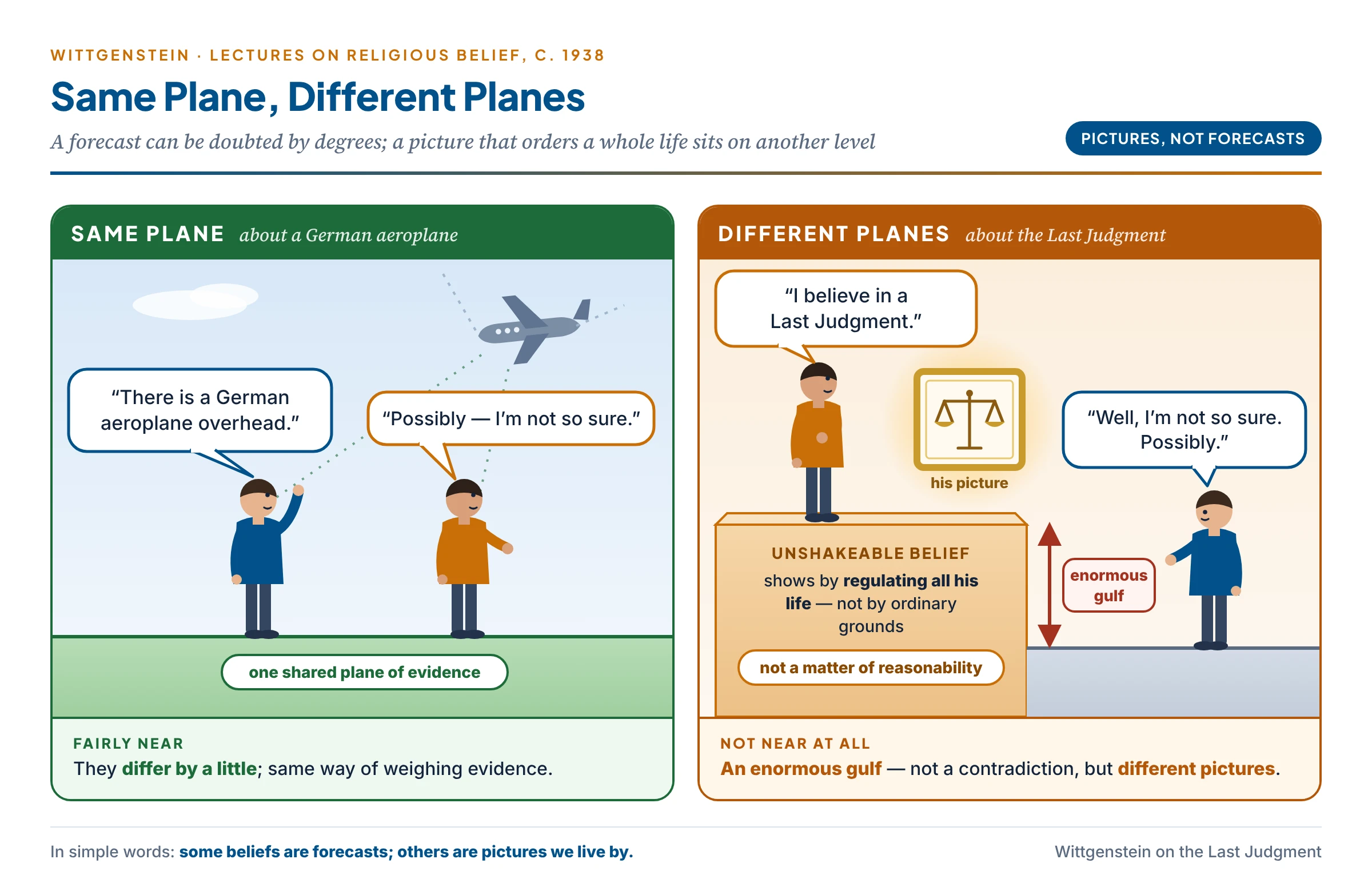
The Last Judgment and the German aeroplane:
- “Suppose someone were a believer and said: ‘I believe in a Last Judgement,’ and I said: ‘Well, I’m not so sure. Possibly.’ You would say that there is an enormous gulf between us. If he said ‘There is a German aeroplane overhead,’ and I said ‘Possibly I’m not so sure,’ you’d say we were fairly near.“
- The point: with the aeroplane, believer and doubter share one way of thinking (evidence, probability) and differ only slightly. With the Last Judgment, “it isn’t a question of my being anywhere near him, but on an entirely different plane“. The religious belief is not an extreme case of an ordinary prediction.
Not contradicting — different pictures:
- “Suppose someone is ill and he says: ‘This is a punishment,’ and I say: ‘If I’m ill, I don’t think of punishment at all.’” If you ask, “Don’t you believe the opposite?”, Wittgenstein says — “you can call it believing the opposite, but it is entirely different from what we would normally call believing the opposite”. Asked whether he contradicts the believer, he answers: “No.“
- “I think differently, in a different way. I say different things to myself. I have different pictures.“
- So: talk of the Last Judgment or of life after death is talk about the picture one has of the world. If we do not share the speaker’s picture, we cannot expect to understand — or contradict — him in the ordinary way.
Unshakeable belief that regulates a life:
- The believer “has what you might call an unshakeable belief. It will show, not by reasoning or by appeal to ordinary grounds for belief, but rather by regulating for in all his life.“
- “This is a very much stronger fact — foregoing pleasures, always appealing to this picture. This in one sense must be called the firmest of all beliefs” — because the man risks things on account of it that he would not risk on things far better established for him.
- Not a matter of reasonability: believers “don’t treat this as a matter of reasonability“. Their reasons “look entirely different from normal reasons“. Wittgenstein found a theologian who tried to make religious belief look like a reasonable hypothesis “ludicrous”: if that is religious belief, “then it’s all superstition“.
- A form of life: “Why shouldn’t one form of life culminate in an utterance of belief in a Last Judgement?“
In simple words
A mother keeps her late son’s photograph on the table and every morning says, “Good morning, beta.” A scientist who told her, “That piece of paper cannot hear you; your belief is false”, would have misunderstood what she is doing. She is not testing a hypothesis about paper; she is living with love and grief in a certain way. Wittgenstein thought much religious language is like her greeting — and that treating it as bad science is the real mistake.
Religious Belief as a Picture and a Commitment
- Regulative function: religious language-games give us pictures by which we orient our lives. For Wittgenstein, believing in the Resurrection would be for “a certain picture [to] play the role of constantly admonishing me“.
- A system of reference: “It strikes me that a religious belief could only be something like a passionate commitment to a system of reference. Hence, although it’s belief, it’s really a way of living, or a way of assessing life.” Instruction in a religious faith would therefore be a portrayal of that system of reference and, at the same time, an appeal to conscience.
- Expressive function: Christianity is “not a doctrine, not a theory about what has happened and will happen to the human soul, but a description of something that actually takes place in human life” — for “consciousness of sin” is a real event, and so are despair and salvation through faith.
- History used differently: Christianity is not based on historical truth in the way a history book is; it offers a narrative and says, “now believe!” Its historical claims “are not treated as historical, empirical propositions” — a believer’s faith does not rise and fall with the latest archaeological report.
Ritual and Frazer
- Sir James Frazer, in The Golden Bough, explained magic and ritual as primitive, mistaken science — failed attempts to control nature.
- Wittgenstein’s reply (Remarks on Frazer’s Golden Bough): this is a gross misunderstanding. Rituals are not pseudo-technology; they are expressive — a symbolism in their own right.
- “Frazer is much more savage than most of his savages“, for his explanations of their practices are cruder than the sense of the practices themselves.
- Kissing the photograph of a loved one is not based on the belief that it will affect the person — it expresses love.
- The adoption rite: when a woman marks the adoption of a baby by drawing the child from beneath her clothes, “it is crazy to think there is an error in this and that she believes she has borne the child“. The gesture expresses that she will be as close to it as if she had borne it.
- Lesson for religious language: to read rituals and religious beliefs as explanations or hypotheses is to make religion look trivial and stupid; their real depth lies in what they express and how they shape life.
Theology as Grammar
- “Grammar tells what kind of object anything is. (Theology as grammar.)“
- Grammar here means the rules for the use of a word — what it makes sense to say. The grammar of “God” is very different from the grammar of “table”:
- It makes sense to ask “Where is the table?” or “When did it come into existence?” — but not of God.
- To ask “Does God exist?” as if God were an object that might or might not turn up is to mistake the grammar of the word.
- Surface and depth grammar: “I have a pain in my foot” looks grammatically like “I have a key in my pocket”, but a surgeon who cut the foot open would not find a pain-shaped object. Likewise “There is a God” looks like “there is a tiger in the garden”, but its depth grammar is quite different.
- Doubt needs a question: doubt is possible only where a question arises, and a question only where an answer is possible. Religious “statements” do not invite the kind of doubt that factual claims do; they are meaningful within the religious sphere — in their impact on the life and activity of the believer — and lie beyond verification and falsification.
- Philosophy leaves everything as it is: philosophy should not justify or refute religious language from outside, but describe how it is used. “Philosophy may in no way interfere with the actual use of language… It leaves everything as it is.“
In simple words
“Where is God?” A child asks it as she would ask “Where is the cat?” — expecting a place. A teacher of the faith answers, “Everywhere“, which is not a place at all. The answer is not a strange fact; it is a lesson in grammar — it teaches the child that “God” is not the kind of word that takes a location. Wittgenstein called theology a kind of grammar for exactly this reason.
The Story of the Football Match and the Coherence Theory
- The story goes that Wittgenstein arrived at the idea of language-games after watching a football match. Just as football and rugby operate by rules — footballers understand the offside trap, rugby players rucks and mauls — so religious people understand the rules of religious language.
- Coherence, not correspondence: this view fits the coherence theory of truth — knowledge as a broad spread of statements that hang together like a patchwork quilt; a statement is true if it fits with the others. It rejects the correspondence theory, on which language is meaningful only if it mirrors facts. Wittgenstein and the pragmatists who followed him judged meaning by use rather than by correspondence.
- Cognitive and non-cognitive within the game: inside the religious language-game, both kinds of language — factual-sounding statements and expressions of praise, symbol and command — can be used meaningfully, because speakers and hearers know the context. If a word is also used in other contexts, no misunderstanding occurs so long as people are clear which game they are playing.
Common confusion
Did Wittgenstein say religious statements are meaningless? No — that was the early, Tractarian line taken up by the positivists (and even the early Wittgenstein thought the “unsayable” was the most important, not the least). The later Wittgenstein held that religious language is fully meaningful — its meaning lies in its use within a form of life. What he denied is that it is like scientific hypothesis. Calling his view “non-cognitive” means it is not fact-stating in the scientific way — not that it is empty.
D. Z. Phillips — the Wittgensteinian Philosophy of Religion
D. Z. Phillips (1934–2006) developed Wittgenstein’s remarks into a full philosophy of religion (The Concept of Prayer, 1965; Death and Immortality, 1970).
- Internal criteria: the criteria of meaning and truth in religion are internal to religion itself. Different kinds of language — of religion and of science — are different language-games, the linguistic aspects of different forms of life. To participate in the Christian form of life is, among other things, to use distinctively Christian language with its own internal criteria of true and false.
- Immune to outside criticism: so religious utterances are immune to scientific and other non-religious comment. The story of Adam and Eve and the fall does not clash with the scientific theory that humans did not descend from a single pair or live in a paradise — science is a different language-game. To link religion to mundane facts and demand compatibility with them would be profoundly irreligious.
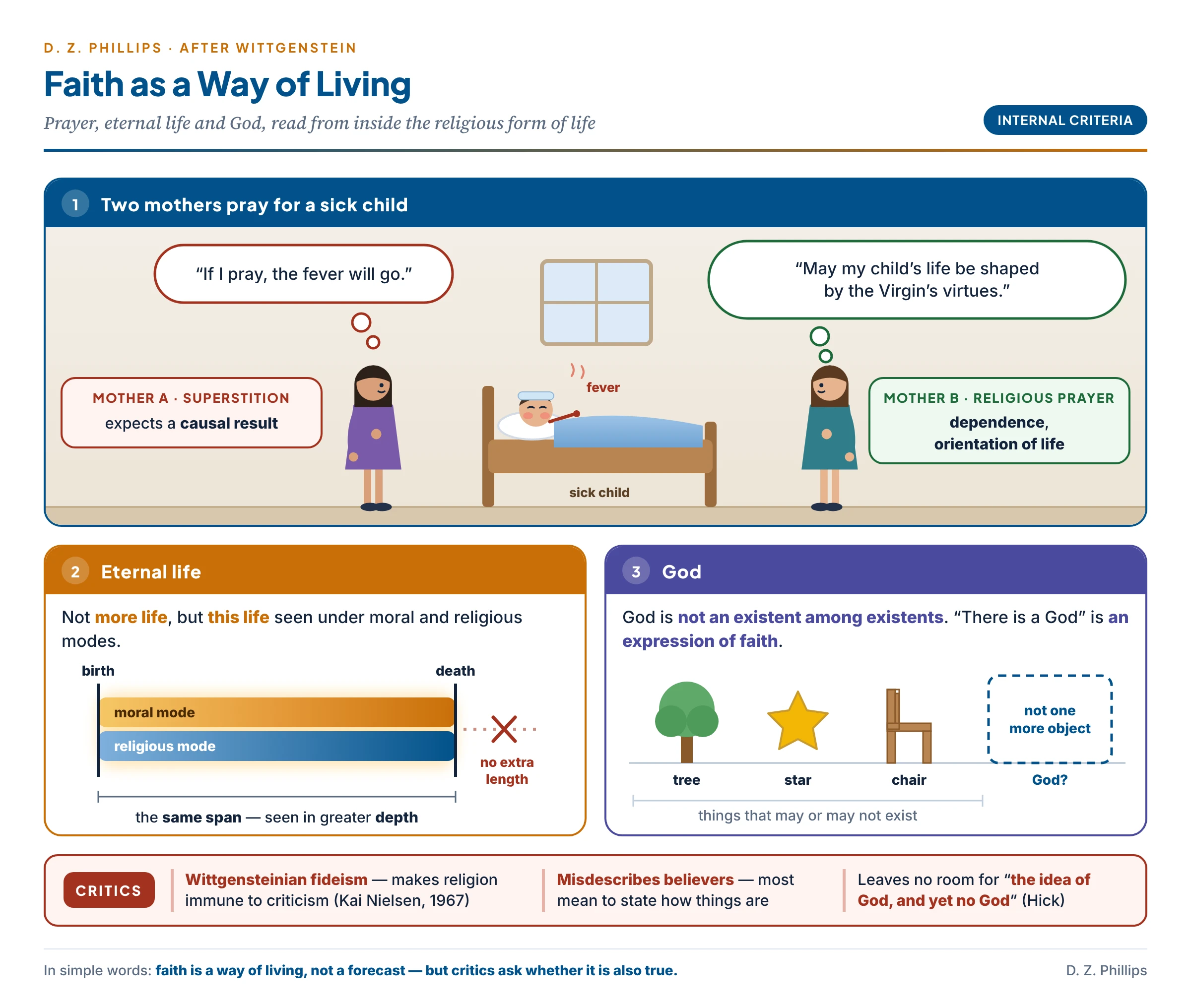
- Prayer: two mothers pray to the Virgin Mary for a sick child. The first expects things to turn out otherwise as a result — Phillips calls this superstition. The second wants her child’s life to be orientated in the Virgin’s virtues — this is religious prayer. Petition is really the expression of dependence and of the desire to live in God’s will.
- Immortality and eternal life:
- “He’d sell his soul for money” is a perfectly natural remark which implies no theory of a separate soul; it is a moral observation about a person’s integrity. Talk of the immortality of the soul plays a similar role.
- “Eternity is not more life, but this life seen under certain moral and religious modes of thought.” Questions about immortality are questions about the kind of life a person is living, not about its length beyond the grave.
- Dying to the self: renouncing the idea of a life to come teaches the believer that he has no claims on the way things go, and that his own life is not a necessity.
- God not an object: “One will never understand what is meant by belief in God if one thinks of God as a being who may or may not exist.” If one day we “checked” and found God as we had thought, we would have discovered a God of whom it still made sense to say He might not exist — but “a God who is an existent among existents is not the God of religious belief“. “There is a God“, though it appears to be in the indicative mood, is an expression of faith.
- Knowing God: “To know how to use this language is to know God“; “To have the idea of God is to know God.“
- Belief not a hypothesis: belief in God is not based on grounds, not open to falsification and not held tentatively; to see the world as God’s creation is to see meaning in life — a meaning untouched by evil because it was never inferred from the state of the world.
- Rush Rhees: the connection between religious language and religious life is internal: reverence, devotion and exaltation “would not be what they are without the language of them“.
In simple words
Two neighbours watch the same flood destroy their fields. One says, “God has tested us; we will rebuild together.” The other says, “Bad luck; we will rebuild.” They expect the same weather, the same insurance, the same work. What differs is the picture within which each lives through the loss — and that picture shows itself in how they grieve, help others and hope. Wittgenstein’s point is that such a difference is real without being a difference in predictions.
Religious Doctrines: Not Quasi-scientific, but a Form of Life
- The quasi-scientific reading: doctrines are hypotheses about unobserved entities (God, soul, heaven), offered as explanations of the world and open to confirmation or refutation like scientific theories. On this reading, Wisdom’s and Flew’s gardeners show religion to be a poor hypothesis (Articles 4–5).
- The form-of-life reading (Wittgenstein, Phillips, Rhees, Winch):
- Doctrines are not explanations competing with science; they are expressions of what goes deep in people’s lives — birth, death, guilt, forgiveness, gratitude — and they are not founded on anything, but express values concerning what is deep and important.
- They regulate life, like the Last Judgment picture.
- They are learnt by participation in a community with a tradition, which teaches what it is right and wrong to say — the grammar of the faith.
- They are unshakeable not because evidence is overwhelming but because they are the framework within which the believer weighs evidence.
- What this explains: why believers are not troubled by the lack of scientific proof; why faith survives disasters; why religious disagreement feels like a clash of worlds, not of predictions.
- What it struggles to explain: why believers do care about history (did Jesus rise?), why they argue for God’s existence, why people convert on the basis of reasons, and why religions make claims about how things are beyond the believer’s life.
Critical Evaluation
Criticisms — “Wittgensteinian Fideism” and Others
- Fideism (Kai Nielsen, 1967): the language-game view makes religion immune to external criticism. Fideism is the view that faith needs no rational support and cannot be judged by reason. Nielsen coined “Wittgensteinian fideism” for the claim that forms of life can be neither criticised nor defended from outside — on that view “no philosophical or other kind of reasonable criticism, or for that matter defence, is possible for forms of life”.
- Unfalsifiable by construction: the theory protects religion from Flew’s challenge by definition — religious language is made unfalsifiable because it is placed in a separate game. This is the same “death by a thousand qualifications” in a new form.
- It misdescribes believers: most believers plainly intend to assert something about how things are. The theory is not an account of ordinary religious language but a radical reinterpretation: religious expressions are systematically deprived of the cosmic implications they have always been assumed to have. “There is a God” is, for most believers, indicative — it states that there is a subject of whom attributes can truly be predicated (Davies).
- The sceptical possibility disappears: if “to have the idea of God is to know God”, there is no room for the obvious possibility that people have the idea of God, take part in theistic language — and yet there is no God (Hick).
- Different concepts of truth and existence — a high price: Phillips implies that “true”, “real” and “exists” mean something different in religion. But it does not feel as if “exist” means something different in “God really exists” and “King Arthur really existed”, or “true” in “Jesus rose” and “Cretans spoke Greek in 1200 BCE” (Alston). Surely “Jesus arose from the dead” is true if and only if Jesus arose from the dead.
- Selfish concern does not disprove a future life: it does not follow from the fact that people can be selfishly anxious about a life to come that there is no such life. In Christian belief the hope of eternal life rests not on human desire but on the nature of God, who will not drop half-formed creatures out of existence — as Luther said, “Anyone with whom God speaks, whether in wrath or in mercy, the same is certainly immortal.“
- History and argument are not irrelevant: if Christianity rests partly on claims about the life, death and resurrection of Jesus, how can historical research be irrelevant to it? How can reasons for and against God’s existence be irrelevant to beliefs that presuppose it?
- Religious language is not sealed: the Nicene Creed contains ordinary terms (“crucified under Pontius Pilate“, “suffered death and was buried”); petitionary prayer asks for healing of sick bodies. These are not used in special religious senses.
- Meaning from practice — partly, not wholly: it is plausible that words like grace, agape, glory are fully understood only by those who share in the religious form of life. But this supports only a partial dependence of meaning on practice — not the radical autonomy Phillips claims (Alston).
- Relativism: if every form of life is immune to outside criticism, so are astrology, witchcraft and harmful cults; and conflicts between religions become unresolvable.
- Believers live in many games at once: the same person is a scientist, citizen and worshipper; the games overlap and must be reconciled — they cannot be kept in sealed compartments.
Defences
- Against crude positivism and Frazer: it rightly refuses to treat religion as bad science or primitive technology.
- True to the phenomenology of faith: it captures the unshakeable, life-regulating character of religious belief and why it is not held tentatively.
- Meaning in use: it applies a powerful general theory of meaning that defeated the verification principle.
- Depth not superstition: Phillips’ distinction between superstitious and religious prayer illuminates real differences in religious life.
- Not necessarily fideist: Wittgenstein himself never said religious practices cannot be criticised; he criticised superstition and “reasonable-hypothesis” theology. Language-games overlap and can be judged by their depth, coherence and fruits.
Critics and Defenders
Criticism — Against the language-game view
- Wittgensteinian fideism — places religion beyond criticism (Nielsen).
- Unfalsifiable by construction — Flew’s problem in disguise.
- Misdescribes believers, who intend to assert facts; a revisionary proposal (Hick).
- Leaves no room for “the idea of God, and yet no God”.
- Splits “true” and “exists” into different senses (Alston).
- Makes history and argument irrelevant; invites relativism.
Defence — For the language-game view
- Meaning is use: religious words get meaning in a form of life.
- Religion is not bad science — Frazer misread ritual.
- Explains the unshakeable, life-regulating firmness of faith.
- Distinguishes religious from superstitious belief (Phillips’ two mothers).
- Language-games overlap; depth and fruits allow criticism without positivism.
Cross-Tradition Comparison
| Theme | Wittgenstein / Phillips | Indian parallels |
|---|---|---|
| Meaning learnt from use | Meaning is use; the builders | Vṛddha-vyavahāra: Mīmāṃsā and Nyāya hold that a child learns word-meaning by watching elders’ usage — one says “bring the cow”, another brings it |
| Language and life inseparable | Language-games woven into forms of life | Bhartṛhari: all cognition is shot through with word (śabda); language and world are inseparable |
| Teaching adapted to the hearer | Different language-games for different forms of life | Buddhist upāya (skilful means) — the Buddha teaches differently to different audiences; the parable of the burning house |
| Many valid standpoints | Many language-games, no single standard | Jaina nayavāda — partial standpoints, each valid within its limits |
| Two levels of discourse | Religious vs scientific games | Advaita’s vyāvahārika (empirical) and pāramārthika (absolute) levels; Nāgārjuna’s two truths |
| Belief as a way of life | Passionate commitment to a system of reference | Darśana as a “way of seeing” tied to sādhanā (practice); bhakti as lived devotion |
Indian Connect — Indian Connect — vyavahāra and the use theory of meaning
- Indian theories of language long held that we learn what words mean from usage (vyavahāra) — from watching elders say “bring the cow” and someone bringing it — very close to Wittgenstein’s builders.
- Yet Indian schools did not conclude that religious language is confined to its own game: Advaita and Nyāya held that scripture and reason reveal how things really are (Brahman, Īśvara). The Indian two-level view is not a compartment but a ladder — empirical talk is valid at its level and is transcended, not sealed off, at the highest level (Article 8).
Synthesis (Siddhānta)
- The later Wittgenstein replaced the picture theory with meaning as use: words get meaning in language-games woven into forms of life.
- On religion, he held that belief in a Last Judgment is not a forecast on the plane of evidence but a picture that regulates life — unshakeable, not a matter of reasonability; the unbeliever does not contradict but has different pictures. Religious belief is “a passionate commitment to a system of reference“; theology is grammar; ritual is expressive, not mistaken science (Frazer).
- D. Z. Phillips developed this into internal criteria, non-superstitious prayer, eternal life as a quality of this life, and God as not an existent among existents. Religious doctrines are not quasi-scientific but a form of life.
- The critics — Nielsen’s Wittgensteinian fideism, Hick, Alston, Davies — show that the view misdescribes most believers, splits truth and existence, makes religion immune by construction, and cannot explain why history and argument matter to faith.
- The lasting insight: religious language must be understood from within its use and is not bad science; the lasting limit: it also claims something about how things are, which a purely internal account cannot honour.
“It strikes me that a religious belief could only be something like a passionate commitment to a system of reference.” — Ludwig Wittgenstein
Previous Year Questions
- 2023Discuss Wittgenstein’s view about the non-cognitive nature of religious language.
- 2011Examine the view that religious doctrines are not ‘quasi-scientific doctrines’ but represent a form of life.
- 2022Establish the tenability of later Wittgenstein’s notion of language as form of life.