

Nature of Religious Language: Analogical and Symbolic; Cognitivist and Non-cognitive.
Official Syllabus: Paper II, Section B, Unit 10
Indian philosophy faced the problem of religious language long before the Logical Positivists — and faced it from inside the religious traditions. The Upaniṣads declare that Brahman is that “from which words turn back, together with the mind, not reaching it“, yet they are full of words about Brahman. The Buddha refused to answer certain metaphysical questions. The Jainas made “inexpressible” one of the seven forms of judgement. Mīmāṃsā treated the Veda as injunction, Advaita as revelation of an existing reality reached by implication, and the grammarian Bhartṛhari made the Word itself the ultimate. This article sets out these Indian theories — neti neti, anirvacanīyatā, svarūpa and taṭastha lakṣaṇa, the three kinds of lakṣaṇā and tat tvam asi, saguṇa Brahman and pratīka, Rāmānuja’s critique, vidhi and arthavāda, śakti and convention, śabda-brahman, the Buddha’s avyākata, the two truths, apoha and Jaina avaktavya — and compares them with the Western theories of this unit.
In simple words
Someone asks you to describe the taste of a mango to a friend who has never eaten one. You try: “Sweet — but not like sugar; a little sour — but not like lemon; soft — but not like a banana.” Every word misses, yet your friend gets a direction. Finally you hand over a slice and say nothing. The Upaniṣads do all three with Brahman: they deny (“not this, not this”), they point (“truth, knowledge, infinity”), and in the end they fall silent and ask you to taste for yourself.
Context & Problem
Why the Problem Arose in India
- The object exceeds all words: the ultimate — Brahman, nirvāṇa, the liberated self — is said to be beyond the categories of ordinary experience: beyond space and time, subject and object, qualities and relations.
- Yet scripture speaks: the Veda and Upaniṣads are the means of knowing (pramāṇa) the ultimate for the Vedāntin; the Buddha’s sermons and the Jaina āgamas teach the path. So the traditions had to explain how words can reveal what words cannot capture.
- Key Upaniṣadic texts:
- Taittirīya: “yato vāco nivartante aprāpya manasā saha” — “from which words turn back, together with the mind, not reaching it”; he who knows the bliss of Brahman fears nothing.
- Kena: “That which speech does not reveal, but by which speech is revealed — know that alone to be Brahman, not this which people here worship.“
- Bṛhadāraṇyaka: “athāta ādeśo neti neti” — “Now therefore the teaching: not this, not this” — “for there is no other and more appropriate description than this.” And its name is “the Truth of truth“.
- Bhagavad Gītā: the supreme Brahman, without beginning, “is said to be neither being nor non-being” (na sat tan nāsad ucyate).
- Ṛgveda, the hymn of creation (Nāsadīya): “Then there was neither non-being nor being” — and it ends by asking whether even the overseer in the highest heaven knows.
- Ṛgveda: “ekaṃ sad viprā bahudhā vadanti” — “Truth is one; the wise call it by many names” — religious language as many names for one reality.
Core Doctrine
Advaita I — Neti Neti and the Silence of Bāhva
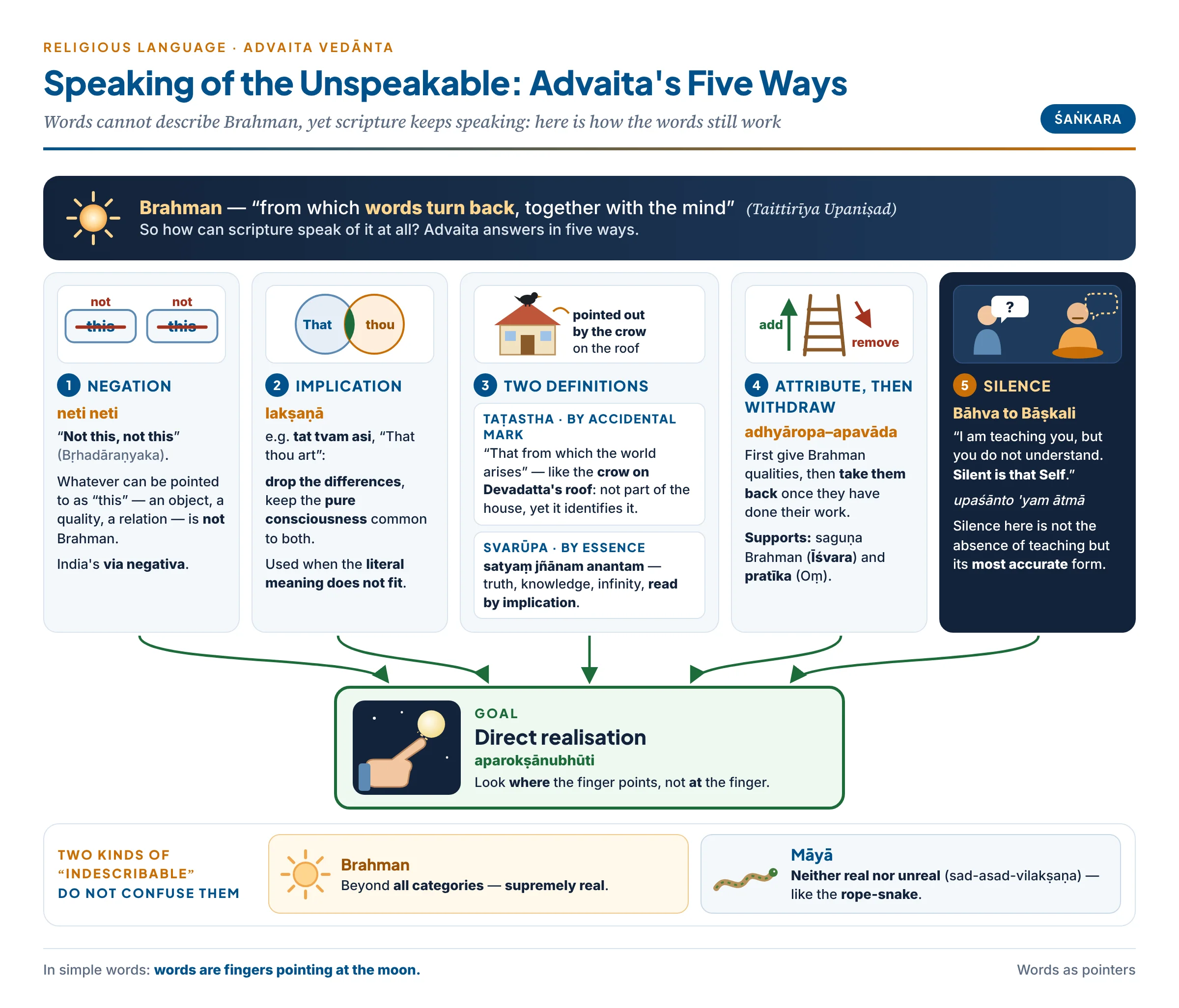
- Neti neti: Brahman is described by denying every determination — whatever can be pointed to as “this” (an object, a quality, a relation) is not Brahman. Śaṅkara reads the double negative as excluding all limiting adjuncts (upādhis). This is India’s via negativa (Article 2).
- Bāhva’s silence: Śaṅkara, commenting on the Brahma Sūtra, quotes a scriptural story. Bāṣkali asked the sage Bāhva to explain Brahman. Bāhva said, “Learn Brahman, my friend“, and became silent. Asked a second and a third time, he replied: “I am teaching you indeed, but you do not understand. Silent is that Self” (upaśānto ‘yam ātmā).
- The point: silence is not the absence of teaching; it is the most accurate teaching about what transcends speech. Compare Wittgenstein’s “Whereof one cannot speak, thereof one must be silent” — but for Bāhva the silence shows the Self rather than ending inquiry.
Advaita II — Anirvacanīyatā (Indescribability)
Anirvacanīya means “indescribable” or “indeterminable”. In Advaita it is used in two quite different senses — and keeping them apart is the key to the 2025 question.
1. Brahman’s indescribability — beyond all categories:
- Brahman is nirguṇa (without qualities), nirviśeṣa (without distinctions), advaya (without a second). Every word works by classifying — by genus (jāti), quality (guṇa), action (kriyā) or relation (sambandha). Brahman has none of these, so no word can denote it directly.
- Brahman is the subject — the witness (sākṣī) of all speech and thought — and can never become an object of speech: “that by which speech is revealed” (Kena). As light shows everything but cannot be pointed at as an object, the Self is never described.
- Yet Brahman is supremely real (pāramārthika sat) — indescribable because it is more than any category, not less.
2. Māyā’s (and avidyā’s) indescribability — between the categories:
- Māyā is “indescribable as either real or unreal” (sad-asad-vilakṣaṇa, sadasadbhyām anirvacanīyā):
- Not real (sat) — it is sublated (bādhita) by knowledge, and what is real is never sublated.
- Not unreal (asat) — it appears and produces the world of experience; the utterly unreal (a hare’s horn, a barren woman’s son) cannot even appear.
- Not both — that would be self-contradictory.
- So the world is mithyā (false): neither the absolute reality of Brahman nor the nothingness of the hare’s horn. The rope-snake is the model — the snake is neither there (it vanishes) nor nothing (it was seen and feared).
- Indescribability is not inability: it does not mean that nothing can be said about māyā — much is said. It means it cannot be classified as real or unreal. “The inexplicability of avidyā is its ornament, not its fault“: if it were consistent and explicable, it would be real.
In simple words
At dusk you see a snake on the path and jump back; a torch shows it is a rope. Was the snake real? No — it vanished when the light came. Was it nothing, like a “hare’s horn”? No — you saw it and your heart pounded. It was neither real nor nothing; that is what Advaita calls anirvacanīya. Brahman is indescribable for the opposite reason: not because it falls between real and unreal, but because it is the light in which both rope and snake are seen.
How anirvacanīyatā bears on religious language:
- It marks the limit of literal language: words work with the pair real/unreal, this/that, subject/object; at the top (Brahman) and in the middle (the world of appearance), these pairs break down.
- It is not agnosticism: Advaita does claim knowledge — Brahman is known, but not as an object of description; it is realised (aparokṣānubhūti) as one’s own Self.
- It turns language into a pointer: scripture works by negation, implication and correction, not by literal description (below).
- It explains why religious talk is “two-level”: at the empirical level (vyavahāra), words about God, worship and the world are valid; at the absolute level (paramārtha), they are transcended.
- Comparison: it parallels the Western via negativa (Article 2), Tillich’s insistence that literal speech makes the infinite finite (Article 3), and the early Wittgenstein’s “showing” — while differing from all three in claiming a direct, non-verbal realisation at the end.
Common confusion
Does “anirvacanīya” mean that Advaita says nothing about Brahman? No. “Indescribable” in Advaita means “not describable by the categories that fit objects” (for Brahman) or “not describable as real or as unreal” (for māyā). Advaita says a great deal: Brahman is sat-cit-ānanda, the Self, the ground of the world. Its claim is that these words work by implication, not literal denotation. When the Nyāya thinker Udayana mocked indescribability as “the silence of the ignorant”, he confused the two. And Brahman’s indescribability (beyond categories, supremely real) must never be confused with māyā’s (between categories, false).
Advaita III — How Words Still Reach Brahman
1. Two kinds of definition (lakṣaṇa):
- Taṭastha-lakṣaṇa — definition by an accidental mark: “That from which these beings are born, by which they live, and into which they return — that is Brahman” (the Brahma Sūtra‘s “janmādy asya yataḥ“). Creation is not Brahman’s essence; it is like pointing out Devadatta’s house “by the crow sitting on its roof” — the crow is not part of the house, but it identifies it.
- Svarūpa-lakṣaṇa — definition by essence: “satyaṃ jñānam anantaṃ brahma” — “Brahman is truth, knowledge, infinity“. Even here, the words are read negatively and by implication: “truth” excludes unreality, “knowledge” excludes inertness, “infinity” excludes limitation.
- Western parallel: taṭastha resembles Aquinas’s analogy of attribution (God known through effects); svarūpa resembles the analogy of proportionality joined to the via negativa (Article 2).
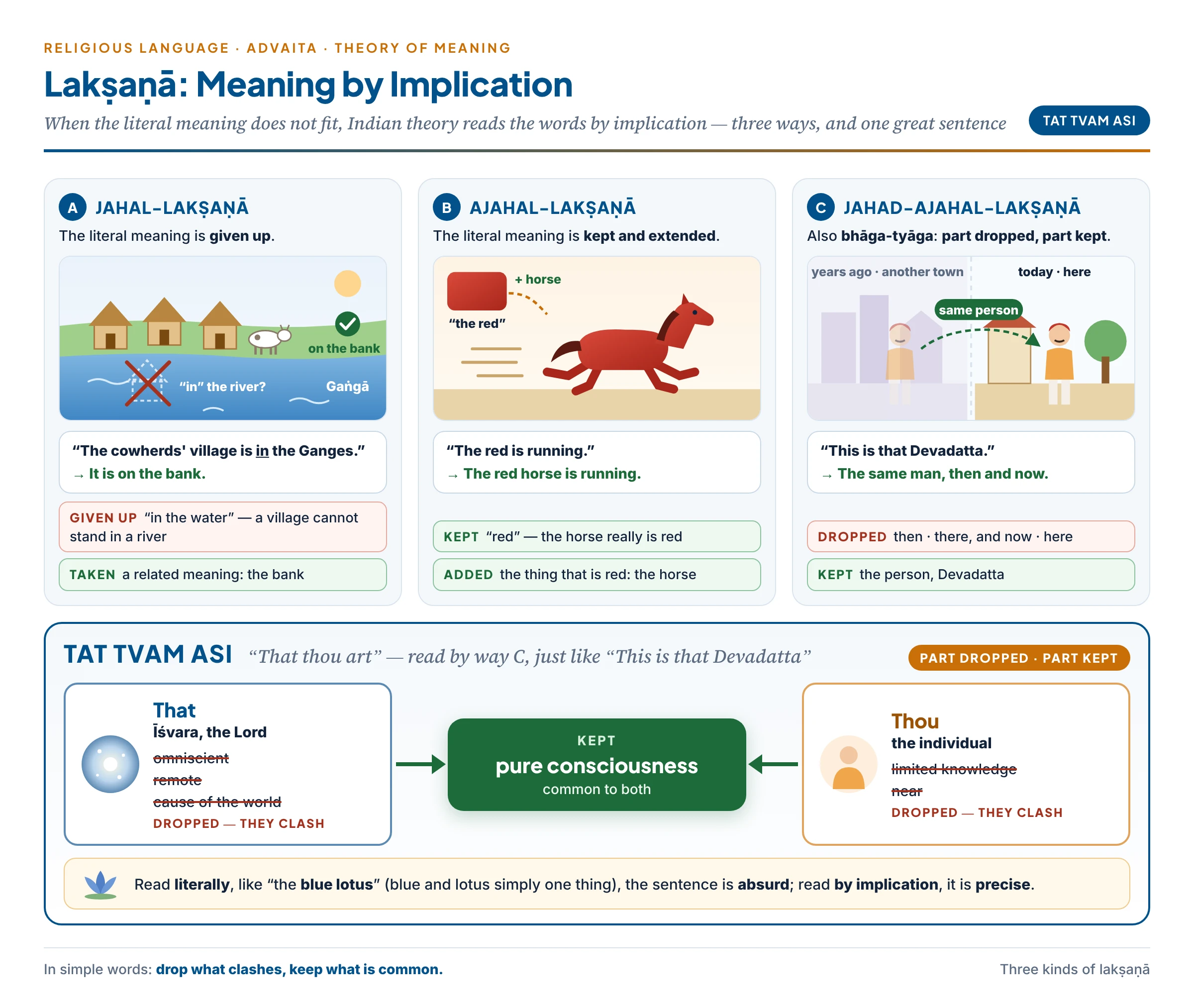
2. The three kinds of lakṣaṇā (implied meaning): Indian theories of meaning distinguish a word’s primary power (śakti or abhidhā, literal denotation) from lakṣaṇā (secondary, implied meaning), used when the literal meaning does not fit the context.
| Kind | What happens | Example |
|---|---|---|
| Jahal-lakṣaṇā (giving up) | The literal meaning is wholly abandoned for a related one | gaṅgāyāṃ ghoṣaḥ — “the cowherds’ village is in the Ganges” means on the bank of the Ganges |
| Ajahal-lakṣaṇā (not giving up) | The literal meaning is kept and something is added | śoṇo dhāvati — “the red is running” means the red horse is running |
| Jahad-ajahal-lakṣaṇā (part given up, part kept) — also bhāga-tyāga-lakṣaṇā | Part of the literal meaning is dropped, part kept | so ‘yaṃ devadattaḥ — “This is that Devadatta“: the differences of time and place (then/there, now/here) are dropped; the person is kept |
3. Tat tvam asi — “That thou art”:
- The great saying (mahāvākya) of the Chāndogya Upaniṣad identifies tat (That — Brahman, Īśvara, omniscient, remote, cause of the world) with tvam (thou — the individual, limited, near, of little knowledge).
- Read literally, as in “the blue lotus” (where blue and lotus simply belong to one thing), the sentence is absurd — the omniscient Lord cannot be identical with a limited person.
- So Advaita applies jahad-ajahal-lakṣaṇā: the contradictory elements — remoteness and nearness, omniscience and limited knowledge — are dropped, and the pure consciousness common to both is kept, exactly as with “this is that Devadatta”.
- The lesson for religious language: scripture gives determinate, non-literal meaning. It is neither literal description (univocity) nor empty sound (equivocity) — a rigorous Indian theory of how religious words work.
4. Adhyāropa–apavāda — attribution and withdrawal:
- Advaita’s teaching method: first attribute qualities to Brahman (creator, lord, inner controller — adhyāropa, deliberate superimposition), then withdraw them (apavāda, rescission) once they have done their work. Words are a ladder kicked away after climbing.
- Saguṇa Brahman (Īśvara) is this attributed form — fully valid for worship and practice (vyavahāra), transcended in liberation. It functions as the highest symbol of nirguṇa Brahman (Article 3).
- Pratīka — meditation on Brahman through a symbol (mind, sun, space, Oṃ) — keeps the rule: the symbol is a support, not the Self.
5. Scripture remains the means of knowledge:
- For Advaita, Brahman is known only from scripture (śāstra-yonitva): perception and inference cannot reach it. So the Upaniṣads are cognitive — they reveal an existing reality (siddha-vastu), not merely commands. Words reach Brahman indirectly, by implication, and their fruit is direct realisation.
In simple words
A child in a crowded railway station asks her father, “Which one is the moon?” He points: “Look at the tip of my finger — there.” She must look along the finger, not at it. If she stares at his nail, she will never see the moon. Advaita treats scriptural words the same way: “truth, knowledge, infinity”, “That thou art” are fingers. Their meaning is where they point, and the pointing succeeds when you see — not when you study the finger.
Rāmānuja’s Critique — All Words Denote a Qualified Brahman
- No knowledge of the attributeless: every cognition and every word grasps an object as qualified — a thing with characteristics. A nirguṇa (attributeless) Brahman could be neither known nor spoken of.
- Scripture speaks of qualities: the Upaniṣads call Brahman omniscient, all-powerful, the abode of auspicious qualities (kalyāṇa-guṇa). “Satyaṃ jñānam anantam” lists real attributes of a qualified Brahman, not implied negations.
- Neti neti denies only that Brahman is limited to the forms just mentioned — not that it has any qualities.
- Anirvacanīyānupapatti — one of his seven objections to Advaita’s avidyā: every cognition is of the real or the unreal; there is no third. To call avidyā “neither real nor unreal” breaks the law of excluded middle, and to call it “indescribable” is already to describe it.
- Advaita’s reply: “real” means never contradicted, “unreal” means never appears; the shell-silver both appears and is contradicted, so the third category comes from experience. And “indescribable” means “not describable as real or unreal“, not “not describable at all”.
- All words name God: since souls and matter are the body (śarīra) of Brahman, every word in its full reach denotes Brahman as qualified by that body (coordinate predication, sāmānādhikaraṇya). Even tat tvam asi is taken literally: Brahman as the inner Self of the individual soul — no need for lakṣaṇā.
- Western parallel: Rāmānuja stands close to the cognitivist and partial-univocity positions — religious language describes a real, qualified God literally, if imperfectly (Articles 2 and 9).
Mīmāṃsā — The Veda as Injunction
- Five kinds of Vedic sentence: injunction (vidhi), sacrificial formula (mantra), name of a rite (nāmadheya), prohibition (niṣedha) and explanatory or eulogistic passage (arthavāda).
- The Veda is for action: its primary purpose is to enjoin dharma — “one desirous of heaven should perform the sacrifice”. Only the injunctions are primary.
- Arthavāda: passages of praise, blame or story do not give independent information about the world; they are meaningful as supplements to injunctions — they commend the enjoined act and encourage the performer. This is strikingly close to Braithwaite’s stories that energise a policy of action (Article 6) — an “action-guiding” view of scriptural language.
- The deity as word: in Mīmāṃsā the deity of a sacrifice is that to which the offering is made as named in the mantra; the gods have little reality beyond the words of the rite — a near non-realist reading of the Vedic gods.
- Words are eternal and the same as ordinary words: the relation of word and meaning is eternal (autpattika), not man-made; the Veda is authorless (apauruṣeya) and self-valid. Vedic words carry the same meanings as everyday words — there is no special “religious dictionary”.
- Words mean universals: “cow” denotes the universal cowness, applied to individuals in use.
Nyāya — Meaning by Convention, Scripture by a Trustworthy Speaker
- Śabda (verbal testimony) is a pramāṇa — the statement of a trustworthy person (āpta). The Veda is authoritative because its author, Īśvara, is omniscient and trustworthy.
- Meaning by convention: the relation of word to meaning (śakti) is fixed by convention (saṅketa) — ultimately by God’s will (“let this word mean this thing”). Meaning is learnt chiefly from usage (vṛddha-vyavahāra): a child watches one elder say “bring the cow” and another bring it.
- Conditions of a meaningful sentence: expectancy (ākāṅkṣā), compatibility (yogyatā), proximity (sannidhi) and intention (tātparya). A sentence like “he wets the ground with fire” is meaningless for lack of yogyatā — an Indian test of sense, very different from verification.
- Lakṣaṇā is accepted when the primary meaning fails to fit the speaker’s intention.
- Western parallel: Nyāya is a firm cognitivist and realist: religious statements are true reports by a trustworthy speaker about a real God.
Bhartṛhari — the Word as Brahman
- The grammarian-philosopher Bhartṛhari (Vākyapadīya, around the fifth century CE) opens: “Brahman, without beginning and end, whose essence is the Word (śabda-tattva), imperishable, appears (vivartate) as objects, from which the world proceeds.“
- No cognition without language: “There is no cognition in the world that is not accompanied by the word; all knowledge appears as if shot through with the word.“
- Sphoṭa: the meaning-bearing word is a single, indivisible whole (sphoṭa) manifested by the sounds, which in turn reveals the meaning — like a whole flash of meaning rather than a string of letters.
- Levels of speech: from audible speech (vaikharī), through the inner mental word (madhyamā), to the undivided “seeing” word (paśyantī) — later traditions add a supreme level (parā).
- Significance: for Bhartṛhari, religious language is not a problem of fitting words to a wordless God; the ultimate is Word, and the deepest religious knowledge is a return from spoken word to its undivided source. This is the boldest Indian answer — the very opposite of the positivists’ view.
Buddhism — Silence, Two Truths and Apoha
1. The unanswered questions (avyākata):
- The wanderer Vacchagotta asked the Buddha ten questions: Is the cosmos eternal or not? Finite or infinite? Are the soul and body the same or different? After death, does the Tathāgata exist, not exist, both, or neither? To each the Buddha answered “no” — he did not take that position.
- The fire simile: “If a fire burning in front of you went out, in which direction did it go — east, west, north or south?” — “That doesn’t apply,” says Vaccha; it is simply called “out“. So too the liberated one: “freed from the classification of form… the Tathāgata is deep, boundless, hard to fathom, like the sea“. The categories of the question do not apply.
- The poisoned arrow: a man struck by an arrow who refused treatment until he knew who shot it, his caste and the bow’s make would die first — metaphysical speculation does not lead to liberation.
- Significance: this is neither positivist “nonsense” nor agnosticism. The questions are set aside because their terms do not fit the reality (like asking where a fire goes) and because they do not conduce to freedom from suffering.
2. The two truths (Nāgārjuna):
- Saṃvṛti-satya (conventional truth) and paramārtha-satya (ultimate truth). “Without a foundation in the conventional truth the significance of the ultimate cannot be taught.“
- Religious language is conventionally valid and indispensable, yet the ultimate — śūnyatā (emptiness) — is not a view to be stated: Nāgārjuna’s four-cornered negation (catuṣkoṭi) denies that reality “is”, “is not”, “both” or “neither”.
- Upāya (skilful means): the Buddha adapts his teaching to his hearers — the parable of the burning house; the teaching is a raft to be left on the further shore, a finger pointing at the moon.
3. Apoha — meaning by exclusion:
- The Buddhist logicians Dignāga and Dharmakīrti held that words do not denote real universals. “Cow” means the exclusion of non-cows (anya-apoha). Meaning is a mental construction by negation.
- Parallel: a whole theory of language built on negation — the logical cousin of the via negativa.
Jainism — Avaktavya, the Inexpressible
- The Jaina saptabhaṅgī (seven-fold predication) gives seven ways of speaking about any object, each prefixed by syāt (“in some respect”): it exists; it does not exist; it exists and does not exist; it is inexpressible (avaktavya); it exists and is inexpressible; it does not exist and is inexpressible; it exists, does not exist and is inexpressible.
- Avaktavya (the fourth) arises when we try to affirm existence and non-existence simultaneously: no single word can say both at once — so in that respect the thing is inexpressible.
In simple words
Ask, “Is this cup of tea hot?” From your hand’s point of view, yes; compared with a boiling kettle, no. Now ask for one word that says “hot and not hot” at the same moment and in the same breath — there is none. In that respect the cup is, as the Jainas say, avaktavya — inexpressible. Not mysterious, just more than one word can carry at once.
- Anekāntavāda (many-sidedness): reality has infinite aspects; every statement is partial (a naya, standpoint), true from its viewpoint.
- Significance: Jainism does not make the inexpressible mystical; it makes it a logical limit of language, and it treats all religious (and other) statements as conditionally true — a valuable model for interreligious understanding.
Critical Evaluation
Criticisms of the Indian Approaches
- Self-refutation of ineffability: to say “Brahman is ineffable” is itself to describe Brahman. If no concept applies to it, then not even “ineffable” or “exists” applies — and “it exists but has no properties” is contradictory. Serious, literal ineffability is self-defeating.
- Advaita’s reply: Brahman is not “a thing with no properties”; it is the subject that cannot be objectified. “Indescribable” means “not describable by object-categories“, and the words used are pointers by implication, not descriptions.
- Rāmānuja’s objection: knowledge and language always concern the qualified; the attributeless is unknowable and a “neither real nor unreal” third is unintelligible.
- Lakṣaṇā can be arbitrary: who decides which part of a meaning to drop? The Advaitin seems to drop exactly what conflicts with his prior non-dualism.
- Mīmāṃsā reduces scripture to ritual command and leaves the gods as words — a near non-realism that Vedāntins rejected.
- The Buddha’s silence can be read as agnosticism or evasion; and “two truths” invites the charge that the ultimate is simply inexpressible nothing.
- Avaktavya and anekānta are accused (by Śaṅkara and others) of indecision — one cannot act on “in some respect it is, in some respect it is not”.
Defences
- Rigour: lakṣaṇā and the conditions of meaningful sentences (expectancy, compatibility, proximity, intention) are precise theories of meaning, not vague mysticism.
- Practice-oriented: Indian schools tie language to sādhanā — words are verified in realisation, not left hanging.
- Two levels without nonsense: the conventional/ultimate distinction keeps religious language valid where it applies, avoiding both literalism and the positivist verdict of meaninglessness.
- Plurality: “Truth is one, the wise call it by many names” and Jaina many-sidedness offer resources for pluralism that Western theories of language lack.
Critics and Defenders
Criticism — Against the Indian approaches
- Ineffability is self-refuting — “ineffable” is a description.
- Rāmānuja: no knowledge of the attributeless; no third besides real and unreal.
- Lakṣaṇā may be applied arbitrarily to suit a doctrine.
- Mīmāṃsā turns scripture into commands and gods into words.
- The Buddha’s silence and the two truths look like evasion.
- Avaktavya leads to indecision.
Defence — For the Indian approaches
- “Indescribable” means beyond object-categories (Brahman) or neither real nor unreal (māyā) — not “nothing can be said”.
- Lakṣaṇā is governed by clear rules: literal meaning must fail and intention guide.
- Two-level discourse keeps religious language valid at its level.
- Silence is itself teaching (Bāhva, the Buddha).
- Realisation verifies the words — a pragmatic end to the debate.
- Many-sidedness fosters pluralism and humility.
Cross-Tradition Comparison
| Western theory | Indian parallel | Key difference |
|---|---|---|
| Via negativa (Pseudo-Dionysius, Maimonides) | Neti neti; Buddhist apoha | Advaita’s negation ends in direct realisation, not only in knowing what God is not |
| Analogy (Aquinas) | Taṭastha / svarūpa lakṣaṇa; Rāmānuja’s “all words name God” | Advaita uses implication (lakṣaṇā) with explicit rules |
| Symbol (Tillich) | Pratīka, Oṃ, saguṇa Brahman | Advaita treats symbols as a stage; Tillich as permanent |
| Non-cognitive policy and stories (Braithwaite) | Mīmāṃsā: vidhi and arthavāda | Mīmāṃsā’s injunctions are eternal and authoritative, not private resolves |
| Language-games / two realms (Wittgenstein) | Vyāvahārika / pāramārthika; Nāgārjuna’s two truths; Jaina naya | Indian levels form a ladder, not sealed compartments |
| Verification (Hick, after death) | Anubhava — realisation in this life | Indian verification is here and now |
| Ineffability and its critics (Yandell) | Anirvacanīyatā and Rāmānuja’s critique | Advaita distinguishes two indescribabilities |
| Silence (early Wittgenstein) | Bāhva’s silence; the Buddha’s avyākata | Silence as teaching, not the end of inquiry |
Indian Connect — Indian Connect — a graded view of religious language
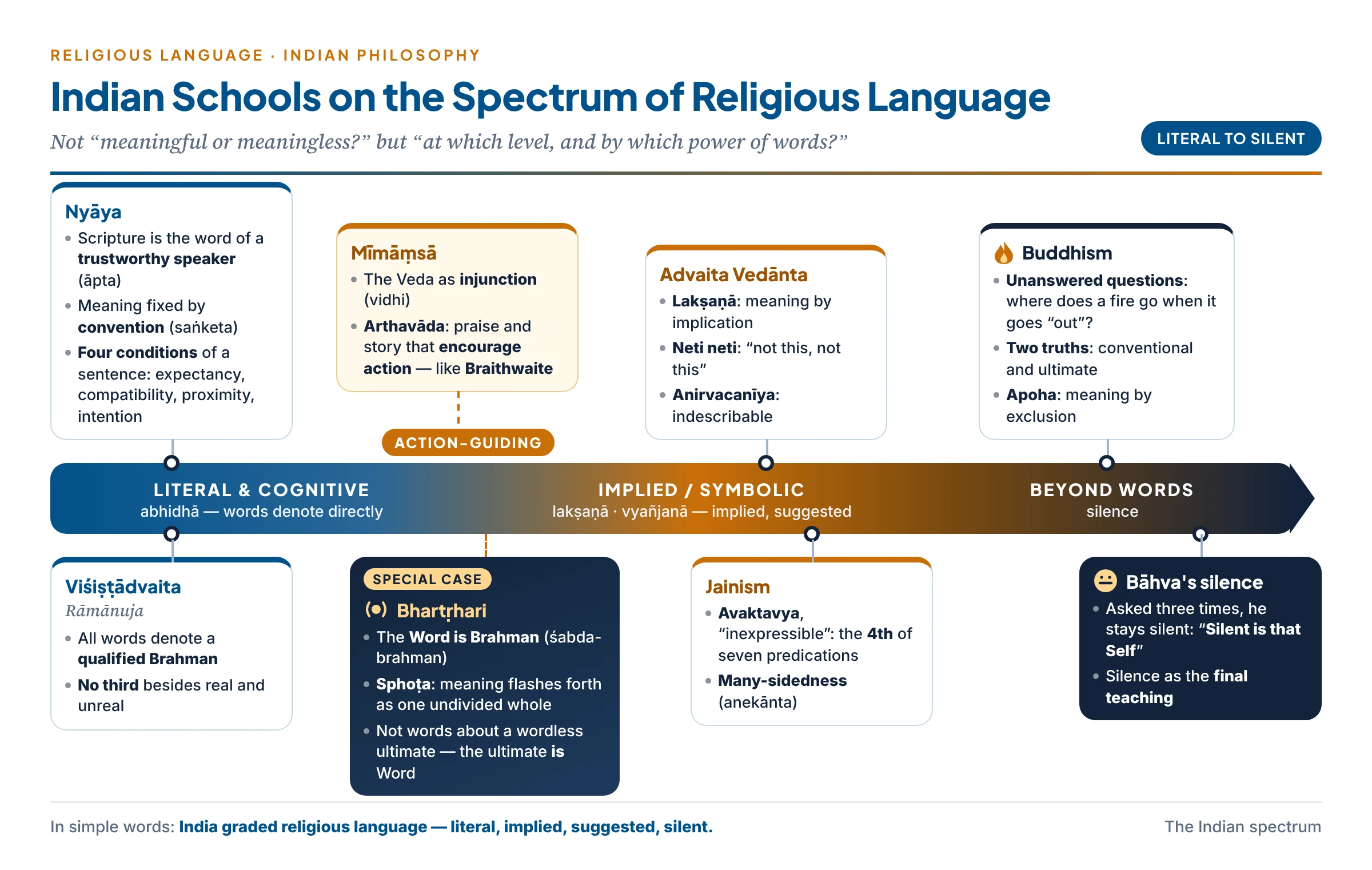
- Indian thought rarely asked “Is religious language meaningful or meaningless?” It asked “At which level, and by which power of words?” — literal denotation (abhidhā) for ordinary objects, implication (lakṣaṇā) for scriptural identities, suggestion (vyañjanā, prized by poets) for what can only be evoked, and silence for what transcends all three. This graded model combines the strengths of the Western cognitive, analogical, symbolic and non-cognitive theories in one scheme.
Synthesis (Siddhānta)
- The Indian traditions met the problem of religious language from within: the ultimate is “that from which words turn back“, yet scripture is a means of knowing it.
- Advaita answers with neti neti, Bāhva’s silence, anirvacanīyatā in two senses (Brahman beyond categories; māyā between real and unreal), taṭastha and svarūpa lakṣaṇa, the three kinds of lakṣaṇā applied to tat tvam asi, adhyāropa–apavāda, saguṇa Brahman and pratīka — words as pointers culminating in realisation.
- Rāmānuja holds that all words denote a qualified Brahman and rejects the indescribable third; Nyāya grounds scripture in a trustworthy speaker and meaning in convention; Mīmāṃsā treats the Veda as injunction with arthavāda as encouragement; Bhartṛhari makes the Word itself Brahman.
- Buddhism sets aside questions whose terms do not apply (the fire that goes “out”), distinguishes two truths, and builds meaning on exclusion (apoha); Jainism makes avaktavya a logical limit and every statement conditionally true.
- Against the charge that ineffability is self-refuting, Advaita replies that “indescribable” means beyond object-categories, not beyond all reference. The Indian contribution is a graded theory of religious language — literal, implied, suggested and silent — that complements the Western theories of analogy, symbol and language-game.
“From which words turn back, together with the mind, not reaching it.” — Taittirīya Upaniṣad
Previous Year Questions
- 2025Discuss the Advaitic notion of indescribability (anirvacanīyatā) in the context of nature of religious language.
- 2018What is the difference between the indescribability (anirvacanīyatā) of Brahman and the indescribability (anirvacanīyatā) of Māyā in the Advaita Vedānta system? Discuss.
- 2012Explain why avidyā and māyā are considered anirvacanīya (indescribable) in Advaita Vāda.