

Nature of Religious Language: Analogical and Symbolic; Cognitivist and Non-cognitive.
Official Syllabus: Paper II, Section B, Unit 10
The second great “middle way” between saying everything and saying nothing about God is the theory that religious language is symbolic. Its classic defender, the German-American theologian Paul Tillich (1886–1965), held that God is not a being among other beings but Being-itself, the ground of all being — and that therefore every concrete statement about God must be symbolic. A symbol, unlike a mere sign, participates in the reality it points to and opens up depths of reality and of the human soul that literal language cannot reach. This article explains Tillich’s theory — sign and symbol, the six marks of a symbol, ultimate concern, the life and death of symbols — together with myth and demythologising, the way symbols bring the sacred into space, time and culture, the role of metaphor, the Indian practice of pratīka and Oṃ, and the main criticisms and defences.
In simple words
A national flag is only coloured cloth. Yet when it is raised, people stand up; when it is burnt, people feel insulted. The flag does not just point to the nation like a road sign points to a town — it carries something of the nation’s dignity and power. Tillich says religious words like “Father”, “Creator” or “Lord” work like the flag, not like the road sign: they share in the holy reality they stand for.
Context & Problem
Why Symbols?
- The problem: our words come from finite experience; God (or the ultimate) is infinite. Literal words drag the infinite down to the level of finite objects — Tillich calls this idolatry.
- Tillich’s starting point — God as Being-itself: God is not the highest being (ens summum) alongside other beings; God is Being-itself (ipsum esse), the ground and power of being in everything. Anything that is a being — even the highest — is limited by other beings; God is not.
- Faith as ultimate concern: religion is the state of being ultimately concerned — gripped by what concerns us unconditionally. Such concern cannot be expressed in ordinary literal speech: “Whatever we say about that which concerns us ultimately, whether or not we call it God, has a symbolic meaning. It points beyond itself while participating in that to which it points. In no other way can faith express itself adequately. The language of faith is the language of symbols.“
- An existential theologian: Tillich, with Karl Barth and Rudolf Bultmann, belonged to the twentieth-century theologians who drew on existentialist philosophy (the individual in crisis and decision) rather than on science-modelled analytic philosophy. Their theology is hard to make intelligible in analytic terms — and the symbolic theory is one reason why.
Core Doctrine
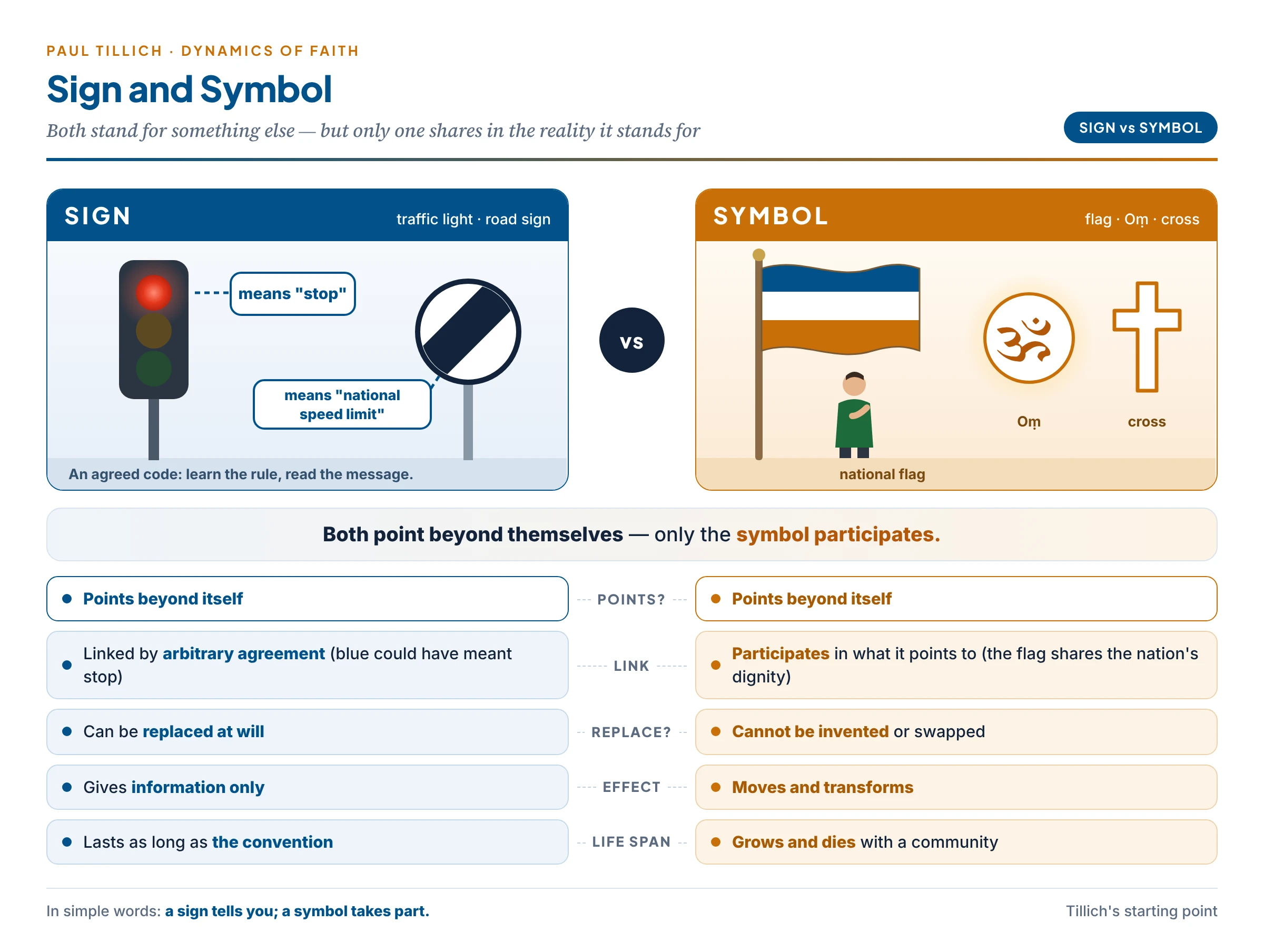
Sign and Symbol
Tillich begins by distinguishing signs from symbols. Both point beyond themselves to something else — but there is a crucial difference.
| Sign | Symbol | |
|---|---|---|
| Link to what it signifies | Arbitrary convention — an external, agreed connection | Inner connection — it participates in what it points to |
| Example | A red traffic light means “stop”; a road sign means “you may now drive at the national speed limit”; letters and numbers | A national flag participates in the power and dignity of the nation; the cross in Christianity |
| Can it be replaced? | Yes — any agreed mark would do (blue could have meant “stop”) | No — it cannot be swapped by decision; it is not invented |
| Effect | Conveys information; no other effect | Moves, transforms, opens new depths; powerful |
| If you do not know the code | It makes no sense | It can still grip and reveal |
| Life span | Lasts as long as the convention | Grows and dies with the community’s experience |
- The cross: it is not only a marker of Christianity; it makes a powerful statement. It immediately reminds Christians of the sacrifice they believe Jesus made for them, of their beliefs about God and of His plan of salvation. In this way a symbol “communicates much more powerfully” than a sign.
The Six Marks of a Symbol
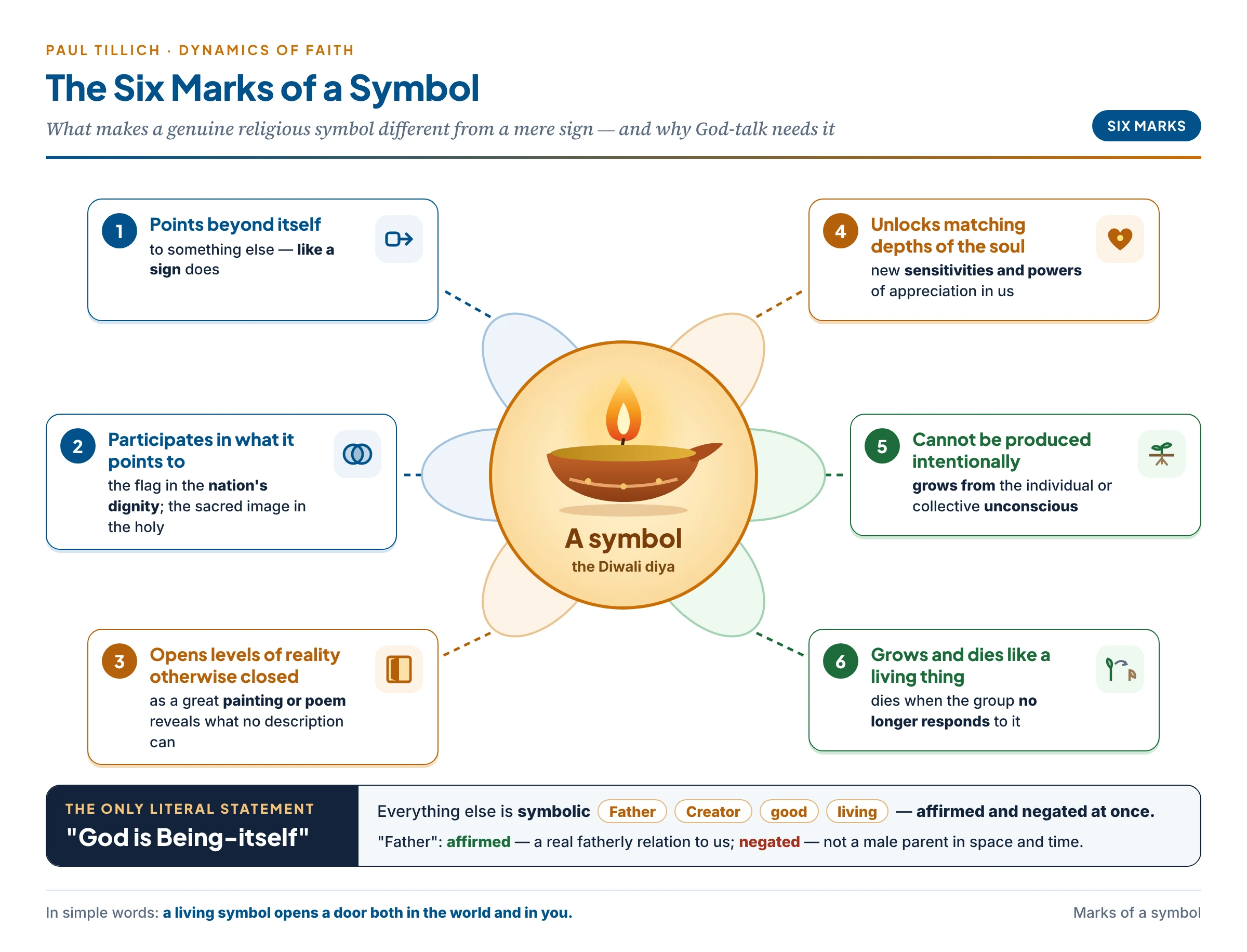
Tillich lists the characteristics of every genuine symbol. Short summaries often list only the first four as “functions”; Tillich adds two more.
- It points beyond itself to something else — like a sign.
- It participates in that to which it points — the flag in the nation’s dignity, the sacred image in the holy.
- It opens up levels of reality which otherwise are closed to us — as a great painting or poem reveals a dimension of the world that no description can.
- It unlocks dimensions and elements of our soul that correspond to those levels of reality — the work of art also opens new sensitivities and powers of appreciation in us.
- It cannot be produced intentionally — symbols are not invented like conventional signs; they “grow out of the individual or collective unconscious” and are accepted by a group.
- It grows and dies — like a living being, a symbol arises when the situation is ripe for it and dies when it no longer produces a response in the group where it once found expression.
- Symbols and art: Tillich argued that symbolic language works much as music, painting or poetry do. They have a deep and profound effect on us that we can only explain in a limited way, and the explanation is really understood only by someone who has seen the same work of art. Like works of art, symbols open new levels of reality and offer a new perspective on life.
- Symbols integrate: a religious symbol integrates the individual with the cosmos and the sacred — and the cosmos and the sacred are humanity’s ultimate concerns.
In simple words
Think of the diya lit on Diwali. You could say, “It is a clay cup with oil and a wick” (a literal description), or “It means the festival has begun” (a sign). But for a family it carries the victory of light over darkness, the return of Rāma, the presence of Lakṣmī, the memory of grandparents who lit it before — and lighting it changes how they feel and live that night. Nobody decided to make the diya mean all this; it grew in a people’s life. That is a symbol in Tillich’s full sense.
God as Being-itself — the Only Non-symbolic Statement
- One literal statement: according to Tillich, there is one and only one literal, non-symbolic statement that can be made about the ultimate reality religion calls God: God is Being-itself.
- Everything else is symbolic: all other theological statements — that God is eternal, living, good, personal, that God is the Creator, that God loves all creatures — are symbolic.
- Affirmed and negated at once: “Any concrete assertion about God must be symbolic, for a concrete assertion is one which uses a segment of finite experience in order to say something about him. It transcends the content of this segment, although it also includes it. The segment of finite reality which becomes the vehicle of a concrete assertion about God is affirmed and negated at the same time.” The word “Father” is affirmed (there is a real fatherly relation of God to us) and negated (God is not a male parent in space and time).
- Even “God” is a symbol: the word “God” itself is a symbol for God — for what concerns us ultimately.
- A later qualification: Tillich later admitted that the statement “everything we say about God is symbolic” is itself not symbolic — it is a literal statement about God-talk. Critics took this as a sign that the theory cannot be stated without some literal footing.
Truth, Idolatry and the Criterion of a Symbol
- True and false symbols: a symbol is not true or false like a factual statement; it is adequate or inadequate to express ultimate concern for a community. Its truth lies in its power to open the ultimate.
- Idolatry (the demonic): when a symbol is mistaken for the ultimate itself — when the image, the book, the nation or the church claims to be the holy rather than to point to it — faith becomes idolatry. Religious history is full of symbols elevated into absolutes.
- The criterion — self-negation: the best symbol is one that points beyond itself and negates its own finitude. For Tillich, the cross is supremely such a symbol: Jesus becomes the Christ by sacrificing himself, refusing to make his finite self ultimate.
- Symbols die: when a community no longer responds, a symbol becomes dead — kept in books and museums but no longer able to open reality. A symbol can also be corrupted — the ancient auspicious svastika was twisted into a sign of hatred in twentieth-century Europe, showing that symbols live in the history of communities.
Common confusion
Does “symbolic” mean “unreal” or “only symbolic”? No. For Tillich the phrase “only a symbol” is a misunderstanding. A symbol is not less than literal speech but more: it is the only way to express the ultimate, because literal speech would turn God into a finite object. Tillich is a realist about the ultimate — Being-itself is the most real of all. (A naturalist such as J. H. Randall later used a very similar theory of symbols without any transcendent reality — Article 6 — and that is where “only symbolic” really applies.)
Myth: Unbroken, Broken and Demythologised
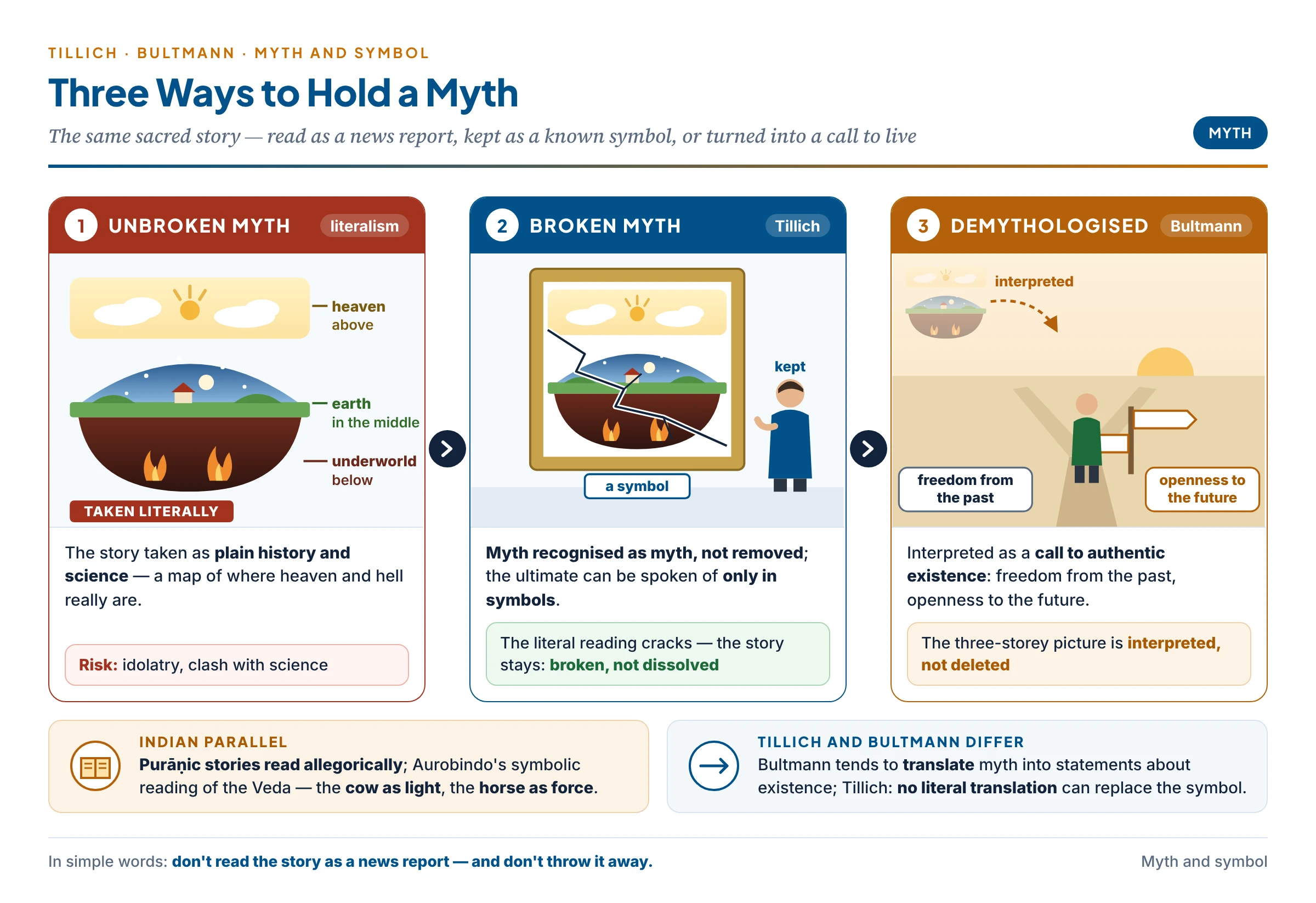
- Myth is a symbolic story — symbols arranged into a narrative of the gods’ or God’s acts (creation, fall, flood, incarnation, avatāras).
- The literalist treats the myth as plain history and science — an “unbroken myth“. This, for Tillich, is a form of idolatry.
- Tillich’s “broken myth”: myth must be recognised as myth — as symbolic — but not removed, because the ultimate can be spoken of only in symbols and myths. A broken myth is one whose symbolic character is understood.
- Bultmann’s demythologising: the New Testament speaks in the mythical world-picture of its time — a three-storeyed universe (heaven above, earth, hell below), angels and demons, miracles. Modern people cannot believe this literally. Bultmann proposed to interpret (not delete) the myths existentially — as calls to authentic existence, freedom from the past and openness to the future. Myth objectifies the transcendent; demythologising recovers its existential meaning.
- Difference: Bultmann tends to translate myth into existential statements; Tillich insists that no literal translation can replace the symbol — myth is broken, not dissolved.
Religious Symbols Mediate the Sacred into Space, Time and Culture
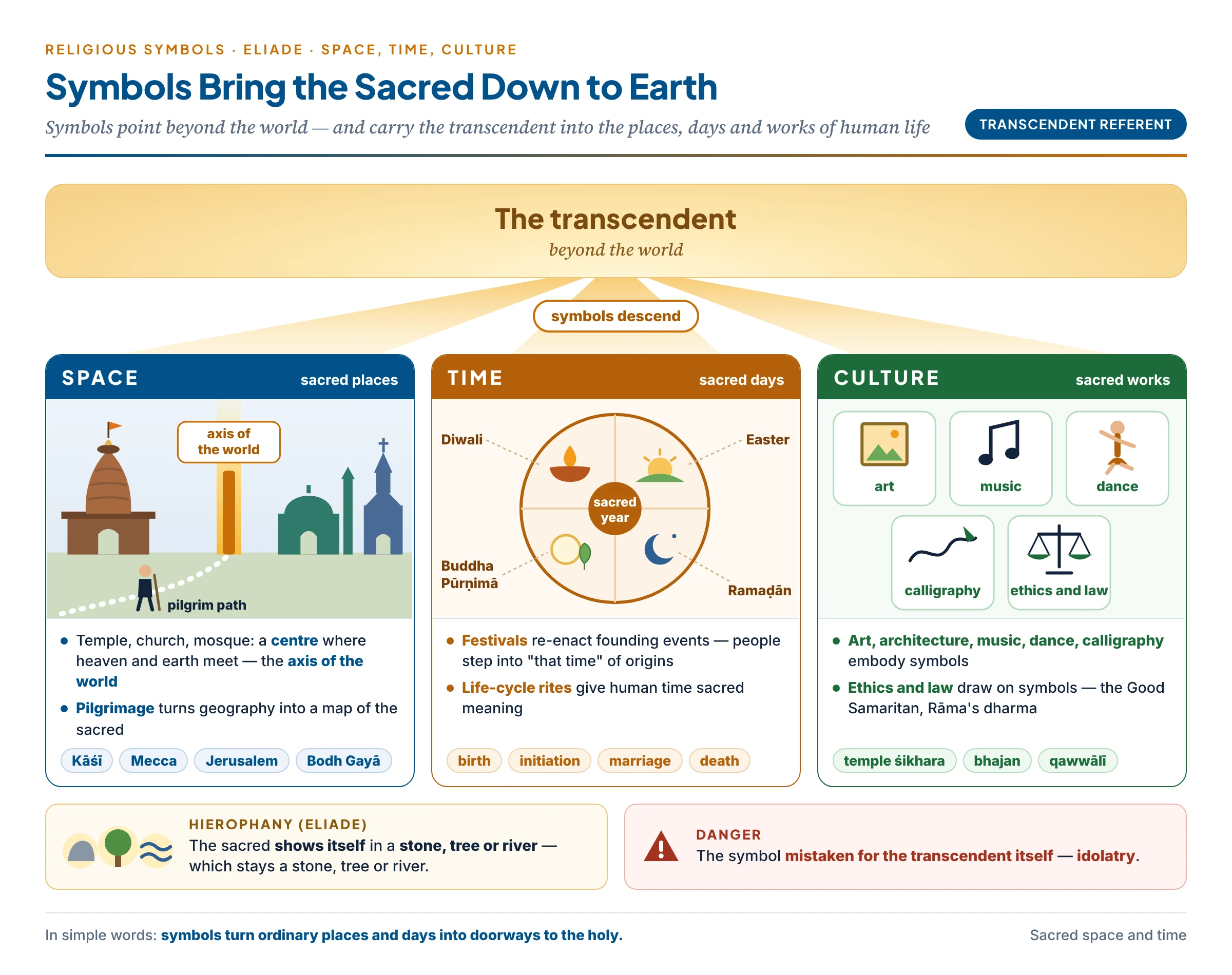
Religious symbols are transcendent referents — they point to what lies beyond the world — yet they mediate that transcendent into the cultural, spatial and temporal world in which people live.
- Hierophany — the sacred shows itself: the historian of religion Mircea Eliade called the manifestation of the sacred in an ordinary object a hierophany — a stone, a tree, a river becomes holy without ceasing to be a stone, tree or river. Once set apart as holy, such objects take on symbolic value: they are the place where the transcendent meets the world.
- Sacred space:
- A temple, church, mosque or gurdwārā marks a centre where heaven and earth meet — the “axis of the world” (axis mundi); the garbhagṛha (womb-chamber) of a Hindu temple, the Ka’ba in Mecca, the altar of a church.
- Pilgrimage places — Kāśī, Bodh Gayā, Jerusalem, Mecca, Amritsar — turn geography into a map of the sacred; the journey itself becomes symbolic.
- Ordinary space (a village, a home shrine, a tulasī plant) is ordered around these centres.
- Sacred time:
- Festivals re-enact the founding events — Easter the resurrection, Ramaḍān the revelation of the Qur’ān, Janmāṣṭamī the birth of Kṛṣṇa, Buddha Pūrṇimā the enlightenment. Eliade: in festival, people step out of ordinary time into “that time” of origins.
- Calendars and life-cycle rites (birth, initiation, marriage, death — the saṃskāras) mark human time with sacred meaning.
- Indian cyclical time (yugas, kalpas) and the Semitic linear time (creation to judgement) are themselves vast symbolic frames.
- Sacred culture:
- Art, architecture, music, dance, calligraphy embody symbols — Gothic spires, temple śikharas, Islamic geometric art, Bharatanāṭyam, qawwālī, bhajan.
- Ethics and law draw on symbols — the Good Samaritan, Rāma’s dharma, the Prophet’s sunna.
- The anthropologist Clifford Geertz defined religion as “a system of symbols which acts to establish powerful, pervasive, and long-lasting moods and motivations” in people by formulating conceptions of a general order of existence.
- Why this matters: symbols are the bridge between the transcendent (which cannot be seen) and the immanent (where people live). Without them, the transcendent would remain abstract; with them, it shapes places, seasons and whole cultures. The danger is that the symbol is taken for the transcendent itself — idolatry — or that it becomes a mere cultural ornament when the experience behind it dies.
In simple words
Most days your town’s riverbank is just mud and steps. On the evening of Chaṭh or Gaṅgā āratī, the same bank fills with lamps, songs and offerings — and for those hours it is holy ground, the river a goddess, the sunset a meeting with the divine. Nothing physical has changed. A symbol has turned ordinary space and ordinary time into a doorway to the sacred.
Metaphor
- What a metaphor is: speaking of one thing in terms suggestive of another — “the Lord is my shepherd“, “the Lord is my rock and my fortress“, “His hands prepared the dry land“. No one thinks God literally herds sheep or has hands; the literal picture is used as an exemplar that brings out a feature of God (care, constancy, creative action).
- Degrees of metaphor: some metaphors are open-ended — Macbeth’s “Life’s a poor player that struts and frets his hour upon the stage” leaves the hearer to draw out its meaning; others make fairly definite claims — Churchill’s “an iron curtain has descended across the continent“.
- Metaphorical theology: some modern theologians hold that all intelligible talk of God is metaphorical — God as Father, Mother, Lover, Friend — each a model that reveals and hides at once.
In simple words
When a family calls the grandmother “the pillar of the house“, nobody looks for bricks. The metaphor picks out a real feature — she holds everyone up — more vividly than a plain sentence could. “The Lord is my rock” works the same way. But if someone asks, “Is God really alive?”, the believer will not answer, “No, that is just a figure of speech” — which shows that not all God-talk is metaphor.
- Limits: much talk of God does not look metaphorical. Negative statements (“God is not material, not limited in space”) are literal. Statements about God’s effects (“God comforted me in my distress”) seem literal too. So “all religious language is metaphor” overreaches.
- Three distinctions often confused:
- Literal vs metaphorical — whether a word is used in its standard sense or figuratively.
- Univocal vs analogical — whether a word has the same sense in two applications (a relation between two uses).
- Precise vs vague — “bald” is literal but vague.
- So: a word stripped of its bodily elements may be used of God literally though not univocally (Article 2).
Symbol, Pratīka and Oṃ in Indian Religion
- Pratīka (symbol, support) — the Upaniṣads teach meditation on Brahman through a symbol: “the mind is Brahman“, “the sun is Brahman“, “ākāśa is Brahman“. The Brahma Sūtra tradition adds a caution: the meditator should not take the symbol to be the Self itself — the symbol is a support, not the goal. This is Tillich’s warning against idolatry, stated centuries earlier.
- Oṃ — the sacred syllable is the supreme symbol of Brahman. The Māṇḍūkya Upaniṣad reads its three sounds A–U–M as the states of waking, dreaming and deep sleep, and the silence after it as turīya, the pure Self. The symbol does not merely point to Brahman by convention; in recitation it is held to participate in and lead into what it signifies — precisely Tillich’s mark of participation.
- Mūrti and consecration — through the rite of prāṇa-pratiṣṭhā an image becomes, for the worshipper, a place of real presence; the deity is worshipped in the image, not as the image. Aniconic symbols — the Śiva-liṅga, the śālagrāma stone — carry the same logic.
- Across traditions: the Buddhist dharma-cakra, stūpa and footprints of the Buddha; the Sikh Ik Oṅkār; Islamic calligraphy and the Ka’ba (in a tradition that forbids images); the Jaina svastika and siddha-cakra.
- Saguṇa as symbol: Advaita treats saguṇa Brahman — God with qualities, Īśvara — as the highest form in which the formless can be approached by finite minds: a symbol of nirguṇa Brahman at the level of practice (vyavahāra).
- Symbolic reading of scripture: Sri Aurobindo read the Vedic hymns symbolically — the cow as light of knowledge, the horse as spiritual force — an Indian parallel to Tillich’s broken myth.
Indian Connect — Indian Connect — pratīka and Tillich’s symbol
- Agreement: both hold that the ultimate is approached through finite forms (pratīka, Oṃ, mūrti / flag, cross), that the true symbol participates in the sacred, and that mistaking the symbol for the ultimate is an error (Tillich’s idolatry; the Vedāntic rule that the pratīka is not the Self).
- Difference: Advaita goes on to a direct, non-symbolic realisation (aparokṣānubhūti) in which all symbols fall away; Tillich holds that for humans the ultimate is always mediated by symbols — even mystical union is described in symbols.
Does Religious Symbolism Lead to Mysticism?
- How it can: a symbol “opens up levels of reality” and “unlocks depths of the soul”. Prolonged contemplation of a symbol — the Oṃ in japa, an icon in Orthodox prayer, the mandala or yantra, the name of God in Sufi dhikr — draws the mind from the outer form to the inner reality, culminating in mystical absorption.
- How it also cannot: mysticism at its peak often leaves symbols behind — Pseudo-Dionysius’ “darkness beyond light”, Advaita’s neti neti, Zen’s “finger pointing at the moon”. The symbol is a ladder to be climbed and then left.
- Balance: symbols are the door, mysticism the room; but the mystic, returning, can speak of the room only in symbols again (Unit 06 develops religious experience).
Is Religious Language Symbolic?
Reasons for saying yes:
- Transcendence: literal language makes God a finite object — symbols alone respect the infinite.
- Ultimate concern: faith involves the whole person, mind, feeling and will — symbols engage all of these, as art does.
- The evidence of scripture and worship: religious texts and rituals are saturated with imagery — light, water, fire, bread, father, king, lotus, ocean.
- Cross-cultural communication: symbols cross language barriers and unite communities.
- Protection from literalism and idolatry: understanding language as symbolic prevents fundamentalism.
Reasons for saying “not wholly”:
- Historical claims are literal: “Jesus was crucified under Pontius Pilate”, “the Buddha attained enlightenment at Bodh Gayā”.
- Negations are literal: “God is not a body”.
- Believers mean some claims literally: “God exists”, “God hears prayer”. To call these merely symbolic seems to empty them.
- Symbols need literal anchors: to know what a symbol points to and whether it is adequate, some non-symbolic knowledge seems necessary — even Tillich needed one literal sentence.
Conclusion: religious language is largely symbolic, especially when it speaks of God’s nature; but it is anchored by literal historical and negative statements and by analogical claims. The best view combines symbol (for depth and mystery) with analogy (for content).
Critical Evaluation
Criticisms of Tillich’s Theory
- “Participation” is undefined: Tillich never fully explains what it means for a symbol to participate in what it symbolises. In “God is good”, is the symbol the proposition “God is good” or the concept “the goodness of God”? Does it participate in Being-itself as a flag participates in a nation’s dignity? Tillich never analyses even the flag case (Hick).
- Everything participates: according to Tillich, everything that exists participates in Being-itself. What then is special about the way symbols participate?
- Not all theology arises from the unconscious: a complex statement like “God is not dependent for his existence on any external reality” was carefully formulated by philosophical theologians, not thrown up by the collective unconscious. And in what sense does it “open hidden depths of our being”?
- Assimilated to art: the marks of a symbol fit paintings and poems better than theological propositions. Tillich’s tendency to merge religious and aesthetic awareness invites a naturalistic reading (Randall’s) in which God disappears.
- No criterion for valid symbols: the theory makes it hard to tell valid from invalid symbols. If symbols are neither true nor false but only adequate or powerful, then a powerful symbol of hatred is as “valid” as a symbol of love.
- Can symbols convey cognitive truth? If “God is good” is purely symbolic, what state of affairs does it affirm? Critics such as William Alston and Paul Edwards argued that a symbol which cannot be cashed in any literal terms tells us nothing — the theory collapses into non-cognitivism.
- Being-itself is obscure: the one literal statement, “God is Being-itself”, is itself hard to understand — “being” is not a thing or property.
- Unintelligible?: by stressing what symbols cannot say, the theory can make religious language seem more mysterious than meaningful.
Defences
- It captures how religion actually works — through images, rites, stories and sacred objects that move people, not through dry propositions.
- It protects God’s transcendence and guards against both literalism and idolatry.
- It explains the power and the death of symbols — why some images endure for millennia and others fade.
- It links religion with art — both reveal levels of reality that science cannot.
- It is cross-culturally fruitful — it illuminates pratīka, Oṃ, icons, calligraphy and pilgrimage alike.
- It shields religion from crude positivism (which tests symbols as if they were scientific hypotheses) and from fundamentalism.
Analogy and Symbol Compared — Is One More Confusing, the Other More Unintelligible?
| Point | Analogy (Aquinas) | Symbol (Tillich) |
|---|---|---|
| Claim | Words apply to God in a related, proportionate sense | Words point to and participate in Being-itself |
| Cognitive status | Quasi-cognitive: real but imperfect knowledge | Quasi-cognitive or existential: disclosure more than information |
| Basis | Causal relation of creature to Creator; analogy of being | Participation in Being-itself; ultimate concern |
| Literal element | Perfection-words (good, wise, living) apply properly to God | Only “God is Being-itself” is literal |
| Strength | Clear about content; avoids anthropomorphism and agnosticism | Rich in existential depth; explains worship, art, myth |
| Weakness | Technical, “confusing” distinctions; assumes creation | Vague, “unintelligible” participation; tends to non-cognitivism |
| Indian parallel | Taṭastha and svarūpa lakṣaṇa | Pratīka, Oṃ, saguṇa Brahman |
- Verdict: analogy can seem confusing because it must hold likeness and unlikeness together; symbol can seem unintelligible because it refuses literal translation. Neither charge is fatal. Analogy is better for what we may say of God; symbol is better for how religious words act on the whole person. The two are complementary — Hick notes that Tillich’s negative side corresponds to the negative side of analogy.
Critics and Defenders
Criticism — Against the symbolic theory
- Participation is never defined; everything participates in Being-itself (Hick).
- Theology is reasoned, not thrown up by the unconscious.
- Too close to art; invites a naturalistic reading (Randall).
- No criterion to separate valid from invalid symbols.
- If no literal translation is possible, symbols say nothing (Alston, Edwards) — the theory slides into non-cognitivism.
- Tillich himself needed one literal statement.
Defence — For the symbolic theory
- Fits the lived reality of religion — rites, images, festivals, myths.
- Guards transcendence against literalism and idolatry.
- Explains why symbols live and die with communities.
- Connects religion with art, both revealing depths of reality.
- Illuminates Indian pratīka, Oṃ and mūrti as well as Christian symbols.
- Complements analogy: analogy gives content, symbol gives depth.
Cross-Tradition Comparison
| Theme | Tillich / Western | Indian |
|---|---|---|
| Symbol participates | Flag in nation; cross in salvation | Oṃ as Brahman; consecrated mūrti as presence |
| Warning against idolatry | Symbol taken as the ultimate becomes demonic | The pratīka is not the Self; worship in, not as, the image |
| Literal statement about the ultimate | “God is Being-itself” | Sat-cit-ānanda understood by implication, not literally (Advaita) |
| Myth | Broken myth; Bultmann’s demythologising | Purāṇic stories read allegorically; Aurobindo’s symbolic Veda |
| Beyond symbols | Mysticism still speaks in symbols | Advaita’s direct realisation where symbols fall away |
Indian Connect — Indian Connect — saguṇa as the symbol of nirguṇa
- In Advaita, Īśvara (saguṇa Brahman) is the highest symbol of nirguṇa Brahman available to finite minds — real for worship (vyavahāra), transcended in liberation (paramārtha). Tillich’s “God above the God of theism” — the ground beyond the personal God of ordinary religion — makes a strikingly similar move.
Synthesis (Siddhānta)
- Tillich holds that since God is Being-itself, not a being, every concrete statement about God is symbolic; the only literal statement is that God is Being-itself.
- A symbol, unlike a sign, participates in what it points to; it opens levels of reality and of the soul, cannot be invented, and grows and dies with a community.
- Faith as ultimate concern can be expressed only in symbols; mistaking the symbol for the ultimate is idolatry; the truest symbol negates itself.
- Myth is to be broken, not literalised (Tillich) or interpreted existentially (Bultmann); symbols mediate the sacred into space, time and culture (Eliade’s hierophany, Geertz’s system of symbols).
- Criticisms — vague participation, no criterion, assimilation to art, slide into non-cognitivism — are serious; the defences — fidelity to lived religion, protection of transcendence, cross-cultural power — keep it indispensable.
- Religious language is largely symbolic but anchored by literal and analogical claims; analogy and symbol are complementary. India’s pratīka, Oṃ and saguṇa Brahman confirm the insight — and Advaita adds a realisation beyond symbols.
“The language of faith is the language of symbols.” — Paul Tillich
Previous Year Questions
- 2025Is religious language symbolic? Give reasons and justification in support of your answer.
- 2023Explain the symbolic nature of religious language according to Tillich.
- 2021Explain the symbolic nature of religious language with special reference to Paul Tillich.
- 2019Discuss whether and how does religious symbolism lead to mysticism.
- 2018Explain the significance of religious symbols as transcendent referent that mediates into the cultural, spatial and temporal world.
- 2017Is not the language of analogies more confusing and the language of symbols more unintelligible? Evaluate in the case of religious language.
- 2012Analyse Paul Tillich’s statement that “symbolic language alone is able to express the ultimate.”
- 2009Is religious language symbolic? Discuss.
- 2004“Man’s ultimate concern must be expressed symbolically because symbolic language alone is able to express the ultimate.” — Paul Tillich. Critical notes.