

Nature of Religious Language: Analogical and Symbolic; Cognitivist and Non-cognitive.
Official Syllabus: Paper II, Section B, Unit 10
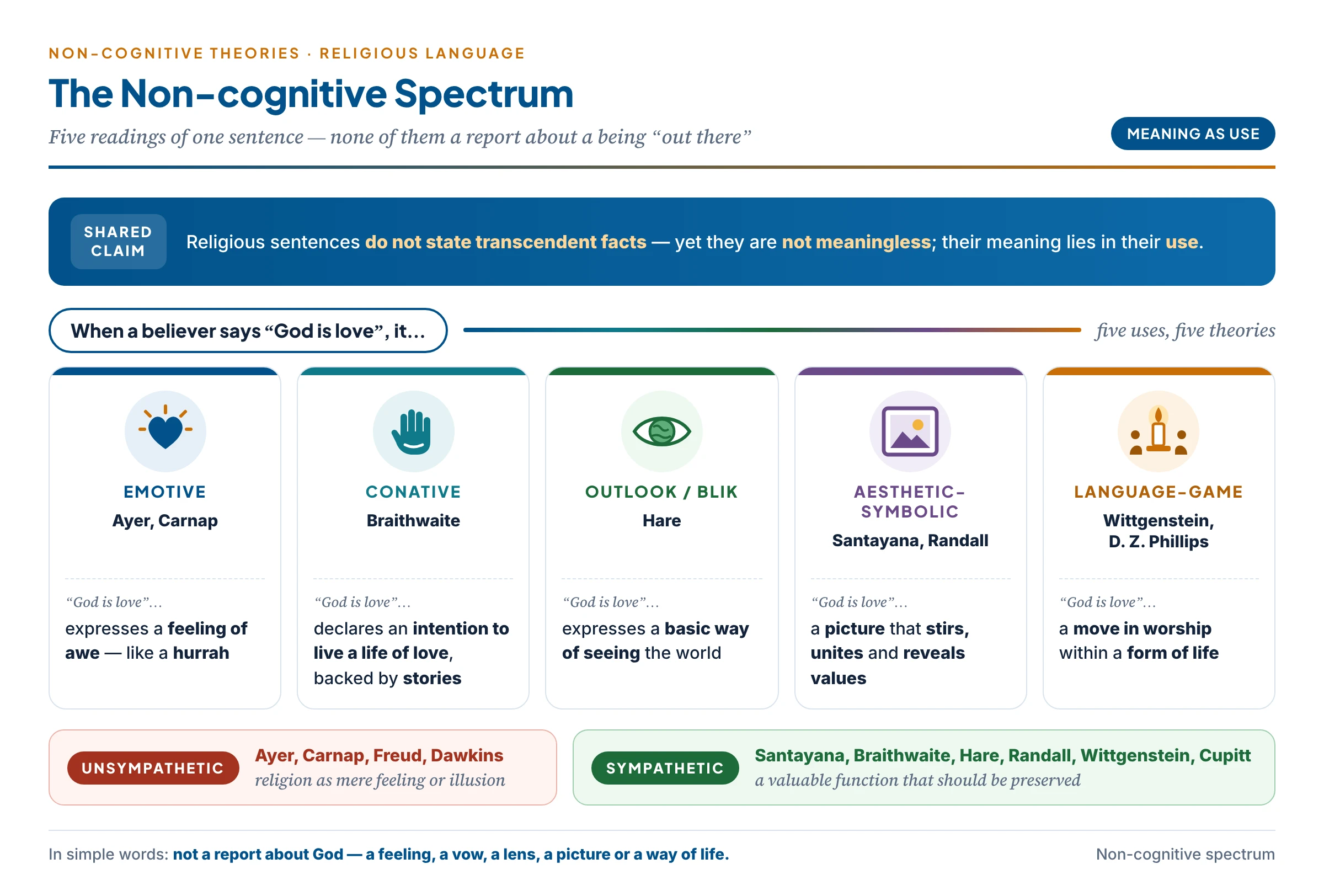
The non-cognitive theories of religious language accept that sentences like “God is love” or “God created the world” do not state facts that could be true or false — but deny that they are therefore empty. They locate the meaning of religious language in its function: expressing feelings (emotivism), declaring intentions to live a certain way (Braithwaite), expressing a basic outlook (Hare’s bliks), stirring and uniting people through symbols (Randall), or forming part of a way of life (Wittgenstein, Article 7). The most influential of these is R. B. Braithwaite’s account of religious assertions as declarations of commitment to a way of life, supported by stories. This article explains what it means to call religious language non-cognitive, how one can formulate such a theory, the theories of Ayer and Carnap, Santayana, Braithwaite, Randall, the naturalist and non-realist readings, and the strong criticisms — especially John Hick’s four objections.
In simple words
At a wedding, the groom says, “I will love and cherish you all my life.” Nobody asks, “Is that sentence true or false?” — it is not a report but a promise: it commits him to a way of living. Braithwaite thought “God is love“, on a Christian’s lips, works like that vow: it is not a report about a heavenly being but a declaration — “I intend to live a life of love” — and its meaning shows in how the person lives.
Context & Problem
What Does “Non-cognitive” Mean?
- Cognitive language conveys facts — things we can know — and is true or false. Non-cognitive language conveys what is not factual: emotions, feelings, attitudes, commitments, commands.
- Saying religious language is non-cognitive means:
- Religious sentences are neither true nor false in the way factual statements are.
- They do not describe a transcendent reality “out there”.
- Their meaning lies in their use or function in the lives of believers.
- They are not meaningless: they have emotive, moral, attitudinal or practical meaning.
- The empiricist background: religious statements are neither analytic (true by definition) nor empirically verifiable. From the cognitive point of view they are meaningless (Article 4). Non-cognitivists accept this — and then ask what other kind of meaning they have.
- Two kinds of non-cognitivist:
- Unsympathetic — religious language is mere feeling or illusion (Ayer, Carnap, Freud, Dawkins).
- Sympathetic — religious language has a valuable non-cognitive function that should be preserved (Santayana, Braithwaite, Hare, Randall, Wittgenstein, Cupitt).
- The functionalist label: such theories look at the function religious language serves rather than what it describes; they support anti-realism about God.
How Can Religious Language Be Formulated as Non-cognitive?
A non-cognitive theory is built in four steps:
- Deny the fact-stating role: show that religious sentences cannot be checked like facts (verification and falsification, Articles 4–5).
- Adopt a use theory of meaning: the meaning of a sentence is given by how it is used — a principle Braithwaite took over from the later Wittgenstein.
- Identify the function: what do believers do with these words? — express emotion; declare a moral policy; express a basic outlook; evoke and share experience through symbols; worship and pray within a form of life.
- Explain the factual-sounding parts: the stories, myths and doctrines are treated as pictures, parables or psychological aids — to be entertained, not believed as literal history.
Core Doctrine
Emotivism — Ayer and Carnap
- Ayer and Carnap held that religious statements are pseudo-statements: cognitively meaningless, but expressive of the feelings and emotions of religious persons. “God is great” is like a cry of awe or a hurrah.
- Carnap saw metaphysics as the expression of an attitude towards life — like lyric poetry or music, but in a misleading theoretical form; the metaphysician is, as it were, “a musician without musical ability“.
- Both religious and irreligious statements are meaningless cognitively — “God exists” and “God does not exist” alike — but religious language keeps emotive importance.
- Matthew Arnold’s older view runs parallel: religion is “morality touched by emotion“.
- Limit: emotivism explains the warmth of religious language but not its structure — creeds, arguments, commitments, stories.
Santayana — Myth as Value in Picture-form
- The philosopher George Santayana (1863–1952) took religious doctrines, which he preferred to call myths, as symbolic expressions of value commitments and attitudes.
- A religious doctrine has two parts:
- An evaluation of some sort.
- That evaluation expressed in a picture or story.
- Example: the Christian story of God’s incarnation in Jesus and his sacrificial, unmerited death on the cross can be read as a symbol of the moral value of self-sacrifice — expressed far more forcefully by the story than by the bare sentence “self-sacrifice is noble”.
- Directive function: myths also guide lives in certain directions — a theme Braithwaite developed.
- His slogan: religions are “not true or false but better or worse“.
Braithwaite’s Conative Theory
R. B. Braithwaite (1900–90), a Cambridge philosopher of science, gave the classic sympathetic non-cognitive account in his lecture “An Empiricist’s View of the Nature of Religious Belief” (1955). He was concerned not with what religious statements are about, but with how they are used.
1. The starting point — an empiricist dilemma:
- Religious statements are not empirical (no observation tests them) and not logically necessary (their denial is not self-contradictory).
- If we insist they are cognitive, they fall into neither class of meaningful statements — so a cognitivist account ends in saying they are meaningless.
- Braithwaite recognised three classes of verifiable statements: statements about particular empirical facts, scientific hypotheses, and logically necessary statements. Religious statements fit none of them.
- So Braithwaite widens the empiricist test so that use as well as verifiability counts as a criterion of meaning — the use principle: the meaning of a statement is given by the way it is used — and asks how religious statements are used.
2. Moral assertions as declarations of intention:
- Braithwaite first analyses ethical statements. The primary use of a moral assertion is “to express the intention of the asserter to act in a particular sort of way specified in the assertion“. “When a man asserts that he ought to do so-and-so, he is using the assertion to declare that he resolves, to the best of his ability, to do so-and-so.“
- This is a conative (will-based) theory, not an emotive one: moral assertions express intentions and policies, not just feelings. They also recommend the policy to others.
3. Religious assertions as moral assertions:
- Religious statements are moral in content and intention. They are “declarations of adherence to a policy of action, declarations of commitment to a way of life“.
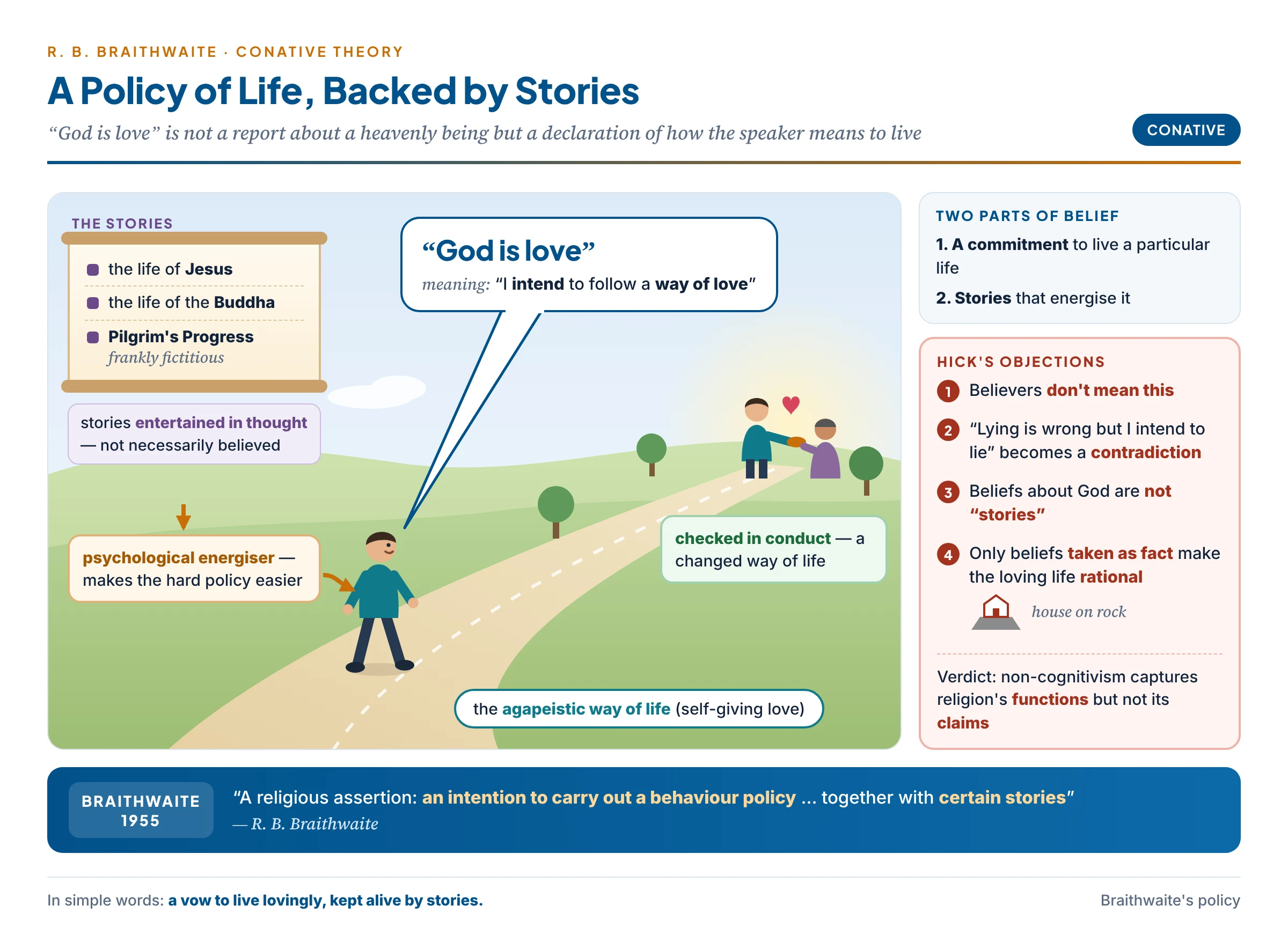
- “God is love” (agape) on a Christian’s lips is the speaker’s declaration of an “intention to follow an agapeistic way of life” — a life of self-giving love, as described in St Paul’s hymn to love (1 Corinthians 13). “It is the intention to behave which constitutes what is known as religious conviction.“
- “God is the almighty father” results in action — and that is why it has meaning.
- Verifiable in conduct: because religious assertions express a policy of behaviour, they can be checked by a change of behaviour — their meaning shows in a way of life that others can observe.
4. What makes religions different — stories:
- If Christianity and Buddhism both recommend much the same policy of living (love and compassion), in what sense are they different religions? Differences of ritual are relatively unimportant.
- The significant difference lies in the different stories (myths, parables) associated with each way of life — the life of Jesus, the life of the Buddha.
- The stories need not be true — or even believed to be true. They need only be entertained in thought. A Christian does not need to produce Jesus’ death certificate; the stories serve as an influence.
- A psychological link: the connection between the stories and the way of life is “a psychological and causal one“. “It is an empirical psychological fact that many people find it easier to resolve upon and to carry through a course of action which is contrary to their natural inclinations if this policy is associated in their minds with certain stories.“
- The example of Bunyan: “Next to the Bible and the Prayer Book the most influential work in English Christian religious life has been a book whose stories are frankly recognised as fictitious — Bunyan’s Pilgrim’s Progress.“
- And novels: he added the novels of Dostoevsky as further examples of fiction that shapes religious life.
- Thoughts, not only beliefs, move us: “It is completely untrue, as a matter of psychological fact, to think that the only intellectual considerations which affect action are beliefs: it is all the thoughts of a man that determine his behaviour; and these include his phantasies, imaginations, ideas of what he would wish to be and do, as well as the propositions which he believes to be true.“
5. Braithwaite’s definition:
“A religious assertion, for me, is the assertion of an intention to carry out a certain behaviour policy, subsumable under a sufficiently general principle to be a moral one, together with the implicit or explicit statement, but not the assertion, of certain stories.” — R. B. Braithwaite
- In short: religious belief rests on (a) a commitment to live a particular life and (b) religious stories that energise it. Religious assertions are meaningful because they result in a particular way of life that can be verified.
- An illustration often given: the writer C. S. Lewis, on becoming a Christian, redirected his whole manner of living and writing. On Braithwaite’s view, what changed was his policy of life, sustained by the Christian stories — whatever their historical status.
- God as a psychological booster: since Kant, the autonomy of morality has become accepted — morality is good not because God wills it; God wills it because it is good. Philosophers then came to regard religion as morality either with emotion (Matthew Arnold) or backed by stories (Braithwaite). Both Kant (who recommended regarding duties “as divine commands”) and Braithwaite bring in God as a psychological booster of morality — a “story as psychological energiser“.
In simple words
A boy who struggles to wake up for morning practice keeps a poster of his favourite athlete above his bed. He may not believe every legend told about her, but the picture and the story get him out of bed at five. Braithwaite says religious stories work the same way: whether or not they happened, keeping them in mind makes it easier to live by a hard ideal — love your enemy, forgive seventy times seven.
Common confusion
Is Braithwaite’s theory the same as Ayer’s emotivism? No. Ayer’s emotive theory makes religious statements expressions of feeling — like a sigh of awe. Braithwaite’s theory is conative (from the will): religious statements declare an intention and a policy of action, which can be checked in conduct. Braithwaite was also sympathetic to religion — he wanted to show how an empiricist could sincerely be a Christian — whereas Ayer dismissed theology as nonsense. Many notes lump the two together as “non-cognitive”; the difference between feeling and will is the key point.
Does the Cognitivist Account Lead to Contradiction?
Braithwaite’s empiricism suggests that it does:
- The cognitivist says “God exists” is a factual statement, true or false.
- But the cognitivist also says God is beyond all observation and that nothing in experience could test the claim — not even in principle (believers resist falsification, Article 5).
- A factual statement that no experience could ever bear on is, for an empiricist, a contradiction in terms — “fact” that makes no difference.
- Again, if religious statements were logically necessary, their denial would be self-contradictory — but “God does not exist” contains no contradiction.
- Therefore the cognitivist account is inconsistent: it claims factual status for statements it treats as untestable.
The cognitivist’s reply — no contradiction:
- There are factual statements beyond present verification: Swinburne’s toys, the earth once covered by sea, Hick’s statements verifiable after death (Articles 4–5). A fact can be real without being testable now.
- Believers do allow evidence to count (Mitchell), so their claims are not wholly untestable.
- Empiricism itself — “only sense experience gives factual knowledge” — is a disputed theory, not a neutral standard.
- The tables turn: Hick shows that Braithwaite’s own ethical theory leads to a contradiction (objection 2 below).
Verdict: the cognitivist account leads to contradiction only if strict empiricism is assumed. Without that assumption, it is consistent — though it bears the burden of saying how its claims could be known.
Randall — Religious Symbols without God
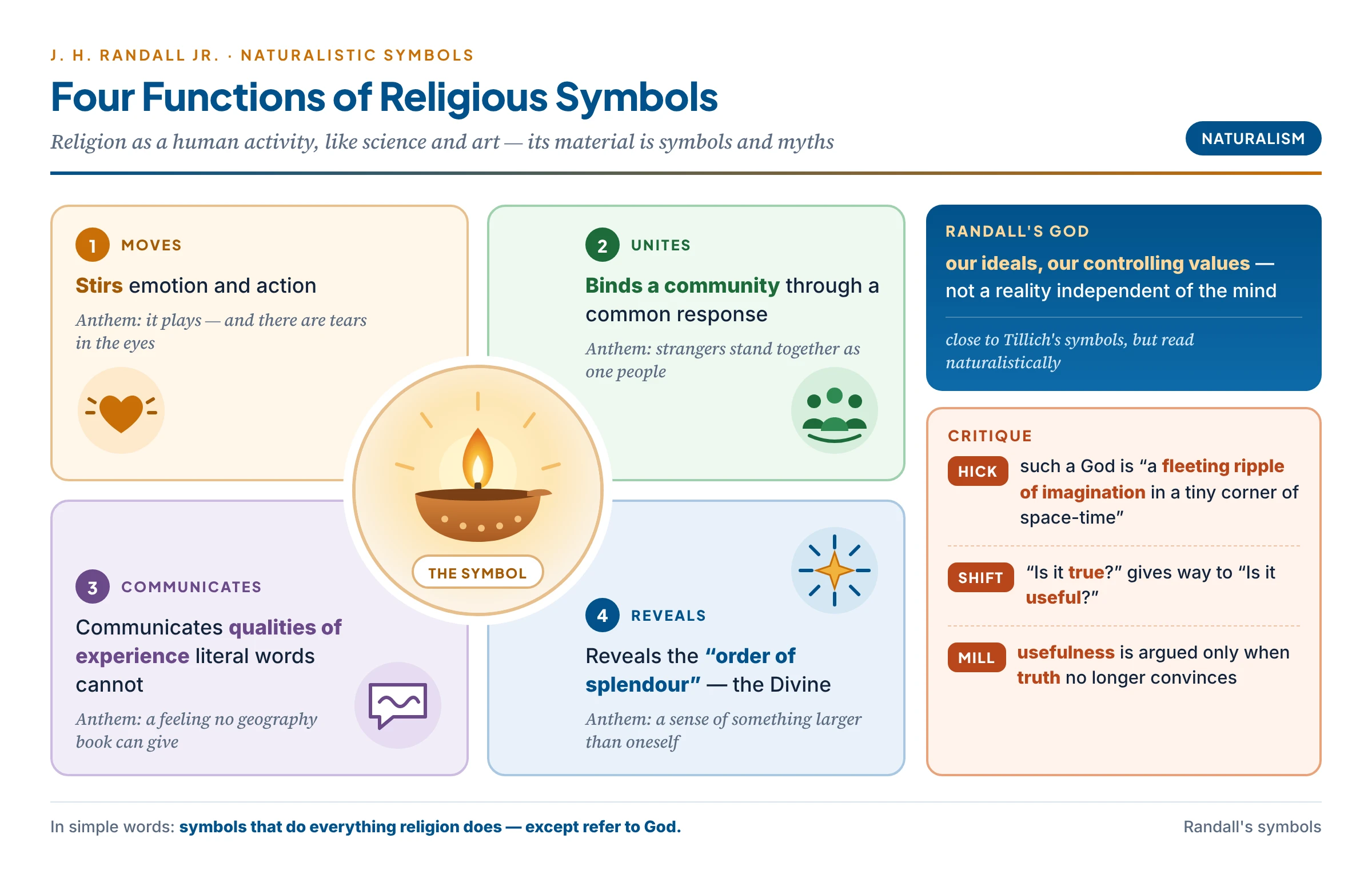
- J. H. Randall Jr., in The Role of Knowledge in Western Religion (1958), conceived religion as a human activity which, like its companions science and art, makes its own contribution to human culture. Its distinctive material is a body of symbols and myths.
- “Religious symbols belong with social and artistic symbols, in the group of symbols that are both non-representative and non-cognitive.” They symbolise not some external thing, but what they themselves do — their functions.
- The fourfold function of religious symbols:
- They arouse emotions and stir people to action, strengthening practical commitment to what they believe right.
- They stimulate cooperative action and bind a community together through a common response.
- They communicate qualities of experience that cannot be expressed in literal language.
- They evoke, foster and clarify our experience of an aspect of the world that can be called the “order of splendour” or the Divine.
- The aesthetic analogy: as the painter, musician and poet teach us to use our eyes, ears and feelings with greater power — to discern unsuspected qualities in the world — so “the prophet and the saint” teach us to see what human life is and might be; “they teach us how to find the Divine; they show us visions of God“.
- But God is not independent: in speaking of “visions of God”, Randall does not mean that God exists as a reality independent of the human mind. God is “our ideals, our controlling values, our ‘ultimate concern’“, “an intellectual symbol for the religious dimension of the world“.
- Close to Tillich: Randall worked with Tillich and said they were “very close to agreement” — showing how Tillich’s symbolic theory (Article 3) can be developed naturalistically.
In simple words
When the national anthem plays before a match, players and crowd stand together, some with tears in their eyes. The anthem does not describe the nation like a geography book; it stirs emotion, binds strangers into one people, conveys a feeling words cannot, and opens a sense of something larger than oneself. Randall says religious symbols do exactly these four things — and, for him, that is all they do; there need be no God “out there”, as there is no nation apart from its people.
Hick’s critique of Randall:
- The products of human imagination are not eternal; they exist only as long as humans exist. Randall’s Divine is “the temporary mental construction or projection of a recently emerged animal inhabiting one of the satellites of a minor star“. God is no longer the Creator and ruler of the universe; God is “a fleeting ripple of imagination in a tiny corner of space-time“.
- From God to religion: Randall’s view reflects a wide modern shift in which the word “religion” (or “faith”) replaces “God“. God becomes one concept within religion, rather than religion being the human response to God. The question “Is it true?” gives way to “Is it useful?“
- Mill’s warning: John Stuart Mill, in The Utility of Religion, observed: “If religion, or any particular form of it, is true, its usefulness follows without other proof… Whether a person is in a pleasant or in an unpleasant place, a palace or a prison, it cannot be otherwise than useful to him to know where he is.” The utility of religion did not need to be asserted until the arguments for its truth had ceased to convince; an argument for its utility invites unbelievers to “a well-meant hypocrisy“.
- A reversal of biblical faith: there is a profound difference between serving and worshipping God and being “interested in religion“. In the second, we sit as appraisers of a human phenomenon; in the first, we bow before a reality infinitely greater than ourselves.
Naturalist Reinterpretations
- Henry Nelson Wieman defined “God” as “that interaction between individuals, groups, and ages which generates and promotes the greatest possible mutuality of good“. Can people pray to an interaction? Yes, he said — that is what they always pray to. (Critics replied that Mr Jones would be disappointed to learn that what his friends loved was not him but their fellowship with him.)
- Julian Huxley, the biologist, offered a naturalistic Trinity: God the Father as the forces of non-human nature, God the Holy Spirit as the ideals humans strive for, God the Son as human nature using nature’s forces in pursuit of those ideals.
- Gordon Kaufman treated the question of God’s existence as a question of the viability of an orientation — a valid understanding of human existence.
- Common feature: these keep the words of theism while giving them a purely this-worldly meaning — the personal, transcendent God is lost.
In simple words
A grandmother tells a child, “God is watching — be kind.” On a realist reading she reports a fact about a heavenly observer. On a naturalist or non-realist reading she is handing on an ideal — kindness matters even when no one sees — in the vivid form of a picture. The child behaves the same either way; the philosophical question is what her words are about.
Non-realism — Cupitt
- Don Cupitt and the “Sea of Faith” movement argue that all religious and ethical ideas are human, with a human history. We should translate dogma into spirituality, understand doctrines as guiding myths to live by, give up ideas of a supernatural world beyond, and see truth as human improvisation and consensus (the Equator image, Article 1).
- Non-realist religion, Cupitt insists, “can work very well as religion” and can even deliver “eternal happiness“.
- Hostile non-realists reach a similar conclusion with the opposite attitude: Freud (religion as illusion, wish-fulfilment, the projection of a father image) and Dawkins and Dennett (religious beliefs as memes that spread like a virus — “an accidental by-product, a misfiring of something useful”).
Hare as a Non-cognitivist
- R. M. Hare’s bliks (Article 5) are also non-cognitive: religious statements are prescriptive expressions of a basic attitude towards life and God, with no factual truth in them, neither true nor false.
Critical Evaluation
Hick’s Four Objections to Braithwaite
- Not how believers use religious language: like Randall, Braithwaite makes religious statements work in a way different from how the great majority of believers have actually used them. In Braithwaite’s Christianity, God becomes a character in fictional stories.
- A flaw in the ethical theory: if moral assertions express the speaker’s intention, then “Lying is wrong” means “I intend never to lie“. Then it would be logically impossible to intend to act wrongly: “Lying is wrong, but I intend to tell a lie” would be a sheer contradiction (“I intend never to lie, but I intend to lie”). Yet people do knowingly intend to act wrongly — so the theory misdescribes ethical language.
- The stories are of different logical types: Christian “stories” include historical statements about Jesus, mythological expressions (creation, final judgement), and belief in God’s existence. Only the first fits Braithwaite’s definition of a story as a set of straightforwardly empirical propositions. Statements like “God was in Christ reconciling the world to himself” or “God loves humankind” are not stories in his sense — so the central religious beliefs, which actually impel people to an agapeistic life, are left unanalysed.
- Beliefs make the way of life rational, not just attractive: Braithwaite treats beliefs about God as psychological reinforcement. But Jesus did not ask people to live against their deepest desires with a story as a bribe; he claimed to reveal the true nature of the world and showed how, in that light, the loving life is the rational one. If the universe were a refined jungle of competing egos, seeking security through power would be rational; Jesus rejected that picture as false because atheistic. His parable of the house built on rock and on sand and the saying about the two ways assume that the universe is so constituted that the loving life builds on enduring foundations. Belief in God as Agape issues in the agapeistic life “like good fruit from a good tree” — only if taken literally, not merely symbolically. “In order to render a distinctive style of life both attractive and rational, religious beliefs must be regarded as assertions of fact, not merely as imaginative fictions.“
Further Criticisms of Non-cognitive Theories
- Doctrine comes first, not last (Mitchell): Christian morality is derived from doctrine — “God loved you; therefore love one another“. Braithwaite reverses the order, making the doctrine a story invented to support the morality.
- All claims become synonymous: if every Christian doctrine is a declaration of the same agapeistic policy, then “God is love”, “Christ rose from the dead” and “God created the world” would all mean the same thing — which is absurd.
- Religion reduced to ethics: worship, prayer, grace, sin, salvation, mokṣa — the specifically religious — disappear. What distinguishes religion from morality plus fiction?
- Stories without belief lose power: a story believed to be fiction rarely motivates martyrdom. People die for what they believe true.
- The believer’s self-understanding: most believers are realists; a theory that tells them they do not mean what they think they mean is a proposal for reform, not a description.
- Truth matters: Mill’s point — if religion were true, its use would follow; arguments from utility alone suggest that its truth has been given up.
- Verification by behaviour is weak: many non-religious people live agapeistic lives, and many religious people do not; behaviour cannot tell us whether “God is love” means what the believer intends.
- Self-defeating motivation: the empiricism that drives non-cognitivism is itself a disputed philosophical theory (Article 4).
What Non-cognitivists Get Right
- Religious language does have expressive, moral, communal and transformative functions — and these are central to religion as lived.
- Religion is inseparable from ethics: “by their fruits you shall know them”; a faith that changes nothing in conduct is dead.
- Stories and symbols really do energise the will — as Braithwaite, Santayana and Randall saw.
- They take seriously the difficulty of treating God-talk as ordinary fact-stating.
Critics and Defenders
Criticism — Against non-cognitive theories
- Misdescribe believers, who mean their claims as true (Hick’s first objection).
- Braithwaite’s ethics makes “Lying is wrong, but I intend to lie” a contradiction.
- Central beliefs about God are not “stories” and are left unanalysed.
- Only beliefs taken as fact make the loving life rational (house on rock).
- Randall’s God is “a fleeting ripple of imagination“; utility replaces truth (Mill).
- Religion collapses into ethics plus fiction.
Defence — For non-cognitive theories
- Religious language plainly does express feeling, commitment and outlook.
- Meaning lies in use — and religious words are used to live by.
- Braithwaite keeps religion meaningful for an empiricist age, verifiable in conduct.
- Stories and symbols energise moral effort — a real psychological fact (Pilgrim’s Progress).
- Randall and Tillich show symbols bind communities and reveal values.
- Avoids the contradictions of treating God as an untestable fact.
Cross-Tradition Comparison
| Theme | Western non-cognitivism | Indian parallels |
|---|---|---|
| Scripture as command, not description | Braithwaite: religious assertions declare policies of action | Mīmāṃsā: the Veda’s purpose is injunction (vidhi) — “Veda is for action” |
| Stories that energise action | Braithwaite’s stories; Santayana’s myths | Arthavāda: Vedic praise and narrative passages are meaningful only as encouragement to perform enjoined acts |
| Gods as words, not beings | Randall: God as an intellectual symbol | Mīmāṃsā: the deity of a sacrifice is what the mantra names — known only as the recipient in the words of the rite |
| Religion as ethics | Braithwaite’s agapeistic policy; Arnold’s “morality touched by emotion” | Buddhism and Jainism as paths of conduct (śīla, mahāvrata) without a creator God; Gandhi’s shift from “God is Truth” to “Truth is God“ |
| Hostile non-realism | Freud’s illusion; Dawkins’ memes | Cārvāka: religion as the invention of priests for a livelihood |
Indian Connect — Indian Connect — Mīmāṃsā’s arthavāda and Braithwaite’s stories
- Mīmāṃsā divides Vedic sentences into injunctions (vidhi), prohibitions, mantras, names of rites and arthavāda — passages of praise, blame and story. Arthavāda, it holds, does not give independent factual information; it is meaningful because it praises what is enjoined and energises the hearer to act.
- This is strikingly close to Braithwaite’s view that religious stories need not be literally believed, but serve to strengthen the will to follow a policy of action. The difference: Mīmāṃsā regarded the injunctions themselves as authoritative and eternal, not as the believer’s private resolve.
Synthesis (Siddhānta)
- To call religious language non-cognitive is to say it does not state transcendent facts but has meaning through its function — expressing feeling, declaring intention, expressing outlook, evoking value, or playing a part in a form of life.
- Emotivism (Ayer, Carnap) gives religious language only emotive meaning; Santayana reads myths as values in picture-form.
- Braithwaite’s conative theory is the most developed: religious assertions are declarations of commitment to a way of life (for Christians, the agapeistic way), together with stories that are entertained, not necessarily believed, and that energise the will. Meaning is checked in conduct.
- Randall develops Tillich’s symbols naturalistically — four functions, no transcendent God; Wieman, Huxley, Kaufman and Cupitt offer naturalist and non-realist versions; Freud and Dawkins a hostile one.
- Hick’s four objections — misdescription of believers, the “Lying is wrong but I intend to lie” contradiction, unanalysed beliefs about God, and the need for factual beliefs to make the loving life rational — show that non-cognitivism captures religion’s functions but not its claims.
- The best lesson: religious language does commit, energise and unite — as Mīmāṃsā’s arthavāda also saw — but believers live as they do because they take certain things to be true.
“Religious statements are declarations of adherence to a policy of action, declarations of commitment to a way of life.” — R. B. Braithwaite
Previous Year Questions
- 2026Critically discuss the views of R. B. Braithwaite on the nature of religious language.
- 2024Distinguish between cognitivist and non-cognitivist account of religious language. Does the cognitivist account lead to any contradiction? Answer with reference to the philosophical views of R. B. Braithwaite.
- 2021What is non-cognitive theory of religious language? Explain critically in the light of R. B. Braithwaite’s views.
- 2018Critically examine Braithwaite’s non-cognitive theory of religious language.
- 2014How do you formulate religious language as non-cognitive?
- 2013What is meant by saying that religious language is non-cognitive?