

Nature of Religious Language: Analogical and Symbolic; Cognitivist and Non-cognitive.
Official Syllabus: Paper II, Section B, Unit 10
In the 1920s and 1930s a group of philosophers in Vienna, and their brilliant English champion A. J. Ayer, made the most radical attack ever launched on religious language. They did not say that “God exists” is false. They said it is meaningless — neither true nor false — because no possible experience could verify it. This is the verification challenge. This article explains the verification principle, its strong and weak forms, Ayer’s and Carnap’s verdict on theology, John Wisdom’s parable of the gardener, the many criticisms that led even Ayer to retreat, and the most famous reply from the believer’s side — John Hick’s eschatological verification, the claim that religious statements will be verified, if true, at the end of the journey of life.
In simple words
If someone says, “There is a cat under your bed”, you know what would settle it — look under the bed. If someone says, “There is an invisible, silent, weightless cat under your bed that no camera, scale or trap can ever detect”, you begin to wonder whether the sentence says anything at all. The logical positivists thought “God exists” is like the second sentence — and that it is not false but empty.
Context & Problem
From Hume to Vienna
- Hume’s fork: the Scottish philosopher David Hume (1711–76) divided all meaningful reasoning into relations of ideas (mathematics, logic) and matters of fact (known by experience). His famous advice: “If we take in our hand any volume; of divinity or school metaphysics, for instance; let us ask, Does it contain any abstract reasoning concerning quantity or number? No. Does it contain any experimental reasoning concerning matter of fact and existence? No. Commit it then to the flames: for it can contain nothing but sophistry and illusion.“
- The Vienna Circle: in the 1920s philosophers gathered in Vienna around Moritz Schlick — among them Otto Neurath, Friedrich Waismann and Rudolf Carnap. Influenced by the early Wittgenstein, they developed a theory of meaning called the verification principle, and their movement came to be called Logical Positivism.
- Two groups of meaningful statements:
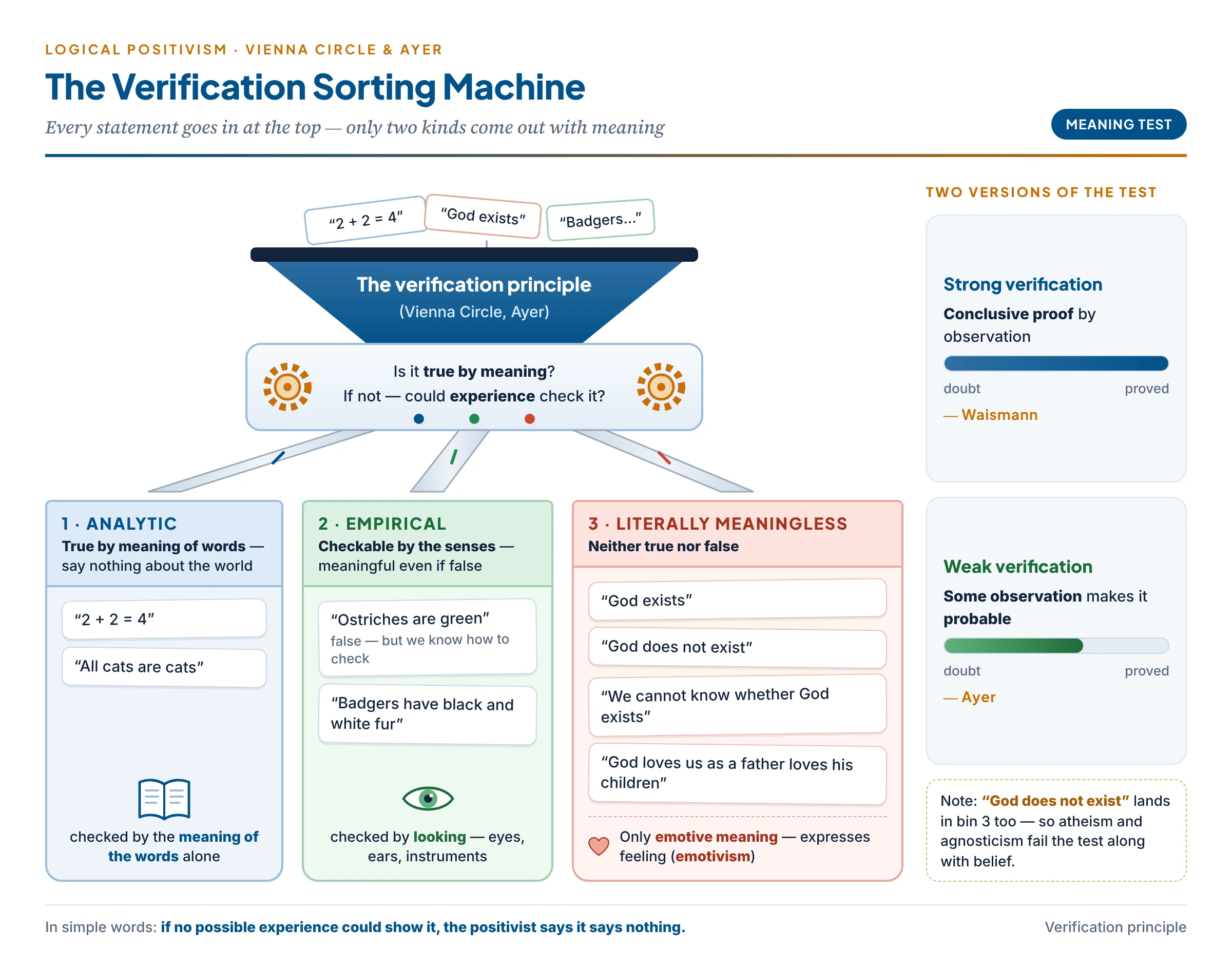
- Analytic statements — mathematics (“2 + 2 = 4”), tautologies (“All cats are cats”), truths of logic. They are true by the meaning of their terms but tell us nothing about the world.
- Empirical (synthetic) statements — factual claims that can be confirmed through the senses, especially by the methods of physics, chemistry and biology.
- Everything else — metaphysics, theology, much of ethics and aesthetics — is literally meaningless: not false, but nonsense in the technical sense (without factual sense).
“Meaningful” — a Logical, Not a Psychological, Term
- When we say “it was a very meaningful experience” or “it means a lot to me”, “meaningful” is psychological.
- For the positivists, “meaningful” is a logical term: a proposition has factual or cognitive meaning if it is in principle verifiable — or at least “probabilifiable” — by human experience. Its truth or falsity must make some possible experienceable difference.
- False but meaningful: “Ostriches are green” is false — but meaningful, because we know at once how to check it (look at an ostrich). “God loves us as a father loves his children” is not meaningful on this test, because there is no way to check it — so we cannot even ask whether it is true.
In simple words
Imagine the news one morning: “Overnight the entire universe, including you, your ruler and the speed of light, has doubled in size.” It sounds sensational — but what could ever show it? Every measuring rod doubled too, so every measurement comes out the same. A claim that makes no possible difference to any observation is, the positivist says, not a discovery but no claim at all. He thinks “God exists” is like that.
Core Doctrine
The Verification Principle — Strong and Weak
- Strong (conclusive) verification: a statement is meaningful only if it can be conclusively verified by observation. Friedrich Waismann stated it thus: “Anyone uttering a sentence must know under what conditions he calls it true and under what conditions he calls it false. If he is unable to state these conditions, he does not know what he has said. A statement which cannot be conclusively verified cannot be verified at all. It is simply devoid of any meaning.“
- Weak verification (adopted by Ayer): a statement is factual and meaningful if sense experience can go at least some way to confirming it — if some observation is relevant to its truth or falsity, making it probable. This became the more popular version, because the strong version would rule out even scientific laws and statements about the past.
- Verifiable in principle, not only in practice: “There are mountains on the far side of the moon” was meaningful even before anyone could go there, because we knew what observation would settle it.
Carnap and Ayer on “God”
- Carnap: “In its metaphysical use the word ‘God’ refers to something beyond experience. The word is deliberately divested of its reference to a physical being or to a spiritual being that is immanent in the physical. And as it is not given a new meaning, it becomes meaningless.” For Carnap, meaningful statements are only of three kinds — tautologies, contradictions and empirical (contingent) statements. Religious statements fit none of them; so, from the cognitive point of view, they are meaningless.
- Ayer, in Language, Truth and Logic (1936): “The term ‘god’ is a metaphysical term. And if ‘god’ is a metaphysical term, then it cannot even be probable that a god exists. For to say that ‘God exists’ is to make a metaphysical utterance which cannot be either true or false. And by the same criterion, no sentence which purports to describe the nature of a transcendent god can possess any literal significance.“
- Ayer’s argument in three steps:
- If we cannot verify the existence of God empirically, it is meaningless to say that there is a God.
- We cannot verify the existence of God empirically.
- So it is meaningless to say that there is a God.
- Ayer’s detailed points:
- “God exists” cannot be demonstrated: no proof from certain premises can establish it, since only tautologies are certain, and tautologies cannot yield existence.
- It cannot even be made probable: if “God” means a transcendent being, no regularity in nature makes “God exists” probable; if “God” just means the regularities of nature, then “God exists” says no more than “nature is regular” — and no believer means that.
- The notion is unintelligible: the idea of a person whose essential attributes are non-empirical is not an intelligible notion at all.
- Not atheism, not agnosticism: if “God exists” is nonsensical, so is “God does not exist” — and so is the agnostic’s “we cannot know whether God exists“, which assumes there is a real question to be unsure about. Ayer does not merely deny God’s existence; he denies the possibility of God’s existence being a genuine question. Needless to say, he rejects all the traditional arguments for God.
- The mystic’s claim: if a mystic says he has intuited God but cannot describe what he intuited, he admits it is ineffable — and then he is “bound to talk nonsense” when he describes it. Religious experience is interesting as psychology, not as knowledge.
- Believers half agree: they themselves say God is beyond experience — not verifiable strongly or weakly, directly or indirectly — and they would never accept “God exists” as an analytic truth. So by their own account it fails both tests.
- The emotive remainder: religious statements are pseudo-statements; they have no cognitive meaning, but they can express the feelings and emotions of religious persons (emotivism). In this sense they have meaning and importance — emotive, not factual (Article 6).
Wisdom’s Parable of the Gardener (“Gods”, 1944)
The Cambridge philosopher John Wisdom opened this chapter of the debate with a parable that later inspired Flew’s (Article 5):
- Two people return to their long-neglected garden and find among the weeds a few old plants surprisingly vigorous.
- One says: “It must be that a gardener has been coming and doing something about these plants.” They find that no neighbour has ever seen anyone at work.
- “He must have worked while people slept.” — “No, someone would have heard him; and anybody who cared about the plants would have kept down these weeds.”
- “Look at the way these are arranged — there is purpose and a feeling for beauty here. I believe someone comes, invisible to mortal eyes.”
- They examine the garden ever so carefully; sometimes they find things suggesting a gardener, sometimes things suggesting the contrary — even that a malicious person has been at work. They also study what happens to gardens left untended. Each learns all the other learns.
- At the end one says, “I still believe a gardener comes“, the other, “I don’t“. Their words now reflect no difference in what they have found, no difference in what they would find if they looked further, and no difference about how fast untended gardens fall into disorder.
- Wisdom’s point: the gardener hypothesis has “ceased to be experimental“. The theist and the atheist do not disagree about any experienceable facts; they react differently to the same facts — with a difference in how they feel towards the garden.
- Consequence: expressions of feeling are not assertions about the world. We cannot say one is right and the other wrong; at most their feelings are more or less satisfying — as Santayana said, “religions are not true or false but better or worse“. Neither position is verifiable, even in principle.

The Life-after-Death Test Case
- “Life after death” is clearly unverifiable this side of death. Is it therefore meaningless?
- It even looks contradictory — we are either alive or dead, not both.
- This test case matters, because the most important reply to the verificationist (Hick’s) turns precisely on life after death.
Critical Evaluation
What Can Be Said for the Positivists
- Verification does separate sense from nonsense in many cases: if I say my dog is a brilliant philosopher, you rightly doubt I am making sense until I point to some behaviour that gives the claim a (funny) meaning. If I say on Tuesday that it will rain on Wednesday, and on Thursday — after a dry Wednesday — insist I was right, you would be justly sceptical.
- God-talk is prima facie puzzling: “There are elephants in Africa” is clear to anyone; “God is transcendent” or “God is immanent” leaves many people at sea — and this is talk offered to everyone, not an experts’ jargon. God is not picturable, so imagination cannot help.
- A healthy discipline: the challenge forced theologians to say what their claims mean and what difference they make.
Criticisms of the Verification Principle
- Self-refuting: the principle itself — “only analytic or empirically verifiable statements are meaningful” — is neither analytic nor empirically verifiable. By its own criterion it is meaningless. (Even the weak version fails: what observation could count in favour of “a statement is meaningful only if some observation counts in its favour”?)
- It excludes too much: universal statements like “All people spend part of their lives asleep” cannot be conclusively verified (one may yet meet someone who never sleeps); “All cats are mortal” cannot be conclusively falsified (however old a cat, it may still die). Scientific laws, statements about the past, about other minds — all would be meaningless on the strong version.
- Possibility need not come first: the positivists assume we must settle “Is God’s existence possible?” before asking “Does God exist?” But proving a thesis possible is often hard apart from studying reasons for thinking it actually true — and proof that it is true is proof that it is possible. We may examine reasons for believing in God without first deciding whether there could be a God.
- We understand statements we cannot verify:
- Swinburne’s toys: “Some of the toys which to all appearances stay in the toy cupboard while people are asleep and no one is watching, actually get up and dance in the middle of the night and then go back to the cupboard leaving no traces of their activity.” We may be utterly incredulous — but we understand it; it is not meaningless.
- Swinburne’s sea: a man can understand “once upon a time, before there were men, the earth was covered by sea” without any idea of what geological evidence would count for or against it.
- Lung cancer: I cannot specify what would count against “people with lung cancer are in danger of death” — I am no medical expert — yet the statement is hardly meaningless.
- Not “ordinary meaning”: Schlick claimed the principle simply states how meaning is assigned “in everyday life and in science“. But many people — religious believers above all — find meaningful and factual a whole range of statements that are not confirmable by sense experience.
- The bridge-principle problem: no statement about unobservables is tested directly; it is tested only when joined to “bridge” statements linking it to observations. But then any statement can be made testable — join “God is perfectly good” to “if God is perfectly good, it will rain here tomorrow”, and the weather becomes “relevant”. No one has found a rule that lets in scientific theories and keeps out theological ones.
- Science itself defeats it: the atomic hypothesis was put forward long before anyone knew how to test it. If it had been meaningless until testable, it could never have become testable. Verificationism was progressively abandoned in the philosophy of science, its own birthplace.
- Ayer’s retreat: in response to an objection originating with Alonzo Church, Ayer himself acknowledged that the verification principle cannot be formulated satisfactorily — and that the same is true of criteria of meaning stated in terms of falsification.
- Too narrow an empiricism: the principle presupposes that sense experience is the only source of factual knowledge — a disputable theory of knowledge (religious experience, moral insight, intuition are excluded in advance).
- Critics fail their own test: Freud’s claims about the primal horde, the Oedipus complex and religion as “the universal obsessional neurosis of humanity” are no more verifiable than the believer’s — yet critics treat them as factual.
In simple words
A notice on a college wall says: “No notice may be put on this wall.” The notice breaks its own rule. The verification principle is in the same position: the sentence “only statements that can be checked by the senses or are true by definition are meaningful” can neither be checked by the senses nor is it true by definition. By its own rule, it should take itself down.
Common confusion
Did Ayer argue that God does not exist? No. Ayer was not an atheist in the ordinary sense. He held that “God exists“, “God does not exist” and “we cannot know whether God exists” are all equally meaningless — theism, atheism and agnosticism are ruled out together, because each treats “God exists” as a genuine factual question. Many notes write “Ayer proved God does not exist”; that is precisely what he said could not be said.
The Believer’s Replies
- 1. Eschatological verification (Hick) — religious statements are verifiable in principle, after death (below).
- 2. Falsifiability in principle (Crombie, Mitchell) — evil and suffering count against “God loves us”, so the statement is a real assertion (Article 5).
- 3. Behaviour as verification (Braithwaite) — religious assertions declare a policy of life, which can be checked in conduct (Article 6).
- 4. A different language-game (Wittgenstein) — demanding empirical verification of religious language is a category mistake (Article 7).
- 5. Reject the principle — since it is self-refuting and abandoned, the challenge simply lapses (Swinburne, Alston, Davies).
Hick’s Eschatological Verification
John Hick (1922–2012) accepted the positivists’ core idea — a factual assertion must make some experienceable difference — and argued that Christian theism passes the test.
Preliminary points:
- Verification is the removal of rational doubt: verifying a proposition is not the same as logically demonstrating it; it means that something happens which makes it clear that it is true, leaving no room for reasonable doubt.
- One may have to put oneself in position: “There is a table in the next room” can be verified only by going into the next room — though no one is compelled to go.
- Publicly verifiable does not mean verified by everyone: a proposition can be verifiable in principle by anyone, yet in fact be verified by only a few.
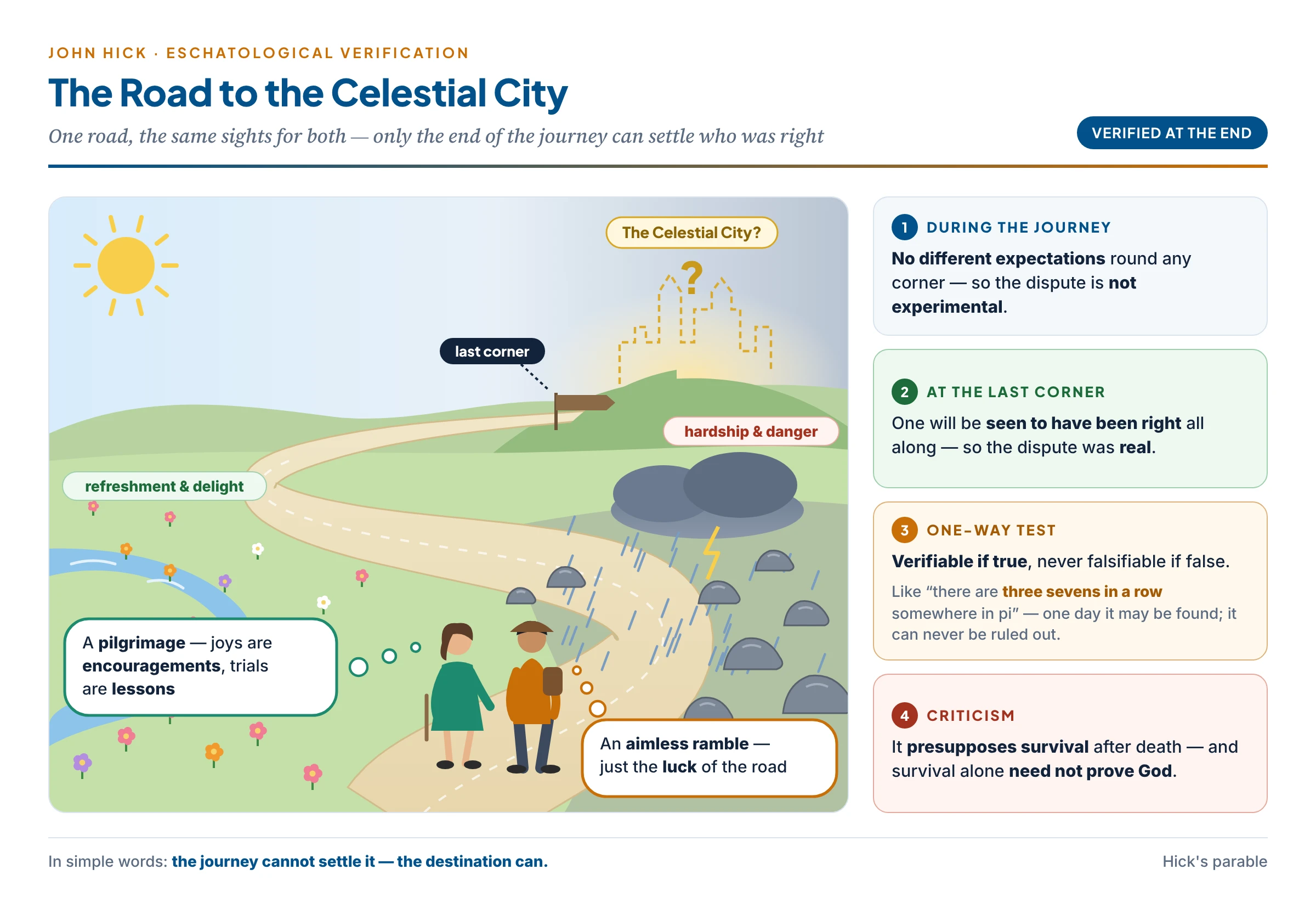
- Verifiable but not falsifiable: some propositions can be verified if true but never falsified if false. Example: “There are three successive sevens in the decimal expansion of pi.” So far no triple seven has been found, but as the calculation goes on for ever, the claim may one day be verified, yet can never be falsified.
- Survival is such a proposition: “There is conscious life after bodily death” will be verified in one’s own experience if true (one will remember dying), but cannot be falsified if false — no one will be there to experience its falsity. This does not make it meaningless: if true, it will be known to be true.
The parable of the Celestial City:
- Two people travel together along a road. One believes it leads to the Celestial City; the other that it leads nowhere. Since it is the only road, both must travel it. Neither has been this way before.
- On the journey they meet moments of refreshment and delight and moments of hardship and danger.
- She thinks of the journey as a pilgrimage: the pleasant parts are encouragements, the obstacles trials and lessons in endurance, prepared by the king of the city to make her a worthy citizen.
- He sees an unavoidable and aimless ramble: he enjoys the good, endures the bad; there is only the road and the luck of the road.
- During the journey the issue is not experimental — they do not expect different things round each corner.
- But when they turn the last corner, it will be apparent that one has been right all the time and the other wrong. So their disagreement was real, not merely a difference of feeling: their rival interpretations were “genuinely rival assertions“, whose assertion-status is “guaranteed retrospectively by a future crux“.
- The point: Jewish and Christian theism postulates an ultimate, unambiguous existence in patria (in the homeland) as well as our present ambiguous existence in via (on the way). The theist and atheist need not expect different events within history, but the theist expects that when history is completed it will be seen to have led to a particular end — the creation of “children of God“. This makes the choice between theism and atheism a real, not an empty or merely verbal, choice.
In simple words
Two cricket fans watch a match in which the scoreboard is broken. One says, “We are winning”; the other, “We are losing”. Ball by ball, they see the same play and interpret it differently. Nothing during the match settles it — but the final result will. Their disagreement was real all along, because the end will show who was right. Hick says theism and atheism are like that: the “result” is announced at the end of life.
Difficulties and Hick’s refinements:
- Survival alone would not verify God: an atheist who wakes after death with a new body in a new environment might take it as just a surprising natural fact. The afterlife could be as religiously ambiguous as this life.
- The Beatific Vision? — the traditional idea of seeing God is hard to make precise; taken literally it would make God an object in space. Hick prefers an experienced situation that points unambiguously to God’s reality — the data, instead of being ambiguous, will at all points confirm faith.
- The Kingdom of God: what would verify Christian theism is the experience of participating in the fulfilment of God’s purpose — becoming “children of God” in eternal life.
- The child and the adult: a child can use the concept “being grown-up” correctly without knowing what it is like; when she reaches adulthood she knows she has reached it. Likewise we have some notion of God’s purpose now (given, for Christians, in the person of Christ), and when we reach it the problem of recognising it will have disappeared.
Criticisms of eschatological verification:
- It presupposes survival: post-mortem verification assumes that there is life after death — which is part of what is in question.
- Survival is not God: as Hick admits, survival might verify survival, not theism.
- Personal identity: who would be the one verifying? If the body perishes, what makes the post-mortem person the same person who believed?
- Asymmetry: a claim that can be verified but never falsified looks suspicious to the falsificationist — the atheist can never be proved right.
- Too late to help now: future verification cannot serve as present evidence; Hick concedes it only shows that theism is a meaningful claim, not a true one.
- Only for some religions: it suits religions with a linear history ending in fulfilment; Buddhism (no God) or Advaita (no separate individual in liberation) would need different accounts.
Defences:
- Hick does not claim to prove God — only to show that religious statements are factual in principle, which is all the verification challenge demanded.
- His use of the principle is clever: in a way he uses the weak verification principle in reverse — not “verifiable now” but “verifiable in the end“.
- Mitchell’s partisan makes a similar point: the Stranger “will be able to reveal his true allegiance after the war“, just as the puzzling parts of faith will be revealed at the end of time (Article 5).
Are Religious Doctrines and Debates Verifiable?
- Historical doctrines (that the Buddha taught at Sārnāth, that Jesus was crucified) are partly verifiable by historical evidence.
- Cosmological claims (the world had a beginning) are partly testable against science.
- Moral teachings are verified, if at all, in lives (Braithwaite’s view; the “fruits” test).
- Metaphysical doctrines (God is infinite, Brahman is one without a second) are not empirically verifiable in this life; at most eschatologically (Hick) or in realisation (the Indian claim).
- Debates between theists and atheists, like Wisdom’s gardeners, are often not experimental — but Hick shows they may still be real debates about how things finally are.
Cross-Tradition Comparison
| Issue | Western | Indian |
|---|---|---|
| Sense experience as the test of meaning | Logical Positivism; Hume’s fork | Cārvāka: only perception (pratyakṣa) is valid; no God, soul or other world — a near-positivist |
| Verification in experience | Hick: eschatological verification after death | Anubhava: Upaniṣadic truths are finally verified in direct realisation; the jīvanmukta knows here and now |
| “Come and see” | Empirical testing | The Buddha’s ehipassiko — “come and see for yourself”; the Kālāma Sutta: do not accept on authority alone, test in experience |
| Validity of testimony | Testimony must be checkable | Śabda as an independent pramāṇa; Mīmāṃsā: knowledge is valid unless defeated (svataḥ-prāmāṇya) |
| Unanswerable questions | Ayer: pseudo-questions | The Buddha’s unanswered questions (avyākata) — set aside as not conducive to liberation |
Indian Connect — Indian Connect — verification by realisation
- Indian schools did not reduce meaning to sense-verification, but most held that religious truth must be verified in experience. Advaita teaches śravaṇa (hearing scripture), manana (reasoning) and nididhyāsana (meditation) culminating in aparokṣānubhūti — direct realisation. Like Hick’s traveller who finally sees the city, the seeker “verifies” the Upaniṣadic sentence when it becomes lived knowledge — but, unlike Hick, Indian traditions claim this can happen in this life.
- The Cārvāka shows that India too had a thoroughgoing empiricist critique of the suprasensible; the other schools’ replies — on inference, testimony and yogic perception — parallel the Western critiques of verificationism.
Critics and Defenders
Criticism — The verification challenge
- Only analytic or empirically verifiable statements are meaningful (Vienna Circle, Ayer).
- “God” in its metaphysical use is divested of reference (Carnap).
- “God exists”, “God does not exist”, “we cannot know” — all meaningless (Ayer).
- Theist and atheist differ only in feeling, not facts (Wisdom’s gardener).
- God-talk is prima facie puzzling — God is not picturable.
Defence — Replies to the challenge
- The principle is self-refuting and was abandoned — even Ayer admitted no satisfactory formulation (Church’s objection).
- It excludes science, history and universal statements; the atomic hypothesis was meaningful before it was testable.
- We understand unverifiable statements — Swinburne’s toys and ancient sea.
- Religious claims are verifiable in principle — at the end (Hick’s Celestial City).
- Religious language may do other jobs (Braithwaite) or belong to another language-game (Wittgenstein).
Synthesis (Siddhānta)
- The verification principle — only analytic or empirically verifiable statements are meaningful — led Ayer and Carnap to declare theology (and atheism and agnosticism) literally meaningless, leaving it at most emotive meaning.
- Wisdom’s gardener sharpened the point: theist and atheist share all the facts and differ only in attitude.
- The principle collapsed under its own weight: it is self-refuting, excludes science and history, cannot handle bridge principles, and was abandoned even by Ayer; Swinburne’s examples show we understand claims we cannot verify.
- Hick’s eschatological verification shows that theism can be a factual claim — verifiable (though not falsifiable) at the end of life — though it presupposes survival and verifies meaning, not truth.
- The debate leaves a lasting lesson: religious claims must say what difference they make. Indian thought meets this by locating verification in realisation — anubhava — while the Cārvāka reminds us that the empiricist challenge is not only Western.
“The term ‘god’ is a metaphysical term. And if ‘god’ is a metaphysical term, then it cannot even be probable that a god exists.” — A. J. Ayer
Previous Year Questions
- 2015How can religious language be verified? Is it correct to say that religious language is verified because it cannot be falsified? Discuss.
- 2013Can religious language be said to be verifiable?
- 2011Are religious doctrines and debates verifiable? Discuss.
- 2012Logical Positivism broadly claims that metaphysics and theology are meaningless because they are neither matters of logic nor verifiable empirically! Critically examine.
- 2009Examine how Ayer eliminates metaphysics.