

Nature of Religious Language: Analogical and Symbolic; Cognitivist and Non-cognitive.
Official Syllabus: Paper II, Section B, Unit 10
If God is infinite and wholly other, how can finite words say anything true about God? Two classical answers dominate the history of theology. The way of negation (via negativa) says we can only say what God is not. The doctrine of analogy, perfected by St Thomas Aquinas, says our words apply to God neither in exactly the same sense as to creatures (univocally) nor in a totally different sense (equivocally), but in a related, proportionate sense (analogically). This article explains both, with Aquinas’s analogy of attribution and of proportionality, the modern versions of Ian Ramsey (models and qualifiers), Ian Crombie (parables) and partial univocity, and the main criticisms and defences — together with the Indian parallels of neti neti, taṭastha-lakṣaṇa and Rāmānuja’s view that all words finally name God.
In simple words
You say a mango is “sweet“, a song is “sweet” and a child’s smile is “sweet“. You are not using the word in exactly the same sense (a song has no sugar), nor in a totally unrelated sense (as when “bank” means a river’s edge and a place for money). There is a real likeness — each gives a kind of delight — within a real difference. That in-between way of using one word for different things is what Aquinas calls analogy, and he thinks it is how we speak of God.
Context & Problem
The Dilemma Analogy Tries to Solve
- Religious language tries to describe the attributes of God — good, wise, loving, powerful. This is difficult because God is not something we have direct experience of, whereas most things our words refer to — love, rabbits, hair, walking — are things we can experience.
- So when we say “God is good“, we must ask how we are using “good”:
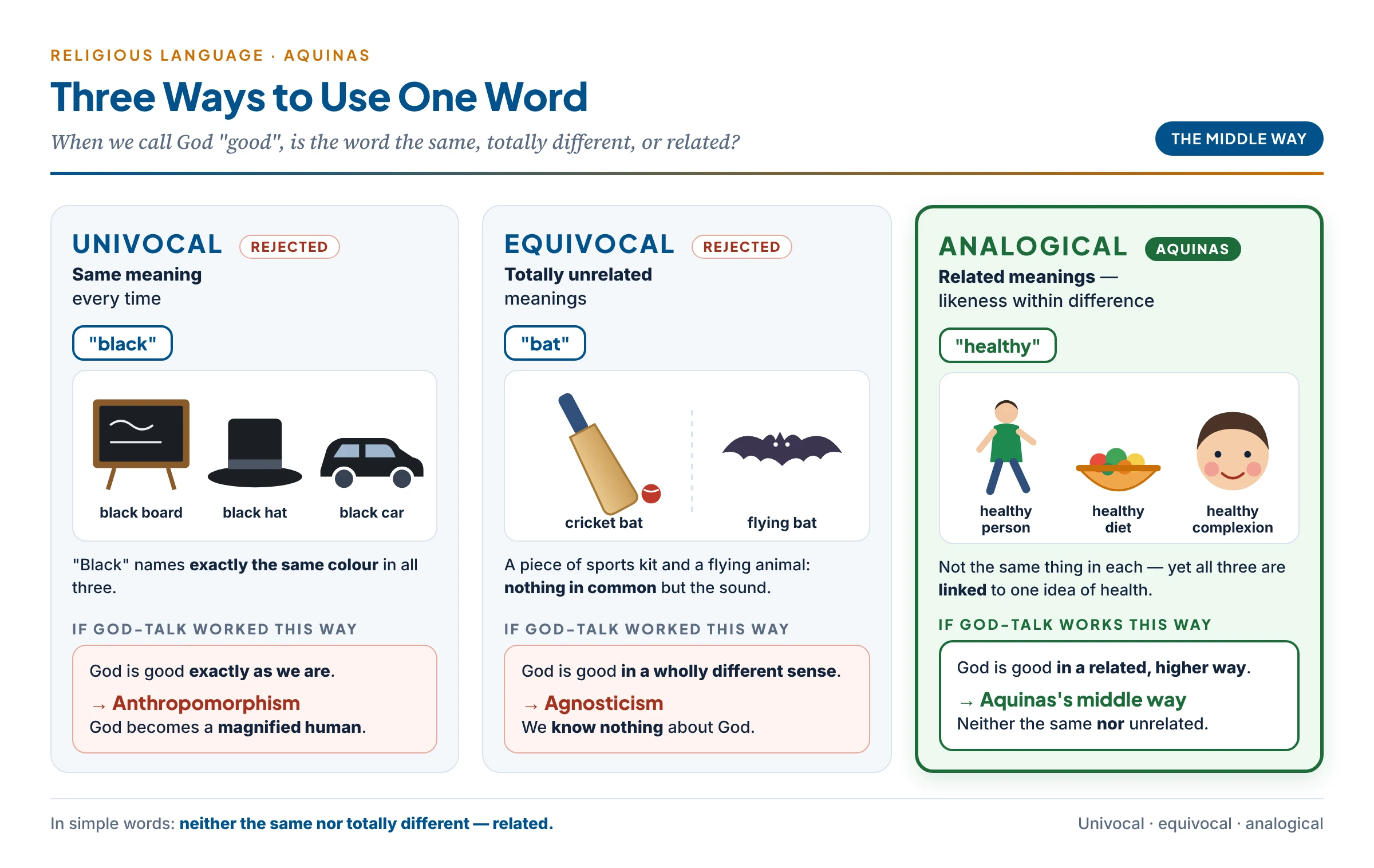
- Univocally — God is good in the same way humans are good. Then we make God a magnified human — anthropomorphism. Aquinas rejects this because God is perfect and imperfect humans cannot be good in the same way.
- Equivocally — God is good in a totally different way. Then we know nothing about God, because the language we use for humans and the experienced world does not apply — agnosticism. Aquinas rejects this too.
- Aquinas believed there is a middle way of talking meaningfully about God — analogy.
Three Ways of Using a Word
| Use | Meaning | Examples |
|---|---|---|
| Univocal | The word means exactly the same in every application | “Black board, black hat, black car” — “black” names the same colour each time; “Fido is a dog”, “Rover is a dog” |
| Equivocal | The word means totally different, unrelated things | “Bat” (cricket bat and flying mammal); “crane” (the bird and the lifting machine); “bank” (river’s edge and money house) |
| Analogical | The word means related but not identical things — similarity within difference | “Healthy” person, healthy diet, healthy complexion; “faithful” dog and faithful friend |
- Equivocal use robs a word of its original meaning: once “gay” came to be used mainly in a new sense, its older sense (“jolly”) was pushed aside. If all God-talk were equivocal, our words would lose their ordinary meaning the moment they touched God — and we would understand nothing.
What Is an Analogy?
- An analogy explains the meaning of something difficult to understand by comparing it with something within our frame of reference.
- A famous theological analogy — Paley’s watch: we have no direct experience of God as creator, but William Paley said God is like a watchmaker who designs an intricate timepiece for a purpose. We know watchmakers; through them we glimpse what “creator” might mean.
- Aquinas’s starting point: Aquinas (1225–74) was a believer who assumed that God exists and that God created the universe (in his day there was no Big Bang theory or theory of evolution to test the claims of Genesis). He held that religious belief is reasonable — that reason can show God’s existence (his Five Ways). His theory of analogy starts from confirmed belief and works backwards to justify our speech about God; modern students usually start from the opposite end, testing whether religious claims are justified at all.
Core Doctrine
The Via Negativa — Saying What God Is Not
Before analogy, there is the older and more austere way of negation (via negativa, also called apophatic theology, from the Greek “to deny”; its opposite, positive speech about God, is cataphatic).
- Pseudo-Dionysius (around 500 CE), the fountainhead of medieval mystical theology, wrote that the Divine is “not soul, not intellect… not greatness, not smallness… not moved, not at rest… not powerful, not power… not living, not life… not one, not unity, not divinity, not goodness“. One can hardly be more negative.
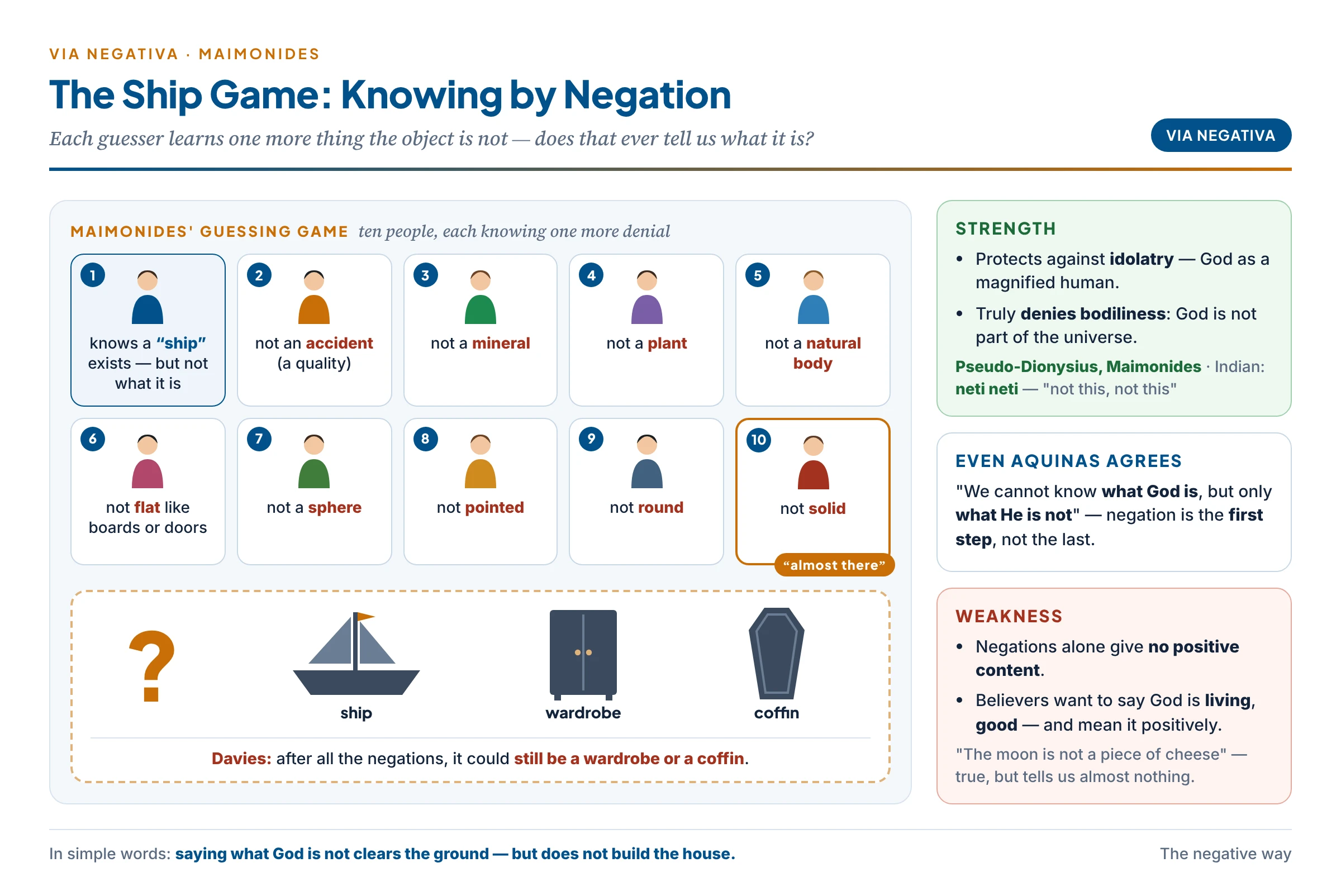
- Moses Maimonides (1135–1204), the great Jewish philosopher, argued that we should form as many negative attributes as possible and avoid positive ones. His illustration:
- A person knows that a “ship” exists but not what it is.
- A second learns it is not an accident (a quality); a third, not a mineral; a fourth, not a plant; a fifth, not a natural body; a sixth, not a flat object like boards or doors; a seventh, not a sphere; an eighth, not pointed; a ninth, not round; a tenth, not solid.
- The tenth person, says Maimonides, has almost arrived at the correct notion of a ship by negations alone. In the same way we come nearer to God by negative attributes. Whoever affirms positive attributes of God “unconsciously loses his belief in God“, because he makes God like a creature.
- Why negation has force:
- God is understood as the Creator, the source of all things and distinct from them all. If so, we can say truly what God is not — for example, God is not bodily: anything bodily is part of the universe and cannot explain there being a universe.
- Negation protects against idolatry — thinking of God as a magnified human being.
- Even Aquinas held that “we cannot know what God is, but only what He is not” — negation is the first step of his theory.
- Why negation alone fails:
- Negations give no idea of what a thing is. “The moon is not a piece of cheese” is true, but tells us almost nothing. Only in special cases does one denial settle the matter (“It’s not a boy” tells a new mother she has a girl). Suppose I say there is something in my room and reject every guess you make — you get no idea at all of what it is.
- Maimonides’ ship fails: someone with all his ten negations could equally be thinking of a wardrobe or a coffin.
- Believers want positive claims: they say “God is Creator“, “God is powerful“, “God knows“, “God is everywhere“, “God is good” — and mean them positively. As Aquinas drily puts it, when people speak of “the living God” they do not simply mean that he differs from a lifeless body.
- Total negation undercuts itself: to say “God is beyond all words” is already to say something.
Indian Connect — Indian Connect — neti neti and the via negativa
- The Bṛhadāraṇyaka Upaniṣad describes the Self as “not this, not this” (neti neti) — it is ungraspable, for it is never grasped. Śaṅkara reads this as the denial of every determination of Brahman: whatever can be pointed out as “this” is not the Self.
- Like Pseudo-Dionysius, Advaita uses negation to purify our idea of the ultimate. Unlike Maimonides, it does not stop there: negation clears the ground for the scriptural positive indications — satyaṃ jñānam anantam (“truth, knowledge, infinity”) — understood by implication (lakṣaṇā), not literally (Article 8).
Aquinas’s Theory in Three Steps
Aquinas explicitly asks: “Are words used univocally or equivocally of God and creatures?” His answer comes in three stages.
- Not univocally: God is infinite and incomprehensible, so there is an enormous difference between God and creatures. What “wise” signifies in God “is not confined to the meaning of our word but goes beyond it“. So “wise” is not used in the same sense of God and humans.
- Not always equivocally: if words were always used equivocally of God, “we could never argue from statements about creatures to statements about God” — yet we do (as in the Five Ways).
- Therefore analogically: words are used of God and creatures because of a real relation between them — and that relation is causal. Goodness in human beings can be said to exist in God because creatures and their properties derive from God as the first cause of all things.
- Not merely “God causes goodness”: Aquinas does not mean that “God is good” simply means “God causes goodness in creatures”. He means there is a real likeness between God and creatures that follows from their coming from God.
- Causes impose their character on effects: for Aquinas, causes and effects are not merely events we see “constantly conjoined” (as Hume thought). A cause is a thing of a certain kind that imposes its character on what it produces. “You cannot give what you have not got” — and though what you give may not look like you, it reflects what you are. So God’s world reflects God, and God can (in principle) be named from creatures.
- Two orders: in the order of knowing, we learn words like “good” and “wise” first from creatures. In the order of being, these perfections belong first and most perfectly to God, and only secondarily to creatures. Our words are learnt “upwards”, but their full meaning lies “above”.
In simple words
A son inherits his father’s generosity. Looking at the son, you learn something real about the father — the son’s generosity is from the father. Yet the father’s generosity may be far larger and freer than the son’s. Aquinas thinks creatures are related to God somewhat like this: every good thing in the world is from God, so its goodness tells us something real about God — while God’s goodness is the source, infinitely fuller than the copy.
The Analogy of Attribution (Analogia Attributionis)
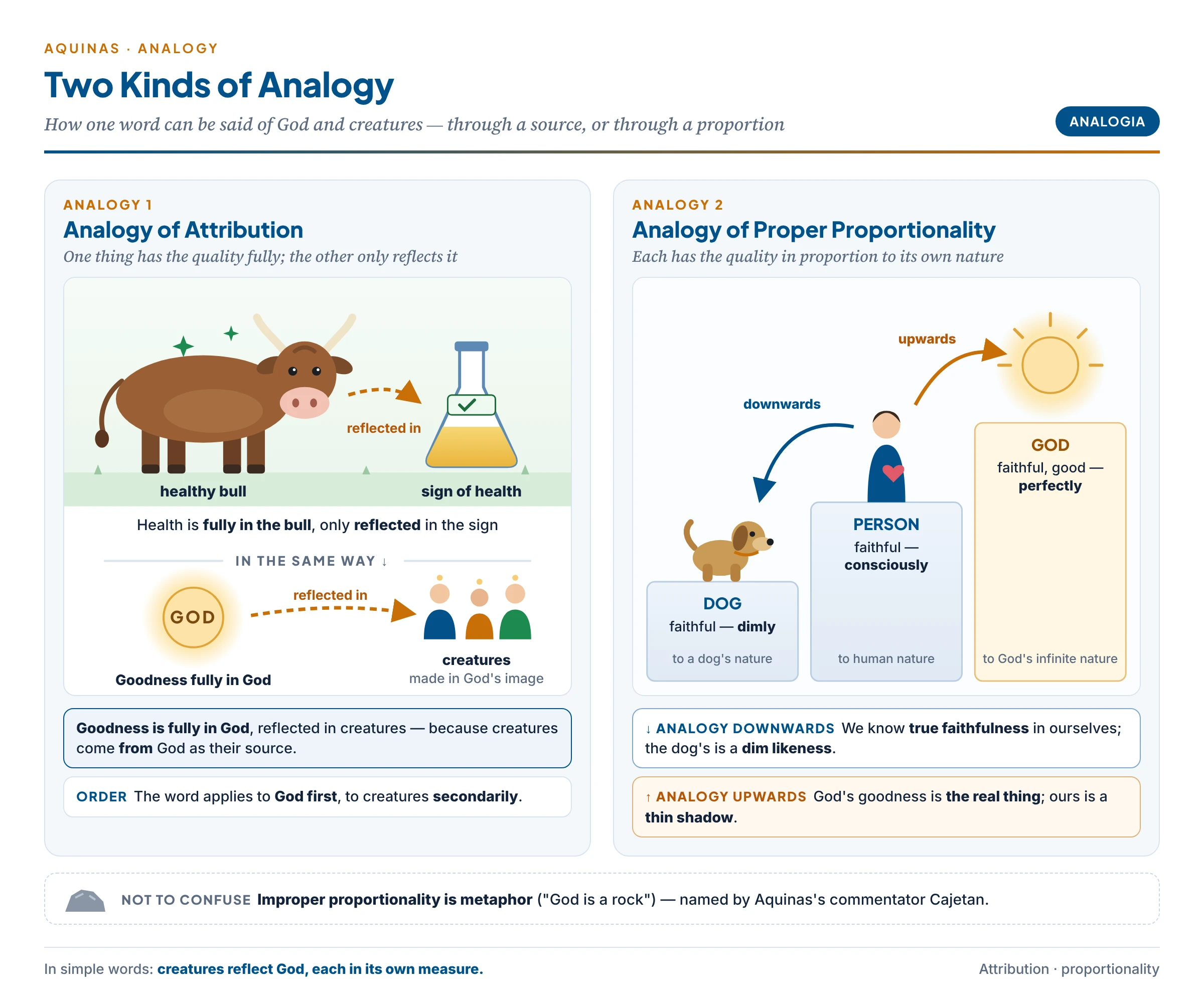
- Starting point: God is the source of all things in the universe and is universally perfect. All beings in the universe in some way imitate God, each according to its own mode of existence.
- Aquinas’s words: “God is called wise not only in so far as He produces wisdom, but also because, in so far as we are wise, we imitate to some extent the power by which He makes us wise. On the other hand, God is not called a stone, even though He has made stones, because in the name stone there is understood a determinate mode of being according to which a stone is distinguished from God. But the stone imitates God as its cause in being and goodness.”
- The bull and its urine (Aquinas’s “healthy” example): one can judge the health of an animal by examining its urine. If a bull’s urine is healthy, we can tell the bull is healthy. But health is more completely and perfectly in the bull itself; it is only reflected in the urine. In the same way, God is the source of qualities in the universe and possesses them first and most perfectly.
- Aquinas’s own fuller example: “healthy” is said of an animal (where health really is), of urine (because it is a sign of health) and of medicine (because it is a cause of health). The animal is the primary case; the other uses are named by reference to it. So too “good” belongs primarily to God and is said of creatures by reference to God.
- An order of reference: these qualities apply to God first and foremost, and to other things secondarily and analogically. Because we are created in the image of God, we have attributes like wisdom and goodness analogically; God has them perfectly.
- The point of the analogy: we attribute a quality to two things because one is the cause or source of it in the other. “Healthy” is said of urine because it is a sign of health in the animal; “good” is said of creatures because their goodness comes from God.
The Analogy of Proper Proportionality (Analogia Proportionalitatis)
- The idea: a quality belongs to each being in proportion to its nature. God’s goodness is to God’s nature as a human’s goodness is to human nature.
- John Hick’s example — the faithful dog: we say a man or woman is faithful, and we also say a dog is faithful.
- Similarity: there is a recognisable likeness in pattern of attitude and behaviour — otherwise we would not call the dog faithful at all. So the word is not equivocal.
- Difference: human faithfulness involves responsible, self-conscious deliberation and moral purposes; a dog’s does not. So the word is not univocal.
- Result: the word is used analogically — “at the level of the dog’s consciousness there is a quality that corresponds to what at the human level we call faithfulness.”
- Downwards and upwards:
- In the analogy downwards (from humans to dogs), true faithfulness is the one we know directly in ourselves; the dog’s dim, imperfect faithfulness is known only by analogy.
- In the analogy upwards (from humans to God) the situation is reversed: our own goodness, love and wisdom are the thin shadows and remote approximations; the perfect qualities of God are the true, normative reality, known to us only by analogy.
- So “God is good” means: there is a quality of the infinitely perfect Being that corresponds to what at our level we call goodness — and only in God is it found “in its true and unfractured nature“.
- Von Hügel’s dog: the Catholic thinker Baron Friedrich von Hügel (1852–1925) noted the faint, dim awareness a dog has of its master. If religion is true, God must be more obscure to me than I am to my dog — for God is not inferior or equal to me, but indefinitely superior, and yet sustains me with an “unpicturable intimacy”.
In simple words
An ant that carries a crumb twenty times its weight is “strong“; so is an elephant that uproots a tree, and so is a bridge that bears a train. We do not mean the ant can uproot trees. Each is strong in proportion to what it is. Aquinas says the same of “good”: a good knife, a good person and a good God are each good in the measure of their own nature — and God’s nature is infinite.
- Improper proportionality — metaphor: a third kind, named by Aquinas’s great commentator Cardinal Cajetan, covers metaphors such as “God is a rock” or “a smiling meadow” — the likeness is in an effect, not a real shared quality. Cajetan regarded proper proportionality as analogy in the strict sense.
Common confusion
Is analogy the same as metaphor? No. A metaphor can be denied literally: “God is a mighty fortress” — “Is God really made of stone?” — “No, I am speaking figuratively.” Analogy claims a literal but related sense: when the believer says “God is good” or “God is alive“, she cannot add “but not really”. Aquinas holds that perfection-words like good, wise, living, being apply to God properly (in fact, more properly than to creatures), only in a higher mode. Metaphor-words like rock, lion, shepherd apply only improperly. Many notes blur the two; the difference is the heart of the theory.
Analogia Entis — the Analogy of Being
- The deepest root of Aquinas’s view is the analogy of being (analogia entis): creatures have being; God is Being itself (in God, essence and existence are identical). Creatures’ being is participated from God’s.
- Its use in proofs: Aquinas felt the difficulty of proving an infinite God from finite data. The analogy of being was his expedient: things pertaining to God can be known on the analogy of excellences found in finite things.
- Its critics: many judge that the analogia entis “demonstrated more the difficulty of proving an infinite God from finite premises than solving it“. The Protestant theologian Karl Barth rejected it outright — no analogy runs from creature to God; there is only an “analogy of faith” given by God’s revelation.
Modern Versions of Analogy
Ian Ramsey — models and qualifiers:
- Ian Ramsey (1915–72), a philosopher and bishop, developed analogy in the twentieth century in Religious Language (1957).
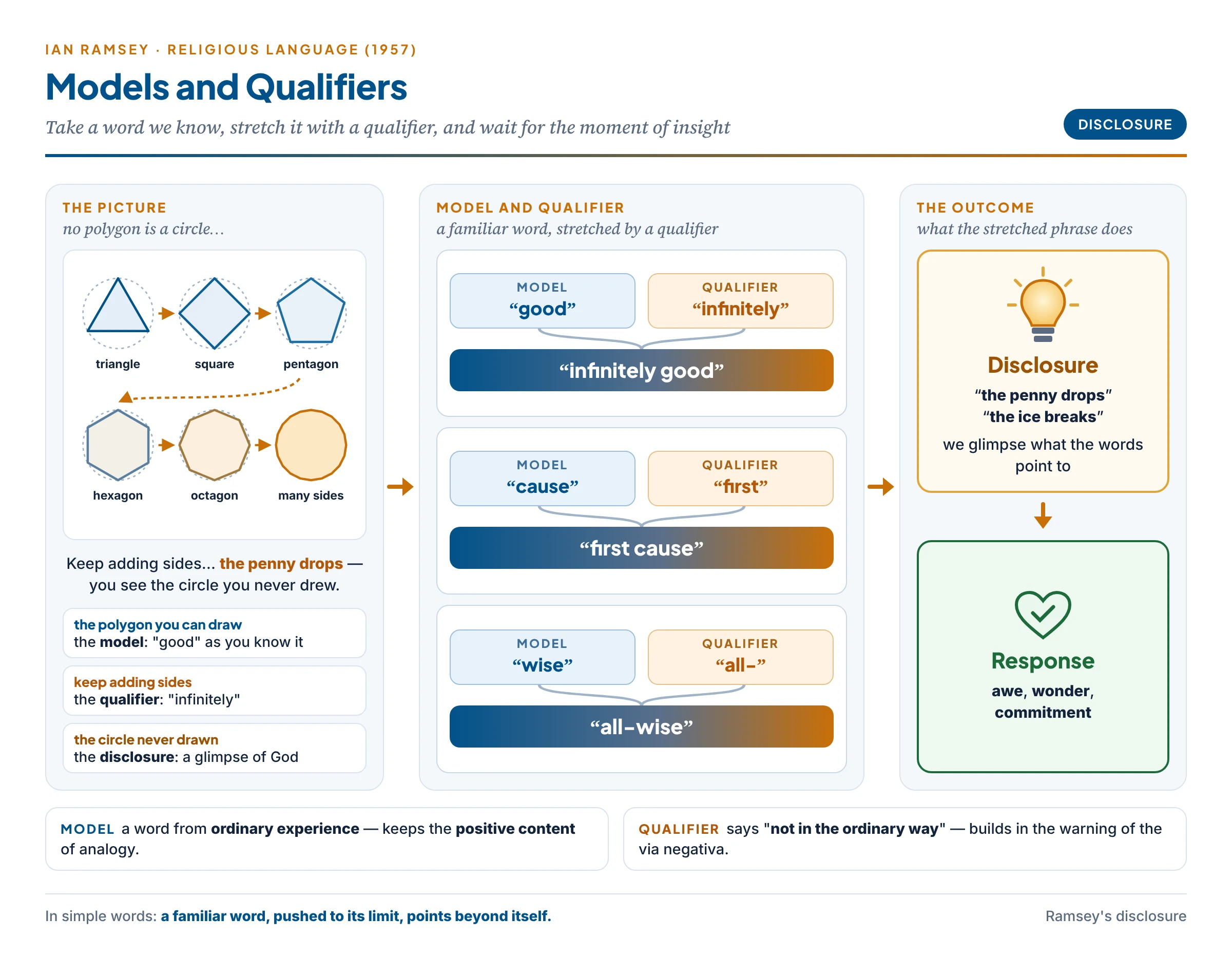
- Model: a word drawn from ordinary experience — “good“, “cause“, “wise“, “father“. When applied to God it is a model for understanding God’s nature.
- Qualifier: because we are dealing with God, the model must be adapted — we add a qualifier such as “infinitely“, “first“, “eternal“, “all-“. “God is good” becomes “God is infinitely good“; “cause” becomes “first cause“.
- The effect: the qualifier pushes the model further and further until a disclosure occurs — “the penny drops“, “the ice breaks” — and we glimpse a reality that the model points to but cannot contain. The disclosure calls for a response of awe, wonder and commitment.
- Why it matters: Ramsey keeps the positive content of analogy (the model) while building in the negative warning (the qualifier says “not in the ordinary way”) — a union of analogy and the via negativa.
In simple words
Draw a triangle, then a square, then a pentagon, a hexagon, and keep adding sides. No single figure is a circle, yet as the sides multiply, at some point you “see” what the series is heading towards. Ramsey’s model is the polygon you can draw (“good” as you know it); his qualifier is “keep adding sides” (“infinitely good”). The disclosure — the circle you never actually drew — is the glimpse of God the words point to.
Ian Crombie — speaking in parables:
- Crombie held that when we speak of God the words are used in their ordinary sense, although we do not suppose that in their ordinary interpretation they are strictly true of God; “we do not even know how much of them applies“.
- How then can we trust them? “What we do is in essence to think of God in parables.” The things we say of God are said on the authority of the words and acts of Christ, who spoke in parable; so we too speak of God in authoritative, authorised parable — knowing that “now we see in a glass darkly“, but trusting the source not to mislead us.
- Limit: this works only for those who accept the authority of the source — it is an account of meaning within a believing community.
The Incarnation as a partial solution:
- Christian theology distinguishes God’s metaphysical attributes (aseity, eternity, infinity) from God’s moral attributes (goodness, love, wisdom).
- The doctrine of the Incarnation claims that the moral attributes were embodied, as far as possible, in a finite human life — that of Jesus. So one can point to Christ to show what “God is good” or “God loves” means: Jesus’ compassion for the sick was God’s compassion; his forgiving was God’s forgiveness.
Partial univocity — a modern alternative:
- Some modern philosophers (notably William Alston) argue that complete univocity is impossible, but partial univocity is not:
- Why not complete: God has no body, so “God spoke” cannot include moving vocal organs, and “God parted the waters” cannot include moving arms. If God is timeless, God’s “planning” cannot involve moving through stages of time.
- What remains: subtract the bodily and temporal parts, and the core survives — willing something for the sake of a result, and the result coming about. God, being omnipotent, needs no bodily go-between. So a stripped-down concept of action applies to God and to us in the same sense.
- Functional concepts: a loudspeaker is anything that turns electronic signals into sound, whatever it is made of. Likewise if “knowledge” or “intention” is defined by its function in guiding action, it can apply to beings as different as God and humans.
- Richard Swinburne goes further: we do not really need analogy. “God is good” and “humans are good” may apply to very different things, but “good” means the same in both — it is used univocally.
- The classical reply: if God is absolutely simple (with no real distinction between God and God’s attributes, as Aquinas held), even partial univocity fails, because every human sentence divides subject from predicate. Hence Aquinas’s saying that, as to the way it signifies, “every name is defective“.
Two Other Answers Aquinas Rejected — Causation and Metaphor
- Causation: “God is good” means only “God causes good things” — as we call the person responsible for a mutilated corpse “horrifying” because the result is horrifying.
- Objection: causes do not always resemble effects — criminals can give birth to saints; makers of ice-cream are not made of ice-cream.
- Absurdity: God causes material, coloured things — is God then material and coloured?
- Metaphor: all talk of God is metaphor (“ship of State”, calling people “worms”).
- Objection: a metaphor can always be denied literally (“Is the State really a ship?” — “No”).
- Believers can say “God is not really a fortress”, but they cannot say “God is not really alive or good” — so not all God-talk is metaphor.
Critical Evaluation
Criticisms of the Doctrine of Analogy
- It rests on religious assumptions: Aquinas assumed that God created the world (as in the Five Ways) and that humans are made in the image and likeness of God (as Genesis says). The idea of creation has been challenged implicitly by Darwin and explicitly by Richard Dawkins. If one does not accept these assumptions, one need not accept that we can learn what God is like by examining a creation that may or may not be His.
- It picks only the good qualities: the world also contains evil. If creatures reflect their creator, does God possess evil qualities too? — Reply: Augustine argued that evil is not a thing but a privation (lack) of good, so there is no positive quality of evil to be traced back to God.
- It tells us nothing new: analogy works from what already exists — like trying to work out everything about a car designer from the car he designed. The car shows skill, but not the designer’s face, family or character.
- A bridge of imaginary blocks: the bridge Aquinas builds between the known and the unknown uses blocks whose other end we never see. — Reply: we can speak meaningfully of life on Mars without having experienced it; and eschatological verification (Article 4) suggests the far end may one day be seen.
- It cannot be verified: the object analogy tries to illustrate cannot be empirically verified, so analogy does not escape the verification and falsification challenges.
- We need prior knowledge of the other term: an analogy “A is to B as C is to D” works only if we already know something of each side. We know dog-faithfulness and human-faithfulness; we do not know divine nature — so the proportion has an unknown in it, and analogy collapses into agnosticism.
- It admits words are limited, yet asserts: analogy confesses that our words are inadequate but still makes assertions about God — some see this as wanting it both ways.
- Swinburne: unnecessary — “good” is used univocally of God and humans; the differences lie in what is good, not in the meaning of the word.
- Analogy is confusing: the distinctions between attribution, proper and improper proportionality are subtle even for scholars; ordinary believers do not use them.
- Grounds for choosing words: even if analogy is possible, why call God “good” and not “plastic” or “mammalian“? Why say God “acts” and not that he “sleeps” or “lives in a flat in London”? The grounds for applying a word to God must bear some relation to the grounds for its ordinary use — and these must be supplied.
Defences of the Doctrine of Analogy
- Ordinary language is full of analogy: Wittgenstein showed that “games” — board-games, card-games, ball-games, Olympic games — have no single common feature, only a network of similarities and relationships. Yet we use the word literally. Likewise “good” food, good books, good people, good wine, a good night’s sleep. So a word can be applied literally in different but related senses without being univocal or equivocal. That is exactly what the theory of analogy says, and in this it is surely right.
- Not a map but a framework: as Hick stresses, analogy does not profess to spell out the concrete character of God’s perfections. It does not claim to map the infinite divine nature; it explains how words are used of a God whose existence is presupposed. It allows limited statements about God without abandoning the sense of mystery that Jewish and Christian thought, at their best, have always kept.
- Valuable within the language-game of believers: the criticisms of people like Ayer are difficult to reject, and an analogical statement about God is impossible to verify. But analogy is incredibly valuable for those already inside the religious language-game — people who already believe. It helps them make sense of what is beyond comprehension and works as an aid to faith. That was Aquinas’s own standpoint.
- A middle way between two errors: analogy keeps believers from anthropomorphism (univocity) and from empty agnosticism (equivocity); it is the most balanced classical answer.
Is the Language of Analogy More Confusing?
- Why it can seem confusing: it says God is good — but not as we are; known — but not known; similar — but more dissimilar. The technical distinctions multiply.
- Why it is not really confusing: the confusion lies in the subject matter, not the method. Analogy simply makes explicit what every believer does when saying “God is my Father” — keeping the likeness while denying the limitation. Compared with Tillich’s symbol, analogy is clearer about content: it claims real, if imperfect, knowledge (Article 3 compares the two).
Critics and Defenders
Criticism — Against analogy
- Assumes creation and the image of God — rejected by Darwin and Dawkins.
- Selects only good qualities; what of evil in creation?
- Tells nothing new — like learning about a car designer from the car.
- Unverifiable — the far end of the analogy is never seen.
- Needs prior knowledge of God to set up the proportion.
- Unnecessary (Swinburne): “good” is univocal.
- The via negativa gives no content at all — Maimonides’ ship could be a coffin.
Defence — For analogy
- Ordinary language works this way: “healthy”, “good”, “games” (Wittgenstein).
- Evil is a privation (Augustine), so it does not count against attribution.
- Not a map of God but a framework for modest speech that keeps mystery (Hick).
- Aid to faith within the believers’ language-game.
- Ramsey adds qualifiers that keep negation inside analogy; partial univocity gives analogy a definite core.
- Avoids both anthropomorphism and agnosticism.
Cross-Tradition Comparison
| Theme | Western | Indian |
|---|---|---|
| Negation | Via negativa — Pseudo-Dionysius, Maimonides | Neti neti (Bṛhadāraṇyaka); “from which words turn back” (Taittirīya) |
| Speaking of God through effects | Analogy of attribution: creatures reflect their cause | Taṭastha-lakṣaṇa: Brahman indicated as “that from which the world arises, by which it lives, into which it returns” — a definition through its effects, like pointing out a house by the crow sitting on its roof |
| Speaking of God’s own nature | Analogy of proportionality; God is Being itself | Svarūpa-lakṣaṇa: satyaṃ jñānam anantam — truth, knowledge, infinity — understood by implication (lakṣaṇā) |
| Words apply first to God | Perfections belong first to God, secondarily to creatures | Rāmānuja: since the whole world is the body of God, every word in its full sense finally denotes God as the inner Self of all things |
| Models and qualifiers | Ramsey: “infinitely good”, “first cause” | “Ananta” (infinite), “para” (supreme), “sarva-” (all-): qualifiers that lift ordinary words towards the ultimate |
Indian Connect — Indian Connect — Rāmānuja and Aquinas
- Aquinas: perfection-words apply first to God and only derivatively to creatures, though we learn them from creatures.
- Rāmānuja: since souls and matter are the body (śarīra) of Brahman, a word like “cow” or “man” in its complete meaning refers to the cow or man as ensouled by God; hence all words, in their final reach, name Brahman. Both thinkers hold that our words are not cut off from God — creation itself makes God-talk possible.
- Difference: Aquinas keeps a sharp gap between Creator and creature (analogy); Rāmānuja binds them as body and soul (śarīra–śarīrī), which brings his view closer to univocity than Aquinas would allow.
Synthesis (Siddhānta)
- God-talk faces a dilemma: univocal language leads to anthropomorphism, equivocal language to agnosticism.
- The via negativa (Pseudo-Dionysius, Maimonides, neti neti) protects God’s transcendence and truly denies bodiliness and limitation — but negation alone gives no positive content.
- Aquinas’s analogy is the classical middle way: attribution (creatures reflect their cause, as urine reflects a bull’s health) and proportionality (each being has a quality in proportion to its nature, as with the faithful dog), grounded in creation and the analogy of being.
- Modern developments — Ramsey’s models and qualifiers, Crombie’s parables, the Incarnation, and partial univocity — refine the theory.
- Criticisms (assumptions, evil, no new knowledge, unverifiability, need of prior knowledge, Swinburne’s univocity) are serious; but the defences — Wittgenstein’s family resemblance, analogy as a framework rather than a map, its value within faith — keep it the most balanced classical account.
- The Indian tradition offers close parallels — neti neti, taṭastha and svarūpa lakṣaṇa, and Rāmānuja’s all words name God — showing that the problem and its middle-way solutions are universal.
“We cannot know what God is, but only what He is not.” — Thomas Aquinas
Previous Year Questions
- 2024Explain the analogical nature of religious language.
- 2017Is not the language of analogies more confusing and the language of symbols more unintelligible? Evaluate in the case of religious language.
- 2010Religious language is dependent on natural language for an analogy and a symbol to work. Why not treat religious language as a specialized language like telegraphic language? Discuss.