

Nature of Religious Language: Analogical and Symbolic; Cognitivist and Non-cognitive.
Official Syllabus: Paper II, Section B, Unit 10
After analogy and symbol, verification and falsification, bliks, policies and language-games, one question remains: is religious language cognitive or non-cognitive? Does “God exists” state a fact that is true or false, or does it do some other job? This final article sets out the cognitivist account in full — realism, Hick, Mitchell, Crombie, Swinburne and William Alston’s case for literal talk about God — reads “God exists” both ways, asks whether religious language carries cognitive content, whether either account falls into contradiction, and which view is most satisfactory. It closes with a graded synthesis drawing on both Western and Indian thought: religious language is cognitive at its core, analogical and symbolic in its reach, expressive and committing in its use, and silent at its limit.
In simple words
A daughter writes to her father abroad, “I know you love me.” Is she stating a fact or expressing a feeling? Both. She is making a claim that could be true or false (he might not love her), and at the same time expressing trust, gratitude and a commitment to the relationship. Most religious sentences are like her letter — and the mistake of many theories is to keep only one half.
Context & Problem
The Two Families — a Recap
| Cognitivist | Non-cognitivist | |
|---|---|---|
| What religious statements do | State facts about a transcendent reality | Express feelings, intentions, outlooks, or play a role in a form of life |
| True or false? | Yes — truth-apt | No — neither true nor false in the factual sense |
| Theory of truth | Correspondence (realism) | Use, coherence, function (anti-realism) |
| Main supporters | Aquinas (analogical), Hick, Mitchell, Crombie, Swinburne, Alston; Tillich (symbolic) as quasi-cognitive | Ayer, Carnap (emotive), Braithwaite (conative), Hare (blik), Randall, Wittgenstein and Phillips, Cupitt |
| Answer to verification | Verifiable in principle (eschatologically); or the principle is self-refuting | Accept that religious statements are unverifiable — and find other meaning |
| Indian counterparts | Nyāya, Rāmānuja, Advaita (scripture reveals an existing reality) | Mīmāṃsā’s arthavāda (encouragement), the gods as words |
The Quasi-cognitive Middle
- Analogical (Aquinas, Ramsey) and symbolic (Tillich) theories claim that religious language gives some sort of vague or imperfect knowledge of God — more than feeling, less than literal description. They are best counted as cognitive in intention, non-literal in form.
Core Doctrine
The Cognitivist Account
1. Realism:
- A statement is true if it corresponds to the state of affairs it attempts to describe. Most theists are realists about God: they may not know whether a given statement about God is true, but they hold that there is a truth to be known.
- Religious language, on this view, provides special knowledge about transcendental realities; verification and falsification are possible at least in theory.
2. John Hick — faith as cognitive:
- Religious statements like “God exists” and “God is omnipresent” are not expressions of feeling but descriptions of God.
- Faith is cognitive: the believer’s awareness of God rests on direct experience — he apprehends God in and through his material and social environment. Moments of ordinary life have religious significance; religious experience is “the whole experience of a religious person” — he feels the pressure of divine command in conscience and sees God’s grace in the beauty of nature.
- Hick concedes that this experience cannot demonstrate God’s existence — but neither can we demonstrate the existence of the real world; both are matters of interpretative trust (“experiencing-as”).
- Religious statements are verifiable after death — eschatological verification (Article 4).
3. Basil Mitchell and Ian Crombie:
- Religious statements are significant articles of faith: real assertions, against which evil counts, though not decisively (Article 5).
- “God is love” would be falsified by utterly pointless suffering — so it is a real claim (Crombie).
4. Richard Swinburne:
- Meaning requires understanding, not verifiability or falsifiability — the toys in the cupboard (Articles 4–5).
- Belief in God can be supported by a cumulative case of arguments and experience that make it more probable than not.
5. William Alston — literal talk about God:
- There are statements about God with truth values, and they are foundational to religious life: they make explicit the rationale for petitionary prayer, confession, thanksgiving and worship. Without “God hears prayer” being true, petition loses its point.
- Much God-talk is literal, not metaphorical:
- Negative statements — “God is immaterial, not restricted to one place, not dependent on anything” — are literal.
- Statements about God’s effects — “God comforted me in my distress”, “God forgives the truly repentant” — report effects literally, without detailing the divine action itself.
- Very abstract terms — “exists”, “powerful”, “not dependent on anything” — apply to God and creatures in the same sense.
- Partial univocity: more concrete terms (action, intention) can be analysed into an abstract core that applies univocally and a concrete part that does not (Article 2).
- Beyond literal speech: what partial univocity cannot say is left to metaphor, symbol, model and “pointing in a certain direction”. Jesus, asked how to pray, did not give a philosophical definition; he said “Our Father” — a metaphor.
In simple words
You have never met the first Prime Minister of a far-off country, and you cannot describe him except “a statesman from long ago“. Yet when you say his name, you refer to him — because the name has been passed down to you, person to person, from people who knew him. Believers often refer to God the same way: through a chain of worshippers going back to those who claimed to meet God — and only partly through a list of attributes.
6. How “God” refers:
- Descriptive reference: we pick out God by descriptions that fit God alone — “the omniscient knower”, “the omnipotent agent”, “the source of being for everything else”.
- Direct reference: we also refer to God as the one encountered in prayer, worship and sacrament, standing at the end of a chain of transmission going back to the experiences of the founders of a tradition — as people refer to “Aristotle” without being able to describe him uniquely.
- Why it matters:
- If reference is fixed mainly by descriptions, the attributes “call the shots” — what lacks them is not God.
- If reference is fixed mainly by experience, people with very different descriptions could still be referring to the same Reality — which opens a door to religious pluralism (Unit 09).
7. “Exists”, “fact” and “real”:
- Does “exists” have one meaning? “Do flying fish exist?” asks about organisms in the sea; “Does the square root of minus one exist?” asks about mathematical conventions; “Does the Freudian superego exist?” asks whether to accept a picture of the psyche. What does “Does God exist?” ask?
- Hick’s suggestion: the common core of “existence”, “fact” and “reality” is “making a difference“. To say God exists is to claim that the universe differs in some specific way from how a God-less universe would be — in its past, present and future (the eschatological difference).
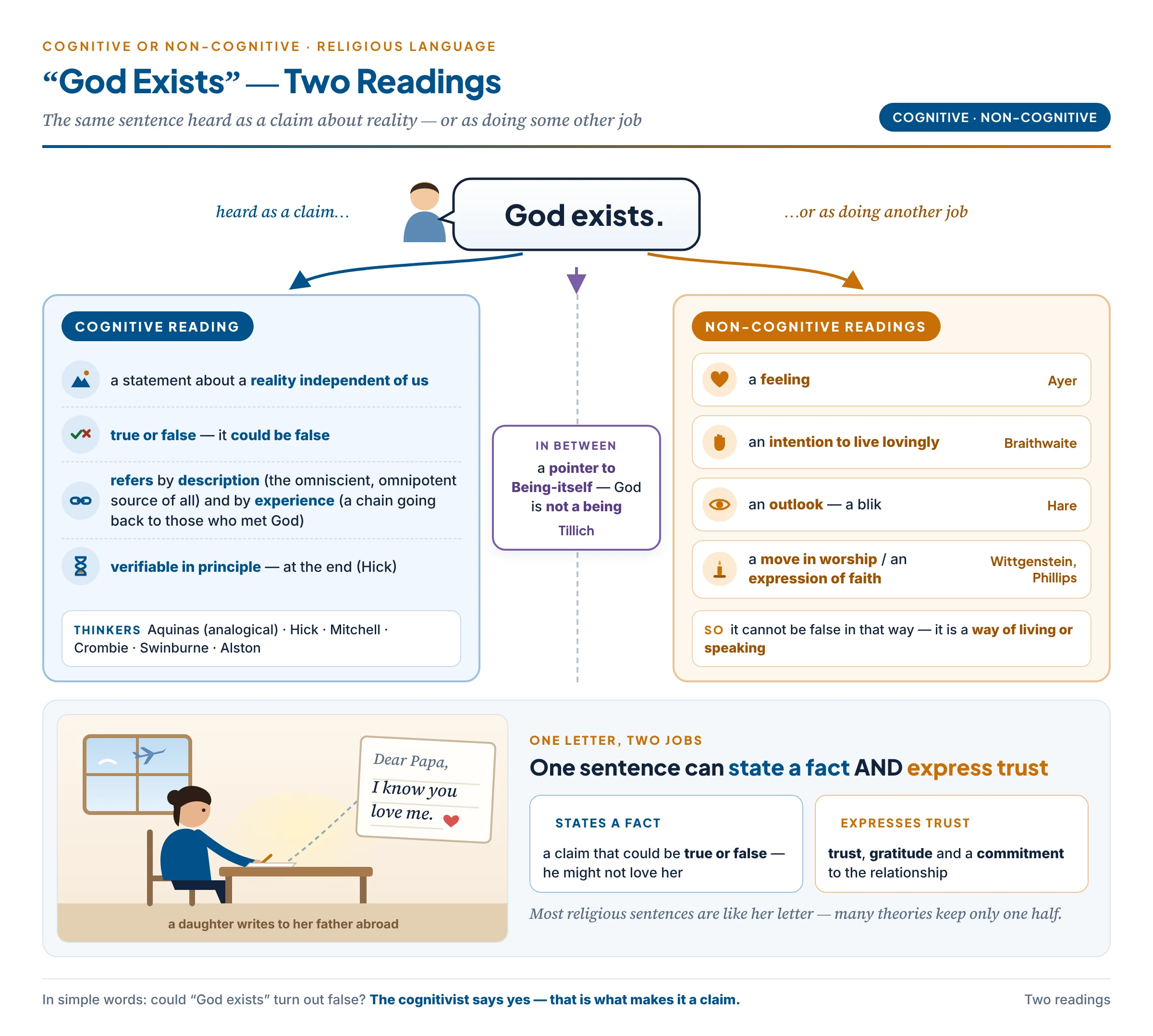
“God Exists” — the Cognitivist and Non-cognitivist Readings
| Reading | What “God exists” means | Strength | Weakness |
|---|---|---|---|
| Cognitivist (realist) | There is a being — Creator, personal, infinite — independent of human belief; the sentence is true or false | Matches what believers intend; grounds worship and hope | Hard to say how it could be checked; faces verification and falsification challenges |
| Analogical | God exists, but “exists” applies in a related, higher sense (God is existence itself) | Keeps truth and transcendence | Content is imperfect; relies on creation |
| Symbolic (Tillich) | God is Being-itself, not a being; to argue that God “exists” like other things is to make God finite — Tillich even said that to argue that God exists is to deny him | Guards against idolatry | Unclear what is asserted |
| Emotive (Ayer) | Expresses religious feeling; states nothing | Explains warmth of devotion | Says believers mean nothing they think they mean |
| Conative (Braithwaite) | Declares an intention to live a certain way | Ties religion to conduct | Leaves God a character in stories |
| Blik (Hare) | Expresses a basic outlook on the world | Explains firmness of faith | No criterion of sane vs insane |
| Language-game (Phillips) | “There is a God” is an expression of faith, not a statement about an object; God is not “an existent among existents” | Respects depth; not bad science | Excludes “the idea of God, and yet no God” |
- The key difference: for the cognitivist, “God exists” can be false — and that possibility is what makes it a claim worth staking a life on. For the non-cognitivist, it cannot be false in that way — it is a way of living or speaking.
In simple words
“The river Sarasvatī flows underground at Prayāg.” A geologist hears a claim to be tested; a pilgrim hears a sacred story that gives the confluence its holiness; a poet hears a symbol of hidden grace. The same sentence can be taken cognitively, symbolically or devotionally. The debate about religious language is partly a debate about which hearing is primary — and whether the others survive if the first one fails.
Does Religious Language Carry Cognitive Content?
Arguments that it does:
- Believers intend it: ordinary believers are realists who mean “God loves us” as true (Hick). A theory that denies this is a reform proposal, not a description.
- Worship presupposes it: praise, thanksgiving and petition make sense only if someone is there to hear (Alston).
- Ethics depends on it: the loving life is rational only if reality is as faith says — the house on rock (Hick against Braithwaite).
- History matters: claims about the Buddha’s enlightenment, Jesus’ resurrection, the Prophet’s revelation are historical in form; believers care whether they happened.
- Some God-talk is plainly literal: negations, statements about effects, abstract predicates (Alston).
- Reasons are given: religious beliefs are argued for and against — proofs, problem of evil, religious experience — which only makes sense if they are cognitive.
- The verification and falsification criteria have collapsed, so they cannot rule out cognitive content (Articles 4–5).
- Indian thought agrees: scripture is a pramāṇa (means of knowledge) in Nyāya and Vedānta; Brahman-knowledge is knowledge (jñāna), not a feeling.
Arguments that it does not (or not fully):
- No empirical test in this life, and believers often allow nothing to count against their claims (Flew).
- Transcendence: if God is beyond all categories, literal content is impossible (via negativa, neti neti, Tillich).
- Functions dominate: much religious language is praise, vow, story, ritual (Braithwaite, Wittgenstein).
- Diversity: conflicting religious claims suggest cultural expression rather than knowledge (non-realists).
Conclusion: religious language does carry cognitive content, but that content is partial, analogical and often symbolic, and it is always embedded in expressive and practical uses. “Cognitive” does not mean “scientific“.
In simple words
“If it rains, the match will be cancelled. It is raining. So the match is cancelled.” The word “rains” must mean the same thing in both sentences for this reasoning to work. Believers reason the same way: “If God loves us, we should love one another; God loves us; so…” If “God loves us” were only a sigh of feeling, it could not sit inside an “if” — nobody sighs in an “if” clause. That is why a purely expressive theory struggles to explain religious reasoning.
Does Either Account Fall into Contradiction?
- The charge against cognitivism (Braithwaite, Flew): it claims factual status for statements that nothing could test — a “fact” that makes no difference (Article 6).
- Reply: some facts are verifiable only in the end (Hick) or in principle (Crombie); evil does count (Mitchell); and strict empiricism is itself disputable.
- The charges against non-cognitivism:
- Braithwaite’s ethics makes “Lying is wrong, but I intend to lie” a contradiction (Hick).
- Tillich needed one literal statement (“God is Being-itself”) to deny that any are literal.
- Phillips must say that “true” and “exists” mean something different in religion — yet “Jesus rose” is true if and only if Jesus rose.
- The embedding problem: we reason with religious sentences — “If God loves us, we should love one another; God loves us; so we should love one another.” This is a valid inference only if “God loves us” means the same thing in the “if” clause (where nobody is expressing a feeling or a vow) and in the plain statement. A purely expressive reading cannot explain why the reasoning is valid. (Philosophers call this the Frege–Geach problem; it troubles all non-cognitive theories.)
- All claims become one: if every Christian doctrine declares the same agapeistic policy, “God created the world” and “Christ rose” would mean the same — absurd.
- Verdict: cognitivism faces an epistemological difficulty (how do we know?); non-cognitivism faces logical and descriptive difficulties (it cannot explain reasoning with religious sentences or what believers mean). The first is the lighter burden.
Which View of Religious Language Is Most Satisfactory?
Criteria for judging a theory:
- Fidelity — does it describe how believers actually use religious language?
- Coherence — is it free of self-refutation and contradiction?
- Transcendence — does it respect the otherness of the divine (avoid anthropomorphism)?
- Content — does it allow religious statements to say something (avoid emptiness)?
- Range — does it explain the many uses — assertion, praise, prayer, story, ritual?
- Resilience — can it meet the verification and falsification challenges?
- Cross-cultural reach — does it illuminate other traditions?
| Theory | Fidelity | Coherence | Transcendence | Content | Range | Resilience |
|---|---|---|---|---|---|---|
| Verificationist verdict (meaningless) | Poor | Self-refuting | — | None | Poor | — |
| Via negativa | Partial | Good | Excellent | Poor | Poor | Good |
| Analogy (Aquinas, Ramsey) | Good | Good | Good | Good | Moderate | Moderate |
| Symbol (Tillich) | Good | Moderate (one literal statement) | Excellent | Weak | Good | Good |
| Eschatological verification (Hick) | Good | Good | Moderate | Good | Moderate | Good |
| Mitchell’s articles of faith | Good | Good | Moderate | Good | Moderate | Good |
| Braithwaite | Poor | Weak | — | Poor | Moderate | Good |
| Hare’s bliks | Partial | Weak (sane/insane) | — | Poor | Moderate | Good |
| Language-games (Wittgenstein, Phillips) | Partial | Moderate | Good | Weak | Excellent | Good (by construction) |
| Partial univocity (Alston) | Good | Good | Moderate | Good | Moderate | Good |
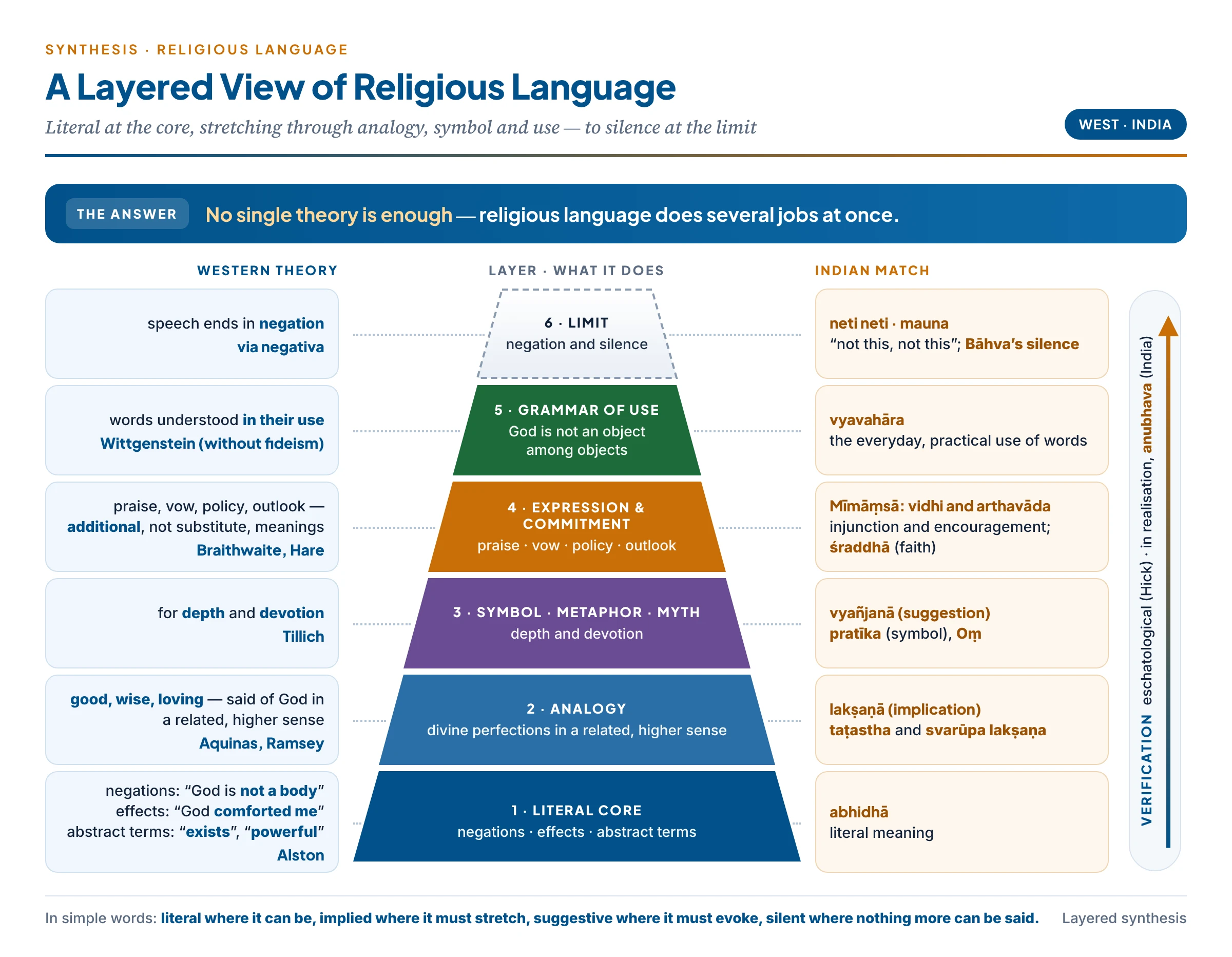
The answer — no single theory, but a layered view:
- No single theory is fully satisfactory, because religious language does several jobs at once. Each theory captures one layer and fails when it claims to be the whole.
- The most defensible combination:
- A cognitive core: some literal claims — negations, effects, abstract predicates (“exists”, “powerful”) — and real assertions held as articles of faith (Alston, Mitchell).
- Analogy for the divine perfections — good, wise, loving — in a related, higher sense (Aquinas, Ramsey).
- Symbol, metaphor and myth for depth, devotion and the transformation of the whole person (Tillich).
- Expressive and committing uses — praise, vow, policy, outlook — recognised as additional, not substitute, meanings (Braithwaite, Hare).
- The grammar insight of the language-game view — God is not an object among objects; religious words must be understood in their use — without its fideist isolation (Wittgenstein).
- A frank recognition of limit — negation and silence at the edge of speech.
- In one sentence: the positivist criterion was too narrow and has been abandoned even by its authors; the non-cognitivist rescues concede too much, since believers do not take themselves to be merely expressing attitudes; the best account combines analogy for content, the language-game point about grammar for use, and Mitchell’s insistence that a faith which nothing could count against has ceased to be faith and become obstinacy.
Where the Debate Stands Today
- Face value: the default view in philosophy of religion today is that religious statements are what they appear to be — truth-apt assertions — unless strong reasons show otherwise.
- Verificationism is regarded as refuted; the objections to it are widely judged conclusive.
- Non-cognitivism survives mainly in revised forms — such as religious fictionalism, which treats religious talk as a valuable fiction that people may engage in without believing literally (a modern relative of Braithwaite’s stories).
- Apophatic (negative) theology has enjoyed a revival, as has interest in metaphor as a genuine way of knowing — “speaking about one thing in terms which are seen to be suggestive of another“.
- Comparative philosophy has brought Indian, Buddhist and Islamic theories of language (lakṣaṇā, apoha, two truths) into the discussion.
Common confusion
If religious language is “cognitive”, must it be scientific? No. “Cognitive” means truth-apt — capable of being true or false — not testable in a laboratory. History, mathematics, ethics (on many views) and statements about other minds are cognitive without being experimental science. The positivists’ mistake was to identify meaning with scientific verifiability. A believer can hold that “God loves us” is true while admitting that no experiment can show it — and that its truth is known, if at all, by experience, testimony, reasoning and, perhaps, at the end.
The Other Side — What Non-cognitivists Rightly Insist On
- Religious language is never merely informative: “God is love” is a claim, but it is also a call, a comfort and a commitment.
- The meaning of religious words is learnt partly by living them — grace, agape, bhakti, śaraṇāgati are fully understood only within a form of life.
- Treating religion as bad science misreads it (Wittgenstein against Frazer).
- Critics too must face the tests: Freud’s claims are no more verifiable than the believer’s; the critic plays a language-game of his own.
- When we speak of “loving God“, the word “love” is stretched — “father”, “shepherd”, “love” are shipped into a new context and slightly adjusted; the believer must not suppose that her private intention fixes their meaning. “It is not that there is nothing to be sensibly communicated; the fault lies not in us, but in our language.“
Critical Evaluation
Critics and Defenders
Criticism — Against the cognitivist verdict
- Religious statements cannot be verified in this life and are often held immune to counter-evidence (Ayer, Flew).
- If God is beyond categories, no literal content is possible (via negativa, neti neti, Tillich).
- Much religious speech is praise, vow, story and ritual, not assertion (Braithwaite, Wittgenstein).
- Religious diversity suggests cultural expression rather than knowledge (non-realists).
- Cognitivism risks treating God as an object among objects.
Defence — For the cognitivist core
- Believers intend their claims as true; worship and prayer presuppose a hearer.
- Only factual beliefs make the religious life rational (Hick’s house on rock).
- Literal talk exists — negations, effects, abstract terms (Alston).
- Non-cognitivism cannot explain reasoning with religious sentences (the embedding problem) and makes all doctrines mean the same.
- Verification and falsification criteria have collapsed; “cognitive” need not mean “scientific”.
- Indian schools treat scripture as a pramāṇa and liberation as knowledge.
Cross-Tradition Comparison
The Synoptic Table
| Thinker / model | Status of religious language | Key image or criterion | Assessment |
|---|---|---|---|
| Aquinas | Cognitive / analogical | Bull and urine; faithful dog | Balanced; assumes creation |
| Ramsey | Cognitive / analogical | Models and qualifiers; “the penny drops” | Unites analogy and negation |
| Tillich | Cognitive in intention / symbolic | Sign vs symbol; Being-itself | Deep; vague on participation |
| Ayer, Carnap | Non-cognitive; meaningless cognitively | Verification principle | Self-refuting, narrow empiricism |
| Flew | Challenge: apparently vacuous | Invisible gardener | Powerful critique of evasion |
| Hare | Non-cognitive blik | Lunatic and dons | Meaning saved, truth lost |
| Mitchell | Cognitive; article of faith | Partisan and the Stranger | Most cogent reply to Flew |
| Hick | Cognitive; eschatologically verifiable | Celestial City | Meaningful, but presupposes survival |
| Braithwaite | Non-cognitive; conative | Policy plus stories | Ties religion to conduct; misdescribes belief |
| Wittgenstein, Phillips | Autonomous language-game | Last Judgment as a picture | Rich; charged with fideism |
| Alston | Cognitive; partly literal | Partial univocity | Strong modern defence |
Indian and Western — One Graded Scheme
| Layer of religious language | Western theory | Indian theory |
|---|---|---|
| Literal statement | Alston’s literal and partially univocal talk; Nyāya’s realism | Abhidhā / śakti — primary meaning; Rāmānuja’s “all words name God” |
| Indirect but determinate meaning | Analogy (Aquinas); models and qualifiers (Ramsey) | Lakṣaṇā — implication (tat tvam asi); taṭastha and svarūpa lakṣaṇa |
| Evocation and depth | Symbol, metaphor, myth (Tillich, Soskice) | Vyañjanā — suggestion; pratīka, Oṃ, mūrti |
| Action and commitment | Braithwaite‘s policy; Hare’s blik | Mīmāṃsā: vidhi and arthavāda; śraddhā |
| Form of life | Language-games (Wittgenstein) | Vyavahāra; sādhanā; upāya |
| Limit | Via negativa; “whereof one cannot speak” | Neti neti; anirvacanīyatā; Bāhva’s and the Buddha’s silence |
| Verification | Eschatological (Hick) | Anubhava — realisation in this life |
Indian Connect — Indian Connect — the four powers of words and the debate
- Indian theorists of meaning distinguished abhidhā (literal meaning), lakṣaṇā (implied meaning) and vyañjanā (suggested meaning), and the spiritual traditions added mauna (silence). Read together, these give a ready-made answer to the question “cognitive or non-cognitive?”: religious language is literal where it can be, implied where it must stretch, suggestive where it must evoke, and silent where nothing more can be said — and its truth is finally tested in anubhava.
Synthesis (Siddhānta)
- The cognitivist account — realism, Hick’s cognitive faith and eschatological verification, Mitchell’s articles of faith, Crombie, Swinburne, and Alston’s literal and partially univocal talk about God, with a theory of reference by description and by experience — holds that religious statements are truth-apt claims about a reality independent of us.
- “God exists” read cognitively states a fact that could be false; read non-cognitively it expresses feeling, intention, outlook, a move in worship or a pointer to Being-itself.
- Religious language does carry cognitive content — partial, analogical and symbolic — embedded in expressive and practical uses. “Cognitive” does not mean “scientific”.
- Cognitivism’s difficulty is epistemological (how do we know?); non-cognitivism’s are logical and descriptive (contradictions, the embedding problem, misdescription of believers). The first burden is lighter.
- No single theory is fully satisfactory. The best account is layered: a cognitive core, analogy for perfections, symbol for depth, expressive and committing uses, the grammar insight of language-games, and negation and silence at the limit.
- India’s abhidhā, lakṣaṇā, vyañjanā and mauna, with verification in anubhava, offer a strikingly complete version of this synthesis — showing that the problem of religious language, and its best solution, are universal.
“The language of faith is the language of symbols.” — Paul Tillich
Previous Year Questions
- 2024Distinguish between cognitivist and non-cognitivist account of religious language. Does the cognitivist account lead to any contradiction? Answer with reference to the philosophical views of R. B. Braithwaite.
- 2022Explain the difference between the cognitivist and non-cognitivist approaches to the religious language with reference to the statement — “God exists“.
- 2020Does religious language carry cognitive content? Elucidate in detail.
- 2017Is not the language of analogies more confusing and the language of symbols more unintelligible? Evaluate in the case of religious language.
- 2016Among the different views of religious language, which one is more satisfactory and why?
- 2012Discuss the cognitivist account of the nature of religious language.