

1.1 Meaning scope and development of Anthropology.
Official Syllabus: Paper I, Unit 1.1
1. Meaning of Anthropology
In simple words
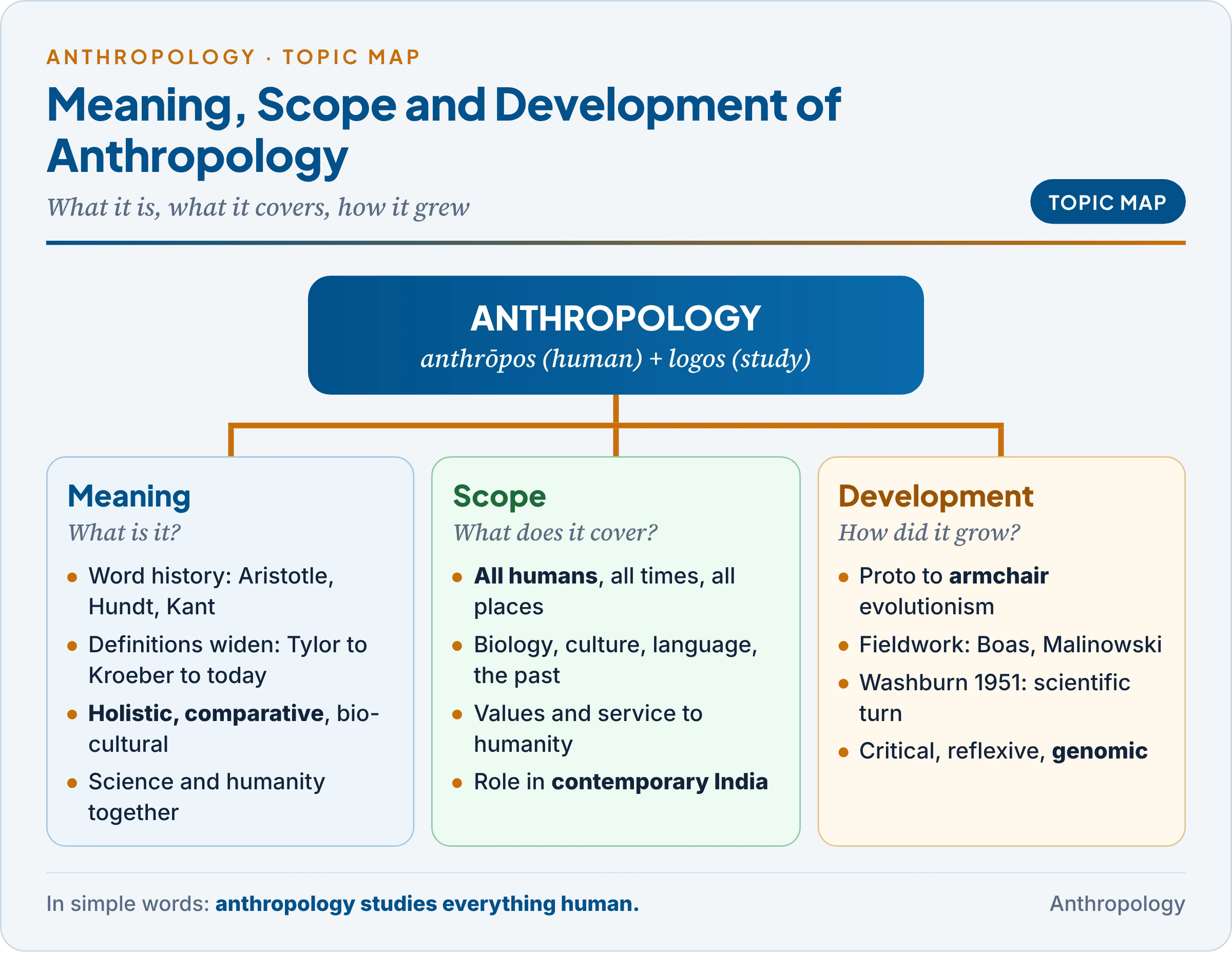
Anthropology is the study of human beings: where we came from, how our bodies vary, how we live together and what our customs mean. Its meaning grew slowly, from a word for “talk about people” to a full science of humankind in all times and places.
- People have always asked who they are, where they came from and why they behave as they do. For most of history, myths and folklore answered these questions, because reliable data on other peoples could not be collected.
- Anthropology is the naturalistic answer to the same questions: it uses evidence (fossils, field observation, artefacts, language records) instead of myth. In its modern form it is about 200 years old.
- It grew slowly because travel was restricted and early travellers misunderstood non-European cultures. Its meaning therefore changed in stages, and the definitions below show those stages.
1.1 Etymology and the word’s history
- Greek anthrōpos (human) + logos (study, reason): “the study of humankind”.
- Aristotle, the Greek philosopher, used anthrōpologos (Nicomachean Ethics) for one who talks about people, i.e. a gossip. The word existed; the discipline did not. Calling Aristotle the “father of anthropology” is a textbook overstatement.
- Herodotus (5th c. BCE), a Greek writer, Histories: he described the customs of the Scythians, Egyptians and Persians and is often called the first ethnographer (a writer who describes the way of life of a people). (Cicero called him the “Father of History”.)
- Neo-Latin anthropologia in Renaissance Germany:
- Magnus Hundt, a German physician-scholar, Antropologium (1501): human anatomy and nature.
- Otto Casmann, a German philosopher, Psychologia anthropologica (1594): the human being as body plus soul.
- In both, “anthropology” meant the study of man as a physical and moral being. The physical side is the body; the moral side is beliefs, ethics and social life.
- Immanuel Kant, the German philosopher, Anthropology from a Pragmatic Point of View (1798), drew a distinction:
- physiological anthropology: what nature makes of man
- pragmatic anthropology: what man, as a free agent, makes of himself
This is the first nature–culture split (body given by nature vs way of life made by people) that later structures the discipline into biological and socio-cultural branches. Kant’s point was that a human being is studied in two ways at once: as an animal shaped by nature, and as a free agent who shapes himself through custom and choice. The same double view survives today in the division between biological and socio-cultural anthropology.
Common confusion
Is Aristotle the “father of anthropology”? No. He used a related Greek word for a gossip. Herodotus is usually called the first ethnographer, and anthropology as a discipline began only in the 19th century.
1.2 Definitions: how the meaning widened
The table traces how scholars defined the subject over 150 years. Notice how the scope moves from “primitive” peoples to all humans, and from the body alone to body, society and culture together.
| Phase | Scholar / source | Definition (gist) | What it shows |
|---|---|---|---|
| 19th c. | E.B. Tylor, British pioneer, Anthropology (1881) | Study of man’s bodily and mental nature, races, languages, arts and customs, centred on “primitive” peoples | Scope tied to the “savage” and to evolution |
| 19th c. | Paul Broca, French anatomist, Société d’Anthropologie de Paris (1859) | Natural history of the human body and races | Physical, measurement-based emphasis |
| Early 20th c. | Boas, Malinowski, Radcliffe-Brown | Man at all levels of development, studied first-hand | Moves to all societies and fieldwork |
| 1923/1948 | A.L. Kroeber, American, Boas’s student, Anthropology | “the science of groups of men and their behavior and productions” | Group, behaviour and artefact focus |
| 1948 | M.J. Herskovits, American, Man and His Works | Study of man and his works | Culture as product |
| 1955 | Jacobs and Stern, General Anthropology | Scientific study of the physical, social and cultural development and behaviour of humans since their appearance on earth | Time depth + bio-cultural scope |
| 1964 | Eric Wolf, American anthropologist, Anthropology | “both the most scientific of the humanities and the most humanistic of the sciences” | Dual identity (§2.4) |
| Today | Standard textbooks (Haviland, Ember) | Systematic, objective and holistic study of humankind in all times and places | Comprehensive comparative science of humanity |
Read down the last column and three shifts appear. First, the subject widens from “primitive” peoples to every human society, including the anthropologist’s own. Second, the focus widens from the body alone (Broca) to body, behaviour, products and meanings together. Third, time depth is added: anthropology covers humans from their first appearance, not only the present. A common mistake is to treat Tylor’s definition as wrong; it was a definition of its time, tied to evolutionism, and later scholars widened rather than discarded it.
- The trajectory: from “the primitive” (Tylor) → “all humans” (Boas onwards) → “humans as bio-cultural beings in all times and places”. Bio-cultural means that human biology and culture shape each other.
- Why it widened: Tylor’s limit to “primitive” peoples split opinion; Broca and others argued for studying modern peoples too. The early 20th-century fieldworkers settled the debate by defining the subject as man at every level of development.
- The 2022 formula, word by word:
- Systematic: the fieldwork, genealogical, excavation and laboratory protocols of Unit 8
- Objective: controlled comparison, keeping emic and etic views apart, reflexivity (§2.3)
- Holistic: biology + society + culture + language + environment
- All times: from 7 mya hominins (members of the human lineage) to the present
- All places: from Jarawa bands to Bengaluru IT campuses
- Clyde Kluckhohn, an American anthropologist, Mirror for Man (1949): anthropology holds up a mirror to humanity so it can see itself in its full variety. This is the reflective, value-giving side of the definition.
- How the mirror works: by seeing that other peoples live well with different arrangements, we realise that many of our own customs are cultural choices, not laws of nature. A reader who learns that the Nayar of Kerala once lived in matrilineal joint households, with husbands visiting rather than living in, sees that the nuclear family is one option among many.
2. Nature of Anthropology: The Distinguishing Themes
In simple words
Many subjects study people. Anthropology stands apart because of a few habits of mind: it looks at the whole of life together, it compares peoples everywhere, it thinks in long time spans, and it tries to see the world as the people studied see it.
- Anatomy, physiology and medicine study the body; the social sciences study social activity; art, music and literature study human works. Anthropology’s special role is its combination of holistic, historical and comparative methods applied to all of these together.
2.1 Holism
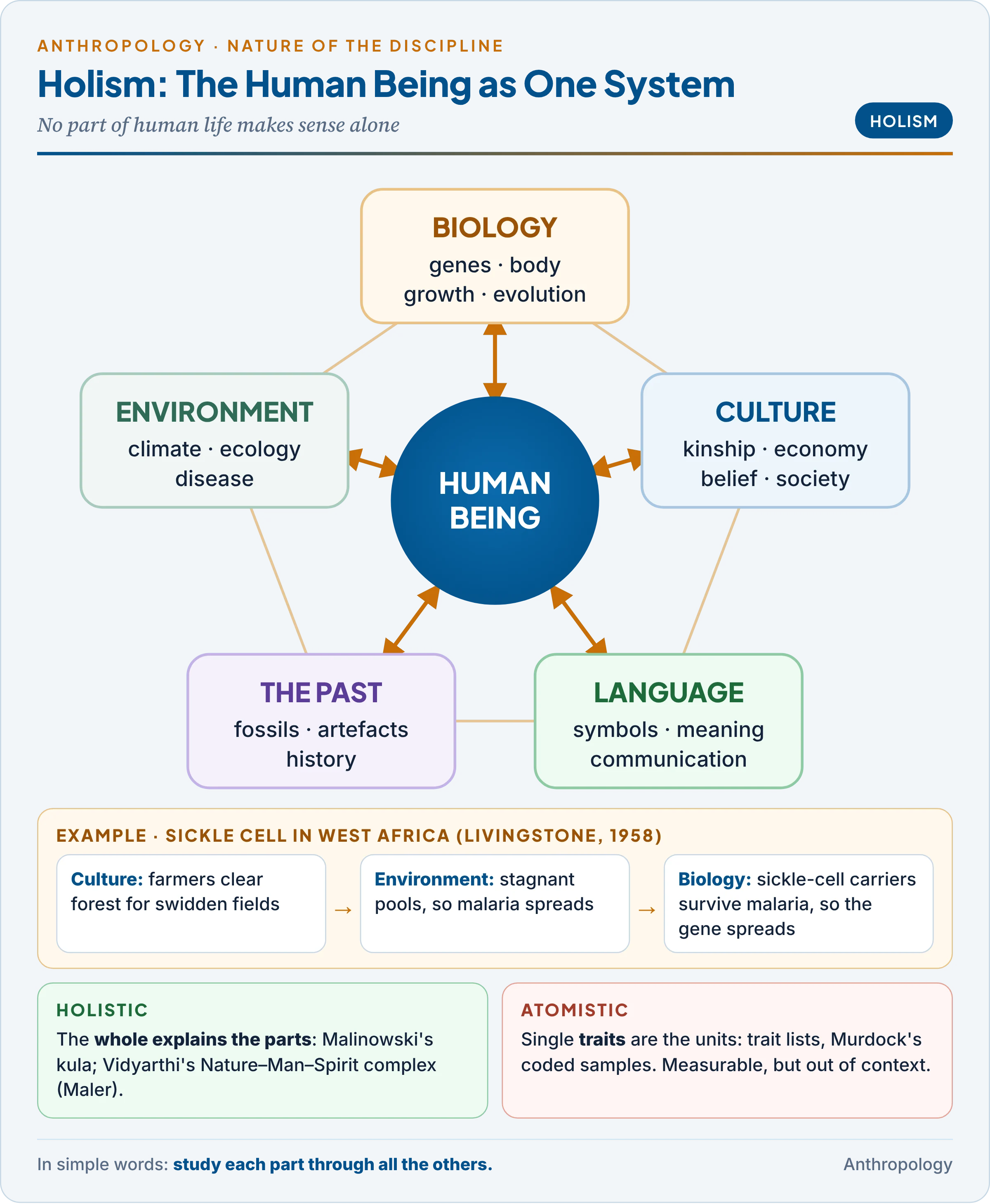
- Example first: in West Africa, farmers cleared forest for yam fields. Stagnant pools formed, mosquitoes bred, and malaria spread. People carrying one copy of the sickle-cell gene resisted malaria better, so the gene became common (Frank Livingstone, an American biological anthropologist, 1958). An economic practice changed human genes. No single discipline could explain this alone.
- Meaning: a human group is studied in terms of the entire pattern of its life. The proposition behind it is that behaviour arises from interactions within a whole cultural system.
- How it works in practice: to understand a harvest festival in a tribal village, the anthropologist asks who owns the land (economy), which clans perform which rites (kinship), what the rites ask of the spirits (religion), what is eaten and shared (nutrition and exchange), and what songs and words are used (language). The festival makes sense only when all these are seen together.
- Methodologically, it pushes anthropologists to resist reductionism (explaining behaviour by one cause only): biological, economic or psychological single-cause explanations.
- Why this matters: a single-cause explanation is usually incomplete. Explaining caste only as an economic system, for instance, misses the rules of purity and pollution that govern food, touch and marriage; explaining it only as religion misses land and labour. Holism keeps both in view.
- Why it separated anthropology from sociology: in the 19th century sociologists focused more and more on society and social systems, while anthropologists insisted on tying together biology, society, culture and psychology.
- Cases:
- Malinowski, the Polish-born British pioneer of fieldwork, on the Trobriand kula (a ring of ceremonial exchange of shell valuables) (Argonauts of the Western Pacific, 1922): economy, magic, prestige and politics in one institution.
- Livingstone (1958): sickle-cell frequency in West Africa explained by swidden clearing (slash-and-burn farming) → stagnant water → malaria → heterozygote advantage (carriers of one copy survive best). Biology and culture are inseparable.
- L.P. Vidyarthi, Indian anthropologist at Ranchi, on the Nature–Man–Spirit complex among the Maler (Rajmahal Hills, Jharkhand): ecology, society and the sacred as one complex.
- Holistic vs atomistic approach (1998 PYQ): the holistic approach explains parts through the whole; the atomistic approach breaks a culture into separate traits or individuals and studies them one by one. The table sets them side by side.
| Holistic | Atomistic |
|---|---|
| The whole precedes and explains the parts | The parts (traits, individuals) are units of analysis |
| Malinowski (functional whole), Benedict (pattern, Patterns of Culture, 1934), Radcliffe-Brown (social structure) | Diffusionists’ trait lists; Wissler’s culture-area trait counts; Murdock’s HRAF coding (1949); Barth’s transactionalism (1966) |
| Strength: context, meaning, interconnection | Strength: measurability, cross-cultural statistics |
| Weakness: hard to test; can assume harmony | Weakness: tears traits out of context (the “Galton’s problem” of non-independent cases) |
The table shows a trade-off rather than a winner. The holistic approach gives depth and meaning but is hard to test statistically, and it can make a society look more harmonious and balanced than it is. The atomistic approach gives numbers and comparisons but loses the context that gives a trait its meaning: a “bride-price” coded as one trait may be a commercial payment in one society and a bond between lineages in another. Most modern research moves between the two, using holistic fieldwork to define what is compared and atomistic methods to test patterns.
- Critique of holism:
- The “general anthropologist” covering every field was more an ideal than a research practice. Boas was among the few genuine practitioners.
- Specialisation (medical, forensic, molecular) now dominates. The reason is the growth of knowledge: genetics, dating methods and ethnographic theory have each become too technical for one person to master, so holism now has to be achieved by teamwork rather than by one mind.
- In India, holism survives partly as under-resourced generalism: physical anthropology departments without laboratories drift into survey-type socio-cultural work. Integration really requires teams of specialists, not one generalist.
2.2 The comparative theme
- Example first: to know whether jealousy between co-wives is “human nature”, you cannot study one village. You must compare polygynous households across many societies and see what varies.
- When anthropology and sociology split in the mid-19th century:
- sociology turned to Western industrial society
- anthropology kept the task of comparing all peoples, living and dead
- Two dimensions of comparison:
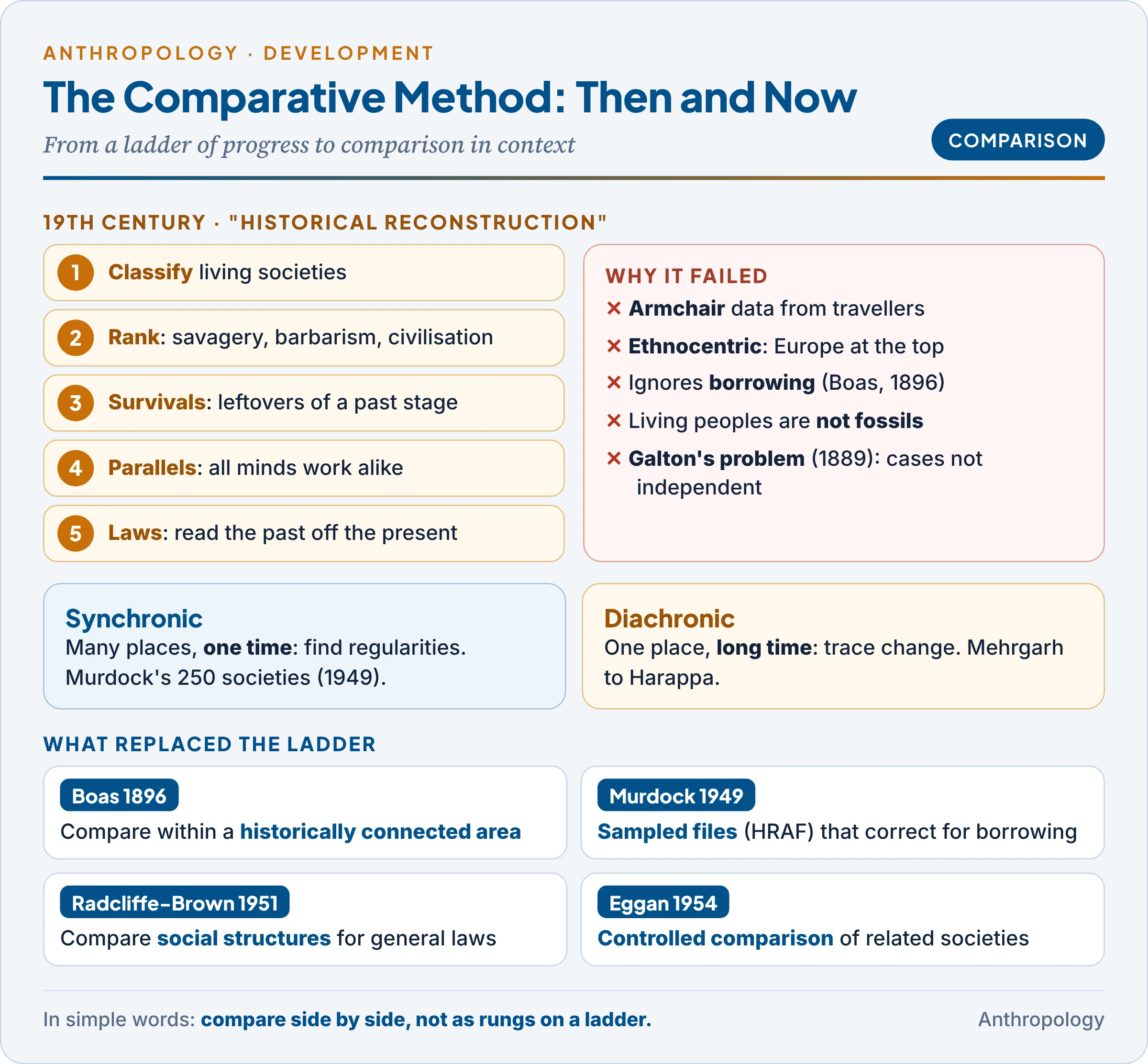
- Synchronic comparison (at one point in time): biological, linguistic, archaeological or ethnographic data compared across a wide area at one chosen moment, usually the present. It shows the regularities of human life around the world.
- Diachronic comparison (through time): the same kinds of data compared over a long period in one limited area. It shows evolution and change.
- Examples: comparing marriage payments among many tribes of central India today is synchronic; tracing how settlements in one valley changed from stone-tool camps to farming villages to towns is diachronic. The first reveals what varies with what; the second reveals how one thing turned into another.
- The aim is to move from the particular case to general laws: what is universal, what is variable, and why. Even a specialist who studies one group, site or fossil population for a lifetime contributes data to this larger synthesis.
- Cross-cultural corrective: most behavioural science is drawn from WEIRD samples (Western, Educated, Industrialised, Rich, Democratic; Henrich, Heine and Norenzayan, 2010). Comparison tests whether “human nature” claims hold beyond them.
- Why it matters: a finding from American university students may be presented as true of all humans when it is not. Even something as basic as seeing an optical illusion varies: Segall, Campbell and Herskovits (1966) found that people from different environments were not equally fooled by the Müller-Lyer arrow illusion. Only comparison across cultures can show which traits are truly universal.
2.3 Other characteristic themes
Besides holism and comparison, six more habits mark anthropological work. Read the table row by row: each theme, what it means, and one example.
| Theme | Content | Example |
|---|---|---|
| Historical / time depth | Reconstructs the course of biological and cultural evolution; places each way of life in historical perspective | Archaeology and ethnohistory of a region |
| Systems and process | Since the 1950s, a shift from static description and classification to how systems adapt and change | Binford’s New Archaeology (cultures as adaptive systems); physical anthropology moving from taxonomy to gene–environment process |
| Case study | Long participant observation in one group, site, language or fossil population; theory built up from concrete detail | Srinivas, Coorg (1952) gave the macro concept Sanskritization |
| Emic / etic | Keeping the insider’s view (emic) separate from the analyst’s categories (etic) at every stage. Terms from Kenneth Pike (1954), developed by Marvin Harris | Harris on the sacred cow (etic ecological logic vs emic religious reason) |
| Bio-cultural | Humans are biological organisms whose survival is mediated by culture | Circumpolar Inuit: culture more than physiology explains adaptation to cold |
| Cultural relativism | Judge practices within their own context (Boas, Herskovits) | Rejects the savage → civilised ranking |
These themes work together rather than separately. Time depth and systems thinking ask how a way of life came to be and how its parts adjust to change. The case study supplies the close detail, the emic/etic distinction keeps that detail honest, and the bio-cultural view reminds the researcher that bodies and cultures interact. Cultural relativism is a method of understanding, not a claim that every practice is morally acceptable: it asks us to grasp a custom in its context before judging it.
- Participant observation means living with a people for a long time, joining their daily life while observing it. It came from the early fieldworkers’ isolation among distant groups, and it still marks anthropological research. Anthropologists feel more at home with “stones and bones, phonemes and morphemes, rituals and market exchanges” than with abstract theory.
- Why emic and etic must be kept apart: it is easy to see what one expects to see. Translating another people’s world into Western academic terms happens twice, while learning and while reporting, and each step can distort. The problem is sharpest in ethnography and linguistics but also affects archaeology and primate studies.
Common confusion
Emic or etic: which is the “true” view? Neither alone. Emic is how the people themselves explain a practice (the cow is sacred to Hindus). Etic is the observer’s outside explanation (the cow is worth more alive, for milk, dung and draught power). Good research records both and does not mix them.
- Micro study, macro theory (1982 PYQ): anthropology studies small units closely but aims at general theory.
- Clifford Geertz, an American interpretive anthropologist (1973): anthropologists do not study villages; they study in villages.
- Robert Redfield, an American anthropologist, The Little Community (1955), and McKim Marriott, Village India (1955): village data lead to universalisation / parochialisation and the Great and Little Tradition, macro models of Indian civilisation.
- S.C. Dube, Indian sociologist-anthropologist, Indian Village (Shamirpet, 1955): one village shows caste, religion and change in India.
- How the move from micro to macro happens: a concept discovered in one place is tested in others. Srinivas noticed among the Coorgs that lower groups raised their status by adopting Brahmin customs. When other researchers found the same process across India, it became Sanskritization, a general model of social mobility built from one community study.
2.4 Science or humanity? (bridging debate)
- The question: should anthropology seek laws, like physics, or interpret meanings, like history and literature? In its early years it was treated as a natural science, because evolutionism saw man as part of nature and social laws as like natural laws. German thinkers, by contrast, separated human life from nature.
- The table sets out the two positions with their leading scholars and methods.
| Anthropology as science | Anthropology as humanity |
|---|---|
| Radcliffe-Brown: social anthropology is a natural science of society, seeking general laws through comparison | Evans-Pritchard, Marett Lecture (1950): societies are moral systems, not natural systems. Anthropology seeks patterns, not laws, and interprets rather than explains; it is closer to history |
| Malinowski, A Scientific Theory of Culture (1944): culture as a response to needs | Boas’s historicism (German tradition of Herder and Dilthey): each culture is a unique historical product |
| Murdock’s HRAF; Harris’s cultural materialism; quantitative biological anthropology | Benedict (culture as personality writ large), Geertz (thick description), Turner (symbols) |
| Methods: measurement, sampling, hypothesis testing, dating, DNA | Methods: empathy, interpretation, life history, text |
The table shows two different ideas of what explanation means. For the scientific side, to explain a custom is to show the general law or function it obeys, as a physicist explains a falling stone. For the humanistic side, to explain a custom is to show what it means to the people who practise it, as a historian explains why a king acted as he did. The first values prediction and testing; the second values understanding and context.
- Evaluation:
- Uniform method across the natural and social sciences (1993 PYQ) is neither possible nor desirable in full. Reflexive, meaning-laden subjects (people who interpret and change their own behaviour) make laboratory-style prediction impossible. A rock does not change because a geologist describes it; a community that reads a report about itself may change its behaviour in response, so human “laws” are never fixed in the way physical laws are.
- Anthropology combines both: biological and archaeological branches are experimental and dated, while socio-cultural branches are interpretive and comparative.
- That combination is its multidimensional strength (2025 PYQ), captured in Wolf’s formula (§1.2).
3. Scope of Anthropology
In simple words
The scope of a subject is the ground it covers. Anthropology covers every human being, past and present, near and far: our evolution, our bodies, our old tools and new cities, our languages and our customs. It also puts this knowledge to practical use.
3.1 Subject matter: all humans, all times, all places
- An anthropologist is as interested in the earliest humans as in people today, and as interested in a small, remote band as in a large city. The world of today and the fragmentary remains of its past are its data.
- The table maps each part of this subject matter to the branch that studies it.
| Dimension | Scope | Branch |
|---|---|---|
| Origin and evolution | Primates, hominins, modern human emergence | Biological (palaeoanthropology, primatology) |
| Human variation | Genetics, growth, adaptation, race critique | Biological (human genetics, ecology) |
| Past cultures | Tools, settlements, prehistoric to historic | Archaeological |
| Living societies | Kinship, economy, polity, religion, change | Socio-cultural |
| Language | Structure, evolution, language in social life | Linguistic |
| Application | Development, health, law, forensics, design | Applied / action |
The table shows why anthropology’s scope is wider than that of any neighbouring discipline. Sociology covers living societies, history covers the written past, and biology covers the body; anthropology covers all of these, for all humans, across the whole of human time. The price of this breadth is that no single anthropologist covers all of it; the scope belongs to the discipline as a whole.
- The branches in brief (detail in Unit 1.3): socio-cultural anthropology studies living societies through fieldwork; biological anthropology studies evolution and human variation; archaeological anthropology reconstructs past ways of life from material remains; linguistic anthropology studies language in its social setting. Applied anthropology puts all four to practical use.
- Widening of scope over time:
- 19th c.: “primitive” peoples.
- 1950s: peasants and villages (Redfield, Srinivas, Dube).
- 1960s–80s: cities, migrants and industry (urban anthropology; Manchester school studies of the Copperbelt mining towns of Zambia).
- Now: corporations, laboratories, the state, digital worlds, and multispecies relations (how humans live with animals, plants and microbes).
- Scope of social and cultural anthropology (2023 PYQ):
- Institutions: marriage, family, kinship, economy, polity, religion.
- Processes: change, development, globalisation.
- Meaning: symbols, worldview.
- Applied fields: tribal welfare, health, gender, conflict.
3.2 Relevance: anthropology in the service of humanity
- Anthropology studies the past and present to help solve problems about the future of mankind. Four kinds of relevance stand out.
(a) A source of values (1982, 1983 PYQs)
- Cultural relativism (judging a custom within its own context) and psychic unity (all human groups share the same basic mental capacities) ground tolerance and the common humanity of all peoples.
- How they produce values: if every group has the same mental abilities, differences between cultures come from history and circumstance, not from inborn superiority. This removes the basis for ranking peoples as “higher” and “lower”, and it supports respect for ways of life different from one’s own.
- The limit: relativism creates a tension with universal human rights. If every custom must be judged within its own culture, harmful practices could seem beyond criticism. Most anthropologists today use relativism as a method of understanding, while accepting that understanding a practice is not the same as approving it.
- Boas, the German-born founder of American anthropology, The Mind of Primitive Man (1911), refuted racial determinism (the idea that race fixes intelligence and culture). He showed that physical traits, language and culture vary independently: people of the same physical type speak different languages and follow different cultures, and even head form changed among immigrants’ children in a new environment. Race therefore cannot explain culture.
- UNESCO Statements on Race (1950 onward): no scientific basis for racial hierarchy.
- AAA Statement on Human Rights (1947, drafted by Herskovits): warned against imposing one culture’s values as universal.
- Indigenous rights: anthropological advocacy fed into UNDRIP (the UN Declaration on the Rights of Indigenous Peoples, 2007).
(b) National character studies (1987, 1991 PYQs)
- What they were: during and after the Second World War, anthropologists tried to describe the typical personality of a whole nation, often without fieldwork there (“culture at a distance”).
| Study | Claim | Assessment |
|---|---|---|
| Ruth Benedict, American anthropologist, The Chrysanthemum and the Sword (1946), Japan | Shame culture vs Western guilt culture; hierarchy and obligation (on, giri) | Strength: shaped US occupation policy; showed culture at a distance is possible |
| Gorer and Rickman, The People of Great Russia (1949) | Infant swaddling → Russian character | Weakness: mocked as “diaperology”; reductionist |
| Mead and Métraux, The Study of Culture at a Distance (1953) | Method: films, literature, émigré interviews | Weakness: stereotyping, ignores class, regional and individual variation |
The table shows both the promise and the danger of these studies. They proved that culture can be studied even when fieldwork is impossible, and that a nation’s behaviour in war or diplomacy has cultural roots. But they treated a nation of millions as if it had one personality, built from a few child-rearing customs. The swaddling thesis is the classic warning: a single habit of infant care was made to explain a whole political system.
- Link to Unit 6: national character extends Kardiner and Linton’s basic personality structure (the personality shared by members of a society because of common child-rearing) (The Individual and His Society, 1939) and Cora Du Bois’s modal personality (the most frequent personality type in a group) (The People of Alor, 1944) from small societies to whole nations.
- Relevance: it introduced culture as a variable in international relations. Its legacy lives on in cross-cultural management (e.g. Hofstede’s dimensions) and conflict studies.
(c) Interpretation of symbols (2011 PYQ)
- A symbol is anything that stands for something else by social agreement: a flag for a nation, a totem for a clan. Anthropologists have offered several ways of reading symbols, summarised below.
| Scholar | Contribution |
|---|---|
| Durkheim, French sociologist, Elementary Forms (1912) | Totem as collective representation of the clan |
| Lévi-Strauss, French structuralist | Symbols as binary oppositions (raw/cooked) structuring myth |
| Victor Turner, British anthropologist, The Forest of Symbols (1967) | Ndembu (Zambia): dominant symbols, multivocality (one symbol, many meanings), ideological vs sensory poles |
| Mary Douglas, British anthropologist, Purity and Danger (1966) | Dirt as “matter out of place”; pollution rules map social order. Dumont’s pure/impure caste model is the Indian parallel |
| Clifford Geertz | Culture as webs of significance; thick description; the Balinese cockfight as a text |
- An example of reading a symbol: among the Ndembu, Turner found that the milk tree (mudyi), which oozes white sap, stands at once for breast milk, the mother–child bond, matrilineal descent and the unity of Ndembu society. One object carries many meanings (multivocality), some bodily and emotional (the sensory pole), some moral and social (the ideological pole). This is why symbols are powerful in ritual: they join feelings to social rules.
- The scholars in the table differ in where they look for meaning: Durkheim in society, Lévi-Strauss in the structure of the mind, Turner in ritual action, Douglas in classification, and Geertz in the public meanings a people share.
(d) Role in contemporary India (2014, 2018 PYQs)
- India’s diversity of thousands of communities makes anthropological knowledge directly useful to policy. The table lists the main fields.
| Field | Anthropological contribution |
|---|---|
| Tribal policy | Verrier Elwin, British-born anthropologist and adviser on tribal affairs, shaped Nehru’s Tribal Panchsheel (Elwin, A Philosophy for NEFA, 1959). The Fifth and Sixth Schedules, PESA 1996 and FRA 2006 rest on ethnographic knowledge of customary law and land |
| Mapping diversity | Anthropological Survey of India (1945). The People of India project under K.S. Singh documented 4,635 communities |
| Development and displacement | Niyamgiri case (Orissa Mining Corporation v. MoEF, 2013): the Supreme Court referred religious and cultural rights to Dongria Kondh gram sabhas, which rejected mining |
| Health | Culturally sensitive delivery: sickle-cell screening among tribes, vaccine hesitancy, traditional healers |
| Forensics and identification | Skeletal and DNA identification in disasters and crime; anthropometry (body measurement) for ergonomic and size standards |
| Social justice | Caste, gender and inequality studies (Béteille, Leela Dube, Xaxa) underpin policy debates such as reservation and ST recognition |
| Heritage and knowledge | Documenting endangered languages, traditional ecological knowledge and GI products |
The common thread in the table is that policy in India works on communities, and communities differ in custom, land use, language and belief. A scheme designed for “tribals” in general often fails for a particular tribe. Anthropology supplies the community-level knowledge that turns a general policy into one that fits the people it is meant for.
- Critique:
- Anthropology’s influence on policy has been advisory and uneven.
- Applied work risks co-option (being used for others’ agendas) (cf. the US Army’s Human Terrain System, 2007–14, which the AAA disapproved).
- Indian anthropology has long been criticised for “tribe-centrism” and weak engagement with cities and the market.
4. Development of Anthropology
In simple words
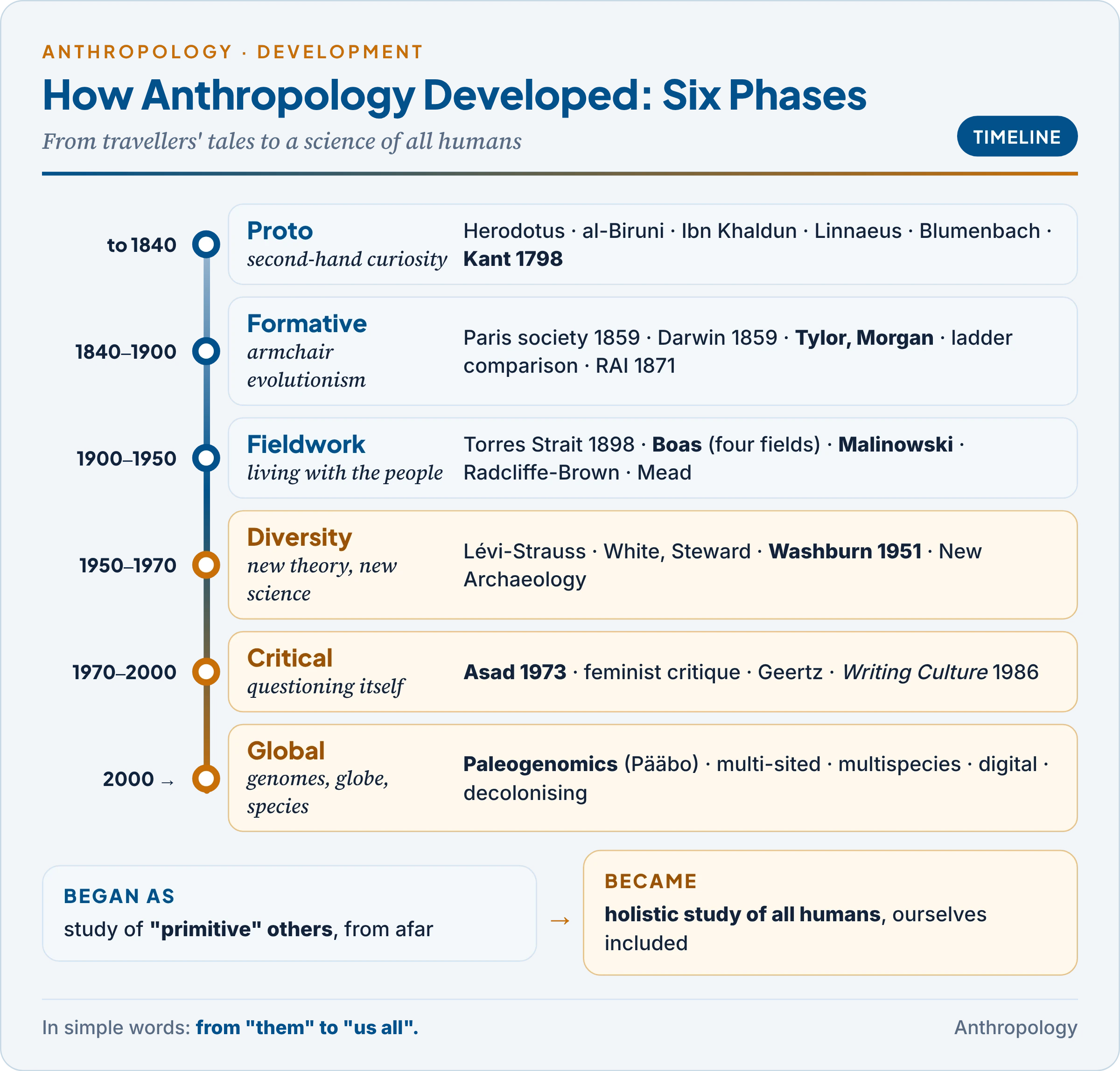
Anthropology grew in stages. First came travellers’ accounts and philosophers’ ideas, then 19th-century scholars who theorised from their armchairs, then fieldworkers who lived among the people they studied, and finally a modern discipline that questions its own past and uses genetics and global data.
4.1 Proto-anthropology (to the early 19th century)
- Proto-anthropology means the writings before the discipline existed that already described other peoples.
- Classical: Herodotus (customs of neighbouring peoples); Tacitus, Roman historian, Germania (98 CE).
- Medieval:
- al-Biruni, Central Asian scholar, Kitab al-Hind (c. 1030): a systematic account of Indian religion, caste and science, written after learning Sanskrit. It is an early model of learning the language and seeing from within.
- Ibn Khaldun, North African historian, Muqaddimah (1377): asabiyyah (group solidarity) and the cycle of nomadic and sedentary societies.
- Age of exploration: travellers’ and missionaries’ accounts (Marco Polo; Lafitau, a French Jesuit, who in 1724 compared Iroquois and ancient customs, an early comparative method).
- Enlightenment:
- Linnaeus, Swedish naturalist, placed Homo sapiens among the primates (Systema Naturae, 10th edn, 1758).
- Blumenbach, German physician (De generis humani varietate nativa, 1775), classified human varieties and is called the father of physical anthropology.
- Kant (1798): physiological vs pragmatic anthropology (§1.1).
- Limitation: the knowledge was second-hand, ethnocentric (judging others by one’s own culture) and unsystematic. Slow growth followed from limited travel and contact. Travellers recorded what struck them as strange, not how a society worked as a whole, and they described others through the categories of their own religion and culture, so customs were often judged as “savage” without being understood.
4.2 Formative period: armchair evolutionism (c. 1840–1900)
- What “armchair” means: these scholars rarely did fieldwork. They read reports by travellers, missionaries and colonial officers and built theories at their desks.
- Institutions:
- Société Ethnologique de Paris (1839)
- Société d’Anthropologie de Paris under Broca (1859)
- Anthropological Society of London (1863), which merged into the Royal Anthropological Institute (1871)
- Tylor appointed at Oxford as Reader in Anthropology (1884)
- Intellectual triggers:
- Darwin, Origin of Species (1859)
- the antiquity of man confirmed (Brixham Cave, Boucher de Perthes)
- colonial expansion
- Works:
- Maine, British jurist, Ancient Law (1861)
- Bachofen, Swiss jurist, Mother Right (1861)
- McLennan, Scottish lawyer, Primitive Marriage (1865)
- Tylor, Primitive Culture (1871)
- Morgan, American lawyer-ethnologist, Ancient Society (1877)
- Frazer, Scottish classicist, The Golden Bough (1890)
The 19th-century comparative method (1983, 1989 PYQs)
- Also called the method of historical reconstruction: contemporary “primitives” stand in for prehistoric stages, so the past is inferred from the present.
- Why they used it: there were no written records for most of human history, so evolutionists assumed that living “simple” societies preserved the stages Europe had passed through.
- Steps:
- Classify present-day societies as primitive, peasant or civilised.
- Arrange them on a ladder: savagery → barbarism → civilisation.
- Detect survivals (Tylor), relics of earlier stages.
- Identify parallels, explained by psychic unity of mankind.
- Derive laws of cultural evolution.
- Survivals are customs that continue after their original purpose has gone; evolutionists read them as clues to an earlier stage. Tylor, for example, treated the custom of saying a blessing when someone sneezes as a relic of older beliefs about spirits. The reasoning was: if a custom no longer makes sense today, it must be left over from a time when it did.
- Role of psychic unity: because all humans were assumed to think alike, the evolutionists expected different peoples to invent the same institutions in the same order. Similar customs in distant places were therefore read as proof of a single path of evolution, not as the result of contact.
- Tylor (1889), “On a Method of Investigating the Development of Institutions”: the first statistical “adhesions” (customs that regularly occur together) across 350 societies. Galton objected that the cases may not be independent because of borrowing (Galton’s problem).
- Lasting gains: despite its flaws, the period established anthropology as a separate discipline, gave it the concept of culture, separated race from culture through psychic unity, and gathered a large body of material.
Limitations of the comparative method
The method was later rejected. The table lists its main faults and who exposed them.
| Limitation | Critic |
|---|---|
| Speculative: armchair data from travellers and missionaries, uncritically used | Malinowski, Boas |
| Ethnocentric: Victorian Europe at the top | Boas, Herskovits |
| Ignores diffusion and history: similar traits can have different origins (convergence) | Boas, “The Limitations of the Comparative Method of Anthropology” (1896) |
| Living peoples are not fossils: they have their own histories | Boas, Lowie |
| Traits torn from context | Functionalists |
The most damaging criticism was Boas’s. He showed that similar traits can have different origins: in one region, geometric designs on pottery developed from realistic pictures that were gradually simplified, while elsewhere similar designs grew out of weaving techniques. If the same result can arise by different routes, then arranging traits on one ladder tells us nothing about real history. Every culture has to be studied in its own historical setting before it can be compared.
- What replaced it:
- Boas: comparison only within a historically connected area.
- Radcliffe-Brown, British structural-functionalist, “The Comparative Method in Social Anthropology” (1951): synchronic comparison of structures to find general laws.
- Fred Eggan, American anthropologist (1954): controlled comparison of related societies.
- G.P. Murdock, American anthropologist: HRAF (Human Relations Area Files, a coded world sample of cultures) sampling that corrects for Galton’s problem.
4.3 The fieldwork era (c. 1900–1950)
- The big change: anthropologists began to collect their own data by living among the people for months or years. Theory now had to answer to first-hand evidence.
- Torres Strait Expedition (1898): Haddon, Rivers, Seligman, British scholars. Rivers’ genealogical method (1910), recording kinship through family trees, followed from it.
- Boas (USA):
- historical particularism (each culture is the product of its own unique history)
- four-field approach (physical, cultural, linguistic, archaeological)
- cultural relativism
- field study of the Kwakiutl (Pacific Northwest)
- trained Kroeber, Lowie, Sapir, Benedict, Mead
- Malinowski (Britain):
- intensive participant observation among the Trobriand Islanders (1915–18)
- goal: “the native’s point of view”
- functionalism (every custom serves a function in meeting human needs)
- Why his method mattered: a visitor could easily mistake the kula for trade. Only by living in the islands, speaking the language and following the exchanges for months did Malinowski see that the valuables were never used and were passed on for prestige and alliance. Long fieldwork revealed meanings that short visits and questionnaires could not.
- Radcliffe-Brown: structural functionalism (customs keep the social structure in balance); The Andaman Islanders (1922). The difference from Malinowski: Malinowski asked how a custom satisfies the needs of individuals; Radcliffe-Brown asked how it maintains the social structure as a whole.
- Culture and personality: Benedict, Mead (Coming of Age in Samoa, 1928), and Linton studied how culture shapes personality.
- Indian strand (detail in Paper 2, Unit 4):
- Asiatic Society (1784)
- S.C. Roy (Man in India, 1921; Munda and Oraon monographs)
- Calcutta University department (1920)
- AnSI (1945)
- Phases: Majumdar’s formulatory / constructive / critical; Vidyarthi’s formative / constructive / analytical
- In short: Indian anthropology began with colonial ethnography and Indian pioneers’ tribal monographs, built institutions in the 1920s–40s, and turned analytical and self-critical after Independence.
- Humanistic tradition (1985 PYQ):
- Boas’s historicism, Benedict’s aesthetic idea of pattern, Redfield’s worldview studies, Evans-Pritchard’s history-like social anthropology.
- This tradition kept the discipline concerned with meaning, values and the individual, not only laws.
- In India: Verrier Elwin’s literary ethnographies and N.K. Bose’s civilisational approach.
4.4 Diversification and the scientific turn (c. 1950–1970)
- Socio-cultural anthropology:
- Lévi-Strauss: structuralism, alliance theory
- White, Steward: neo-evolution, cultural ecology
- Manchester school (Gluckman): conflict and process
- Barth: transactionalism
- Leach: Political Systems of Highland Burma, 1954
- Biological anthropology becomes “scientific” (2025 PYQ): before 1950, physical anthropology mostly measured skulls and bodies to sort people into racial types. After 1950 it began asking how and why human populations vary, using genetics and evolution.
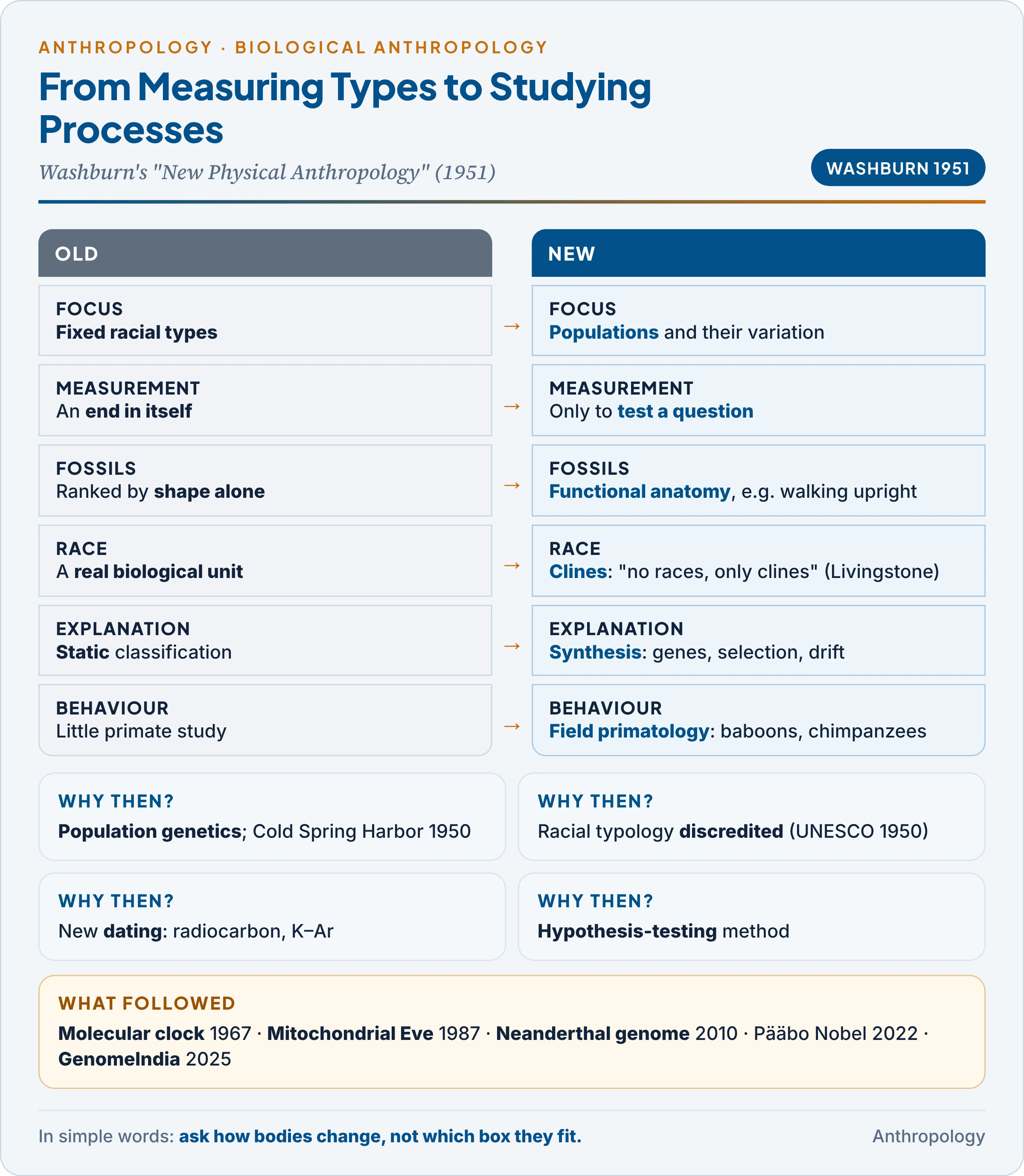
The table contrasts the two approaches that Sherwood Washburn, an American biological anthropologist, distinguished in 1951.
| Old (classical) physical anthropology | New physical anthropology (Washburn, 1951) |
|---|---|
| Typology: fixed racial types | Populations and variation |
| Anthropometry as an end in itself | Measurement only to test hypotheses about process |
| Classification of fossils by morphology alone | Functional anatomy (bipedalism, posture as adaptation) |
| Race as a biological unit | Clines: “there are no races, only clines” (Livingstone, 1962) |
| Static description | Evolutionary synthesis: genetics + selection + drift (Dobzhansky, Mayr; Cold Spring Harbor Symposium, 1950) |
| Little behaviour study | Field primatology (Washburn and DeVore on baboons; later Goodall) |
The table shows a change in the questions asked, not just in techniques. The old approach asked “which type is this?” and answered with measurements. The new approach asked “how and why did this population come to differ?” and answered with genetics, selection and adaptation. For example, instead of using skin colour to sort people into races, the new approach explains skin colour as an adaptation to the intensity of sunlight, which changes gradually across latitude (a cline).
- Key terms in the table: a cline is a gradual change in a trait across geography, with no sharp boundaries; the evolutionary (Modern) Synthesis joined Darwin’s natural selection with Mendelian and population genetics.
- Further scientific steps:
- molecular clock (Sarich and Wilson, 1967: human–ape split far later than fossils suggested); the idea is that genetic differences build up at a roughly steady rate, so they can date when species split
- mitochondrial Eve (Cann, Stoneking and Wilson, 1987): all living humans’ mitochondrial DNA traces back to one African woman
- radiometric dating (K–Ar, ¹⁴C)
- New Archaeology (Binford, 1960s): hypothesis-testing archaeology
- Why mid-century?
- the population genetics and synthesis revolution
- post-Holocaust discredit of racial typology (UNESCO, 1950)
- new dating technologies
- hypothetico-deductive method (state a hypothesis, then test it) entering the field
4.5 Critical and reflexive phase (c. 1970–2000)
- The big change: anthropologists turned their critical eye on their own discipline: its colonial links, its writing and its male bias.
- Colonial critique: Talal Asad, Anthropology and the Colonial Encounter (1973): anthropology as the “handmaiden of colonialism”. Edward Said, Orientalism (1978).
- Crisis of representation: Clifford and Marcus, Writing Culture (1986): ethnography as partial, authored text. This produced reflexivity (the researcher examining their own position and influence), dialogic and multi-vocal ethnography.
- What the critique meant: an ethnography is not a photograph of a society but a text written by one person, shaped by who they were, whom they spoke to, and how they chose to write. A male ethnographer, for instance, might have little access to women’s lives and so present a male view as the whole society’s. Reflexive ethnographers therefore state their own position and include the voices of the people studied.
- Feminist anthropology: Rosaldo and Lamphere, Woman, Culture, and Society (1974); Ortner’s “Is Female to Male as Nature Is to Culture?” (1974). Male bias in earlier ethnography exposed.
- Interpretive and symbolic: Geertz (1973), Turner.
- Political economy and world system: Eric Wolf, Europe and the People Without History (1982). No society is isolated.
- Anthropology at home:
- the self/other division (sociology studies “us”, anthropology studies “them”) broke down
- Indian anthropologists studying their own society, as Srinivas and Béteille did, blurred the line (see 1.2)
4.6 Contemporary anthropology (2000–)
- Globalisation, migration and diaspora: multi-sited ethnography (Marcus, 1995), following people, goods or ideas across several places instead of staying in one village. The reason is that few communities are now self-contained: a village’s life may depend on migrants in the Gulf, remittances, and markets far away, so the fieldworker has to follow these links to understand the village itself.
- Ontological and multispecies turns: Descola, Viveiros de Castro, Tsing (The Mushroom at the End of the World, 2015). Nature–culture dualism questioned. Anthropocene studies.
- Paleogenomics and ancient DNA (reading genomes from ancient bones): human evolution rewritten (Neanderthal and Denisovan admixture).
- Digital and cyber-anthropology; anthropology of science, technology, AI and medicine.
- Decolonising anthropology: indigenous anthropologists, collaborative and community-controlled research, ethics of repatriation of remains.
- Overall trend: from describing the exotic to explaining the human condition everywhere, including the anthropologist’s own society.
Key Terms
| Term | Meaning in simple words |
|---|---|
| Anthropology | The study of human beings in all times and places: body, society, culture and language |
| Ethnography | A detailed description of one people’s way of life, based on fieldwork |
| Holism | Studying all parts of human life together, because they affect one another |
| Reductionism | Explaining behaviour by a single cause (only genes, or only economics) |
| Comparative method | Comparing many societies to find what is universal and what varies |
| Synchronic / diachronic | Comparison at one point in time across places / comparison through time in one place |
| Emic / etic | The insider’s own view / the outside observer’s analytical view |
| Cultural relativism | Understanding a custom within its own cultural context, not judging it by another culture’s standards |
| Ethnocentrism | Judging other cultures by the standards of one’s own |
| Psychic unity of mankind | The idea that all human groups share the same basic mental abilities |
| Survivals | Customs that continue after their original purpose is gone |
| Armchair anthropology | Theorising from others’ reports without doing fieldwork |
| Participant observation | Living with a community and taking part in its life while studying it |
| Bio-cultural | Seeing human biology and culture as shaping each other |
| Typology | Sorting people into fixed types, such as racial types |
| Cline | A gradual change in a trait across geographical space |
| Reflexivity | The researcher examining how their own position shapes what they see and write |
| Paleogenomics | Study of genomes recovered from ancient bones |
Contemporary Developments
- GenomeIndia (DBT): 10,074 whole genomes from 83 populations, released in January 2025 and archived at the Indian Biological Data Centre. It gives an Indian reference genome for population history, disease variants and precision medicine. This is biological anthropology’s scope in practice.
- Census 2027 caste enumeration: the Cabinet Committee on Political Affairs decided on 30 April 2025 to enumerate caste. The reference date is 1 March 2027. Classifying thousands of jatis draws directly on ethnographic expertise (People of India: 4,635 communities).
- Svante Pääbo, Nobel Prize in Physiology or Medicine 2022, for the genomes of extinct hominins:
- the Neanderthal genome (2010)
- discovery of the Denisovans
- paleogenomics as a new discipline
- archaic gene flow such as Denisovan EPAS1 in Tibetan high-altitude adaptation
- Ancient DNA in India: the Rakhigarhi genome (Shinde et al., Cell, 2019) and Narasimhan et al. (Science, 2019) recast debates on Harappan ancestry and the formation of South Asian populations. Archaeology, genetics and history now converge.
- Applied tribal anthropology:
- PM-JANMAN (November 2023) for 75 PVTGs (Particularly Vulnerable Tribal Groups)
- National Sickle Cell Anaemia Elimination Mission (July 2023)
- Both depend on community-level ethnographic and bio-medical knowledge.
Diagrams to Master
- Topic map (Meaning–Scope–Development): label all three strands.
- Holism web: biology, culture, language, environment, past, with a two-way example (sickle cell–malaria–swidden).
- Comparative method: the five-step ladder, its failures, the synchronic/diachronic grid and what replaced it.
- Development timeline (six phases): one name and one date per phase.
- Old vs new physical anthropology: label Washburn 1951 and the shift from typology to process.
Revision Grid
| Scholar | Work (year) | Key idea |
|---|---|---|
| Aristotle | Nicomachean Ethics | anthrōpologos = one who talks about people |
| Herodotus | Histories (5th c. BCE) | First ethnographic descriptions |
| al-Biruni | Kitab al-Hind (c. 1030) | Insider study of Indian society through Sanskrit |
| Ibn Khaldun | Muqaddimah (1377) | Asabiyyah; nomadic–sedentary cycle |
| Magnus Hundt | Antropologium (1501) | Early Latin use of “anthropology” |
| Blumenbach | De generis humani varietate nativa (1775) | Father of physical anthropology |
| Kant | Anthropology from a Pragmatic Point of View (1798) | Physiological vs pragmatic anthropology |
| Broca | Société d’Anthropologie de Paris (1859) | First explicitly anthropological society |
| Tylor | Primitive Culture (1871); “On a Method…” (1889) | Survivals; statistical comparison |
| Galton | Comment on Tylor (1889) | Non-independence of cases (Galton’s problem) |
| Boas | “Limitations of the Comparative Method” (1896) | Historical particularism; four fields; relativism |
| Malinowski | Argonauts of the Western Pacific (1922) | Participant observation; native’s point of view |
| Radcliffe-Brown | “Comparative Method in Social Anthropology” (1951) | Natural science of society |
| Kroeber | Anthropology (1923/1948) | Science of groups of men, behaviour and productions |
| Herskovits | Man and His Works (1948) | Study of man and his works; cultural relativism |
| Evans-Pritchard | Marett Lecture (1950) | Patterns not laws; interpretation; akin to history |
| Washburn | “The New Physical Anthropology” (1951) | From typology to population and process |
| Eggan | Controlled comparison (1954) | Comparison within related societies |
| Pike / Harris | (1954) / cultural materialism | Emic vs etic |
| Benedict | The Chrysanthemum and the Sword (1946) | National character; shame vs guilt culture |
| Eric Wolf | Anthropology (1964) | Most scientific humanity, most humanistic science |
| Geertz | The Interpretation of Cultures (1973) | Thick description; study in villages |
| Asad | Anthropology and the Colonial Encounter (1973) | Colonial critique |
| Clifford and Marcus | Writing Culture (1986) | Crisis of representation; reflexivity |
| Srinivas | Religion and Society among the Coorgs (1952) | Micro study → Sanskritization |
| Vidyarthi | Maler study | Nature–Man–Spirit complex |
| Pääbo | Nobel (2022) | Paleogenomics |
Previous Year Questions
Questions on this topic
- 2025Anthropology provides a multidimensional understanding of human beings by bridging the gap between science and humanities. Elucidate.
- 2025“The agenda of biological anthropology became more scientific from the middle of the twentieth century.” Justify.
- 2023Write notes on: Scope and relevance of Social and Cultural Anthropology.
- 2022“Anthropology is the systematic, objective and holistic study of human kind in all times and places”. Elaborate the argument.
- 2018Write a note in 150 words on the Relevance of Anthropology.
- 2017Define Anthropology. Describe the major branches of Anthropology elaborating on any one branch.
- 2014Critically examine the role of anthropology in Contemporary India.
- 2011Critically examine the contribution of Anthropologists in the interpretation of symbols.
- 1998Write a note on Holistic and atomistic approach.
- 1993Do you think it is possible to bring uniformity of method in the natural and social sciences ? Will it lead to advancement of anthropological research?
- 1991Discuss the relevance of anthropological approach to national character studies.
- 1989Write a note on Background of Anthropological Comparison.
- 1987Write a note on Anthropology in the service of humanity.
- 1987Discuss the relevance of anthropological approach in national character studies.
- 1985Examine the influence of the humanistic tradition on the growth and development of anthropology.
- 1983Analyse the comparative method of the nineteenth century anthropology and its limitations as to the nature and purpose of social-cultural anthropology.
- 1983Discuss how Anthropology is concerned with common humanity and universal values.
- 1982Anthropology studies at the “micro” level, but aims at “macro” level theory. Elaborate.
- 1982Anthropology is a source of values. Substantiate.
Related questions from other units
- 2026Unit 6: Discuss, with appropriate examples, how basic personality types may lead towards building up of national character.
- 2021Unit 1.2: Elaborate the scope of anthropology and elucidate the uniqueness in the field of other social sciences.
- 2020Unit 1.3: How can synergising the core branches of anthropology reinvigorate the holistic spirit of the discipline?
- 2014Unit 1.3: Write a note in 150 words on Major sub-divisions of Anthropology.
- 2013Unit 1.2: Write a note in 150 words on How do you situate Anthropology in Social Sciences ?
- 1991Unit 1.3: Write a note on ‘Classical’ Physical Anthropology.
- 1988Unit 1.3: Bring out the merits and demerits of different contributions on the methods of comparison in social-cultural anthropology.
- 1986Unit 1.2: Do you regard Social Anthropology as a Social Science or a humanistic discipline? Give reasons for you answer.
- 1985Unit 1.3: Write a note on New Physical anthropology.
- 1985Unit 1.3: Discuss the types of comparison in social anthropology.
- 1982Unit 1.2: In Anthropology, science and humanity converge. Examplify.
- 1982Unit 1.3: Discuss the comparative method of cultural evolutionists, diffusionists and modern social anthropologists.