

1.2 Relationships with other disciplines: Social Sciences, Behavioural Sciences, Life Sciences, Medical Sciences, Earth Sciences and Humanities.
Official Syllabus: Paper I, Unit 1.2
1. Anthropology’s Place Among the Sciences
In simple words
Anthropology studies human beings as both animals and culture-makers, so it does not fit neatly into one family of subjects. Its biological side works like a natural science, its study of societies works like a social science, and its study of meanings, art and language works like the humanities. This section explains where it sits and what it gives to and takes from its neighbours.
1.1 Natural science, social science or humanity?
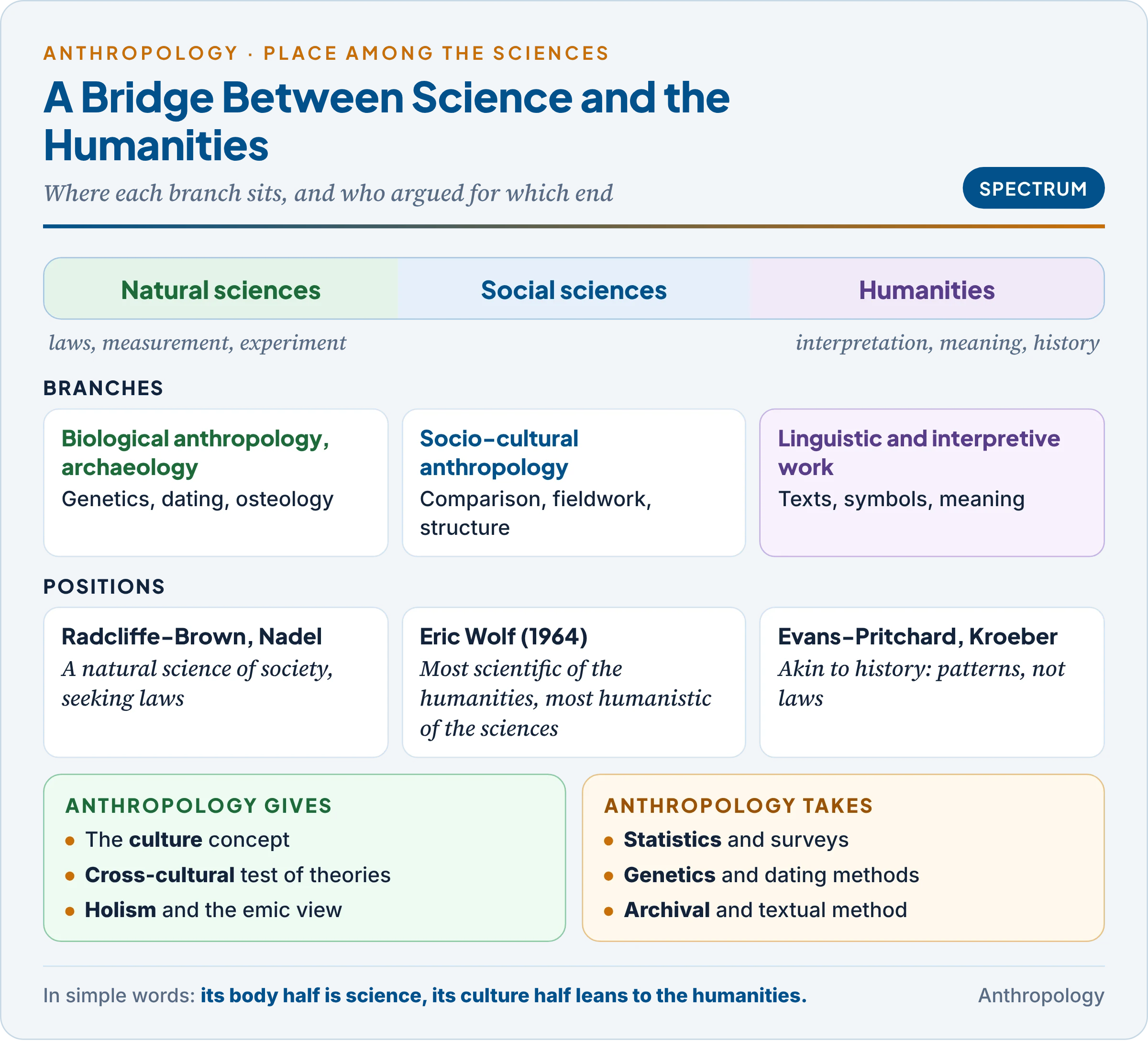
Scholars have argued about this since the discipline began, because each answer implies a different method. If anthropology is a natural science, it should look for laws. If it is a humanity, it should interpret meanings, as a historian or a literary critic does. Four positions stand out:
| Position | Main argument | Proponents |
|---|---|---|
| Natural science | Humans are part of nature; social laws resemble natural laws. This was the view of the evolutionist founders | Tylor, Morgan, Spencer; physical anthropology from Broca onwards |
| Generalising social science | Compares cultures in order to frame laws of social life that hold across time and place | Radcliffe-Brown (a “natural science of society”), Malinowski, S.F. Nadel |
| Humanity / branch of history | Culture and nature are different orders; anthropology interprets meanings and does not discover laws | Kroeber, David Bidney, Evans-Pritchard; the German tradition separating Natur from Geist |
| Bridge discipline | It combines scientific method (biology, dating, statistics) with historical and aesthetic method (ethnography, texts) | Eric Wolf: “most scientific of the humanities, most humanistic of the sciences” |
Reading the table. The four positions are not just labels; each leads to a different kind of research. A natural-science anthropologist asks what causes a custom and looks for a regularity that holds everywhere, such as a link between descent rules and residence. A humanist asks what the custom means to the people who follow it, and is satisfied with a rich interpretation of one case. The “bridge” view accepts that both questions are legitimate, which is why one discipline can contain fossil dating and the interpretation of myth.
- Who they are: Tylor, Spencer and Morgan were 19th-century evolutionists; Broca, a French anatomist, founded physical anthropology; Radcliffe-Brown and Malinowski founded British social anthropology; Kroeber was Boas’s leading American student; Evans-Pritchard was the Oxford anthropologist of the Nuer; Eric Wolf was an American anthropologist of peasants and world history.
- Nature versus mind (Natur/Geist): the German idea that human meaning needs understanding from within, nature causal explanation. A falling stone is explained by gravity; a person bowing to an elder is understood only when we know what respect means in that society. Scholars who accept this division place the study of culture with the humanities.
- Robert Redfield, an American anthropologist of peasant communities, saw holistic tendencies and a growing interest in values and personality (Benedict, Evans-Pritchard). He predicted that anthropology would move closer to the humanities and social sciences than to the natural sciences.
- In practice the answer depends on the branch:
- biological anthropology and archaeology use experimental, measurement-based methods
- socio-cultural and linguistic anthropology use interpretive, comparative methods
- The science–humanity debate in brief (detail in Unit 1.1, §2.4): the scientific side stresses objectivity, comparison and testable generalisation; the humanistic side stresses that human action is meaningful and must be understood from the actor’s point of view. Most anthropologists now hold that the discipline needs both: measurement where things can be measured, interpretation where meanings are at stake.
1.2 A two-way exchange
Anthropology is not only a borrower. The table pairs what it gives other disciplines with what it takes from them; read each row as one exchange.
| Anthropology gives | Anthropology takes |
|---|---|
| The concept of culture, now basic to every human science | Statistics, sampling and survey from sociology and economics |
| Cross-cultural data: a test of whether claims about “human nature” hold beyond Western samples | Tests and experiments from psychology |
| Holism: links biology, ecology, economy, politics and belief in one frame | Genetics, anatomy, physiology from the life sciences |
| Cultural relativism and the emic view; a check on ethnocentric theory | Stratigraphy and geochronology from the earth sciences |
| Participant observation and the genealogical method (Rivers) | Archival and textual method from history and the humanities |
What the exchange shows. Anthropology’s main exports are ideas and evidence (culture, cross-cultural data, holism, relativism), while its imports are mostly techniques (statistics, tests, laboratory genetics, dating). This is why it is called a synthesising discipline: it gathers methods from many neighbours and applies them to the whole human being.
- The genealogical method (collecting family trees in the field to map kinship and social groups) was devised by W.H.R. Rivers, a British psychologist-anthropologist, on the Torres Strait expedition. Holism, relativism and the emic view are explained in Key Terms.
- Social scientists mostly study their own or closely related societies. Before they generalise about human psychology, politics or economics, they need anthropological data on other societies. Otherwise a “law” of human behaviour may simply describe one Western society.
- Humanities specialists turn to cultural anthropologists for the art, music and literature of non-Western peoples. Anthropologists in turn borrow the humanities’ methods for analysing styles and texts.
- Comparing modern societies with very different ones makes the familiar strange. It brings out unusual features of modern society and thought that its own members take for granted.
1.3 Situating anthropology among the social sciences
Every social science studies human society, so the question is what anthropology does that the others do not. The table lists five distinctive features.
| Distinctive feature | What it adds |
|---|---|
| Scope | All humans, all times and places, biological as well as cultural |
| Holism | Studies the whole pattern of life. Other social sciences each isolate one aspect (the economy, the polity, the mind) |
| Comparison | Generalisations are tested across cultures, not within one nation |
| Fieldwork | Long-term participant observation, local language, the emic view |
| Bio-cultural | The only social science in which biologists and ethnographers share one discipline |
Why these features matter. Each feature corrects a weakness of a neighbouring science. Scope corrects the tendency to treat modern Western society as “normal”. Holism corrects the habit of studying the economy or the polity as if it stood alone. Comparison checks whether a generalisation is really human or merely local. Fieldwork gives access to what people actually do, not only what they report in surveys. The bio-cultural link lets anthropology test claims about “human nature” against biological evidence.
- Gopal Sarana (an Indian anthropologist at Lucknow who wrote on comparative method): anthropology’s relationship with sociology, psychology and history is intimate, but with economics and political science it is more perfunctory (formal and limited). The latter two deal with only one aspect of behaviour, mostly in modern nation-states, while anthropology studies economic, political, legal and religious life together. Sociology, psychology and history share anthropology’s interest in the whole person in society, so ideas move freely between them; economics and political science share only a slice of its subject, so the contact is limited to specific topics such as exchange or power.
- Boundaries in India (Srivastava, The Eastern Anthropologist, 2004):
- The Indian Science Congress regrouped anthropology under a general “behavioural science” section with psychology and education. This ignored its links with sociology, history and economics and its biological half.
- The “general anthropologist” ideal (one person expert in all branches; Boas was its rare true practitioner) survives in India. Often it yields a thin mix of physical and social anthropology rather than real integration.
- The way forward: specialists who understand the boundaries between disciplines and work in teams on frontier problems. Examples:
- with sociology: inequality, poverty, caste and power
- with physical anthropology: endemic and ethnic-specific diseases
- New work grows at these frontiers, because problems that cross disciplinary lines cannot be solved by any one discipline’s method.
2. Anthropology and the Social Sciences
In simple words
The social sciences (sociology, history, economics, political science, geography and demography) each study one part of social life. Anthropology studies the same things but in all kinds of societies, through long fieldwork and by seeing how the parts fit together. The closest neighbours are sociology and history; the relationship with economics and political science is narrower.
2.1 Sociology
An example to start with: a sociologist studying caste in a city might survey 2,000 households about occupation and marriage. A social anthropologist would live in one village for a year, learning how caste shapes who eats with whom, who marries whom and who attends whose funeral. Both study caste; they differ in scale, method and depth.
Shared origins: both study human social relations, and both draw on Émile Durkheim, the French founder of sociology. Through Radcliffe-Brown, Durkheim shaped British structural-functionalism (the view that each institution is a part of a social structure and functions to keep the whole working). No real distinction between the two subjects was drawn until the early twentieth century. Durkheim argued that social facts (such as laws, customs and moral rules) exist outside individuals and constrain them, so society must be studied as a reality of its own. Both sociologists and social anthropologists built on this idea, which is why their basic concepts, such as institution, function and solidarity, are the same.
- E.A. Hoebel, an American legal anthropologist, Man in the Primitive World: “Sociology and social anthropology are, in their broadest senses, one and the same.“
- Evans-Pritchard, Social Anthropology (1951): social anthropology is the branch of sociological studies that chiefly devotes itself to primitive societies.
- Kroeber called the two “twin sisters”.
- All three statements make the same point: the two subjects share concepts and aims; what separates them is the kind of society studied and the methods used.
Why they split: both emerged under colonialism, which divided the world into a modern “self” and a primitive “other”.
- Sociology studied the self: industrial, urban, Western society.
- Anthropology studied the other: colonised, tribal, non-literate societies.
- This was a historical division of labour, not a difference of subject. That is why the line between them blurs once anthropologists study cities and sociologists study villages.
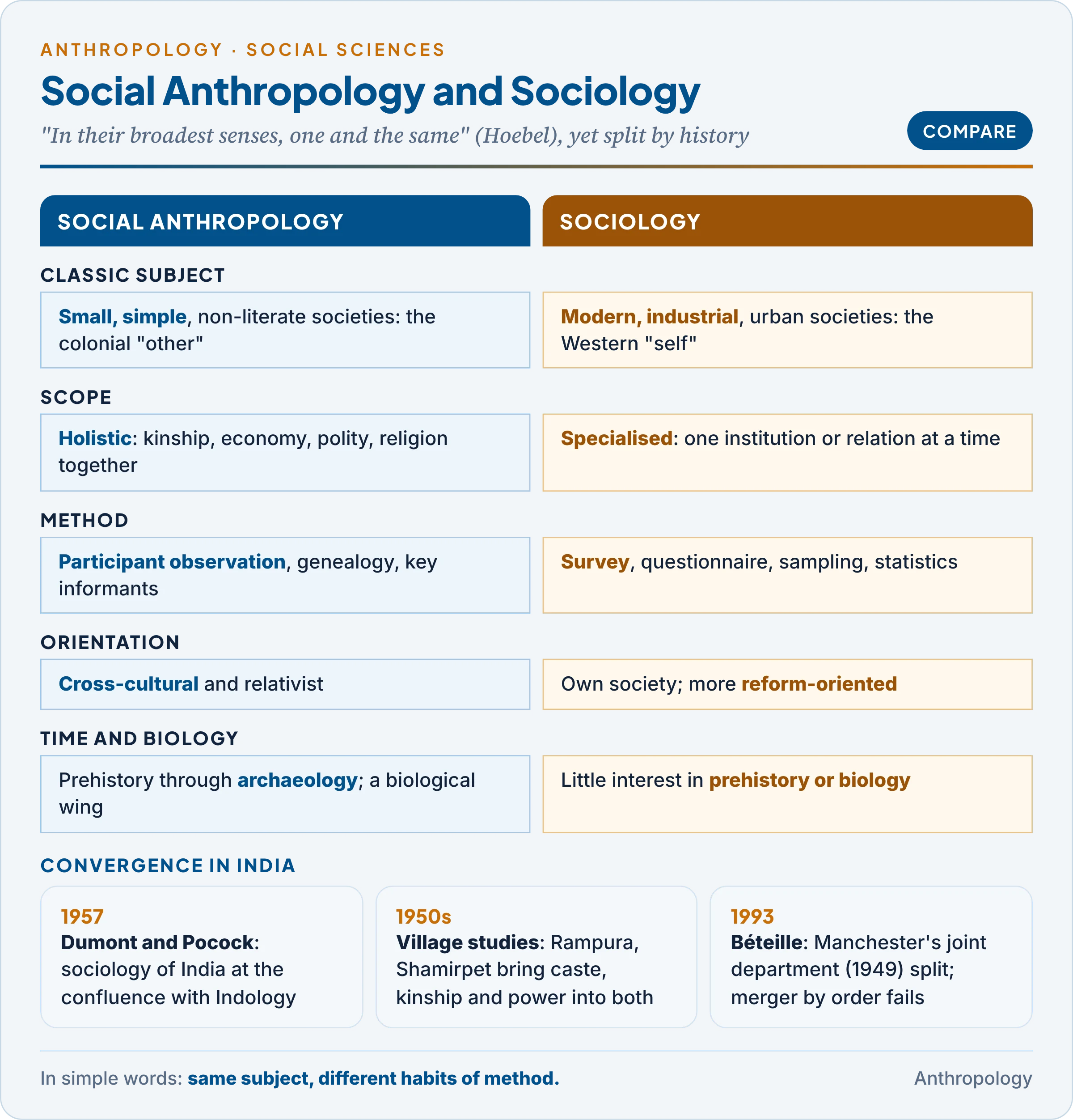
The table sets out the classic contrasts. Remember that each row describes the traditional emphasis; today many practitioners cross over.
| Basis | Social anthropology | Sociology |
|---|---|---|
| Classic subject | Small-scale, simple, non-literate societies (now all societies) | Complex, modern, industrial societies |
| Scope | Holistic: kinship, economy, polity, religion together | Specialised: social relations and interactions, often one institution at a time |
| Method | Participant observation, key informants, genealogy, qualitative | Survey, questionnaire, sampling, statistical analysis |
| Orientation | Cross-cultural comparison; relativist | Mostly its own society; more reform-oriented and prescriptive |
| Time and biology | Time depth through archaeology; a biological wing | Little concern with prehistory or human biology |
Reading the table. The contrasts follow from the kind of society each discipline first studied. A small, non-literate community can be observed as a whole by one fieldworker over a year, so anthropology developed holism and participant observation. A large industrial society cannot be observed whole, so sociology developed sampling and statistics. As anthropologists moved to cities and sociologists to villages, each borrowed the other’s methods, and the contrasts weakened.
Common confusion
Is the difference between sociology and social anthropology a difference of subject matter? No. Both study social relations and institutions. The difference was historical (who studied the colonial “self” and who studied the “other”) and is now mainly one of method and emphasis: long-term fieldwork and holism in anthropology, surveys and statistics more often in sociology.
What anthropology gave sociology:
- Culture concept, culture traits and culture areas, and the idea of the functional interdependence of institutions (Malinowski): a change in one institution, such as the economy, produces changes in others, such as the family. (Cultural lag is not an anthropological gift: it is the American sociologist W.F. Ogburn’s concept, from Social Change, 1922.)
- Basic personality structure (Abram Kardiner, an American psychoanalyst, and Ralph Linton, an American anthropologist, The Individual and His Society, 1939): the personality type that a society’s child-rearing practices produce in most of its members. The reasoning runs in steps: shared ways of feeding, disciplining and caring for infants (primary institutions) produce shared anxieties and expectations in adults, and these are then expressed in religion, folklore and ritual (secondary institutions). Also national character studies (Ruth Benedict).
- The case against racism: Franz Boas, the German-born founder of American anthropology, in Anthropology and Modern Life (1928), and Otto Klineberg, a psychologist, in Race Differences (1935), showed that mental differences come from environment, not physical type. Sociologists such as R.M. MacIver built on this.
Convergence in India:
- Louis Dumont (a French anthropologist of India) and David Pocock (1957): “a Sociology of India lies at the point of confluence of Sociology and Indology.” In other words, Indian society must be studied through its own classical texts and categories as well as through fieldwork.
- Before: Indian anthropologists first studied the rural or tribal “other”, while sociologists studied the urban “self”.
- The shift: village studies of the 1950s, including M.N. Srinivas’s Rampura (Karnataka) and S.C. Dube’s Shamirpet (Telangana), carried sociologists into kinship and ritual and anthropologists into caste, inequality and power.
- M.N. Srinivas, an Oxford-trained social anthropologist, built sociology departments at Baroda and Delhi.
- G.S. Ghurye’s Bombay department taught the two together.
- André Béteille (1993), an Indian sociologist:
- Indian-trained sociologists are routinely labelled “anthropologists” in American universities.
- Max Gluckman’s joint department at Manchester (1949) later split: a merger by administrative order does not produce integration. Integration comes from working together on shared problems, not from sharing a building or a budget.
- Today: anthropologists study corporations and markets, as in Karen Ho, Liquidated: An Ethnography of Wall Street (2009), and sociologists use ethnography. The boundary is now one of method and emphasis, not subject.
2.2 History
An example to start with: a historian reconstructs the Santhal rebellion of 1855 from British records and petitions. An anthropologist working in a Santhal village today records how the rebellion is remembered in songs and festivals. One uses documents, the other living memory and practice; together they give a fuller picture.
Similarities:
- both study the human past
- both are idiographic at the level of the case (they describe particular peoples and events rather than framing general laws)
- both stress context
The table lists where they part company.
| Basis | Anthropology | History |
|---|---|---|
| Sources | Fieldwork, oral tradition, genealogies, material remains | Written documents and archives |
| Coverage | Pre-literate and prehistoric peoples too; biology as well as culture | Mainly literate societies; political, economic and social events |
| Focus | Recurrent patterns, structures, culture | Particular events, periods, persons, in chronological order |
| Time | Synchronic (functionalists) and diachronic (evolutionists, archaeology) | Diachronic |
Reading the table. The key difference is in sources. Because history depends on written documents, it is strongest for literate societies and recent centuries. Anthropology creates its own sources through fieldwork, oral tradition and excavation, so it can reach peoples and periods that left no writing. This is why the two are complementary: each covers what the other cannot.
- Synchronic study looks at a society at one point in time, like a photograph; diachronic study follows it through time, like a film.
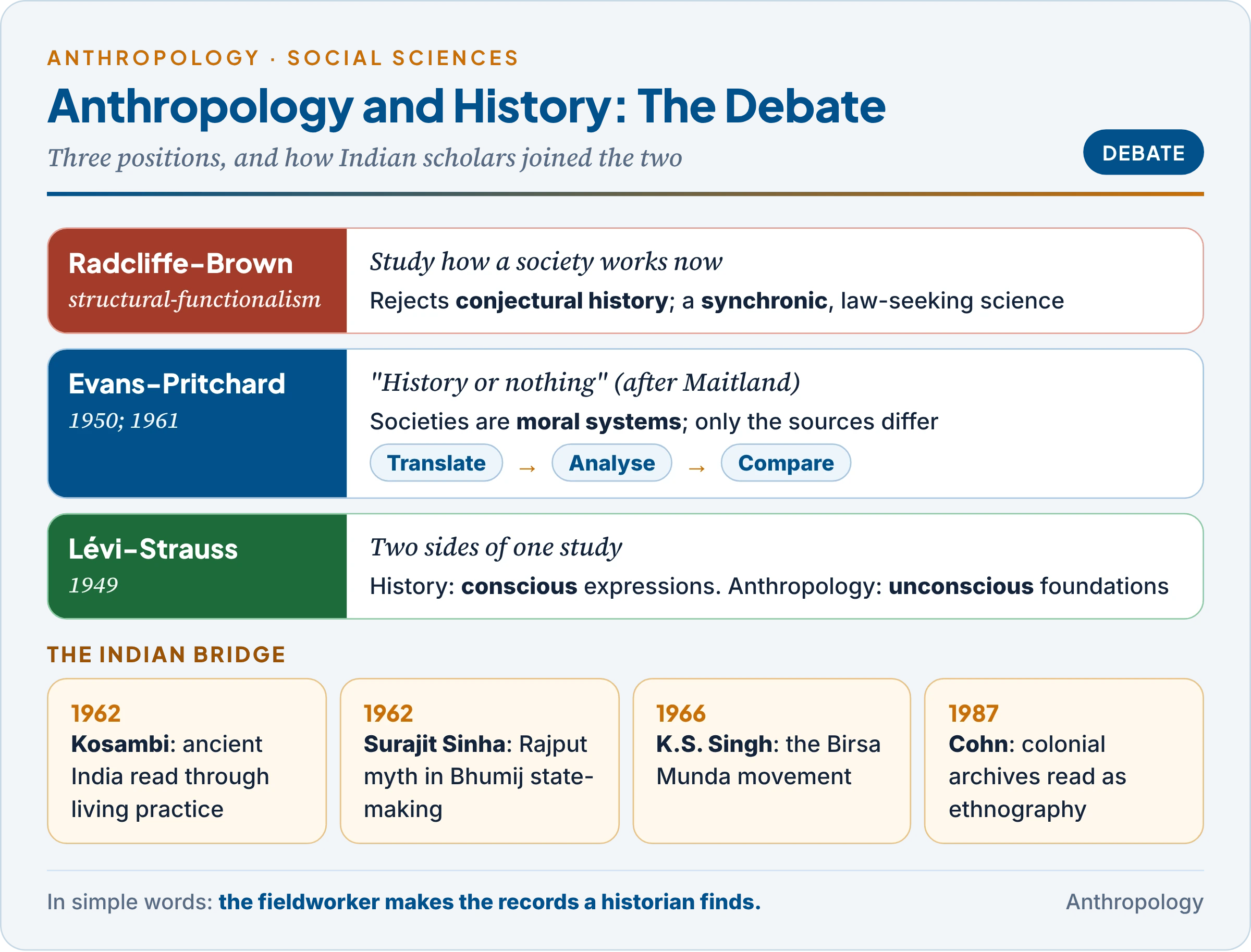
The debate:
- Evolutionists and diffusionists wrote conjectural history: stages and migrations reconstructed without documents, by guessing how customs must have developed or travelled.
- Radcliffe-Brown rejected this. Social anthropology should be synchronic and law-seeking, studying how a system works now. His reason: a past that cannot be documented cannot be known, so it cannot explain anything. For example, instead of guessing that the mother’s brother’s special role among some African peoples is a “survival” of an earlier matrilineal stage, he explained it by the way the present kinship system works.
- Boas: each culture is the product of its own history (historical particularism), so cultures must be studied one by one before any comparison.
- Evans-Pritchard, Marett Lecture (1950) and Anthropology and History (1961):
- he endorsed the verdict of F.W. Maitland, an English legal historian, that “by and by anthropology will have the choice between being history and being nothing“
- societies are moral systems, and the method has three steps: translate a culture, analyse its structure, compare it with others
- the anthropologist differs from the historian only in creating his own sources through fieldwork
- Claude Lévi-Strauss, the French founder of structuralism, “History and Anthropology” (1949): history organises data around conscious expressions of social life, anthropology around its unconscious foundations (rules people follow without stating them, like grammar). The two are complementary. A historian of a kingdom reads the king’s decrees and chronicles (what people consciously recorded); an anthropologist of the same society looks for the marriage rules or classifications that everyone follows but no one writes down. Each sees a level the other misses.
Convergence:
- Ethnohistory (history of non-literate peoples from oral and documentary sources) and oral tradition: Jan Vansina, a Belgian historian of Africa, Oral Tradition (1961; English 1965).
- Historical anthropology: Marshall Sahlins, an American anthropologist, Islands of History (1985), on how Hawaiian culture shaped the events of Captain Cook’s arrival.
- Eric Wolf, Europe and the People Without History (1982): the peoples whom Europe called “without history” were in fact shaped by centuries of trade, conquest and colonialism, so anthropology must study them historically (Unit 1.1, §4.5).
- Indian bridges:
- D.D. Kosambi, an Indian mathematician and historian, Myth and Reality (1962) and “Combined Methods in Indology” (1963): reading ancient India through living tribal and peasant practice
- Bernard Cohn, an American historian-anthropologist of India, An Anthropologist among the Historians (1987): colonial census and archives as ethnographic objects
- Surajit Sinha, an Indian anthropologist (1962): Rajput myths in tribal state formation (Bhumij, central India)
- K.S. Singh, The Dust-Storm and the Hanging Mist (1966): the Birsa Munda movement, written by a historian who later led the People of India project
- the Subaltern Studies collective (from 1982): history from below, using oral and ethnographic sources
2.3 Economics
Indian Connect
Example first: in a north Indian village studied in the 1930s, a barber, a potter and a washerman served landowning families for generations and were paid in grain at harvest, not in cash per job. No price model explains this; it rests on caste, custom and obligation. This is the jajmani system described by W.H. Wiser.
Economics treats one aspect of behaviour, production, distribution and consumption, mainly in market economies. Economic anthropology studies the same processes embedded in kinship, politics and religion (that is, not separable from them), in tribal, peasant and, increasingly, urban settings. The table compares the two.
| Basis | Economics | Economic anthropology |
|---|---|---|
| Unit | Firm, market, nation | Community, household, kin group |
| Assumption | Scarcity and rational maximisation (homo economicus) | Rationality is culturally defined: prestige, obligation, sacredness |
| Exchange | Market price, money | Reciprocity, redistribution and market (Polanyi) |
| Method | Models, statistics, quantitative data | Ethnography, case study, qualitative data |
| Value | Price | Social meaning: the gift creates bonds (Mauss) |
Reading the table. Economics begins from the individual who chooses rationally under scarcity. Economic anthropology asks first what counts as rational in a given society, because people may value prestige, alliance or religious merit above profit. A chief who gives away all his yams at a feast is not irrational: he is converting goods into status and followers, which matter more in his society than stored wealth.
- Terms in the table:
- homo economicus: the “economic man” of theory, who always chooses to maximise his own gain
- reciprocity: exchange between equals, such as gifts returned later
- redistribution: goods flow to a centre (a chief, a temple) and are handed out again
- Classic cases:
- Malinowski, Argonauts of the Western Pacific (1922): the kula ring of the Trobriand Islands, a circular exchange of armshells and necklaces between islands, made for status and alliance, not profit. The valuables have no practical use; their importance lies in the partnerships they create, since each exchange obliges a return and keeps islands linked across generations
- Marcel Mauss, a French anthropologist, The Gift (1925): gifts create obligations to give, to receive and to return, and so bind people together. In many Indian families, wedding gifts are noted down so that an equal or larger gift can be returned later: the record keeps the relationship alive
- Raymond Firth, a New Zealand-born British anthropologist, Primitive Polynesian Economy (1939), on Tikopia
- M.J. Herskovits, an American anthropologist, The Economic Life of Primitive Peoples (1940), revised as Economic Anthropology (1952)
- Karl Polanyi, a Hungarian economic historian, The Great Transformation (1944): the economy as embedded in society
- Formalist–substantivist debate (Unit 3): formalists apply market theory everywhere; substantivists, following Polanyi, study non-market economies on their own terms. Faced with the jajmani system, a formalist would look for the hidden “price” each party gains; a substantivist would describe it as an exchange governed by caste and custom, where obligation, not bargaining, sets the terms.
- Indian anchor: W.H. Wiser, an American missionary-scholar, The Hindu Jajmani System (1936), on Karimpur (Uttar Pradesh): hereditary service exchange paid in kind.
- Economics turning ethnographic:
- Elinor Ostrom (Nobel Prize 2009) drew on field cases of community-managed commons such as forests, pastures and irrigation systems
- Banerjee, Duflo and Kremer (Nobel Prize 2019) built field experiments that depend on local social knowledge
- behavioural economics tests rationality across cultures
2.4 Political science (and law)
Political science is built around the state; political anthropology was created to explain how societies without rulers, such as the Nuer, keep order.
| Basis | Political science | Political anthropology |
|---|---|---|
| Object | The state, constitutions, parties, elections; political philosophy from Plato and Aristotle to David Easton | Stateless and pre-state societies as well as states |
| Power | A separate institution; acquired through competition and election | Fused with kinship and religion; often inherited and divinely sanctioned |
| Distribution | Vertical: hierarchy of offices | Often horizontal: balanced segments, elders, councils |
Reading the table. Political science long assumed that order requires a state. Political anthropology showed that many societies keep order without one, by balancing groups against each other, by the authority of elders, and by religious sanctions. This widened the very definition of politics, from “the study of government” to “the study of power and order in any society”.
- Classic cases:
- Meyer Fortes and Evans-Pritchard, African Political Systems (1940): centralised states versus stateless societies
- Nuer (South Sudan): order through segmentary lineages (descent groups that unite against outsiders and split into smaller groups when the threat is internal) and the threat of feud, without rulers. Two brothers’ families may quarrel, but they unite against a cousin’s lineage, and all of them unite against another clan: the balance of opposed segments prevents any one group from dominating
- Pierre Clastres, a French anthropologist, Society Against the State (1974): some societies actively prevent a ruler from emerging
- Concepts political science took from anthropology:
- M.N. Srinivas, “vote bank” (1955) and “dominant caste” (Rampura): a caste that dominates a village through numbers, land and ritual rank. A “vote bank” is a caste or community whose members vote as a bloc on their leaders’ advice; both ideas came from watching village politics at close range, and both are now everyday terms in Indian political analysis
- F.G. Bailey, a British anthropologist, Tribe, Caste and Nation (1960) and Stratagems and Spoils (1969), from fieldwork in Odisha
- James C. Scott, an American political scientist, Weapons of the Weak (1985): everyday resistance such as foot-dragging and gossip, from Malaysian village fieldwork
- Legal anthropology:
- Henry Maine, a British jurist, Ancient Law (1861): from status to contract, that is, from rights fixed by birth and family to rights fixed by individual agreement, as when a hereditary caste occupation gives way to a job taken on by contract
- Karl Llewellyn and Hoebel, The Cheyenne Way (1941)
- Hoebel, The Law of Primitive Man (1954)
- All three show law and social control without courts or police: through public opinion, ridicule, compensation and ritual (Unit 4).
2.5 Geography and demography
- Geography:
- Friedrich Ratzel, a German geographer, Anthropogeographie (1882–91): environmental determinism (the environment decides the form of culture), later answered by the French possibilists, for whom the environment only sets possibilities among which people choose. Two peoples in the same forest may live very differently, one by shifting cultivation and another by hunting, which shows that culture, not environment alone, makes the choice
- Julian Steward, an American anthropologist, Theory of Culture Change (1955): cultural ecology, linking environment, technology and social organisation
- Demography:
- fertility, mortality and migration are shaped by values, kinship and marriage
- the success of family-planning programmes depends on socio-cultural acceptance: where sons are needed for old-age support or rituals, families keep having children until a son is born
- anthropological demography joins the two (Unit 11)
3. Anthropology and the Behavioural Sciences
In simple words
Psychology studies how an individual thinks, feels and behaves. Anthropology shows that much of this is learned from culture and so differs from society to society. Together they ask which parts of human behaviour are universal and which are shaped by the way a people raise and train their children.
An example to start with: in the early 1900s many psychologists believed that adolescence is everywhere a time of “storm and stress”. Margaret Mead went to Samoa and reported that teenage girls there grew up without this turmoil. Whether or not her findings were right in every detail, the study showed why psychology needs evidence from other cultures before calling anything universal.
Psychology studies individual behaviour and mental processes. Anthropology studies behaviour as patterned by culture across groups. The two are complementary:
- psychology explains the mechanisms of behaviour
- anthropology shows how cultural environments shape them
The closest meeting point is between social psychology and cultural anthropology. Hoebel put it neatly: the anthropologist concentrates on the society of the primitive, the sociologist on contemporary civilisation, and “the social psychologist roams happily between them manipulating his tests and measurements”.
The table lists the main anthropological contributions to psychology; each row is a case where cultural evidence tested a psychological claim.
| Contribution | Study | What it showed |
|---|---|---|
| Perception | W.H.R. Rivers, Torres Strait expedition (1898); Segall, Campbell and Herskovits (1966) | Susceptibility to the Müller-Lyer illusion varies with environment: the “carpentered world” hypothesis |
| Adolescence | Margaret Mead, Coming of Age in Samoa (1928) | Samoan adolescence was not stressful, against G. Stanley Hall’s universal “storm and stress” |
| Oedipus complex | Malinowski, Sex and Repression in Savage Society (1927) | In the matrilineal Trobriands, a boy’s tension is with the mother’s brother, not the father |
| Personality | Benedict, Patterns of Culture (1934); Kardiner and Linton; Cora Du Bois, The People of Alor (1944) | Configurations, basic personality and modal personality |
| Child training | Whiting and Child, Child Training and Personality (1953) | Cross-cultural tests of socialisation hypotheses |
| Cognition | Berlin and Kay, Basic Color Terms (1969) | Ethnoscience: universals and variation in classification |
| Mental illness | Culture-bound syndromes; DSM-5 (2013) cultural concepts of distress | Symptoms and their meaning are shaped by culture |
Reading the table. Each study took a claim that psychologists had treated as universal and tested it in another culture. Malinowski’s case shows the method clearly. Among the matrilineal Trobrianders, a boy’s authority figure is his mother’s brother, while his father is an affectionate companion. Malinowski found the boy’s resentment directed at the uncle, not the father, and concluded that the tension Freud described follows authority in the family structure, not a universal sexual rivalry.
- Terms in the table:
- “carpentered world” hypothesis: people raised among straight walls and right angles are more prone to the Müller-Lyer illusion (two equal lines that look unequal because of arrow-shaped ends) than people raised in round huts and open country
- Oedipus complex: Freud’s claim that every boy feels rivalry with his father
- configuration (Benedict): the overall pattern of a culture; modal personality (Du Bois): the personality type most common in a society
- DSM-5: the American psychiatric manual, which since 2013 includes cultural concepts of distress
Indian anchors:
- Verrier Elwin (a British-born anthropologist who lived among and later became a citizen of India), The Muria and their Ghotul (1947): the Muria (Bastar) ghotul (youth dormitory) socialised adolescents with less restraint and conflict than caste Hindu society.
- Dhat syndrome (named by N.N. Wig, an Indian psychiatrist, 1960): semen-loss anxiety, a culture-bound syndrome of South Asia.
- Sudhir Kakar, an Indian psychoanalyst, The Inner World (1978): a psychoanalysis of Indian childhood and family.
- G.M. Carstairs and R.L. Kapur, The Great Universe of Kota (1976): mental illness and healers in a coastal Karnataka village.
The two disciplines also differ in unit, setting and method:
| Basis | Psychology | Anthropology |
|---|---|---|
| Unit | The individual | The group and humankind |
| Setting | Laboratory, clinic | Field, natural community |
| Method | Experiment, tests, introspection, psychometrics | Participant observation, life history, cross-cultural comparison |
| Claims | Often universal, from Western samples | Tests universality across cultures |
Reading the table. The two disciplines complement each other. Psychology’s experiments are precise but usually drawn from a narrow population, often university students in Western countries. Anthropology’s fieldwork is less controlled but covers the full range of human societies. A claim about the human mind is strongest when it survives both tests.
- Critique: culture-and-personality studies stereotyped whole nations. Benedict’s The Chrysanthemum and the Sword (1946) described Japan without fieldwork there, from interviews and documents during the war. The objection is that a whole nation contains many regions, classes and individuals; describing it as one personality hides this variation and can harden into prejudice. Later work moved to cognitive anthropology (how people classify and reason) and psychological anthropology proper, which studies individuals within cultures rather than whole “national characters” (Unit 6).
4. Anthropology and the Life Sciences
In simple words
Humans are animals, so their bodies, genes, growth and evolution are studied with the methods of biology. Biological anthropology borrows those methods but always asks how culture, such as diet, marriage rules or medicine, shapes human biology. The life sciences in turn depend on anthropology for knowledge of human variation across the world.
Humans are biological organisms, so growth, reproduction, nutrition, adaptation and evolution are shared ground with biology. Through biological anthropology, anthropology links to zoology, anatomy, physiology, embryology, genetics, ecology and ethology (the study of animal behaviour).
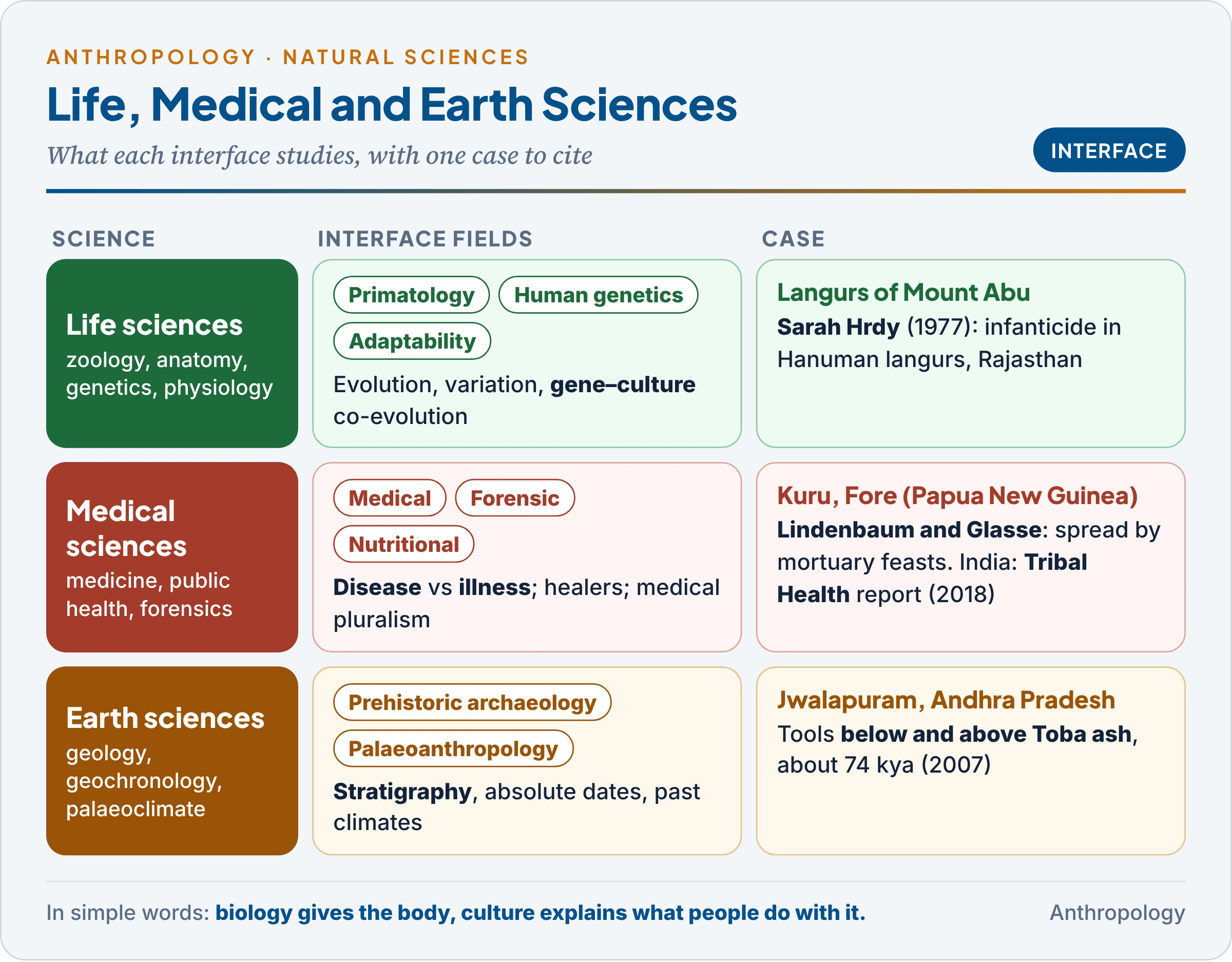
Each row of the table pairs a life science with the anthropological field it created and an example.
| Life science | Interface field | Example |
|---|---|---|
| Zoology / ethology | Primatology | Jane Goodall (Gombe, 1960): chimpanzee tool use. Sarah Hrdy, The Langurs of Abu (1977): infanticide among Hanuman langurs at Mount Abu, Rajasthan |
| Anatomy | Human osteology, comparative anatomy | Skeletal changes of bipedalism; fossil reconstruction (Unit 1.5) |
| Physiology | Human adaptability | High-altitude adaptation (Tibetans, Andeans, Ladakhis), heat and cold (Unit 9) |
| Genetics | Population genetics, ancient DNA | Sickle cell–malaria balance; lactase persistence as gene–culture co-evolution |
| Evolutionary biology | Human evolution | Darwin; the Modern Synthesis; Washburn’s “new physical anthropology” (1951) |
| Nutrition and ecology | Nutritional and ecological anthropology | Diet, growth and disease in specific environments |
Reading the table. In each row the life science supplies the method and anthropology supplies the human and cultural question. The sickle-cell case shows how this works. A person with one copy of the sickle-cell gene is protected against malaria, while a person with two copies suffers severe anaemia. Where malaria is common, carriers survive better, so the gene stays frequent despite its cost. Genetics explains the mechanism; anthropology explains why malaria was common there, through settlement and farming practices.
- Terms in the table:
- osteology: the study of bones; bipedalism: walking upright
- lactase persistence: the ability to digest milk as an adult, which spread in herding peoples who drank milk, a clear case of gene–culture co-evolution (genes and culture changing together)
- Modern Synthesis: the joining, in the 1930s–40s, of Darwin’s natural selection with Mendelian and population genetics
- Washburn’s “new physical anthropology” (1951): study populations and evolutionary processes, not racial types (Units 1.1 and 1.3)
- Two-way exchange:
- biologists depend on anthropology for data on human variation in different cultures
- anthropologists borrow methods from biology: serology (blood-group study), DNA analysis, anthropometric statistics
- Indian anchors:
- D.N. Majumdar, an Indian anthropologist, and C.R. Rao, an Indian statistician, Race Elements in Bengal (1960): body measurements analysed with modern statistics
- sickle-cell studies among central Indian tribes
- Sociobiology debate:
- E.O. Wilson, an American biologist, Sociobiology (1975), explained social behaviour through genes
- Marshall Sahlins, The Use and Abuse of Biology (1976), replied that kinship is cultural, not genetic: kin categories do not follow degrees of genetic relatedness (for example, many societies treat a father’s brother’s children as siblings but a mother’s brother’s children as possible spouses, though both are equally related)
- Gene–culture co-evolution is the present middle ground
- Difference in scope: biology studies the human organism. Anthropology adds culture, society and language, and treats biology as shaped by culture: diet, marriage rules and medicine all alter gene pools.
5. Anthropology and the Medical Sciences
In simple words
A disease is a biological fact, but how people explain it, whom they consult and whether they accept a cure depend on their culture. Medical anthropology studies this meeting point. Its findings help doctors and health programmes work with communities instead of against their beliefs.
An example to start with: in a tribal village, a family whose child has a fever may first call the ojha (healer), who explains the illness as the work of an angry spirit, and only later go to the health centre. A programme that ignores the healer’s role will fail; one that works with it can succeed.
The link is as old as the discipline. Illness is biological, but its meaning, its cause and the choice of cure are cultural.
Development of the link: the table traces how medical anthropology grew from studies of “primitive medicine” into a field of its own.
| Year | Work | Contribution |
|---|---|---|
| 1924 | W.H.R. Rivers, Medicine, Magic and Religion | Treated primitive medicine as a logical system following from beliefs about causation |
| 1932 | Forrest Clements, Primitive Concepts of Disease | Five worldwide concepts of disease: sorcery, breach of taboo, object intrusion, spirit intrusion, soul loss |
| 1937–41 | M.J. Field (Ga, Gold Coast); Dorothy Spencer (Fiji); George Harley (Mano, Liberia) | Ethnographies of indigenous medicine |
| 1942 | Erwin Ackerknecht | Primitive medicine “is not a queer collection of errors and superstitions”. What counts is the place medicine occupies in the life of a people |
| 1947 | Margaret Mead | Culture and psychosomatic medicine |
| 1953 / 1963 | William Caudill; Norman Scotch | “Applied anthropology in medicine”; the field named medical anthropology |
| 1978 | Foster and Anderson, Medical Anthropology | Personalistic (agent-caused) versus naturalistic (imbalance-caused) disease theories |
| 1980 | Arthur Kleinman, Patients and Healers in the Context of Culture | Disease versus illness; explanatory models; popular, folk and professional sectors |
Reading the table. The table shows a steady change of attitude. Early writers treated non-Western medicine as error to be replaced. From Rivers and Ackerknecht onwards, it was studied as a system of ideas with its own logic. By Kleinman’s time, the focus had shifted to how patients everywhere, including in Western hospitals, interpret illness and choose among healers. Clements’s five concepts, for instance, explain why a family that believes in soul loss will seek a ritual to call the soul back before, or alongside, a doctor.
- Terms in the table:
- personalistic theories blame a person or spirit (a witch, a god); naturalistic theories blame an imbalance (heat and cold, the doshas of Ayurveda)
- explanatory model: a patient’s or healer’s own account of what the illness is, why it happened and what will cure it
- popular, folk and professional sectors: care by family, by traditional healers and by trained doctors
Common confusion
Are “disease” and “illness” the same? No. In Kleinman’s terms, disease is the biological malfunction that a doctor diagnoses; illness is the patient’s experience of being unwell, including its meaning and social effects. A cure can treat the disease while leaving the illness, such as stigma or fear, untouched.
- Kuru (Fore, Papua New Guinea), a fatal brain disease:
- Shirley Lindenbaum and Robert Glasse showed it spread through mortuary feasting, the ritual eating of deceased kin
- Carleton Gajdusek, an American physician, proved it transmissible and won the Nobel Prize (1976)
- The classic proof that ethnography solves medical puzzles: once the feasting stopped, new cases fell away
- Public health:
- Western medicine succeeds only when it adapts to local social structure and the expectations placed on healers
- In the West African Ebola epidemic (2014–16), anthropologists helped redesign safe, dignified burials (Paul Richards, a British anthropologist, Ebola, 2016), because traditional washing of the dead was spreading the virus and families resisted burials that ignored their customs
- Critical medical anthropology: Paul Farmer, an American physician-anthropologist: structural violence, meaning harm caused by poverty, racism and unequal institutions rather than by any single person (Haiti; AIDS and Accusation, 1992).
- Medical pluralism in India (several healing systems used side by side):
- Charles Leslie, an American anthropologist, Asian Medical Systems (1976)
- AYUSH (Ayurveda, Yoga, Unani, Siddha, Sowa-Rigpa and Homoeopathy), folk healers and biomedicine coexist
- tribal patients often consult a shaman (ojha, guniya) before a clinic
- Expert Committee on Tribal Health (chair Abhay Bang, an Indian public-health doctor, MoHFW–MoTA, 2018) called for health care adapted to tribal culture.
- Serology and race:
- blood-group frequencies vary gradually (clinally) across populations
- they cut across the boundaries of traditional racial types
- serology therefore helped dismantle typological race, the idea that humans fall into a few fixed racial boxes (Unit 9)
- Forensic anthropology applies osteology and DNA to identification of human remains in crime and disaster cases: estimating age, sex and stature from bones (Unit 12).
6. Anthropology and the Earth Sciences
In simple words
To understand human evolution and prehistory, we must know where fossils and stone tools were found and how old they are. The earth sciences, such as geology and the study of past climates, supply that context and those dates. Anthropology gives back the story of how humans have changed the planet.
Prehistoric archaeology and palaeoanthropology depend on the earth sciences for context and time. Each row of the table names an earth science, what it gives anthropology and an example.
| Earth science | What it gives anthropology | Example |
|---|---|---|
| Geology / stratigraphy | Superposition, deep time (Hutton; Lyell, Principles of Geology, 1830–33) | Relative dating of tools and fossils |
| Geochronology | Absolute dates (K–Ar, Ar–Ar, U-series, TL, OSL, ¹⁴C) | Zinjanthropus, Olduvai: 1.75 mya by K–Ar (Leakey, Evernden and Curtis, 1961) |
| Quaternary geology / palaeoclimate | Glacial–interglacial sequence; climate as a driver of evolution | Alpine sequence (Günz–Mindel–Riss–Würm), now marine isotope stages; Potts’s variability-selection hypothesis |
| Palaeontology | Fossil fauna for biostratigraphy | Siwalik fossil apes (Sivapithecus) |
| Geomorphology / soils | River terraces, site formation | De Terra and Paterson (1939): Kashmir and Potwar terraces linked to the Soanian tools |
| Volcanology / tephra | Marker horizons | Jwalapuram (Andhra Pradesh): Middle Palaeolithic tools below and above the Toba ash, about 74 kya (Petraglia et al., 2007) |
Reading the table. The earth sciences answer two questions that anthropology cannot answer alone: how old a find is and what the environment was like when people lived there. Absolute dating often works by bracketing: a fossil found between two volcanic layers must be younger than the lower layer and older than the upper one, and each layer can be dated by potassium–argon. At Jwalapuram, the same logic, using the Toba ash as a dated marker, showed that tool-makers were present both before and after the eruption.
- Terms in the table:
- relative dates say only older or younger (from layers); absolute dates give an age in years from radioactive decay: K–Ar for volcanic rock, ¹⁴C (radiocarbon) for organic remains up to about 50,000 years, TL/OSL (luminescence) for burnt flint and sediments (Unit 1.8)
- Quaternary: the last 2.6 million years, the age of the Ice Ages and of Homo; marine isotope stages are warm and cold phases read from deep-sea cores
- biostratigraphy: dating layers by the extinct animals in them; tephra: volcanic ash, a marker horizon of one known date
- variability selection (Richard Potts): unstable climates favoured adaptable human ancestors; mya / kya: million / thousand years ago
- Indian fossil anchor: the Narmada cranium, found at Hathnora (Madhya Pradesh) by Arun Sonakia of the Geological Survey of India in 1982. It is the subcontinent’s only Middle Pleistocene hominin cranium, recovered from river gravels.
- Environmental archaeology is an interdisciplinary field. It treats sites in their landscape setting, with geologists, soil chemists, botanists and zoologists.
- Two-way: anthropology returns the question of the human impact on the planet: the Anthropocene, the proposed name for an age in which human activity is the main force changing the earth (see Contemporary Developments).
7. Anthropology and the Humanities
In simple words
The humanities study what people create and believe: art, music, literature, religion, philosophy and language. Anthropology adds the creations of peoples outside the great written traditions and studies them where they are made and used. In return it borrows the humanities’ skills for reading texts, styles and meanings.
The humanities (history, philosophy, literature, art, music, religion and language) study the works of humanity. Anthropology supplies their cross-cultural range. Its concept of culture implies that styles of art, music and literature rest on criteria specific to each tradition, not on one universal standard. The table pairs each humanity with its anthropological interface.
| Humanity | Interface | Example |
|---|---|---|
| Philosophy | Relativism, ethics, theories of knowledge | Evans-Pritchard on Azande witchcraft and the rationality debate |
| Literature and folklore | Myth analysis, oral literature | Lévi-Strauss on myth; Verrier Elwin, Myths of Middle India (1949); A.K. Ramanujan, “Three Hundred Rāmāyaṇas” (1991) |
| Art | Anthropology of art | Boas, Primitive Art (1927); Alfred Gell, Art and Agency (1998); Gond and Warli painting |
| Music | Ethnomusicology | Alan Merriam, The Anthropology of Music (1964) |
| Religion | Comparative religion | L.P. Vidyarthi, The Sacred Complex of Hindu Gaya (1961) |
| Language | Linguistic anthropology | Sapir–Whorf; structuralism borrowed from Saussure (Units 1.3 and 7) |
Reading the table. The humanities and anthropology study the same kinds of creation, but from different starting points. A literary scholar usually begins with a written text of a great tradition; an anthropologist begins with a performance, a ritual or an object in the community where it is used. Bringing the two together shows, for example, that a myth recited at a Gond festival is as rich a work of thought as a classical epic.
- What the examples mean:
- The rationality debate: Evans-Pritchard showed that Azande witchcraft beliefs are logical within their own premises: they explain why misfortune struck this person at this moment. Philosophers then asked whether rationality is universal or culture-specific.
- A.K. Ramanujan, an Indian poet and folklorist, showed that the Ramayana exists in hundreds of tellings across languages and communities, not one authoritative text.
- Alfred Gell treated art objects as agents that act on people.
- Ethnomusicology studies music in its cultural context; L.P. Vidyarthi‘s sacred complex treats Gaya’s holy geography, rituals and priests as one system.
- Linguistic anthropology in brief: the Sapir–Whorf hypothesis holds that the language we speak influences how we perceive and think; Lévi-Strauss borrowed from the Swiss linguist Ferdinand de Saussure the idea that elements gain meaning from their relations within a system, and applied it to kinship and myth.
- Indian bridge: Irawati Karve, an Indian anthropologist at Pune, read kinship through Sanskrit texts and the epics (Kinship Organisation in India, 1953). Her Yuganta (1967) is a study of the Mahabharata‘s characters.
- The literary turn:
- Clifford Geertz, an American interpretive anthropologist, “Blurred Genres” (1980) and Works and Lives (1988): ethnography as interpretation and authorship
- James Clifford and George Marcus, Writing Culture (1986): ethnographies are texts shaped by rhetoric and power, so the way an anthropologist writes affects what readers believe about a people
- Difference from the humanities: the humanities mostly study the high traditions of literate civilisations (the “great tradition”, in Redfield’s term). Anthropology studies everyday and little traditions (the folk beliefs and practices of ordinary villagers), and studies them in the field. Redfield’s point was that the two traditions constantly influence each other: village festivals borrow from Sanskrit texts, and the texts absorb local deities and stories. Understanding Indian civilisation requires both.
Key Terms
| Term | Meaning in simple words |
|---|---|
| Holism | Studying all parts of a people’s life together, because each affects the others |
| Emic / etic | The insiders’ own view and categories / the outside observer’s view and categories |
| Cultural relativism | Understanding a custom within its own culture, not judging it by the observer’s standards |
| Ethnocentrism | Treating one’s own culture as the standard for judging others |
| Structural-functionalism | The view that each institution is part of a social structure and helps keep it working |
| Idiographic | Describing particular cases, as opposed to seeking general laws (nomothetic) |
| Synchronic / diachronic | Studying a society at one point in time / following it through time |
| Conjectural history | Guessing past stages or migrations without documentary evidence |
| Embedded economy | An economy that cannot be separated from kinship, politics and religion (Polanyi) |
| Reciprocity / redistribution | Exchange between equals / pooling goods at a centre and handing them out again |
| Culture-bound syndrome | An illness pattern recognised only within particular cultures, such as dhat |
| Disease / illness | The biological malfunction / the patient’s experience and meaning of being unwell |
| Structural violence | Harm caused by poverty and unequal institutions, not by a single person |
| Gene–culture co-evolution | Genes and cultural practices changing together, such as milk-drinking and lactase persistence |
Contemporary Developments
- Anthropocene rejected as an epoch (March 2024): the ICS Subcommission on Quaternary Stratigraphy voted down the proposal, and the IUGS upheld the vote. Earth scientists, archaeologists and anthropologists still use the term informally for the human transformation of the planet.
- Harbin cranium identified as Denisovan (June 2025): 95 ancient proteins (Science) and mitochondrial DNA from dental calculus (Cell), from a skull at least 146,000 years old, gave the Denisovans a face. Palaeoproteomics (recovering ancient proteins) now links fossil anatomy and molecular biology.
- WHO Global Traditional Medicine Strategy 2025–2034: adopted by the 78th World Health Assembly on 26 May 2025. It recognises indigenous peoples’ traditional knowledge. India hosts the WHO Global Traditional Medicine Centre at Jamnagar, Gujarat (2022). Medical pluralism is now global health policy.
- Field-based economics:
- the 2019 Nobel Prize (Banerjee, Duflo, Kremer)
- the 2009 Nobel Prize (Ostrom, on commons)
- Both reward economics built on local institutions and field evidence.
- Tribal health in policy: the Expert Committee on Tribal Health report (2018) set a culturally adapted roadmap for tribal health care. It is the reference point for later tribal health missions.
Diagrams to Master
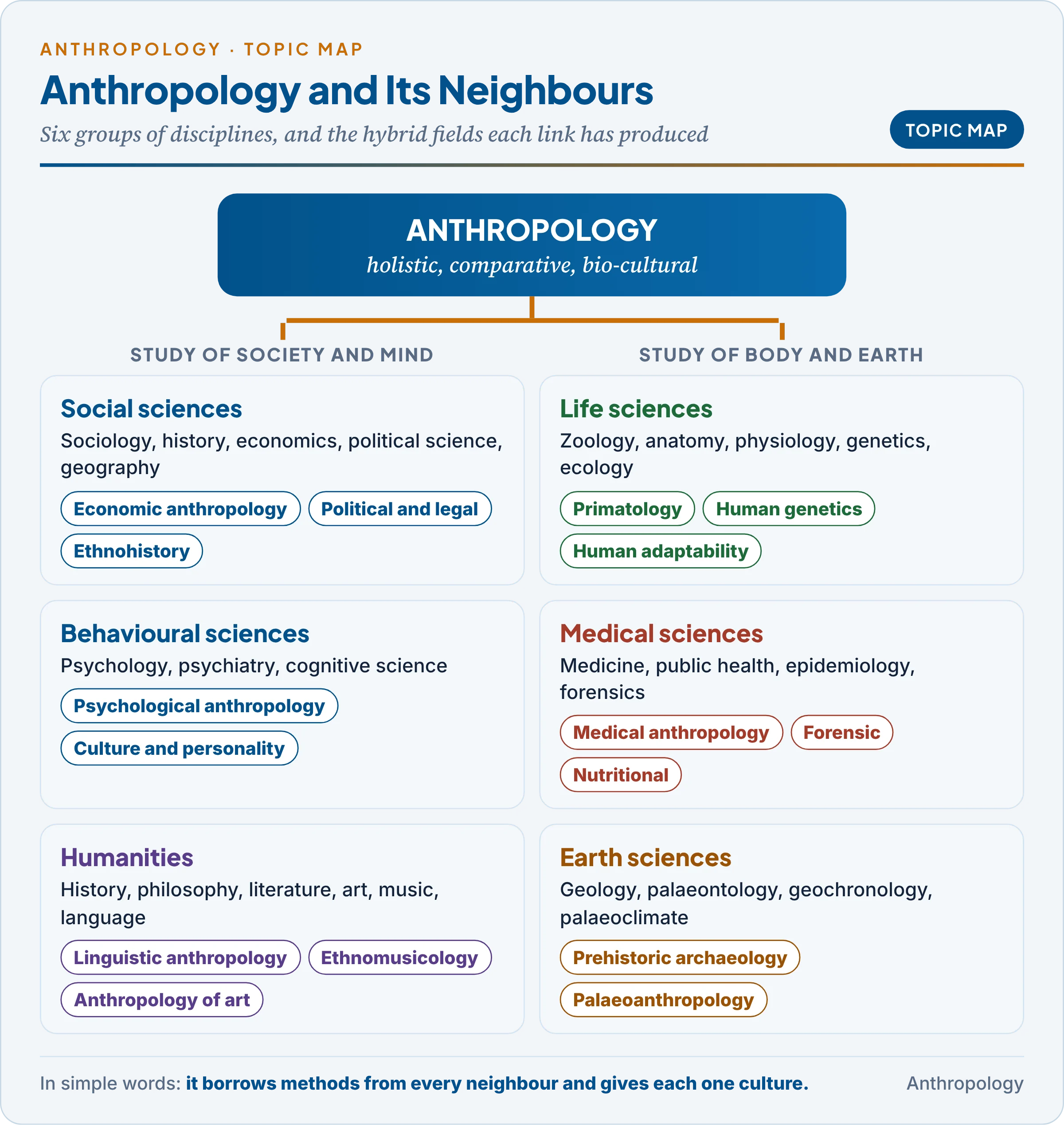
- Topic map: anthropology at the centre with six discipline groups; write one hybrid field on each link (e.g. psychological, medical, economic anthropology).
- Anthropology among the sciences: a spectrum from natural science to humanity; place biological anthropology, archaeology, socio-cultural anthropology and linguistic anthropology on it; add Radcliffe-Brown at one end, Evans-Pritchard at the other and Wolf in the middle.
- Sociology vs social anthropology: five rows (subject, scope, method, orientation, time and biology) and the Indian convergence (Dumont–Pocock, village studies, Srinivas).
- History debate: Radcliffe-Brown (synchronic, against conjectural history), Evans-Pritchard (history or nothing), Lévi-Strauss (conscious and unconscious levels); the Indian bridge (Kosambi, Cohn, Sinha, K.S. Singh).
- Natural sciences interface: life, medical and earth sciences, each with an interface field and an Indian case (Hrdy’s langurs, kuru or tribal health, Jwalapuram–Toba).
Revision Grid
| Scholar | Work (year) | Key idea |
|---|---|---|
| Radcliffe-Brown | Structure and Function in Primitive Society (1952) | Social anthropology as a natural science of society |
| Evans-Pritchard | Marett Lecture (1950); Anthropology and History (1961) | Anthropology is akin to history; patterns, not laws |
| F.W. Maitland | Collected essay (1911) | Anthropology must choose between history and nothing |
| Lévi-Strauss | “History and Anthropology” (1949) | History: conscious; anthropology: unconscious foundations |
| Eric Wolf | Anthropology (1964) | Most scientific humanity, most humanistic science |
| E.A. Hoebel | Man in the Primitive World | Sociology and social anthropology one and the same |
| Dumont and Pocock | Contributions to Indian Sociology (1957) | Sociology of India at the confluence with Indology |
| André Béteille | Essays (1993) | Joint departments split; colonial self/other division |
| D.D. Kosambi | Myth and Reality (1962); “Combined Methods in Indology” (1963) | Combined methods: history through living practice |
| Bernard Cohn | An Anthropologist among the Historians (1987) | Colonial archives read ethnographically |
| K.S. Singh | The Dust-Storm and the Hanging Mist (1966) | Birsa Munda movement; historian–anthropologist |
| Malinowski | Argonauts (1922); Sex and Repression (1927) | Kula; Oedipus complex is culture-bound |
| Polanyi | The Great Transformation (1944) | Economy embedded in society |
| W.H. Wiser | The Hindu Jajmani System (1936) | Non-market service exchange (Karimpur) |
| Fortes and Evans-Pritchard | African Political Systems (1940) | States vs stateless societies |
| M.N. Srinivas | “Social System of a Mysore Village” (1955) | Vote bank, dominant caste |
| Margaret Mead | Coming of Age in Samoa (1928) | Adolescence culturally shaped |
| Segall, Campbell, Herskovits | Influence of Culture on Visual Perception (1966) | Carpentered-world hypothesis |
| Sarah Hrdy | The Langurs of Abu (1977) | Infanticide in langurs (Rajasthan) |
| Sahlins | The Use and Abuse of Biology (1976) | Critique of sociobiology |
| Clements | Primitive Concepts of Disease (1932) | Five disease concepts |
| Ackerknecht | Papers (1942) | Medicine’s place in culture |
| Foster and Anderson | Medical Anthropology (1978) | Personalistic vs naturalistic |
| Kleinman | Patients and Healers (1980) | Disease vs illness; explanatory models |
| Lindenbaum and Glasse | Kuru studies (1960s) | Mortuary feasting spread kuru |
| De Terra and Paterson | Studies on the Ice Age in India (1939) | Terraces and Soanian culture |
| Petraglia et al. | Science (2007) | Jwalapuram tools around Toba ash |
| Irawati Karve | Kinship Organisation in India (1953); Yuganta (1967) | Kinship through texts and epics |
| Clifford and Marcus | Writing Culture (1986) | Ethnography as text |
Previous Year Questions
1.2 Relationships with other disciplines
- 2021Elaborate the scope of anthropology and elucidate the uniqueness in the field of other social sciences.
- 2016Write a note in 150 words on differences between Social Anthropology and Sociology.
- 2013Write a note in 150 words on How do you situate Anthropology in Social Sciences ?
- 2013Differentiate between Economics and Economic Anthropology. (150 words).
- 1999Discuss the relationship of anthropology with psychology and medicine.
- 1989Write a note on Relationship between Social Anthropology and History.
- 1988Write a note on Psychological anthropology.
- 1987Write a note on Prehistoric anthropology and its relation to other science.
- 1986Write a note on Relationship between Social anthropology and History.
- 1986Do you regard Social Anthropology as a Social Science or a humanistic discipline? Give reasons for you answer.
- 1985Write a note in 200 words on the relation of Anthropology to the social sciences.
- 1983Assess the relative strength of anthropological techniques for scientific study in social sciences.
- 1982In Anthropology, science and humanity converge. Examplify.
- 1981Identify the controversies around the relation between History and Social Anthropology. (200 words).
Related questions from other units
- 2025Unit 1.1: Anthropology provides a multidimensional understanding of human beings by bridging the gap between science and humanities. Elucidate.
- 2023Unit 5: How did Clifford Geertz look at religion? Differentiate between anthropological and psychological approaches to the study of religion.
- 2019Unit 1.3: Write a note in 150 words on the relationship between Linguistics and Social-Cultural Anthropology.
- 1996Unit 1.3: Write a note on Medical Anthropology.
- 1995Unit 6: What was Boas approach of studying primitive cultures ? Delineate the role of field work and history in anthropological study.
- 1993Unit 1.1: Do you think it is possible to bring uniformity of method in the natural and social sciences ? Will it lead to advancement of anthropological research?
- 1990Unit 1.3: Write a note on Recent trends in psychological anthropology.
- 1985Unit 1.1: Examine the influence of the humanistic tradition on the growth and development of anthropology.
- 1985Unit 1.3: What are the common aspects of structural anthropology and linguistics?
- 1981Unit 3: “Economics relations are an aspect of social relations.” Justify. (200 words).