

1.3 Main branches of Anthropology, their scope and relevance: (a) Social-cultural Anthropology. (b) Biological Anthropology. (c) Archaeological Anthropology. (d) Linguistic Anthropology.
Official Syllabus: Paper I, Unit 1.3
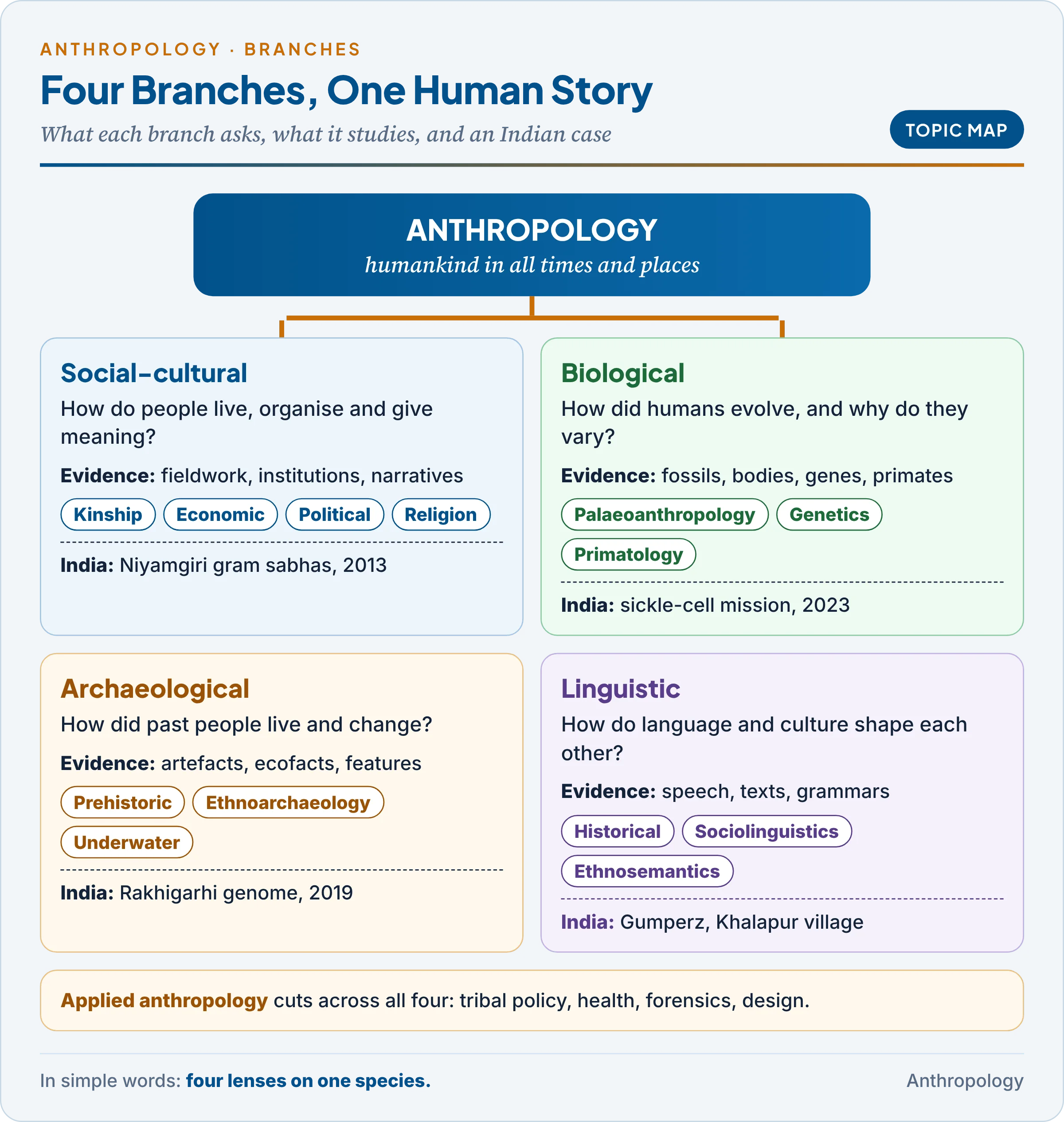
1. The Four-Field Structure
In simple words
Anthropology studies human beings as a whole: our bodies, our ways of life, our past and our languages. No single method can study all of these, so the discipline is divided into four branches. Each branch asks a different question about the same species, and together they give a complete picture.
Think of one tribal community, such as the Santal of Jharkhand. A socio-cultural anthropologist studies their festivals, clans and village council. A biological anthropologist studies their growth, blood groups and genetic ancestry. An archaeologist studies the stone tools and pottery left at old settlement sites. A linguistic anthropologist studies the Santali language and how it is used. Each of these is a branch of one discipline.
- Anthropology is one discipline with four branches because humans are at once biological, social, historical and symbolic (using language and meaning). No single method can capture all four.
- The four-field model is American in origin. Franz Boas, the German-born founder of American academic anthropology, built it into teaching at Columbia University. His reasoning was practical: to understand a Native American people properly, one needed their bodies, languages, past and customs together, and all four were vanishing at the same time.
- British usage long recognised three branches: physical anthropology, social (or cultural) anthropology and archaeology, with linguistics treated as a specialist field (Colin Renfrew and Paul Bahn, British archaeologists, in Archaeology, 1991).
- Indian departments follow an integrated model: all branches are studied together and specialisation comes late. The UPSC syllabus mirrors this.
- Applied anthropology is often called the “fifth field”. It has no subject matter of its own; it uses the knowledge of all four branches to solve practical problems (§6).
The table below sets the four branches side by side. Notice that each asks a different question and works with a different kind of evidence.
| Branch | Core question | Main evidence | Time depth | Typical method | Bridges to |
|---|---|---|---|---|---|
| Social-cultural | How do people live, organise and give meaning? | Observed behaviour, narratives, institutions | Present and recent past | Participant observation, comparison | Sociology, history, psychology |
| Biological | How did humans evolve and why do they vary? | Fossils, bodies, genes, primates | 7 million years to now | Measurement, laboratory analysis | Anatomy, genetics, medicine |
| Archaeological | How did past people live and change? | Artefacts, ecofacts, features | 3.3 million years to recent | Survey, excavation, dating | Geology, history, chemistry |
| Linguistic | How do language and culture shape each other? | Speech, texts, grammars | Present, reconstructed past | Recording, transcription, analysis | Linguistics, psychology, semiotics |
Read the table across each row and a pattern appears. The branches differ mainly in evidence and time depth: socio-cultural and linguistic anthropologists work with living people who can be asked and observed, while archaeologists and palaeoanthropologists work with silent remains that must be interpreted. This is also why their methods differ, from conversation and observation at one end to excavation and laboratory dating at the other. Yet every row ends in the same question, what makes humans what they are, which is why the four belong to one discipline.
- Why keep the branches together? Holism: studying a group as a connected whole, because its biology, society, language and history affect one another. In West Africa, forest clearing for farming (culture) created pools where malaria mosquitoes bred (environment), which favoured the sickle-cell gene (biology); one branch alone would miss the chain (Unit 1.1 §2.1).
- How the branches cooperate in practice, and the pressures pulling them apart, are discussed in §7.
2. Social-Cultural Anthropology
In simple words
This branch studies how living people organise their lives: families, marriage, work, power, religion and the meanings behind them. The anthropologist lives with a community for a long time, learns its language and watches daily life, then compares what was found with other societies to see what is common to all humans and what is particular.
2.1 Meaning and definitions
- Social-cultural anthropology is the comparative study of living human societies and cultures: their institutions (established patterns such as marriage, markets or councils), their values, and the meanings people give to them.
- Charles Winick, an American anthropologist who compiled the Dictionary of Anthropology (1956), described it as the study of social behaviour, especially through the systematic comparison of social forms and institutions.
- A.R. Radcliffe-Brown, the British founder of structural-functionalism, called social anthropology “comparative sociology” and a “theoretical natural science of human society” (A Natural Science of Society, lectures of 1937, published 1957). He meant that societies can be studied like natural systems, to find general laws.
- E.E. Evans-Pritchard, the Oxford anthropologist known for his work on the Nuer of Sudan, defined it as the branch of sociological studies that devotes itself chiefly to primitive societies (Social Anthropology, 1951). Unlike Radcliffe-Brown, he argued that it is closer to history than to natural science, because it interprets meanings rather than discovering laws (Unit 1.2).
- Because humans always have culture and always live in societies, in a broad sense all anthropology is socio-cultural. Within the discipline, the label marks those who study existing or recent ways of life rather than fossils or ancient sites.
The two names of the branch reflect two national traditions. The table shows how they differed and how they have since come together.
| Basis | Social anthropology (British) | Cultural anthropology (American) |
|---|---|---|
| Key concept | Social structure: the network of relations and institutions | Culture: learned traditions, values, symbols |
| Founders | Radcliffe-Brown, Malinowski, Evans-Pritchard | Boas, Kroeber, Benedict, Mead |
| Relation of the two | Culture as an aspect of social structure | Society as an aspect of culture |
| Typical question | How does an institution sustain social order? | What does a pattern mean; how did it develop? |
| Today | The distinction has largely merged into “socio-cultural anthropology” |
The two traditions began from different starting points, not different subjects. A British social anthropologist studying a Nuer feud asked how the feud maintains order between lineages; an American cultural anthropologist studying the same feud would ask what values and meanings it expresses. Both answers are needed, which is why the labels have merged.
Common confusion
Are social anthropology and cultural anthropology two different subjects? No. They are two traditions of one branch. British scholars stressed social relations and institutions; American scholars stressed learned culture and meaning. Since human relations always follow cultural rules, the two overlap almost completely, and most anthropologists now say “socio-cultural anthropology”.
2.2 Ethnography, ethnology and social anthropology
These three words are easily confused. A simple way to remember them: ethnography describes one community, ethnology compares many, and anthropology generalises about all humans.
- Ethnography: the detailed descriptive account of one community, written after long fieldwork. Bronisław Malinowski, the Polish-born anthropologist who pioneered long-term fieldwork in the Trobriand Islands, set the standard with Argonauts of the Western Pacific (1922). S.C. Roy‘s The Mundas and Their Country (1912) is the Indian landmark: Roy, a Ranchi lawyer, became the first major Indian ethnographer of tribal life.
- Ethnology: in Evans-Pritchard’s sense, the classification of peoples by racial and cultural traits and the explanation of their present distribution by migration and diffusion (the spread of traits from one group to another). Its reconstructions are conjectural: for peoples without written history, several contrary hypotheses can fit the same facts, so ethnology can tell us what may have happened, not what did.
- Social anthropology: studies a custom as part of the whole social life of a people today. For the ethnologist, a custom plotted on a distribution map is evidence of past contact between peoples. For the social anthropologist, it matters as a working part of a social system, whatever its origin. For example, if a bride-price custom is found in several neighbouring tribes, the ethnologist asks who borrowed it from whom, while the social anthropologist asks what it does today: how it links two families, stabilises the marriage and moves wealth.
- Claude Lévi-Strauss, the French founder of structuralism, treated the three as stages of one enterprise: ethnography (observation and description), ethnology (synthesis and comparison) and anthropology (general knowledge of humankind) (Structural Anthropology, 1958).
- In American usage, “ethnology” is often simply a synonym for cultural anthropology.
2.3 Scope
What the branch tries to do. Its classic aims are to describe cultures in their present form; to study culture contact and change (what happens when societies meet); to reconstruct social history where records are missing; and to search for general regularities that hold across cultures. Its method is to study every aspect of one culture together (holism) and then compare across cultures.
As the branch grew, specialists began to focus on one area of social life each. The table lists the main sub-fields with an Indian study for each.
| Sub-field | Studies | Indian anchor |
|---|---|---|
| Kinship and social organisation | Marriage, family, descent, alliance | Irawati Karve, Kinship Organisation in India (1953) |
| Economic | Production, exchange, reciprocity | Jajmani system (Wiser, The Hindu Jajmani System, 1936) |
| Political and legal | Power, authority, dispute settlement | Tribal councils; PESA gram sabhas |
| Religion | Belief, ritual, magic, shamanism | Vidyarthi’s nature–man–spirit complex (The Maler, 1963) |
| Psychological | Individual, personality and culture | Culture-and-personality, later cognitive studies (§6) |
| Ecological | Culture as adaptation to environment | Shifting cultivation of the Dongria Kondh (Odisha) |
| Medical | Illness, healing, health systems | Ethno-medicine; sickle cell outreach (§3) |
| Urban, development, visual, digital | Cities, planned change, images, online life | Village studies (Srinivas, S.C. Dube, Indian Village, 1955) |
The sub-fields are lenses, not separate subjects. In a real community, the economy, kinship, politics and religion are bound together: the jajmani system, for instance, is at once an economic exchange, a caste hierarchy and a ritual relationship. A specialist therefore starts from one lens but must keep the whole society in view, which is the holistic habit that distinguishes the branch.
Why “primitive” societies were studied first
- In anthropology the word primitive was a technical term. It meant societies that are small in scale, with simple technology and economy, little specialisation of work and no writing. It never meant earlier in time or inferior: such societies have as long a history as any other, and are often more developed in some respects (kinship, ritual, ecological knowledge).
- Four reasons made them the first focus:
- they could be observed as wholes by one fieldworker, which helped in seeing how institutions fit together
- their “otherness” sharpened observation, because unfamiliar customs are easier to notice than one’s own
- they were disappearing under colonial and industrial pressure, so there was an urgency to record them (salvage ethnography)
- they extend the range of variation that comparison needs: a theory of marriage is tested better against polyandry and group marriage than against monogamy alone
- Critique: the focus froze peoples as timeless isolates and often served colonial administration (Talal Asad, ed., Anthropology and the Colonial Encounter, 1973). Since the 1950s the branch studies peasants, cities, corporations and states as well: Robert Redfield on peasant society, and M.N. Srinivas and S.C. Dube on Indian villages.
2.4 The comparative method in social-cultural anthropology
Comparison is the anthropologist’s substitute for the laboratory experiment. A chemist can repeat an experiment under controlled conditions; an anthropologist cannot. Instead, the anthropologist compares societies that differ in one respect to see what follows from that difference.
How the method developed (summary of Unit 1.1 §4.2). The 19th-century evolutionists compared customs from all over the world, torn out of their context, and arranged them on a single ladder from “savagery” to “civilisation”. Boas showed in 1896 that this was unsound: similar customs can arise from different causes, so they cannot be ranked without knowing each society’s history. Later schools compared in more careful ways, as the table shows.
| School | What is compared | Purpose |
|---|---|---|
| Evolutionists (Tylor, Morgan, Frazer) | Customs torn from context, ranked on a ladder | Reconstruct stages of human progress |
| Diffusionists (Graebner, Schmidt, Elliot Smith) | Distribution of traits and trait complexes | Trace historical contact and culture circles |
| Structural-functionalists (Radcliffe-Brown, 1951) | Whole social structures, synchronically (at one point in time) | Find general laws of social life |
| Controlled comparison (Fred Eggan, 1954) | Societies within one region sharing history | Hold background constant; isolate variables |
| Cross-cultural survey (G.P. Murdock) | Coded samples of world societies | Statistical tests of correlations |
The table shows comparison becoming more careful over time. The evolutionists and diffusionists compared single traits taken out of context, and used them to write conjectural history. Later schools compared whole systems (the functionalists), compared within a controlled region (Eggan), or compared many cases statistically (Murdock). The direction of change is from reconstructing the past to explaining how societies work.
- Fred Eggan (American; Pueblo societies) compared neighbours with a shared history, so their differences could be traced to specific causes, much like a controlled experiment. G.P. Murdock (American, Yale) built the Human Relations Area Files (HRAF), a coded archive of ethnographies for statistical testing across hundreds of cultures.
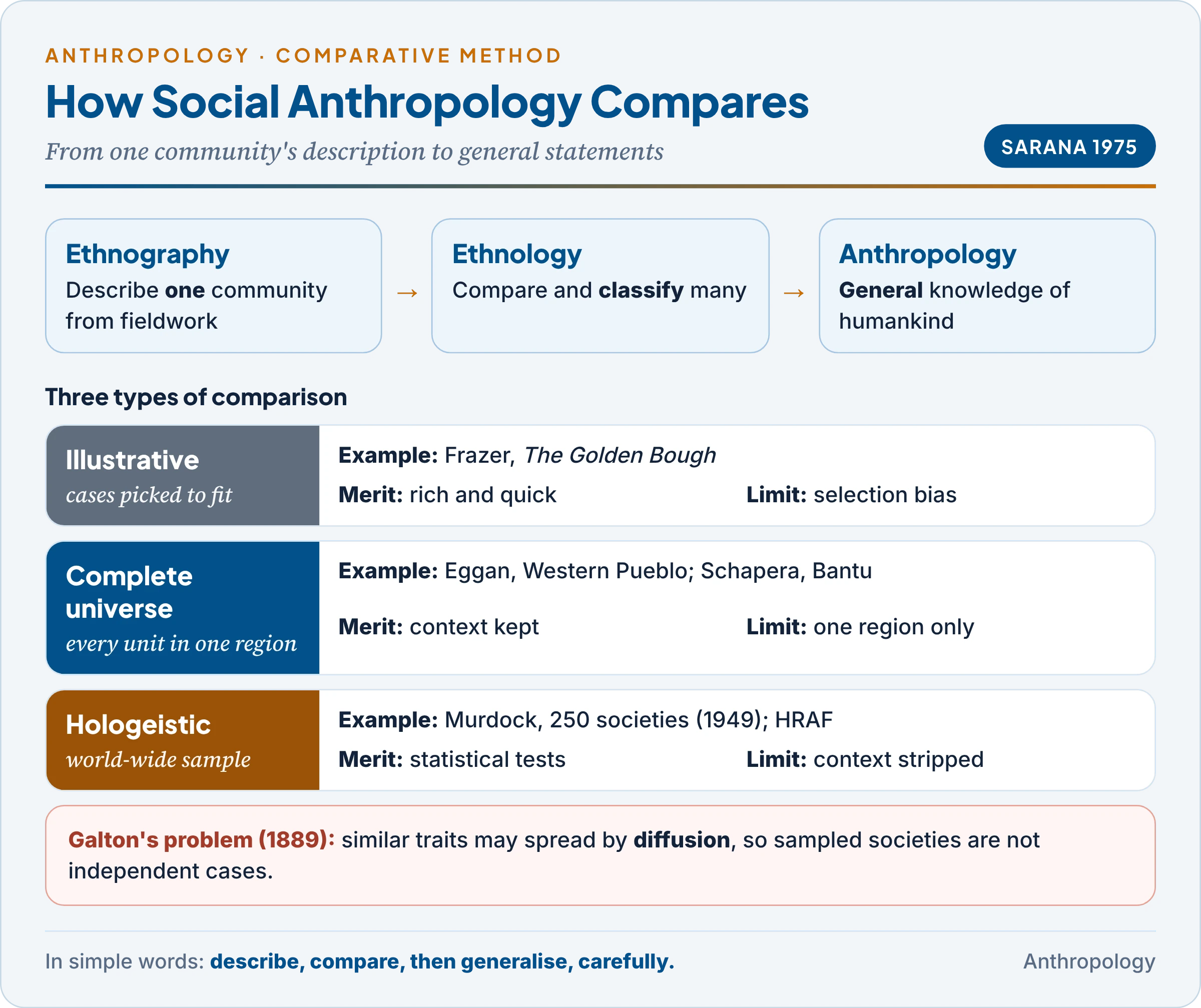
Gopala Sarana, an Indian anthropologist at Lucknow University who wrote the standard study of comparison, The Methodology of Anthropological Comparisons (1975), classified all these methods into three types according to how the cases are chosen: picked to illustrate a point, all cases in one bounded area, or a statistical sample of the world (hologeistic, from Greek holo, whole, and geo, earth).
| Type | How it works | Example | Merit | Demerit |
|---|---|---|---|---|
| Illustrative comparison | Cases chosen to illustrate a point | Frazer, The Golden Bough | Rich, quick to build | Selection bias; proves nothing |
| Complete-universe comparison | Every unit in a bounded universe | Eggan on the Western Pueblo; Schapera on Bantu Africa | Context kept; no sampling error | Limited to one region; hard to generalise |
| Hologeistic (sampled) comparison | Statistical sample of world cultures | Murdock, Social Structure (1949), 250 societies; the HRAF files | Tests hypotheses worldwide | Coding strips context; units unclear |
The three types trade depth against breadth. Illustrative comparison is easy but can prove anything, because the author chooses only the cases that fit. Complete-universe comparison keeps each custom in its context but covers one region only. Hologeistic comparison covers the whole world and allows statistical tests, but to code hundreds of societies it must reduce rich customs to simple categories, and it is often unclear what counts as one “society”.
- Galton’s problem (raised by Francis Galton in 1889 when Tylor presented a statistical comparison): societies may share a trait because one borrowed it or both inherited it, not because it has the same cause in each. Such cases are not independent, so statistics can mislead. For example, if ten societies in a sample practise cross-cousin marriage because all ten descend from one ancestral group, they are really one case counted ten times, and any correlation built on them is inflated.
- Radcliffe-Brown‘s classic illustration (1951): Australian Aborigines divide society into two halves (moieties) named after the Eaglehawk and the Crow, two birds seen as rivals yet related. He compared this with paired oppositions in other societies and found a general principle of opposition and unity: groups are defined by being both opposed and linked.
- Sarana concluded that comparison is inescapable in anthropology. Among the three types he favoured complete-universe comparison, because it keeps each custom in its context while still allowing generalisation.
2.5 Two approaches within the branch
Two debates, about where theory comes from and what culture is, run through the branch.
- Empiricism: the British view that theory must be built inductively (step by step, from observed facts upward) from field data. Malinowski’s long fieldwork and Radcliffe-Brown’s classification of social types followed this path.
- Edmund Leach (British; highland Burma) mocked endless typing of societies as “butterfly collecting” (Rethinking Anthropology, 1961): sorting specimens without explaining them. His point was that a list of types (patrilineal, matrilineal, and so on) says nothing about why a society works as it does; classification had become a substitute for theory.
- Lévi-Strauss‘s structuralism was the rationalist reply: the real structures of society are models in the mind, which the analyst reaches by reasoning, not by counting observed facts.
- Cognitive approach (also called ethnoscience or the new ethnography, 1950s–60s): culture is what one must know in order to behave acceptably among a people (Ward Goodenough, an American anthropologist, 1957). Culture is thus treated as knowledge in people’s heads, like the grammar of a language.
- Method: componential analysis (breaking terms into their meaning components, e.g. a kin term into sex, generation and side of the family), used by Goodenough and Floyd Lounsbury (1956); folk classifications such as Harold Conklin‘s study of colour categories among the Hanunóo of the Philippines (1955).
- Implication: an emic description, that is, one built from the insider’s own categories rather than the observer’s.
- Critique: the neat formal models may not match what is really in people’s minds; Robbins Burling asked whether they were “God’s truth or hocus-pocus?” (1964). The approach also neglected actual behaviour and power. Burling’s point was that several different models can fit the same set of kin terms equally well, so there is no way to know which one is in people’s heads; and knowing the rules of a culture does not tell us what people actually do or who benefits.
2.6 Relevance
What use is the study of living cultures? Its main value is that it shows policy-makers and planners how a community actually works from the inside.
- Policy for tribal and rural India: anthropological fieldwork underlies Fifth and Sixth Schedule administration, the identification of Particularly Vulnerable Tribal Groups (PVTGs) and the Forest Rights Act process.
- In the Niyamgiri case (Supreme Court, April 2013), the Dongria Kondh gram sabhas (village assemblies) were asked to decide on bauxite mining because the hill is their deity, Niyam Raja; all rejected it. The case turned on what the hill meant to the community, which is what ethnography provides.
- Institutions: the Anthropological Survey of India (1945); the People of India project under K.S. Singh (launched 1985) profiled 4,635 communities.
- Displacement and rehabilitation, health, education and disaster response need an insider view; plans made without it often fail.
- Business and design: Genevieve Bell, an Australian anthropologist at Intel, studied how people in different cultures use technology, to guide product design.
- Ethics debate: the US Army’s Human Terrain System (2007–2014) embedded social scientists with troops in Iraq and Afghanistan. The American Anthropological Association condemned it in 2007 as incompatible with its ethics code, because research subjects could not freely consent and could be harmed.
3. Biological Anthropology
In simple words
This branch studies humans as a living species: where we came from, how our bodies and genes differ from group to group, and how we adapt to heat, cold, altitude and disease. Its special point is that it always asks how culture, such as diet, marriage rules or farming, has shaped our biology.
3.1 Meaning and development
- Biological (physical) anthropology is the oldest branch. It studies humans as a biological species in a cultural setting: the comparative science of humans as physical organisms in relation to their total environment, social, cultural and physical.
- Founders: Buffon (French naturalist); Johann Blumenbach (German physician who classified humans by skull form, often called the father of physical anthropology); Samuel Morton (American skull-measurer, craniometry); Paul Broca (French surgeon, Société d’Anthropologie de Paris, 1859); Darwin and Wallace (evolution by natural selection).
- Name change: “physical” stressed measuring the body; “biological” stresses evolution, genetics and adaptation. The American Association of Physical Anthropologists became the American Association of Biological Anthropologists in 2021.
- What sets it apart from other human biology: medicine studies disease in individuals, and anatomy studies the standard human body. Biological anthropology studies the normal variation between populations and always asks how culture shapes it.
3.2 From measurement to science: how the agenda changed
For its first century, physical anthropology mostly measured bodies and sorted people into racial types. From about 1950 it became a science of populations and evolutionary processes. Understanding this shift explains most of what the branch does today.
Washburn’s “New Physical Anthropology” (summary of Unit 1.1 §4.4). Sherwood Washburn, an American physical anthropologist, argued in 1951 that the field should stop measuring for its own sake and should instead ask questions about how and why human bodies change. He drew on the Modern Synthesis (the union of Darwin’s natural selection with Mendelian and population genetics, completed in the 1930s–40s), which explains evolution as changes in gene frequencies within populations. The table contrasts the two phases.
| Classical physical anthropology (to c. 1950) | New physical anthropology (from Washburn, 1951) |
|---|---|
| Anthropometry (measuring the body) as an end in itself; static racial typology | Populations, variation and evolutionary process |
| Lasker‘s five areas: form of bones and teeth; age, sex and ethnic group from bones; growth; body composition; body build for human engineering. Plus dermatoglyphics (finger- and palm-print patterns) | Serology (blood groups); biochemical genetics of polymorphisms; mutation, selection, gene flow; primatology; demographic genetics of inbreeding and drift; anthropometry linked to nutrition; ecology of biological and cultural adaptation |
| Describes what a trait is | Explains why: function and adaptation |
The key contrast in the table is between typology and process. Classical work assumed that each race had a fixed “type”, and that careful measurement would reveal it. The new approach assumed that populations change constantly through mutation, selection, migration and drift, so the task is to explain how and why a trait came to vary, not to sort people into boxes.
- Gabriel Lasker, an American biological anthropologist, listed the classical areas of interest shown in the table.
- Example: classical work measured brow ridges (the bony ridges above the eyes) in isolation. The new approach recognised that brow ridges depend on the size and shape of the skull and face as a whole, and must be read functionally, in terms of chewing forces and skull growth.
- Old data were not discarded: Lasker’s areas still supply data for new questions. Classification remains the first step, but it is now followed by a problem and its interpretation.
Milestones in the scientific turn
- Boas (1911): he measured the head form of immigrants’ children in the USA and found it changed with the new environment. This showed plasticity (the body’s capacity to change with conditions) in a trait thought to be a fixed racial marker.
- 1950: the Cold Spring Harbor symposium joined geneticists and anthropologists; W.C. Boyd classified populations by blood-group genes; Coon, Garn and Birdsell treated races as adapted populations; the UNESCO Statement on Race rejected racial hierarchy.
- 1951: Washburn, “The New Physical Anthropology”.
- 1958: Frank Livingstone, an American anthropologist, linked the sickle-cell gene, malaria and yam cultivation in West Africa. The mechanism: a person with one copy of the sickle-cell gene resists malaria; a person with two copies suffers sickle-cell disease. Where malaria is common, carriers survive and have children more often, so the gene stays common despite the disease it causes. Forest clearing for yam farming spread malaria, and with it the gene.
- 1964–74: the Human Adaptability section of the International Biological Programme studied populations at high altitude (Andes, Ethiopia, Nepal), in cold (Inuit) and in heat.
- Molecular era: the molecular clock (dating splits from protein differences; Sarich and Wilson, 1967); mitochondrial Eve (the common maternal ancestor of living humans, in Africa; Cann, Stoneking and Wilson, 1987); the Neanderthal genome (2010); Svante Pääbo‘s Nobel Prize (2022) for ancient-DNA work.
3.3 Branches and scope
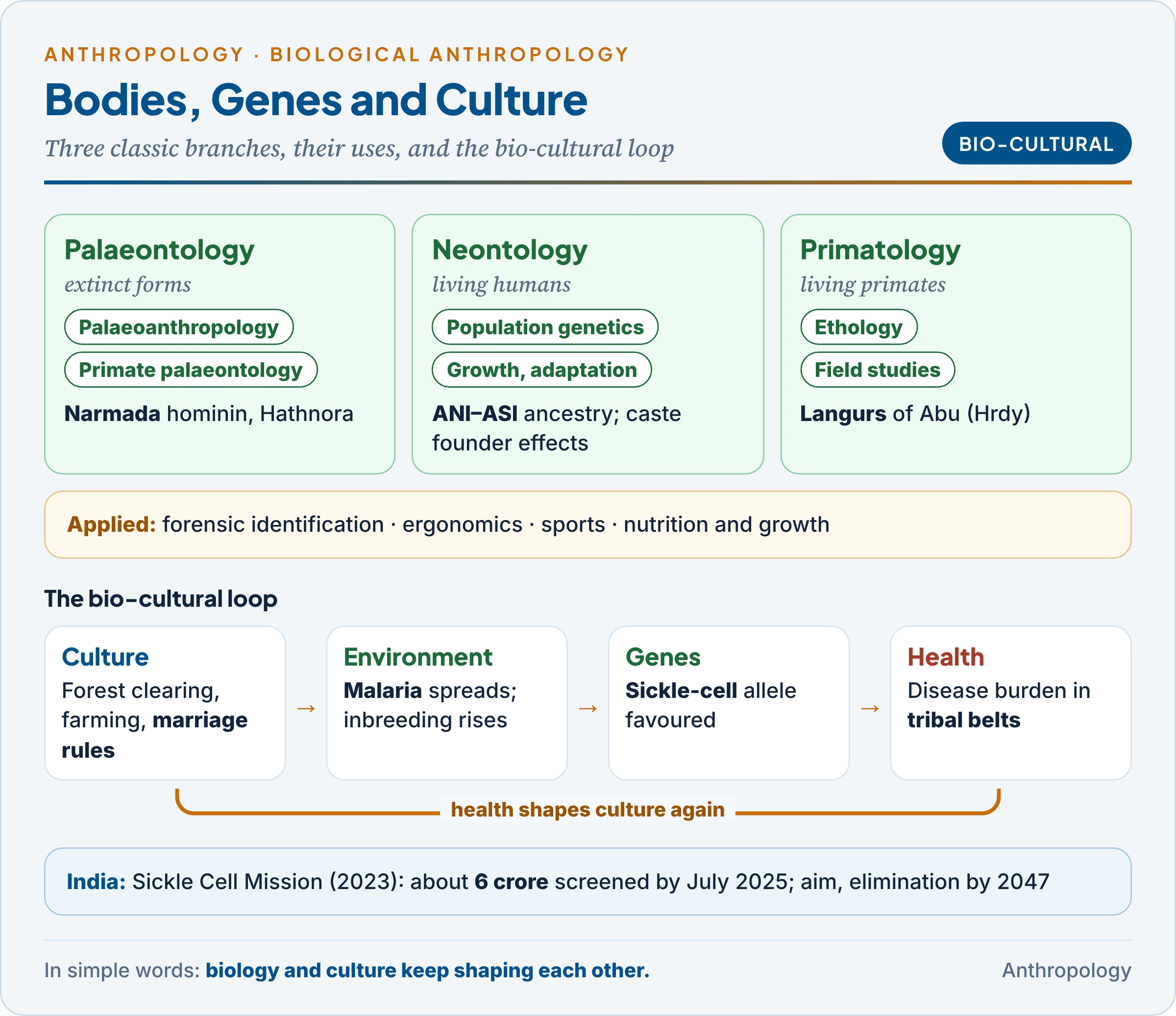
The older textbook division of the branch is threefold, and is still used in answers:
- Palaeontology (study of extinct forms): fossil humans and fossil primates.
- Neontology (study of living forms): anatomy, variation, genetics, growth and adaptation of living humans.
- Ethology (study of behaviour), today usually called primatology: behaviour of monkeys and apes in the wild and in captivity, which helps explain the origins of human social life.
Modern biological anthropology has many more specialised fields. The table lists them with an Indian example for each.
| Branch | Studies | Indian anchor |
|---|---|---|
| Palaeoanthropology (human palaeontology) | Fossil hominins, the evolutionary record | Narmada hominin, Hathnora (Arun Sonakia, GSI, 1982) |
| Primate palaeontology | Fossil primates | Siwalik fossil apes such as Sivapithecus |
| Primatology (ethology) | Behaviour and biology of living primates | Sarah Hrdy, The Langurs of Abu (1977): infanticide by langur males |
| Human population genetics | Gene frequencies, mating systems, drift | Reich et al. (2009): ANI–ASI ancestral components; caste endogamy produced strong founder effects (2017) |
| Human adaptability and ecology | Adaptation to altitude, heat, cold, disease | High-altitude adaptation in Himalayan populations |
| Growth and nutrition (auxology) | Growth, maturation, nutritional status | NFHS-5 (2019–21): 35.5% of children under five stunted |
| Forensic anthropology | Identifying age, sex, stature from remains | Mass-disaster and crime identification |
| Kinanthropometry and ergonomics | Body build for sport and design | Equipment sizing (Unit 12) |
| Serology and dermatoglyphics | Blood groups, finger-ridge patterns | D.N. Majumdar’s anthropometric and serological survey of UP (1941) with P.C. Mahalanobis |
| Palaeopathology and bioarchaeology | Disease and life from skeletons | Harappan skeletons (§4.5) |
The table shows the branch moving from bones to genes to bodies in society. Palaeoanthropology works with millions of years, population genetics with thousands, and growth and forensic studies with a single lifetime. What links them is the question of variation: how and why human bodies differ across time, space and social conditions.
- ANI and ASI (Ancestral North and South Indians): two ancient populations whose mixing, in different proportions, accounts for most Indian ancestry today.
- Founder effect: a population’s genes reflect its few founders; centuries of caste endogamy (marriage within the group) let rare disease genes become common within one group.
- Stunting: low height for age, a marker of long-term undernutrition.
3.4 The bio-cultural approach
Example first. Sickle-cell disease is common among tribal communities of central and western India. To understand why, one needs both biology and culture. The sickle-cell gene protects carriers against malaria; malaria was endemic in the forested areas where these communities live; and forest clearing for cultivation increases mosquito breeding. Biology alone or culture alone cannot explain the pattern; the two together can.
- Core idea: human biology cannot be explained without culture, and culture often responds to biology. The task is to explain the interplay, not to divide traits neatly into “heredity” and “environment”.
- Culture shapes biology:
- mating rules and inbreeding: cross-cousin and uncle–niece marriage in South India raise homozygosity (inheriting the same gene version from both parents), so recessive disorders appear more often (Units 2.3 and 9)
- diet and food taboos; body modification
- migration and settlement history
- dairying selected for lactase persistence (the ability of adults to digest milk), an example of gene–culture co-evolution: once people kept cattle and drank milk, adults who could digest it had a survival advantage, so the gene spread in herding populations
- forest clearing for cultivation spread malaria and so favoured the sickle-cell allele (Livingstone)
- Biology shapes culture: disease loads shape settlement, ritual and health practices; growth and nutrition shape work and fertility.
- Indian application: the National Sickle Cell Anaemia Elimination Mission (launched 1 July 2023 at Shahdol, MP) aims at elimination by 2047. By July 2025 about 6 crore people had been screened. Its counselling depends on understanding marriage customs in the affected communities, a bio-cultural task.
- Critique and caution: the branch’s history includes race science:
- Morton’s ranking of races by skull size
- H.H. Risley, a British colonial official, used the nasal index (nose width relative to height) to rank castes (The People of India, 1908)
- eugenics, the discredited programme of “improving” populations by controlling who may reproduce
Modern biological anthropology rejects racial typology and studies clines (gradual geographic change in a trait) and populations instead (Unit 9).
4. Archaeological Anthropology
In simple words
Archaeology reconstructs how people lived in the past from what they left behind: tools, pots, bones, seeds, houses and graves. For most of human history there was no writing, so these remains are our only evidence. Archaeologists dig carefully, record where everything lies, date it, and then work out what it tells us about past ways of life.
4.1 Meaning
- Archaeological anthropology reconstructs past ways of life from material remains. These remains fall into three types:
- artefacts: objects made or used by people (tools, pottery, ornaments)
- ecofacts: natural remains that reveal human activity (seeds, pollen, animal bones, charcoal)
- features: things that cannot be lifted out of the ground (hearths, pits, walls, burials)
- It is the “past tense of cultural anthropology”: it asks the same questions about economy, society and belief, but with different evidence. A cultural anthropologist can ask people; an archaeologist must read objects.
- Why it is indispensable: writing began only about 3000 BCE in West Asia, and much later elsewhere (Australia not until 1788 CE). For over 99% of the human past, material remains are the only record.
- Lewis Binford, an American archaeologist who led the “New Archaeology”, argued in “Archaeology as Anthropology” (1962) that archaeology’s goal is the anthropological explanation of culture change, not just the collection of objects.
- Archaeologists work with many specialists: geologists, palynologists (pollen experts), zoologists, chemists and physicists for dating (Unit 1.8).
4.2 Divisions and specialisations
- By period (Indian usage):
- prehistoric: before writing
- protohistoric: writing exists but is undeciphered, or the people are described only by outsiders (e.g. the Harappans, whose script is unread)
- historical: periods with readable written records
- A four-way division by the role of texts:
- prehistoric (from the first humans to writing)
- text-aided or classical (literate civilisations, where texts guide the excavation)
- text-free (non-literate peoples of the Old and New Worlds, known only from digging)
- salvage (rescuing sites threatened by dams, roads or erosion before they are lost)
Within archaeology, many specialisations have grown up. Each uses a different kind of evidence or setting, as the table shows.
| Specialisation | Focus | Example |
|---|---|---|
| Ethnoarchaeology | Living people’s material culture to interpret the past | Binford among the Nunamiut (Alaska): butchery and bone refuse; megalith-raising as a living tradition among the Khasi and Naga (North-East India) |
| Environmental archaeology | Past climate, plants and animals around sites | Pollen, snails and rodents as climate indicators |
| Underwater (marine) archaeology | Submerged sites and shipwrecks | Dwarka (Gujarat): S.R. Rao’s offshore work from the 1980s; ASI explorations resumed 2025 |
| Garbology | Archaeology of modern waste | William Rathje’s Garbage Project, Tucson (from 1973): households under-reported their beer drinking compared with what their bins showed |
| Experimental archaeology | Replicating tools and processes | Knapping stone tools to read use-wear |
| Bioarchaeology | Human remains in their cultural context | Diet, disease and kinship from skeletons and ancient DNA |
Each specialisation answers a gap in the evidence. Bones and tools alone cannot tell how they came to lie where they did, so ethnoarchaeology watches living people; sites alone do not show the landscape, so environmental archaeology reconstructs it; some evidence lies underwater or in modern bins, so special methods were built for those settings. Together they widen what can be known about the past.
- Why ethnoarchaeology matters: excavated bones do not explain themselves. Watching living hunters butcher and discard, Binford learned which patterns in a site come from human activity and which from natural processes. Garbology shows the same methods work on the present: what people throw away is more honest than what they say.
4.3 Old, new and post-processual archaeology
Archaeology’s aims have changed in three broad phases, from describing the past, to explaining it scientifically, to interpreting its meanings.
| Phase | Approach | Key figures |
|---|---|---|
| Culture-historical (to c. 1960) | Description and chronology of cultures; spread explained by diffusion and migration | Childe; in India, Wheeler |
| Processual or New Archaeology (1960s) | Culture as an adaptive system; evolutionary and ecological focus; hypothetico-deductive testing (stating a hypothesis, then testing it against evidence); ethnographic analogy | Binford (1962); David Clarke, Analytical Archaeology (1968) |
| Post-processual (1980s) | Meaning, symbols, agency, gender; many interpretations; the archaeologist’s own position | Ian Hodder, a British archaeologist |
- Processualists faulted the older approach for listing cultures and dates without asking why change happened; post-processualists faulted them in turn for treating people as parts of a system and ignoring what objects meant to their makers. For instance, a processualist might explain a burial with rich grave goods as a sign of economic surplus, while a post-processualist would ask what the goods symbolised to the mourners and whose view of the past the explanation reflects.
Common confusion
Is “New Archaeology” the same as recent archaeology? No. “New Archaeology” is the name of a specific school of the 1960s (also called processual archaeology), led by Lewis Binford. It is now itself an older approach, followed by post-processual archaeology in the 1980s.
4.4 Field methods
Example first. At Rakhigarhi in Haryana, one of the largest Harappan sites, archaeologists surveyed the mounds, excavated houses and a cemetery layer by layer, recorded every find, dated the layers, and finally extracted ancient DNA from a skeleton in the laboratory. Each of these is a stage of archaeological method, shown in the sequence below.
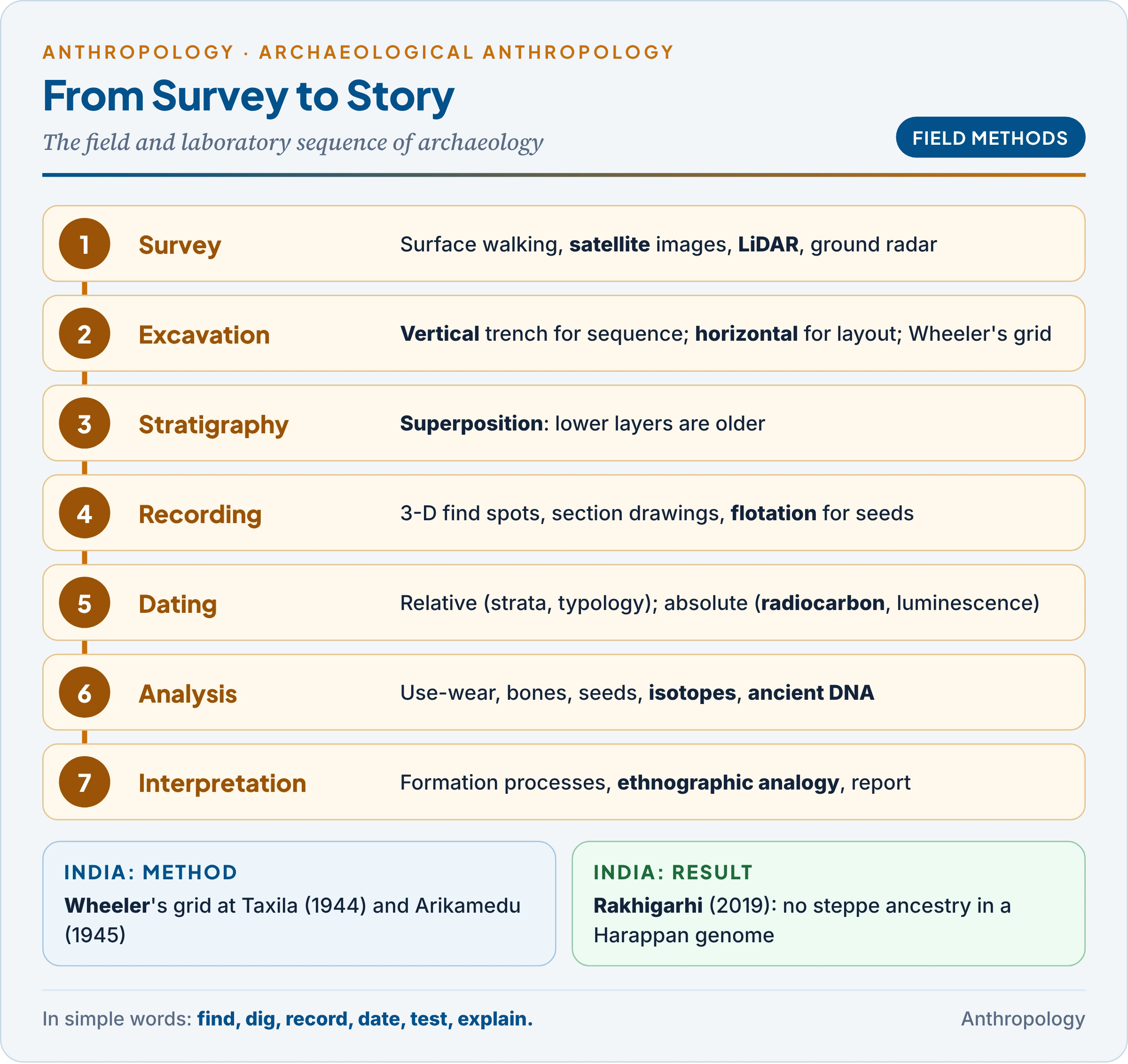
- Exploration and survey: finding sites before digging: surface walking, satellite imagery, LiDAR (airborne laser scanning that sees through vegetation), ground-penetrating radar, magnetometry, place-names and local knowledge.
- Excavation:
- vertical excavation (deep, narrow trenches) to establish the sequence of layers
- horizontal (open-area) excavation to expose the layout of a settlement at one period
- Mortimer Wheeler, the British archaeologist who headed the Archaeological Survey of India in the 1940s, introduced the grid or box system in India. He trained Indian archaeologists at the Taxila school (1944) and excavated Arikamedu (1945)
- Stratigraphy: the study of layers. By the law of superposition, lower layers are older than those above them, unless disturbed (by pits, burrowing animals or floods). So even without a date in years, the order of layers tells which objects are earlier and later; this is the basis of relative dating. Layers are recorded and ordered, today often with a Harris matrix (a diagram showing the sequence of layers).
- Recording and sampling: the 3-D position of every find, section drawings, photogrammetry, flotation (floating soil in water to recover charred seeds). Excavation destroys the site, so the record is all that survives.
- Dating: relative methods give order (stratigraphy, typology, fluorine); absolute methods give years (radiocarbon, potassium–argon, luminescence, dendrochronology). Detail in Unit 1.8.
- Laboratory analysis:
- typology (sorting objects by form) and use-wear (microscopic traces showing how a tool was used)
- zooarchaeology (animal bones) and archaeobotany (plant remains)
- stable isotopes in bones and teeth, which reveal diet and movement
- ancient DNA
- Interpretation and publication: working out formation processes (how natural and human actions created the site), using ethnographic analogy and building models. Ethics: consent and involvement of descendant communities.
4.5 Relevance
- Deep-time view of adaptation: how societies met climate change and collapse. A drying phase around 4,200 years ago is debated as a factor in Harappan de-urbanisation (cities declining into villages).
- Ancient DNA joins archaeology to biology: the Rakhigarhi genome (Shinde et al., Cell, 2019) showed no steppe pastoralist ancestry (ancestry from the Central Asian grasslands). It carried an ancestry related to early Iranian groups that split before farming began, suggesting farming in South Asia arose largely locally.
- Heritage and identity: protection of sites, museums, tourism and community memory; underwater cultural heritage.
- Salvage before development (Nagarjunakonda) and forensic archaeology in crime and disaster investigation.
- Critique: interpretations are built from fragmentary and biased samples, since only durable materials survive; and the past can be pulled into nationalist or identity politics.
5. Linguistic Anthropology
In simple words
This branch studies language as part of culture. It asks how languages change and split into families, how they are built, and above all how people use speech in daily life: to show respect, to mark caste or class, to claim identity, or to perform a ritual. Language also gives the anthropologist entry into a people’s own way of seeing the world.
5.1 Meaning
- Linguistic anthropology is the study of language as a cultural resource and speaking as a cultural practice (Alessandro Duranti, an Italian-American linguistic anthropologist, Linguistic Anthropology, 1997).
- How it differs from linguistics: linguistics studies the history, structure, variation and meaning of language apart from its social setting. Linguistic anthropology studies the same things inside social and cultural contexts.
- Unlike the polyglot (who simply speaks many languages) or the philologist (who studies language through literature and old texts), the linguistic anthropologist asks how language relates to the rest of culture.
- Roots: Boas, Handbook of American Indian Languages (1911), recording unwritten languages; his student Edward Sapir, Language (1921); and Sapir’s student Benjamin Lee Whorf, on language and thought.
- Name: the field was called “anthropological linguistics” until Dell Hymes, an American linguist-anthropologist, argued in 1964 for “linguistic anthropology”, to stress that the questions should be anthropological ones.
Alessandro Duranti divided the history of the branch into three phases, each with a different main interest. The table summarises them.
| Paradigm | Period | Focus |
|---|---|---|
| 1. Documentation | Boas to the 1950s | Recording and describing unwritten languages; grammars, texts, dictionaries |
| 2. Ethnography of communication | 1960s onward | Variation and language use in speech events: Gumperz and Hymes (1964, 1972); Hymes’s SPEAKING model |
| 3. Language as social action | 1990s onward | Identity, power, ideology, socialisation through talk |
The three paradigms show the branch moving from the dictionary to the conversation. The first asked what a language is: its sounds, words and grammar. The second asked how language is used in real situations, such as a ritual or a village dispute. The third asks what speaking does: how it builds identities, signals power and passes on culture to children.
- Hymes’s SPEAKING model is a checklist for describing any speech event: Setting, Participants, Ends (purposes), Act sequence, Key (tone), Instrumentalities (channel and variety), Norms and Genre.
5.2 Branches
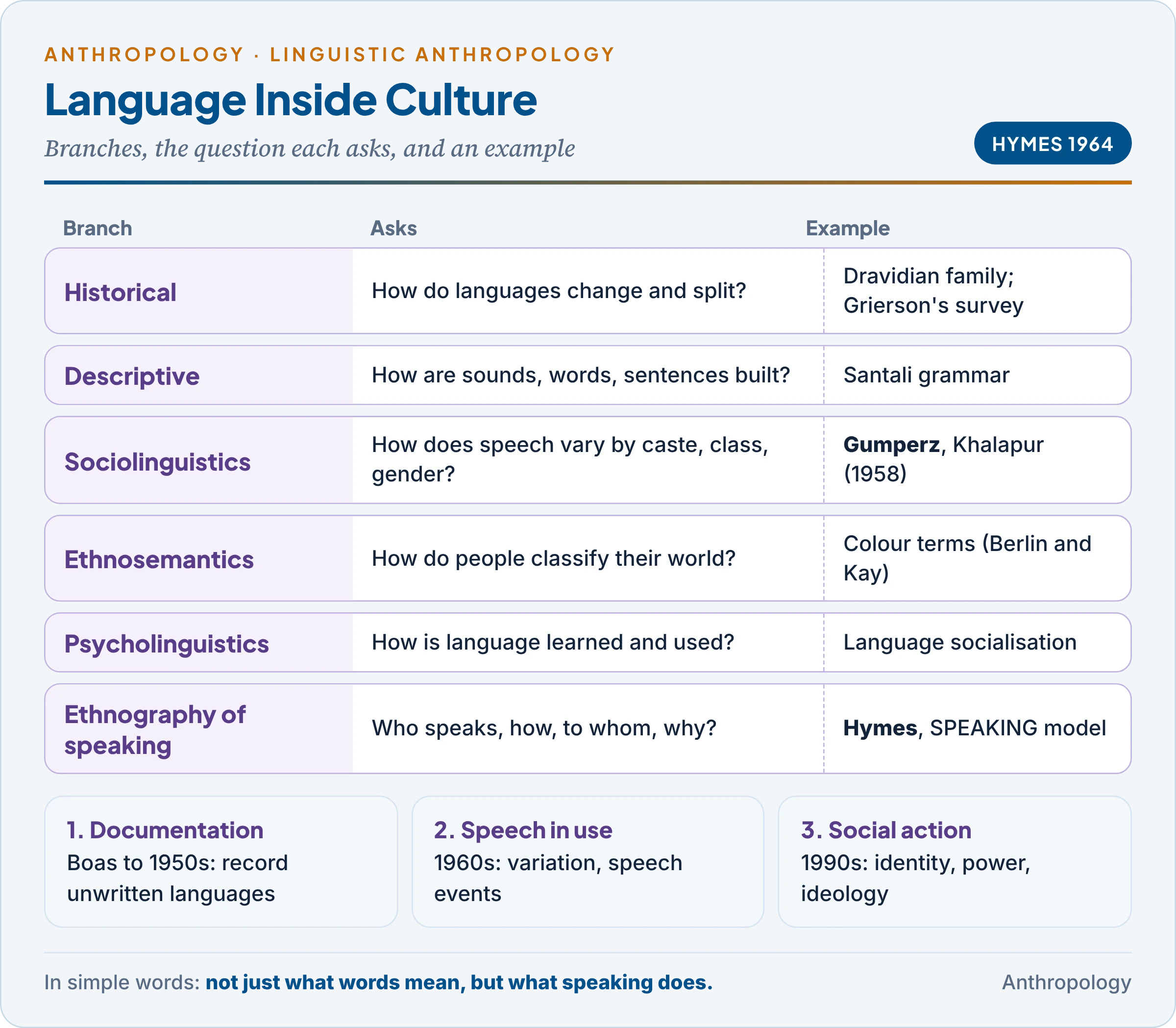
Each branch of linguistic anthropology asks a different question about language. The table lists them with an example each.
| Branch | Studies | Example |
|---|---|---|
| Historical (comparative) linguistics | Language change, families, reconstruction of proto-languages; glottochronology (Swadesh) | Indo-European, Dravidian, Austroasiatic, Tibeto-Burman families; Grierson’s Linguistic Survey of India (1894–1928) |
| Descriptive (structural) linguistics | Phonology, morphology, syntax: how sounds make words and words make sentences | Grammars of tribal languages such as Santali and Kurukh |
| Sociolinguistics | Speech variation by class, caste, gender, situation | Labov, New York (1966); Gumperz, Khalapur (UP, 1958): caste groups marked by dialect differences |
| Ethnosemantics (ethnoscience) | How a people classify their world: plants, colours, illness, kin | Berlin and Kay, Basic Color Terms (1969) |
| Psycholinguistics | Acquisition and processing of language | Language socialisation (Schieffelin and Ochs, 1986) |
| Ethnography of communication | Who speaks, how, when, to whom, for what purpose | Hymes’s SPEAKING grid |
| Language and thought | Whether language shapes perception | Sapir–Whorf hypothesis (Unit 7) |
The first two branches study language itself (its history and structure); the rest study language in relation to society and the mind. The linguistic anthropologist uses both: a careful description of a language is needed before one can study how it varies by caste or how it shapes a people’s classification of the world.
- Proto-language: the reconstructed ancestor of a language family, e.g. Proto-Dravidian, rebuilt by comparing Tamil, Telugu, Kannada and Malayalam words. Glottochronology (Morris Swadesh, American linguist) dates such splits from the rate at which basic words are replaced; it is used with caution because the rate is not constant.
- William Labov (American linguist, 1966) found New Yorkers pronounced the “r” in “fourth floor” more often in higher-status stores: speech varies systematically with class. John Gumperz found the same for caste in Khalapur.
- Sapir–Whorf hypothesis: the language we speak shapes how we perceive and think (Unit 7 treats it in detail).
- South Asia as a “linguistic area”: M.B. Emeneau, an American scholar of Dravidian languages, showed in 1956 that unrelated language families in India share features such as retroflex sounds (made with the tongue curled back), because of centuries of contact.
5.3 Language use in social and cultural settings
Example first. In a Hindi-speaking household, a child calls a younger sibling tū, a friend tum, and a teacher āp. The choice of one small word shows intimacy, equality or respect. This is what linguistic anthropologists mean by language use in social settings: the same message changes meaning depending on who speaks to whom.
- Status and respect: Hindi tū / tum / āp encode intimacy and hierarchy; Brown and Gilman (American psychologists, 1960) called such pronouns markers of power and solidarity.
- Caste and dialect: in Khalapur, Gumperz found speech differences tracking caste and touchability, not just region. Speech can mark social boundaries as clearly as dress or food.
- Code-switching: shifting between languages mid-conversation to signal identity or change the frame, as between English and Hindi (Gumperz). A manager may give instructions in English but switch to Hindi to joke or show warmth; the switch itself carries social meaning.
- Diglossia: a high variety of a language for formal and written use alongside a low variety for everyday speech (Charles Ferguson, an American linguist, 1959). Tamil, with its literary and spoken forms, is a standard Indian case.
- Kinship terms as social categories: Irawati Karve, the pioneering Indian anthropologist, contrasted northern and southern Indian kin vocabularies and linked them to different marriage rules (Unit 2.5).
- Avoidance: in many north Indian households a wife does not utter her husband’s name.
- Language and political identity:
- linguistic reorganisation of states (1956)
- Santali in the Eighth Schedule (2003), written in the Ol Chiki script
5.4 Structuralism in linguistics and in social anthropology
Structuralism is an approach that looks for the hidden system of relations behind what we observe. It began in linguistics and was then borrowed by social anthropology, which is why the two fields are often compared.
- Source in linguistics:
- Ferdinand de Saussure (Swiss linguist): signs mean through differences (“cat” is not “bat”); langue (the shared system) vs parole (individual speech); synchronic analysis (a system at one time).
- the Prague school (Trubetzkoy, Jakobson): phonemes (basic sound units) are bundles of binary distinctive features, such as voiced vs unvoiced.
- Borrowing in anthropology: Lévi-Strauss, in “Structural analysis in linguistics and in anthropology” (1945), argued that kinship terms are like phonemes. They mean something only as parts of systems and are generated by unconscious rules. From this came his atom of kinship (the basic unit of brother, sister, her husband and their son, which explains the avunculate, the special tie between mother’s brother and sister’s son) and his analysis of myths into mythemes (the smallest units of a myth).
The analogy works in some respects and fails in others, as the table shows.
| Common ground | Where the analogy fails |
|---|---|
| Elements defined by relations, not by themselves | Kinship and myth carry content, power and sentiment, not only contrasts |
| Binary oppositions | Social systems change through history; phonology is relatively closed |
| Unconscious structure behind conscious usage | Structures are hard to verify in observed behaviour |
| Synchronic analysis | Leach and others: too formal, ignores individual choice |
The analogy is strongest where both language and kinship are systems of relations: a kin term like “mother’s brother” means something only in contrast with “father” and “father’s brother”, just as a phoneme is defined by contrast with other phonemes. It is weakest where social life involves feelings, interests and change. People choose whom to marry, quarrel over inheritance and alter customs, while speakers do not choose their phonemes, so a model built for sounds can miss the human agency in society.
- Gopala Sarana (1965) noted that structuralism in linguistics and functionalism in anthropology grew from a similar concern: to see each element as part of a working system.
5.5 Relevance
- Fieldwork depends on language: a people’s own categories, kin terms and ritual vocabulary are the social anthropologist’s data. Malinowski insisted on learning the local language for exactly this reason. This is the core of the relationship between linguistics and social-cultural anthropology (§7).
- Endangered languages:
- Boa Sr, last speaker of Bo (a Great Andamanese language), died in 2010; with her went a body of knowledge about the islands
- the People’s Linguistic Survey of India (G.N. Devy, from 2010) recorded about 780 languages
- the Scheme for Protection and Preservation of Endangered Languages (CIIL, 2013)
- Education: children learn best in the language they speak at home. Multilingual education in tribal mother tongues (Odisha) and NEP 2020, which prefers the home language as the medium of instruction at least up to Grade 5, apply this finding.
- Health and law: culturally fitted health messages; language in courts and police interviews; language technology for low-resource languages (languages with little digital text).
6. Applied, Action and Other Branches
In simple words
Besides the four main branches, anthropology has branches defined by purpose rather than subject. Applied anthropology uses anthropological knowledge to solve real problems; action anthropology works together with a community to meet its own goals. Medical and psychological anthropology study health and the mind in their cultural setting.
Most of these branches draw on all four main fields, which is why they are listed separately. The table summarises them.
| Branch | Meaning | Key points |
|---|---|---|
| Applied anthropology | Use of anthropological knowledge to solve practical problems | Malinowski, “Practical Anthropology” (1929); in India, tribal administration, Tribal Research Institutes, impact assessment; detail in Unit 12 |
| Action anthropology | Research with a community to meet its goals while learning from the process | Sol Tax, Fox (Meskwaki) Project, Iowa (1948–59); the community, not the anthropologist, decides |
| Medical anthropology | Health, illness and healing in cultural context | Ethno-medicine, illness narratives, health programmes, epidemics |
| Psychological anthropology | Culture and the individual mind | From culture and personality (Benedict, Mead, Kardiner) to cognitive, psychiatric and cultural-psychology studies |
| Applied physical anthropology | Biological knowledge put to use | Forensics, ergonomics, sports, nutrition (Unit 12) |
These branches are defined by purpose, not by evidence or method: each borrows from the four main fields to address a practical concern, such as health, development or the mind.
- Applied vs action anthropology: in applied work, the anthropologist usually advises a government or agency, which then decides. In action anthropology, as Sol Tax (an American anthropologist at Chicago) practised it among the Meskwaki, the community sets the goals and the anthropologist helps while learning. The difference lies in who holds the power to decide.
- Recent trends in psychological anthropology: the early culture-and-personality school gave whole nations one personality type, criticised as stereotyping. Later work turned to cognition within a culture, mental illness across cultures, and how culture and mind make each other.
- Medical anthropology asks why people choose one form of healing over another and why health programmes succeed or fail; in India it is central to tribal health and sickle-cell counselling.
7. Synergy of the Branches: Reviving Holism
In simple words
Each branch sees only part of a community. When the four work together, they can answer questions none could answer alone: who a people are, where they came from, how they live and what threatens them. Keeping the branches connected is what makes anthropology different from its neighbouring sciences.
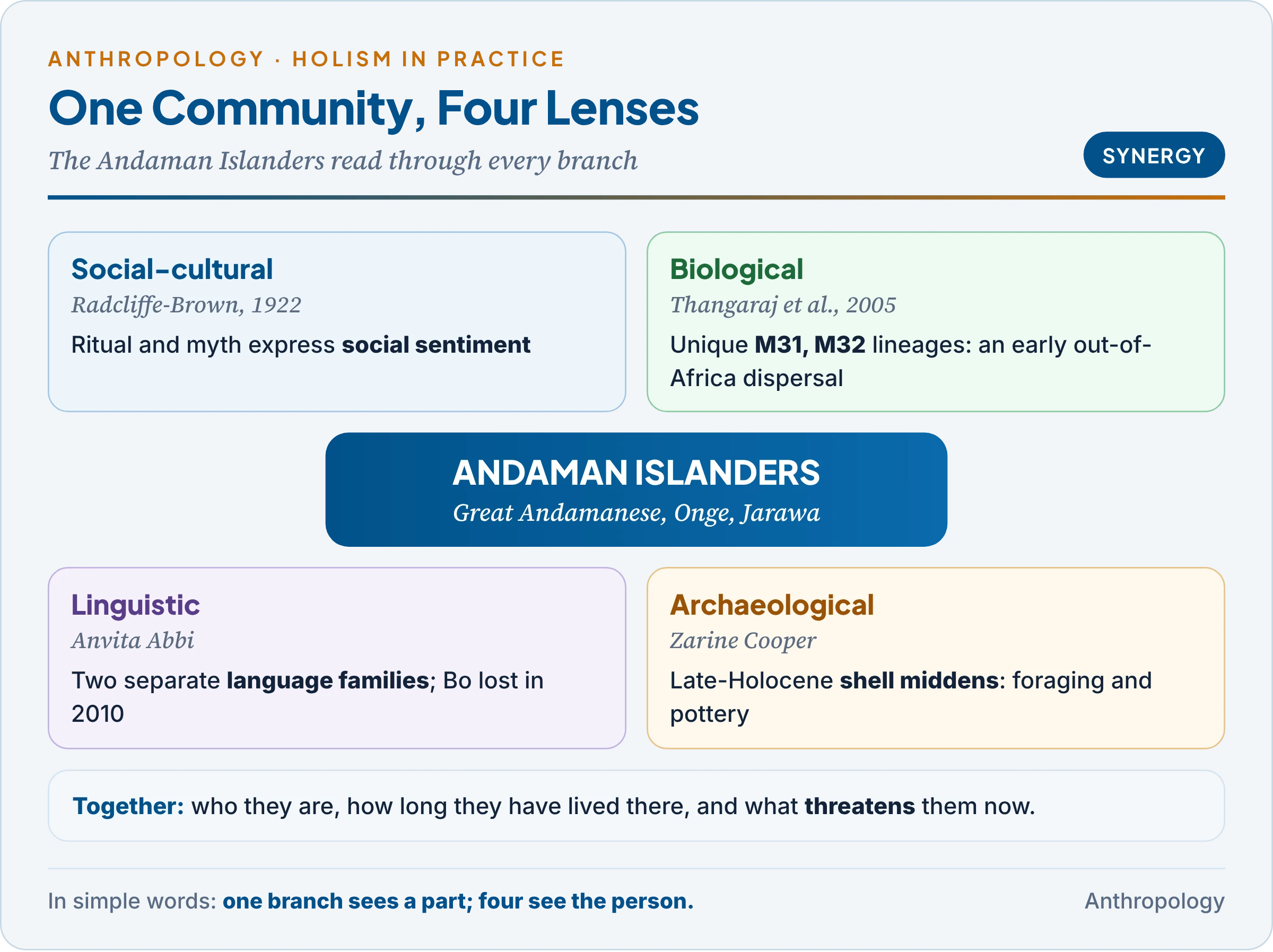
One case, four branches: the Andaman Islands
- Social-cultural: Radcliffe-Brown, The Andaman Islanders (1922): ritual and myth as expressions of social sentiment, the feelings that hold a society together.
- Biological: Thangaraj et al. (Science, 2005) found unique mitochondrial lineages (M31, M32) among the Onge and Great Andamanese. Mitochondrial DNA is inherited through the mother, so these lineages trace an unbroken maternal line pointing to an early out-of-Africa dispersal.
- Linguistic: Anvita Abbi, an Indian linguist, showed that Great Andamanese and Ongan (Onge, Jarawa) are separate language families; the Bo language died with Boa Sr in 2010.
- Archaeological: late-Holocene shell middens (refuse heaps of shells and other food waste), studied by Zarine Cooper, record foraging and pottery over centuries.
- Together they answer what no branch can alone: who the islanders are, how long they have been there, and what threatens them now.
Why the branches need each other. Each pair of branches exchanges something essential, as the table shows.
| Pair | What each gives the other |
|---|---|
| Linguistic ↔ social-cultural | Language gives access to emic categories; structuralism and ethnoscience came from linguistics; kin terms are social data |
| Archaeological ↔ social-cultural | Archaeology adds time depth; ethnography supplies analogies (ethnoarchaeology) |
| Biological ↔ social-cultural | Culture explains mating, diet and disease patterns; biology tests claims about “race” and caste origins |
| Biological ↔ archaeological | Skeletons, isotopes and ancient DNA tell who lived at a site (Rakhigarhi) |
| Linguistic ↔ biological / archaeological | Language families, genes and material cultures together trace population history |
The table makes one point clear: no branch is self-sufficient. Archaeology without ethnography has no living analogies to interpret its finds; genetics without archaeology cannot place ancestry in time and place; socio-cultural study without language cannot reach people’s own meanings. Each branch fills a gap that the others leave.
- Pressures toward fragmentation: specialisation (separate journals, methods and jargon); Stanford split its department in 1998 and reunited it about a decade later; the American Anthropological Association‘s 2010 debate over dropping “science” from its mission showed the gap between scientific and interpretive anthropologists. Fragmentation matters because the questions that matter most, such as caste and health, migration or climate adaptation, cross branch lines; a discipline split into separate camps loses the holistic view that is its chief strength.
- Indian situation: integrated teaching survives, but under-equipped laboratories push biological anthropologists into survey-type work that imitates socio-cultural research. Real integration needs teams of specialists around shared problems, such as endemic and community-specific diseases, rather than one generalist doing everything.
- Ways of synergising:
- the biocultural synthesis (Alan Goodman and Thomas Leatherman, 1998), which studies how social inequality and political economy shape human biology
- ancient DNA joined to archaeology and linguistics, as at Rakhigarhi
- ethnoarchaeology, joining living cultures to the archaeological record
- forensic teamwork between biological anthropologists and archaeologists
- community-based documentation of language, heritage and health
Key Terms
| Term | Meaning in simple words |
|---|---|
| Four-field approach | Dividing anthropology into social-cultural, biological, archaeological and linguistic branches, taught together |
| Holism | Studying a people as a connected whole, because biology, society, language and history affect one another |
| Ethnography | A detailed description of one community, written after long fieldwork |
| Ethnology | Comparison and classification of many peoples and cultures |
| Emic / etic | The insider’s own categories / the outside observer’s categories |
| Hologeistic comparison | Comparing a statistical sample of cultures from the whole world |
| Galton’s problem | Similar traits in a sample may come from borrowing, so the cases are not independent |
| Modern Synthesis | The union of Darwin’s natural selection with genetics, explaining evolution as change in gene frequencies |
| Bio-cultural approach | Explaining human biology and culture together, as each shapes the other |
| Founder effect | A population’s genes reflect the few people who founded it |
| Artefact / ecofact / feature | Object made by people / natural remain showing human activity / immovable remain such as a hearth |
| Stratigraphy | Study of the layers at a site; lower layers are usually older |
| Ethnoarchaeology | Studying living people’s material culture to interpret archaeological remains |
| Salvage archaeology | Rescuing sites before they are destroyed by development |
| Sociolinguistics | Study of how speech varies with class, caste, gender and situation |
| Diglossia | A formal “high” and an everyday “low” variety of one language used side by side |
| Action anthropology | Research done with a community, which itself decides the goals |
Contemporary Developments
- GenomeIndia (January 2025): whole genomes of 10,000 individuals from across India were archived at the Indian Biological Data Centre, Faridabad, as a reference for Indian genetic diversity.
- Sickle cell mission: about 6 crore people screened by July 2025 against a target of 7 crore; 2.15 lakh diagnosed and 16.7 lakh carriers identified, mostly in tribal belts.
- Underwater archaeology revived (February 2025): the ASI’s Underwater Archaeology Wing resumed explorations off Dwarka and Bet Dwarka, with a team that included more women archaeologists than any earlier ASI underwater team.
- Renaming: the US professional body became the American Association of Biological Anthropologists (2021), marking the shift from measurement to biology and evolution.
- Language technology: mother-tongue instruction under NEP 2020 and AI tools for low-resource languages have created new applied work for linguistic anthropologists.
Diagrams to Master
- Four-field map: four boxes around “anthropology”; in each, the core question, evidence, two sub-fields and an Indian example.
- Comparison in socio-cultural anthropology: the ladder ethnography → ethnology → anthropology, then Sarana’s illustrative, complete-universe, hologeistic types with one example and one weakness each.
- Biological anthropology: three branches (palaeontology, neontology, primatology), applied uses, and a bio-cultural loop (culture → mating, diet → genes → health → culture).
- Archaeological field sequence: survey → excavation → stratigraphy → recording → dating → analysis → interpretation; mark Wheeler’s grid and Rakhigarhi.
- Linguistic branches: historical, descriptive, socio-, ethno-semantics, psycho-, ethnography of communication; add Hymes 1964 and Gumperz, Khalapur.
- Andaman case: one community at the centre, four branches around it, each with its scholar and finding.
Revision Grid
| Scholar | Work (year) | Key idea |
|---|---|---|
| Boas | Handbook of American Indian Languages (1911); immigrant study (1911) | Four fields; plasticity of head form |
| Radcliffe-Brown | The Andaman Islanders (1922); “Comparative Method in Social Anthropology” (1951) | Comparative sociology; Eaglehawk and Crow |
| Evans-Pritchard | Social Anthropology (1951) | Ethnology vs social anthropology; nearer history |
| Lévi-Strauss | “Structural analysis in linguistics and in anthropology” (1945); Structural Anthropology (1958) | Kin terms like phonemes; ethnography–ethnology–anthropology |
| Eggan | “Controlled comparison” (1954) | Regional comparison holding history constant |
| Murdock | Social Structure (1949) | Hologeistic survey of 250 societies |
| Sarana | The Methodology of Anthropological Comparisons (1975) | Illustrative, complete-universe, hologeistic |
| Goodenough | 1957; componential analysis (1956) | Culture as knowledge; ethnoscience |
| Washburn | “The New Physical Anthropology” (1951) | From typology to process |
| Lasker | Classical areas of physical anthropology | Bones, age-sex, growth, composition, body build |
| Livingstone | 1958 | Sickle cell, malaria and agriculture |
| Binford | “Archaeology as Anthropology” (1962) | New (processual) archaeology; Nunamiut ethnoarchaeology |
| Hodder | 1980s | Post-processual archaeology |
| Rathje | Garbage Project (1973) | Archaeology of the present |
| Hymes | 1962, 1964, 1972 | Ethnography of speaking; “linguistic anthropology”; SPEAKING |
| Gumperz | Khalapur (1958) | Caste and dialect; code-switching |
| Duranti | Linguistic Anthropology (1997); three paradigms (2003) | Language as cultural resource and practice |
| Sol Tax | Fox Project (1948–59) | Action anthropology |
| Thangaraj et al. | Science (2005) | Andamanese early dispersal |
| Shinde et al. | Cell (2019) | Rakhigarhi genome |
Previous Year Questions
Unit 1.3: Main branches of Anthropology, their scope and relevance
- 2021Mention the major branches of linguistic anthropology and discuss language use in social and cultural settings.
- 2020How can synergising the core branches of anthropology reinvigorate the holistic spirit of the discipline?
- 2019Write a note in 150 words on the relationship between Linguistics and Social-Cultural Anthropology.
- 2018Give an account of- the field methods used in the study of Archaeological Anthropology.
- 2015Write a note in 150 words on Archaeological Anthropology.
- 2014Write a note in 150 words on Major sub-divisions of Anthropology.
- 2013Write a note in 150 words on Linguistic Anthropology.
- 2008Write a note on Biological Anthropology.
- 2002Write a note on Biological Anthropology.
- 1999Write a note on Action anthropology.
- 1996What is cognitive approach ? Critically examine its implications in Sociocultural Anthropology.
- 1996Write a note on Medical Anthropology.
- 1995Write a note on Action anthropology.
- 1994Write a note on Social and cultural anthropology.
- 1992Write an essay on the aims and scope of applied anthropology with special reference to India.
- 1992Write a note on Archaeological Anthropology.
- 1991Discuss the merits and demerits of different methods of comparison used in social-cultural anthropology.
- 1991Write a note on ‘Classical’ Physical Anthropology.
- 1990Write a note on Recent trends in psychological anthropology.
- 1990Write a note on Linguistic anthropology.
- 1989Write a note on ‘New Physical Anthropology’.
- 1989Write a note on Theme of Linguistic Anthropology.
- 1988Bring out the merits and demerits of different contributions on the methods of comparison in social-cultural anthropology.
- 1985Write a note on New Physical anthropology.
- 1985Write a note on Empiricism in social anthropology.
- 1985Discuss the types of comparison in social anthropology.
- 1985What are the common aspects of structural anthropology and linguistics?
- 1983Does structuralism in social anthropology coincide with that in linguistics ? Critically assess their analogy.
- 1982Discuss the comparative method of cultural evolutionists, diffusionists and modern social anthropologists.
Related questions from other units
- 2026Unit 1.8: Write notes on: Ethnoarchaeology and classical archaeology.
- 2025Unit 1.1: “The agenda of biological anthropology became more scientific from the middle of the twentieth century.” Justify.
- 2025Unit 7: Describe briefly the theoretical perspectives in linguistic anthropology to explain the relationship of culture, language and thought.
- 2023Unit 1.1: Write notes on: Scope and relevance of Social and Cultural Anthropology.
- 2021Unit 1.4: “The bio-cultural approach is the hallmark of Biological Anthropology.” Explain. (in about 150 words).
- 2017Unit 1.1: Define Anthropology. Describe the major branches of Anthropology elaborating on any one branch.
- 2007Unit 12: Briefly Describe various applications of physical Anthropology.
- 1989Unit 12: What is meant by Applied Anthropology? Explain its methods and scope in Indian context.
- 1986Unit 1.4: Write a note on Biological evolution and concept of new physical anthropology.