

1.4 Human Evolution and emergence of Man: Biological and Cultural factors in human evolution. Theories of Organic Evolution (Pre-Darwinian, Darwinian and Post-Darwinian). Synthetic theory of evolution; Brief outline of terms and concepts of evolutionary biology (Doll’s rule, Cope’s rule, Gause’s rule, parallelism, convergence, adaptive radiation, and mosaic evolution).
Official Syllabus: Paper I, Unit 1.4
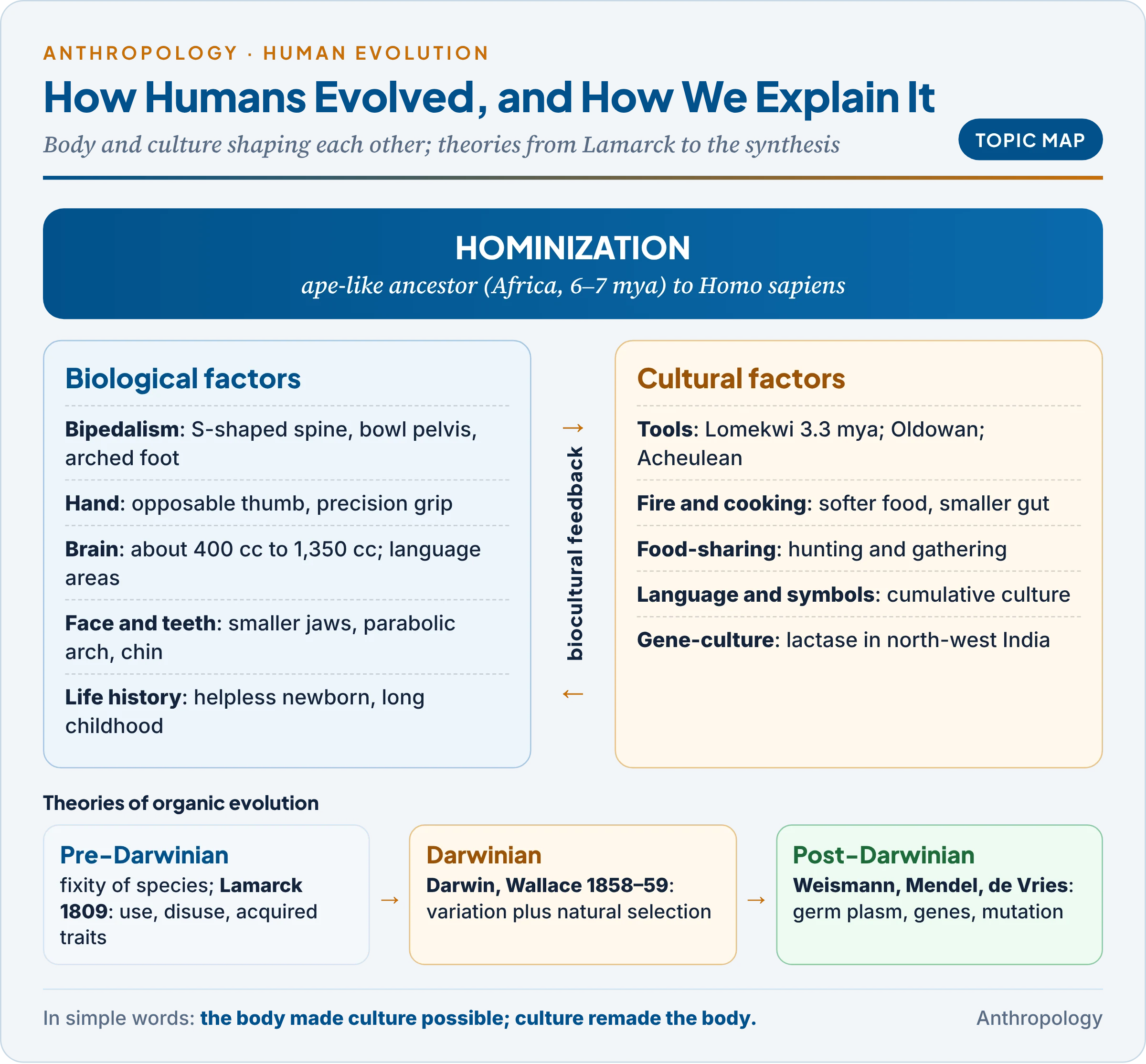
This article covers the biological and cultural factors in human evolution and the pre-Darwinian, Darwinian and post-Darwinian theories. The synthetic theory and the terms of evolutionary biology are in Unit 1.4b.
1. Human Evolution and the Process of Hominization
In simple words
Human evolution is the long story of how an ape-like ancestor living in Africa about seven million years ago slowly became the modern human. It did not happen in one step: first our ancestors walked upright, much later the brain grew large, and language and culture came last. Biology and culture pushed each other forward throughout.
At Laetoli in Tanzania, volcanic ash preserved a trail of footprints about 3.66 million years old. The prints show a raised arch, a big toe in line with the others and a heel strike: their makers walked upright like us. Yet those makers, almost certainly Australopithecus afarensis, had a brain the size of a chimpanzee’s (about 400–500 cc). One trail shows the central fact of human evolution: the human body was assembled part by part, at different times.
- Human evolution is the history of the human lineage after it separated from the chimpanzee line, about 6–7 million years ago (mya) on fossil and molecular evidence. The oldest claimed member, Sahelanthropus from Chad (about 7 mya), is still debated.
- Hominization is the set of biological and cultural changes that turned an ape-like ancestor into Homo sapiens: upright walking, a skilful hand, a large reorganised brain, a smaller face and teeth, speech, a long childhood and dependence on culture.
- Why “process” matters: hominization was not a ladder with a goal but many branching species, several living at once; only one survives.
- Evidence: fossils and artefacts, and living and ancient DNA, which dates splits and detects interbreeding.
Common confusion
Hominid or hominin: which word means “the human line”? In older books and many past questions, hominid (family Hominidae) meant humans and their upright ancestors only. Genes later showed humans are closer to chimpanzees than chimpanzees are to orangutans, so Hominidae now includes all great apes, and the human line is called hominin. Both usages are correct in their own scheme; this note uses “hominin”.
1.1 Major trends in hominization
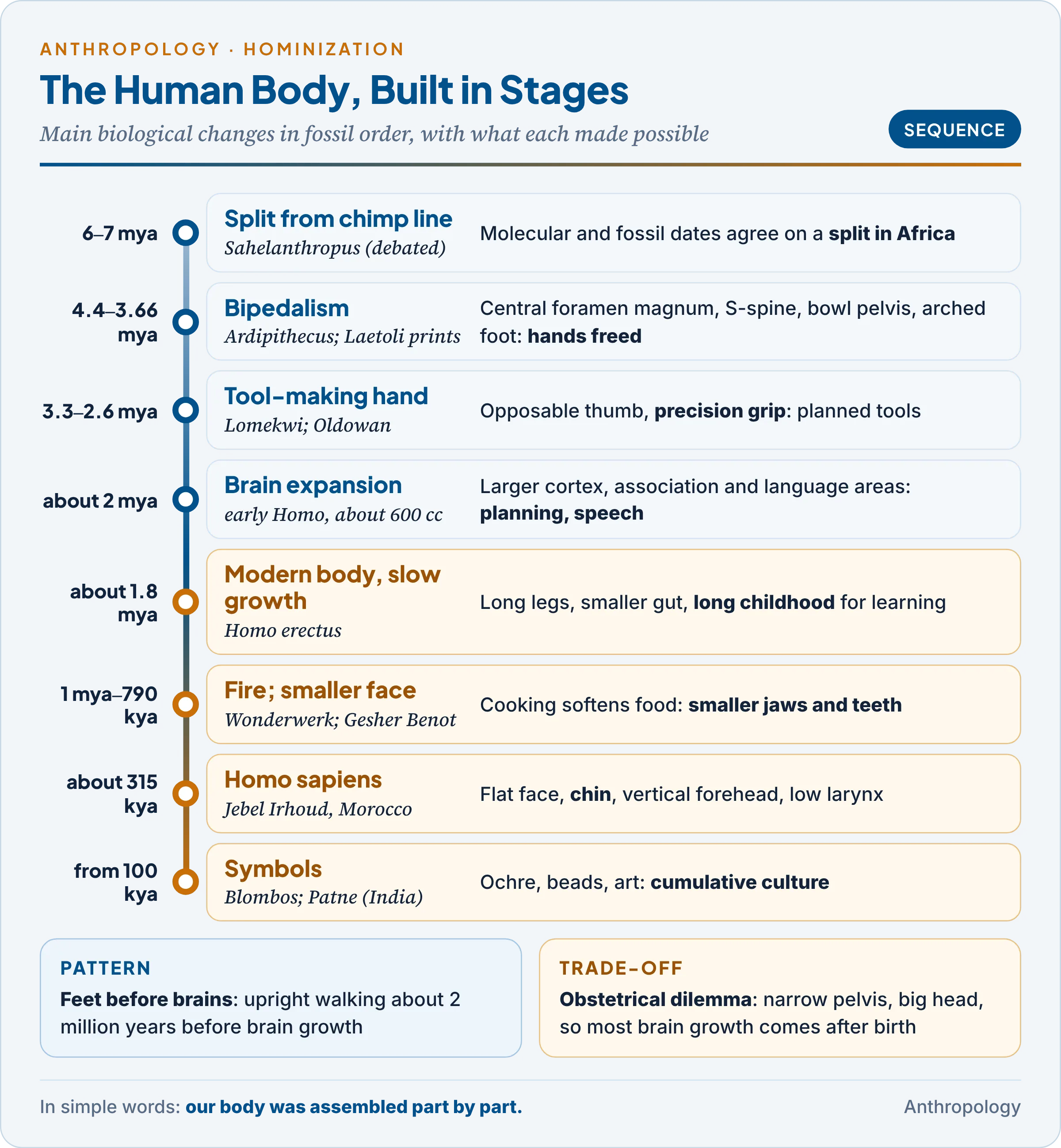
The trends did not appear together. The table lists them in the order the fossil record shows them, and that order is itself the main lesson.
| Trend | What changed | Earliest clear evidence | Why it mattered |
|---|---|---|---|
| Bipedalism | Upright posture, two-legged walking | Ardipithecus 4.4 mya; Laetoli 3.66 mya | Freed the hands; reshaped spine, pelvis, legs, foot |
| Tool-making hand | Long, fully opposable thumb; precision grip | Lomekwi tools 3.3 mya; Oldowan 2.6 mya | Made planned tool-making possible |
| Facial reduction | Smaller canines, no diastema, parabolic arch, flatter face | Australopithecines onward; chin only in H. sapiens | Tools and cooking took over the jaws’ work |
| Encephalization | Brain grows faster than body; cortex reorganised | Early Homo, about 2 mya | Planning, language, social intelligence |
| Long life history | Slow growth, long childhood, helpless newborn | Homo erectus onward | Time to learn culture |
| Speech and symbol | Lowered larynx, language areas, art and ornament | Clear symbols from about 100,000 years ago | Culture becomes cumulative |
Read down the third column: feet before brains. Upright walking appears millions of years before the brain expands, and symbolic culture comes last. This uneven pace is mosaic evolution (different parts evolving at different rates; Unit 1.4b). It also corrects the old assumption, behind the acceptance of the faked Piltdown skull (exposed 1953), that a big brain came first. Older textbooks also placed Ramapithecus, jaws from the Siwalik Hills of India and Pakistan (about 12–8 mya), at the base of the human line; fuller finds in the 1980s showed it belongs with Sivapithecus, an ancestor of the orangutan (Unit 1.5).
1.2 Why Africa is central
- Every early stage is African: the earliest hominins (Sahelanthropus, Chad; Orrorin, Kenya; Ardipithecus, Ethiopia), all australopithecines, the earliest Homo (Ledi-Geraru jaw, Ethiopia, about 2.8 mya), the earliest tools (Lomekwi, 3.3 mya) and the earliest Homo sapiens (Jebel Irhoud, Morocco, about 315,000 years ago).
- Genes agree: Africans carry the greatest genetic diversity, and the mitochondrial DNA of all living humans traces to an African ancestor (Rebecca Cann, Mark Stoneking and Allan Wilson, American geneticists, 1987). Diversity is highest where a species has lived longest.
- Darwin predicted it (The Descent of Man, 1871), because chimpanzees and gorillas live in Africa.
- But Asia is not a mere receiver. Hominins and tools reached Dmanisi, Georgia (about 1.8 mya) and Shangchen, China (about 2.1 mya). In India, Attirampakkam (Tamil Nadu) has Acheulean tools about 1.5 million years old (Shanti Pappu and colleagues, 2011). Asia held Denisovans and Homo floresiensis, and modern humans interbred with Neanderthals and Denisovans after leaving Africa.
- Balanced view: Africa is the cradle; Eurasia was a theatre where lineages evolved, met and mixed (fossils in Unit 1.6).
2. Biological Factors in Human Evolution
In simple words
The human body changed in a few key ways: we walk upright, our hands grip finely, our brains became very large, our faces and teeth became smaller, and our babies are born helpless and grow slowly. Each change made the next one possible, and together they prepared the body for a life based on culture.
A human newborn’s head barely passes through its mother’s pelvis; the baby must rotate during birth, and most mothers are helped by others, which is rare among primates. Two defining traits pull in opposite directions: upright walking favours a narrow pelvis, a large brain needs a wide birth canal. The American biological anthropologist Sherwood Washburn called this the obstetrical dilemma (1960). The compromise was a baby born with a brain only about 30 per cent of adult size, so most brain growth happens after birth, in a cultural world. One example ties bipedalism, brain and culture together.
2.1 Erect posture and bipedal locomotion
Bipedalism (habitual walking on two legs) is the earliest hominin trait, and it reshaped almost every bone.
- Skull: the foramen magnum (the hole for the spinal cord) moved forward and down to the centre of the skull base, so the head balances on the spine. Apes have it further back and need heavy neck muscles.
- Spine: a C-shaped curve became an S-shaped curve with a forward bend in the lower back (lumbar lordosis), placing the body’s weight over the hips. Humans usually have five lumbar vertebrae, great apes three or four.
- Pelvis: the ilium (upper blade of the hip bone) became short, broad and bowl-shaped. Two buttock muscles moved to the side, where they stop the pelvis tilting when one foot leaves the ground.
- Leg: the thigh bone (femur) slopes inward to the knee (the valgus or bicondylar angle), bringing the feet under the centre of gravity; legs became longer than arms.
- Foot: a big toe in line with the others, two arches acting as springs, and a large heel.
Why did it evolve? The main hypotheses (treated fully in Unit 1.5) are freeing the hands for carrying and tools (Darwin, 1871), energy efficiency over knuckle-walking (Peter Rodman and Henry McHenry, 1980), keeping cool by exposing less of the body to the midday sun (Peter Wheeler, 1991), provisioning of mates and young (C.O. Lovejoy, 1981) and endurance running (Dennis Bramble and Daniel Lieberman, 2004). They are not exclusive: early bipedalism was probably about efficient walking between woodland patches, while carrying and running mattered later, in Homo erectus.
2.2 The hand and the precision grip
- Hominins added a long, strong thumb that can be fully opposed to every finger tip.
- The British primatologist John Napier distinguished the power grip (whole hand round an object, as with a hammer) from the precision grip (a small object between thumb and finger tips, as with a needle) (1956). Only humans combine both fully.
- Why it mattered: making a stone tool needs both grips at once, one hand holding the core and the other striking at a controlled angle. A precise hand, a brain that plans the blows, and hands freed by bipedalism made the first tools possible.
2.3 Expansion and reorganisation of the brain
Encephalization is brain growth beyond what body size predicts. Brain size roughly tripled in two million years:
| Hominin | Approx. brain size (cc) |
|---|---|
| Chimpanzee (comparison) | 350–400 |
| Australopithecus afarensis | 400–500 |
| Homo habilis | about 600 |
| Homo erectus | 750–1,250 |
| Neanderthals | about 1,450 |
| Homo sapiens | about 1,350 |
Neanderthals had larger brains than ours, so organisation, not volume alone, explains human abilities.
- Association areas: growth was mainly in the cerebral cortex. Around each sensory area lie association areas, which match new input with memory and make recognition possible. In humans, large fibre bundles link association areas directly (the basis of thinking) and connect them to the areas that control the hand (the basis of skilled tool use).
- Language areas: Broca’s area (frontal lobe; produces speech) and Wernicke’s area (temporal lobe; understands speech), joined by the arcuate fasciculus, plus the angular gyrus, which links sight, hearing and touch to words. Being in the cortex, they let humans speak without passing through the older emotional centres.
- The cost: the brain is about 2 per cent of body weight but uses about 20 per cent of resting energy. The expensive-tissue hypothesis (Leslie Aiello and Peter Wheeler, British anthropologists, 1995) argues that the gut shrank as the brain grew, which needed high-quality food: meat, marrow and later cooked food.
- The social brain hypothesis (Robin Dunbar, British evolutionary psychologist, 1998): primates in larger groups have larger neocortices, so the brain grew mainly to manage complex social life.
2.4 Reduction of the face, jaws and teeth
The craniofacial changes form a clear sequence.
| Feature | Earlier hominins | Modern humans |
|---|---|---|
| Prognathism (projecting jaws) | Marked | Reduced; face tucked under the brain case |
| Canines and diastema | Large canines; gap in the opposite jaw | Small canines; no gap |
| Dental arcade | U-shaped | Parabolic |
| Brow ridges, forehead | Heavy ridges; low sloping forehead | Small ridges; vertical forehead |
| Chin | Absent, even in Neanderthals | Present: unique to H. sapiens |
| Sagittal crest | Present in robust forms | Absent |
Three causes worked together. A larger brain under the obstetric limit made the snout shrink to make room. Tools and cooking took over cutting and softening food, so the mouth stopped being a “fifth hand” and big jaws were no longer favoured. A shorter face helped speech.
2.5 Speech and a long childhood
- Vocal tract: the larynx sits low in the throat, so throat and mouth form a two-part sound chamber that produces the full range of vowels (at the cost of a higher risk of choking).
- The hyoid bone of a Neanderthal from Kebara, Israel (about 60,000 years ago) is almost identical to ours; the speech-related gene FOXP2 has a human-specific form that Neanderthals shared. Language has deep roots.
- Slow growth: helpless infancy and a long childhood. Washburn explained the newborn’s helplessness (secondary altriciality) by the obstetrical dilemma; the metabolic hypothesis (Holly Dunsworth and colleagues, 2012) adds that birth occurs when the foetus’s energy needs exceed what the mother can supply.
- Why it matters: a long childhood is the period of learning culture, and it needs helpers. The grandmother hypothesis (Kristen Hawkes, 1998) argues that older women feeding grandchildren favoured long life after menopause.
3. Cultural Factors and the Biocultural Feedback
In simple words
Culture is not something humans added after their bodies were finished. Tools, fire, food-sharing and language changed which bodies survived, so culture shaped human biology. In return, each biological change made more culture possible. This two-way process is called biocultural evolution.
In north-western India, many people of herding and dairying communities digest milk all their lives, while in much of southern and north-eastern India most adults cannot. This ability, lactase persistence, depends on a variant (−13910*T) that keeps the milk-digesting enzyme working after childhood. Irene Gallego Romero and colleagues (2012) found the variant common where cattle were herded and milked, reaching levels that could make up to about 73 per cent of adults lactase-persistent in some north Indian populations, and rare or absent in many southern and north-eastern groups. Dairying made the gene useful, and the gene spread: culture changed biology.
3.1 Tools: “man makes himself”
- The sequence: the earliest tools are from Lomekwi 3, Kenya (3.3 mya), older than Homo. The Oldowan (simple flakes and choppers) begins about 2.6 mya; the Acheulean (symmetrical hand-axes) about 1.76 mya in Kenya and 1.5 mya at Attirampakkam.
- Tools shaped the body: Washburn argued (1960) that the success of even the simplest tools started the trend of human evolution: once tools were used, selection favoured better hands, larger brains and smaller teeth. This reverses the older order in which the brain came first and then invented tools.
- “Man makes himself”: the archaeologist V. Gordon Childe used this as the title of his book (Man Makes Himself, 1936): by creating their own means of living (tools, farming, cities), humans created the conditions of their own development.
- Tools need foresight: a tool helps only if it is carried until needed, which requires planning and free hands. The British palaeontologist Kenneth Oakley called humans “man the tool-maker” (1949) because making tools to a set pattern for future use requires abstract thought.
3.2 Fire and cooking
- Evidence: burnt bone and ash at Wonderwerk Cave, South Africa (about 1 mya), and repeated hearths at Gesher Benot Ya’aqov, Israel (about 790,000 years ago).
- The cooking hypothesis of the British primatologist Richard Wrangham (Catching Fire, 2009): cooking made food softer and more digestible, giving more energy from the same food. This explains the smaller teeth and gut of H. erectus and helped pay for a larger brain.
- Fire also gave warmth, protection and a hearth for sharing and talking after dark.
3.3 Hunting, sharing, language and social life
- Man the Hunter (Richard Lee and Irven DeVore, eds., 1968) argued that cooperative hunting drove intelligence, cooperation and the sexual division of labour.
- The feminist critique “Woman the Gatherer” (Sally Slocum, 1975) showed that among foragers such as the !Kung San of the Kalahari, gathered plant food supplies most calories, and that sharing and child care mattered as much as hunting. The current view stresses food-sharing at a home base, which needs trust, memory and communication.
- Language made culture cumulative: knowledge is taught and improved across generations instead of being rediscovered. Symbols appear from about 100,000 years ago (engraved ochre and shell beads, Blombos Cave, South Africa); in India, ostrich-eggshell beads come from Patne (Maharashtra), about 25,000 years ago.
3.4 Gene-culture co-evolution
Gene-culture co-evolution (or dual inheritance theory) holds that humans inherit genes and culture, and that each changes the other. Its main formulations came from Luigi Luca Cavalli-Sforza and Marcus Feldman (1981), Robert Boyd and Peter Richerson (Culture and the Evolutionary Process, 1985) and William Durham (Coevolution, 1991). Niche construction (John Odling-Smee, Kevin Laland and Feldman, 2003) adds that organisms change their own environment and so the selection acting on them.
Every case below follows one mechanism: a cultural practice changes the environment, and the new environment changes which genes succeed.
| Cultural practice | Environmental change | Genetic response | Population and study |
|---|---|---|---|
| Dairying | Milk available to adults | Lactase persistence spreads | North-west India, Europe, East Africa (Gallego Romero, 2012) |
| Forest clearing for yam farming | Standing water breeds malaria mosquitoes | Sickle-cell gene protects carriers | West Africa (Frank Livingstone, 1958); central Indian tribal belts |
| Starchy diets | More starch to digest | More copies of the amylase gene | Farming peoples (George Perry, 2007) |
| Breath-hold diving | Long dives for food | Larger spleens | Bajau sea nomads, Indonesia (Melissa Ilardo, 2018) |
| Mortuary cannibalism | Spread of the prion disease kuru | Protective prion-gene variant | Fore, Papua New Guinea (Simon Mead, 2009) |
| Caste and community endogamy | Small closed breeding groups | Founder effects; more recessive disease | Many Indian groups (Nathan Nakatsuka, 2017) |
In every row culture comes first and the genetic change follows. The sickle-cell gene protects carriers against malaria but causes disease in those with two copies, which is why it is common in malarial regions and why India’s National Sickle Cell Anaemia Elimination Mission (2023) concentrates on tribal districts. In the endogamy row, a social rule studied by social anthropologists has measurable genetic effects: the two branches need each other.
3.5 Biological and cultural evolution compared
Human evolution has two strands that work differently. The table shows why cultural change now outpaces biological change.
| Basis | Biological evolution | Cultural evolution |
|---|---|---|
| What is inherited | Genes (DNA) | Learned ideas, skills, values, artefacts |
| Route | Parents to offspring only | Parents, peers, teachers, media |
| Novelty from | Random mutation, recombination | Invention, often purposeful |
| Acquired traits passed on? | No | Yes (“Lamarckian”) |
| Speed | Slow: many generations | Fast: within a lifetime |
| Pattern | Branching only | Branches and merges (borrowing) |
| Reversibility | Practically irreversible | Traits abandoned or revived |
Because culture passes on what is learned, it responds to a problem in years, while genes need generations. That is why sociocultural evolution is not parallel to biological evolution: the body has changed little in 40,000 years, while societies moved from foraging bands to industrial states. The American anthropologist Alfred Kroeber called culture “superorganic” (1917), a level with its own laws. The Russian-American geneticist Theodosius Dobzhansky took the middle path (Mankind Evolving, 1962): culture is the most powerful adaptation biology has produced, yet it has not stopped biological evolution (Unit 1.4b shows human genes are still changing).
3.6 The bio-cultural approach in biological anthropology
Biological anthropology treats human biology and culture as one system; this bio-cultural approach is its defining feature.
- Adaptability perspective: the Human Adaptability section of the International Biological Programme (1964–74) studied how populations cope with altitude, cold and heat. The American biological anthropologist Gabriel Lasker (1969) showed humans adapt at several levels: genetic (natural selection), developmental (during growth), short-term acclimatisation, and cultural (clothing, housing, technology) (Unit 9.7).
- Political-economy perspective: Alan Goodman and Thomas Leatherman (Building a New Biocultural Synthesis, 1998) argued that the environment humans adapt to is largely made by society: poverty, unequal land, wage labour, discrimination. Inequality shows up in the body as stunting, anaemia and disease.
- Integration: the newer synthesis keeps the adaptability and ecological tools (variation as a fit to environment) but asks who is exposed to which stress, and why. In India, NFHS-5 (2019–21) recorded stunting in 35.5 per cent of children under five overall, but 40.9 per cent among Scheduled Tribe and 39.2 per cent among Scheduled Caste children. An ecological reading looks for adaptation; the political-economy reading explains the gap by unequal access to land, food, sanitation and care.
4. Organic Evolution: Meaning and Evidence
In simple words
Organic evolution means that living things change over generations, and that new kinds of plants and animals arise from older ones. We know this from fossils, from similar bone plans in different animals, from embryos, from where species live, from DNA, and from changes we can watch today.
Every human has a coccyx (tailbone) of fused tail vertebrae, a small appendix, and ear muscles most people cannot use. These parts make no sense in a species designed from scratch, but perfect sense if humans descend from tailed, ear-moving ancestors. Such vestigial organs (reduced remnants of organs that worked in ancestors) are one of several independent lines of evidence for evolution.
- Meaning: the English philosopher Herbert Spencer popularised “evolution” for the development of the universe, life and society (1857). Darwin preferred “descent with modification“: new species descend from ancestral ones and are modified along the way.
- Organic evolution is the change in heritable characteristics of populations over generations, leading to new species from earlier ones. Change in societies is cultural evolution.
- Ontogeny and phylogeny (both coined by the German zoologist Ernst Haeckel, 1866): ontogeny is the development of one individual; phylogeny the evolutionary history of a group of species. Evolution concerns phylogeny.
The evidence comes from independent sciences, which is why the conclusion is secure.
| Line of evidence | What it shows | Example |
|---|---|---|
| Fossils | Ordered sequences, transitional forms | Archaeopteryx (reptile-bird); horse and hominin series |
| Comparative anatomy | Homologous organs: same plan, different use | Human arm, bat wing, whale flipper |
| Vestigial organs | Remnants of ancestral organs | Coccyx, appendix, ear muscles |
| Embryology | Related species look alike as embryos | Human embryo has pharyngeal arches and a tail |
| Biogeography | Species resemble those of the nearest mainland | Galápagos finches; Australia’s marsupials |
| Molecular biology | Shared code; similarity tracks relationship | Humans and chimpanzees differ at about 1.2 per cent of DNA letters |
| Direct observation | Evolution happening now | Finch beaks after the 1977 drought; antibiotic resistance |
Molecular evidence is strong because it is independent of anatomy: humans share with other monkeys and apes a broken vitamin-C gene (GULO) with the same defects, best explained by a common ancestor in which it first broke.
5. Pre-Darwinian Theories
In simple words
Before Darwin, most people believed that each species was created separately and never changed. Thinkers gradually found fossils of extinct animals, learned that the earth is very old, and began to suspect that species change. Lamarck gave the first full theory of how they change, but his mechanism was wrong.
For centuries, women in many Indian communities have had their ears and noses pierced, and Jewish and Muslim boys have been circumcised. Yet no baby is born with pierced ears or without a foreskin. If changes made during life were inherited, these would long since have become inborn. This everyday fact is the simplest refutation of the best-known pre-Darwinian theory, the inheritance of acquired characters.
5.1 From fixity of species to the idea of change
The period moved from belief in fixed, separately created species towards the idea that species change over a very long time.
| Idea | Thinker (date) | Core claim | Significance or weakness |
|---|---|---|---|
| Spontaneous generation | Aristotle; Greek tradition | Life arises from non-living matter | Disproved by Redi (1668) and Pasteur (1859–62) |
| Great chain of being | Aristotle; Augustine, Aquinas | All beings in a fixed ladder up to God | A ladder, not a tree |
| Special creation | Biblical tradition; Francisco Suárez | God created each species separately | Fixity of species |
| Classification | Linnaeus, Systema Naturae (1735) | Fixed species, binomial names | Nested groups later read as common descent |
| Preformation | Malpighi; Hartsoeker’s homunculus (1694); Bonnet’s encasement | A miniature adult in egg or sperm | Disproved by embryology |
| Epigenesis | C.F. Wolff (1759) | Organs form gradually | Correct; basis of embryology |
| Mutability | Buffon, Histoire naturelle (from 1749) | Species change with environment | First serious challenge to fixity |
| Common origin | Erasmus Darwin, Zoonomia (1794–96) | All life from one source | Charles Darwin’s grandfather; no mechanism |
| Catastrophism | Cuvier (early 1800s) | Extinction is real; repeated catastrophes | Founded palaeontology; opposed evolution |
| Uniformitarianism | Hutton (1788); Lyell (1830–33) | Slow present processes over vast time | Gave Darwin deep time |
| Population pressure | Malthus (1798) | Population outgrows food | Gave Darwin the struggle for existence |
The last three rows matter most. Cuvier proved that species go extinct, Lyell that the earth is very old, and Malthus that more are born than can survive. Darwin combined all three. Lamarck, meanwhile, offered the first complete theory of how species change.
5.2 Lamarckism: the inheritance of acquired characters
Jean-Baptiste Lamarck (1744–1829), a French naturalist, set out his theory in Philosophie Zoologique (1809). He was the first to argue that evolution is a general fact covering all life, against the fixity defended by Cuvier.
The four propositions:
- Internal tendency to growth: organisms and their parts tend to increase in size and complexity.
- New needs produce new organs: a changed environment creates new needs (besoins), new habits and, through them, new organs.
- Use and disuse: organs used constantly develop; unused organs weaken and vanish.
- Inheritance of acquired characters: changes acquired in life are passed to offspring.
His examples: the giraffe, whose ancestors stretched for high leaves, lengthening the neck a little each generation; webbed feet of ducks from stretching the toes; limbless snakes from creeping through narrow places; blind moles and cave animals from disuse. It was simple, matched experience (exercise builds muscle) and could be tested.
Critique, proposition by proposition:
- Growth in size is not universal: giant tree-ferns gave way to smaller flowering plants.
- Need does not create organs: humans have always wished to fly but never grew wings.
- Use and disuse works within a lifetime (a blacksmith’s arm) but proves nothing unless inherited; the heart works constantly yet does not keep growing.
- Inheritance of acquired characters failed every test:
- August Weismann, a German zoologist, cut off the tails of mice for five generations (901 young) and reported in 1889 that none was born with a shorter tail.
- Ear and nose piercing in India, circumcision and Chinese foot-binding produced no inherited change.
- William Castle and John Phillips transplanted the ovaries of a black guinea pig into a white female (1909); mated to a white male, she bore only black young. Offspring followed the genes in the ovary, not the body carrying it.
- Why it fails: changes in body cells do not alter the sex cells that carry heredity (§7.1).
5.3 Neo-Lamarckism and its modern echoes
- Neo-Lamarckism (term coined by Alpheus Packard, 1885) revived Lamarck in the late 19th century, especially in America (Edward Drinker Cope, Packard, Alpheus Hyatt) and in Herbert Spencer. Its followers held that environment and habit, not selection, drive evolution.
- Failed or false experiments: Paul Kammerer‘s midwife toads, whose inherited “nuptial pads” were shown in 1926 to have been injected with ink; William McDougall‘s rats, said to learn a water maze faster each generation (1920s–30s), not replicated; and Trofim Lysenko, whose state-backed Lamarckism suppressed Soviet genetics (the geneticist Nikolai Vavilov died in prison, 1943), a warning about ideology overriding evidence.
- Epigenetics: chemical tags on DNA (such as methylation) change how genes are expressed without changing the sequence, and the environment can set them. People conceived in the Dutch Hunger Winter (1944–45) still showed altered methylation of the IGF2 gene six decades later (Bastiaan Heijmans and colleagues, 2008). But most tags are erased each generation, and inheritance over several human generations is not established. Epigenetics qualifies Weismann’s rule; it does not restore Lamarckism.
- Baldwin effect (James Mark Baldwin, American psychologist, 1896): a learned behaviour can change which genes are favoured, so learning guides genetic evolution without inheriting acquired traits. Lactase persistence (§3) is a human case.
Common confusion
Did Lamarck and Darwin disagree about whether evolution happens? No. Both accepted evolution; they disagreed about its mechanism. For Lamarck, a giraffe acquired a longer neck by stretching and passed it on. For Darwin, giraffes already varied in neck length; those born with longer necks survived and bred more. Darwin himself did not reject inheritance of acquired characters; that came later, with Weismann.
6. Darwinian Theory: Natural Selection
In simple words
Darwin noticed that living things produce more young than can survive, that the young differ, and that some differences are inherited. Those whose differences suit their surroundings survive and breed more, so useful differences become common. Over very long periods, this natural selection can turn one species into another.
On Daphne Major, a tiny Galápagos island, the biologists Peter and Rosemary Grant measured every finch for decades. In the drought of 1977, small soft seeds ran out and only large hard seeds remained. Medium ground finches with deeper beaks could crack them; most others starved. Because beak depth is inherited, the next generation had measurably deeper beaks (Peter Boag and Peter Grant, 1981). This is natural selection observed directly, on the birds Darwin collected.
6.1 How the theory was formed
- Charles Darwin (1809–1882), son of a Shrewsbury doctor, sailed as naturalist on HMS Beagle (1831–36).
- What he saw: fossils of giant extinct mammals in Argentina resembling living South American forms; and on the Galápagos, finches, mockingbirds and tortoises that differed from island to island yet resembled mainland species, suggesting descent from mainland colonists with change on each island.
- What he read and learned: Lyell‘s deep time; Malthus (read in 1838); and breeders’ artificial selection of pigeons and cattle.
- Wallace: in 1858 Alfred Russel Wallace, a British naturalist in the Malay Archipelago, sent Darwin an essay with the same theory. Their papers were read at the Linnean Society on 1 July 1858, and On the Origin of Species appeared on 24 November 1859.
- “Survival of the fittest” is Spencer‘s phrase (1864); Darwin adopted it in 1869.
6.2 The logic: five facts, three inferences
The German-American biologist Ernst Mayr (The Growth of Biological Thought, 1982) reduced Darwin’s argument to five facts and three inferences. Each conclusion follows from observation.
| Observed facts | Inference |
|---|---|
| 1. Overproduction: populations could grow geometrically (even the slow-breeding elephant, Darwin calculated, would leave nearly nineteen million descendants from one pair in about 750 years). 2. Yet populations stay roughly stable. 3. Resources are limited. | I. Struggle for existence: most offspring die young. The struggle is within species, between species, and against drought or cold. |
| 4. Variation: no two individuals are alike. 5. Much variation is heritable. | II. Natural selection: those with favourable variations survive and reproduce more (differential reproduction). |
| All five, over many generations | III. Evolution and origin of species: favourable traits accumulate; populations in different conditions diverge into species. |
Every step rests on something observable, which is the argument’s strength. “Fittest” means not the strongest but the one that leaves most surviving offspring in that environment; a drought-tolerant plant or a cooperative animal can be the fittest.
6.3 Darwin’s supplementary theories
- Artificial selection: selection under human control, which produced breeds as different as greyhound and bulldog from one wolf stock; Darwin’s model for natural selection.
- Sexual selection (The Descent of Man, 1871): traits that help in winning mates, through male competition (antlers) or female choice (the peacock’s tail). It explains traits that seem costly for survival.
- Pangenesis (1868): every body part sheds particles (gemmules) that travel to the sex organs, so bodily changes could be inherited. His cousin Francis Galton transfused blood between rabbits of different colours (1871) and found no effect on the young; the idea was abandoned.
6.4 Critique of Darwinism
Each objection was real in Darwin’s time, and each was answered by a later discovery.
| Objection | Why it held | How it was answered |
|---|---|---|
| No source of variation: it explains the survival of the fittest, not their arrival | Heredity unknown | Mutation and recombination |
| Blending inheritance would dilute new variants (Fleeming Jenkin, 1867) | Offspring thought a blend of parents | Mendel: genes do not blend |
| Useless beginnings: half a wing cannot fly (St George Mivart, 1871) | Early stages seem valueless | Early stages had other uses (feathers for warmth): exaptation (Gould and Vrba, 1982) |
| Overspecialisation: giant antlers of the Irish elk | Selection should not create burdens | Sexual selection and growth scaling (Gould, 1974) |
| Pangenesis was Lamarckian | Darwin needed a theory of heredity | Rejected by Galton and Weismann |
| Not all change is adaptive | Darwin stressed selection almost alone | Genetic drift and the neutral theory (Unit 1.4b) |
| “Tooth and claw” | Struggle read as fighting | Struggle includes drought; cooperation aids survival (Peter Kropotkin, Mutual Aid, 1902) |
Darwin’s core idea, selection acting on heritable variation, survived every objection; what was missing was a theory of heredity, which genetics supplied. The theory was also misused: Social Darwinism used “survival of the fittest” to justify inequality and empire, and eugenics (Galton’s word, 1883) led to forced sterilisation. Both are rejected as scientifically wrong and morally indefensible.
6.5 Lamarckism and Darwinism compared
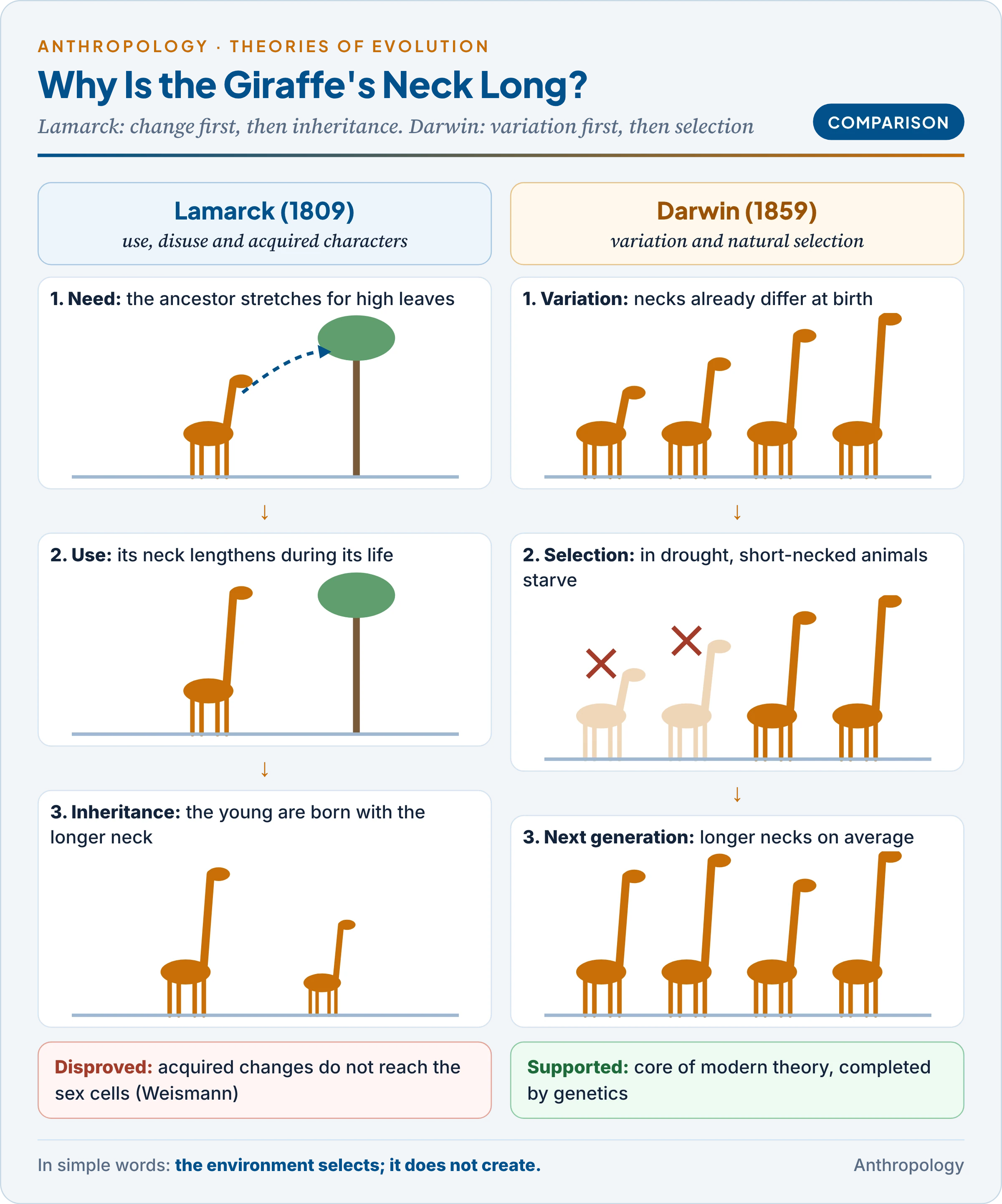
Both accept evolution and both explain adaptation. They differ in the order of events: for Lamarck, the change comes first and is then inherited; for Darwin, variation comes first and is then selected.
| Basis | Lamarckism | Darwinism |
|---|---|---|
| Source of change | Need and effort of the organism | Chance variation already present |
| Role of environment | Directly causes change | Selects among variants |
| What changes | The individual, in its life | The population, over generations |
| Inheritance | Acquired characters inherited | Inborn variation inherited |
| Direction | Towards perfection | No goal |
| Status today | Rejected for genes; echoes in epigenetics and cultural inheritance | Core of modern theory, completed by genetics |
Contribution to the synthetic theory: Darwin supplied its mechanism (natural selection) and its population thinking. Lamarck’s lasting contribution was that evolution is a general fact and that adaptation to the environment is what needs explaining. Debates on epigenetics, the Baldwin effect and niche construction revisit his questions while rejecting his mechanism.
7. Post-Darwinian Theories
In simple words
After Darwin, scientists argued about what his theory could not explain: how traits are inherited and where new variations come from. Some found that heredity runs only through the sex cells, some rediscovered Mendel’s laws, and some thought new species appear suddenly through big mutations. These debates prepared the way for the synthetic theory.
In 1886, in a field near Hilversum in the Netherlands, the Dutch botanist Hugo de Vries found evening primroses (Oenothera lamarckiana) with new forms that bred true at once: giants, dwarfs, plants with odd leaves. He concluded that new species arise suddenly, in one step. The example captures the period: critics now looked for the source of variation, and some believed they had found a rival to natural selection.
7.1 Weismann’s germ-plasm theory
- August Weismann (Das Keimplasma, 1892) divided the body into the germ plasm (hereditary material of the sex cells) and the somatoplasm (all other cells).
- Continuity of the germ plasm: the germ plasm passes unbroken between generations; the body is its temporary carrier, and bodily changes cannot reach it (the Weismann barrier).
- Why it mattered: it ruled out Lamarckism and pangenesis, leaving selection of inborn variation. George Romanes called this purified theory neo-Darwinism (1890s).
- Limits: in plants and many simple animals the germ line separates late, and epigenetics shows some effects can cross (§5.3).
7.2 Mendel and the rediscovery of heredity
- Gregor Mendel, an Austrian monk, showed with garden peas (1866) that traits are carried by separate factors that segregate in forming sex cells and assort independently.
- Ignored for decades, his work was rediscovered in 1900 by de Vries, Carl Correns and Erich von Tschermak.
- Why it mattered: inheritance is particulate, not blending, so a rare new variant is not diluted and can be selected, answering Jenkin (§6.4).
- New vocabulary: Bateson named genetics (1905); Johannsen coined gene, genotype and phenotype (1909); Morgan‘s fruit flies (from 1910) placed genes on chromosomes.
7.3 Mutation theory
- Hugo de Vries (Die Mutationstheorie, 1901–03): new species arise by large, sudden, heritable changes (mutations); evolution proceeds by saltation (jumps), and selection only removes the unfit.
- Strength: he made mutation the source of new variation, which Darwin lacked.
- Weaknesses: most of his Oenothera “mutations” were later shown to be chromosomal irregularities (doubled chromosome sets, unusual chromosome rings), not ordinary gene changes. Real mutations are mostly small and often harmful or neutral, and new species rarely arise in one jump. Richard Goldschmidt’s later “hopeful monsters” (1940) found little support.
7.4 Isolation, orthogenesis and recapitulation
- Isolation theory: Moritz Wagner (1868) argued that geographical isolation is needed for new species, since interbreeding would otherwise erase local differences; Mayr later made it central (Unit 1.4b).
- Orthogenesis (“straight-line evolution”; term by Wilhelm Haacke, 1893, popularised by Theodor Eimer and later H.F. Osborn): evolution moves in fixed directions driven by an inner force, as in a supposed straight-line growth of the horse or the human brain. Critique: George Gaylord Simpson (Horses, 1951) showed horse evolution was a branching bush with reversals; long trends reflect consistent selection, not an inner drive.
- Recapitulation (Haeckel’s biogenetic law, 1866): “ontogeny recapitulates phylogeny“, an embryo passing through its ancestors’ adult stages. Critique: embryos resemble the embryos of related species, not their adults, as Karl Ernst von Baer had observed (1828); Haeckel’s drawings exaggerated. Only a modest version survives, in evolutionary developmental biology (“evo-devo”).
7.5 The “eclipse of Darwinism” and the road to synthesis
- From about 1880 to 1920 natural selection lost support: Julian Huxley’s “eclipse of Darwinism“.
- Mutationists (Bateson, de Vries) held that evolution proceeds by discrete jumps; biometricians (Karl Pearson, W.F.R. Weldon, followers of Galton) measured continuous variation such as height and defended gradual selection.
- Resolution: the British statistician R.A. Fisher showed (1918) that many genes of small effect produce smooth, continuous variation, so Mendel and Darwin were compatible. Population genetics, and then the synthetic theory of the 1930s–40s, followed (Unit 1.4b).
Key Terms
| Term | Meaning in simple words |
|---|---|
| Hominization | All the biological and cultural changes that turned an ape-like ancestor into modern humans |
| Hominin | A member of the human line after the split from chimpanzees (older books: “hominid”) |
| Bipedalism | Habitually walking upright on two legs |
| Encephalization | Brain growth beyond what body size predicts |
| Obstetrical dilemma | Conflict between a narrow pelvis for walking and a big-headed baby |
| Gene-culture co-evolution | A cultural practice changes which genes are favoured |
| Organic evolution | Change in inherited traits of populations over generations, producing new species |
| Homologous organs | Same basic structure and origin, different uses |
| Vestigial organ | A reduced remnant of an organ that worked in ancestors |
| Inheritance of acquired characters | Lamarck’s idea that changes made in life pass to offspring |
| Natural selection | Individuals with favourable inherited variations leave more offspring |
| Pangenesis | Darwin’s disproved idea that body particles carry acquired traits to sex cells |
| Weismann barrier | Bodily changes cannot reach the hereditary material of the sex cells |
| Orthogenesis | The rejected idea of straight-line evolution driven by an inner force |
Contemporary Developments
- Selection is still at work (2026): nearly 16,000 ancient genomes from West Eurasia showed 479 gene variants strongly selected over the last 10,000 years, with selection accelerating after farming (Ali Akbari, David Reich and colleagues, Nature, April 2026): a cultural change intensified biological evolution.
- Denisovans get a face (June 2025): proteins and mitochondrial DNA from dental plaque identified the Harbin cranium (north-east China, at least 146,000 years old) as Denisovan (Science, Cell).
- Interbreeding dated (December 2024): early modern human genomes showed Neanderthal gene flow lasting about 7,000 years, centred on about 47,000 years ago (Nature, Science).
Diagrams to Master
- Topic map: biological and cultural factors around human evolution; below, the three phases of theory.
- Hominization sequence: bipedalism (Laetoli 3.66 mya) → tools (Lomekwi 3.3 mya) → brain expansion (2 mya) → long childhood → symbols; label “feet before brains”.
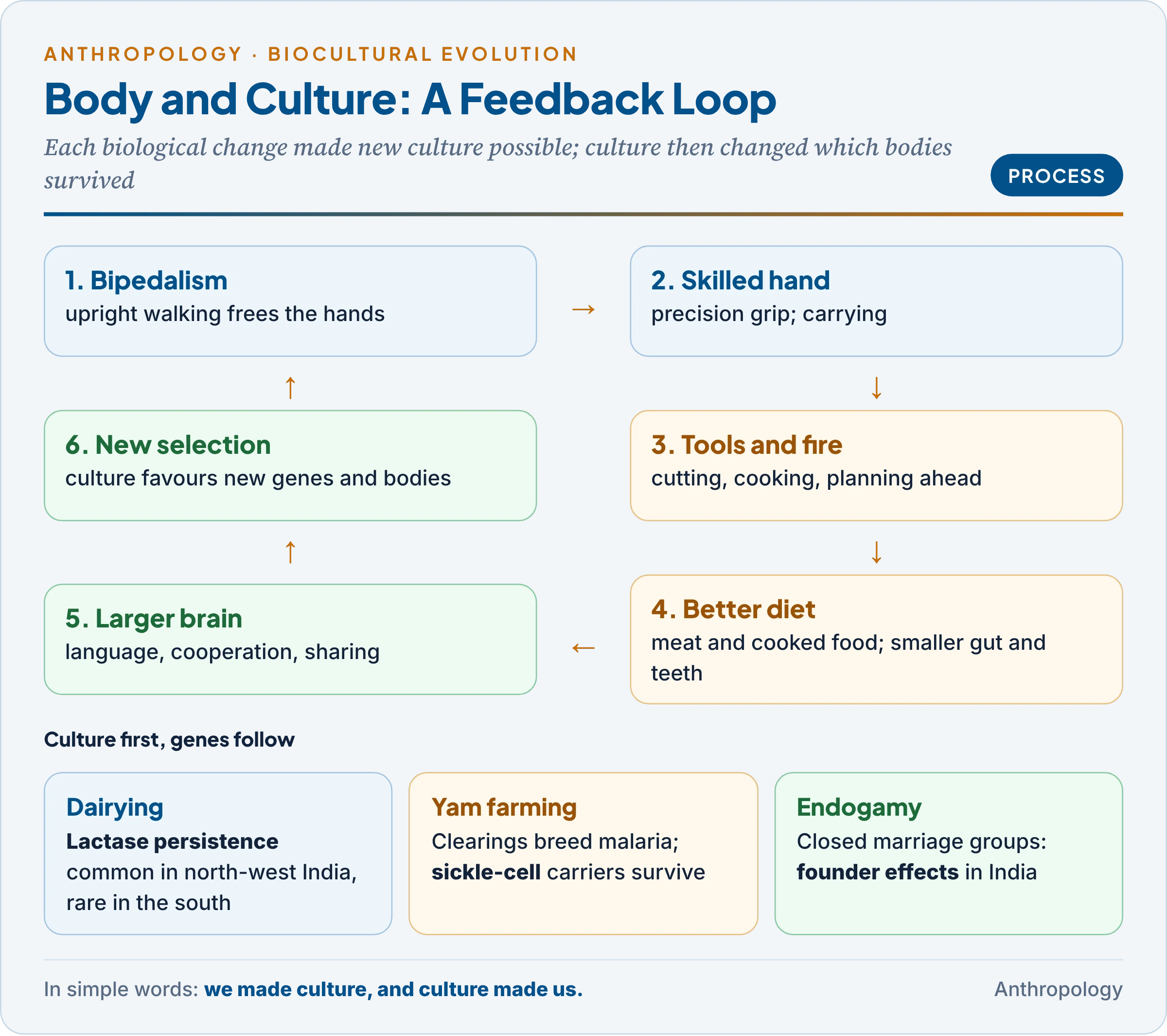
- Biocultural loop: free hands → tools → better diet → larger brain → culture → new selection; mark lactase (north-west India) and sickle cell (malaria).
- Lamarck vs Darwin giraffe: stretch → longer neck → inherited against variation → selection → more long-necked young.
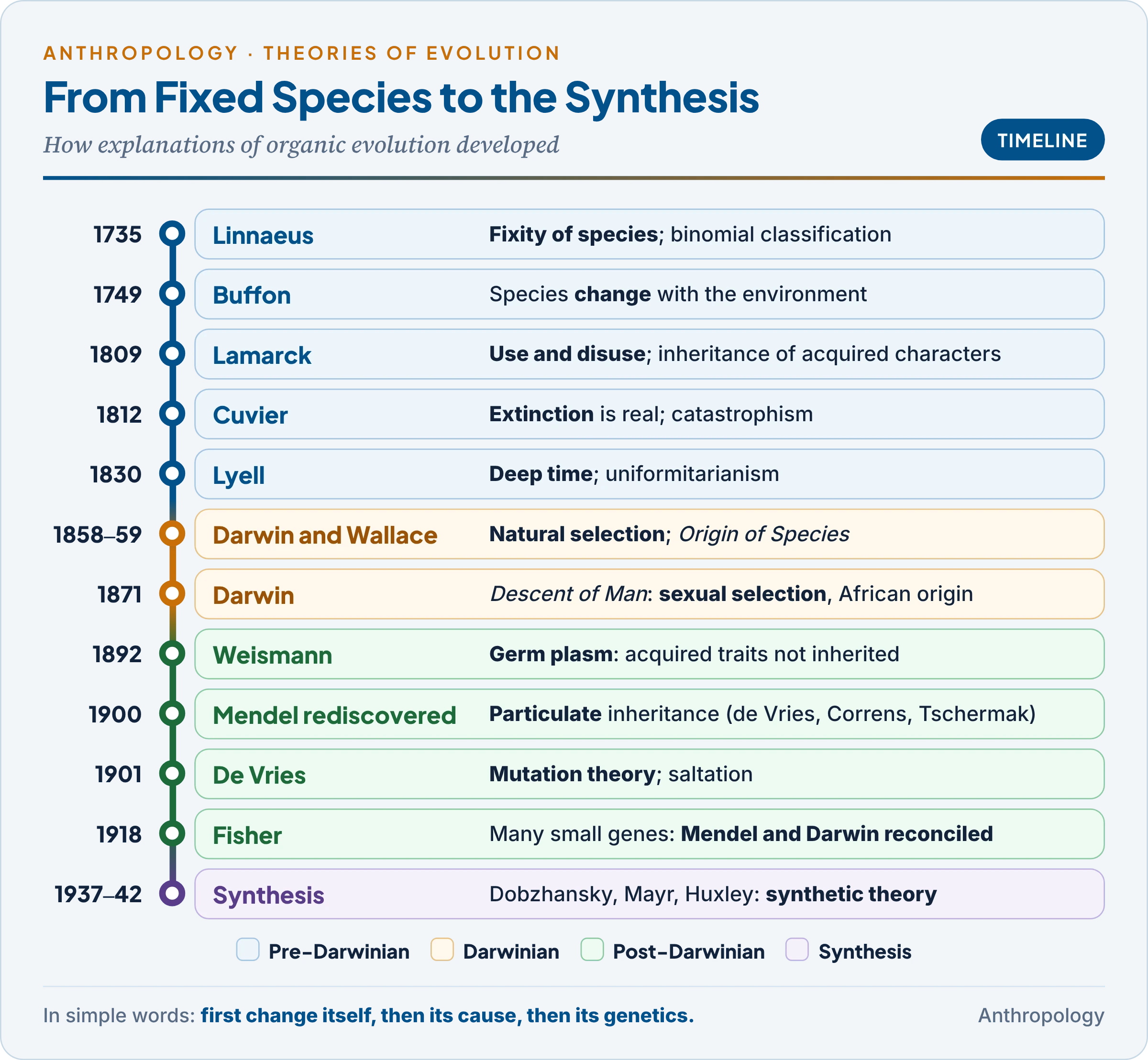
- Timeline: Linnaeus 1735 → Lamarck 1809 → Lyell 1830 → Darwin and Wallace 1858–59 → Weismann 1892 → Mendel rediscovered 1900 → de Vries 1901 → Fisher 1918 → synthesis.
Revision Grid
| Scholar | Work (year) | Key idea |
|---|---|---|
| Lamarck | Philosophie Zoologique (1809) | Use and disuse; acquired characters inherited |
| Darwin | Origin of Species (1859); Descent of Man (1871) | Natural selection; sexual selection; African origin |
| Galton | Transfusions (1871) | Disproved pangenesis |
| Weismann | Mouse tails (1889); Das Keimplasma (1892) | Germ plasm; Weismann barrier |
| Mendel | 1866; rediscovered 1900 | Particulate inheritance |
| De Vries | Die Mutationstheorie (1901–03) | Mutation; saltation |
| Fisher | 1918 | Many small genes reconcile Mendel and Darwin |
| Washburn | “Tools and Human Evolution” (1960) | Tools shaped the body; obstetrical dilemma |
| Childe | Man Makes Himself (1936) | Humans create their own conditions |
| Wrangham | Catching Fire (2009) | Cooking hypothesis |
| Boyd and Richerson | 1985 | Dual inheritance |
| Livingstone | 1958 | Farming, malaria, sickle cell |
| Lasker | 1969 | Levels of adaptability |
| Goodman and Leatherman | 1998 | Political economy in human biology |
Previous Year Questions
Unit 1.4: Human evolution, biological and cultural factors, and theories of organic evolution
- 2026Human evolution is a product of both biological and cultural factors. Elaborate.
- 2025How political economy is integrated with ecological and adaptability perspectives in bio-cultural anthropology?
- 2025Critically discuss the centrality of the African continent in the narrative of human evolution.
- 2024Critically discuss the synergistic effect of biological and cultural factors in human evolution.
- 2023What is hominization process? Discuss the major trends in human evolution with the help of suitable examples and illustrations.
- 2021“The bio-cultural approach is the hallmark of Biological Anthropology.” Explain. (in about 150 words).
- 2018Explain the biological changes that made human beings capable of making culture.
- 2016Elucidate the biological and cultural factors in human evolution.
- 2015Elucidate the biological and cultural factors in Human Evolution.
- 2015Critically examine Darwin’s theory of evolution in understanding evolution.
- 2010What are the major craniofacial changes that occurred during Hominid evolution ? Discuss.
- 2009Distinguish between ‘chronological age’ and ‘biological age’
- 2002What is Organic Evolution ? Explain the theories of evolution.
- 1997Write a note on Biological evolution of early man.
- 1996Discuss the geographic distribution and taxonomic issues concerning early hominids. Elucidate evidence in support of alternative positions.
- 1992What is organic evolution ? Give evidences for human evolution.
- 1991Write a note on Social-cultural evolution.
- 1991What is organic evolution ? Describe the theories of organic evolution.
- 1990Evolution is biological and sociocultural. Discuss.
- 1989Elucidate the Theory of Evolution as put forward by Lamarck.
- 1989Write a note on Meaning of Biological and Socio-cultural Evolution.
- 1987‘Evolution is biological and cultural’. Discuss.
- 1987How is Darwinism different from Lamarckism ? Critically evaluate their contribution to synthetic theory of evolution.
- 1986Write a note on Biological evolution and concept of new physical anthropology.
- 1986Write a note on Lamarckism and Darwinism.
- 1986Write a note on Relationship between cultural evolution and biological evolution.
- 1985Write a note on Theory of organic evolution.
- 1984Distinguish between : Lamarckism and Darwinism.
- 1984Discuss the inter-relation of biological and cultural dimensions in Human Evolution.
- 1983Sociocultural evolution is not parallel to biological evolution in man. Substantiate.
- 1983Darwinism is not adequate to explain [evolution. Give your] view. (wording garbled in all available copies)
- 1982Man has made himself. Justify.
- 1982Human evolution has cultural dimensions. Elaborate.
- 1981Has biological evolution caused [ceased] in man? Briefly substantiate your answer. (200 words).
Related questions from other units and from Unit 1.4b
- 2025Unit 1.7: Write notes on: Mitochondrial DNA and human evolution.
- 2025Unit 1.5: Discuss the Miocene hominoid remains and their significance in evolution.
- 2020Unit 1.4: Elucidate how Darwin and Post-Darwin theories of evolution resulted in the development of Synthetic theory of evolution.
- 2019Unit 1.5: Discuss the evolutionary significance of bipedalism and erect posture.
- 2017Unit 1.5: Bring out the comparative anatomical features of man and apes. Discuss their evolutionary significance.
- 2013Unit 1.4: Discuss how Neo-Darwinism integrated the fields of Genetics and Evolution. (250 words).
- 2012Unit 9.3: Write a note in 150 words on How ‘natural selection’ acts on variation?
- 2009Unit 9.3: Write a note on Natural selection in humans.
- 1994Unit 1.4: How Darwinism differs from the synthetic theory of organic evolution ?